
4. VITAMIN-A
PROPHYLAXIS
PROGRAMME
1970
 Vitamin A deficiency is the most common cause of
preventable blindness in children (1-3yrs).
 20-40 million children worldwide- estimated to have
at least mild vitamin A deficiency (VAD), half reside in
India.
 VAD causes an estimated 60,000 children in India to go
blind each year.
 Prevalence rates vary greatly among the states and range
from less than 1% to 6%.
 Prevalence of Xeropthalmia 0.6% as per GBD(global
burden of disease) 2000 estimates
 VAD in India remains a significant public health
problem.
4. VITAMIN-A
PROPHYLAXIS
PROGRAMME
1970
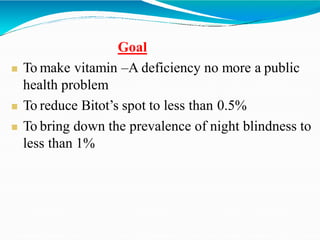
Goal
 To make vitamin –A deficiency no more a public
health problem
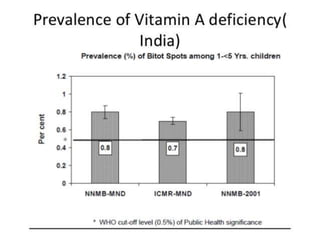
 To reduce Bitot’s spot to less than 0.5%
 To bring down the prevalence of night blindness to
less than 1%
STRATEGY
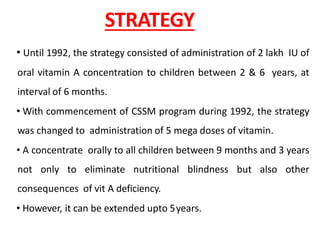
• Until 1992, the strategy consisted of administration of 2 lakh IU of
oral vitamin A concentration to children between 2 & 6 years, at
interval of 6 months.
• With commencement of CSSM program during 1992, the strategy
was changed to administration of 5 mega doses of vitamin.
• A concentrate orally to all children between 9 months and 3 years
not only to eliminate nutritional blindness but also other
consequences of vit A deficiency.
• However, it can be extended upto 5years.
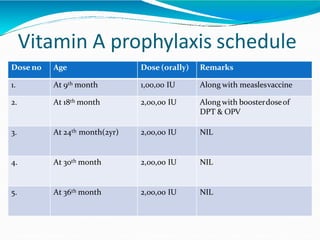
Vitamin A prophylaxis schedule
Dose no Age Dose (orally) Remarks
1. At 9th month 1,00,00 IU Along with measlesvaccine
2. At 18th month 2,00,00 IU Along with boosterdoseof
DPT & OPV
3. At 24th month(2yr) 2,00,00 IU NIL
4. At 30th month 2,00,00 IU NIL
5. At 36th month 2,00,00 IU NIL
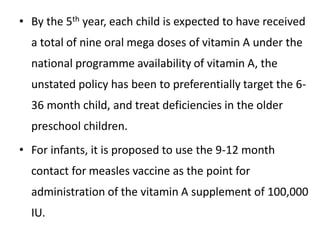
• By the 5th year, each child is expected to have received
a total of nine oral mega doses of vitamin A under the
national programme availability of vitamin A, the
unstated policy has been to preferentially target the 6-
36 month child, and treat deficiencies in the older
preschool children.
• For infants, it is proposed to use the 9-12 month
contact for measles vaccine as the point for
administration of the vitamin A supplement of 100,000
IU.
APPROACH TO COMBAT
VITAMIN A DEFICIENCY
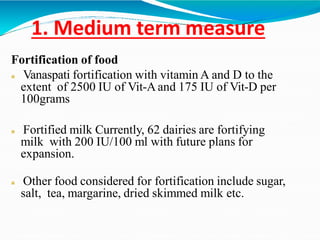
1. Medium term measure
Fortification of food
 Vanaspati fortification with vitamin A and D to the
extent of 2500 IU of Vit-Aand 175 IU of Vit-D per
100grams
 Fortified milk Currently, 62 dairies are fortifying
milk with 200 IU/100 ml with future plans for
expansion.
 Other food considered for fortification include sugar,
salt, tea, margarine, dried skimmed milk etc.
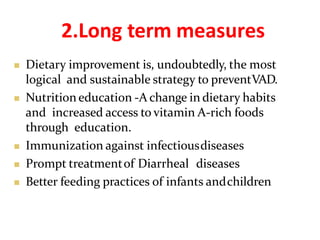
2.Long term measures
 Dietary improvement is, undoubtedly, the most
logical and sustainable strategy to preventVAD.
 Nutrition education -A change in dietary habits
and increased access to vitamin A-rich foods
through education.
 Immunization against infectiousdiseases
 Prompt treatmentof Diarrheal diseases
 Better feeding practices of infants andchildren
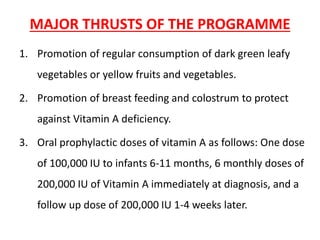
MAJOR THRUSTS OF THE PROGRAMME
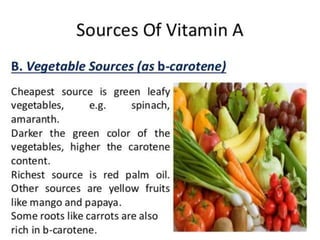
1. Promotion of regular consumption of dark green leafy
vegetables or yellow fruits and vegetables.
2. Promotion of breast feeding and colostrum to protect
against Vitamin A deficiency.
3. Oral prophylactic doses of vitamin A as follows: One dose
of 100,000 IU to infants 6-11 months, 6 monthly doses of
200,000 IU of Vitamin A immediately at diagnosis, and a
follow up dose of 200,000 IU 1-4 weeks later.
5.Prophylaxis against
nutritional
anaemia (1970)
 The programme was launched in 1970 to prevent nutritional
anaemia in mothers and children.
 Under this programme, expecting and nursing mothers as well as
acceptors of family planning were given the supplementation of
iron and folic acid.
 This programme is being taken up by Maternal and Child Health
(MCH), division of Ministry of Health and Family welfare.
 In 1992 it became part of CSSM programme.
 In 1997 it became part of RCH programme.
 Under this programme all expecting and nursing mothers as well as
acceptors of family planning are given 1 tablet of iron and folic acid
containing 100 mg elementary iron and 0.5 mg of folic acid daily for a
period of 100 days.
 All anaemic mothers were given 2 tablets of iron and folic acid per
day for 100 days.
 All anaemic children in the age group of 1-5 years are given 1 tablet
of iron containing 20 mg elementary iron (60 mg of ferrous sulphate and
0.1 mg of folic acid) daily for a period of 100 days.
 All acceptors of family planning (IUD) are given one tablet of
iron and folic acid for 100 days.
 All adolescent girls were given 1 tablet of iron and folic acid per
week.
Prevalence of nutritional anemia in India
(annual report ministry of health 2009-
2010 )
 65% infant and toddlers
 60% 1-6 years of age,
 88% adolescent girls (3.3% has hemoglobin <7 gm/dl;
severe anemia)
 85% pregnant women (9.9% having severe anemia).
 The prevalence of anemia was marginally higher in lactating
women as compared to pregnancy.
 The commonest is iron deficiency anemia.
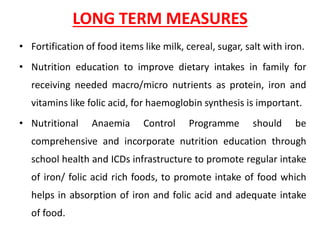
LONG TERM MEASURES
• Fortification of food items like milk, cereal, sugar, salt with iron.
• Nutrition education to improve dietary intakes in family for
receiving needed macro/micro nutrients as protein, iron and
vitamins like folic acid, for haemoglobin synthesis is important.
• Nutritional Anaemia Control Programme should be
comprehensive and incorporate nutrition education through
school health and ICDs infrastructure to promote regular intake
of iron/ folic acid rich foods, to promote intake of food which
helps in absorption of iron and folic acid and adequate intake
of food.
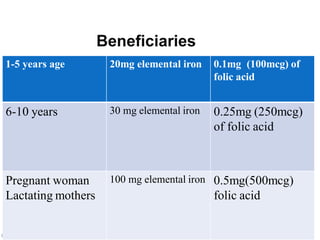
Beneficiaries
1-5 years age 20mg elemental iron 0.1mg (100mcg) of
folic acid
6-10 years 30 mg elemental iron 0.25mg (250mcg)
of folic acid
Pregnant woman
Lactating mothers
100 mg elemental iron 0.5mg(500mcg)
folic acid
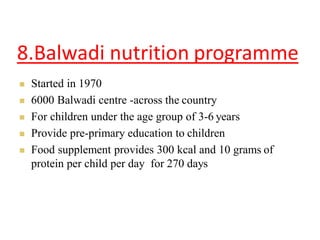
8.Balwadi nutrition programme
 Started in 1970
 6000 Balwadi centre -across the country
 For children under the age group of 3-6 years
 Provide pre-primary education to children
 Food supplement provides 300 kcal and 10 grams of
protein per child per day for 270 days
Vitamin A prophylaxis programme

Vitamin A prophylaxis programme

  • 1.
  • 11.
     Vitamin Adeficiency is the most common cause of preventable blindness in children (1-3yrs).  20-40 million children worldwide- estimated to have at least mild vitamin A deficiency (VAD), half reside in India.  VAD causes an estimated 60,000 children in India to go blind each year.
  • 12.
     Prevalence ratesvary greatly among the states and range from less than 1% to 6%.  Prevalence of Xeropthalmia 0.6% as per GBD(global burden of disease) 2000 estimates  VAD in India remains a significant public health problem.
  • 13.
  • 20.
    Goal  To makevitamin –A deficiency no more a public health problem  To reduce Bitot’s spot to less than 0.5%  To bring down the prevalence of night blindness to less than 1%
  • 21.
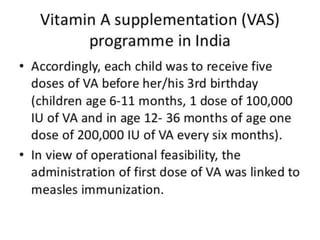
    STRATEGY • Until 1992,the strategy consisted of administration of 2 lakh IU of oral vitamin A concentration to children between 2 & 6 years, at interval of 6 months. • With commencement of CSSM program during 1992, the strategy was changed to administration of 5 mega doses of vitamin. • A concentrate orally to all children between 9 months and 3 years not only to eliminate nutritional blindness but also other consequences of vit A deficiency. • However, it can be extended upto 5years.
  • 23.
    Vitamin A prophylaxisschedule Dose no Age Dose (orally) Remarks 1. At 9th month 1,00,00 IU Along with measlesvaccine 2. At 18th month 2,00,00 IU Along with boosterdoseof DPT & OPV 3. At 24th month(2yr) 2,00,00 IU NIL 4. At 30th month 2,00,00 IU NIL 5. At 36th month 2,00,00 IU NIL
  • 24.
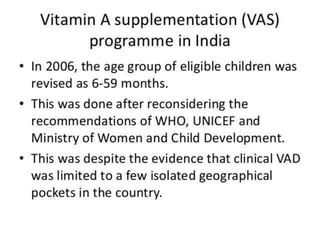
    • By the5th year, each child is expected to have received a total of nine oral mega doses of vitamin A under the national programme availability of vitamin A, the unstated policy has been to preferentially target the 6- 36 month child, and treat deficiencies in the older preschool children. • For infants, it is proposed to use the 9-12 month contact for measles vaccine as the point for administration of the vitamin A supplement of 100,000 IU.
  • 25.
  • 26.
    1. Medium termmeasure Fortification of food  Vanaspati fortification with vitamin A and D to the extent of 2500 IU of Vit-Aand 175 IU of Vit-D per 100grams  Fortified milk Currently, 62 dairies are fortifying milk with 200 IU/100 ml with future plans for expansion.  Other food considered for fortification include sugar, salt, tea, margarine, dried skimmed milk etc.
  • 27.
    2.Long term measures Dietary improvement is, undoubtedly, the most logical and sustainable strategy to preventVAD.  Nutrition education -A change in dietary habits and increased access to vitamin A-rich foods through education.  Immunization against infectiousdiseases  Prompt treatmentof Diarrheal diseases  Better feeding practices of infants andchildren
  • 28.
    MAJOR THRUSTS OFTHE PROGRAMME 1. Promotion of regular consumption of dark green leafy vegetables or yellow fruits and vegetables. 2. Promotion of breast feeding and colostrum to protect against Vitamin A deficiency. 3. Oral prophylactic doses of vitamin A as follows: One dose of 100,000 IU to infants 6-11 months, 6 monthly doses of 200,000 IU of Vitamin A immediately at diagnosis, and a follow up dose of 200,000 IU 1-4 weeks later.
  • 29.
  • 30.
     The programmewas launched in 1970 to prevent nutritional anaemia in mothers and children.  Under this programme, expecting and nursing mothers as well as acceptors of family planning were given the supplementation of iron and folic acid.  This programme is being taken up by Maternal and Child Health (MCH), division of Ministry of Health and Family welfare.  In 1992 it became part of CSSM programme.  In 1997 it became part of RCH programme.
  • 31.
     Under thisprogramme all expecting and nursing mothers as well as acceptors of family planning are given 1 tablet of iron and folic acid containing 100 mg elementary iron and 0.5 mg of folic acid daily for a period of 100 days.  All anaemic mothers were given 2 tablets of iron and folic acid per day for 100 days.  All anaemic children in the age group of 1-5 years are given 1 tablet of iron containing 20 mg elementary iron (60 mg of ferrous sulphate and 0.1 mg of folic acid) daily for a period of 100 days.  All acceptors of family planning (IUD) are given one tablet of iron and folic acid for 100 days.  All adolescent girls were given 1 tablet of iron and folic acid per week.
  • 32.
    Prevalence of nutritionalanemia in India (annual report ministry of health 2009- 2010 )  65% infant and toddlers  60% 1-6 years of age,  88% adolescent girls (3.3% has hemoglobin <7 gm/dl; severe anemia)  85% pregnant women (9.9% having severe anemia).  The prevalence of anemia was marginally higher in lactating women as compared to pregnancy.  The commonest is iron deficiency anemia.
  • 33.
    LONG TERM MEASURES •Fortification of food items like milk, cereal, sugar, salt with iron. • Nutrition education to improve dietary intakes in family for receiving needed macro/micro nutrients as protein, iron and vitamins like folic acid, for haemoglobin synthesis is important. • Nutritional Anaemia Control Programme should be comprehensive and incorporate nutrition education through school health and ICDs infrastructure to promote regular intake of iron/ folic acid rich foods, to promote intake of food which helps in absorption of iron and folic acid and adequate intake of food.
  • 34.
    Beneficiaries 1-5 years age20mg elemental iron 0.1mg (100mcg) of folic acid 6-10 years 30 mg elemental iron 0.25mg (250mcg) of folic acid Pregnant woman Lactating mothers 100 mg elemental iron 0.5mg(500mcg) folic acid
  • 35.
    8.Balwadi nutrition programme Started in 1970  6000 Balwadi centre -across the country  For children under the age group of 3-6 years  Provide pre-primary education to children  Food supplement provides 300 kcal and 10 grams of protein per child per day for 270 days