Presented by:
Ms. Priya
M.Sc Nursing 2nd year
INTRODUCTION:
In health care system, material management is concerned with
providing the drugs, supplies and equipment needed by health
personnel deliver health services.
Material after being inspected received and stored in the storeroom
till its conception or distribution. supplies are arranged on racks
with both sides (front and back) open, and these racks are always
filled from backside and issued or distributed from front side. This
maintains the principles of first in first out (FIFO) which helps in
issuing those material first which are received first.
DEFINITION
Inventory Control: It is defined as the supervision of
stocked up items, whether they are adequate in terms of
supply and accessibility, in the stores so that the items are
readily available when needed.
Inventory control is a function of Material Management,
which is planning, directing, controlling & co-coordinating
all the activities concern with material & inventory from
the inception to their introduction into the manufacturing
processes.
OBJECTIVES OF INVENTORY CONTROL
 To reduce financial investment.
 To facilitate smooth production.
 If an offer of discount comes for a bulk purchase, to decide
whether to go for it or not.
 To supply the material in time.
 To avoid shortage of stock.
 To minimize the losses due to deterioration, and damage of
stock.
 To average out demand fluctuation.
IMPORTANCE OF INVENTORY CONTROL
 To provide maximum supply service, consistent with maximum
efficiency & optimum investment.
 To provide cushion between forecasted & actual demand for a
material.
 To have optimum level of inventory not too large, not small.
 To eliminate duplication in ordering.
 To take care of fluctuation in demand and lead time.
 To minimize the inventory costs.
 To minimizing waiting time.
Steps in Inventory Control
 Fixing minimum quantities or points of ordering, and
maximum quantities on all materials.
 Arranging a method for allocation of material and
orders that are in process.
 Creating stores accounts that will control the store
room.
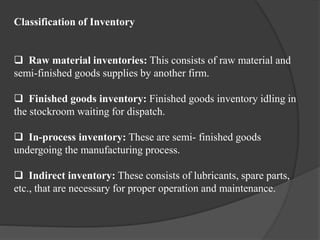
Classification of Inventory
 Raw material inventories: This consists of raw material and
semi-finished goods supplies by another firm.
 Finished goods inventory: Finished goods inventory idling in
the stockroom waiting for dispatch.
 In-process inventory: These are semi- finished goods
undergoing the manufacturing process.
 Indirect inventory: These consists of lubricants, spare parts,
etc., that are necessary for proper operation and maintenance.
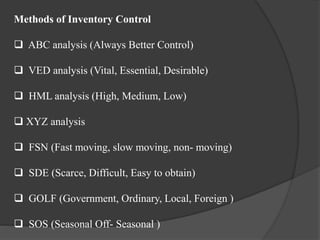
Methods of Inventory Control
 ABC analysis (Always Better Control)
 VED analysis (Vital, Essential, Desirable)
 HML analysis (High, Medium, Low)
 XYZ analysis
 FSN (Fast moving, slow moving, non- moving)
 SDE (Scarce, Difficult, Easy to obtain)
 GOLF (Government, Ordinary, Local, Foreign )
 SOS (Seasonal Off- Seasonal )
Functions of Inventory Control
 To provide consistent optimum equipment supply services
with maximum efficiency and affordable investment.
 To provide good cohesion between the suggested and
demanded material.
Principles of inventory management
 Determination of Quantity of order.
 Determination of Reorder point.
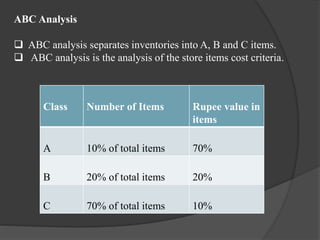
ABC Analysis
 ABC analysis separates inventories into A, B and C items.
 ABC analysis is the analysis of the store items cost criteria.
Class Number of Items Rupee value in
items
A 10% of total items 70%
B 20% of total items 20%
C 70% of total items 10%
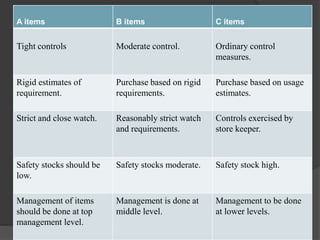
A items B items C items
Tight controls Moderate control. Ordinary control
measures.
Rigid estimates of
requirement.
Purchase based on rigid
requirements.
Purchase based on usage
estimates.
Strict and close watch. Reasonably strict watch
and requirements.
Controls exercised by
store keeper.
Safety stocks should be
low.
Safety stocks moderate. Safety stock high.
Management of items
should be done at top
management level.
Management is done at
middle level.
Management to be done
at lower levels.
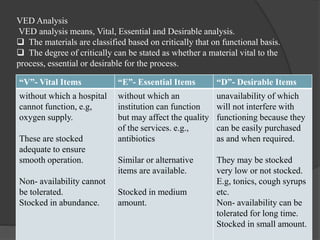
VED Analysis
VED analysis means, Vital, Essential and Desirable analysis.
 The materials are classified based on critically that on functional basis.
 The degree of critically can be stated as whether a material vital to the
process, essential or desirable for the process.
“V”- Vital Items “E”- Essential Items “D”- Desirable Items
without which a hospital
cannot function, e.g,
oxygen supply.
These are stocked
adequate to ensure
smooth operation.
Non- availability cannot
be tolerated.
Stocked in abundance.
without which an
institution can function
but may affect the quality
of the services. e.g.,
antibiotics
Similar or alternative
items are available.
Stocked in medium
amount.
unavailability of which
will not interfere with
functioning because they
can be easily purchased
as and when required.
They may be stocked
very low or not stocked.
E.g, tonics, cough syrups
etc.
Non- availability can be
tolerated for long time.
Stocked in small amount.
HML XYZ analysis SDE GOLF SOS
The basic
criterion-
classification is the
unit value of the
item. materials are
further classified
into high value
materials, medium
value material and
low value
materials.
Analysis
List out all the
items in
descending order
of unit value and
the management
may fix the limits
for determining
three categories.
classification is
based on the value
of the inventory
stored.
The ‘X’ items are
those whose
inventory values
are high,
while ‘Z’ items
are those whose
inventory values
are low and
‘Y’ items are
those which have
moderate
inventory stocks.
Usually XYZ
analysis is made
in conjunction
with ABC or
HML analysis
Scarce,
Difficult, Easy
to obtain)
Problems faced
in procurement
Generally done
on the basis of
problems faced
in procurement
of an item and
based on
availability of
items.
Government,
Ordinary,
Local,
Foreign)
Source of the
material.
GOLF
analysis is
carried out
on the basis
of source of
material.
Seasonal,
off-
Seasonal)
S’ seasonal,
but
available
only for a
limited
period.
Off-
seasonal,
items
whose
quantity is
determined
on different
considerati
on.
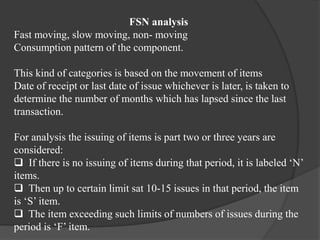
FSN analysis
Fast moving, slow moving, non- moving
Consumption pattern of the component.
This kind of categories is based on the movement of items
Date of receipt or last date of issue whichever is later, is taken to
determine the number of months which has lapsed since the last
transaction.
For analysis the issuing of items is part two or three years are
considered:
 If there is no issuing of items during that period, it is labeled ‘N’
items.
 Then up to certain limit sat 10-15 issues in that period, the item
is ‘S’ item.
 The item exceeding such limits of numbers of issues during the
period is ‘F’ item.
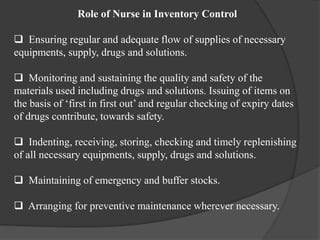
Role of Nurse in Inventory Control
 Ensuring regular and adequate flow of supplies of necessary
equipments, supply, drugs and solutions.
 Monitoring and sustaining the quality and safety of the
materials used including drugs and solutions. Issuing of items on
the basis of ‘first in first out’ and regular checking of expiry dates
of drugs contribute, towards safety.
 Indenting, receiving, storing, checking and timely replenishing
of all necessary equipments, supply, drugs and solutions.
 Maintaining of emergency and buffer stocks.
 Arranging for preventive maintenance wherever necessary.
 Maintaining inventory and stock of all items and supplies.
 Arranging for condemnation of articles in accordance with the
laid down policies of the organization and maintaining of a dead
stock register.
 Arranging and assisting in audit of material.
 Participation of policy making for material management.
 Participation in tender/ procurement sub-committees.
 Orienting nursing personnel on material management policies
from time to time.
 Evaluating the efficacy of the material management system
followed in particular nursing unit.
Bibliography
 Nursing Administration and Management, Trained Nurses
Association of India: 2007, page no- 120-124
 Vati J, Principles & practice of nursing management and
administration: 2013, page no- 559-562.
 I. Clemet, Management & Administration of Nursing
Services, 2nd edition page no- 101-103.
 Retrieved from- http://currentnursing.com/nursing-
management
inventory Control Card
(stock keeping record)
Thank You

presentation on Inventory Control.pptx

  • 1.
  • 2.
    INTRODUCTION: In health caresystem, material management is concerned with providing the drugs, supplies and equipment needed by health personnel deliver health services. Material after being inspected received and stored in the storeroom till its conception or distribution. supplies are arranged on racks with both sides (front and back) open, and these racks are always filled from backside and issued or distributed from front side. This maintains the principles of first in first out (FIFO) which helps in issuing those material first which are received first.
  • 3.
    DEFINITION Inventory Control: Itis defined as the supervision of stocked up items, whether they are adequate in terms of supply and accessibility, in the stores so that the items are readily available when needed. Inventory control is a function of Material Management, which is planning, directing, controlling & co-coordinating all the activities concern with material & inventory from the inception to their introduction into the manufacturing processes.
  • 4.
    OBJECTIVES OF INVENTORYCONTROL  To reduce financial investment.  To facilitate smooth production.  If an offer of discount comes for a bulk purchase, to decide whether to go for it or not.  To supply the material in time.  To avoid shortage of stock.  To minimize the losses due to deterioration, and damage of stock.  To average out demand fluctuation.
  • 5.
    IMPORTANCE OF INVENTORYCONTROL  To provide maximum supply service, consistent with maximum efficiency & optimum investment.  To provide cushion between forecasted & actual demand for a material.  To have optimum level of inventory not too large, not small.  To eliminate duplication in ordering.  To take care of fluctuation in demand and lead time.  To minimize the inventory costs.  To minimizing waiting time.
  • 6.
    Steps in InventoryControl  Fixing minimum quantities or points of ordering, and maximum quantities on all materials.  Arranging a method for allocation of material and orders that are in process.  Creating stores accounts that will control the store room.
  • 7.
    Classification of Inventory Raw material inventories: This consists of raw material and semi-finished goods supplies by another firm.  Finished goods inventory: Finished goods inventory idling in the stockroom waiting for dispatch.  In-process inventory: These are semi- finished goods undergoing the manufacturing process.  Indirect inventory: These consists of lubricants, spare parts, etc., that are necessary for proper operation and maintenance.
  • 8.
    Methods of InventoryControl  ABC analysis (Always Better Control)  VED analysis (Vital, Essential, Desirable)  HML analysis (High, Medium, Low)  XYZ analysis  FSN (Fast moving, slow moving, non- moving)  SDE (Scarce, Difficult, Easy to obtain)  GOLF (Government, Ordinary, Local, Foreign )  SOS (Seasonal Off- Seasonal )
  • 9.
    Functions of InventoryControl  To provide consistent optimum equipment supply services with maximum efficiency and affordable investment.  To provide good cohesion between the suggested and demanded material. Principles of inventory management  Determination of Quantity of order.  Determination of Reorder point.
  • 10.
    ABC Analysis  ABCanalysis separates inventories into A, B and C items.  ABC analysis is the analysis of the store items cost criteria. Class Number of Items Rupee value in items A 10% of total items 70% B 20% of total items 20% C 70% of total items 10%
  • 11.
    A items Bitems C items Tight controls Moderate control. Ordinary control measures. Rigid estimates of requirement. Purchase based on rigid requirements. Purchase based on usage estimates. Strict and close watch. Reasonably strict watch and requirements. Controls exercised by store keeper. Safety stocks should be low. Safety stocks moderate. Safety stock high. Management of items should be done at top management level. Management is done at middle level. Management to be done at lower levels.
  • 12.
    VED Analysis VED analysismeans, Vital, Essential and Desirable analysis.  The materials are classified based on critically that on functional basis.  The degree of critically can be stated as whether a material vital to the process, essential or desirable for the process. “V”- Vital Items “E”- Essential Items “D”- Desirable Items without which a hospital cannot function, e.g, oxygen supply. These are stocked adequate to ensure smooth operation. Non- availability cannot be tolerated. Stocked in abundance. without which an institution can function but may affect the quality of the services. e.g., antibiotics Similar or alternative items are available. Stocked in medium amount. unavailability of which will not interfere with functioning because they can be easily purchased as and when required. They may be stocked very low or not stocked. E.g, tonics, cough syrups etc. Non- availability can be tolerated for long time. Stocked in small amount.
  • 13.
    HML XYZ analysisSDE GOLF SOS The basic criterion- classification is the unit value of the item. materials are further classified into high value materials, medium value material and low value materials. Analysis List out all the items in descending order of unit value and the management may fix the limits for determining three categories. classification is based on the value of the inventory stored. The ‘X’ items are those whose inventory values are high, while ‘Z’ items are those whose inventory values are low and ‘Y’ items are those which have moderate inventory stocks. Usually XYZ analysis is made in conjunction with ABC or HML analysis Scarce, Difficult, Easy to obtain) Problems faced in procurement Generally done on the basis of problems faced in procurement of an item and based on availability of items. Government, Ordinary, Local, Foreign) Source of the material. GOLF analysis is carried out on the basis of source of material. Seasonal, off- Seasonal) S’ seasonal, but available only for a limited period. Off- seasonal, items whose quantity is determined on different considerati on.
  • 14.
    FSN analysis Fast moving,slow moving, non- moving Consumption pattern of the component. This kind of categories is based on the movement of items Date of receipt or last date of issue whichever is later, is taken to determine the number of months which has lapsed since the last transaction. For analysis the issuing of items is part two or three years are considered:  If there is no issuing of items during that period, it is labeled ‘N’ items.  Then up to certain limit sat 10-15 issues in that period, the item is ‘S’ item.  The item exceeding such limits of numbers of issues during the period is ‘F’ item.
  • 15.
    Role of Nursein Inventory Control  Ensuring regular and adequate flow of supplies of necessary equipments, supply, drugs and solutions.  Monitoring and sustaining the quality and safety of the materials used including drugs and solutions. Issuing of items on the basis of ‘first in first out’ and regular checking of expiry dates of drugs contribute, towards safety.  Indenting, receiving, storing, checking and timely replenishing of all necessary equipments, supply, drugs and solutions.  Maintaining of emergency and buffer stocks.  Arranging for preventive maintenance wherever necessary.
  • 16.
     Maintaining inventoryand stock of all items and supplies.  Arranging for condemnation of articles in accordance with the laid down policies of the organization and maintaining of a dead stock register.  Arranging and assisting in audit of material.  Participation of policy making for material management.  Participation in tender/ procurement sub-committees.  Orienting nursing personnel on material management policies from time to time.  Evaluating the efficacy of the material management system followed in particular nursing unit.
  • 17.
    Bibliography  Nursing Administrationand Management, Trained Nurses Association of India: 2007, page no- 120-124  Vati J, Principles & practice of nursing management and administration: 2013, page no- 559-562.  I. Clemet, Management & Administration of Nursing Services, 2nd edition page no- 101-103.  Retrieved from- http://currentnursing.com/nursing- management
  • 18.
  • 21.