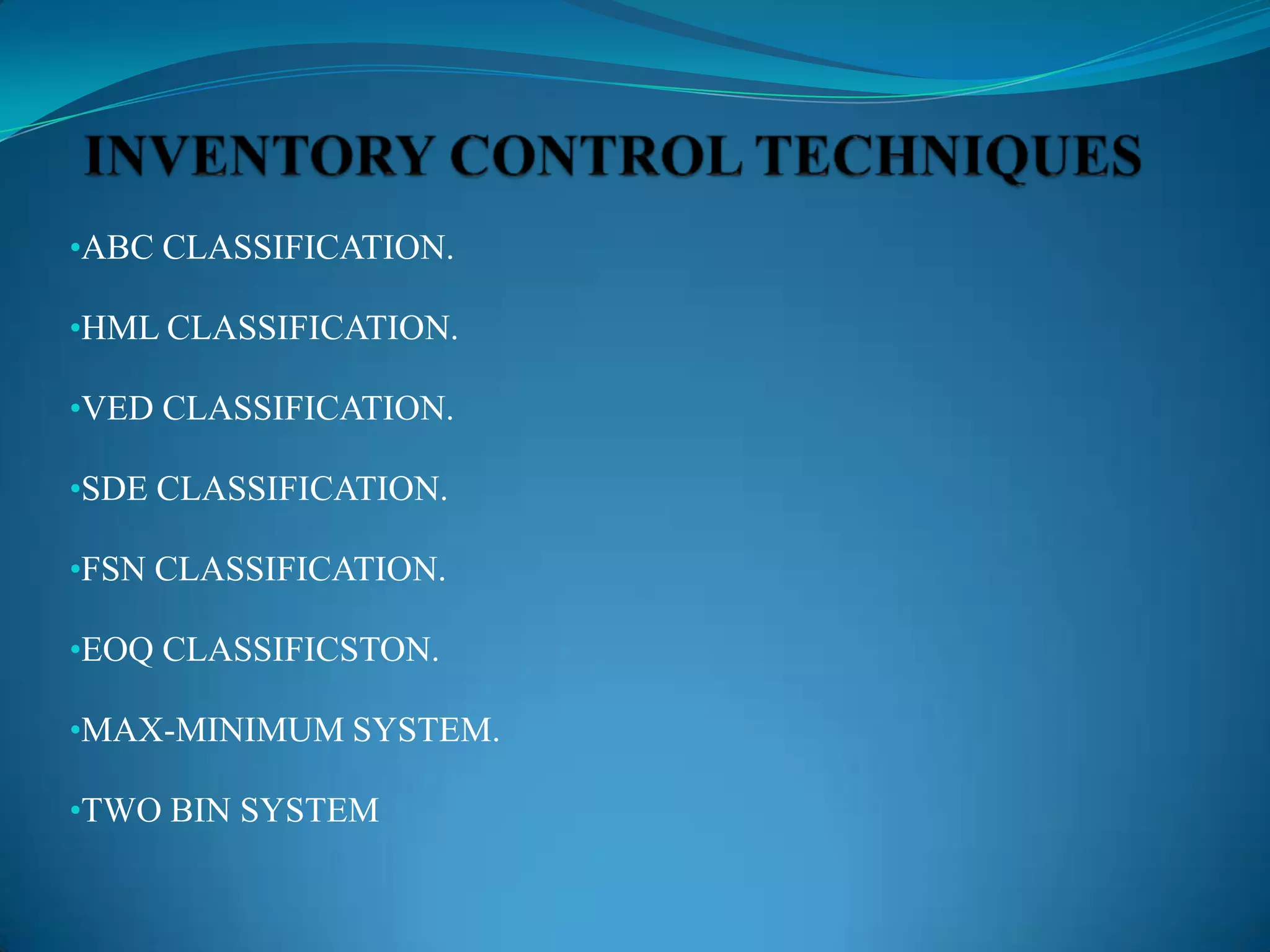
•ABC CLASSIFICATION.
•HML CLASSIFICATION.
•VED CLASSIFICATION.
•SDE CLASSIFICATION.
•FSN CLASSIFICATION.
•EOQ CLASSIFICSTON.
•MAX-MINIMUM SYSTEM.
•TWO BIN SYSTEM
ABC Analysis:
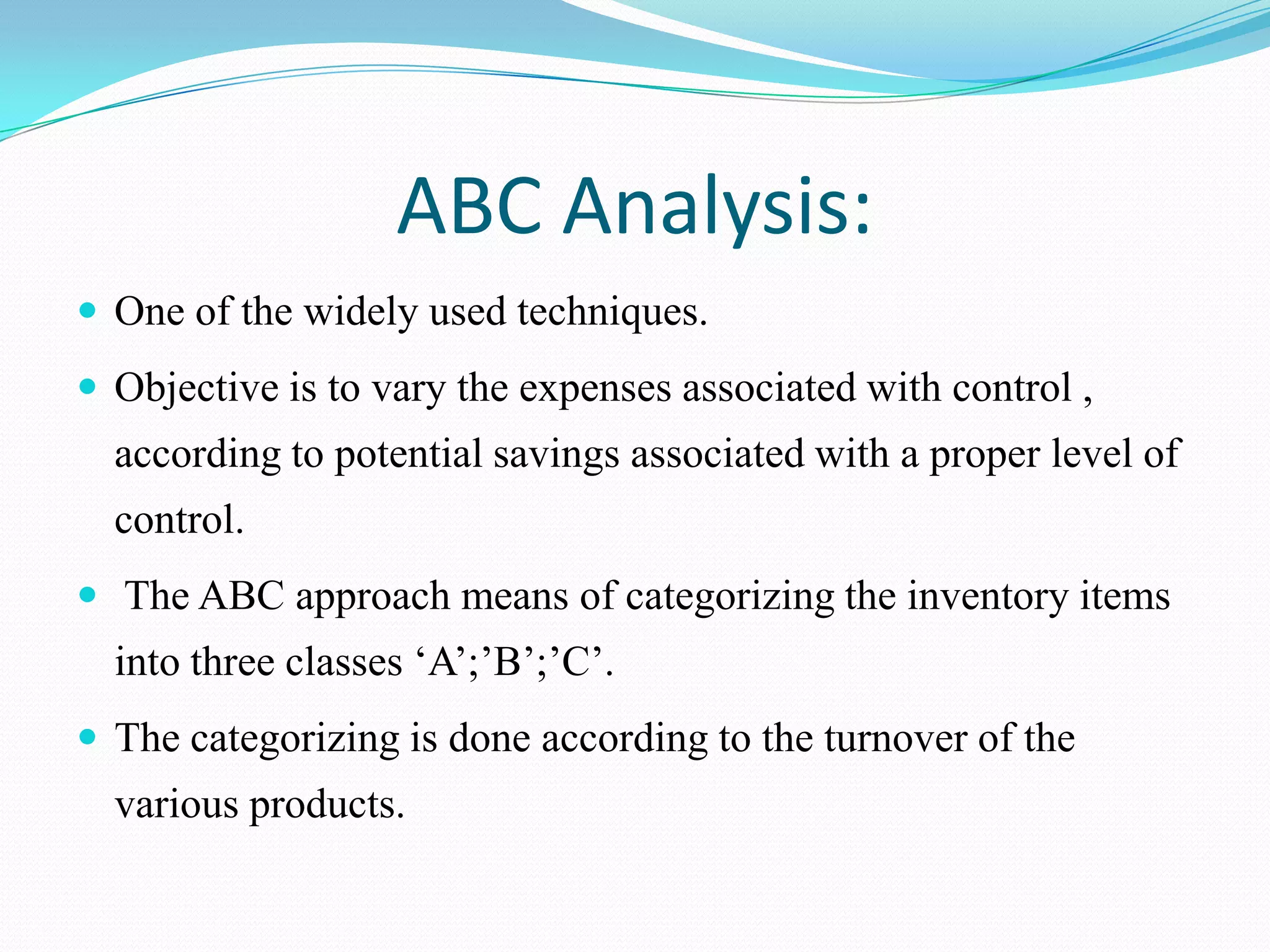
 One of the widely used techniques.
 Objective is to vary the expenses associated with control ,
according to potential savings associated with a proper level of
control.
 The ABC approach means of categorizing the inventory items
into three classes „A‟;‟B‟;‟C‟.
 The categorizing is done according to the turnover of the
various products.
Procedure:
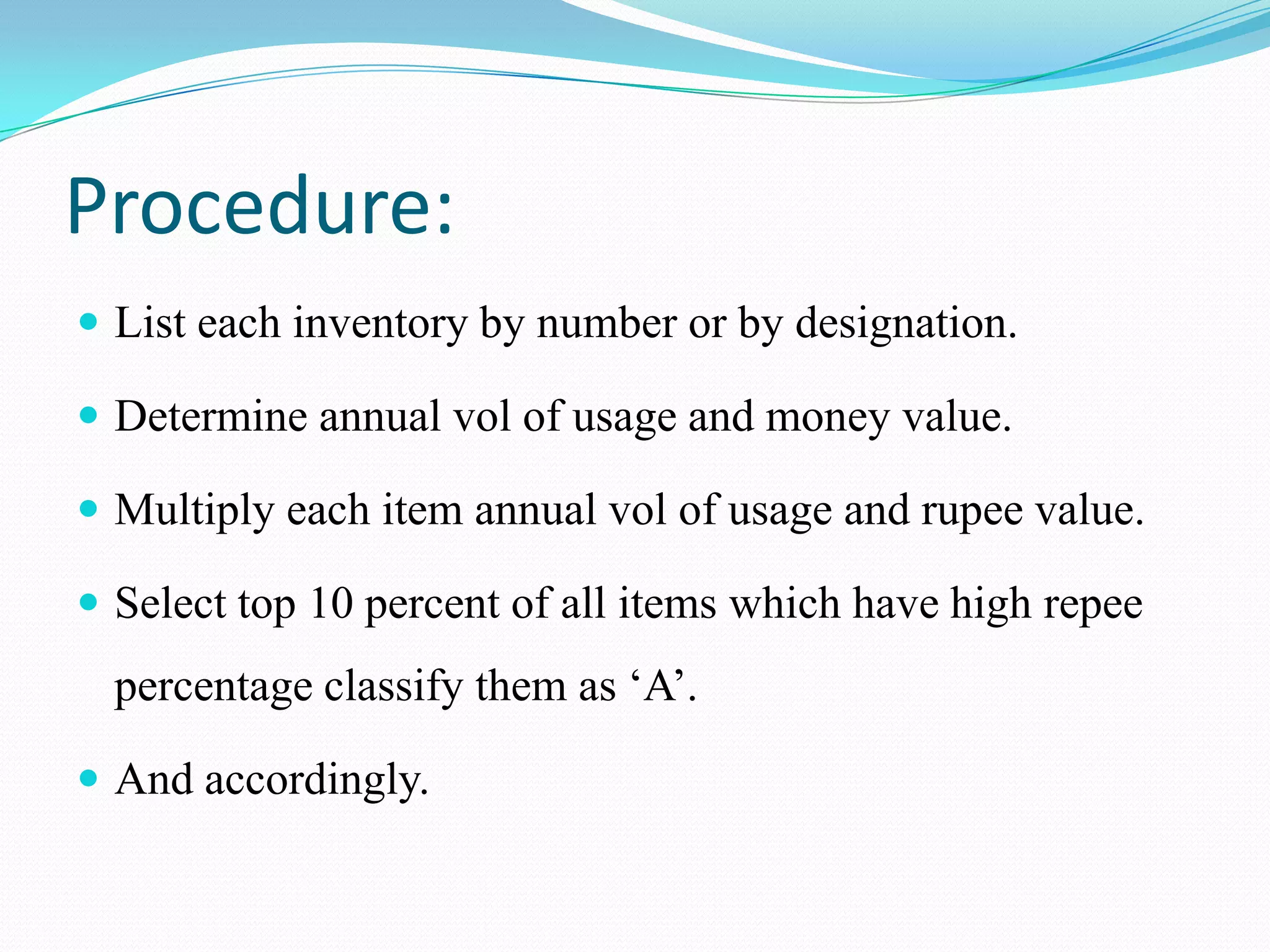
 List each inventory by number or by designation.
 Determine annual vol of usage and money value.
 Multiply each item annual vol of usage and rupee value.
 Select top 10 percent of all items which have high repee
percentage classify them as „A‟.
 And accordingly.
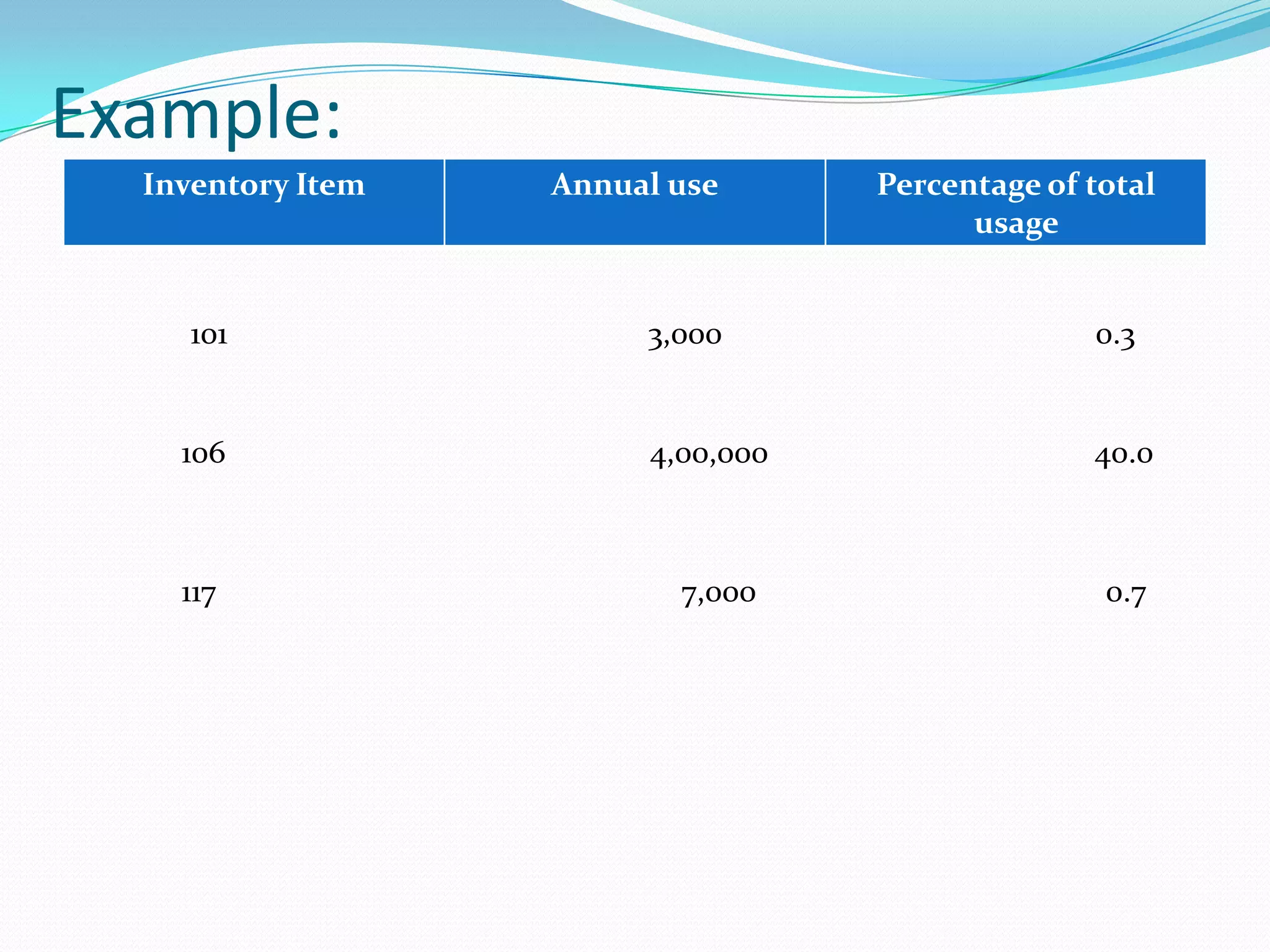
Example:
Inventory Item Annual use Percentage of total
usage
101 3,000 0.3
106 4,00,000 40.0
117 7,000 0.7
High Medium Low(HML):
 The HML classification is same procedure as adopted in ABC.
 The core difference is HML classification unit value is the
criterion and not the annual consumption value.
 The inventories should be place in descending order and it is up
to mgmt to fix limits of these three categories.
 Example: the mgmt may decide all units with unit value of Rs
2,000 and above will be H items…..
Vital Essential Desirable:
 They are done to determine the criticality of an item and
its effect on production and other services.
 It is specially used for classification of spare parts.
 If the part is vital most it is given „V‟, if it is essential then
is given as „E” ,if it is not so essential it is given as „D‟.
 For „V‟ items large stocks are maintained while for „E‟
items minimum stock is enough.
SDE Classification:
 The SDE is based upon the availability of items.
 Here „S‟ refers to „Scarce‟ items
 „D‟ refers to „Difficult‟ items
 „E‟ refers to „Easy to acquire‟
 This is based on problems faced in procurement, were
some strategies are made on purchasing.
FSN Analysis:
 The abbreviation for FSN in “Fast moving, Slow moving and
Non moving”.
 Here in this analysis, the date of receipt or the last date of issue,
which ever is later, to determine the no.of months which have
lapsed from last transaction.
 FSN is helpful in identifying active items which need to be
reviewed regularly and surplus items and non-moving items are
examined.
SOS Analysis:
 ‘S‟ stands for Seasonal items and „OS‟- Off Seasonal items.
 In general it is merit to seller to buy seasonal items at lower
price and keep inventory and sell them at high price during Off
seasons.
 If not the seller has to buy the goods at higher prices during Off
seasons.
 Decisions are taken based on the fluctuations and availability.
XYZ Analysis:
 This classification is based on the value of inventory of materials actually held in
stores at given time.
 This helps to control the average inventory model value.
 „X‟ items which are 10% of no.of items stored, but accounting for 70% of the total
inventory value.
 „Y‟ items are 20% of no.of items stored and account for 20% of total inventory
value.
 „Z‟ items are 70% of no.of items stored and account for 10% of the total value.
 This analysis focuses on efforts to reduce the inventory of these items.
GOLF Analysis:
 This stands for Govt, Open mkt, Local or Foreign source
of supply.
 For certain items, imports are canalized through govt
agencies viz; State trading corp, Minerals and Metals
Trading Corp, Indian drugs and Pharma.
 Here no control techiques are not applied.
Inventory control techniques

Inventory control techniques

  • 1.
    •ABC CLASSIFICATION. •HML CLASSIFICATION. •VEDCLASSIFICATION. •SDE CLASSIFICATION. •FSN CLASSIFICATION. •EOQ CLASSIFICSTON. •MAX-MINIMUM SYSTEM. •TWO BIN SYSTEM
  • 2.
    ABC Analysis:  Oneof the widely used techniques.  Objective is to vary the expenses associated with control , according to potential savings associated with a proper level of control.  The ABC approach means of categorizing the inventory items into three classes „A‟;‟B‟;‟C‟.  The categorizing is done according to the turnover of the various products.
  • 3.
    Procedure:  List eachinventory by number or by designation.  Determine annual vol of usage and money value.  Multiply each item annual vol of usage and rupee value.  Select top 10 percent of all items which have high repee percentage classify them as „A‟.  And accordingly.
  • 4.
    Example: Inventory Item Annualuse Percentage of total usage 101 3,000 0.3 106 4,00,000 40.0 117 7,000 0.7
  • 5.
    High Medium Low(HML): The HML classification is same procedure as adopted in ABC.  The core difference is HML classification unit value is the criterion and not the annual consumption value.  The inventories should be place in descending order and it is up to mgmt to fix limits of these three categories.  Example: the mgmt may decide all units with unit value of Rs 2,000 and above will be H items…..
  • 6.
    Vital Essential Desirable: They are done to determine the criticality of an item and its effect on production and other services.  It is specially used for classification of spare parts.  If the part is vital most it is given „V‟, if it is essential then is given as „E” ,if it is not so essential it is given as „D‟.  For „V‟ items large stocks are maintained while for „E‟ items minimum stock is enough.
  • 7.
    SDE Classification:  TheSDE is based upon the availability of items.  Here „S‟ refers to „Scarce‟ items  „D‟ refers to „Difficult‟ items  „E‟ refers to „Easy to acquire‟  This is based on problems faced in procurement, were some strategies are made on purchasing.
  • 8.
    FSN Analysis:  Theabbreviation for FSN in “Fast moving, Slow moving and Non moving”.  Here in this analysis, the date of receipt or the last date of issue, which ever is later, to determine the no.of months which have lapsed from last transaction.  FSN is helpful in identifying active items which need to be reviewed regularly and surplus items and non-moving items are examined.
  • 9.
    SOS Analysis:  ‘S‟stands for Seasonal items and „OS‟- Off Seasonal items.  In general it is merit to seller to buy seasonal items at lower price and keep inventory and sell them at high price during Off seasons.  If not the seller has to buy the goods at higher prices during Off seasons.  Decisions are taken based on the fluctuations and availability.
  • 10.
    XYZ Analysis:  Thisclassification is based on the value of inventory of materials actually held in stores at given time.  This helps to control the average inventory model value.  „X‟ items which are 10% of no.of items stored, but accounting for 70% of the total inventory value.  „Y‟ items are 20% of no.of items stored and account for 20% of total inventory value.  „Z‟ items are 70% of no.of items stored and account for 10% of the total value.  This analysis focuses on efforts to reduce the inventory of these items.
  • 11.
    GOLF Analysis:  Thisstands for Govt, Open mkt, Local or Foreign source of supply.  For certain items, imports are canalized through govt agencies viz; State trading corp, Minerals and Metals Trading Corp, Indian drugs and Pharma.  Here no control techiques are not applied.