Inventory Control System
Sonali
BBA/13/913
Tuesday, December 29, 2015
INTRODUCTION
Inventory is material that the firm obtains in advance of need,
holds until it is needed, and then used, consumes, incorporates
into a product, sells, or otherwise disposes it of. A business
inventory is temporary in nature.
Inventories are stock of any kind like fuel and lubricants, spare
parts and semi-processed materials to be stored for future use
mainly in the process of production or it can be known as the
ideal resource of any kind having some economic values.
Items carried in
inventory can be
 Raw materials
 Purchased parts
 Subassemblies
 Work-in-process
 Finished goods
Reasons for
keeping
Inventories
To stabilise production
To take advantage of price discounts
To meet the demand during the
replenishment period
To prevent loss of orders(sales)
To keep pace with changing market
conditions
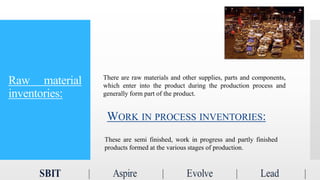
Raw material
inventories:
There are raw materials and other supplies, parts and components,
which enter into the product during the production process and
generally form part of the product.
These are semi finished, work in progress and partly finished
products formed at the various stages of production.
WORK IN PROCESS INVENTORIES:
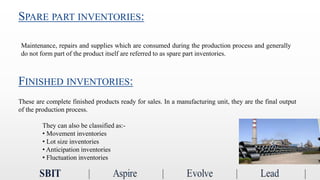
SPARE PART INVENTORIES:
FINISHED INVENTORIES:
Maintenance, repairs and supplies which are consumed during the production process and generally
do not form part of the product itself are referred to as spare part inventories.
These are complete finished products ready for sales. In a manufacturing unit, they are the final output
of the production process.
They can also be classified as:-
• Movement inventories
• Lot size inventories
• Anticipation inventories
• Fluctuation inventories
Classification of
inventories cost:
Inventories’ cost are traditionally categorized into
four basic types:
Purchase cost:
For items that are purchased from outside the firms, this is usually
the unit price that the firm pays to its vendor. As an item moves
through the logistics system of the firms, it purchase cost in the
inventory analysis should reflect its fully landed cost, by which is
meant the cost to acquire and moves the item to that point in the
system.
ORDERING COST:
In addition to the per unit purchase cost, there is usually an
additional cost which is incurred whenever we order, reorder or
replenish the inventory. If we produce items internally then there
will be an organization set up cost. This happens because we have to
shut down the manufacturing line and change over, reconfigure the
line to make a specific item.
This is the cost involved with processing the order, involving paying
the bill, auditing, and so forth.
HOLDING COST:
SHORTAGE COST:
The cost that accrue due to the actual holding of the inventory over a time period. Many different kinds of cost
can be considered as holding cost. The key characteristics of holding cost varies with the amount of inventory
being held and the time that the inventory is held. The holding cost can further be classified as follows:
• Storage cost
• Service cost
• Risk cost
•Capital cost.
When a demand arises which cannot be satisfied from available inventory an inventory shortage occurs.
Purchase, ordering and holding cost can be thought of as the cost of having inventories, while shortage cost
result for not having inventory, or for not having enough inventory at the right place at the right time
Inventory
control:
 Inventory control is the means by which materials of the correct quality and
in correct quantity are made available as and when required with due
regard to economic in storage and ordering cost. Hear the desired level of
inventory can neither be high or low because high level inventory will lead
to increase in carrying cost while low level of inventory will lead to
increase in ordering cost
Objectives of
inventory
control:
• To ensure smooth flow of stock.
• To provide for required quality of materials.
•To control investments in stock.
• Protection against fluctuating demand.
• Protection against fluctuations in output.
• Minimization of risk and uncertainty.
• Risk of obsolescence.
•Minimization of material cost.
•Inventory control aims at keeping track of inventories. In other words,
inventories of good quality and right quantities should be made available
to different departments as and when they needed.
Inventory
Control
Decisions
Decisions:
 How much to order?
 When to order?
CONCLUSIONS
 Careful classification of your inventory, and continuing
analysis of those classifications, can play a vital role in
maintaining cost at the efficient levels you have established
as your goals
 Inventory control is a constant requirement of doing business
successfully.
inventory control system

inventory control system

  • 1.
  • 2.
    INTRODUCTION Inventory is materialthat the firm obtains in advance of need, holds until it is needed, and then used, consumes, incorporates into a product, sells, or otherwise disposes it of. A business inventory is temporary in nature. Inventories are stock of any kind like fuel and lubricants, spare parts and semi-processed materials to be stored for future use mainly in the process of production or it can be known as the ideal resource of any kind having some economic values.
  • 3.
    Items carried in inventorycan be  Raw materials  Purchased parts  Subassemblies  Work-in-process  Finished goods
  • 4.
    Reasons for keeping Inventories To stabiliseproduction To take advantage of price discounts To meet the demand during the replenishment period To prevent loss of orders(sales) To keep pace with changing market conditions
  • 5.
    Raw material inventories: There areraw materials and other supplies, parts and components, which enter into the product during the production process and generally form part of the product. These are semi finished, work in progress and partly finished products formed at the various stages of production. WORK IN PROCESS INVENTORIES:
  • 6.
    SPARE PART INVENTORIES: FINISHEDINVENTORIES: Maintenance, repairs and supplies which are consumed during the production process and generally do not form part of the product itself are referred to as spare part inventories. These are complete finished products ready for sales. In a manufacturing unit, they are the final output of the production process. They can also be classified as:- • Movement inventories • Lot size inventories • Anticipation inventories • Fluctuation inventories
  • 7.
    Classification of inventories cost: Inventories’cost are traditionally categorized into four basic types:
  • 8.
    Purchase cost: For itemsthat are purchased from outside the firms, this is usually the unit price that the firm pays to its vendor. As an item moves through the logistics system of the firms, it purchase cost in the inventory analysis should reflect its fully landed cost, by which is meant the cost to acquire and moves the item to that point in the system. ORDERING COST: In addition to the per unit purchase cost, there is usually an additional cost which is incurred whenever we order, reorder or replenish the inventory. If we produce items internally then there will be an organization set up cost. This happens because we have to shut down the manufacturing line and change over, reconfigure the line to make a specific item. This is the cost involved with processing the order, involving paying the bill, auditing, and so forth.
  • 9.
    HOLDING COST: SHORTAGE COST: Thecost that accrue due to the actual holding of the inventory over a time period. Many different kinds of cost can be considered as holding cost. The key characteristics of holding cost varies with the amount of inventory being held and the time that the inventory is held. The holding cost can further be classified as follows: • Storage cost • Service cost • Risk cost •Capital cost. When a demand arises which cannot be satisfied from available inventory an inventory shortage occurs. Purchase, ordering and holding cost can be thought of as the cost of having inventories, while shortage cost result for not having inventory, or for not having enough inventory at the right place at the right time
  • 10.
    Inventory control:  Inventory controlis the means by which materials of the correct quality and in correct quantity are made available as and when required with due regard to economic in storage and ordering cost. Hear the desired level of inventory can neither be high or low because high level inventory will lead to increase in carrying cost while low level of inventory will lead to increase in ordering cost
  • 11.
    Objectives of inventory control: • Toensure smooth flow of stock. • To provide for required quality of materials. •To control investments in stock. • Protection against fluctuating demand. • Protection against fluctuations in output. • Minimization of risk and uncertainty. • Risk of obsolescence. •Minimization of material cost. •Inventory control aims at keeping track of inventories. In other words, inventories of good quality and right quantities should be made available to different departments as and when they needed.
  • 12.
  • 13.
    CONCLUSIONS  Careful classificationof your inventory, and continuing analysis of those classifications, can play a vital role in maintaining cost at the efficient levels you have established as your goals  Inventory control is a constant requirement of doing business successfully.