
MATERIALS AND INVENTORY
MANAGEMENT
UNIT 4: INVENTORY MANAGEMENT
POLICIES
Prepared and presented by,
Ganesha Pandian . N
Assistant Professor.
1
RLIMS-MBA2018
CONTENT
 Inventory control
 Inventory control parameters
 Inventory record keeping
 Reactive, planning and adaptive methods
 Push pull inventory control methods
 Risk pooling
2
RLIMS-MBA2018
INTRODUCTION
 Proper inventory control policies and procedures
reduces the cost associated with the inventory
 The inventory policies must align with the overall
firm’s financial goals and operational needs.
 Inventory control – efficiency in inventory
management – increases the profit of firm
3
RLIMS-MBA2018
INVENTORY POLICIES AND CONTROL
 Inventory policies and control decisions are
concerned with maximizing the customer
satisfaction and minimizing the cost.
 The main components in inventory control are: 1.
carrying cost 2. ordering cost 3. shortage cost
 One is to decide on when to order and how much to
order and then to create a systematic tracking of
inventory 4
RLIMS-MBA2018
INVENTORY CONTROL PARAMETERS
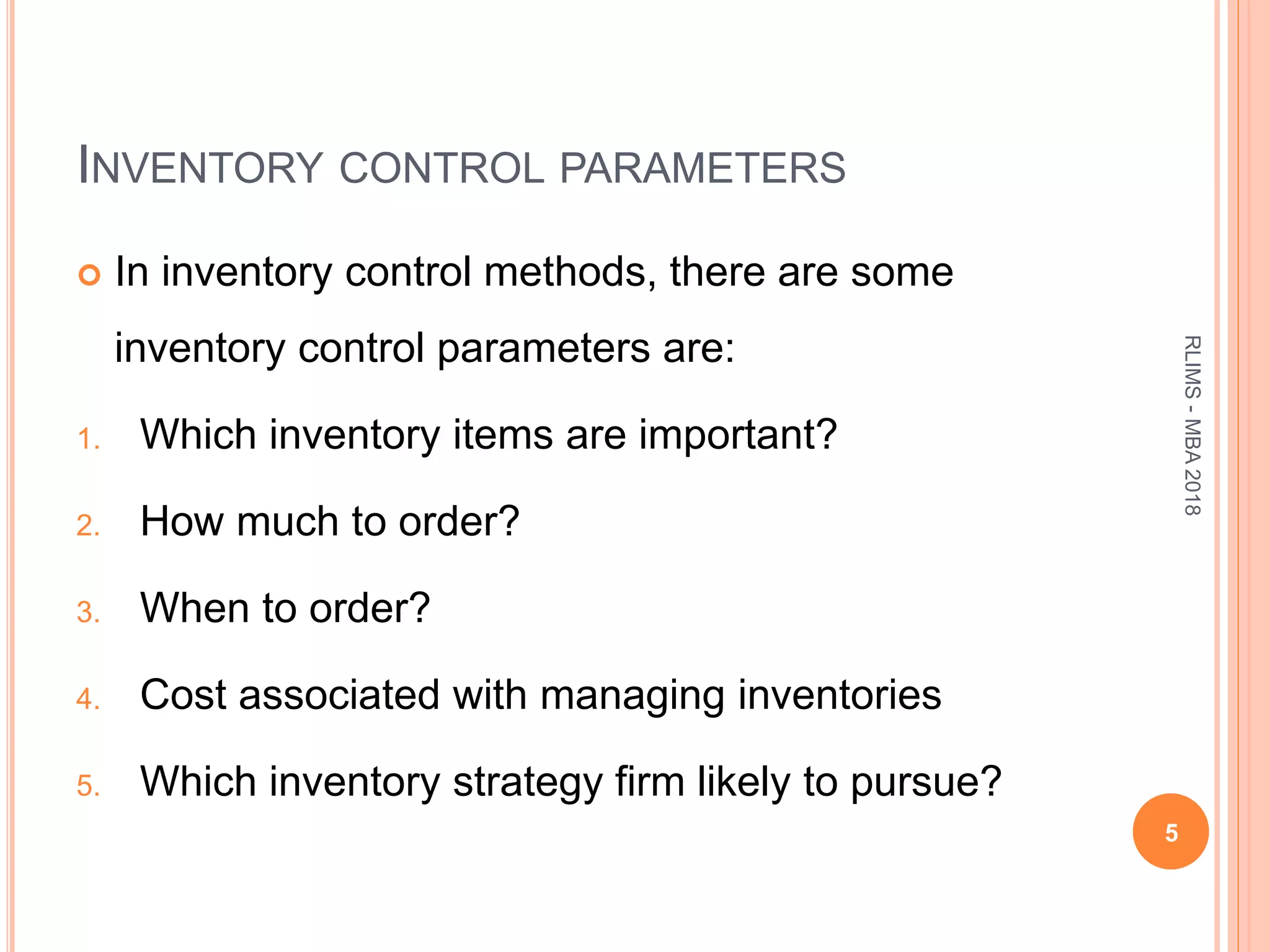
 In inventory control methods, there are some
inventory control parameters are:
1. Which inventory items are important?
2. How much to order?
3. When to order?
4. Cost associated with managing inventories
5. Which inventory strategy firm likely to pursue?
5
RLIMS-MBA2018
INVENTORY CONTROL METHODS
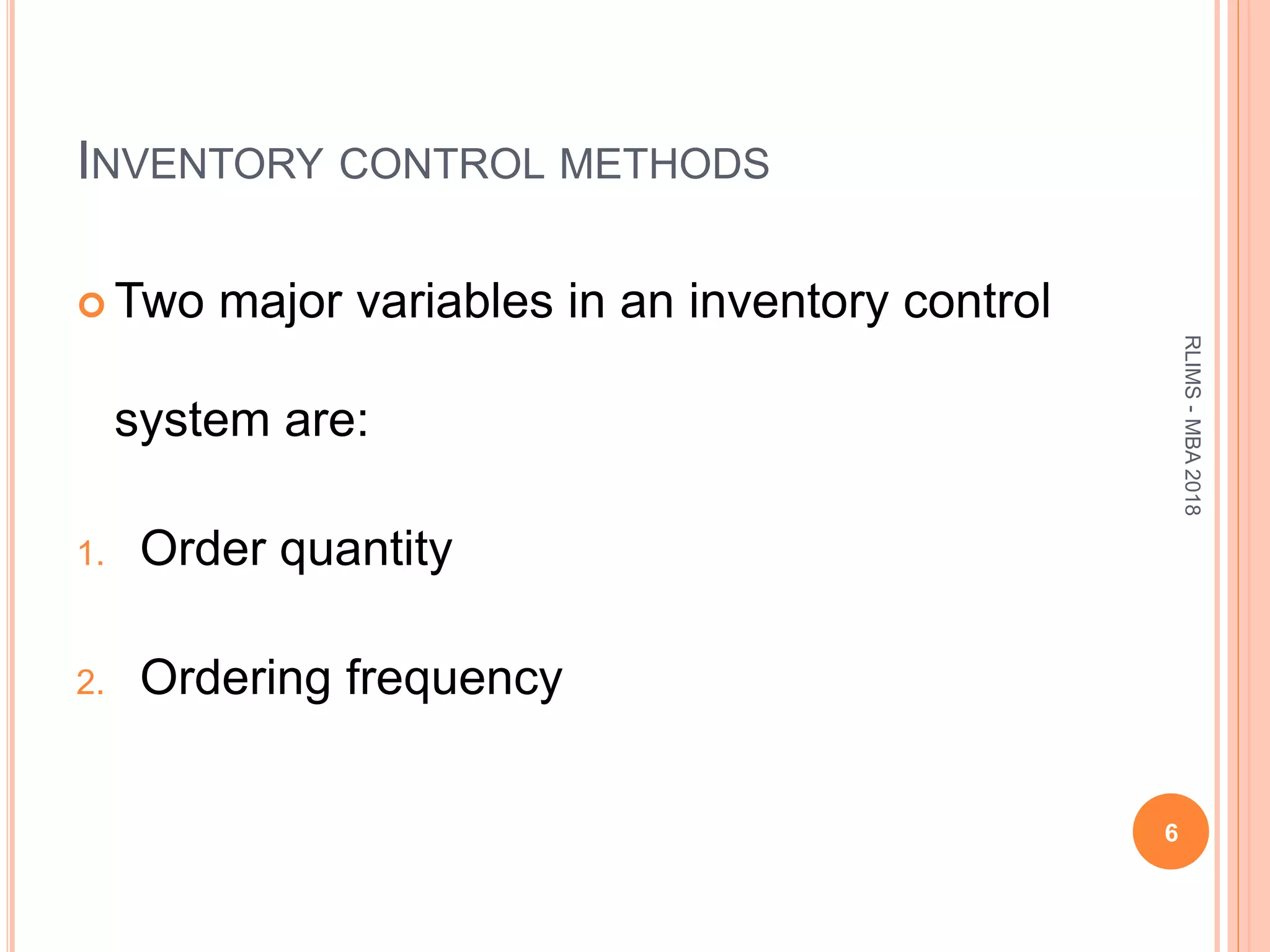
 Two major variables in an inventory control
system are:
1. Order quantity
2. Ordering frequency
6
RLIMS-MBA2018
INVENTORY CONTROL SYSTEMS
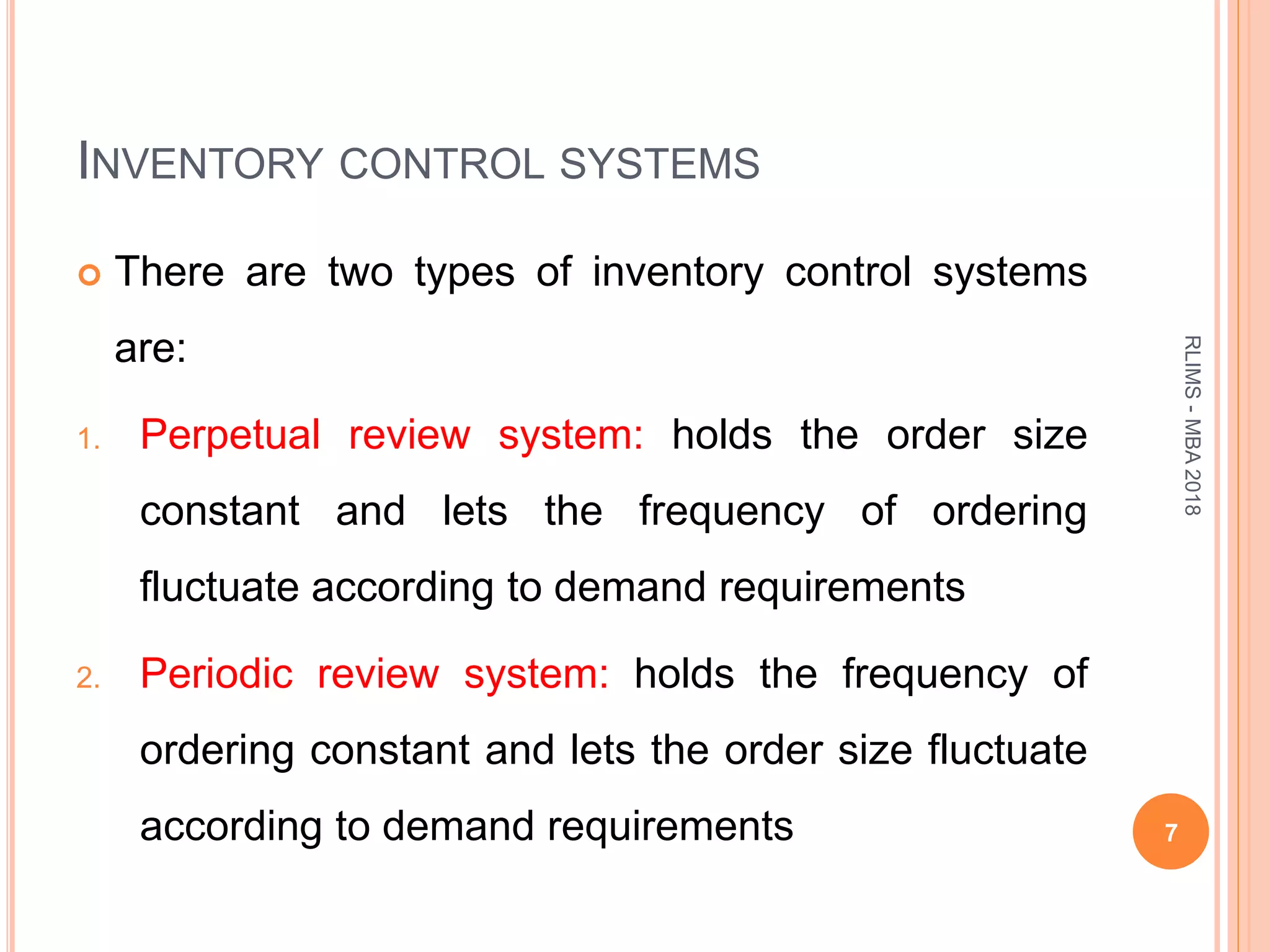
 There are two types of inventory control systems
are:
1. Perpetual review system: holds the order size
constant and lets the frequency of ordering
fluctuate according to demand requirements
2. Periodic review system: holds the frequency of
ordering constant and lets the order size fluctuate
according to demand requirements 7
RLIMS-MBA2018
PERPETUAL CONTROL SYSTEM
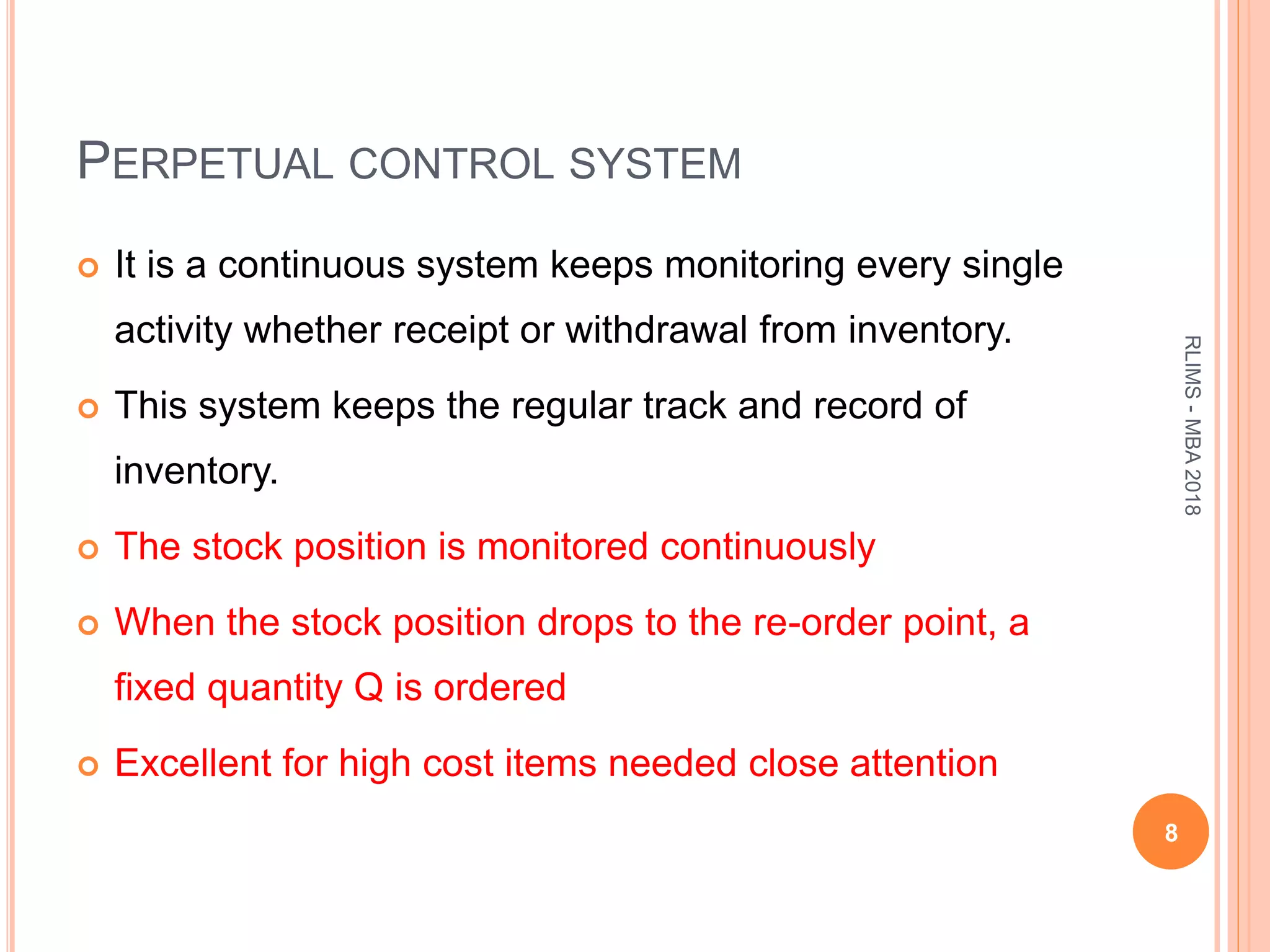
 It is a continuous system keeps monitoring every single
activity whether receipt or withdrawal from inventory.
 This system keeps the regular track and record of
inventory.
 The stock position is monitored continuously
 When the stock position drops to the re-order point, a
fixed quantity Q is ordered
 Excellent for high cost items needed close attention
8
RLIMS-MBA2018
ADVANTAGES OF PERPETUAL INVENTORY
SYSTEM
 An efficient and meaningful order size
 Safety stock needed for the lead time period
 More attention for fast moving items
 Relatively insensitive to forecast and parameters
change
9
RLIMS-MBA2018
DISADVANTAGES OF PERPETUAL INVENTORY
SYSTEM
 Requires perpetual auditing of inventory in stock
 Prevents the economies, as the several items in
one order
10
RLIMS-MBA2018
PERIODIC CONTROL SYSTEM
 Does not attempt to keep track inventory on a
continuous basis.
 The periodic system monitors inventory at regular
basis as weekly, monthly and yearly depends
 Periodic review systems need larger safety stock
than continuous review systems
11
RLIMS-MBA2018
FEATURES OF PERIODIC REVIEW SYSTEM
 The stock position is reviewed at regular intervals
 An amount equal to a target inventory T minus the stock
position is ordered after each review
 The periodic system is well suited for inventory control
when there is one central supplier and items are
expensive
12
RLIMS-MBA2018
COMPARISON TO PERPETUAL SYSTEM
1. It does not have re-order point but rather than a
target inventory
2. It does not have an EOQ, since the quantity varies
according to demand.
3. The order interval is fixed, but the order quantity
will vary 13
RLIMS-MBA2018
ADVANTAGES OF PERIODIC SYSTEM
 Various items can be ordered from the same
vendor or supplier and delivered in the same
shipment
 Less record keeping due to scheduled
replenishment
14
RLIMS-MBA2018
DISADVANTAGES OF PERIODIC SYSTEM
 Requires safety stock for protection against
demand fluctuation during both the review period
and lead time
 This results in a large safety stock as compared to
the perpetual system
15
RLIMS-MBA2018
PHYSICAL COUNTING SYSTEM
 It is a part of internal management and audit
requirement.
 In case of perpetual system, then the physical counting
become necessary
 Organizations use the warehouse management system
software to perform efficient and effective counting
16
RLIMS-MBA2018
TWO BIN INVENTORY CONTROL SYSTEM
 It is a fixed order system, often used for
inexpensive or low value item
 When the first inventory have finished, the ext order
is made to replenish or refill these inventory items.
17
RLIMS-MBA2018
FIFO METHOD
 Under this system, the stock first comes should go
first out of the warehouse
 This method is commonly practices in countries like
US
18
RLIMS-MBA2018
LIFO METHOD
 Under this method, the stock which came last
should go out first.
 This is the most commonly used method in many
places
19
RLIMS-MBA2018
WEIGHTED AVERAGE COST METHOD
 Under this method, the items are priced as
weighted average cost.
 A new weighted average cost calculated at every
time of delivery
20
RLIMS-MBA2018
STANDARD COSTING METHOD
 Under this technique, a standard price is fixed on the
basis of cost incurred for manufacturing a particular
product
 The difference between the actual and standard price is
compared and contrasted
 Inventory issued is charged as per the standard price
21
RLIMS-MBA2018
PUSH PULL INVENTORY CONTROL SYSTEM
 Push method is more of proactive in nature and
often used when the demand is predictable
 Pull method is reactive method and it involves
production process gets initiated when the
customer order is fulfilled
22
RLIMS-MBA2018
RISK POOLING
 Risk pooling is the concept that advocates that –
one can combine or aggregate demand to reduce
the unevenness or variations in demand
 Risk pooling can be even across regions, across
time or across products
23
RLIMS-MBA2018
24
RLIMS-MBA2018

Unit 4 inventory management policies

  • 1.
    MATERIALS AND INVENTORY MANAGEMENT UNIT4: INVENTORY MANAGEMENT POLICIES Prepared and presented by, Ganesha Pandian . N Assistant Professor. 1 RLIMS-MBA2018
  • 2.
    CONTENT  Inventory control Inventory control parameters  Inventory record keeping  Reactive, planning and adaptive methods  Push pull inventory control methods  Risk pooling 2 RLIMS-MBA2018
  • 3.
    INTRODUCTION  Proper inventorycontrol policies and procedures reduces the cost associated with the inventory  The inventory policies must align with the overall firm’s financial goals and operational needs.  Inventory control – efficiency in inventory management – increases the profit of firm 3 RLIMS-MBA2018
  • 4.
    INVENTORY POLICIES ANDCONTROL  Inventory policies and control decisions are concerned with maximizing the customer satisfaction and minimizing the cost.  The main components in inventory control are: 1. carrying cost 2. ordering cost 3. shortage cost  One is to decide on when to order and how much to order and then to create a systematic tracking of inventory 4 RLIMS-MBA2018
  • 5.
    INVENTORY CONTROL PARAMETERS In inventory control methods, there are some inventory control parameters are: 1. Which inventory items are important? 2. How much to order? 3. When to order? 4. Cost associated with managing inventories 5. Which inventory strategy firm likely to pursue? 5 RLIMS-MBA2018
  • 6.
    INVENTORY CONTROL METHODS Two major variables in an inventory control system are: 1. Order quantity 2. Ordering frequency 6 RLIMS-MBA2018
  • 7.
    INVENTORY CONTROL SYSTEMS There are two types of inventory control systems are: 1. Perpetual review system: holds the order size constant and lets the frequency of ordering fluctuate according to demand requirements 2. Periodic review system: holds the frequency of ordering constant and lets the order size fluctuate according to demand requirements 7 RLIMS-MBA2018
  • 8.
    PERPETUAL CONTROL SYSTEM It is a continuous system keeps monitoring every single activity whether receipt or withdrawal from inventory.  This system keeps the regular track and record of inventory.  The stock position is monitored continuously  When the stock position drops to the re-order point, a fixed quantity Q is ordered  Excellent for high cost items needed close attention 8 RLIMS-MBA2018
  • 9.
    ADVANTAGES OF PERPETUALINVENTORY SYSTEM  An efficient and meaningful order size  Safety stock needed for the lead time period  More attention for fast moving items  Relatively insensitive to forecast and parameters change 9 RLIMS-MBA2018
  • 10.
    DISADVANTAGES OF PERPETUALINVENTORY SYSTEM  Requires perpetual auditing of inventory in stock  Prevents the economies, as the several items in one order 10 RLIMS-MBA2018
  • 11.
    PERIODIC CONTROL SYSTEM Does not attempt to keep track inventory on a continuous basis.  The periodic system monitors inventory at regular basis as weekly, monthly and yearly depends  Periodic review systems need larger safety stock than continuous review systems 11 RLIMS-MBA2018
  • 12.
    FEATURES OF PERIODICREVIEW SYSTEM  The stock position is reviewed at regular intervals  An amount equal to a target inventory T minus the stock position is ordered after each review  The periodic system is well suited for inventory control when there is one central supplier and items are expensive 12 RLIMS-MBA2018
  • 13.
    COMPARISON TO PERPETUALSYSTEM 1. It does not have re-order point but rather than a target inventory 2. It does not have an EOQ, since the quantity varies according to demand. 3. The order interval is fixed, but the order quantity will vary 13 RLIMS-MBA2018
  • 14.
    ADVANTAGES OF PERIODICSYSTEM  Various items can be ordered from the same vendor or supplier and delivered in the same shipment  Less record keeping due to scheduled replenishment 14 RLIMS-MBA2018
  • 15.
    DISADVANTAGES OF PERIODICSYSTEM  Requires safety stock for protection against demand fluctuation during both the review period and lead time  This results in a large safety stock as compared to the perpetual system 15 RLIMS-MBA2018
  • 16.
    PHYSICAL COUNTING SYSTEM It is a part of internal management and audit requirement.  In case of perpetual system, then the physical counting become necessary  Organizations use the warehouse management system software to perform efficient and effective counting 16 RLIMS-MBA2018
  • 17.
    TWO BIN INVENTORYCONTROL SYSTEM  It is a fixed order system, often used for inexpensive or low value item  When the first inventory have finished, the ext order is made to replenish or refill these inventory items. 17 RLIMS-MBA2018
  • 18.
    FIFO METHOD  Underthis system, the stock first comes should go first out of the warehouse  This method is commonly practices in countries like US 18 RLIMS-MBA2018
  • 19.
    LIFO METHOD  Underthis method, the stock which came last should go out first.  This is the most commonly used method in many places 19 RLIMS-MBA2018
  • 20.
    WEIGHTED AVERAGE COSTMETHOD  Under this method, the items are priced as weighted average cost.  A new weighted average cost calculated at every time of delivery 20 RLIMS-MBA2018
  • 21.
    STANDARD COSTING METHOD Under this technique, a standard price is fixed on the basis of cost incurred for manufacturing a particular product  The difference between the actual and standard price is compared and contrasted  Inventory issued is charged as per the standard price 21 RLIMS-MBA2018
  • 22.
    PUSH PULL INVENTORYCONTROL SYSTEM  Push method is more of proactive in nature and often used when the demand is predictable  Pull method is reactive method and it involves production process gets initiated when the customer order is fulfilled 22 RLIMS-MBA2018
  • 23.
    RISK POOLING  Riskpooling is the concept that advocates that – one can combine or aggregate demand to reduce the unevenness or variations in demand  Risk pooling can be even across regions, across time or across products 23 RLIMS-MBA2018
  • 24.