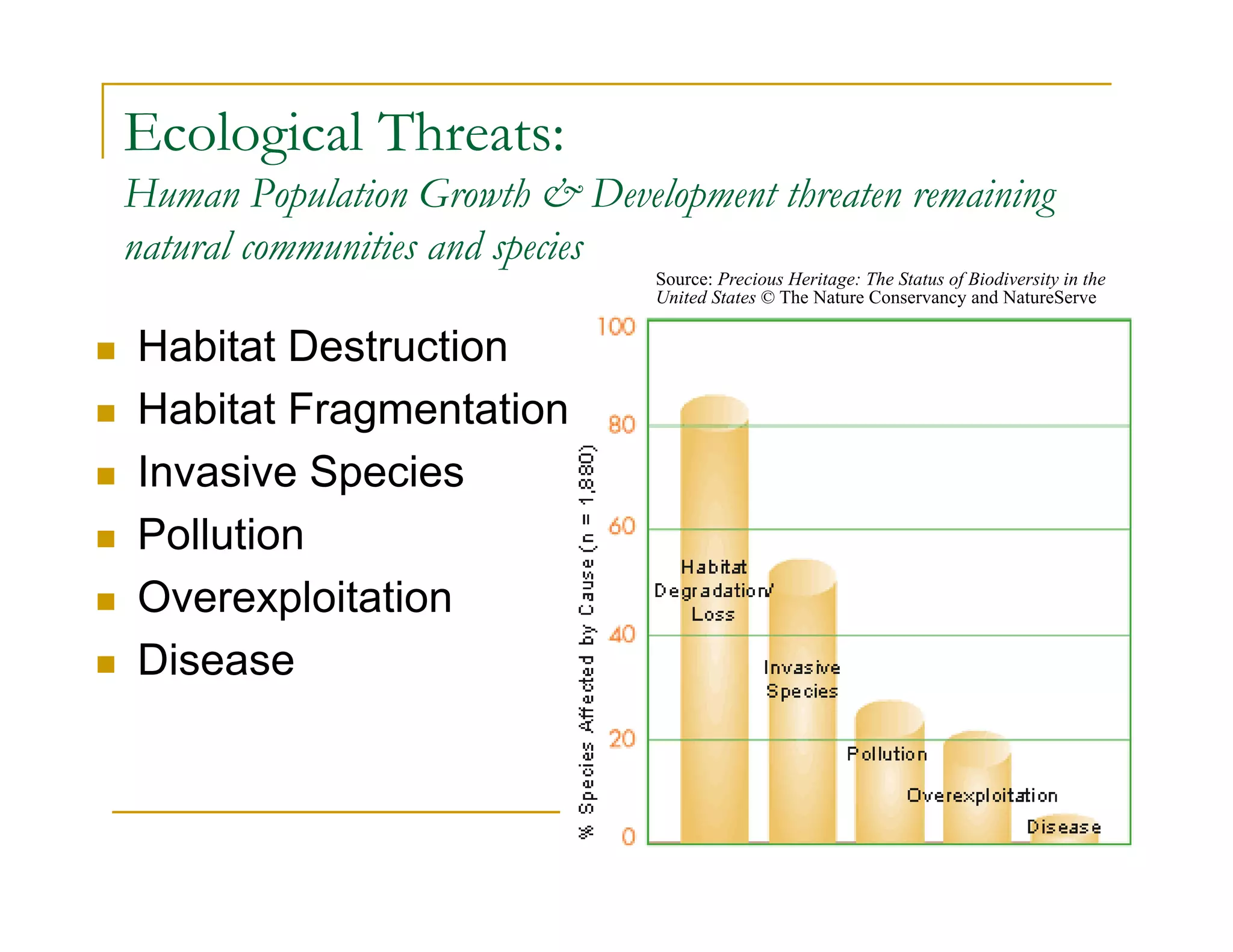
Ecological Threats:
Human Population Growth & Development threaten remaining
natural communities and species
 Habitat Destruction
 Habitat Fragmentation
 Invasive Species
 Pollution
 Overexploitation
 Disease
Source: Precious Heritage: The Status of Biodiversity in the
United States © The Nature Conservancy and NatureServe
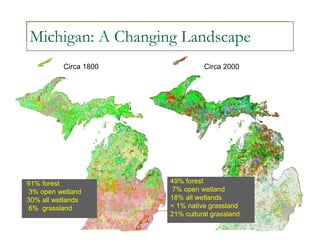
91% forest
3% open wetland
30% all wetlands
6% grassland
49% forest
7% open wetland
18% all wetlands
< 1% native grassland
21% cultural grassland
Michigan: A Changing Landscape
Circa 1800 Circa 2000
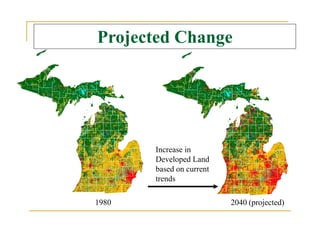
1980 2040 (projected)
Projected Change
Increase in
Developed Land
based on current
trends
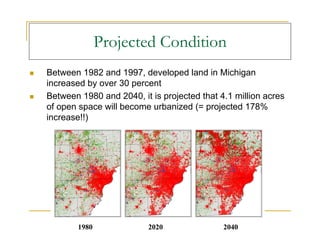
 Between 1982 and 1997, developed land in Michigan
increased by over 30 percent
 Between 1980 and 2040, it is projected that 4.1 million acres
of open space will become urbanized (= projected 178%
increase!!)
1980 2020 2040
Projected Condition
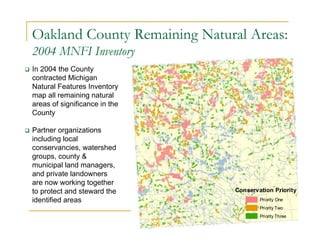
Oakland County Remaining Natural Areas:
2004 MNFI Inventory
 In 2004 the County
contracted Michigan
Natural Features Inventory
map all remaining natural
areas of significance in the
County
 Partner organizations
including local
conservancies, watershed
groups, county &
municipal land managers,
and private landowners
are now working together
to protect and steward the
identified areas
Conservation Priority
Priority One
Priority Two
Priority Three
Focus on Invasive Species Management
The annual cost of invasive species to the United States economy
is estimated at $120 billion a year. The annual cost of impacts and
control efforts equal 5% of the world’s economy.
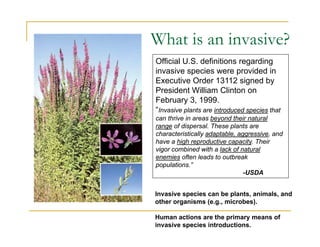
What is an invasive?
Official U.S. definitions regarding
invasive species were provided in
Executive Order 13112 signed by
President William Clinton on
February 3, 1999.
“Invasive plants are introduced species that
can thrive in areas beyond their natural
range of dispersal. These plants are
characteristically adaptable, aggressive, and
have a high reproductive capacity. Their
vigor combined with a lack of natural
enemies often leads to outbreak
populations.”
-USDA
Invasive species can be plants, animals, and
other organisms (e.g., microbes).
Human actions are the primary means of
invasive species introductions.
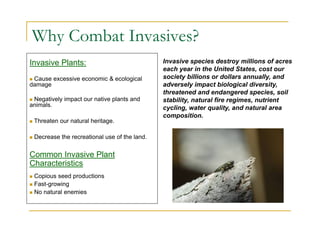
Why Combat Invasives?
Invasive Plants:
 Cause excessive economic & ecological
damage
 Negatively impact our native plants and
animals.
 Threaten our natural heritage.
 Decrease the recreational use of the land.
Common Invasive Plant
Characteristics
 Copious seed productions
 Fast-growing
 No natural enemies
Invasive species destroy millions of acres
each year in the United States, cost our
society billions or dollars annually, and
adversely impact biological diversity,
threatened and endangered species, soil
stability, natural fire regimes, nutrient
cycling, water quality, and natural area
composition.
Invasive Plants of Major
Concern
The following plants spread aggressively and cause
serious ecological and economic damage
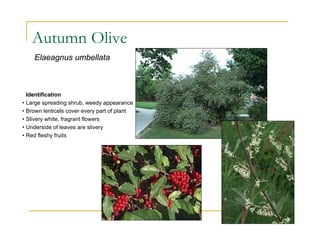
Autumn Olive
Identification
• Large spreading shrub, weedy appearance
• Brown lenticels cover every part of plant
• Slivery white, fragrant flowers
• Underside of leaves are slivery
• Red fleshy fruits
Elaeagnus umbellata
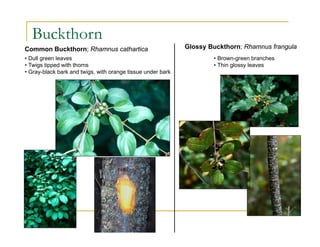
Buckthorn
Common Buckthorn; Rhamnus cathartica Glossy Buckthorn; Rhamnus frangula
• Dull green leaves
• Twigs tipped with thorns
• Gray-black bark and twigs, with orange tissue under bark
• Brown-green branches
• Thin glossy leaves
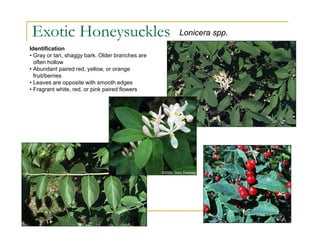
Exotic Honeysuckles
Identification
• Gray or tan, shaggy bark. Older branches are
often hollow
• Abundant paired red, yellow, or orange
fruit/berries
• Leaves are opposite with smooth edges
• Fragrant white, red, or pink paired flowers
Lonicera spp.
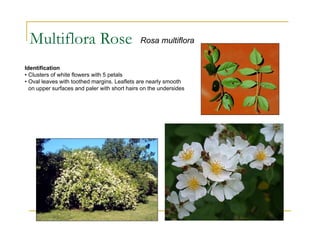
Multiflora Rose Rosa multiflora
Identification
• Clusters of white flowers with 5 petals
• Oval leaves with toothed margins. Leaflets are nearly smooth
on upper surfaces and paler with short hairs on the undersides
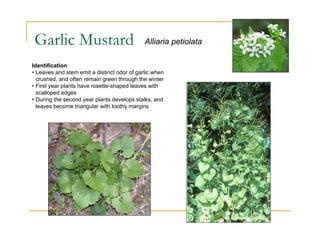
Garlic Mustard Alliaria petiolata
Identification
• Leaves and stem emit a distinct odor of garlic when
crushed, and often remain green through the winter
• First year plants have rosette-shaped leaves with
scalloped edges
• During the second year plants develops stalks, and
leaves become triangular with toothy margins
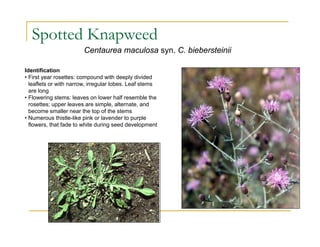
Spotted Knapweed
Centaurea maculosa syn. C. biebersteinii
Identification
• First year rosettes: compound with deeply divided
leaflets or with narrow, irregular lobes. Leaf stems
are long
• Flowering stems: leaves on lower half resemble the
rosettes; upper leaves are simple, alternate, and
become smaller near the top of the stems
• Numerous thistle-like pink or lavender to purple
flowers, that fade to white during seed development
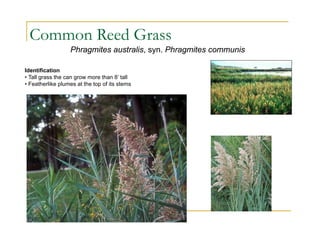
Common Reed Grass
Phragmites australis, syn. Phragmites communis
Identification
• Tall grass the can grow more than 8’ tall
• Featherlike plumes at the top of its stems
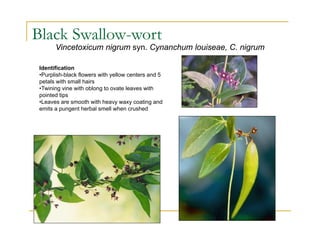
Black Swallow-wort
Vincetoxicum nigrum syn. Cynanchum louiseae, C. nigrum
Identification
•Purplish-black flowers with yellow centers and 5
petals with small hairs
•Twining vine with oblong to ovate leaves with
pointed tips
•Leaves are smooth with heavy waxy coating and
emits a pungent herbal smell when crushed
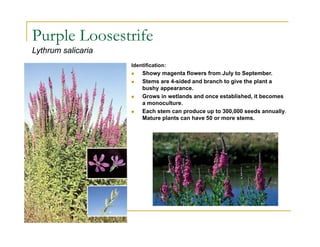
Purple Loosestrife
Lythrum salicaria
Identification:
 Showy magenta flowers from July to September.
 Stems are 4-sided and branch to give the plant a
bushy appearance.
 Grows in wetlands and once established, it becomes
a monoculture.
 Each stem can produce up to 300,000 seeds annually.
Mature plants can have 50 or more stems.
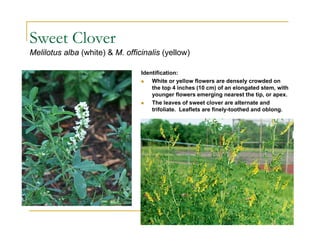
Sweet Clover
Melilotus alba (white) & M. officinalis (yellow)
Identification:
 White or yellow flowers are densely crowded on
the top 4 inches (10 cm) of an elongated stem, with
younger flowers emerging nearest the tip, or apex.
 The leaves of sweet clover are alternate and
trifoliate. Leaflets are finely-toothed and oblong.
Management Techniques
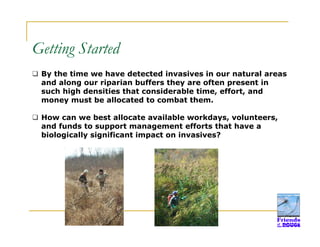
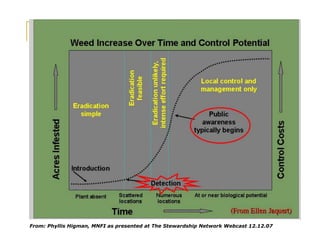
 By the time we have detected invasives in our natural areas
and along our riparian buffers they are often present in
such high densities that considerable time, effort, and
money must be allocated to combat them.
 How can we best allocate available workdays, volunteers,
and funds to support management efforts that have a
biologically significant impact on invasives?
Getting Started
From: Phyllis Higman, MNFI as presented at The Stewardship Network Webcast 12.12.07
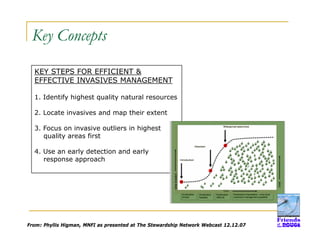
Key Concepts
KEY STEPS FOR EFFICIENT &
EFFECTIVE INVASIVES MANAGEMENT
1. Identify highest quality natural resources
2. Locate invasives and map their extent
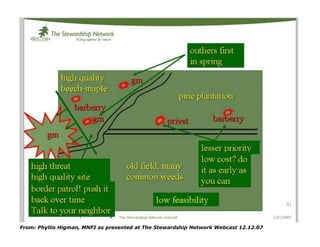
3. Focus on invasive outliers in highest
quality areas first
4. Use an early detection and early
response approach
From: Phyllis Higman, MNFI as presented at The Stewardship Network Webcast 12.12.07
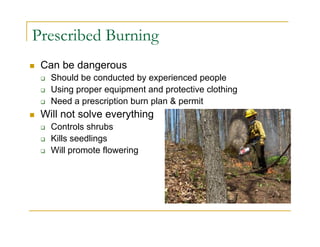
Prescribed Burning
 Can be dangerous
 Should be conducted by experienced people
 Using proper equipment and protective clothing
 Need a prescription burn plan & permit
 Will not solve everything
 Controls shrubs
 Kills seedlings
 Will promote flowering
Biological Control
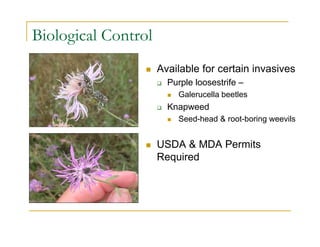
 Available for certain invasives
 Purple loosestrife –
 Galerucella beetles
 Knapweed
 Seed-head & root-boring weevils
 USDA & MDA Permits
Required
Mechanical Control
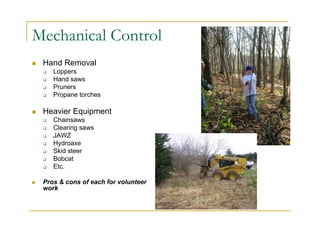
 Hand Removal
 Loppers
 Hand saws
 Pruners
 Propane torches
 Heavier Equipment
 Chainsaws
 Clearing saws
 JAWZ
 Hydroaxe
 Skid steer
 Bobcat
 Etc.
 Pros & cons of each for volunteer
work
Chemical Control
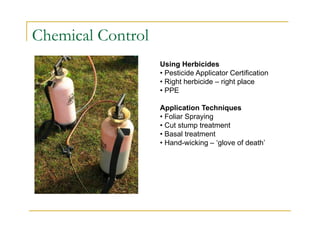
Using Herbicides
• Pesticide Applicator Certification
• Right herbicide – right place
• PPE
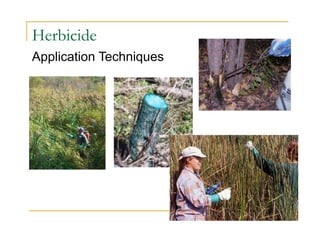
Application Techniques
• Foliar Spraying
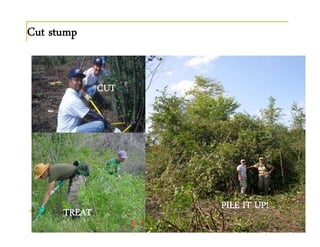
• Cut stump treatment
• Basal treatment
• Hand-wicking – ‘glove of death’
Herbicide
Selection – Right Herbicide/ Right Place
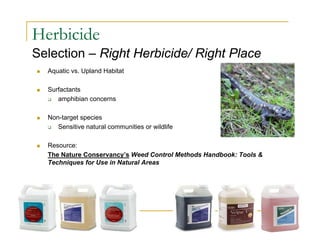
 Aquatic vs. Upland Habitat
 Surfactants
 amphibian concerns
 Non-target species
 Sensitive natural communities or wildlife
 Resource:
The Nature Conservancy’s Weed Control Methods Handbook: Tools &
Techniques for Use in Natural Areas
Herbicide
Application Techniques
Cut stump
CUT
TREAT
PILE IT UP!
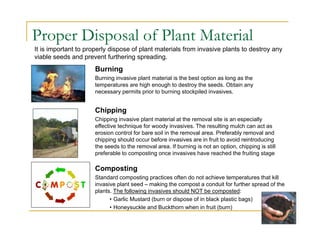
Proper Disposal of Plant Material
It is important to properly dispose of plant materials from invasive plants to destroy any
viable seeds and prevent furthering spreading.
Burning
Burning invasive plant material is the best option as long as the
temperatures are high enough to destroy the seeds. Obtain any
necessary permits prior to burning stockpiled invasives.
Composting
Standard composting practices often do not achieve temperatures that kill
invasive plant seed – making the compost a conduit for further spread of the
plants. The following invasives should NOT be composted:
• Garlic Mustard (burn or dispose of in black plastic bags)
• Honeysuckle and Buckthorn when in fruit (burn)
Chipping
Chipping invasive plant material at the removal site is an especially
effective technique for woody invasives. The resulting mulch can act as
erosion control for bare soil in the removal area. Preferably removal and
chipping should occur before invasives are in fruit to avoid reintroducing
the seeds to the removal area. If burning is not an option, chipping is still
preferable to composting once invasives have reached the fruiting stage

AmericorpsTrainingPPT 2011 07 08_bb_hh

  • 1.
    Ecological Threats: Human PopulationGrowth & Development threaten remaining natural communities and species  Habitat Destruction  Habitat Fragmentation  Invasive Species  Pollution  Overexploitation  Disease Source: Precious Heritage: The Status of Biodiversity in the United States © The Nature Conservancy and NatureServe
  • 2.
    91% forest 3% openwetland 30% all wetlands 6% grassland 49% forest 7% open wetland 18% all wetlands < 1% native grassland 21% cultural grassland Michigan: A Changing Landscape Circa 1800 Circa 2000
  • 3.
    1980 2040 (projected) ProjectedChange Increase in Developed Land based on current trends
  • 4.
     Between 1982and 1997, developed land in Michigan increased by over 30 percent  Between 1980 and 2040, it is projected that 4.1 million acres of open space will become urbanized (= projected 178% increase!!) 1980 2020 2040 Projected Condition
  • 5.
    Oakland County RemainingNatural Areas: 2004 MNFI Inventory  In 2004 the County contracted Michigan Natural Features Inventory map all remaining natural areas of significance in the County  Partner organizations including local conservancies, watershed groups, county & municipal land managers, and private landowners are now working together to protect and steward the identified areas Conservation Priority Priority One Priority Two Priority Three
  • 6.
    Focus on InvasiveSpecies Management The annual cost of invasive species to the United States economy is estimated at $120 billion a year. The annual cost of impacts and control efforts equal 5% of the world’s economy.
  • 7.
    What is aninvasive? Official U.S. definitions regarding invasive species were provided in Executive Order 13112 signed by President William Clinton on February 3, 1999. “Invasive plants are introduced species that can thrive in areas beyond their natural range of dispersal. These plants are characteristically adaptable, aggressive, and have a high reproductive capacity. Their vigor combined with a lack of natural enemies often leads to outbreak populations.” -USDA Invasive species can be plants, animals, and other organisms (e.g., microbes). Human actions are the primary means of invasive species introductions.
  • 8.
    Why Combat Invasives? InvasivePlants:  Cause excessive economic & ecological damage  Negatively impact our native plants and animals.  Threaten our natural heritage.  Decrease the recreational use of the land. Common Invasive Plant Characteristics  Copious seed productions  Fast-growing  No natural enemies Invasive species destroy millions of acres each year in the United States, cost our society billions or dollars annually, and adversely impact biological diversity, threatened and endangered species, soil stability, natural fire regimes, nutrient cycling, water quality, and natural area composition.
  • 9.
    Invasive Plants ofMajor Concern The following plants spread aggressively and cause serious ecological and economic damage
  • 10.
    Autumn Olive Identification • Largespreading shrub, weedy appearance • Brown lenticels cover every part of plant • Slivery white, fragrant flowers • Underside of leaves are slivery • Red fleshy fruits Elaeagnus umbellata
  • 11.
    Buckthorn Common Buckthorn; Rhamnuscathartica Glossy Buckthorn; Rhamnus frangula • Dull green leaves • Twigs tipped with thorns • Gray-black bark and twigs, with orange tissue under bark • Brown-green branches • Thin glossy leaves
  • 12.
    Exotic Honeysuckles Identification • Grayor tan, shaggy bark. Older branches are often hollow • Abundant paired red, yellow, or orange fruit/berries • Leaves are opposite with smooth edges • Fragrant white, red, or pink paired flowers Lonicera spp.
  • 13.
    Multiflora Rose Rosamultiflora Identification • Clusters of white flowers with 5 petals • Oval leaves with toothed margins. Leaflets are nearly smooth on upper surfaces and paler with short hairs on the undersides
  • 14.
    Garlic Mustard Alliariapetiolata Identification • Leaves and stem emit a distinct odor of garlic when crushed, and often remain green through the winter • First year plants have rosette-shaped leaves with scalloped edges • During the second year plants develops stalks, and leaves become triangular with toothy margins
  • 15.
    Spotted Knapweed Centaurea maculosasyn. C. biebersteinii Identification • First year rosettes: compound with deeply divided leaflets or with narrow, irregular lobes. Leaf stems are long • Flowering stems: leaves on lower half resemble the rosettes; upper leaves are simple, alternate, and become smaller near the top of the stems • Numerous thistle-like pink or lavender to purple flowers, that fade to white during seed development
  • 16.
    Common Reed Grass Phragmitesaustralis, syn. Phragmites communis Identification • Tall grass the can grow more than 8’ tall • Featherlike plumes at the top of its stems
  • 17.
    Black Swallow-wort Vincetoxicum nigrumsyn. Cynanchum louiseae, C. nigrum Identification •Purplish-black flowers with yellow centers and 5 petals with small hairs •Twining vine with oblong to ovate leaves with pointed tips •Leaves are smooth with heavy waxy coating and emits a pungent herbal smell when crushed
  • 18.
    Purple Loosestrife Lythrum salicaria Identification: Showy magenta flowers from July to September.  Stems are 4-sided and branch to give the plant a bushy appearance.  Grows in wetlands and once established, it becomes a monoculture.  Each stem can produce up to 300,000 seeds annually. Mature plants can have 50 or more stems.
  • 19.
    Sweet Clover Melilotus alba(white) & M. officinalis (yellow) Identification:  White or yellow flowers are densely crowded on the top 4 inches (10 cm) of an elongated stem, with younger flowers emerging nearest the tip, or apex.  The leaves of sweet clover are alternate and trifoliate. Leaflets are finely-toothed and oblong.
  • 20.
  • 21.
     By thetime we have detected invasives in our natural areas and along our riparian buffers they are often present in such high densities that considerable time, effort, and money must be allocated to combat them.  How can we best allocate available workdays, volunteers, and funds to support management efforts that have a biologically significant impact on invasives? Getting Started
  • 22.
    From: Phyllis Higman,MNFI as presented at The Stewardship Network Webcast 12.12.07
  • 23.
    Key Concepts KEY STEPSFOR EFFICIENT & EFFECTIVE INVASIVES MANAGEMENT 1. Identify highest quality natural resources 2. Locate invasives and map their extent 3. Focus on invasive outliers in highest quality areas first 4. Use an early detection and early response approach From: Phyllis Higman, MNFI as presented at The Stewardship Network Webcast 12.12.07
  • 24.
    From: Phyllis Higman,MNFI as presented at The Stewardship Network Webcast 12.12.07
  • 25.
    Prescribed Burning  Canbe dangerous  Should be conducted by experienced people  Using proper equipment and protective clothing  Need a prescription burn plan & permit  Will not solve everything  Controls shrubs  Kills seedlings  Will promote flowering
  • 26.
    Biological Control  Availablefor certain invasives  Purple loosestrife –  Galerucella beetles  Knapweed  Seed-head & root-boring weevils  USDA & MDA Permits Required
  • 27.
    Mechanical Control  HandRemoval  Loppers  Hand saws  Pruners  Propane torches  Heavier Equipment  Chainsaws  Clearing saws  JAWZ  Hydroaxe  Skid steer  Bobcat  Etc.  Pros & cons of each for volunteer work
  • 28.
    Chemical Control Using Herbicides •Pesticide Applicator Certification • Right herbicide – right place • PPE Application Techniques • Foliar Spraying • Cut stump treatment • Basal treatment • Hand-wicking – ‘glove of death’
  • 29.
    Herbicide Selection – RightHerbicide/ Right Place  Aquatic vs. Upland Habitat  Surfactants  amphibian concerns  Non-target species  Sensitive natural communities or wildlife  Resource: The Nature Conservancy’s Weed Control Methods Handbook: Tools & Techniques for Use in Natural Areas
  • 30.
  • 31.
  • 32.
    Proper Disposal ofPlant Material It is important to properly dispose of plant materials from invasive plants to destroy any viable seeds and prevent furthering spreading. Burning Burning invasive plant material is the best option as long as the temperatures are high enough to destroy the seeds. Obtain any necessary permits prior to burning stockpiled invasives. Composting Standard composting practices often do not achieve temperatures that kill invasive plant seed – making the compost a conduit for further spread of the plants. The following invasives should NOT be composted: • Garlic Mustard (burn or dispose of in black plastic bags) • Honeysuckle and Buckthorn when in fruit (burn) Chipping Chipping invasive plant material at the removal site is an especially effective technique for woody invasives. The resulting mulch can act as erosion control for bare soil in the removal area. Preferably removal and chipping should occur before invasives are in fruit to avoid reintroducing the seeds to the removal area. If burning is not an option, chipping is still preferable to composting once invasives have reached the fruiting stage