Intubasi Sulit
NUR HAJRIYA BRAHMI
Definition
Difficult Airway :
 the clinical situation in which a conventionally
trained anesthesiologist experiences difficulty with
facemask ventilation of the upper airway, difficulty
with tracheal intubation, or both.

American Society of Anesthesiologist : Practice
Guidelines for Management of The Difficult
Airway, An update report, 2003
Incidens

 the incidence of difficult tracheal intubation has

been estimated at 3-18%.
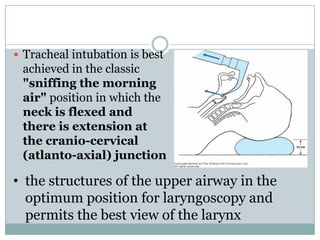
 Tracheal intubation is best

achieved in the classic
"sniffing the morning
air" position in which the
neck is flexed and
there is extension at
the cranio-cervical
(atlanto-axial) junction

• the structures of the upper airway in the
optimum position for laryngoscopy and
permits the best view of the larynx
Evaluasi Kesulitan Intubasi
Kriteria :
- Skala LEMON atau MELON
- LM MAP
- 4D
- Wilson Risk Scale
- Magboul 4M
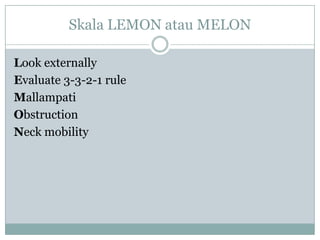
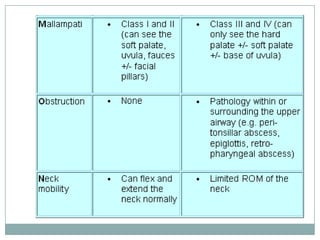
Skala LEMON atau MELON
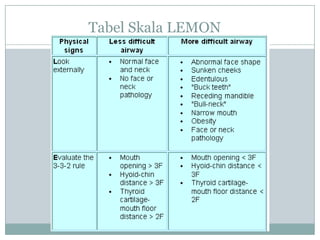
Look externally
Evaluate 3-3-2-1 rule
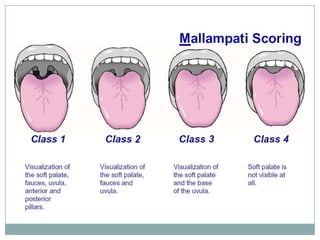
Mallampati
Obstruction
Neck mobility
Tabel Skala LEMON
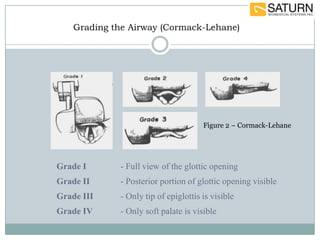
Grading the Airway (Cormack-Lehane)

Figure 2 – Cormack-Lehane

Grade I

- Full view of the glottic opening

Grade II

- Posterior portion of glottic opening visible

Grade III

- Only tip of epiglottis is visible

Grade IV

- Only soft palate is visible
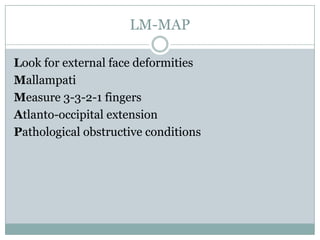
LM-MAP
Look for external face deformities
Mallampati
Measure 3-3-2-1 fingers
Atlanto-occipital extension
Pathological obstructive conditions
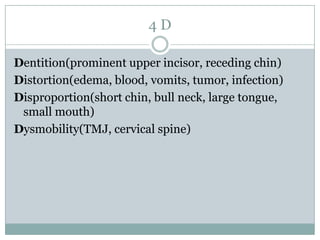
4D
Dentition(prominent upper incisor, receding chin)
Distortion(edema, blood, vomits, tumor, infection)
Disproportion(short chin, bull neck, large tongue,
small mouth)
Dysmobility(TMJ, cervical spine)
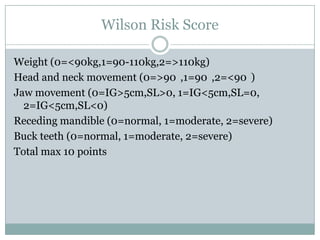
Wilson Risk Score
Weight (0=<90kg,1=90-110kg,2=>110kg)
Head and neck movement (0=>90 ,1=90 ,2=<90 )
Jaw movement (0=IG>5cm,SL>0, 1=IG<5cm,SL=0,
2=IG<5cm,SL<0)
Receding mandible (0=normal, 1=moderate, 2=severe)
Buck teeth (0=normal, 1=moderate, 2=severe)
Total max 10 points
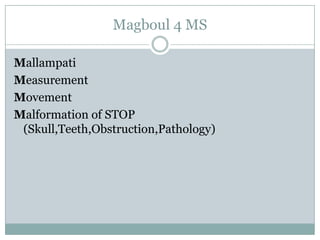
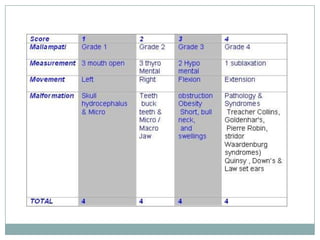
Magboul 4 MS
Mallampati
Measurement
Movement
Malformation of STOP
(Skull,Teeth,Obstruction,Pathology)
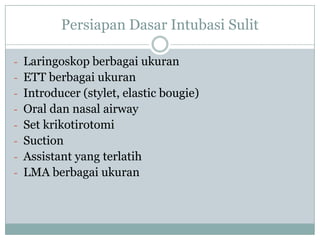
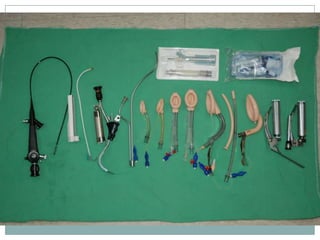
Persiapan Dasar Intubasi Sulit
- Laringoskop berbagai ukuran
- ETT berbagai ukuran
- Introducer (stylet, elastic bougie)
- Oral dan nasal airway
- Set krikotirotomi

- Suction
- Assistant yang terlatih
- LMA berbagai ukuran
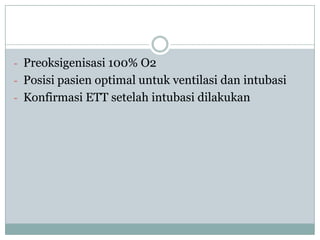
- Preoksigenisasi 100% O2
- Posisi pasien optimal untuk ventilasi dan intubasi
- Konfirmasi ETT setelah intubasi dilakukan
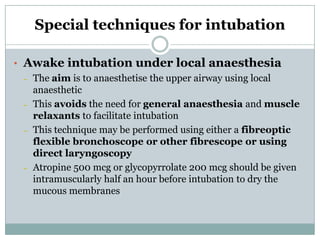
Special techniques for intubation
• Awake intubation under local anaesthesia
– The aim is to anaesthetise the upper airway using local
anaesthetic
– This avoids the need for general anaesthesia and muscle
relaxants to facilitate intubation
– This technique may be performed using either a fibreoptic
flexible bronchoscope or other fibrescope or using
direct laryngoscopy
– Atropine 500 mcg or glycopyrrolate 200 mcg should be given
intramuscularly half an hour before intubation to dry the
mucous membranes
 Awake tracheostomy performed under local

anaesthesia is the best solution when a patient is an
impossible intubation,
 sedation with ketamine has been used to facilitate
this approach
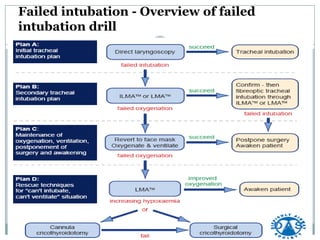
Failed intubation - Overview of failed
intubation drill
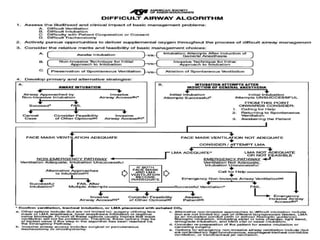
Alogaritma jalan nafas sulit
 Diciptakan oleh American Society of

Anesthesiologists(ASA) pada tahun 1993 dan
diperbaharui pada tahun2003
 Dimulai dengan menentukan apakah
“difficulty airway” bisa dikenali/diketahui
(reconigzed) atau tidak bisa dikenali/diketahui
(unrecognized)
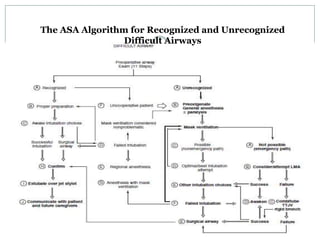
The ASA Algorithm for Recognized and Unrecognized
Difficult Airways
REMEMBER.....
- Pada jalan nafas sulit (ventilasi dan intubasi),

intubasi awake adalah pilihan terbaik
- Pelumpuh otot diberikan apabila sudah pasti tidak
ada kesulitan ventilasi

Intubasi sulit pr dr danu1

  • 1.
  • 2.
    Definition Difficult Airway : the clinical situation in which a conventionally trained anesthesiologist experiences difficulty with facemask ventilation of the upper airway, difficulty with tracheal intubation, or both. American Society of Anesthesiologist : Practice Guidelines for Management of The Difficult Airway, An update report, 2003
  • 3.
    Incidens  the incidenceof difficult tracheal intubation has been estimated at 3-18%.
  • 4.
     Tracheal intubationis best achieved in the classic "sniffing the morning air" position in which the neck is flexed and there is extension at the cranio-cervical (atlanto-axial) junction • the structures of the upper airway in the optimum position for laryngoscopy and permits the best view of the larynx
  • 5.
    Evaluasi Kesulitan Intubasi Kriteria: - Skala LEMON atau MELON - LM MAP - 4D - Wilson Risk Scale - Magboul 4M
  • 6.
    Skala LEMON atauMELON Look externally Evaluate 3-3-2-1 rule Mallampati Obstruction Neck mobility
  • 8.
  • 11.
    Grading the Airway(Cormack-Lehane) Figure 2 – Cormack-Lehane Grade I - Full view of the glottic opening Grade II - Posterior portion of glottic opening visible Grade III - Only tip of epiglottis is visible Grade IV - Only soft palate is visible
  • 12.
    LM-MAP Look for externalface deformities Mallampati Measure 3-3-2-1 fingers Atlanto-occipital extension Pathological obstructive conditions
  • 13.
    4D Dentition(prominent upper incisor,receding chin) Distortion(edema, blood, vomits, tumor, infection) Disproportion(short chin, bull neck, large tongue, small mouth) Dysmobility(TMJ, cervical spine)
  • 14.
    Wilson Risk Score Weight(0=<90kg,1=90-110kg,2=>110kg) Head and neck movement (0=>90 ,1=90 ,2=<90 ) Jaw movement (0=IG>5cm,SL>0, 1=IG<5cm,SL=0, 2=IG<5cm,SL<0) Receding mandible (0=normal, 1=moderate, 2=severe) Buck teeth (0=normal, 1=moderate, 2=severe) Total max 10 points
  • 15.
    Magboul 4 MS Mallampati Measurement Movement Malformationof STOP (Skull,Teeth,Obstruction,Pathology)
  • 17.
    Persiapan Dasar IntubasiSulit - Laringoskop berbagai ukuran - ETT berbagai ukuran - Introducer (stylet, elastic bougie) - Oral dan nasal airway - Set krikotirotomi - Suction - Assistant yang terlatih - LMA berbagai ukuran
  • 19.
    - Preoksigenisasi 100%O2 - Posisi pasien optimal untuk ventilasi dan intubasi - Konfirmasi ETT setelah intubasi dilakukan
  • 20.
    Special techniques forintubation • Awake intubation under local anaesthesia – The aim is to anaesthetise the upper airway using local anaesthetic – This avoids the need for general anaesthesia and muscle relaxants to facilitate intubation – This technique may be performed using either a fibreoptic flexible bronchoscope or other fibrescope or using direct laryngoscopy – Atropine 500 mcg or glycopyrrolate 200 mcg should be given intramuscularly half an hour before intubation to dry the mucous membranes
  • 21.
     Awake tracheostomyperformed under local anaesthesia is the best solution when a patient is an impossible intubation,  sedation with ketamine has been used to facilitate this approach
  • 22.
    Failed intubation -Overview of failed intubation drill
  • 23.
    Alogaritma jalan nafassulit  Diciptakan oleh American Society of Anesthesiologists(ASA) pada tahun 1993 dan diperbaharui pada tahun2003  Dimulai dengan menentukan apakah “difficulty airway” bisa dikenali/diketahui (reconigzed) atau tidak bisa dikenali/diketahui (unrecognized)
  • 24.
    The ASA Algorithmfor Recognized and Unrecognized Difficult Airways
  • 26.
    REMEMBER..... - Pada jalannafas sulit (ventilasi dan intubasi), intubasi awake adalah pilihan terbaik - Pelumpuh otot diberikan apabila sudah pasti tidak ada kesulitan ventilasi