AIRWAY ALGORITHM
&
DIFFICULT AIRWAY
OBJECTIVE
• Intubation in ED
• Indication for intubation
• Difficult airway
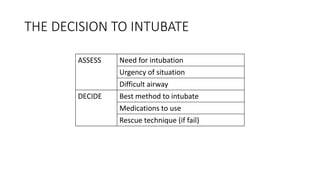
THE DECISION TO INTUBATE
ASSESS Need for intubation
Urgency of situation
Difficult airway
DECIDE Best method to intubate
Medications to use
Rescue technique (if fail)
INDICATION FOR INTUBATION
• Is there a failure of airway maintenance or protection?
• Is there a failure of ventilation or oxygenation?
• What is the anticipated clinical course?
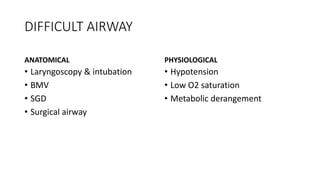
DIFFICULT AIRWAY
ANATOMICAL
• Laryngoscopy & intubation
• BMV
• SGD
• Surgical airway
PHYSIOLOGICAL
• Hypotension
• Low O2 saturation
• Metabolic derangement
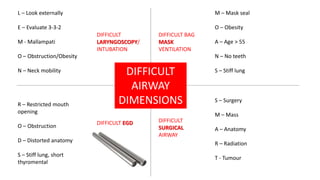
L – Look externally
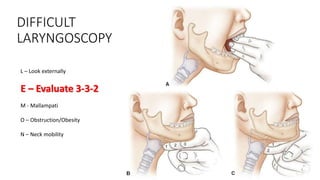
E – Evaluate 3-3-2
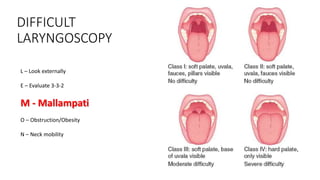
M - Mallampati
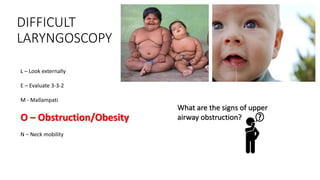
O – Obstruction/Obesity
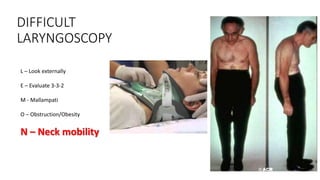
N – Neck mobility
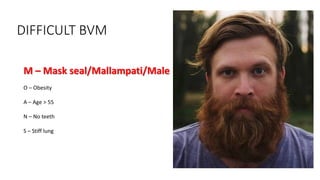
M – Mask seal
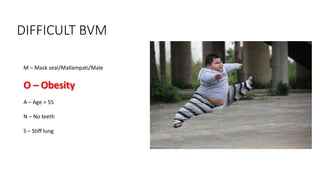
O – Obesity
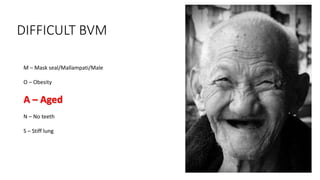
A – Age > 55
N – No teeth
S – Stiff lung
R – Restricted mouth
opening
O – Obstruction
D – Distorted anatomy
S – Stiff lung, short
thyromental
S – Surgery
M – Mass
A – Anatomy
R – Radiation
T - Tumour
DIFFICULT
AIRWAY
DIMENSIONS
DIFFICULT
LARYNGOSCOPY/
INTUBATION
DIFFICULT BAG
MASK
VENTILATION
DIFFICULT EGD DIFFICULT
SURGICAL
AIRWAY
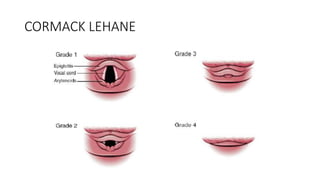
CORMACK LEHANE
DIFFICULT
LARYNGOSCOPY
L – Look externally
E – Evaluate 3-3-2
M - Mallampati
O – Obstruction/Obesity
N – Neck mobility
DIFFICULT
LARYNGOSCOPY
L – Look externally
E – Evaluate 3-3-2
M - Mallampati
O – Obstruction/Obesity
N – Neck mobility
DIFFICULT
LARYNGOSCOPY
L – Look externally
E – Evaluate 3-3-2
M - Mallampati
O – Obstruction/Obesity
N – Neck mobility
DIFFICULT
LARYNGOSCOPY
L – Look externally
E – Evaluate 3-3-2
M - Mallampati
O – Obstruction/Obesity
N – Neck mobility
What are the signs of upper
airway obstruction?
DIFFICULT
LARYNGOSCOPY
L – Look externally
E – Evaluate 3-3-2
M - Mallampati
O – Obstruction/Obesity
N – Neck mobility
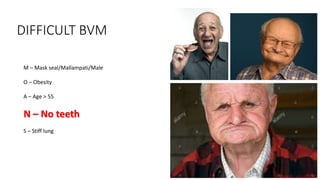
DIFFICULT BVM
M – Mask seal/Mallampati/Male
O – Obesity
A – Age > 55
N – No teeth
S – Stiff lung
DIFFICULT BVM
M – Mask seal/Mallampati/Male
O – Obesity
A – Age > 55
N – No teeth
S – Stiff lung
DIFFICULT BVM
M – Mask seal/Mallampati/Male
O – Obesity
A – Aged
N – No teeth
S – Stiff lung
DIFFICULT BVM
M – Mask seal/Mallampati/Male
O – Obesity
A – Age > 55
N – No teeth
S – Stiff lung
DIFFICULT BVM
M – Mask seal/Mallampati/Male
O – Obesity
A – Age > 55
N – No teeth
S – Stiff lung
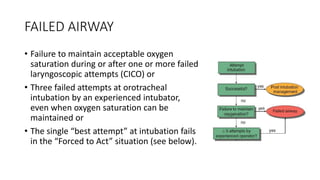
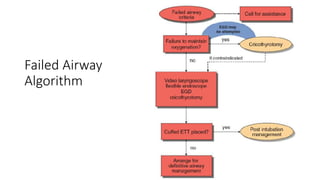
FAILED AIRWAY
• Failure to maintain acceptable oxygen
saturation during or after one or more failed
laryngoscopic attempts (CICO) or
• Three failed attempts at orotracheal
intubation by an experienced intubator,
even when oxygen saturation can be
maintained or
• The single “best attempt” at intubation fails
in the “Forced to Act” situation (see below).
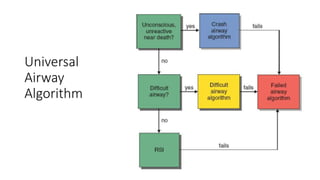
Universal
Airway
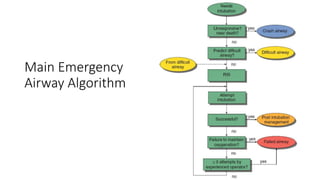
Algorithm
Main Emergency
Airway Algorithm
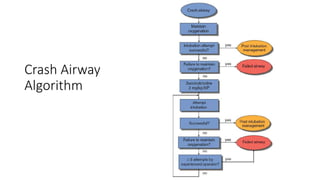
Crash Airway
Algorithm
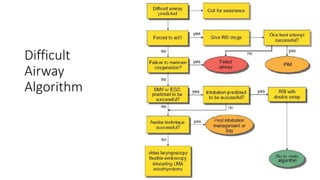
Difficult
Airway
Algorithm
Failed Airway
Algorithm
AIRWAY ALGORITHM.pptx

AIRWAY ALGORITHM.pptx

Editor's Notes

  • #4 The decision to intubate is the first step in emergency airway management, and sets in motion a complex series of actions required of the clinician, before performing the actual intubation:: - Rapidly assess the patient’s need for intubation and the urgency of the situation. Determine the best method of airway management based on assessment of the patient’s predicted difficulty and pathophysiology. Decide which pharmacologic agents are indicated, in what order, and in what doses. Prepare a plan in the event that the primary method is unsuccessful, know in advance how to recognize when the planned airway intervention has failed or will inevitably fail, and clearly lay out the alternative (rescue) technique(s).
  • #5 A. Is there a failure of airway maintenance or protection? Without a patent airway and intact protective reflexes, adequate oxygenation and ventilation may be difficult or impossible and aspiration of gastric contents can occur. Both expose the patient to significant morbidity and mortality. -Difference between maintaining airway (eg use OPA in morphine overdose or PSA cx) and protecting airway (definitive) Don’t use gag reflex to indicate airway protection Anticipated clinical course These are the patients for whom intubation is likely or inevitable because their conditions, and airways, are predicted to deteriorate from dynamic and progressive changes related to the presenting pathophysiology or because the work of breathing will become overwhelming in the face of catastrophic illness or injury. For example, consider the patient who presents with a stab wound to the midzone of the anterior neck and a visible hematoma. At presentation, the patient may have perfectly adequate airway maintenance and protection and be ventilating and oxygenating well. The hematoma, however, provides clear evidence of significant vascular injury. Ongoing bleeding may be clinically occult because the blood often tracks down the tissue planes of the neck (e.g., prevertebral space) rather than demonstrating visible expansion of the hematoma. Furthermore, the anatomical distortion caused by the enlarging internal hematoma may well thwart a variety of airway management techniques that would have been successful if undertaken earlier. The patient inexorably progresses from awake and alert with a patent airway to a state in which the airway becomes obstructed, often quite suddenly, and the anatomy is so distorted that airway management is difficult or impossible. Not every trauma patient or every patient with a serious medical disorder requires intubation. However, in general, it is better to err on the side of performing an intubation that might not, in retrospect, have been required, than to delay intubation, thus exposing the patient to the risk of serious deterioration. Although there is no absolute cutoff for oxygen saturation or CO2 that dictates intubation, a saturation that cannot be sustained above 80%, a RR > 30 or a CO2 > 100 has strong associations with intubation.
  • #9 L—Look externally: Although a gestalt of difficult intubation is not particularly sensitive (meaning that many difficult airways are not readily apparent externally), it is quite specific, meaning that if the airway looks difficult, it probably is. Most of the litany of physical features associated with difficult laryngoscopy and intubation (e.g., small mandible, large tongue, large teeth, and short neck) are accounted for by the remaining elements of LEMON and so do not need to be specifically recalled or sought, which can be a difficult memory challenge in a critical situation. The external look specified here is for the “feeling” that the airway will be difficult. This feeling may be driven by a specific finding, such as external evidence of lower facial disruption and bleeding that might make intubation difficult, or it might be the ill-defined composite impression of the patient, such as the obese, agitated patient with a short neck and small mouth, whose airway appears formidable even before any formal evaluation (the rest of the LEMON attributes) is undertaken. This “gestalt” of the patient is influenced by patient attributes, the setting, and clinician expertise and experience, and likely is as valid for VL as for DL.
  • #12 O—Obstruction/Obesity: Upper airway obstruction is a marker for difficult laryngoscopy. The four cardinal signs of upper airway obstruction are muffled voice (hot potato voice), difficulty swallowing secretions (because of either pain or obstruction), stridor, and a sensation of dyspnea. The first two signs do not ordinarily herald imminent total upper airway obstruction in adults, but critical obstruction is much more imminent when the sensation of dyspnea occurs. Stridor is a particularly ominous sign. The presence of stridor is generally considered to indicate that the airway has been reduced to <50% of its normal caliber, or to a diameter of 4.5 mm or less. The management of patients with upper airway obstruction is discussed in Chapter 36. Although it is controversial whether obesity per se is an independent marker for difficult laryngoscopy or whether obesity simply is associated with various difficult airway attributes, such as high Mallampati score or failure of the 3-3-2 rule, obese patients frequently have poor glottic views by DL or VL, and obesity, in itself, should be considered to portend difficult laryngoscopy. 1.Muffled or “hot potato” voice (as though the patient is speaking with a mouthful of hot food) 2.Inability to swallow secretions, because of either pain or obstruction 3.Stridor 4.Dyspnea The first two signs do not necessarily herald imminent total upper airway obstruction; stridor, if new or progressive, usually does, and dyspnea also is a compelling symptom.
  • #13 Neck mobility: The ability to position the head and neck is one of the key factors in achieving the best possible view of the larynx by DL. Cervical spine immobilization for trauma, by itself, may not create a degree of difficulty that ultimately leads one to avoid RSI after applying the thought processes of the difficult airway algorithm. However, cervical spine immobilization will make intubation more difficult and will compound the effects of other identified difficult airway markers. In addition, intrinsic cervical spine immobility, as in cases of ankylosing spondylitis or rheumatoid arthritis, can make intubation by DL extremely difficult or impossible and should be considered a much more serious issue than the ubiquitous cervical collar (which mandates inline manual immobilization). VL requires much less (or no) head extension, depending on blade shape, and provides a glottic view superior to that by DL when head extension or neck flexion is restricted. Other devices, such as the Airtraq or the Shikani optical stylet, discussed elsewhere in this manual, also may require less cervical spine movement than DL although image size and clarity are far inferior to that obtained with VL.
  • #19 In the “Forced to Act” scenario, airway difficulty is apparent, but the clinical conditions (e.g., combative, hypoxic, rapidly deteriorating patient) force the operator’s hand, requiring administration of RSI drugs in an attempt to create the best possible circumstances for tracheal intubation, with immediate progression to failed airway management if that one best attempt is not successful
  • #24 Call for assistance: specialist, penyelia, equipments, more people