NETWORK SECURITY
Name of the Staff : M.FLORENCE DAYANA M.C.A.,M.Phil.,(Ph.D).,
Head, Dept. of CA
Bon Secours College For Women
Thanjavur.
Class : II MSc., CS
Semester : III
Unit : V
Topic : Intruders
2/15/2019 1
System Security
• systems security refers to the processes and
methodologies involved with keeping
information confidential, available, and assuring
its integrity.
• It also refers to: Access controls, which prevent
unauthorized personnel from entering or
accessing a system.
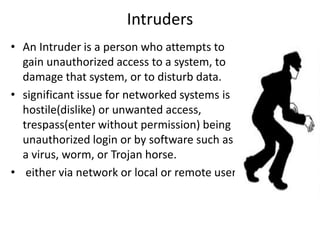
Intruders
• An Intruder is a person who attempts to
gain unauthorized access to a system, to
damage that system, or to disturb data.
• significant issue for networked systems is
hostile(dislike) or unwanted access,
trespass(enter without permission) being
unauthorized login or by software such as
a virus, worm, or Trojan horse.
• either via network or local or remote user
• Types of intruders:
– Masquerader- An individual who is not authorized to
use the computer (outsider)
– Misfeasor- authentic user doing unauthorized
actions. A legitimate user who accesses unauthorized
data, programs, or resources (insider)
– Clandestine(confidential)user- : An individual who
seizes supervisory control of the system and uses this
control to evade auditing and access controls or to
suppress audit collection (either)
Intrusion Techniques
• The basic aim is to gain access and/or
increase privileges on some system.
• basic attack methodology is taken from
– target acquisition and information gathering
– initial access
– privilege escalation (rise)
– covering tracks
• key goal often is to acquire a user (preferably
administrator) password
• so the attacker can login and exercise
all the access rights of the account owner.
Password Guessing
• one of the most common attack is password
guessing
• attacker knows a login (from email/web page etc)
• then attempts to guess password for it
– defaults, short passwords, common word searches
– user info (variations on names, birthday, phone, common
words/interests)
– exhaustively searching all possible passwords
• check by login or against stolen password file
• success depends on password chosen by user
• surveys show many users choose poorly
Password Capture
• another attack involves password capture
– watching over shoulder as password is entered
– using a trojan horse program eg. game program
– monitoring an insecure network login
– extracting recorded info after successful login
(web history/cache, last number dialed etc)
• using valid login/password can impersonate user
• users need to be educated to use suitable
precautions/countermeasures
Intrusion Detection
• Intrusions are the activities that violate the
security policy of system
• Intrusion Detection is the process used to
identify intrusions(ie).,
– block if detected quickly (block access & minimize
damage)
– act as deterrent (can collect info on intruders to
improve future security)
• Intrusion detection is based on the assumption that the
behavior of the intruder differs from that of a legitimate
user in ways that can be quantified
Approaches to Intrusion Detection
• Statistical anomaly detection- collect data relating
to the behavior of legitimate users, then use
statistical tests to determine with a high level of
confidence whether new behavior is legitimate user
behavior or not.
-Threshold(entry)-define thresholds,
independent of user, for the frequency of
occurrence of events.
-Profile based-develop profile of activity of each
user and use to detect changes in the behavior
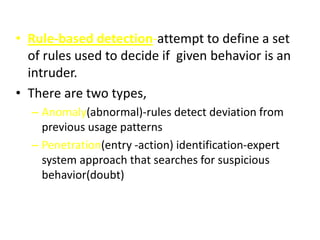
• Rule-based detection-attempt to define a set
of rules used to decide if given behavior is an
intruder.
• There are two types,
– Anomaly(abnormal)-rules detect deviation from
previous usage patterns
– Penetration(entry -action) identification-expert
system approach that searches for suspicious
behavior(doubt)
Audit Records
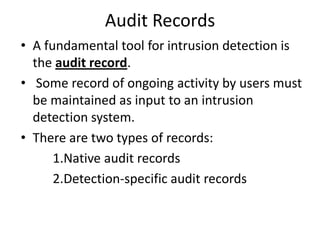
• A fundamental tool for intrusion detection is
the audit record.
• Some record of ongoing activity by users must
be maintained as input to an intrusion
detection system.
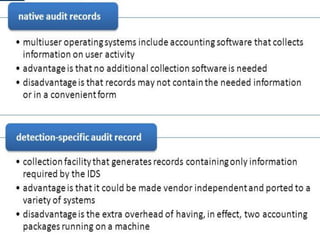
• There are two types of records:
1.Native audit records
2.Detection-specific audit records
Audit Record Analysis
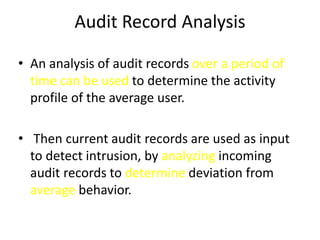
• An analysis of audit records over a period of
time can be used to determine the activity
profile of the average user.
• Then current audit records are used as input
to detect intrusion, by analyzing incoming
audit records to determine deviation from
average behavior.
• Example:
Counter-times of logins, command executed during a
single user session, number of password failures,
Gauge-the number of logical connections assigned to
a user application
Interval timer-the length of time between successive
logins to an account,
Resource Utilization-number of pages printed
during a user session
• Using the examples,
various tests can be performed to determine
whether current activities fit within
acceptable limits.
• • Mean and standard deviation.
• • Multivariate
• • Markov process
• • Time series
• • Operational
Base-Rate Fallacy
• practically an intrusion detection system needs to
detect a substantial percentage of intrusions with
few false alarms
– if few intrusions detected -> the system provides a
false sense of security
– If the system frequently triggers an alert when there is
no intrusion (a false alarm), then either system
managers will begin to ignore the alarms.
Distributed Intrusion Detection
• traditional focus is on single systems
• but typically have networked systems
• more effective defense can be achieved by
coordination and cooperation among
intrusion detection systems across the
network.
Deisgn Issuses
– integrity & confidentiality of networked data
– centralized or decentralized architecture
Distributed Intrusion Detection -
Architecture
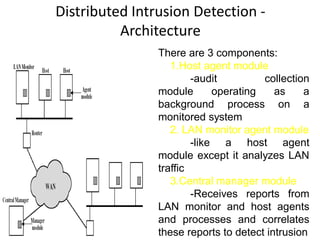
There are 3 components:
1.Host agent module
-audit collection
module operating as a
background process on a
monitored system
2. LAN monitor agent module
-like a host agent
module except it analyzes LAN
traffic
3.Central manager module
-Receives reports from
LAN monitor and host agents
and processes and correlates
these reports to detect intrusion
Distributed Intrusion Detection – Agent Implementation
•The agent captures each native O/S
audit record, & applies a filter that
retains only records of security interest.
•These records are then reformatted
into a standardized format (HAR).
•Then a template-driven logic module
analyzes the records for suspicious
activity. When suspicious activity is
detected, an alert is sent to the central
manager.
•The central manager includes an
expert system that can draw inferences
from received data.
•The manager may also query
individual systems for copies of HARs
to correlate with those from other
agents.
Honeypots
• a honeypot is a computer security mechanism set to
detect, deflect, or, in some manner, counteract
attempts at unauthorized use of information systems.
• Honeypots are decoy systems to lure attackers away
from accessing critical systems
– to collect information about the attacker’s activity
– to encourage attacker to stay on system so administrator can
respond
• These pots are filled with fabricated information
designed to valuable.
• instrumented to collect detailed information on
attackers activities
• single or multiple networked systems
Password Studies
• Password length is only part of the problem, since
many people pick a password that is guessable, such
as their own name, their street name, a common
dictionary word, and so forth. This makes the job of
password cracking straightforward.
• In 1992 - many short passwords (ie) easly searchable
• In 1990 - many guessable passwords
• conclusion is that users choose poor passwords too
often
• A strategy is needed to force users to select
passwords that are difficult to guess.
Password Management
• front-line of defense against intruders is the
password system.
• where a user provides a name/login identifier
(ID) and a password
• Passwords are usually stored in encrypted.
• Unix systems uses multiple DES
– more recent operating systems use cryptographic
hash function
Managing Passwords - Education
• Goal is to eliminate guessable passwords while
allowing user to select a memorable password
• Four basic techniques are in use: education,
computer generation, reactive checking(regular
check up) & proactive checking.(random using
method)
• can use policies and good user education
• educate on importance of good passwords
• give guidelines for good passwords
– minimum length (>6)
– require a mix of upper & lower case letters, numbers,
punctuation
– not dictionary words
• but likely to be ignored by many users
Managing Passwords - Computer Generated
• Computer-generated passwords create a
password for the user, but have problems
• if password is random likely not memorisable,
so will be written down
• even pronounceable not remembered
• In general, computer-generated password
schemes have a history of poor acceptance by
users
Managing Passwords - Reactive Checking(regular Check
up)
• A reactive password checking strategy is one
in which the system periodically runs its own
password cracker to find guessable passwords
• The system cancels any passwords that are
guessed and notifies the user.
• any existing passwords remain vulnerable until
the reactive password checker finds them.
Managing Passwords - Proactive Checking(Random
Check)
• most promising approach to improving
password security is a proactive password
checker.
• User is allowed to select his own password,
but have system verify it is acceptable or
rejects.
– simple rule enforcement
– Compile a large dictionary of “bad” passwords
And check the password is disapproved list.
– use algorithmic (markov model or bloom filter) to
detect poor choices

Intruders

  • 1.
    NETWORK SECURITY Name ofthe Staff : M.FLORENCE DAYANA M.C.A.,M.Phil.,(Ph.D)., Head, Dept. of CA Bon Secours College For Women Thanjavur. Class : II MSc., CS Semester : III Unit : V Topic : Intruders 2/15/2019 1
  • 2.
    System Security • systemssecurity refers to the processes and methodologies involved with keeping information confidential, available, and assuring its integrity. • It also refers to: Access controls, which prevent unauthorized personnel from entering or accessing a system.
  • 3.
    Intruders • An Intruderis a person who attempts to gain unauthorized access to a system, to damage that system, or to disturb data. • significant issue for networked systems is hostile(dislike) or unwanted access, trespass(enter without permission) being unauthorized login or by software such as a virus, worm, or Trojan horse. • either via network or local or remote user
  • 4.
    • Types ofintruders: – Masquerader- An individual who is not authorized to use the computer (outsider) – Misfeasor- authentic user doing unauthorized actions. A legitimate user who accesses unauthorized data, programs, or resources (insider) – Clandestine(confidential)user- : An individual who seizes supervisory control of the system and uses this control to evade auditing and access controls or to suppress audit collection (either)
  • 5.
    Intrusion Techniques • Thebasic aim is to gain access and/or increase privileges on some system. • basic attack methodology is taken from – target acquisition and information gathering – initial access – privilege escalation (rise) – covering tracks • key goal often is to acquire a user (preferably administrator) password • so the attacker can login and exercise all the access rights of the account owner.
  • 6.
    Password Guessing • oneof the most common attack is password guessing • attacker knows a login (from email/web page etc) • then attempts to guess password for it – defaults, short passwords, common word searches – user info (variations on names, birthday, phone, common words/interests) – exhaustively searching all possible passwords • check by login or against stolen password file • success depends on password chosen by user • surveys show many users choose poorly
  • 7.
    Password Capture • anotherattack involves password capture – watching over shoulder as password is entered – using a trojan horse program eg. game program – monitoring an insecure network login – extracting recorded info after successful login (web history/cache, last number dialed etc) • using valid login/password can impersonate user • users need to be educated to use suitable precautions/countermeasures
  • 8.
    Intrusion Detection • Intrusionsare the activities that violate the security policy of system • Intrusion Detection is the process used to identify intrusions(ie)., – block if detected quickly (block access & minimize damage) – act as deterrent (can collect info on intruders to improve future security) • Intrusion detection is based on the assumption that the behavior of the intruder differs from that of a legitimate user in ways that can be quantified
  • 9.
    Approaches to IntrusionDetection • Statistical anomaly detection- collect data relating to the behavior of legitimate users, then use statistical tests to determine with a high level of confidence whether new behavior is legitimate user behavior or not. -Threshold(entry)-define thresholds, independent of user, for the frequency of occurrence of events. -Profile based-develop profile of activity of each user and use to detect changes in the behavior
  • 10.
    • Rule-based detection-attemptto define a set of rules used to decide if given behavior is an intruder. • There are two types, – Anomaly(abnormal)-rules detect deviation from previous usage patterns – Penetration(entry -action) identification-expert system approach that searches for suspicious behavior(doubt)
  • 11.
    Audit Records • Afundamental tool for intrusion detection is the audit record. • Some record of ongoing activity by users must be maintained as input to an intrusion detection system. • There are two types of records: 1.Native audit records 2.Detection-specific audit records
  • 13.
    Audit Record Analysis •An analysis of audit records over a period of time can be used to determine the activity profile of the average user. • Then current audit records are used as input to detect intrusion, by analyzing incoming audit records to determine deviation from average behavior.
  • 14.
    • Example: Counter-times oflogins, command executed during a single user session, number of password failures, Gauge-the number of logical connections assigned to a user application Interval timer-the length of time between successive logins to an account, Resource Utilization-number of pages printed during a user session
  • 15.
    • Using theexamples, various tests can be performed to determine whether current activities fit within acceptable limits. • • Mean and standard deviation. • • Multivariate • • Markov process • • Time series • • Operational
  • 16.
    Base-Rate Fallacy • practicallyan intrusion detection system needs to detect a substantial percentage of intrusions with few false alarms – if few intrusions detected -> the system provides a false sense of security – If the system frequently triggers an alert when there is no intrusion (a false alarm), then either system managers will begin to ignore the alarms.
  • 17.
    Distributed Intrusion Detection •traditional focus is on single systems • but typically have networked systems • more effective defense can be achieved by coordination and cooperation among intrusion detection systems across the network. Deisgn Issuses – integrity & confidentiality of networked data – centralized or decentralized architecture
  • 18.
    Distributed Intrusion Detection- Architecture There are 3 components: 1.Host agent module -audit collection module operating as a background process on a monitored system 2. LAN monitor agent module -like a host agent module except it analyzes LAN traffic 3.Central manager module -Receives reports from LAN monitor and host agents and processes and correlates these reports to detect intrusion
  • 19.
    Distributed Intrusion Detection– Agent Implementation •The agent captures each native O/S audit record, & applies a filter that retains only records of security interest. •These records are then reformatted into a standardized format (HAR). •Then a template-driven logic module analyzes the records for suspicious activity. When suspicious activity is detected, an alert is sent to the central manager. •The central manager includes an expert system that can draw inferences from received data. •The manager may also query individual systems for copies of HARs to correlate with those from other agents.
  • 20.
    Honeypots • a honeypotis a computer security mechanism set to detect, deflect, or, in some manner, counteract attempts at unauthorized use of information systems. • Honeypots are decoy systems to lure attackers away from accessing critical systems – to collect information about the attacker’s activity – to encourage attacker to stay on system so administrator can respond • These pots are filled with fabricated information designed to valuable. • instrumented to collect detailed information on attackers activities • single or multiple networked systems
  • 21.
    Password Studies • Passwordlength is only part of the problem, since many people pick a password that is guessable, such as their own name, their street name, a common dictionary word, and so forth. This makes the job of password cracking straightforward. • In 1992 - many short passwords (ie) easly searchable • In 1990 - many guessable passwords • conclusion is that users choose poor passwords too often • A strategy is needed to force users to select passwords that are difficult to guess.
  • 22.
    Password Management • front-lineof defense against intruders is the password system. • where a user provides a name/login identifier (ID) and a password • Passwords are usually stored in encrypted. • Unix systems uses multiple DES – more recent operating systems use cryptographic hash function
  • 23.
    Managing Passwords -Education • Goal is to eliminate guessable passwords while allowing user to select a memorable password • Four basic techniques are in use: education, computer generation, reactive checking(regular check up) & proactive checking.(random using method) • can use policies and good user education • educate on importance of good passwords • give guidelines for good passwords – minimum length (>6) – require a mix of upper & lower case letters, numbers, punctuation – not dictionary words • but likely to be ignored by many users
  • 24.
    Managing Passwords -Computer Generated • Computer-generated passwords create a password for the user, but have problems • if password is random likely not memorisable, so will be written down • even pronounceable not remembered • In general, computer-generated password schemes have a history of poor acceptance by users
  • 25.
    Managing Passwords -Reactive Checking(regular Check up) • A reactive password checking strategy is one in which the system periodically runs its own password cracker to find guessable passwords • The system cancels any passwords that are guessed and notifies the user. • any existing passwords remain vulnerable until the reactive password checker finds them.
  • 26.
    Managing Passwords -Proactive Checking(Random Check) • most promising approach to improving password security is a proactive password checker. • User is allowed to select his own password, but have system verify it is acceptable or rejects. – simple rule enforcement – Compile a large dictionary of “bad” passwords And check the password is disapproved list. – use algorithmic (markov model or bloom filter) to detect poor choices