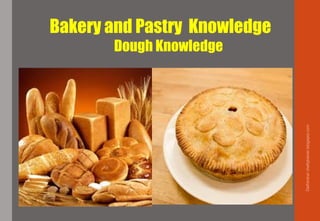
Bakery and Pastry Knowledge
Dough Knowledge
Delhindra/chefqtrainer.blogspot.com
 Identify Bread dough and recipe
 List the 4 major ingredients in baking and their functions
 List the types of bread
 Basic recipes of bread
 Knowing step by step how to make bread
 Knowing bread texture problem
 Knowing types of pastry dough
Learning Objectives
Delhindra/chefqtrainer.blogspot.com
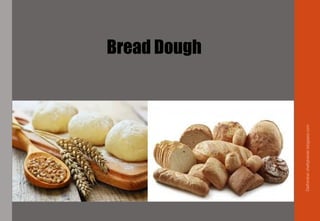
Bread Dough
Delhindra/chefqtrainer.blogspot.com
 Bread is a kind of food made of flour or meal that has been
mixed with milk or water, made into a dough or batter, with
or without yeast or other leavening agent, and baked.
 Dough is typically made by mixing flour with a small
amount of water and/or other liquid, and sometimes
includes yeast or other leavening agents as well as other
ingredients such as various fats or flavorings.
 Gluten (from Latin gluten, "glue") is a mixture of proteins
found in wheat and related grains, including barley, rye oat
 It gives elasticity to dough, helping it rise and keep its
shape and often gives the final product a chewy texture.
Bread Dough
Delhindra/chefqtrainer.blogspot.com
5 major ingredients in baking
Main Ingredients
Softener and flavor
Improver
Filling
Delhindra/chefqtrainer.blogspot.com
 Main Ingredients
 Flour: rye, wheat flour, almond flour, barley flour, oat flour,
corn flour, rice flour, quinoa flour, semolina flour, tapioca
flour, etc.
 Liquid: Water, Milk, butter milk, yoghurt, coconut milk, fruit
juices, vegetable juice, etc.
 Yeast: regular active dry yeast and instant yeast
 Salt: table salt, kosher salt, iodized salt,
Delhindra/chefqtrainer.blogspot.com
 Softener and flavor
 Sugar: white granulated sugar, icing sugar, brown sugar, etc.
 Fat: butter, margarine, shortening, olive oil, clarified butter,
ghee, cocoa butter, etc.
 Egg: chicken egg, duck egg, etc.
 Milk: whole milk, low fat milk, butter milk, etc.
Delhindra/chefqtrainer.blogspot.com
 Improver
 Bread improver
 Baking soda
 Baking powder
Delhindra/chefqtrainer.blogspot.com
 Filling and Topping
 Chocolate
 Cheese
 Fruit
 Meat
 Raisin
 Grated Coconut
 Vegetables
 Seeds
 Nut
 Sugar
 Jam, marmalade, etc.
Delhindra/chefqtrainer.blogspot.com
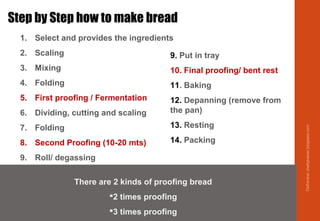
Step by Step how to make bread
1. Select and provides the ingredients
2. Scaling
3. Mixing
4. Folding
5. First proofing / Fermentation
6. Dividing, cutting and scaling
7. Folding
8. Second Proofing (10-20 mts)
9. Roll/ degassing
9. Put in tray
10. Final proofing/ bent rest
11. Baking
12. Depanning (remove from
the pan)
13. Resting
14. Packing
There are 2 kinds of proofing bread
2 times proofing
3 times proofing
Delhindra/chefqtrainer.blogspot.com
French bread/ baguette
Brioche bread
Bagel
Bread stick
Bahn mi (Vietnam bread)
Flatbread
Pizza Bread
Sourdough Bread
Pitta Bread
Challah (Jewish Bread)
Ciabatta (Italian loaf bread)
Croissant
Rye bread
White bread
Chapati Bread
Paratha Bread
Focaccia Bread
Scones
Kinds of Bread
Delhindra/chefqtrainer.blogspot.com
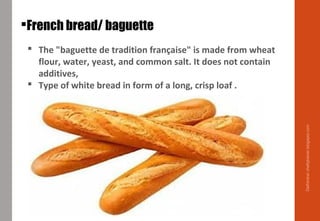
French bread/ baguette
 The "baguette de tradition française" is made from wheat
flour, water, yeast, and common salt. It does not contain
additives,
 Type of white bread in form of a long, crisp loaf .
Delhindra/chefqtrainer.blogspot.com
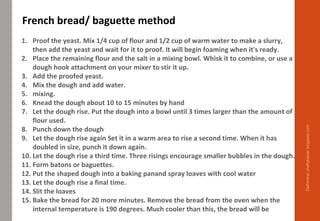
1. Proof the yeast. Mix 1/4 cup of flour and 1/2 cup of warm water to make a slurry,
then add the yeast and wait for it to proof. It will begin foaming when it's ready.
2. Place the remaining flour and the salt in a mixing bowl. Whisk it to combine, or use a
dough hook attachment on your mixer to stir it up.
3. Add the proofed yeast.
4. Mix the dough and add water.
5. mixing.
6. Knead the dough about 10 to 15 minutes by hand
7. Let the dough rise. Put the dough into a bowl until 3 times larger than the amount of
flour used.
8. Punch down the dough
9. Let the dough rise again Set it in a warm area to rise a second time. When it has
doubled in size, punch it down again.
10. Let the dough rise a third time. Three risings encourage smaller bubbles in the dough.
11. Form batons or baguettes.
12. Put the shaped dough into a baking panand spray loaves with cool water
13. Let the dough rise a final time.
14. Slit the loaves
15. Bake the bread for 20 more minutes. Remove the bread from the oven when the
internal temperature is 190 degrees. Much cooler than this, the bread will be
French bread/ baguette method
Delhindra/chefqtrainer.blogspot.com
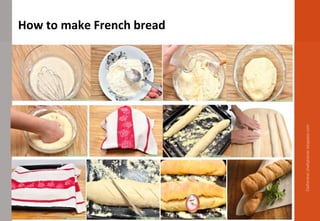
How to make French bread
Delhindra/chefqtrainer.blogspot.com
 Brioche dough
 Brioche dough is the dough used for brioches, kouglof
(koughelhopf) and certain types of bread.
 The name covers rich doughs, made with yeast, which need time
to rise.
 Brioche dough is enriched with butter and eggs and is best
handled cold (the butter keeps it firm), but should then be left in
a warm place to rise.
Delhindra/chefqtrainer.blogspot.com
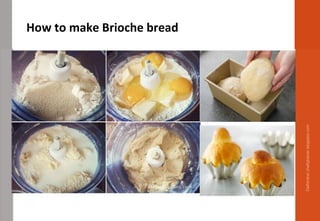
How to make Brioche bread
Delhindra/chefqtrainer.blogspot.com
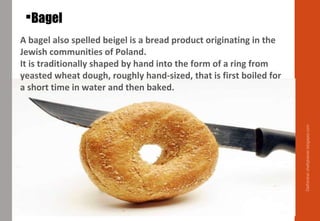
Bagel
A bagel also spelled beigel is a bread product originating in the
Jewish communities of Poland.
It is traditionally shaped by hand into the form of a ring from
yeasted wheat dough, roughly hand-sized, that is first boiled for
a short time in water and then baked.
Delhindra/chefqtrainer.blogspot.com
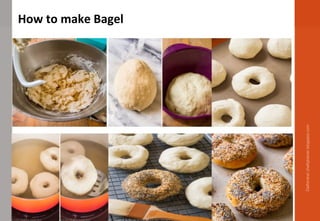
How to make Bagel
Delhindra/chefqtrainer.blogspot.com
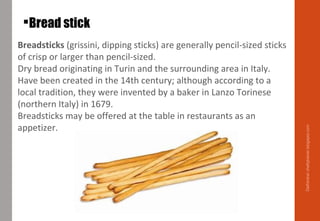
Bread stick
Breadsticks (grissini, dipping sticks) are generally pencil-sized sticks
of crisp or larger than pencil-sized.
Dry bread originating in Turin and the surrounding area in Italy.
Have been created in the 14th century; although according to a
local tradition, they were invented by a baker in Lanzo Torinese
(northern Italy) in 1679.
Breadsticks may be offered at the table in restaurants as an
appetizer.
Delhindra/chefqtrainer.blogspot.com
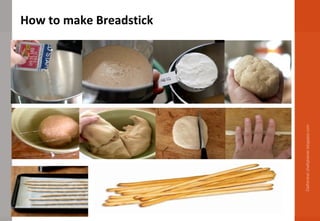
How to make Breadstick
Delhindra/chefqtrainer.blogspot.com
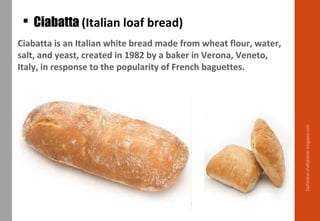
 Ciabatta (Italian loaf bread)
Ciabatta is an Italian white bread made from wheat flour, water,
salt, and yeast, created in 1982 by a baker in Verona, Veneto,
Italy, in response to the popularity of French baguettes.
Delhindra/chefqtrainer.blogspot.com
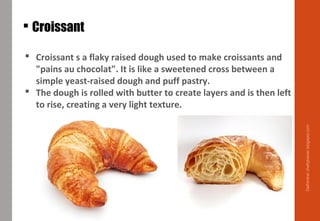
 Croissant
 Croissant s a flaky raised dough used to make croissants and
"pains au chocolat". It is like a sweetened cross between a
simple yeast-raised dough and puff pastry.
 The dough is rolled with butter to create layers and is then left
to rise, creating a very light texture.
Delhindra/chefqtrainer.blogspot.com
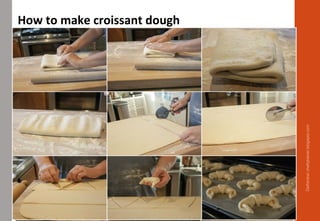
How to make croissant dough
Delhindra/chefqtrainer.blogspot.com
Bánh mì is a Vietnamese term for all kinds of bread. The word
is derived from bánh (bread) and mì (wheat, also spelled mỳ in
northern Vietnam). Bread, or more specifically the baguette,
was introduced by the French during its colonial period.
the Vietnamese baguette is made with rice flour along with
wheat flour.]
Bahn mi (Vietnam bread)
Delhindra/chefqtrainer.blogspot.com
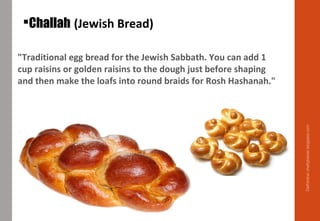
"Traditional egg bread for the Jewish Sabbath. You can add 1
cup raisins or golden raisins to the dough just before shaping
and then make the loafs into round braids for Rosh Hashanah."
Challah (Jewish Bread)
Delhindra/chefqtrainer.blogspot.com
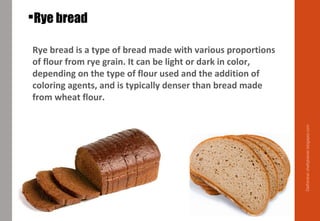
Rye bread
Rye bread is a type of bread made with various proportions
of flour from rye grain. It can be light or dark in color,
depending on the type of flour used and the addition of
coloring agents, and is typically denser than bread made
from wheat flour.
Delhindra/chefqtrainer.blogspot.com
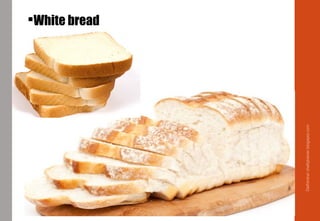
White bread
Delhindra/chefqtrainer.blogspot.com
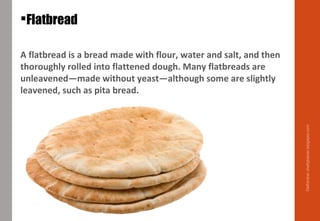
A flatbread is a bread made with flour, water and salt, and then
thoroughly rolled into flattened dough. Many flatbreads are
unleavened—made without yeast—although some are slightly
leavened, such as pita bread.
Flatbread
Delhindra/chefqtrainer.blogspot.com
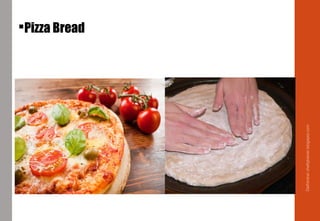
Pizza Bread
Delhindra/chefqtrainer.blogspot.com
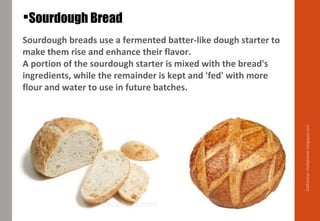
Sourdough breads use a fermented batter-like dough starter to
make them rise and enhance their flavor.
A portion of the sourdough starter is mixed with the bread's
ingredients, while the remainder is kept and 'fed' with more
flour and water to use in future batches.
Sourdough Bread
Delhindra/chefqtrainer.blogspot.com
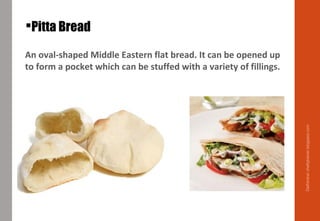
Pitta Bread
An oval-shaped Middle Eastern flat bread. It can be opened up
to form a pocket which can be stuffed with a variety of fillings.
Delhindra/chefqtrainer.blogspot.com
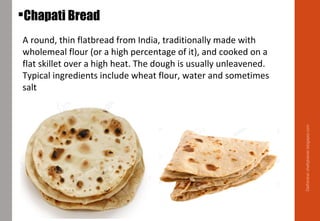
A round, thin flatbread from India, traditionally made with
wholemeal flour (or a high percentage of it), and cooked on a
flat skillet over a high heat. The dough is usually unleavened.
Typical ingredients include wheat flour, water and sometimes
salt
Chapati Bread
Delhindra/chefqtrainer.blogspot.com
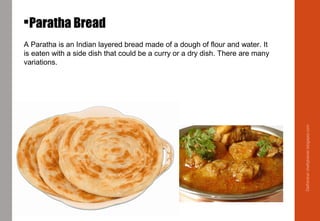
Paratha Bread
A Paratha is an Indian layered bread made of a dough of flour and water. It
is eaten with a side dish that could be a curry or a dry dish. There are many
variations.
Delhindra/chefqtrainer.blogspot.com
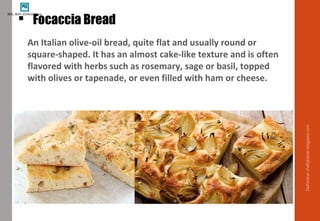
An Italian olive-oil bread, quite flat and usually round or
square-shaped. It has an almost cake-like texture and is often
flavored with herbs such as rosemary, sage or basil, topped
with olives or tapenade, or even filled with ham or cheese.
 Focaccia Bread
IMG_4634-1024x1024.jpg
Delhindra/chefqtrainer.blogspot.com
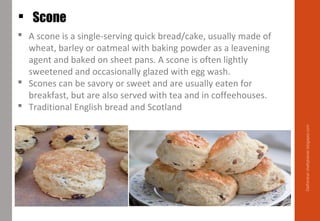
 A scone is a single-serving quick bread/cake, usually made of
wheat, barley or oatmeal with baking powder as a leavening
agent and baked on sheet pans. A scone is often lightly
sweetened and occasionally glazed with egg wash.
 Scones can be savory or sweet and are usually eaten for
breakfast, but are also served with tea and in coffeehouses.
 Traditional English bread and Scotland
 Scone
Delhindra/chefqtrainer.blogspot.com
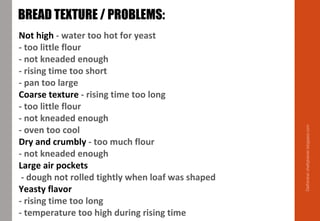
Not high - water too hot for yeast
- too little flour
- not kneaded enough
- rising time too short
- pan too large
Coarse texture - rising time too long
- too little flour
- not kneaded enough
- oven too cool
Dry and crumbly - too much flour
- not kneaded enough
Large air pockets
- dough not rolled tightly when loaf was shaped
Yeasty flavor
- rising time too long
- temperature too high during rising time
BREAD TEXTURE / PROBLEMS:
Delhindra/chefqtrainer.blogspot.com
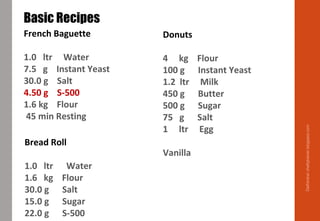
French Baguette
1.0 ltr Water
7.5 g Instant Yeast
30.0 g Salt
4.50 g S-500
1.6 kg Flour
45 min Resting
Basic Recipes
Bread Roll
1.0 ltr Water
1.6 kg Flour
30.0 g Salt
15.0 g Sugar
22.0 g S-500
Donuts
4 kg Flour
100 g Instant Yeast
1.2 ltr Milk
450 g Butter
500 g Sugar
75 g Salt
1 ltr Egg
Vanilla
Delhindra/chefqtrainer.blogspot.com
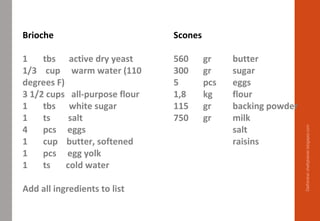
Brioche
1 tbs active dry yeast
1/3 cup warm water (110
degrees F)
3 1/2 cups all-purpose flour
1 tbs white sugar
1 ts salt
4 pcs eggs
1 cup butter, softened
1 pcs egg yolk
1 ts cold water
Add all ingredients to list
Scones
560 gr butter
300 gr sugar
5 pcs eggs
1,8 kg flour
115 gr backing powder
750 gr milk
salt
raisins
Delhindra/chefqtrainer.blogspot.com
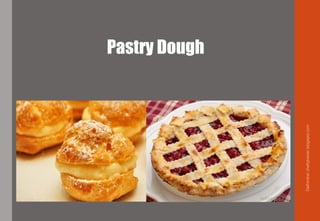
Pastry Dough
Delhindra/chefqtrainer.blogspot.com
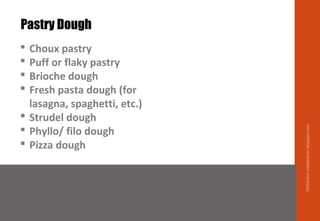
Pastry Dough
 Choux pastry
 Puff or flaky pastry
 Brioche dough
 Fresh pasta dough (for
lasagna, spaghetti, etc.)
 Strudel dough
 Phyllo/ filo dough
 Pizza dough
Delhindra/chefqtrainer.blogspot.com
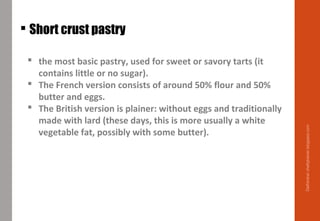
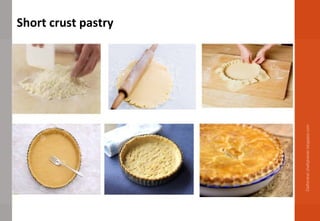
 Short crust pastry
 the most basic pastry, used for sweet or savory tarts (it
contains little or no sugar).
 The French version consists of around 50% flour and 50%
butter and eggs.
 The British version is plainer: without eggs and traditionally
made with lard (these days, this is more usually a white
vegetable fat, possibly with some butter).
Delhindra/chefqtrainer.blogspot.com
 Sift the flour, sugar and salt into a large bowl.
 Add the butter and shortening.
 Rub the fats between your fingertips and thumbs, or use a
pastry blender, until the mixture resembles coarse crumbs.
 One tablespoon at a time, work in enough ice water just until
the dough comes together, being careful not to over mix.
How to make short crust pastry
Delhindra/chefqtrainer.blogspot.com
Short crust pastry
Delhindra/chefqtrainer.blogspot.com
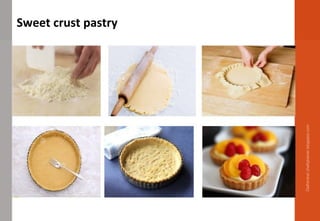
 Sweet crust pastry
 The pastry dough for sweet tarts.
 This is similar to short crust pastry, but with 15% sugar
added, sometimes also (a great improvement!) with 15%
ground almonds.
 It is fragile and crumbly, delicious on its own, so can be
used just as it is to make biscuits.
Delhindra/chefqtrainer.blogspot.com
 Sift the flour, sugar and salt into a large bowl.
 Add the butter and shortening.
 Rub the fats between your fingertips and thumbs, or use a
pastry blender, until the mixture resembles coarse crumbs.
 One tablespoon at a time, work in enough ice water just until
the dough comes together, being careful not to over mix.
How to make sweet crust pastry
Delhindra/chefqtrainer.blogspot.com
Sweet crust pastry
Delhindra/chefqtrainer.blogspot.com
 the famous French dough used for éclairs, Saint-Honoré and
profiteroles.
 It starts as a butter + water + milk + flour mixture, called
“panade” in French, into which eggs are then incorporated.
 During cooking, the water contained in the dough turns to
steam to form bubbles.
 Choux pastry
Delhindra/chefqtrainer.blogspot.com
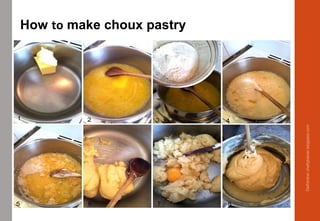
Gently heat milk, butter and water until the butter has melted,
then bring to the boil.
Once boiling, turn off the heat and quickly shoot in flour (and
sugar, if using).
Beat vigorously with a wooden spoon until the mixture is well
combined and comes away from the sides.
Cool to hand temperature and beat in the eggs gradually to a
smooth dough the texture should be a reluctant dropping
consistency.
To make eclairs, fit a piping bag with a 1.5 – 2cm round nozzle.
Wet your finger and press down any peaks.
Pipe 8 - 12 cm lengths onto a greased baking sheet.
Place in a heated oven and bake until golden and firm.
How to make choux pastry
Delhindra/chefqtrainer.blogspot.com
How to make choux pastry
Delhindra/chefqtrainer.blogspot.com
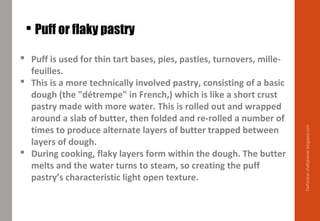
 Puff or flaky pastry
 Puff is used for thin tart bases, pies, pasties, turnovers, mille-
feuilles.
 This is a more technically involved pastry, consisting of a basic
dough (the "détrempe" in French,) which is like a short crust
pastry made with more water. This is rolled out and wrapped
around a slab of butter, then folded and re-rolled a number of
times to produce alternate layers of butter trapped between
layers of dough.
 During cooking, flaky layers form within the dough. The butter
melts and the water turns to steam, so creating the puff
pastry’s characteristic light open texture.
Delhindra/chefqtrainer.blogspot.com
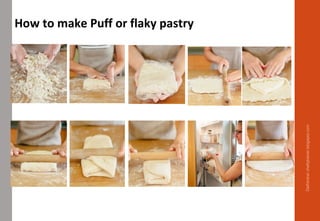
How to make Puff or flaky pastry
Delhindra/chefqtrainer.blogspot.com
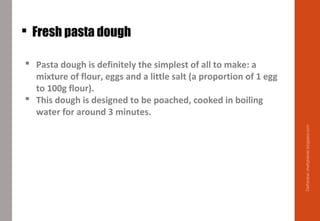
 Fresh pasta dough
 Pasta dough is definitely the simplest of all to make: a
mixture of flour, eggs and a little salt (a proportion of 1 egg
to 100g flour).
 This dough is designed to be poached, cooked in boiling
water for around 3 minutes.
Delhindra/chefqtrainer.blogspot.com
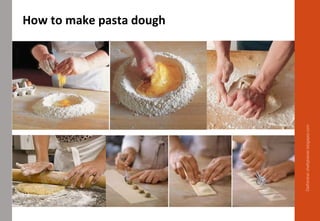
How to make pasta dough
Delhindra/chefqtrainer.blogspot.com
 Phyllo/ filo
 The flaky, flavorful, layered sheets of tissue-thin pastry are
best known for use in traditional Greek and Mediterranean
dishes such as baklava, spanakopita and apple strudel.
 Filo-based pastries are made by layering many sheets of filo
brushed with olive oil; the pastry is then baked.
 But light, elegant fillo adds a sophisticated taste and texture
to almost any dish you can imagine – from appetizers and
snacks to main dishes and desserts.
Delhindra/chefqtrainer.blogspot.com
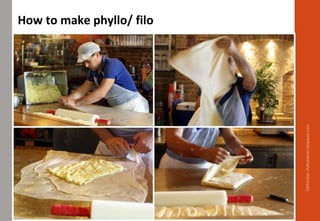
How to make phyllo/ filo
Delhindra/chefqtrainer.blogspot.com
 The strudel is Austrian in origin, and its name comes from
the German word Strudel, meaning "whirlpool" - which the
pastry resembles when cut to reveal its thin sheet of dough
rolled around the filling.
 Strudels can be sweet or savory, but the sweet apple strudel
is the most famous.
 Strudel
Delhindra/chefqtrainer.blogspot.com
 Pizza dough
 Pizza dough is typically a lean, yeast-leavened bread-
type dough that is similar in formulation to French bread
and Middle Eastern flat breads.
 Pizza crusts or shells may be categorised as thin or thick
crust
Delhindra/chefqtrainer.blogspot.com

Bread and Pastry Dough: www.chefqtrainer.blogspot.com

  • 1.
    Bakery and PastryKnowledge Dough Knowledge Delhindra/chefqtrainer.blogspot.com
  • 2.
     Identify Breaddough and recipe  List the 4 major ingredients in baking and their functions  List the types of bread  Basic recipes of bread  Knowing step by step how to make bread  Knowing bread texture problem  Knowing types of pastry dough Learning Objectives Delhindra/chefqtrainer.blogspot.com
  • 3.
  • 4.
     Bread isa kind of food made of flour or meal that has been mixed with milk or water, made into a dough or batter, with or without yeast or other leavening agent, and baked.  Dough is typically made by mixing flour with a small amount of water and/or other liquid, and sometimes includes yeast or other leavening agents as well as other ingredients such as various fats or flavorings.  Gluten (from Latin gluten, "glue") is a mixture of proteins found in wheat and related grains, including barley, rye oat  It gives elasticity to dough, helping it rise and keep its shape and often gives the final product a chewy texture. Bread Dough Delhindra/chefqtrainer.blogspot.com
  • 5.
    5 major ingredientsin baking Main Ingredients Softener and flavor Improver Filling Delhindra/chefqtrainer.blogspot.com
  • 6.
     Main Ingredients Flour: rye, wheat flour, almond flour, barley flour, oat flour, corn flour, rice flour, quinoa flour, semolina flour, tapioca flour, etc.  Liquid: Water, Milk, butter milk, yoghurt, coconut milk, fruit juices, vegetable juice, etc.  Yeast: regular active dry yeast and instant yeast  Salt: table salt, kosher salt, iodized salt, Delhindra/chefqtrainer.blogspot.com
  • 7.
     Softener andflavor  Sugar: white granulated sugar, icing sugar, brown sugar, etc.  Fat: butter, margarine, shortening, olive oil, clarified butter, ghee, cocoa butter, etc.  Egg: chicken egg, duck egg, etc.  Milk: whole milk, low fat milk, butter milk, etc. Delhindra/chefqtrainer.blogspot.com
  • 8.
     Improver  Breadimprover  Baking soda  Baking powder Delhindra/chefqtrainer.blogspot.com
  • 9.
     Filling andTopping  Chocolate  Cheese  Fruit  Meat  Raisin  Grated Coconut  Vegetables  Seeds  Nut  Sugar  Jam, marmalade, etc. Delhindra/chefqtrainer.blogspot.com
  • 10.
    Step by Stephow to make bread 1. Select and provides the ingredients 2. Scaling 3. Mixing 4. Folding 5. First proofing / Fermentation 6. Dividing, cutting and scaling 7. Folding 8. Second Proofing (10-20 mts) 9. Roll/ degassing 9. Put in tray 10. Final proofing/ bent rest 11. Baking 12. Depanning (remove from the pan) 13. Resting 14. Packing There are 2 kinds of proofing bread 2 times proofing 3 times proofing Delhindra/chefqtrainer.blogspot.com
  • 11.
    French bread/ baguette Briochebread Bagel Bread stick Bahn mi (Vietnam bread) Flatbread Pizza Bread Sourdough Bread Pitta Bread Challah (Jewish Bread) Ciabatta (Italian loaf bread) Croissant Rye bread White bread Chapati Bread Paratha Bread Focaccia Bread Scones Kinds of Bread Delhindra/chefqtrainer.blogspot.com
  • 12.
    French bread/ baguette The "baguette de tradition française" is made from wheat flour, water, yeast, and common salt. It does not contain additives,  Type of white bread in form of a long, crisp loaf . Delhindra/chefqtrainer.blogspot.com
  • 13.
    1. Proof theyeast. Mix 1/4 cup of flour and 1/2 cup of warm water to make a slurry, then add the yeast and wait for it to proof. It will begin foaming when it's ready. 2. Place the remaining flour and the salt in a mixing bowl. Whisk it to combine, or use a dough hook attachment on your mixer to stir it up. 3. Add the proofed yeast. 4. Mix the dough and add water. 5. mixing. 6. Knead the dough about 10 to 15 minutes by hand 7. Let the dough rise. Put the dough into a bowl until 3 times larger than the amount of flour used. 8. Punch down the dough 9. Let the dough rise again Set it in a warm area to rise a second time. When it has doubled in size, punch it down again. 10. Let the dough rise a third time. Three risings encourage smaller bubbles in the dough. 11. Form batons or baguettes. 12. Put the shaped dough into a baking panand spray loaves with cool water 13. Let the dough rise a final time. 14. Slit the loaves 15. Bake the bread for 20 more minutes. Remove the bread from the oven when the internal temperature is 190 degrees. Much cooler than this, the bread will be French bread/ baguette method Delhindra/chefqtrainer.blogspot.com
  • 14.
    How to makeFrench bread Delhindra/chefqtrainer.blogspot.com
  • 15.
     Brioche dough Brioche dough is the dough used for brioches, kouglof (koughelhopf) and certain types of bread.  The name covers rich doughs, made with yeast, which need time to rise.  Brioche dough is enriched with butter and eggs and is best handled cold (the butter keeps it firm), but should then be left in a warm place to rise. Delhindra/chefqtrainer.blogspot.com
  • 16.
    How to makeBrioche bread Delhindra/chefqtrainer.blogspot.com
  • 17.
    Bagel A bagel alsospelled beigel is a bread product originating in the Jewish communities of Poland. It is traditionally shaped by hand into the form of a ring from yeasted wheat dough, roughly hand-sized, that is first boiled for a short time in water and then baked. Delhindra/chefqtrainer.blogspot.com
  • 18.
    How to makeBagel Delhindra/chefqtrainer.blogspot.com
  • 19.
    Bread stick Breadsticks (grissini,dipping sticks) are generally pencil-sized sticks of crisp or larger than pencil-sized. Dry bread originating in Turin and the surrounding area in Italy. Have been created in the 14th century; although according to a local tradition, they were invented by a baker in Lanzo Torinese (northern Italy) in 1679. Breadsticks may be offered at the table in restaurants as an appetizer. Delhindra/chefqtrainer.blogspot.com
  • 20.
    How to makeBreadstick Delhindra/chefqtrainer.blogspot.com
  • 21.
     Ciabatta (Italianloaf bread) Ciabatta is an Italian white bread made from wheat flour, water, salt, and yeast, created in 1982 by a baker in Verona, Veneto, Italy, in response to the popularity of French baguettes. Delhindra/chefqtrainer.blogspot.com
  • 22.
     Croissant  Croissants a flaky raised dough used to make croissants and "pains au chocolat". It is like a sweetened cross between a simple yeast-raised dough and puff pastry.  The dough is rolled with butter to create layers and is then left to rise, creating a very light texture. Delhindra/chefqtrainer.blogspot.com
  • 23.
    How to makecroissant dough Delhindra/chefqtrainer.blogspot.com
  • 24.
    Bánh mì isa Vietnamese term for all kinds of bread. The word is derived from bánh (bread) and mì (wheat, also spelled mỳ in northern Vietnam). Bread, or more specifically the baguette, was introduced by the French during its colonial period. the Vietnamese baguette is made with rice flour along with wheat flour.] Bahn mi (Vietnam bread) Delhindra/chefqtrainer.blogspot.com
  • 25.
    "Traditional egg breadfor the Jewish Sabbath. You can add 1 cup raisins or golden raisins to the dough just before shaping and then make the loafs into round braids for Rosh Hashanah." Challah (Jewish Bread) Delhindra/chefqtrainer.blogspot.com
  • 26.
    Rye bread Rye breadis a type of bread made with various proportions of flour from rye grain. It can be light or dark in color, depending on the type of flour used and the addition of coloring agents, and is typically denser than bread made from wheat flour. Delhindra/chefqtrainer.blogspot.com
  • 27.
  • 28.
    A flatbread isa bread made with flour, water and salt, and then thoroughly rolled into flattened dough. Many flatbreads are unleavened—made without yeast—although some are slightly leavened, such as pita bread. Flatbread Delhindra/chefqtrainer.blogspot.com
  • 29.
  • 30.
    Sourdough breads usea fermented batter-like dough starter to make them rise and enhance their flavor. A portion of the sourdough starter is mixed with the bread's ingredients, while the remainder is kept and 'fed' with more flour and water to use in future batches. Sourdough Bread Delhindra/chefqtrainer.blogspot.com
  • 31.
    Pitta Bread An oval-shapedMiddle Eastern flat bread. It can be opened up to form a pocket which can be stuffed with a variety of fillings. Delhindra/chefqtrainer.blogspot.com
  • 32.
    A round, thinflatbread from India, traditionally made with wholemeal flour (or a high percentage of it), and cooked on a flat skillet over a high heat. The dough is usually unleavened. Typical ingredients include wheat flour, water and sometimes salt Chapati Bread Delhindra/chefqtrainer.blogspot.com
  • 33.
    Paratha Bread A Parathais an Indian layered bread made of a dough of flour and water. It is eaten with a side dish that could be a curry or a dry dish. There are many variations. Delhindra/chefqtrainer.blogspot.com
  • 34.
    An Italian olive-oilbread, quite flat and usually round or square-shaped. It has an almost cake-like texture and is often flavored with herbs such as rosemary, sage or basil, topped with olives or tapenade, or even filled with ham or cheese.  Focaccia Bread IMG_4634-1024x1024.jpg Delhindra/chefqtrainer.blogspot.com
  • 35.
     A sconeis a single-serving quick bread/cake, usually made of wheat, barley or oatmeal with baking powder as a leavening agent and baked on sheet pans. A scone is often lightly sweetened and occasionally glazed with egg wash.  Scones can be savory or sweet and are usually eaten for breakfast, but are also served with tea and in coffeehouses.  Traditional English bread and Scotland  Scone Delhindra/chefqtrainer.blogspot.com
  • 36.
    Not high -water too hot for yeast - too little flour - not kneaded enough - rising time too short - pan too large Coarse texture - rising time too long - too little flour - not kneaded enough - oven too cool Dry and crumbly - too much flour - not kneaded enough Large air pockets - dough not rolled tightly when loaf was shaped Yeasty flavor - rising time too long - temperature too high during rising time BREAD TEXTURE / PROBLEMS: Delhindra/chefqtrainer.blogspot.com
  • 37.
    French Baguette 1.0 ltrWater 7.5 g Instant Yeast 30.0 g Salt 4.50 g S-500 1.6 kg Flour 45 min Resting Basic Recipes Bread Roll 1.0 ltr Water 1.6 kg Flour 30.0 g Salt 15.0 g Sugar 22.0 g S-500 Donuts 4 kg Flour 100 g Instant Yeast 1.2 ltr Milk 450 g Butter 500 g Sugar 75 g Salt 1 ltr Egg Vanilla Delhindra/chefqtrainer.blogspot.com
  • 38.
    Brioche 1 tbs activedry yeast 1/3 cup warm water (110 degrees F) 3 1/2 cups all-purpose flour 1 tbs white sugar 1 ts salt 4 pcs eggs 1 cup butter, softened 1 pcs egg yolk 1 ts cold water Add all ingredients to list Scones 560 gr butter 300 gr sugar 5 pcs eggs 1,8 kg flour 115 gr backing powder 750 gr milk salt raisins Delhindra/chefqtrainer.blogspot.com
  • 39.
  • 40.
    Pastry Dough  Chouxpastry  Puff or flaky pastry  Brioche dough  Fresh pasta dough (for lasagna, spaghetti, etc.)  Strudel dough  Phyllo/ filo dough  Pizza dough Delhindra/chefqtrainer.blogspot.com
  • 41.
     Short crustpastry  the most basic pastry, used for sweet or savory tarts (it contains little or no sugar).  The French version consists of around 50% flour and 50% butter and eggs.  The British version is plainer: without eggs and traditionally made with lard (these days, this is more usually a white vegetable fat, possibly with some butter). Delhindra/chefqtrainer.blogspot.com
  • 42.
     Sift theflour, sugar and salt into a large bowl.  Add the butter and shortening.  Rub the fats between your fingertips and thumbs, or use a pastry blender, until the mixture resembles coarse crumbs.  One tablespoon at a time, work in enough ice water just until the dough comes together, being careful not to over mix. How to make short crust pastry Delhindra/chefqtrainer.blogspot.com
  • 43.
  • 44.
     Sweet crustpastry  The pastry dough for sweet tarts.  This is similar to short crust pastry, but with 15% sugar added, sometimes also (a great improvement!) with 15% ground almonds.  It is fragile and crumbly, delicious on its own, so can be used just as it is to make biscuits. Delhindra/chefqtrainer.blogspot.com
  • 45.
     Sift theflour, sugar and salt into a large bowl.  Add the butter and shortening.  Rub the fats between your fingertips and thumbs, or use a pastry blender, until the mixture resembles coarse crumbs.  One tablespoon at a time, work in enough ice water just until the dough comes together, being careful not to over mix. How to make sweet crust pastry Delhindra/chefqtrainer.blogspot.com
  • 46.
  • 47.
     the famousFrench dough used for éclairs, Saint-Honoré and profiteroles.  It starts as a butter + water + milk + flour mixture, called “panade” in French, into which eggs are then incorporated.  During cooking, the water contained in the dough turns to steam to form bubbles.  Choux pastry Delhindra/chefqtrainer.blogspot.com
  • 48.
    Gently heat milk,butter and water until the butter has melted, then bring to the boil. Once boiling, turn off the heat and quickly shoot in flour (and sugar, if using). Beat vigorously with a wooden spoon until the mixture is well combined and comes away from the sides. Cool to hand temperature and beat in the eggs gradually to a smooth dough the texture should be a reluctant dropping consistency. To make eclairs, fit a piping bag with a 1.5 – 2cm round nozzle. Wet your finger and press down any peaks. Pipe 8 - 12 cm lengths onto a greased baking sheet. Place in a heated oven and bake until golden and firm. How to make choux pastry Delhindra/chefqtrainer.blogspot.com
  • 49.
    How to makechoux pastry Delhindra/chefqtrainer.blogspot.com
  • 50.
     Puff orflaky pastry  Puff is used for thin tart bases, pies, pasties, turnovers, mille- feuilles.  This is a more technically involved pastry, consisting of a basic dough (the "détrempe" in French,) which is like a short crust pastry made with more water. This is rolled out and wrapped around a slab of butter, then folded and re-rolled a number of times to produce alternate layers of butter trapped between layers of dough.  During cooking, flaky layers form within the dough. The butter melts and the water turns to steam, so creating the puff pastry’s characteristic light open texture. Delhindra/chefqtrainer.blogspot.com
  • 51.
    How to makePuff or flaky pastry Delhindra/chefqtrainer.blogspot.com
  • 52.
     Fresh pastadough  Pasta dough is definitely the simplest of all to make: a mixture of flour, eggs and a little salt (a proportion of 1 egg to 100g flour).  This dough is designed to be poached, cooked in boiling water for around 3 minutes. Delhindra/chefqtrainer.blogspot.com
  • 53.
    How to makepasta dough Delhindra/chefqtrainer.blogspot.com
  • 54.
     Phyllo/ filo The flaky, flavorful, layered sheets of tissue-thin pastry are best known for use in traditional Greek and Mediterranean dishes such as baklava, spanakopita and apple strudel.  Filo-based pastries are made by layering many sheets of filo brushed with olive oil; the pastry is then baked.  But light, elegant fillo adds a sophisticated taste and texture to almost any dish you can imagine – from appetizers and snacks to main dishes and desserts. Delhindra/chefqtrainer.blogspot.com
  • 55.
    How to makephyllo/ filo Delhindra/chefqtrainer.blogspot.com
  • 56.
     The strudelis Austrian in origin, and its name comes from the German word Strudel, meaning "whirlpool" - which the pastry resembles when cut to reveal its thin sheet of dough rolled around the filling.  Strudels can be sweet or savory, but the sweet apple strudel is the most famous.  Strudel Delhindra/chefqtrainer.blogspot.com
  • 57.
     Pizza dough Pizza dough is typically a lean, yeast-leavened bread- type dough that is similar in formulation to French bread and Middle Eastern flat breads.  Pizza crusts or shells may be categorised as thin or thick crust Delhindra/chefqtrainer.blogspot.com
  • 58.

Editor's Notes

  • #37 Rising = proofing= permentation Kneaded= diremas=uleni=mixing Coarse texture = textur kasar