LYCEUM OF ABULUG
Tuguegarao Archdiocesan School System
Centro, Abulug, Cagayan
CURRICULUM MAP
S.Y. 2022-2023
SUBJECT: SCIENCE
QUARTER: FIRST QUARTER
GRADE LEVEL: GRADE NINE
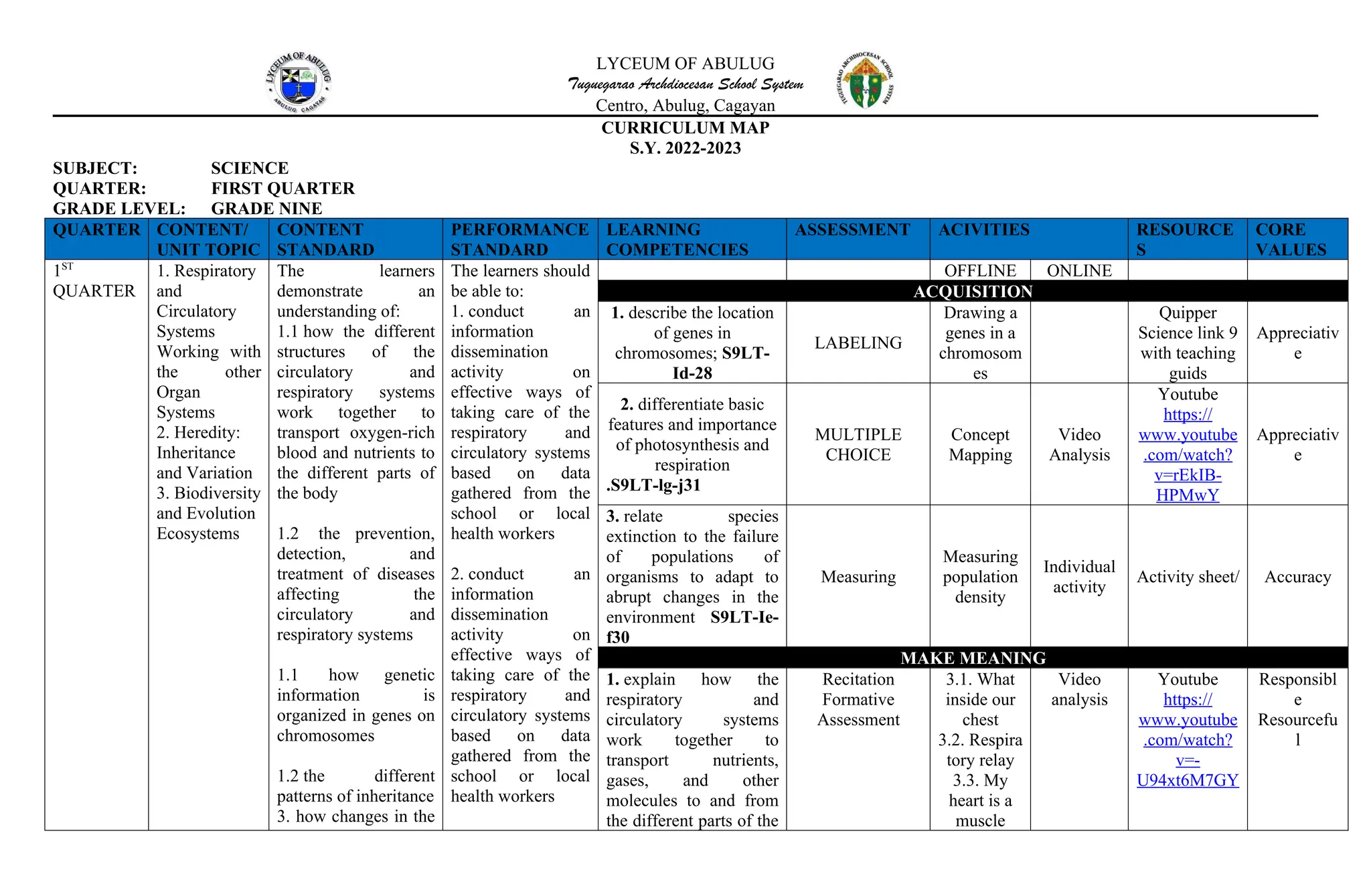
QUARTER CONTENT/
UNIT TOPIC
CONTENT
STANDARD
PERFORMANCE
STANDARD
LEARNING
COMPETENCIES
ASSESSMENT ACIVITIES RESOURCE
S
CORE
VALUES
1ST
QUARTER
1. Respiratory
and
Circulatory
Systems
Working with
the other
Organ
Systems
2. Heredity:
Inheritance
and Variation
3. Biodiversity
and Evolution
Ecosystems
The learners
demonstrate an
understanding of:
1.1 how the different
structures of the
circulatory and
respiratory systems
work together to
transport oxygen-rich
blood and nutrients to
the different parts of
the body
1.2 the prevention,
detection, and
treatment of diseases
affecting the
circulatory and
respiratory systems
1.1 how genetic
information is
organized in genes on
chromosomes
1.2 the different
patterns of inheritance
3. how changes in the
The learners should
be able to:
1. conduct an
information
dissemination
activity on
effective ways of
taking care of the
respiratory and
circulatory systems
based on data
gathered from the
school or local
health workers
2. conduct an
information
dissemination
activity on
effective ways of
taking care of the
respiratory and
circulatory systems
based on data
gathered from the
school or local
health workers
OFFLINE ONLINE
ACQUISITION
1. describe the location
of genes in
chromosomes; S9LT-
Id-28
LABELING
Drawing a
genes in a
chromosom
es
Quipper
Science link 9
with teaching
guids
Appreciativ
e
2. differentiate basic
features and importance
of photosynthesis and
respiration
.S9LT-lg-j31
MULTIPLE
CHOICE
Concept
Mapping
Video
Analysis
Youtube
https://
www.youtube
.com/watch?
v=rEkIB-
HPMwY
Appreciativ
e
3. relate species
extinction to the failure
of populations of
organisms to adapt to
abrupt changes in the
environment S9LT-Ie-
f30
Measuring
Measuring
population
density
Individual
activity
Activity sheet/ Accuracy
MAKE MEANING
1. explain how the
respiratory and
circulatory systems
work together to
transport nutrients,
gases, and other
molecules to and from
the different parts of the
Recitation
Formative
Assessment
3.1. What
inside our
chest
3.2. Respira
tory relay
3.3. My
heart is a
muscle
Video
analysis
Youtube
https://
www.youtube
.com/watch?
v=-
U94xt6M7GY
Responsibl
e
Resourcefu
l
LYCEUM OF ABULUG
Tuguegarao Archdiocesan School System
Centro, Abulug, Cagayan
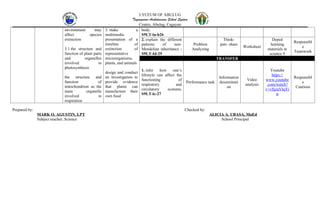
environment may
affect species
extinction
3.1 the structure and
function of plant parts
and organelles
involved in
photosynthesis
the structure and
function of
mitochondrion as the
main organelle
involved in
respiration
3. make a
multimedia
presentation of a
timeline of
extinction of
representative
microorganisms,
plants, and animals
design and conduct
an investigation to
provide evidence
that plants can
manufacture their
own food
body.
S9LT-la-b26
2. explain the different
patterns of non-
Mendelian inheritance ;
S9LT-Id-29
Problem
Analyzing
Think-
pair- share
Worksheet
Deped
learning
materials in
science 9
Responsibl
e
Teamwork
TRANSFER
1. infer how one’s
lifestyle can affect the
functioning of
respiratory and
circulatory systems;
S9LT-lc-27
Performance task
Information
dessiminati
on
Video
analysis
Youtube
https://
www.youtube
.com/watch?
v=vSjzaVIqYi
w
Responsibl
e
Cautious
Prepared by: Checked by:
MARK O. AGUSTIN, LPT ALICIA A. UBASA, MaEd
Subject teacher, Science School Principal
LYCEUM OF ABULUG
Tuguegarao Archdiocesan School System
Centro, Abulug, Cagayan
CURRICULUM MAP
S.Y. 2022-2023
SUBJECT: SCIENCE
QUARTER: SECOND QUARTER
GRADE LEVEL: GRADE NINE
QUARTER
/ MONTH
UNIT
TOPIC:
CONTENT
CONTENT
STANDARD
PERFORMANC
E STANDARD
LEARNING
COMPETENCIE
S
ASSESSMENT ACTIVITY
RESOURCE
S
CORE
VALUES
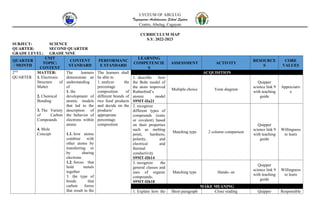
2ND
QUARTER
MATTER:
1. Electronic
Structure of
Matter
2. Chemical
Bonding
3. The Variety
of Carbon
Compounds
4. Mole
Concept
The learners
demonstrate an
understanding
of
1. the
development of
atomic models
that led to the
description of
the behavior of
electrons within
atoms
1.1. how atoms
combine with
other atoms by
transferring or
by sharing
electrons
1.2. forces that
hold metals
together
3. the type of
bonds that
carbon forms
that result in the
The learners shall
be able to
1. analyze the
percentage
composition of
different brands of
two food products
and decide on the
products’
appropriate
percentage
composition
ACQUISITION
1. .describe how
the Bohr model of
the atom improved
Rutherford’s
atomic model
S9MT-IIa21
Multiple choice Venn diagram
Quipper
science link 9
with teaching
guide
Appreciativ
e
2. recognize
different types of
compounds (ionic
or covalent) based
on their properties
such as melting
point, hardness,
polarity, and
electrical and
thermal
conductivity
S9MT-IIb14
Matching type 2 column comparison
Quipper
science link 9
with teaching
guide
Willingness
to learn
3. recognize the
general classes and
uses of organic
compounds;
S9MT-IIh18
Matching type Hands- on
Quipper
science link 9
with teaching
guide
Willingness
to learn
MAKE MEANING
1. Explain how the Short paragraph Close reading Quipper Responsible
LYCEUM OF ABULUG
Tuguegarao Archdiocesan School System
Centro, Abulug, Cagayan
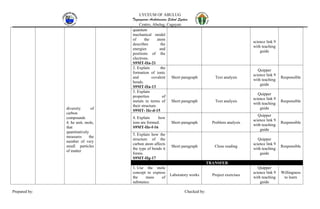
diversity of
carbon
compounds
4. he unit, mole,
that
quantitatively
measures the
number of very
small particles
of matter
quantum
mechanical model
of the atom
describes the
energies and
positions of the
electrons.
S9MT-IIa-21
science link 9
with teaching
guide
2. Explain the
formation of ionic
and covalent
bonds.
S9MT-IIa-13
Short paragraph Text analysis
Quipper
science link 9
with teaching
guide
Responsible
3. Explain
properties of
metals in terms of
their structure.
S9MT- IIc-d-15
Short paragraph Text analysis
Quipper
science link 9
with teaching
guide
Responsible
4. Explain how
ions are formed.
S9MT-IIe-f-16
Short paragraph Problem analysis
Quipper
science link 9
with teaching
guide
Responsible
5. Explain how the
structure of the
carbon atom affects
the type of bonds it
forms.
S9MT-IIg-17
Short paragraph Close reading
Quipper
science link 9
with teaching
guide
Responsible
TRANSFER
1. Use the mole
concept to express
the mass of
substance.
Laboratory works Project exercises
Quipper
science link 9
with teaching
guide
Willingness
to learn
Prepared by: Checked by:
LYCEUM OF ABULUG
Tuguegarao Archdiocesan School System
Centro, Abulug, Cagayan
MARK O. AGUSTIN, LPT ALICIA A. UBASA, MaEd
Subject teacher, Science School Principal

CURRICULUM MAP IN SCIENCE 9 1st quarter.docx

  • 1.
    LYCEUM OF ABULUG TuguegaraoArchdiocesan School System Centro, Abulug, Cagayan CURRICULUM MAP S.Y. 2022-2023 SUBJECT: SCIENCE QUARTER: FIRST QUARTER GRADE LEVEL: GRADE NINE QUARTER CONTENT/ UNIT TOPIC CONTENT STANDARD PERFORMANCE STANDARD LEARNING COMPETENCIES ASSESSMENT ACIVITIES RESOURCE S CORE VALUES 1ST QUARTER 1. Respiratory and Circulatory Systems Working with the other Organ Systems 2. Heredity: Inheritance and Variation 3. Biodiversity and Evolution Ecosystems The learners demonstrate an understanding of: 1.1 how the different structures of the circulatory and respiratory systems work together to transport oxygen-rich blood and nutrients to the different parts of the body 1.2 the prevention, detection, and treatment of diseases affecting the circulatory and respiratory systems 1.1 how genetic information is organized in genes on chromosomes 1.2 the different patterns of inheritance 3. how changes in the The learners should be able to: 1. conduct an information dissemination activity on effective ways of taking care of the respiratory and circulatory systems based on data gathered from the school or local health workers 2. conduct an information dissemination activity on effective ways of taking care of the respiratory and circulatory systems based on data gathered from the school or local health workers OFFLINE ONLINE ACQUISITION 1. describe the location of genes in chromosomes; S9LT- Id-28 LABELING Drawing a genes in a chromosom es Quipper Science link 9 with teaching guids Appreciativ e 2. differentiate basic features and importance of photosynthesis and respiration .S9LT-lg-j31 MULTIPLE CHOICE Concept Mapping Video Analysis Youtube https:// www.youtube .com/watch? v=rEkIB- HPMwY Appreciativ e 3. relate species extinction to the failure of populations of organisms to adapt to abrupt changes in the environment S9LT-Ie- f30 Measuring Measuring population density Individual activity Activity sheet/ Accuracy MAKE MEANING 1. explain how the respiratory and circulatory systems work together to transport nutrients, gases, and other molecules to and from the different parts of the Recitation Formative Assessment 3.1. What inside our chest 3.2. Respira tory relay 3.3. My heart is a muscle Video analysis Youtube https:// www.youtube .com/watch? v=- U94xt6M7GY Responsibl e Resourcefu l
  • 2.
    LYCEUM OF ABULUG TuguegaraoArchdiocesan School System Centro, Abulug, Cagayan environment may affect species extinction 3.1 the structure and function of plant parts and organelles involved in photosynthesis the structure and function of mitochondrion as the main organelle involved in respiration 3. make a multimedia presentation of a timeline of extinction of representative microorganisms, plants, and animals design and conduct an investigation to provide evidence that plants can manufacture their own food body. S9LT-la-b26 2. explain the different patterns of non- Mendelian inheritance ; S9LT-Id-29 Problem Analyzing Think- pair- share Worksheet Deped learning materials in science 9 Responsibl e Teamwork TRANSFER 1. infer how one’s lifestyle can affect the functioning of respiratory and circulatory systems; S9LT-lc-27 Performance task Information dessiminati on Video analysis Youtube https:// www.youtube .com/watch? v=vSjzaVIqYi w Responsibl e Cautious Prepared by: Checked by: MARK O. AGUSTIN, LPT ALICIA A. UBASA, MaEd Subject teacher, Science School Principal
  • 3.
    LYCEUM OF ABULUG TuguegaraoArchdiocesan School System Centro, Abulug, Cagayan CURRICULUM MAP S.Y. 2022-2023 SUBJECT: SCIENCE QUARTER: SECOND QUARTER GRADE LEVEL: GRADE NINE QUARTER / MONTH UNIT TOPIC: CONTENT CONTENT STANDARD PERFORMANC E STANDARD LEARNING COMPETENCIE S ASSESSMENT ACTIVITY RESOURCE S CORE VALUES 2ND QUARTER MATTER: 1. Electronic Structure of Matter 2. Chemical Bonding 3. The Variety of Carbon Compounds 4. Mole Concept The learners demonstrate an understanding of 1. the development of atomic models that led to the description of the behavior of electrons within atoms 1.1. how atoms combine with other atoms by transferring or by sharing electrons 1.2. forces that hold metals together 3. the type of bonds that carbon forms that result in the The learners shall be able to 1. analyze the percentage composition of different brands of two food products and decide on the products’ appropriate percentage composition ACQUISITION 1. .describe how the Bohr model of the atom improved Rutherford’s atomic model S9MT-IIa21 Multiple choice Venn diagram Quipper science link 9 with teaching guide Appreciativ e 2. recognize different types of compounds (ionic or covalent) based on their properties such as melting point, hardness, polarity, and electrical and thermal conductivity S9MT-IIb14 Matching type 2 column comparison Quipper science link 9 with teaching guide Willingness to learn 3. recognize the general classes and uses of organic compounds; S9MT-IIh18 Matching type Hands- on Quipper science link 9 with teaching guide Willingness to learn MAKE MEANING 1. Explain how the Short paragraph Close reading Quipper Responsible
  • 4.
    LYCEUM OF ABULUG TuguegaraoArchdiocesan School System Centro, Abulug, Cagayan diversity of carbon compounds 4. he unit, mole, that quantitatively measures the number of very small particles of matter quantum mechanical model of the atom describes the energies and positions of the electrons. S9MT-IIa-21 science link 9 with teaching guide 2. Explain the formation of ionic and covalent bonds. S9MT-IIa-13 Short paragraph Text analysis Quipper science link 9 with teaching guide Responsible 3. Explain properties of metals in terms of their structure. S9MT- IIc-d-15 Short paragraph Text analysis Quipper science link 9 with teaching guide Responsible 4. Explain how ions are formed. S9MT-IIe-f-16 Short paragraph Problem analysis Quipper science link 9 with teaching guide Responsible 5. Explain how the structure of the carbon atom affects the type of bonds it forms. S9MT-IIg-17 Short paragraph Close reading Quipper science link 9 with teaching guide Responsible TRANSFER 1. Use the mole concept to express the mass of substance. Laboratory works Project exercises Quipper science link 9 with teaching guide Willingness to learn Prepared by: Checked by:
  • 5.
    LYCEUM OF ABULUG TuguegaraoArchdiocesan School System Centro, Abulug, Cagayan MARK O. AGUSTIN, LPT ALICIA A. UBASA, MaEd Subject teacher, Science School Principal