SCIENCE 10
Quarter 2
Week 1
LET’S
DISCOVER
ELECTROMAGNETIC
WAVES
OBJECTIVE/S: Compare the relative
wavelengths of different forms of
electromagnetic waves (S10FE-IIa-b-47);
Subtask:
1.Identify the relationship among
wavelength, frequency and energy of
an electromagnetic wave.
2. Determine the different forms of EM
waves.
3. Cite situations that applies EM
waves.
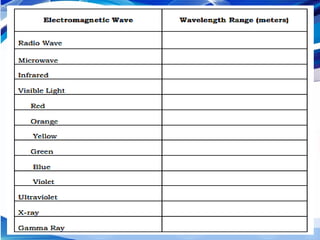
DIFFERENT FORMS
OF
ELECTROMAGNETIC
RADIATION
ELECTROMAGNETIC WAVES
are waves which can travel
through the vacuum of outer
space .
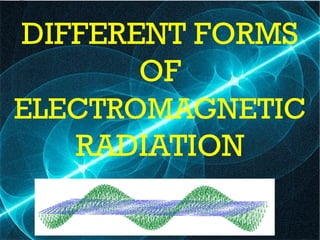
are formed when an electric field
couples with a magnetic field.
The magnetic and electric fields
of an electromagnetic waves are
perpendicular to each other and
to the direction of waves.”
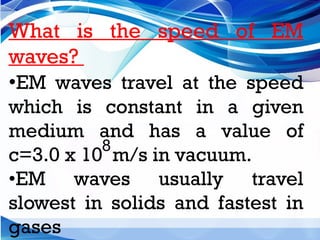
What is the speed of EM
waves?
•EM waves travel at the speed
which is constant in a given
medium and has a value of
c=3.0 x 10 m/s in vacuum.
•EM waves usually travel
slowest in solids and fastest in
gases
8
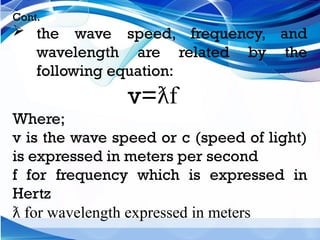
Cont.
 the wave speed, frequency, and
wavelength are related by the
following equation:
v= f
ƛ
Where;
v is the wave speed or c (speed of light)
is expressed in meters per second
f for frequency which is expressed in
Hertz
for wavelength expressed in meters
ƛ
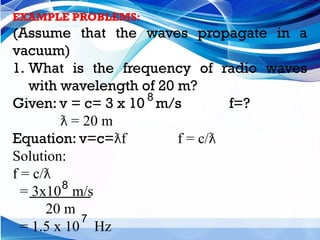
EXAMPLE PROBLEMS:
(Assume that the waves propagate in a
vacuum)
1. What is the frequency of radio waves
with wavelength of 20 m?
Given: v = c= 3 x 10 m/s f=?
= 20 m
ƛ
Equation: v=c= f f = c/
ƛ ƛ
Solution:
f = c/ƛ
= 3x10 m/s
20 m
= 1.5 x 10 Hz
8
8
7
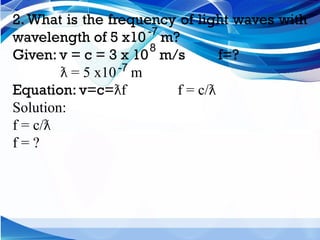
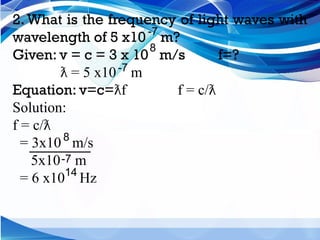
2. What is the frequency of light waves with
wavelength of 5 x10 m?
Given: v = c = 3 x 10 m/s f=?
= 5 x10 m
ƛ
Equation: v=c= f f = c/
ƛ ƛ
Solution:
f = c/ƛ
f = ?
-7
8
-7
2. What is the frequency of light waves with
wavelength of 5 x10 m?
Given: v = c = 3 x 10 m/s f=?
= 5 x10 m
ƛ
Equation: v=c= f f = c/
ƛ ƛ
Solution:
f = c/ƛ
= 3x10 m/s
5x10 m
= 6 x10 Hz
-7
8
8
-7
-7
14
RADIATION
 is an energy that comes
from a source and travels
through space and may be
able to penetrate various
materials
Electromagnetic Radiation
is a radiant energy coming from the sun.
It is one of energies present in the universe.
This energy is produced through nuclear
reactions in the sun’s core which streams
from its surface in waves of different
wavelength. The shortest and the longest
wavelength are invisible to the eye but
medium wavelength is visible radiation we
call sunlight.
All substances give off electromagnetic
radiation in the form of electromagnetic
waves.
PIONEERING SCIENTIST
 James Clerk Maxwell
- formulated the Electromagnetic Wave
Theory which says that an oscillating
electric current should be capable of
radiating energy in the form of
electromagnetic waves.
 Heinrich Hertz
- discovered the Hertzian waves which
is now known as radio waves.
TYPES OF EM WAVES
1. Radio waves
2. Microwaves
3. Infrared waves
4. Visible light
5. Ultraviolet
6. X-rays
7. Gamma rays
ACTIVITY
KEY CONCEPT
Wavelength is the distance
between crest to crest or trough
to trough. EM waves are bounded
at different ranges. Meaning each
type of EM waves has upper and
lower limits on the spectrum.
Directions:
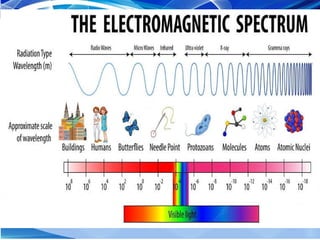
Using the illustration on the next
slide, determine the wavelength
ranges of each of the forms of
electromagnetic waves. On a
separate sheet of paper, copy and
answer the given table. Afterwards
answer the questions that follow.
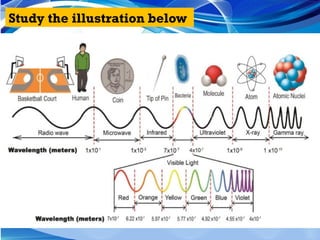
Study the illustration below
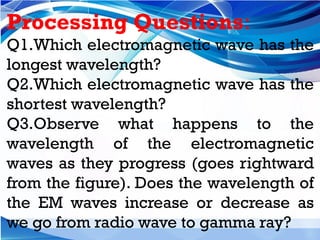
Processing Questions:
Q1.Which electromagnetic wave has the
longest wavelength?
Q2.Which electromagnetic wave has the
shortest wavelength?
Q3.Observe what happens to the
wavelength of the electromagnetic
waves as they progress (goes rightward
from the figure). Does the wavelength of
the EM waves increase or decrease as
we go from radio wave to gamma ray?
The
Electromagnetic
Spectrum
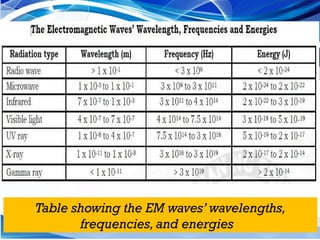
Table showing the EM waves’ wavelengths,
frequencies, and energies
1.Radio waves
- have the longest wavelength
- produced by making electrons
vibrate in an antenna.
- used to transmit sound and
picture information over long
distances.
2.Microwaves
- have smaller wavelengths than
radio waves
- can penetrate the atmosphere of
the Earth
- used in satellite
communication,radar,television
transmission and cooking
3.Infrared waves
- lies beyond the red end of the
visible light.
- it is emitted by all objects.The
amount and wavelength of
radiation depend on temperature.
Below 500 C
ͦ , an object emits only
infrared radiation. Above 500 C, an
ͦ
object glows and emits both infrared
and some visible light.
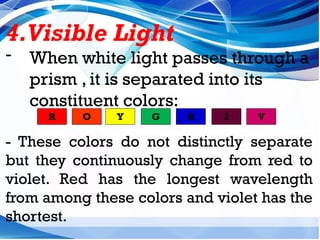
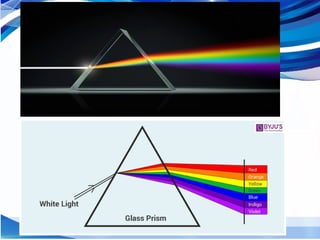
4.Visible Light
- When white light passes through a
prism , it is separated into its
constituent colors:
- These colors do not distinctly separate
but they continuously change from red to
violet. Red has the longest wavelength
from among these colors and violet has the
shortest.
R O Y G B I V
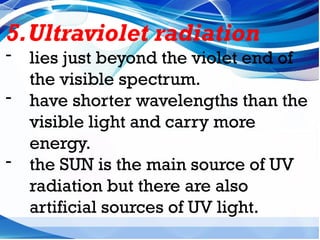
5.Ultraviolet radiation
- lies just beyond the violet end of
the visible spectrum.
- have shorter wavelengths than the
visible light and carry more
energy.
- the SUN is the main source of UV
radiation but there are also
artificial sources of UV light.
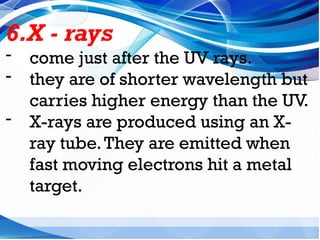
6.X - rays
- come just after the UV rays.
- they are of shorter wavelength but
carries higher energy than the UV.
- X-rays are produced using an X-
ray tube.They are emitted when
fast moving electrons hit a metal
target.
7.Gamma rays
- lie at the other end of the EM
spectrum.
- they are shortest in wavelength
and highest in frequency.
- they carry the highest amount of
energy,thus they are more
dangerous.
- emitted by stars and some
radioactive substances.

forms of electromagnetic waves powerpoint

  • 1.
  • 2.
  • 3.
  • 4.
    OBJECTIVE/S: Compare therelative wavelengths of different forms of electromagnetic waves (S10FE-IIa-b-47); Subtask: 1.Identify the relationship among wavelength, frequency and energy of an electromagnetic wave. 2. Determine the different forms of EM waves. 3. Cite situations that applies EM waves.
  • 5.
  • 6.
    ELECTROMAGNETIC WAVES are waveswhich can travel through the vacuum of outer space . are formed when an electric field couples with a magnetic field. The magnetic and electric fields of an electromagnetic waves are perpendicular to each other and to the direction of waves.”
  • 7.
    What is thespeed of EM waves? •EM waves travel at the speed which is constant in a given medium and has a value of c=3.0 x 10 m/s in vacuum. •EM waves usually travel slowest in solids and fastest in gases 8
  • 8.
    Cont.  the wavespeed, frequency, and wavelength are related by the following equation: v= f ƛ Where; v is the wave speed or c (speed of light) is expressed in meters per second f for frequency which is expressed in Hertz for wavelength expressed in meters ƛ
  • 9.
    EXAMPLE PROBLEMS: (Assume thatthe waves propagate in a vacuum) 1. What is the frequency of radio waves with wavelength of 20 m? Given: v = c= 3 x 10 m/s f=? = 20 m ƛ Equation: v=c= f f = c/ ƛ ƛ Solution: f = c/ƛ = 3x10 m/s 20 m = 1.5 x 10 Hz 8 8 7
  • 10.
    2. What isthe frequency of light waves with wavelength of 5 x10 m? Given: v = c = 3 x 10 m/s f=? = 5 x10 m ƛ Equation: v=c= f f = c/ ƛ ƛ Solution: f = c/ƛ f = ? -7 8 -7
  • 11.
    2. What isthe frequency of light waves with wavelength of 5 x10 m? Given: v = c = 3 x 10 m/s f=? = 5 x10 m ƛ Equation: v=c= f f = c/ ƛ ƛ Solution: f = c/ƛ = 3x10 m/s 5x10 m = 6 x10 Hz -7 8 8 -7 -7 14
  • 12.
    RADIATION  is anenergy that comes from a source and travels through space and may be able to penetrate various materials
  • 13.
    Electromagnetic Radiation is aradiant energy coming from the sun. It is one of energies present in the universe. This energy is produced through nuclear reactions in the sun’s core which streams from its surface in waves of different wavelength. The shortest and the longest wavelength are invisible to the eye but medium wavelength is visible radiation we call sunlight. All substances give off electromagnetic radiation in the form of electromagnetic waves.
  • 14.
    PIONEERING SCIENTIST  JamesClerk Maxwell - formulated the Electromagnetic Wave Theory which says that an oscillating electric current should be capable of radiating energy in the form of electromagnetic waves.  Heinrich Hertz - discovered the Hertzian waves which is now known as radio waves.
  • 15.
    TYPES OF EMWAVES 1. Radio waves 2. Microwaves 3. Infrared waves 4. Visible light 5. Ultraviolet 6. X-rays 7. Gamma rays
  • 16.
  • 17.
    KEY CONCEPT Wavelength isthe distance between crest to crest or trough to trough. EM waves are bounded at different ranges. Meaning each type of EM waves has upper and lower limits on the spectrum.
  • 18.
    Directions: Using the illustrationon the next slide, determine the wavelength ranges of each of the forms of electromagnetic waves. On a separate sheet of paper, copy and answer the given table. Afterwards answer the questions that follow.
  • 19.
  • 21.
    Processing Questions: Q1.Which electromagneticwave has the longest wavelength? Q2.Which electromagnetic wave has the shortest wavelength? Q3.Observe what happens to the wavelength of the electromagnetic waves as they progress (goes rightward from the figure). Does the wavelength of the EM waves increase or decrease as we go from radio wave to gamma ray?
  • 22.
  • 24.
    Table showing theEM waves’ wavelengths, frequencies, and energies
  • 25.
    1.Radio waves - havethe longest wavelength - produced by making electrons vibrate in an antenna. - used to transmit sound and picture information over long distances.
  • 26.
    2.Microwaves - have smallerwavelengths than radio waves - can penetrate the atmosphere of the Earth - used in satellite communication,radar,television transmission and cooking
  • 27.
    3.Infrared waves - liesbeyond the red end of the visible light. - it is emitted by all objects.The amount and wavelength of radiation depend on temperature. Below 500 C ͦ , an object emits only infrared radiation. Above 500 C, an ͦ object glows and emits both infrared and some visible light.
  • 28.
    4.Visible Light - Whenwhite light passes through a prism , it is separated into its constituent colors: - These colors do not distinctly separate but they continuously change from red to violet. Red has the longest wavelength from among these colors and violet has the shortest. R O Y G B I V
  • 30.
    5.Ultraviolet radiation - liesjust beyond the violet end of the visible spectrum. - have shorter wavelengths than the visible light and carry more energy. - the SUN is the main source of UV radiation but there are also artificial sources of UV light.
  • 31.
    6.X - rays -come just after the UV rays. - they are of shorter wavelength but carries higher energy than the UV. - X-rays are produced using an X- ray tube.They are emitted when fast moving electrons hit a metal target.
  • 32.
    7.Gamma rays - lieat the other end of the EM spectrum. - they are shortest in wavelength and highest in frequency. - they carry the highest amount of energy,thus they are more dangerous. - emitted by stars and some radioactive substances.

Editor's Notes

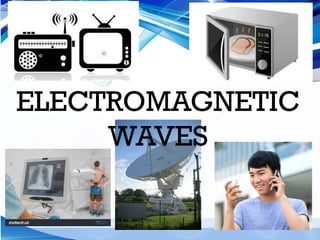
  • #3 If you have ever tuned in to listen to a radio ,a spoken headphone , turned on a light ,hand on X ray taken, felt the warmth of the sun on your skin. …WHEN YOU COOKED USING A MICROWAVE OVEN YOU ACTUALLY USES AN ENERGY…WHAT IS FORM OF ENERGY OR WAVE IS PENETRATED AND TRAVEL FROM ONE SURFACE TO ANOTHER? ANSWER: ELECTROMAGNETIC WAVES…VARIOUS HUMAN ACTIVITIES FROM DAY TO DAY LIVING ACTUALLY UTILIZES EM WAVES…BUT WHAT ARE ELECTROMAGNETIC WAVES?HOW CAN THESE WAVES BECOME USEFUL TO US?
  • #7 C = 3x10 8 m/s and denoted as c (speed of light).
  • #8 C = 3x10 8 m/s and denoted as c (speed of light).
  • #9 C = 3x10 8 m/s and denoted as c (speed of light).
  • #10 C = 3x10 8 m/s and denoted as c (speed of light).
  • #11 C = 3x10 8 m/s and denoted as c (speed of light).
  • #14 There are seven different types of EM waves. In order of increasing frequency, the EM spectrum includes radio waves, microwaves, infrared, visible light, ultraviolet, X-ray, and gamma ray
  • #15 They are arranged in a gradual progression from the waves of lowest frequency to highest frequency. This arrangement of EM waves is called electromagnetic spectrum. Most EM Waves are invisible to the eye but detectable. Only the visible light is seen by humans.
  • #16 Now let’s strengthen your concepts regarding the different EM waves by comparing their relative wavelengths and frequencies. And as you move along, discover some characteristics of EM waves. So if you’re ready to ride the waves, answer the following enrichment activities and dive into the world of EM waves.
  • #22 Let us identify one by one the relationship among wavelength, frequency and energy of the different regions of electromagnetic wave from RADIO WavE to GAMMA RAYS…including the properties of each EM waves ..for you to be aware of its negative impact particularly to human.
  • #27 Our bodies radiate infrared and under infrared camera or a night vision goggle, our images appear in variety of colors. The differences in color determine the differences in temperature. For example, shades of blue and green indicate regions of cooler temperature, and red and yellow for warmer temperature.
  • #28 Our eyes is sensitive to EM waves of wavelenghts that ranges from 4x10 -7 m and to 7 x10 -7 m. This is the range of wavelenghts of white light.Thus, the spectrum of white light is therefore called the visible spectrum.
  • #31 All X-rays are dangerous because they can damage healthy living cells of the body. This is the reason why frequent exposure to X-rays should be avoided.Too much exposure can damage body tissues and can cause cancer.