LESSON PLAN In SCIENCE GRADE 8
(Darwin, Fleming, Hooke, Mendel, Pasteur)
I. OBJECTIVES
Content Standard
The learners demonstrate an understanding of:
the relationship between faults and earthquakes
the formation of typhoons and their movement within the PAR
the characteristics of comets, meteors, and asteroids
Performance
Standard
The learners shall be able to:
make an emergency plan and prepare an emergency kit for use at home and in
school
demonstrate precautionary measures before, during and after a typhoon, including
following advisories, storm signals, and calls for evacuation given by government
agencies in charge discuss whether beliefs and practices about comets, meteors, and
asteroids
Learning Competency
To explain how typhoon develops and how it is affected by landmasses and bodies of
water, specifically you are to:
1. explain how tropical cyclones form;
2. Explain how typhoons develop; 3. Describe the factors that affect a typhoon
(NO MELCs Code)
II.CONTENT UNDERSTANDING TYPHOON
III. LEARNING
RESOURCES
Science links: worktext for scientific and technology literacy.Rex Book Store.
Grade 8 Science Learner’s Material
Grade 8 Science Teacher’s Guide.
Layers of the atmosphere. https://pin.it/C2NPKQt
Stages of Development:from disturbance to hurricane http:ww2010.atmos.uiuc.edu
/(GH)guides/mtr/hurr/stages.rxm
ELICIT
(REVIEW)
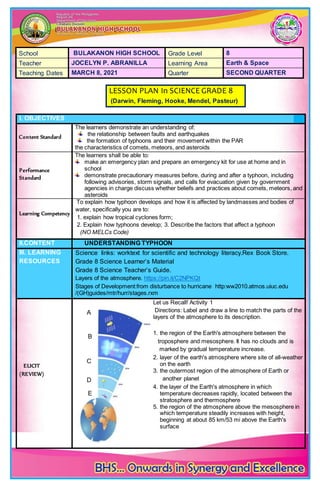
Let us Recall! Activity 1
Directions: Label and draw a line to match the parts of the
layers of the atmosphere to its description.
1. the region of the Earth's atmosphere between the
troposphere and mesosphere. It has no clouds and is
marked by gradual temperature increase.
2. layer of the earth's atmosphere where site of all-weather
on the earth
3. the outermost region of the atmosphere of Earth or
another planet
4. the layer of the Earth's atmosphere in which
temperature decreases rapidly, located between the
stratosphere and thermosphere
5. the region of the atmosphere above the mesosphere in
which temperature steadily increases with height,
beginning at about 85 km/53 mi above the Earth's
surface
School BULAKANON HIGH SCHOOL Grade Level 8
Teacher JOCELYN P. ABRANILLA Learning Area Earth & Space
Teaching Dates MARCH 8, 2021 Quarter SECOND QUARTER
A
B
C
D
E
You have surely learned from your Grade 7
science that the TROPOSPHERE is a part of
the atmosphere where clouds are being
formed. This layer consists of water vapor,
carbon dioxide, methane, nitrous oxide, and
others. These gases block some heat that is
radiated back from the ground. Through the
process of conduction and convection, heat
is being transferred from one place to
another. It is also through convection that a
warm, moist air combines with cold air which
leads to the low-pressure system formation
where tropical cyclones are initiated.
ENGAGE
Show a video presentation on the activity.
Activity 2- What Kind of Air Causes the Formation of Typhoon?
Objective: After showing this activity, you will be able to describe what will happen when cold air and
warm air meet.
Guide Questions
1. Which color will be on top and in bottom?
2. Will the two colors separate or mix?
3. What do you think will happen when the cold air and warm air meet?
EXPLORE
Do the following activity. (Areas with frequent no answer in Module)
Activity 4- Dissecting of a Tropical Cyclone
Activity 5- When tropical cyclone becomes stronger!
Activity 6 Factors Affecting Typhoon
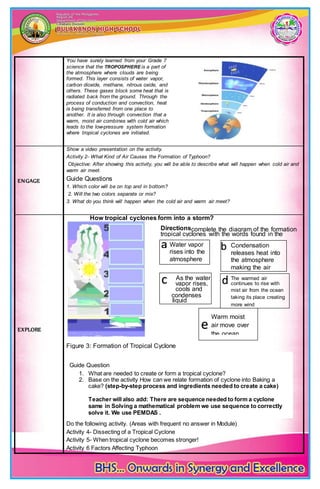
How tropical cyclones form into a storm?
Directions
:
complete the diagram of the formation
of
tropical cyclones with the words found in the
boxes.
The warmed air
continues to rise with
mist air from the ocean
taking its place creating
more wind
Condensation
releases heat into
the atmosphere
making the air
lighter
As the water
vapor rises,
it
cools and
condenses
liquid
droplets.
Water vapor
rises into the
atmosphere
Warm moist
air move over
the ocean
.
Figure 3: Formation of Tropical Cyclone
b
d
c
e
Guide Question
1. What are needed to create or form a tropical cyclone?
2. Base on the activity How can we relate formation of cyclone into Baking a
cake? (step-by-step process and ingredients needed to create a cake)
Teacher will also add: There are sequence needed to form a cyclone
same in Solving a mathematical problem we use sequence to correctly
solve it. We use PEMDAS .
EXPLAIN Presentation of answer through Group Chat
Provides Feed Back on the Activity based on their presentation
Teacher will show correct answers through video
Teachers discuss t0 formalize concept
ELABORATE
Ask Student questions for clarification.
1. What are needed for the cyclone to form?
2. Enumerate the process of cyclone formation.
3. How tropical cyclone turn into cyclone?
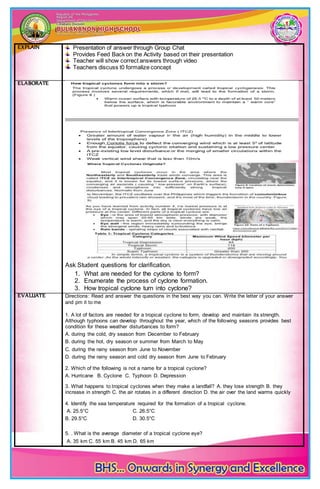
EVALUATE Directions: Read and answer the questions in the best way you can. Write the letter of your answer
and pm it to me
1. A lot of factors are needed for a tropical cyclone to form, develop and maintain its strength.
Although typhoons can develop throughout the year, which of the following seasons provides best
condition for these weather disturbances to form?
A. during the cold, dry season from December to February
B. during the hot, dry season or summer from March to May
C. during the rainy season from June to November
D. during the rainy season and cold dry season from June to February
2. Which of the following is not a name for a tropical cyclone?
A. Hurricane B. Cyclone C. Typhoon D. Depression
3. What happens to tropical cyclones when they make a landfall? A. they lose strength B. they
increase in strength C. the air rotates in a different direction D. the air over the land warms quickly
4. Identify the sea temperature required for the formation of a tropical cyclone.
A. 25.5°C C. 26.5°C
B. 29.5°C D. 30.5°C
5. . What is the average diameter of a tropical cyclone eye?
A. 35 km C. 55 km B. 45 km D. 65 km
Prepared :
JOCELYN P. ABRANILLA
Subject Teacher
Checked and Observed:
MAGNA A. CHAVEZ
Master Teacher 1
MARILYN S. TOQUERO
Master Teacher 1
ELIZABETH P. CANAYA
Head Teacher 1
REBECCA E. MORALES
School Principal
EXTEND
SCIENCE 8

SCIENCE 8

  • 1.
    LESSON PLAN InSCIENCE GRADE 8 (Darwin, Fleming, Hooke, Mendel, Pasteur) I. OBJECTIVES Content Standard The learners demonstrate an understanding of: the relationship between faults and earthquakes the formation of typhoons and their movement within the PAR the characteristics of comets, meteors, and asteroids Performance Standard The learners shall be able to: make an emergency plan and prepare an emergency kit for use at home and in school demonstrate precautionary measures before, during and after a typhoon, including following advisories, storm signals, and calls for evacuation given by government agencies in charge discuss whether beliefs and practices about comets, meteors, and asteroids Learning Competency To explain how typhoon develops and how it is affected by landmasses and bodies of water, specifically you are to: 1. explain how tropical cyclones form; 2. Explain how typhoons develop; 3. Describe the factors that affect a typhoon (NO MELCs Code) II.CONTENT UNDERSTANDING TYPHOON III. LEARNING RESOURCES Science links: worktext for scientific and technology literacy.Rex Book Store. Grade 8 Science Learner’s Material Grade 8 Science Teacher’s Guide. Layers of the atmosphere. https://pin.it/C2NPKQt Stages of Development:from disturbance to hurricane http:ww2010.atmos.uiuc.edu /(GH)guides/mtr/hurr/stages.rxm ELICIT (REVIEW) Let us Recall! Activity 1 Directions: Label and draw a line to match the parts of the layers of the atmosphere to its description. 1. the region of the Earth's atmosphere between the troposphere and mesosphere. It has no clouds and is marked by gradual temperature increase. 2. layer of the earth's atmosphere where site of all-weather on the earth 3. the outermost region of the atmosphere of Earth or another planet 4. the layer of the Earth's atmosphere in which temperature decreases rapidly, located between the stratosphere and thermosphere 5. the region of the atmosphere above the mesosphere in which temperature steadily increases with height, beginning at about 85 km/53 mi above the Earth's surface School BULAKANON HIGH SCHOOL Grade Level 8 Teacher JOCELYN P. ABRANILLA Learning Area Earth & Space Teaching Dates MARCH 8, 2021 Quarter SECOND QUARTER A B C D E
  • 2.
    You have surelylearned from your Grade 7 science that the TROPOSPHERE is a part of the atmosphere where clouds are being formed. This layer consists of water vapor, carbon dioxide, methane, nitrous oxide, and others. These gases block some heat that is radiated back from the ground. Through the process of conduction and convection, heat is being transferred from one place to another. It is also through convection that a warm, moist air combines with cold air which leads to the low-pressure system formation where tropical cyclones are initiated. ENGAGE Show a video presentation on the activity. Activity 2- What Kind of Air Causes the Formation of Typhoon? Objective: After showing this activity, you will be able to describe what will happen when cold air and warm air meet. Guide Questions 1. Which color will be on top and in bottom? 2. Will the two colors separate or mix? 3. What do you think will happen when the cold air and warm air meet? EXPLORE Do the following activity. (Areas with frequent no answer in Module) Activity 4- Dissecting of a Tropical Cyclone Activity 5- When tropical cyclone becomes stronger! Activity 6 Factors Affecting Typhoon How tropical cyclones form into a storm? Directions : complete the diagram of the formation of tropical cyclones with the words found in the boxes. The warmed air continues to rise with mist air from the ocean taking its place creating more wind Condensation releases heat into the atmosphere making the air lighter As the water vapor rises, it cools and condenses liquid droplets. Water vapor rises into the atmosphere Warm moist air move over the ocean . Figure 3: Formation of Tropical Cyclone b d c e Guide Question 1. What are needed to create or form a tropical cyclone? 2. Base on the activity How can we relate formation of cyclone into Baking a cake? (step-by-step process and ingredients needed to create a cake) Teacher will also add: There are sequence needed to form a cyclone same in Solving a mathematical problem we use sequence to correctly solve it. We use PEMDAS .
  • 3.
    EXPLAIN Presentation ofanswer through Group Chat Provides Feed Back on the Activity based on their presentation Teacher will show correct answers through video Teachers discuss t0 formalize concept ELABORATE Ask Student questions for clarification. 1. What are needed for the cyclone to form? 2. Enumerate the process of cyclone formation. 3. How tropical cyclone turn into cyclone? EVALUATE Directions: Read and answer the questions in the best way you can. Write the letter of your answer and pm it to me 1. A lot of factors are needed for a tropical cyclone to form, develop and maintain its strength. Although typhoons can develop throughout the year, which of the following seasons provides best condition for these weather disturbances to form? A. during the cold, dry season from December to February B. during the hot, dry season or summer from March to May C. during the rainy season from June to November D. during the rainy season and cold dry season from June to February 2. Which of the following is not a name for a tropical cyclone? A. Hurricane B. Cyclone C. Typhoon D. Depression 3. What happens to tropical cyclones when they make a landfall? A. they lose strength B. they increase in strength C. the air rotates in a different direction D. the air over the land warms quickly 4. Identify the sea temperature required for the formation of a tropical cyclone. A. 25.5°C C. 26.5°C B. 29.5°C D. 30.5°C 5. . What is the average diameter of a tropical cyclone eye? A. 35 km C. 55 km B. 45 km D. 65 km
  • 4.
    Prepared : JOCELYN P.ABRANILLA Subject Teacher Checked and Observed: MAGNA A. CHAVEZ Master Teacher 1 MARILYN S. TOQUERO Master Teacher 1 ELIZABETH P. CANAYA Head Teacher 1 REBECCA E. MORALES School Principal EXTEND