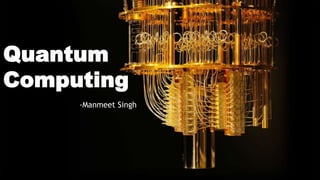
Quantum
Computing
-Manmeet Singh
CONTENTS
1. What is Quantum Computing?
2. Main Processes
3. Qubits
4. Superposition
5. Representation Of Data
6. Entanglement
7. Why is it a Game Changer?
8. Applications
9. Quantum Cryptography
10. Quantum Tunneling
11. Laws Involved in Cryptography
12. Limitations Of Quantum Cryptography
13. References
What is Quantum Computing?
Quantum computing is basically
an idea evolved out of math,
computer science and physics.
Quantum computing is governed
by laws of quantum mechanics
which help us understand the
behavior at microscopic or
subatomic level.
Main concepts involved in
quantum computer:
• Quantum Bits
• Superposition
• Entanglement
• Quantum Tunneling
QUBITS
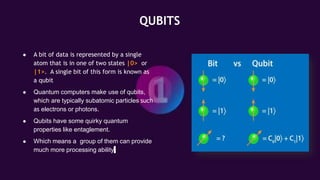
● A bit of data is represented by a single
atom that is in one of two states |0> or
|1>. A single bit of this form is known as
a qubit
● Quantum computers make use of qubits,
which are typically subatomic particles such
as electrons or photons.
● Qubits have some quirky quantum
properties like entaglement.
● Which means a group of them can provide
much more processing ability
Quantum Superposition
● Benefits of quantum superposition
○ Parallelism
○ Not just fast, it provides more
parallel
computational power
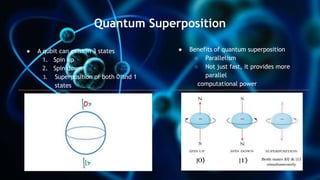
● A qubit can exist in 3 states
1. Spin up
2. Spin down
3. Superposition of both 0 and 1
states
Representation of Data - Superposition
• A single qubit can be forced into a superposition of the two states denoted by the addition of
the state vectors.
• A qubit in superposition is in both of the states |1> and |0 at the same time
• Basically initially when magnetic field is applied the qubit aligns in 0 state in which its
magnetic moment aligns parallel to applied field so as to achieve stable state.
• Using correct frequency photon pulses we can push the qubit to achieve the highest energy
state or unstable equillibrium ie 1 state
• However if we stop emitting pulse in middle it may lead to the fact that qubit exist in the
between both states as a superposition of both states.
Quantum Entanglement
Quantum Entanglement is the
phenomenon that does not allow two
particles to exist side by side
independently or it’s the process by
which altering state of one particle
alters the state of all nearby particles.
This is what makes a system of qubits
interconnected and efficient.
Why is it a Game Changer?
1. Quantum computers increase flexiblity since u have
much more storage hence much more flexible use and
storage of data.
2. Perform multiple task simultaneously,hence faster.
3. Quantum computers reduce power consumption.
4. Can solve unsolvable problems like breaking difficult
encryptions,analyzing huge data sets where u have to
make decisions analyzing large datas.
Quantum Computing works better in the
situations where we have to analyze a huge
set of outcomes and make decisions.
Quantum Tunneling
APPLICATIONS OF QUANTUM COMPUTING
 Present
• Bristlecone, by Google (Boasts of 72 qubits)
• Q System, by IBM (Uses 49 qubits)
• D - Wave 2000Q, Goldman Sachs (a quantum annealing system with 2000
qubits and adv. feature controls)
 Future uses
• Artificial Intelligence (Optimising search through gigantic datasets)
• Cybersecurity (Breaking Encryption)
Quantum Cryptography
• Cryptography is a method of protecting
information and communications through
the use of codes, so that only those for
whom the information is intended can
read and process it.
• In cryptography our text is converted into
cipher text using a private key. This
process is called encryption.
• The cipher text and key is sent to the
other entity and converted to normal
text. This process is called decryption.
The key is usually a string of binary digits.
 QUANTUM CRYPTOGRAPHY IS BASED ON QUANTUM PHYSICS AND
RELIES ON THE DIFFERENT LAWS OF QUANTUM MECHANICS.
The main two rules on which quantum cryptography relies are:
Heisenberg’s Uncertainty
Principle
Polarization
Limitations of Quantum Cryptography
Communication Range
Applicable over small
distances. Increasing it
causes channel loss
High Cost
As of now QKD
requires expensive
equipments.
Research is going on
to miniaturize it.
Requires New System
QKD requires physical
equipments which
makes it difficult to
integrate in current
systems.
REFERENCES
● https://www.explainthatstuff.com/quantum-computing.html
● http://spark.spit.ac.in/index.php/2017/11/22/geekonic-quantum-
computinghttp://www.physics.org/article-questions.asp?id=124
● https://www.quantiki.org/wiki/quantum-gates
● https://www.ibm.com/quantum-computing/what-is-quantum-computing/
2K20_CO_258 QUANTUM COMPUTING ASSIGNMENT.pptx

2K20_CO_258 QUANTUM COMPUTING ASSIGNMENT.pptx

  • 1.
  • 2.
    CONTENTS 1. What isQuantum Computing? 2. Main Processes 3. Qubits 4. Superposition 5. Representation Of Data 6. Entanglement 7. Why is it a Game Changer? 8. Applications 9. Quantum Cryptography 10. Quantum Tunneling 11. Laws Involved in Cryptography 12. Limitations Of Quantum Cryptography 13. References
  • 3.
    What is QuantumComputing? Quantum computing is basically an idea evolved out of math, computer science and physics. Quantum computing is governed by laws of quantum mechanics which help us understand the behavior at microscopic or subatomic level.
  • 4.
    Main concepts involvedin quantum computer: • Quantum Bits • Superposition • Entanglement • Quantum Tunneling
  • 5.
    QUBITS ● A bitof data is represented by a single atom that is in one of two states |0> or |1>. A single bit of this form is known as a qubit ● Quantum computers make use of qubits, which are typically subatomic particles such as electrons or photons. ● Qubits have some quirky quantum properties like entaglement. ● Which means a group of them can provide much more processing ability
  • 6.
    Quantum Superposition ● Benefitsof quantum superposition ○ Parallelism ○ Not just fast, it provides more parallel computational power ● A qubit can exist in 3 states 1. Spin up 2. Spin down 3. Superposition of both 0 and 1 states
  • 7.
    Representation of Data- Superposition • A single qubit can be forced into a superposition of the two states denoted by the addition of the state vectors. • A qubit in superposition is in both of the states |1> and |0 at the same time • Basically initially when magnetic field is applied the qubit aligns in 0 state in which its magnetic moment aligns parallel to applied field so as to achieve stable state. • Using correct frequency photon pulses we can push the qubit to achieve the highest energy state or unstable equillibrium ie 1 state • However if we stop emitting pulse in middle it may lead to the fact that qubit exist in the between both states as a superposition of both states.
  • 8.
    Quantum Entanglement Quantum Entanglementis the phenomenon that does not allow two particles to exist side by side independently or it’s the process by which altering state of one particle alters the state of all nearby particles. This is what makes a system of qubits interconnected and efficient.
  • 9.
    Why is ita Game Changer? 1. Quantum computers increase flexiblity since u have much more storage hence much more flexible use and storage of data. 2. Perform multiple task simultaneously,hence faster. 3. Quantum computers reduce power consumption. 4. Can solve unsolvable problems like breaking difficult encryptions,analyzing huge data sets where u have to make decisions analyzing large datas. Quantum Computing works better in the situations where we have to analyze a huge set of outcomes and make decisions.
  • 10.
  • 11.
    APPLICATIONS OF QUANTUMCOMPUTING  Present • Bristlecone, by Google (Boasts of 72 qubits) • Q System, by IBM (Uses 49 qubits) • D - Wave 2000Q, Goldman Sachs (a quantum annealing system with 2000 qubits and adv. feature controls)  Future uses • Artificial Intelligence (Optimising search through gigantic datasets) • Cybersecurity (Breaking Encryption)
  • 12.
    Quantum Cryptography • Cryptographyis a method of protecting information and communications through the use of codes, so that only those for whom the information is intended can read and process it. • In cryptography our text is converted into cipher text using a private key. This process is called encryption. • The cipher text and key is sent to the other entity and converted to normal text. This process is called decryption. The key is usually a string of binary digits.
  • 13.
     QUANTUM CRYPTOGRAPHYIS BASED ON QUANTUM PHYSICS AND RELIES ON THE DIFFERENT LAWS OF QUANTUM MECHANICS. The main two rules on which quantum cryptography relies are: Heisenberg’s Uncertainty Principle Polarization
  • 14.
    Limitations of QuantumCryptography Communication Range Applicable over small distances. Increasing it causes channel loss High Cost As of now QKD requires expensive equipments. Research is going on to miniaturize it. Requires New System QKD requires physical equipments which makes it difficult to integrate in current systems.
  • 15.