1 – INTRODUCTION OPERATIONS MANAGEMENT
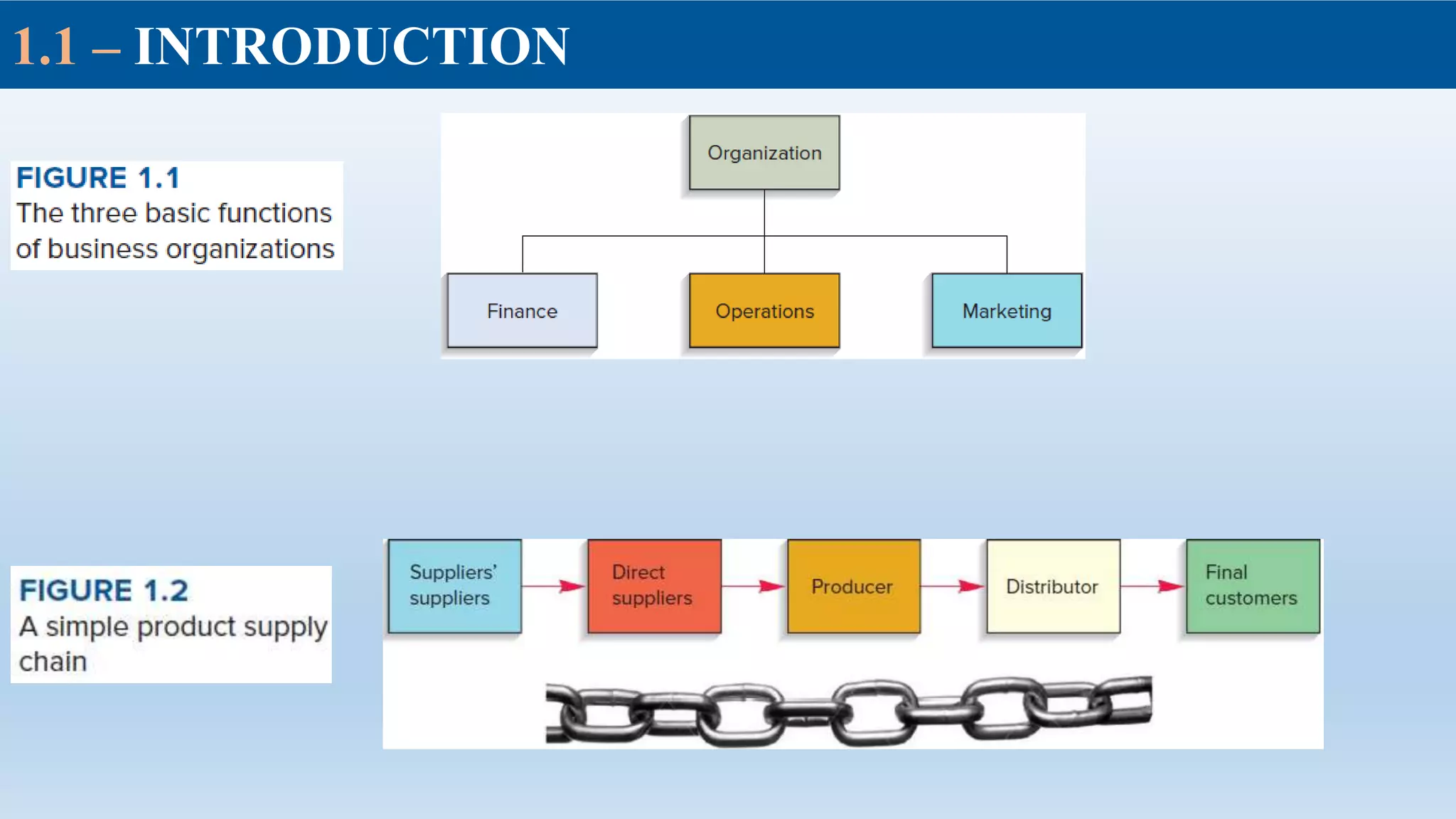
1.1 – INTRODUCTION
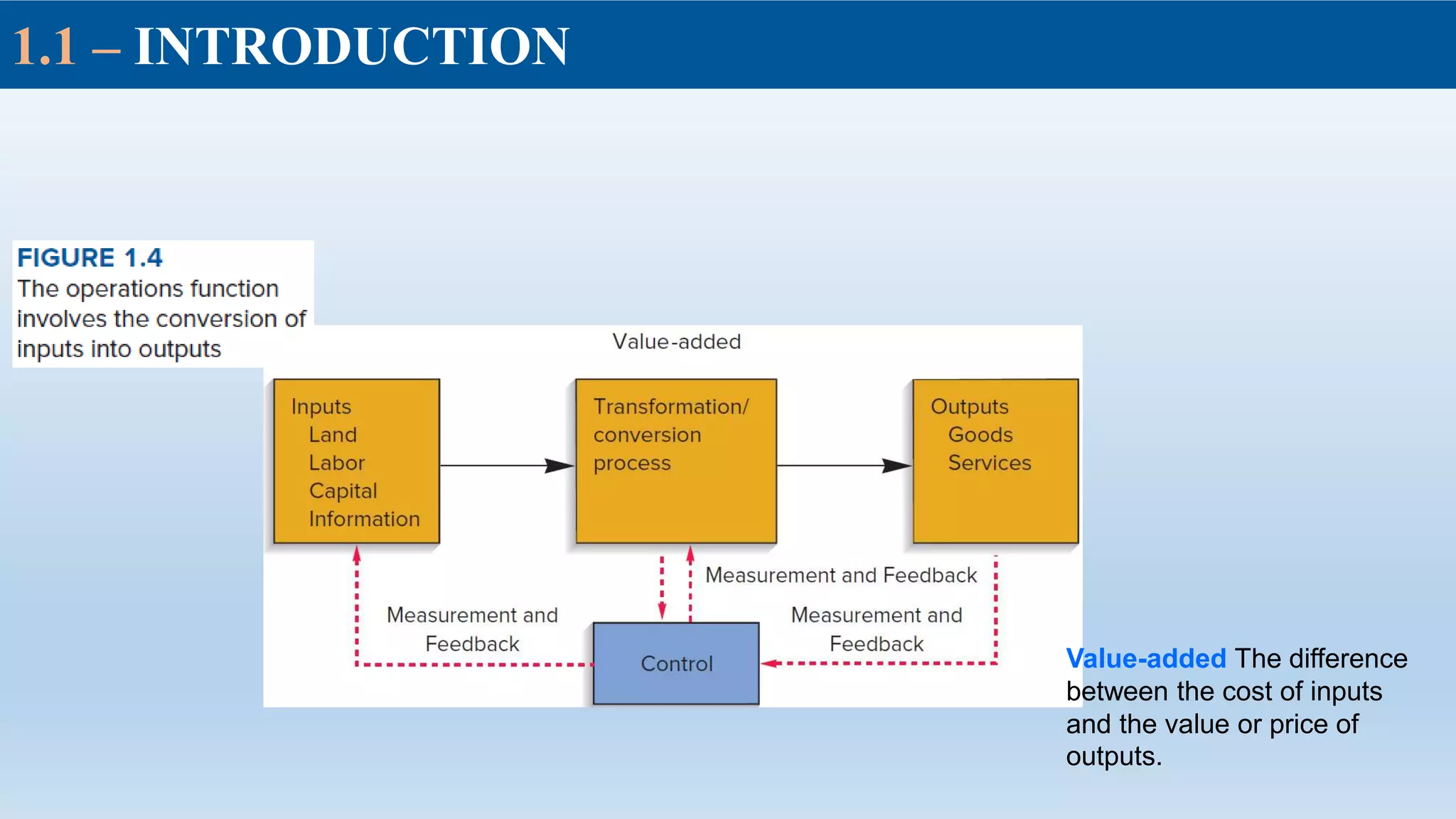
Value-added The difference
between the cost of inputs
and the value or price of
outputs.
1.1 – INTRODUCTION
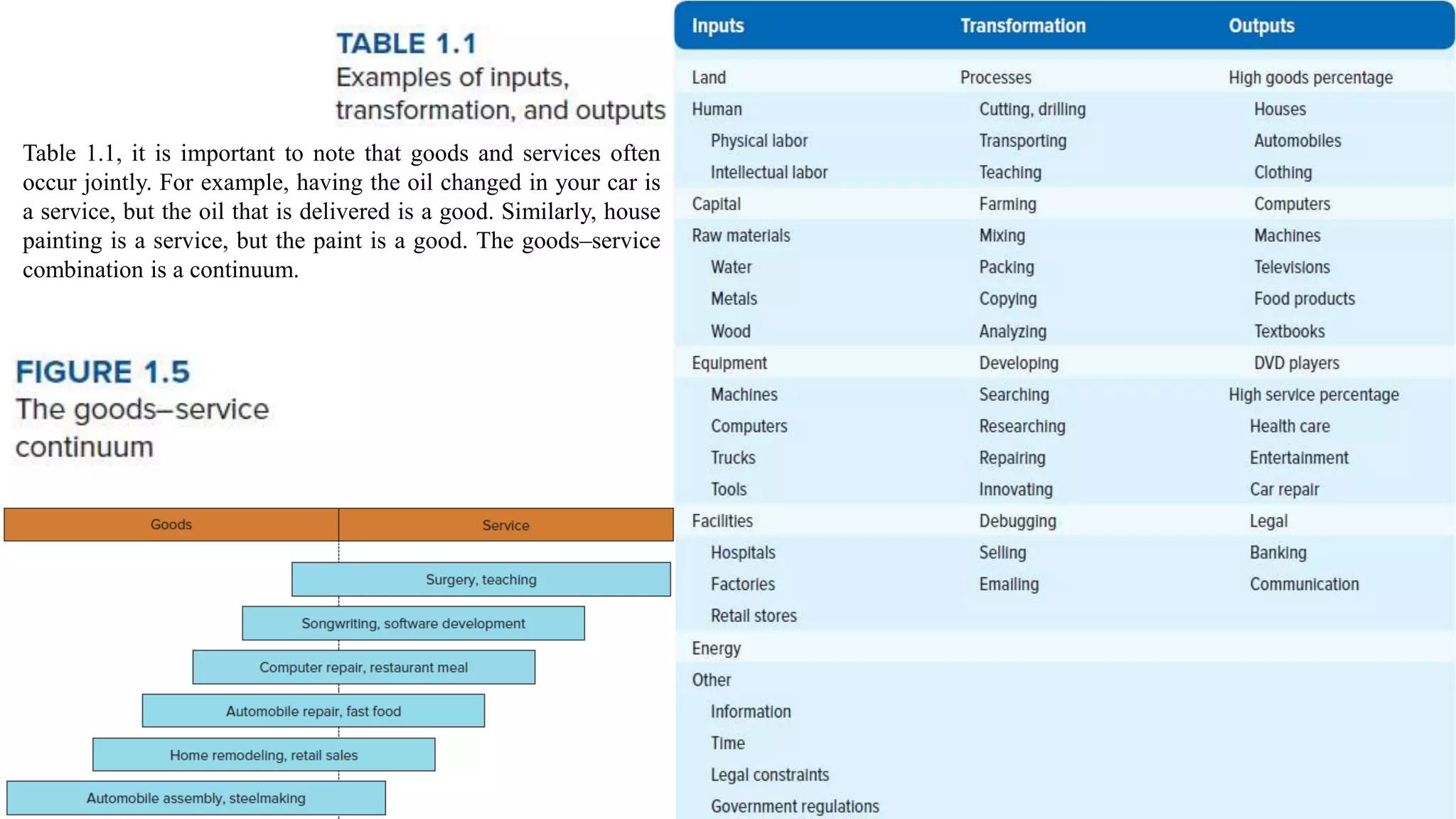
Table 1.1, it is important to note that goods and services often
occur jointly. For example, having the oil changed in your car is
a service, but the oil that is delivered is a good. Similarly, house
painting is a service, but the paint is a good. The goods–service
combination is a continuum.
1.2 – PRODUCTION OF GOODS VERSUS PROVIDINGSERVICES
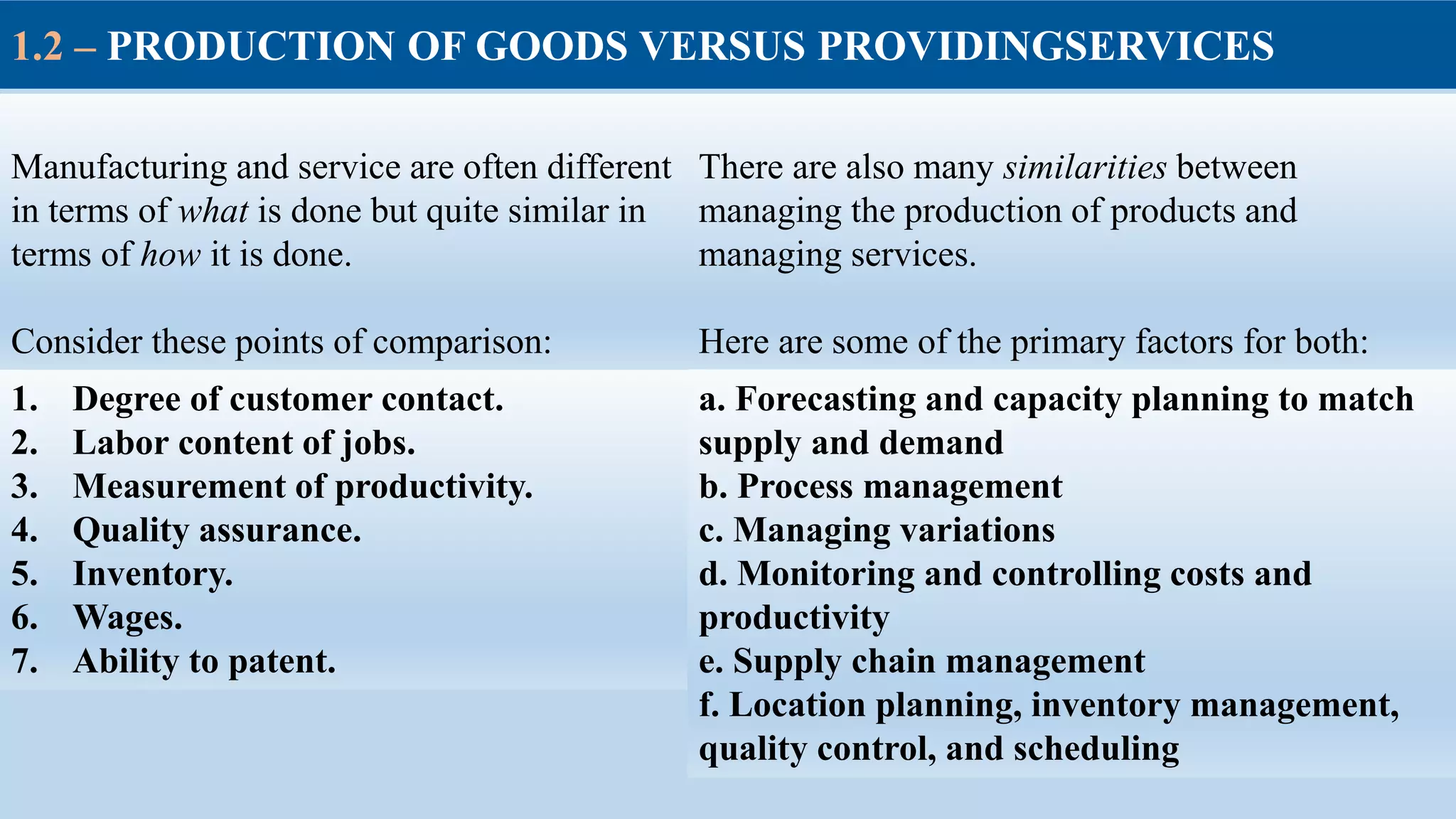
1. Degree of customer contact.
2. Labor content of jobs.
3. Measurement of productivity.
4. Quality assurance.
5. Inventory.
6. Wages.
7. Ability to patent.
Manufacturing and service are often different
in terms of what is done but quite similar in
terms of how it is done.
Consider these points of comparison:
There are also many similarities between
managing the production of products and
managing services.
Here are some of the primary factors for both:
a. Forecasting and capacity planning to match
supply and demand
b. Process management
c. Managing variations
d. Monitoring and controlling costs and
productivity
e. Supply chain management
f. Location planning, inventory management,
quality control, and scheduling
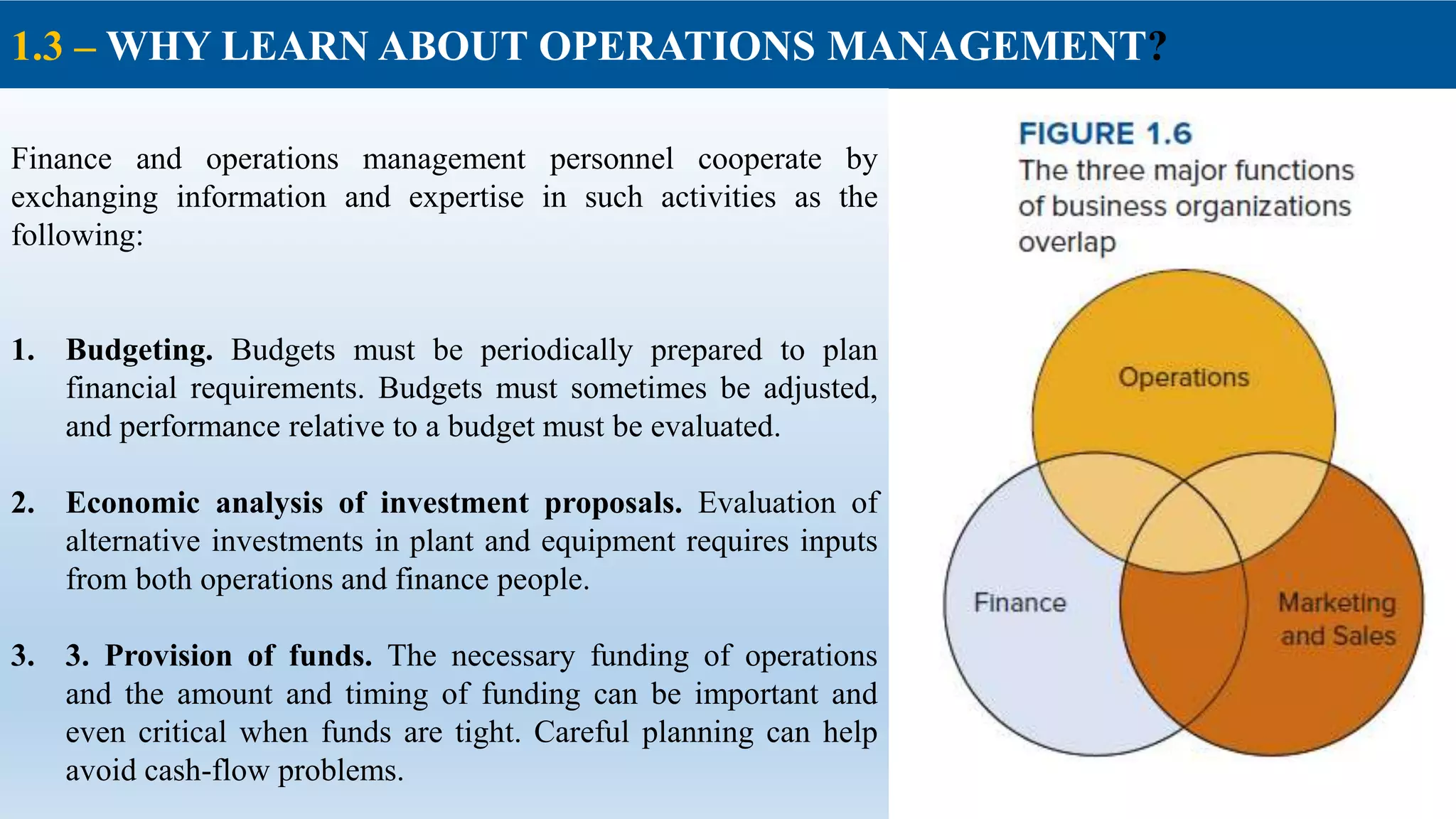
1.3 – WHY LEARN ABOUT OPERATIONS MANAGEMENT?
Finance and operations management personnel cooperate by
exchanging information and expertise in such activities as the
following:
1. Budgeting. Budgets must be periodically prepared to plan
financial requirements. Budgets must sometimes be adjusted,
and performance relative to a budget must be evaluated.
2. Economic analysis of investment proposals. Evaluation of
alternative investments in plant and equipment requires inputs
from both operations and finance people.
3. 3. Provision of funds. The necessary funding of operations
and the amount and timing of funding can be important and
even critical when funds are tight. Careful planning can help
avoid cash-flow problems.
1.3 – WHY LEARN ABOUT OPERATIONS MANAGEMENT?
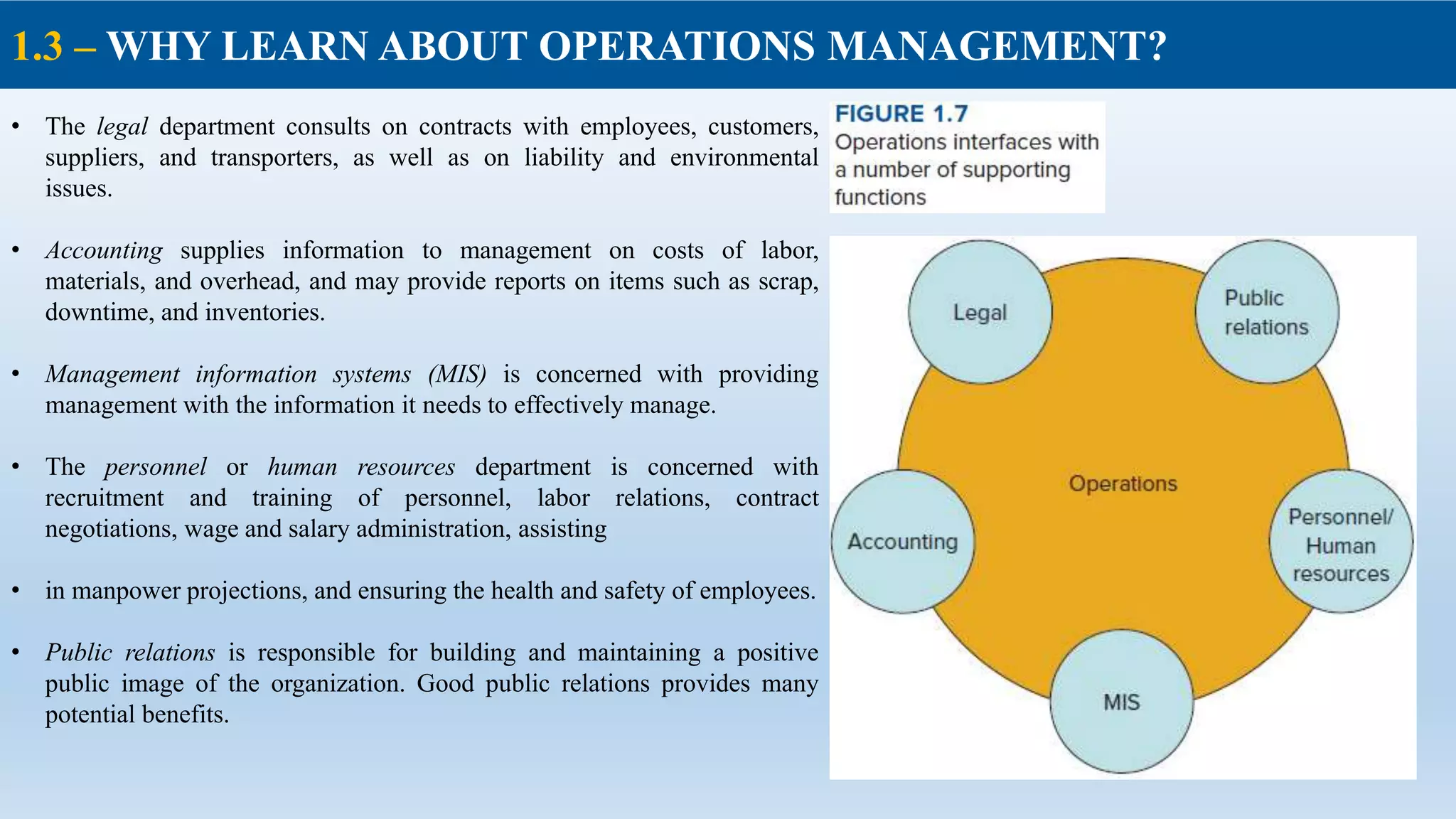
• The legal department consults on contracts with employees, customers,
suppliers, and transporters, as well as on liability and environmental
issues.
• Accounting supplies information to management on costs of labor,
materials, and overhead, and may provide reports on items such as scrap,
downtime, and inventories.
• Management information systems (MIS) is concerned with providing
management with the information it needs to effectively manage.
• The personnel or human resources department is concerned with
recruitment and training of personnel, labor relations, contract
negotiations, wage and salary administration, assisting
• in manpower projections, and ensuring the health and safety of employees.
• Public relations is responsible for building and maintaining a positive
public image of the organization. Good public relations provides many
potential benefits.
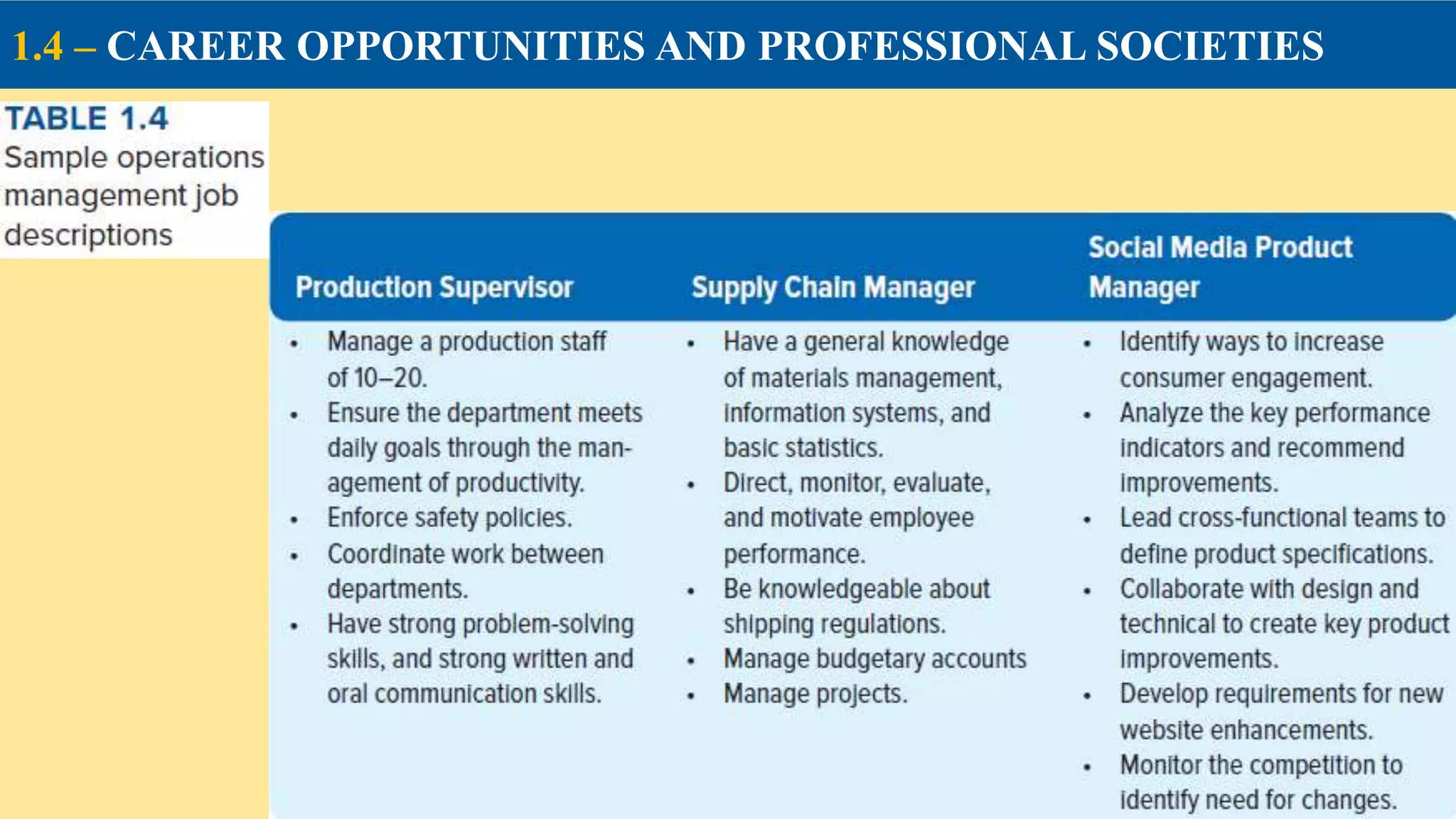
1.4 – CAREER OPPORTUNITIES AND PROFESSIONAL SOCIETIES
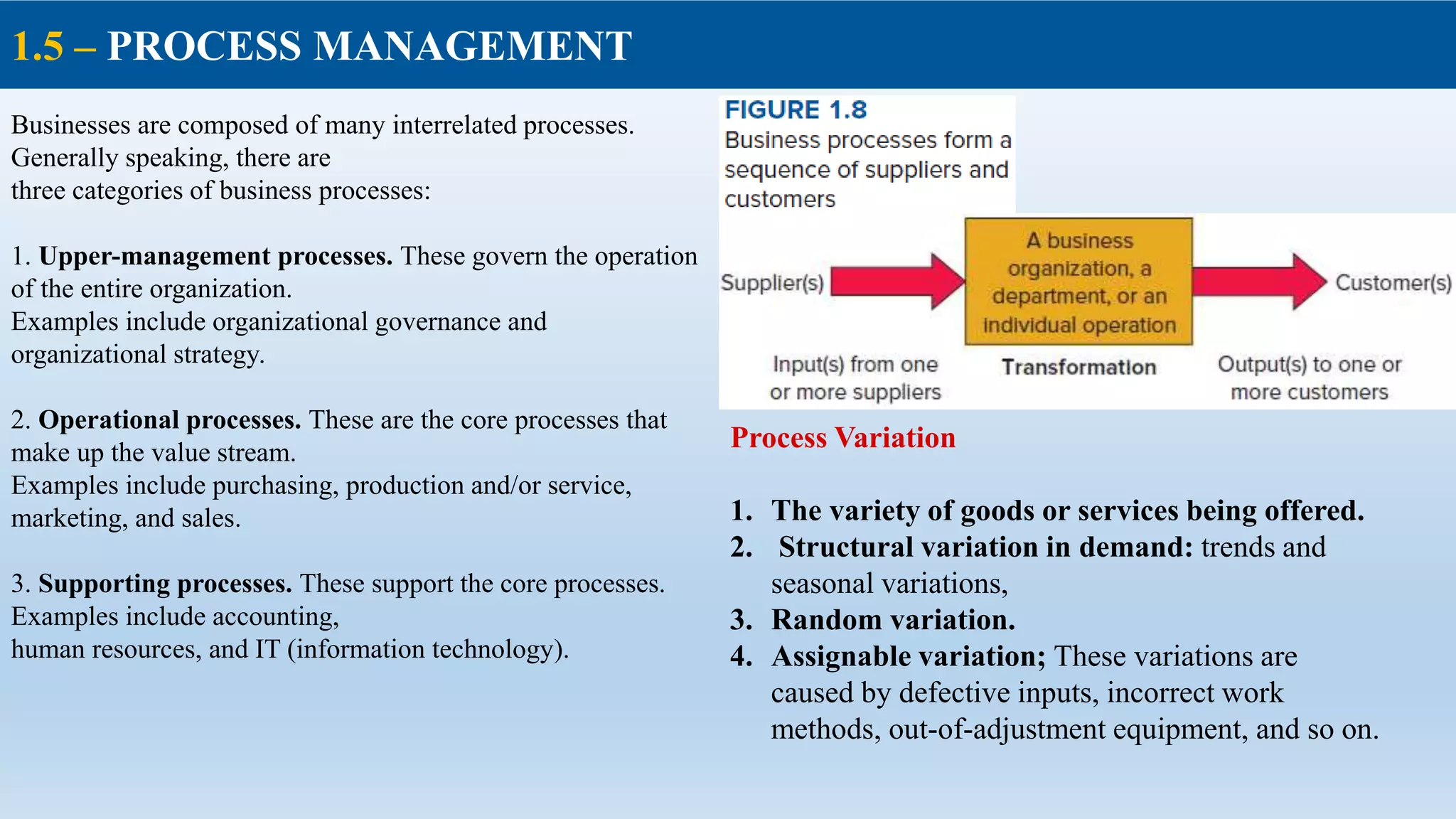
1.5 – PROCESS MANAGEMENT
Process Variation
1. The variety of goods or services being offered.
2. Structural variation in demand: trends and
seasonal variations,
3. Random variation.
4. Assignable variation; These variations are
caused by defective inputs, incorrect work
methods, out-of-adjustment equipment, and so on.
Businesses are composed of many interrelated processes.
Generally speaking, there are
three categories of business processes:
1. Upper-management processes. These govern the operation
of the entire organization.
Examples include organizational governance and
organizational strategy.
2. Operational processes. These are the core processes that
make up the value stream.
Examples include purchasing, production and/or service,
marketing, and sales.
3. Supporting processes. These support the core processes.
Examples include accounting,
human resources, and IT (information technology).
1.6 – THE SCOPE OF OPERATIONS MANAGEMENT
The scope of operations management ranges across the
organization. Operations management people are
involved in:
• Product and Service Design
• Process Selection
• Selection and Management of Technology
• Design of Work Systems
• Location Planning
• Facilities Planning
• Quality Improvement of the organization’s
products or services.
The operations function includes many
interrelated activities, such as:
• Forecasting
• Capacity Planning
• Scheduling
• Managing Inventories
• Assuring Quality
• Motivating Employees
• Deciding where to locate facilities,
and more.
A number of other areas are part of, or support, the operations function. They include purchasing,
industrial engineering, distribution, and maintenance
1.7 – OPERATIONS MANAGEMENT AND DECISION MAKING
Model An abstraction of reality; a simplified
representation of something.
1. Physical Models
2. Schematic Models
3. Mathematical Models
• Quantitative Approaches
• Performance Metrics
• Analysis of Trade-Offs
• Degree of Customization
• A Systems Approach
• Establishing Priorities
Operations management professionals make a number of
key decisions that affect the entire organization. These
include the following:
What: What resources will be needed, and in what
amounts?
When: When will each resource be needed? When should
the work be scheduled? When should materials and other
supplies be ordered? When is corrective action needed?
Where: Where will the work be done?
How: How will the product or service be designed? How
will the work be done (organization, methods, equipment)?
How will resources be allocated?
Who: Who will do the work?
1.8 – HISTORICAL EVOLUTION OF OPERATIONS MANAGEMENT
.
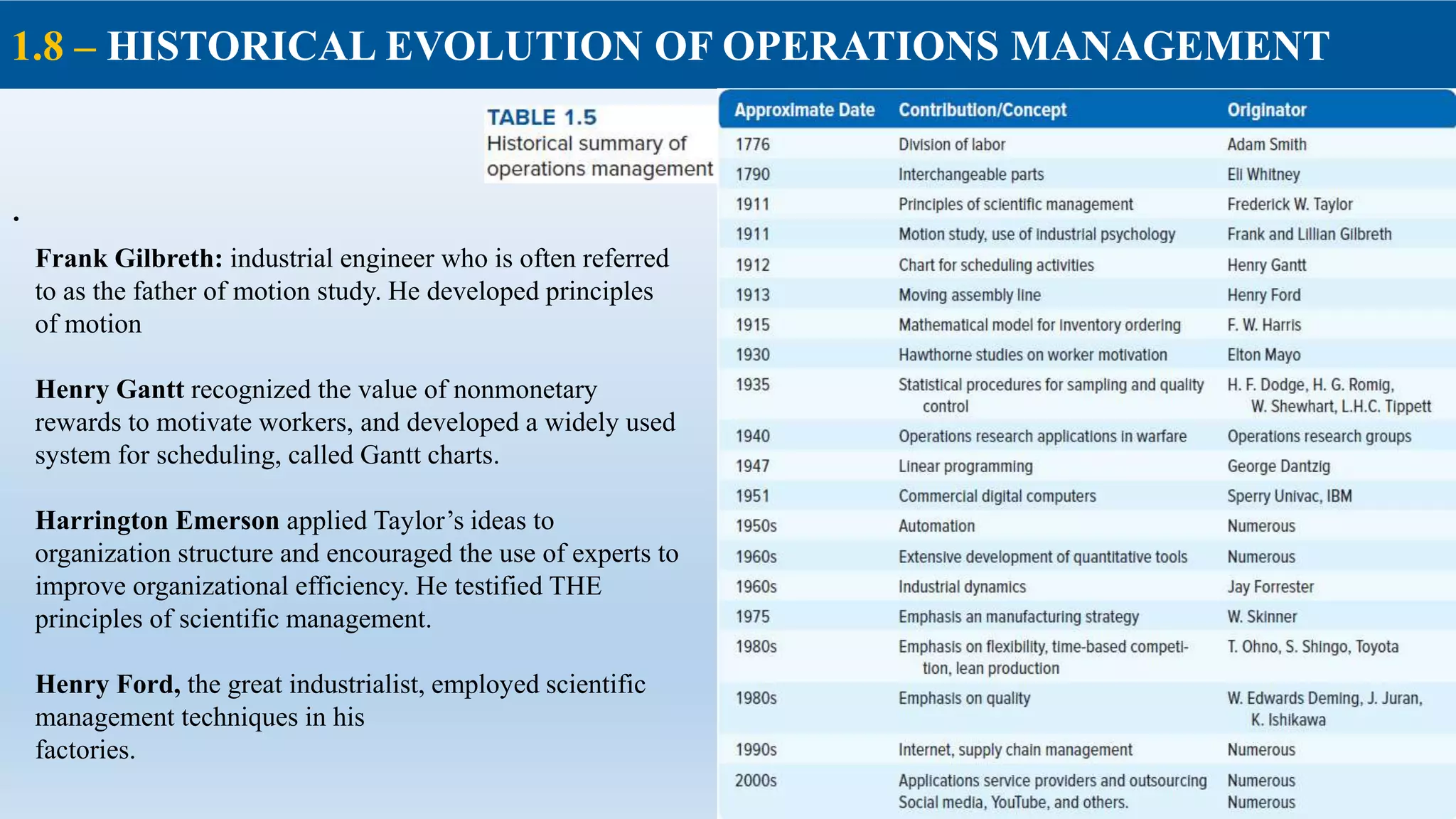
Frank Gilbreth: industrial engineer who is often referred
to as the father of motion study. He developed principles
of motion
Henry Gantt recognized the value of nonmonetary
rewards to motivate workers, and developed a widely used
system for scheduling, called Gantt charts.
Harrington Emerson applied Taylor’s ideas to
organization structure and encouraged the use of experts to
improve organizational efficiency. He testified THE
principles of scientific management.
Henry Ford, the great industrialist, employed scientific
management techniques in his
factories.
1.9 – OPERATIONS TODAY
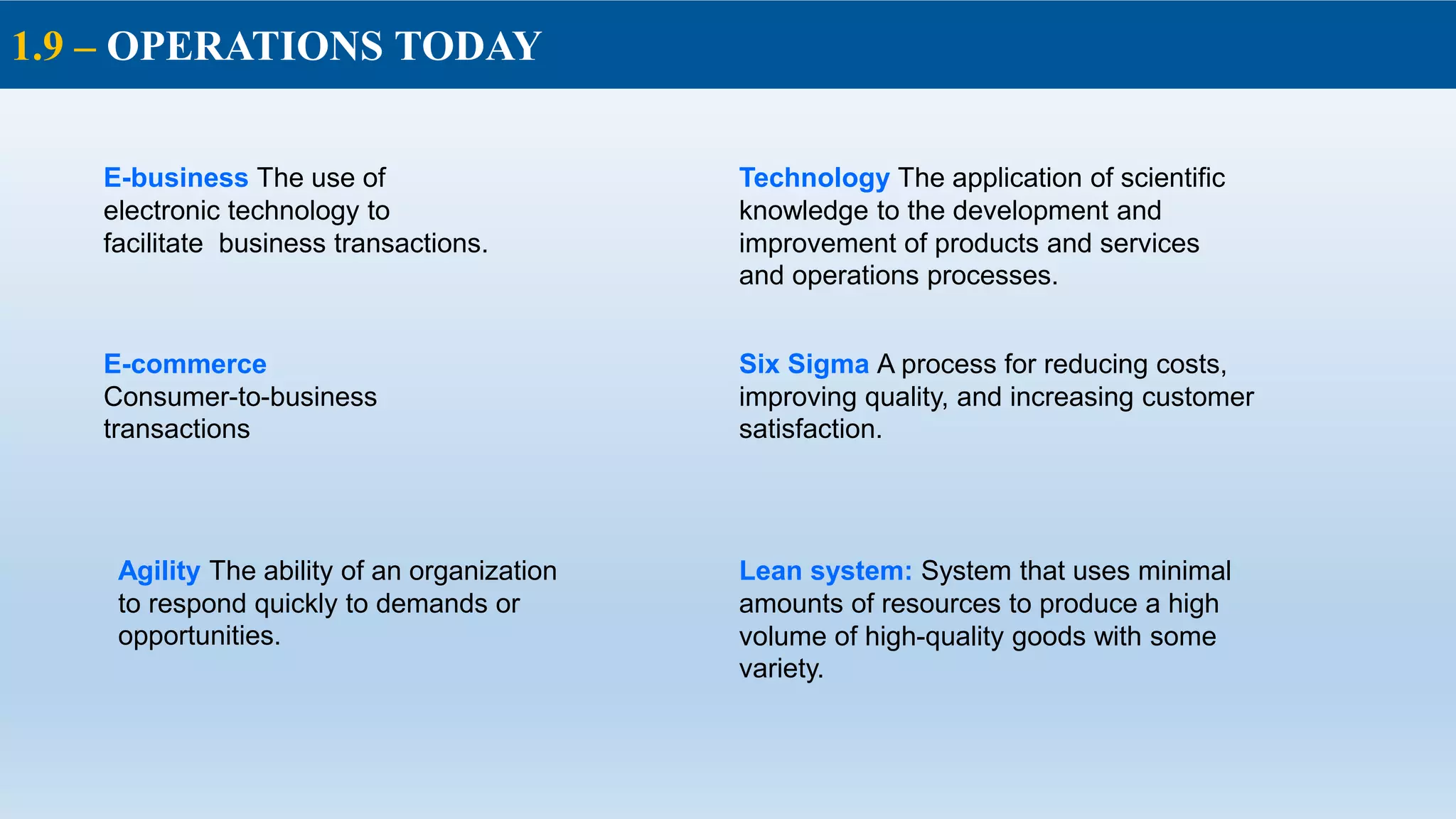
E-business The use of
electronic technology to
facilitate business transactions.
Technology The application of scientific
knowledge to the development and
improvement of products and services
and operations processes.
Six Sigma A process for reducing costs,
improving quality, and increasing customer
satisfaction.
Agility The ability of an organization
to respond quickly to demands or
opportunities.
Lean system: System that uses minimal
amounts of resources to produce a high
volume of high-quality goods with some
variety.
E-commerce
Consumer-to-business
transactions
1.10 – KEY ISSUES FOR TODAY’S BUSINESS OPERATIONS
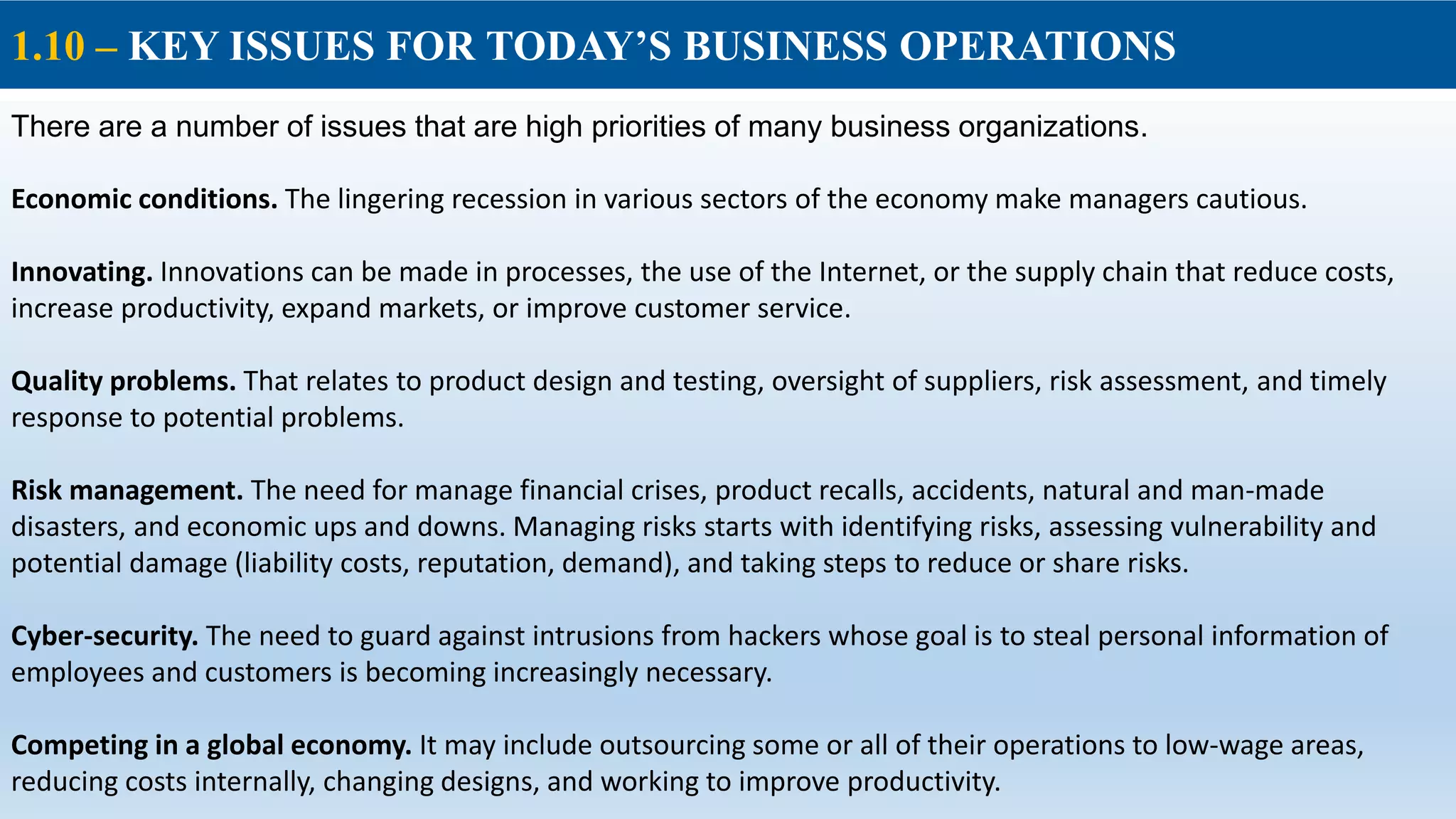
There are a number of issues that are high priorities of many business organizations.
Economic conditions. The lingering recession in various sectors of the economy make managers cautious.
Innovating. Innovations can be made in processes, the use of the Internet, or the supply chain that reduce costs,
increase productivity, expand markets, or improve customer service.
Quality problems. That relates to product design and testing, oversight of suppliers, risk assessment, and timely
response to potential problems.
Risk management. The need for manage financial crises, product recalls, accidents, natural and man-made
disasters, and economic ups and downs. Managing risks starts with identifying risks, assessing vulnerability and
potential damage (liability costs, reputation, demand), and taking steps to reduce or share risks.
Cyber-security. The need to guard against intrusions from hackers whose goal is to steal personal information of
employees and customers is becoming increasingly necessary.
Competing in a global economy. It may include outsourcing some or all of their operations to low-wage areas,
reducing costs internally, changing designs, and working to improve productivity.
Environmental Concerns and Sustainability: Using resources in
ways that do not harm ecological systems that
support human existence
1.10 – KEY ISSUES FOR TODAY’S BUSINESS OPERATIONS (Cont..)
The Need to Manage the Supply Chain
• The need to improve operations.
• Increasing levels of outsourcing.
• Increasing transportation costs.
• Competitive pressures.
• Increasing globalization.
• Increasing importance of e-business.
• The complexity of supply chains.
• The need to manage inventories.
Ethical Conduct A standard of behavior that guides how one should act in
various situations.
Ethical framework A sequence of steps intended to guide thinking and
subsequent decision or action:
1. Recognize an ethical issue by asking if an action could be damaging to a
group or an individual. Is there more to it than just what is legal?
2. Make sure the pertinent facts are known, such as who will be impacted,
and what options are available.
3. Evaluate the options by referring to the appropriate preceding ethical
principle.
4. Identify the “best” option and then further examine it by asking how
someone you respect would view it.
5. In retrospect, consider the effect your decision had and what you can learn
from it.
Three other key areas require more in-depth discussion:

OPERATIONS MANAGEMENT chapter 1

  • 4.
    1 – INTRODUCTIONOPERATIONS MANAGEMENT
  • 5.
    1 – INTRODUCTIONOPERATIONS MANAGEMENT
  • 6.
  • 7.
    Value-added The difference betweenthe cost of inputs and the value or price of outputs. 1.1 – INTRODUCTION
  • 8.
    Table 1.1, itis important to note that goods and services often occur jointly. For example, having the oil changed in your car is a service, but the oil that is delivered is a good. Similarly, house painting is a service, but the paint is a good. The goods–service combination is a continuum.
  • 9.
    1.2 – PRODUCTIONOF GOODS VERSUS PROVIDINGSERVICES 1. Degree of customer contact. 2. Labor content of jobs. 3. Measurement of productivity. 4. Quality assurance. 5. Inventory. 6. Wages. 7. Ability to patent. Manufacturing and service are often different in terms of what is done but quite similar in terms of how it is done. Consider these points of comparison: There are also many similarities between managing the production of products and managing services. Here are some of the primary factors for both: a. Forecasting and capacity planning to match supply and demand b. Process management c. Managing variations d. Monitoring and controlling costs and productivity e. Supply chain management f. Location planning, inventory management, quality control, and scheduling
  • 10.
    1.3 – WHYLEARN ABOUT OPERATIONS MANAGEMENT? Finance and operations management personnel cooperate by exchanging information and expertise in such activities as the following: 1. Budgeting. Budgets must be periodically prepared to plan financial requirements. Budgets must sometimes be adjusted, and performance relative to a budget must be evaluated. 2. Economic analysis of investment proposals. Evaluation of alternative investments in plant and equipment requires inputs from both operations and finance people. 3. 3. Provision of funds. The necessary funding of operations and the amount and timing of funding can be important and even critical when funds are tight. Careful planning can help avoid cash-flow problems.
  • 11.
    1.3 – WHYLEARN ABOUT OPERATIONS MANAGEMENT? • The legal department consults on contracts with employees, customers, suppliers, and transporters, as well as on liability and environmental issues. • Accounting supplies information to management on costs of labor, materials, and overhead, and may provide reports on items such as scrap, downtime, and inventories. • Management information systems (MIS) is concerned with providing management with the information it needs to effectively manage. • The personnel or human resources department is concerned with recruitment and training of personnel, labor relations, contract negotiations, wage and salary administration, assisting • in manpower projections, and ensuring the health and safety of employees. • Public relations is responsible for building and maintaining a positive public image of the organization. Good public relations provides many potential benefits.
  • 12.
    1.4 – CAREEROPPORTUNITIES AND PROFESSIONAL SOCIETIES
  • 13.
    1.5 – PROCESSMANAGEMENT Process Variation 1. The variety of goods or services being offered. 2. Structural variation in demand: trends and seasonal variations, 3. Random variation. 4. Assignable variation; These variations are caused by defective inputs, incorrect work methods, out-of-adjustment equipment, and so on. Businesses are composed of many interrelated processes. Generally speaking, there are three categories of business processes: 1. Upper-management processes. These govern the operation of the entire organization. Examples include organizational governance and organizational strategy. 2. Operational processes. These are the core processes that make up the value stream. Examples include purchasing, production and/or service, marketing, and sales. 3. Supporting processes. These support the core processes. Examples include accounting, human resources, and IT (information technology).
  • 14.
    1.6 – THESCOPE OF OPERATIONS MANAGEMENT The scope of operations management ranges across the organization. Operations management people are involved in: • Product and Service Design • Process Selection • Selection and Management of Technology • Design of Work Systems • Location Planning • Facilities Planning • Quality Improvement of the organization’s products or services. The operations function includes many interrelated activities, such as: • Forecasting • Capacity Planning • Scheduling • Managing Inventories • Assuring Quality • Motivating Employees • Deciding where to locate facilities, and more. A number of other areas are part of, or support, the operations function. They include purchasing, industrial engineering, distribution, and maintenance
  • 15.
    1.7 – OPERATIONSMANAGEMENT AND DECISION MAKING Model An abstraction of reality; a simplified representation of something. 1. Physical Models 2. Schematic Models 3. Mathematical Models • Quantitative Approaches • Performance Metrics • Analysis of Trade-Offs • Degree of Customization • A Systems Approach • Establishing Priorities Operations management professionals make a number of key decisions that affect the entire organization. These include the following: What: What resources will be needed, and in what amounts? When: When will each resource be needed? When should the work be scheduled? When should materials and other supplies be ordered? When is corrective action needed? Where: Where will the work be done? How: How will the product or service be designed? How will the work be done (organization, methods, equipment)? How will resources be allocated? Who: Who will do the work?
  • 16.
    1.8 – HISTORICALEVOLUTION OF OPERATIONS MANAGEMENT . Frank Gilbreth: industrial engineer who is often referred to as the father of motion study. He developed principles of motion Henry Gantt recognized the value of nonmonetary rewards to motivate workers, and developed a widely used system for scheduling, called Gantt charts. Harrington Emerson applied Taylor’s ideas to organization structure and encouraged the use of experts to improve organizational efficiency. He testified THE principles of scientific management. Henry Ford, the great industrialist, employed scientific management techniques in his factories.
  • 17.
    1.9 – OPERATIONSTODAY E-business The use of electronic technology to facilitate business transactions. Technology The application of scientific knowledge to the development and improvement of products and services and operations processes. Six Sigma A process for reducing costs, improving quality, and increasing customer satisfaction. Agility The ability of an organization to respond quickly to demands or opportunities. Lean system: System that uses minimal amounts of resources to produce a high volume of high-quality goods with some variety. E-commerce Consumer-to-business transactions
  • 18.
    1.10 – KEYISSUES FOR TODAY’S BUSINESS OPERATIONS There are a number of issues that are high priorities of many business organizations. Economic conditions. The lingering recession in various sectors of the economy make managers cautious. Innovating. Innovations can be made in processes, the use of the Internet, or the supply chain that reduce costs, increase productivity, expand markets, or improve customer service. Quality problems. That relates to product design and testing, oversight of suppliers, risk assessment, and timely response to potential problems. Risk management. The need for manage financial crises, product recalls, accidents, natural and man-made disasters, and economic ups and downs. Managing risks starts with identifying risks, assessing vulnerability and potential damage (liability costs, reputation, demand), and taking steps to reduce or share risks. Cyber-security. The need to guard against intrusions from hackers whose goal is to steal personal information of employees and customers is becoming increasingly necessary. Competing in a global economy. It may include outsourcing some or all of their operations to low-wage areas, reducing costs internally, changing designs, and working to improve productivity.
  • 19.
    Environmental Concerns andSustainability: Using resources in ways that do not harm ecological systems that support human existence 1.10 – KEY ISSUES FOR TODAY’S BUSINESS OPERATIONS (Cont..) The Need to Manage the Supply Chain • The need to improve operations. • Increasing levels of outsourcing. • Increasing transportation costs. • Competitive pressures. • Increasing globalization. • Increasing importance of e-business. • The complexity of supply chains. • The need to manage inventories. Ethical Conduct A standard of behavior that guides how one should act in various situations. Ethical framework A sequence of steps intended to guide thinking and subsequent decision or action: 1. Recognize an ethical issue by asking if an action could be damaging to a group or an individual. Is there more to it than just what is legal? 2. Make sure the pertinent facts are known, such as who will be impacted, and what options are available. 3. Evaluate the options by referring to the appropriate preceding ethical principle. 4. Identify the “best” option and then further examine it by asking how someone you respect would view it. 5. In retrospect, consider the effect your decision had and what you can learn from it. Three other key areas require more in-depth discussion: