Myopia Control Strategies
Riton Deb, B.Optom, MSc, Fellow(LVPEI)
Consultant Optometrist
Contact: riton.optom@gmail.com
+88 01822920611
Disclaimer
• No financial disclosure
• Company or brand names mentioned in this
presentation is only for information purpose
Introduction
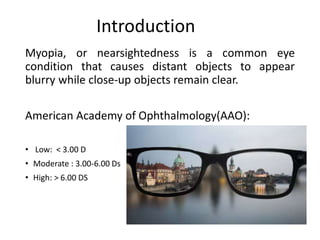
Myopia, or nearsightedness is a common eye
condition that causes distant objects to appear
blurry while close-up objects remain clear.
American Academy of Ophthalmology(AAO):
• Low: < 3.00 D
• Moderate : 3.00-6.00 Ds
• High: > 6.00 DS
PREVALENCE
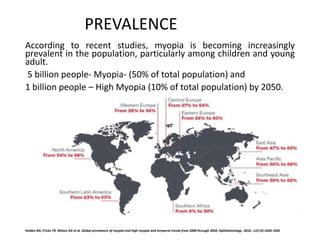
According to recent studies, myopia is becoming increasingly
prevalent in the population, particularly among children and young
adult.
5 billion people- Myopia- (50% of total population) and
1 billion people – High Myopia (10% of total population) by 2050.
Holden BA, Fricke TR, Wilson DA et al. Global prevalance of myopia and high myopia and temporal trends from 2000 through 2050. Ophthalmology. 2016 ; 123 (5):1036-1042
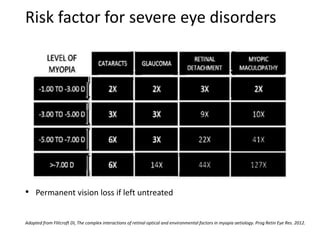
Risk factor for severe eye disorders
• Permanent vision loss if left untreated
Adopted from Flitcroft DI, The complex interactions of retinal optical and environmental factors in myopia aetiology. Prog Retin Eye Res. 2012.
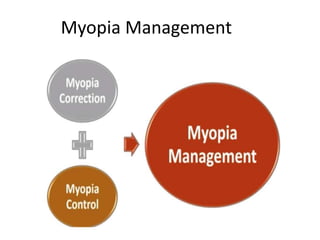
Myopia Management
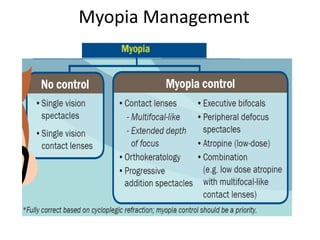
Myopia Management
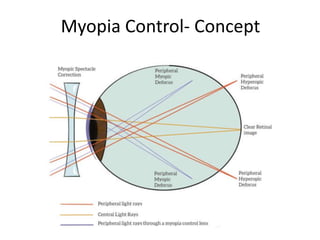
Myopia Control- Concept
When to start myopia control ?
As a rule of thumb, we should begin discussing myopia control
as an optio
• If the patient’s progression is >0.50 D a year
• Early onset- Early treatment, especially if parents highly
myopic.
dopted from K Zadnik, The Collaborative Longitudinal Evaluation of Ethnicity and Refractive Error (CLEERE) Study, 2015.
Clinical Examination- SOP by IMI
• History taking
• Visual Acuity
• Refraction (Cycloplegic)
• Binocular vision assessment
• Pupillary examination- photopic & mesopic
condition
• Ocular health assessment- SLE / IOP measurement
• Fundus evaluation
• Corneal topography
• A-scan (Axial length measurement)
Exclude from Myopia control strategy
• Congenital Myopia
• Pathological Myopia
• Degenerative Myopia
• Positional Myopia
• Index Myopia
• Corneal irregularity
• Accommodative spasm
• Myopia associated with any other eye diseases
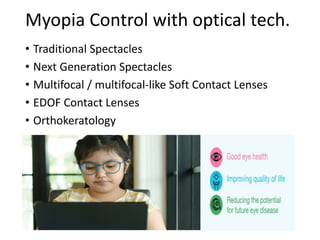
Myopia Control with optical tech.
• Traditional Spectacles
• Next Generation Spectacles
• Multifocal / multifocal-like Soft Contact Lenses
• EDOF Contact Lenses
• Orthokeratology
Traditional Spectacles
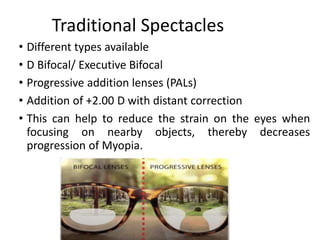
• Different types available
• D Bifocal/ Executive Bifocal
• Progressive addition lenses (PALs)
• Addition of +2.00 D with distant correction
• This can help to reduce the strain on the eyes when
focusing on nearby objects, thereby decreases
progression of Myopia.
Next Generation Spectacles
• Also Called Peripheral defocus lenses
• A type of spectacle lens design to reduce the
progression of Myopia in Children.
• These lenses work by creating myopic defocus on
the retinal periphery.
• DIMS, HALT, CARE & DOT
D.I.M.S Technology
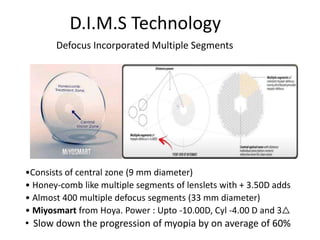
Defocus Incorporated Multiple Segments
•Consists of central zone (9 mm diameter)
• Honey-comb like multiple segments of lenslets with + 3.50D adds
• Almost 400 multiple defocus segments (33 mm diameter)
• Miyosmart from Hoya. Power : Upto -10.00D, Cyl -4.00 D and 3△
• Slow down the progression of myopia by on average of 60%
H.A.L.T Technology
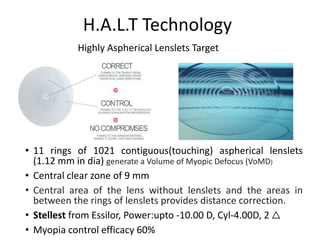
Highly Aspherical Lenslets Target
• 11 rings of 1021 contiguous(touching) aspherical lenslets
(1.12 mm in dia) generate a Volume of Myopic Defocus (VoMD)
• Central clear zone of 9 mm
• Central area of the lens without lenslets and the areas in
between the rings of lenslets provides distance correction.
• Stellest from Essilor, Power:upto -10.00 D, Cyl-4.00D, 2 △
• Myopia control efficacy 60%
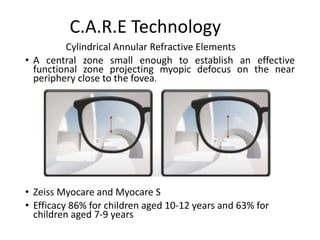
C.A.R.E Technology
Cylindrical Annular Refractive Elements
• A central zone small enough to establish an effective
functional zone projecting myopic defocus on the near
periphery close to the fovea.
• Zeiss Myocare and Myocare S
• Efficacy 86% for children aged 10-12 years and 63% for
children aged 7-9 years
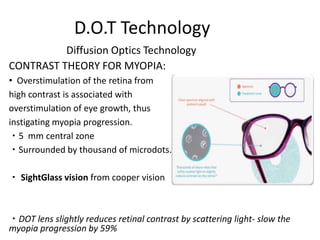
D.O.T Technology
Diffusion Optics Technology
CONTRAST THEORY FOR MYOPIA:
• Overstimulation of the retina from
high contrast is associated with
overstimulation of eye growth, thus
instigating myopia progression.
・5 mm central zone
・Surrounded by thousand of microdots.
・ SightGlass vision from cooper vision
・DOT lens slightly reduces retinal contrast by scattering light- slow the
myopia progression by 59%
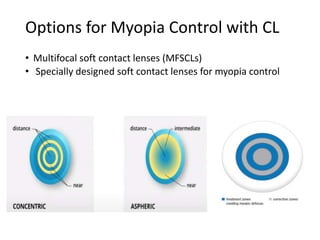
Options for Myopia Control with CL
• Multifocal soft contact lenses (MFSCLs)
• Specially designed soft contact lenses for myopia control
•
•
MFSCLs
• Soft contact lenses are increasingly used as a
myopia management option
• There is solid scientific evidence of successful
myopia control with centre distance multifocal
contact lenses
• Addition power ranging from +1.50 to + 2.50D
(Majority + 2.00D)
• Advised for children 8 years and older
• A daily disposable modality is recommended
• Power available up to -12.00D
• Misight 1 day - multifocal like contact lens( –6.00D)
EDOF Contact Lenses
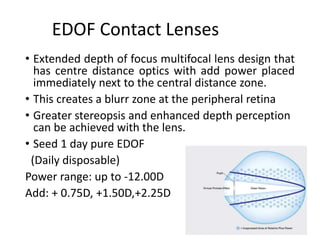
• Extended depth of focus multifocal lens design that
has centre distance optics with add power placed
immediately next to the central distance zone.
• This creates a blurr zone at the peripheral retina
• Greater stereopsis and enhanced depth perception
can be achieved with the lens.
• Seed 1 day pure EDOF
(Daily disposable)
Power range: up to -12.00D
Add: + 0.75D, +1.50D,+2.25D
Orthokeratology
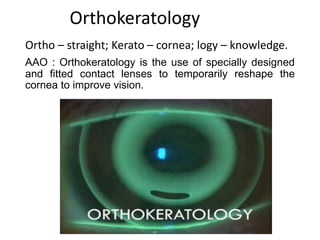
Ortho – straight; Kerato – cornea; logy – knowledge.
AAO : Orthokeratology is the use of specially designed
and fitted contact lenses to temporarily reshape the
cornea to improve vision.
Ortho-K, OK
• George Jessen in 1960 first attempted to
deliberately change refractive myopic error with
rigid PMMA contact lens using a technique he
named ‘orthofocus’.
• Ortho-k is FDA approved for overnight wear and
indicated for the correction of myopia and
astigmatism in patients of all ages.
• Corneal Refracive Therapy (CRT)
• Vision Shaping Treatment (VST)
• Breath-o-correct
-All are made from high DK materials
Ortho-K Design
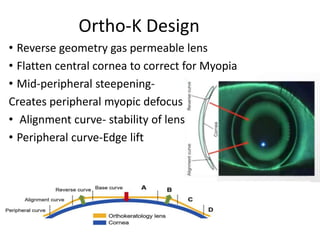
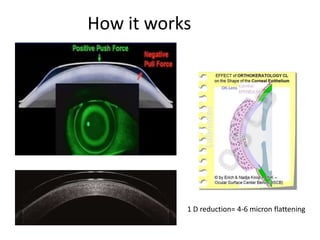
• Reverse geometry gas permeable lens
• Flatten central cornea to correct for Myopia
• Mid-peripheral steepening-
Creates peripheral myopic defocus
• Alignment curve- stability of lens
• Peripheral curve-Edge lift
How it works
1 D reduction= 4-6 micron flattening
Indications
• Eyes with a clear cornea that have no history of surgery (No
irregular cornea)
• Myopia from -1.00 Diopter to – 8.00 Diopter
• With-the-rule astigmatisms of up to -1.75 D and against-
the-rule astigmatisms of up to- 0.75D
• Age from 6 years and above.
• Highly motivatted patients
• Can afford cost
• Anyone who wants to be free of spectacles and contact
lenses during the day and falls on the specified correction
power.
• Multifocal Soft contact lens failures
Occupational Applications:
• Airline Pilots
• Military
• Firemen/Police
• Bus /Truck Drivers
Contraindications
• Irregular corneas (keratoconus, corneal scar, PMD)
-Corneal Dystrophies and degenerations
• Nystagmus
• Glaucoma
• Ocular inflammation and infection
• High Myopia > – 8.00D, Astigmatism > 1.75 D
• Large Pupils > 6.00 mm
• Severe allergic conjunctivitis
• Severe dry eye disease
• Sleep deprived patients
• Any previous ocular refractive surgery
Baseline Data
• Patient’s history
• Visual acuity and Refraction (Cycloplegic)
• Binocular vision evaluation
• Slit lamp examination
• Measurement of corneal HVID
• Pupil size measurement
• Baseline corneal topography
• Baseline A-scan
• Discussion of patient motivation and expectation
Fitting Philosophy
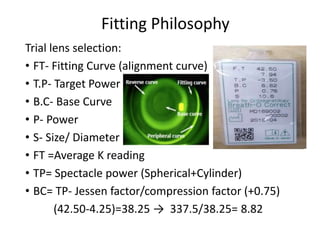
Trial lens selection:
• FT- Fitting Curve (alignment curve)
• T.P- Target Power
• B.C- Base Curve
• P- Power
• S- Size/ Diameter
• FT =Average K reading
• TP= Spectacle power (Spherical+Cylinder)
• BC= TP- Jessen factor/compression factor (+0.75)
(42.50-4.25)=38.25 → 337.5/38.25= 8.82
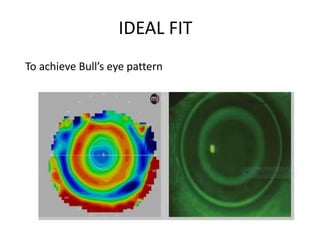
IDEAL FIT
To achieve Bull’s eye pattern
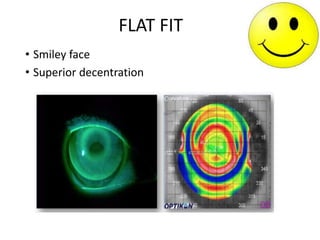
FLAT FIT
• Smiley face
• Superior decentration
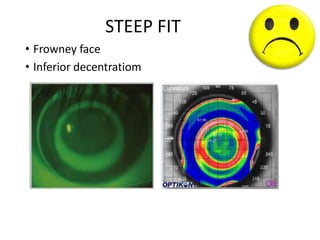
STEEP FIT
• Frowney face
• Inferior decentratiom
Fitting Philosophy
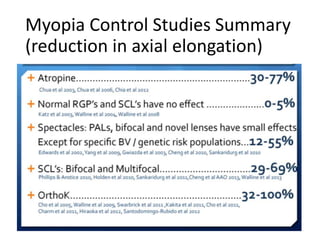
Myopia Control Studies Summary
(reduction in axial elongation)
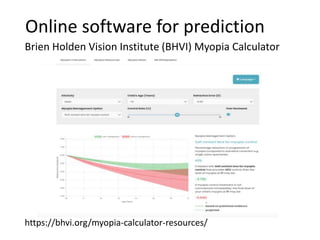
Online software for prediction
Brien Holden Vision Institute (BHVI) Myopia Calculator
https://bhvi.org/myopia-calculator-resources/
THANK YOU

Myopia Management & Control Strategies.pptx

  • 1.
    Myopia Control Strategies RitonDeb, B.Optom, MSc, Fellow(LVPEI) Consultant Optometrist Contact: riton.optom@gmail.com +88 01822920611
  • 2.
    Disclaimer • No financialdisclosure • Company or brand names mentioned in this presentation is only for information purpose
  • 3.
    Introduction Myopia, or nearsightednessis a common eye condition that causes distant objects to appear blurry while close-up objects remain clear. American Academy of Ophthalmology(AAO): • Low: < 3.00 D • Moderate : 3.00-6.00 Ds • High: > 6.00 DS
  • 4.
    PREVALENCE According to recentstudies, myopia is becoming increasingly prevalent in the population, particularly among children and young adult. 5 billion people- Myopia- (50% of total population) and 1 billion people – High Myopia (10% of total population) by 2050. Holden BA, Fricke TR, Wilson DA et al. Global prevalance of myopia and high myopia and temporal trends from 2000 through 2050. Ophthalmology. 2016 ; 123 (5):1036-1042
  • 5.
    Risk factor forsevere eye disorders • Permanent vision loss if left untreated Adopted from Flitcroft DI, The complex interactions of retinal optical and environmental factors in myopia aetiology. Prog Retin Eye Res. 2012.
  • 6.
  • 7.
  • 8.
  • 9.
    When to startmyopia control ? As a rule of thumb, we should begin discussing myopia control as an optio • If the patient’s progression is >0.50 D a year • Early onset- Early treatment, especially if parents highly myopic. dopted from K Zadnik, The Collaborative Longitudinal Evaluation of Ethnicity and Refractive Error (CLEERE) Study, 2015.
  • 10.
    Clinical Examination- SOPby IMI • History taking • Visual Acuity • Refraction (Cycloplegic) • Binocular vision assessment • Pupillary examination- photopic & mesopic condition • Ocular health assessment- SLE / IOP measurement • Fundus evaluation • Corneal topography • A-scan (Axial length measurement)
  • 11.
    Exclude from Myopiacontrol strategy • Congenital Myopia • Pathological Myopia • Degenerative Myopia • Positional Myopia • Index Myopia • Corneal irregularity • Accommodative spasm • Myopia associated with any other eye diseases
  • 12.
    Myopia Control withoptical tech. • Traditional Spectacles • Next Generation Spectacles • Multifocal / multifocal-like Soft Contact Lenses • EDOF Contact Lenses • Orthokeratology
  • 13.
    Traditional Spectacles • Differenttypes available • D Bifocal/ Executive Bifocal • Progressive addition lenses (PALs) • Addition of +2.00 D with distant correction • This can help to reduce the strain on the eyes when focusing on nearby objects, thereby decreases progression of Myopia.
  • 14.
    Next Generation Spectacles •Also Called Peripheral defocus lenses • A type of spectacle lens design to reduce the progression of Myopia in Children. • These lenses work by creating myopic defocus on the retinal periphery. • DIMS, HALT, CARE & DOT
  • 15.
    D.I.M.S Technology Defocus IncorporatedMultiple Segments •Consists of central zone (9 mm diameter) • Honey-comb like multiple segments of lenslets with + 3.50D adds • Almost 400 multiple defocus segments (33 mm diameter) • Miyosmart from Hoya. Power : Upto -10.00D, Cyl -4.00 D and 3△ • Slow down the progression of myopia by on average of 60%
  • 16.
    H.A.L.T Technology Highly AsphericalLenslets Target • 11 rings of 1021 contiguous(touching) aspherical lenslets (1.12 mm in dia) generate a Volume of Myopic Defocus (VoMD) • Central clear zone of 9 mm • Central area of the lens without lenslets and the areas in between the rings of lenslets provides distance correction. • Stellest from Essilor, Power:upto -10.00 D, Cyl-4.00D, 2 △ • Myopia control efficacy 60%
  • 17.
    C.A.R.E Technology Cylindrical AnnularRefractive Elements • A central zone small enough to establish an effective functional zone projecting myopic defocus on the near periphery close to the fovea. • Zeiss Myocare and Myocare S • Efficacy 86% for children aged 10-12 years and 63% for children aged 7-9 years
  • 18.
    D.O.T Technology Diffusion OpticsTechnology CONTRAST THEORY FOR MYOPIA: • Overstimulation of the retina from high contrast is associated with overstimulation of eye growth, thus instigating myopia progression. ・5 mm central zone ・Surrounded by thousand of microdots. ・ SightGlass vision from cooper vision ・DOT lens slightly reduces retinal contrast by scattering light- slow the myopia progression by 59%
  • 19.
    Options for MyopiaControl with CL • Multifocal soft contact lenses (MFSCLs) • Specially designed soft contact lenses for myopia control • •
  • 20.
    MFSCLs • Soft contactlenses are increasingly used as a myopia management option • There is solid scientific evidence of successful myopia control with centre distance multifocal contact lenses • Addition power ranging from +1.50 to + 2.50D (Majority + 2.00D) • Advised for children 8 years and older • A daily disposable modality is recommended • Power available up to -12.00D • Misight 1 day - multifocal like contact lens( –6.00D)
  • 21.
    EDOF Contact Lenses •Extended depth of focus multifocal lens design that has centre distance optics with add power placed immediately next to the central distance zone. • This creates a blurr zone at the peripheral retina • Greater stereopsis and enhanced depth perception can be achieved with the lens. • Seed 1 day pure EDOF (Daily disposable) Power range: up to -12.00D Add: + 0.75D, +1.50D,+2.25D
  • 22.
    Orthokeratology Ortho – straight;Kerato – cornea; logy – knowledge. AAO : Orthokeratology is the use of specially designed and fitted contact lenses to temporarily reshape the cornea to improve vision.
  • 23.
    Ortho-K, OK • GeorgeJessen in 1960 first attempted to deliberately change refractive myopic error with rigid PMMA contact lens using a technique he named ‘orthofocus’. • Ortho-k is FDA approved for overnight wear and indicated for the correction of myopia and astigmatism in patients of all ages. • Corneal Refracive Therapy (CRT) • Vision Shaping Treatment (VST) • Breath-o-correct -All are made from high DK materials
  • 24.
    Ortho-K Design • Reversegeometry gas permeable lens • Flatten central cornea to correct for Myopia • Mid-peripheral steepening- Creates peripheral myopic defocus • Alignment curve- stability of lens • Peripheral curve-Edge lift
  • 25.
    How it works 1D reduction= 4-6 micron flattening
  • 26.
    Indications • Eyes witha clear cornea that have no history of surgery (No irregular cornea) • Myopia from -1.00 Diopter to – 8.00 Diopter • With-the-rule astigmatisms of up to -1.75 D and against- the-rule astigmatisms of up to- 0.75D • Age from 6 years and above. • Highly motivatted patients • Can afford cost • Anyone who wants to be free of spectacles and contact lenses during the day and falls on the specified correction power. • Multifocal Soft contact lens failures Occupational Applications: • Airline Pilots • Military • Firemen/Police • Bus /Truck Drivers
  • 27.
    Contraindications • Irregular corneas(keratoconus, corneal scar, PMD) -Corneal Dystrophies and degenerations • Nystagmus • Glaucoma • Ocular inflammation and infection • High Myopia > – 8.00D, Astigmatism > 1.75 D • Large Pupils > 6.00 mm • Severe allergic conjunctivitis • Severe dry eye disease • Sleep deprived patients • Any previous ocular refractive surgery
  • 28.
    Baseline Data • Patient’shistory • Visual acuity and Refraction (Cycloplegic) • Binocular vision evaluation • Slit lamp examination • Measurement of corneal HVID • Pupil size measurement • Baseline corneal topography • Baseline A-scan • Discussion of patient motivation and expectation
  • 29.
    Fitting Philosophy Trial lensselection: • FT- Fitting Curve (alignment curve) • T.P- Target Power • B.C- Base Curve • P- Power • S- Size/ Diameter • FT =Average K reading • TP= Spectacle power (Spherical+Cylinder) • BC= TP- Jessen factor/compression factor (+0.75) (42.50-4.25)=38.25 → 337.5/38.25= 8.82
  • 30.
    IDEAL FIT To achieveBull’s eye pattern
  • 31.
    FLAT FIT • Smileyface • Superior decentration
  • 32.
    STEEP FIT • Frowneyface • Inferior decentratiom
  • 33.
  • 34.
    Myopia Control StudiesSummary (reduction in axial elongation)
  • 35.
    Online software forprediction Brien Holden Vision Institute (BHVI) Myopia Calculator https://bhvi.org/myopia-calculator-resources/
  • 36.