
GANDHINAGAR INSTITUTE OF
TECHNOLOGY(012)
Active Learning Assignment on the topic of
“Refrigeration”
SUBJECT : ELEMENTS OF MECHANICAL
ENGINEERING(2110006)
BE
Prepared By: Pandya Yash D. (Enrollment no.)
2/27/2018 1
CONTAINS
2/27/2018 2
 Introduction
 How does it work ?
 Refrigerant
 Unit of Refrigeration
 Applications of Refrigeration
 Refrigeration system for Industrial
 Types Of Refrigeration
Introduction
2/27/2018 3
 The machine used for lowering or producing low temp.
in a body or a space, whose temp. is already below the
temp. of its surrounding, is called the refrigeration
system.
 Here the heat is being generally pumped from low level
to the higher one and is rejected at high temp.
 The term refrigeration may be defined as the process of
removing heat from a substance under controlled
conditions.
 It also includes the process of reducing heat &
maintaining the temp. of a body below the general
temp. of its surroundings.
How does it work?
2/27/2018 4
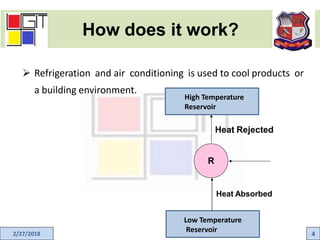
 Refrigeration and air conditioning is used to cool products or
a building environment.
R
Heat Rejected
High Temperature
Reservoir
Low Temperature
Reservoir
Heat Absorbed
How does it work?
2/27/2018 5
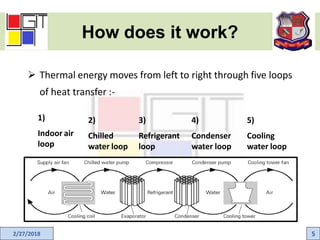
 Thermal energy moves from left to right through five loops
of heat transfer :-
1)
Indoor air
loop
2)
Chilled
water loop
3)
Refrigerant
loop
4)
Condenser
water loop
5)
Cooling
water loop
Refrigerant
2/27/2018 6
 The working substance used in refrigerating equipment is
known as Refrigerant.
 The refrigerant is a heat carrying medium which during their
cycle in a refrigeration system absorbs heat from a low temp.
system & delivers it to a higher temp. system.
 Refrigerant under goes various process of refrigeration cycles
which are used to produce refrigeration.
 Commonly used refrigerants are CFC, CHCIF2, NH3, CO2 and air.
Unit Of Refrigeration
2/27/2018 7
 The unit of refrigeration is ton of refrigeration.
 Simply ton denoted by TR.
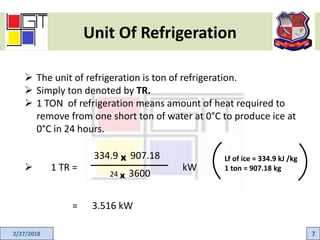
 1 TON of refrigeration means amount of heat required to
remove from one short ton of water at 0°C to produce ice at
0°C in 24 hours.
 1 TR = kW
= 3.516 kW
334.9 ₓ 907.18
24 ₓ 3600
Lf of ice = 334.9 kJ /kg
1 ton = 907.18 kg
Refrigeration system for
Industrial
2/27/2018 8
 Small capacity modular units of direct
expansion type (50 Tons of Refrigeration)
 Centralized chilled water plants with chilled
water as a secondary coolant (50 – 250 TR)
 Brine plants with brines as lower
temperature, secondary coolant (>250 TR
Types Of Refrigeration
2/27/2018 9
 There are two types of refrigeration :-
1) Vapour Compression Refrigeration
(VCR): uses mechanical energy
2) Vapour Absorption Refrigeration
(VAR): uses thermal energy
1) Vapour Compression
Refrigeration
2/27/2018 10
 This is the most important system from the point of
commercial & domestic utility & most practical form of
refrigeration.
 This system of refrigeration thus act as latent heat pump
since its pump its latent heat from the cold body or brine
& rejects it or deliver it to the external hot body or the
cooling medium.
 According to the law of thermodynamics , this can be
done only on the expenditure of energy which is
supplied to the system in the form of electrical energy
driving the compressor.
 The vapour compression cycle is used in most of the
modern refrigeration systems in large industrial plants.
VCR
2/27/2018 11
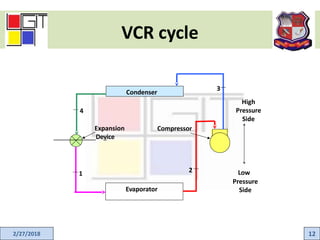
 The vapour in this cycle is circulated through the various
components of the system, where it undergoes a
number of changes in its state or condition
 Each cycle of operation consists of the four fundamental
changes of state or processes:-
 Expansion
 Vaporisation
 Compression
 Condensation
VCR cycle
2/27/2018 12
Condenser
High
Pressure
Side
Expansion
Device
3
4
2 Low
Pressure
Side
1
Evaporator
Compressor
2) Vapour Absorption
Refrigeration
2/27/2018 13
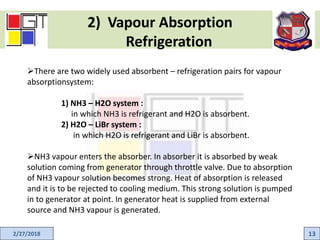
There are two widely used absorbent – refrigeration pairs for vapour
absorptionsystem:
1) NH3 – H2O system :
in which NH3 is refrigerant and H2O is absorbent.
2) H2O – LiBr system :
in which H2O is refrigerant and LiBr is absorbent.
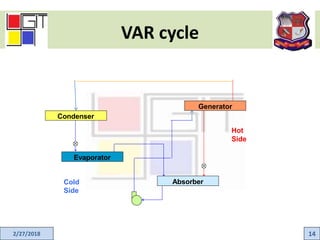
NH3 vapour enters the absorber. In absorber it is absorbed by weak
solution coming from generator through throttle valve. Due to absorption
of NH3 vapour solution becomes strong. Heat of absorption is released
and it is to be rejected to cooling medium. This strong solution is pumped
in to generator at point. In generator heat is supplied from external
source and NH3 vapour is generated.
VAR cycle
2/27/2018 14
Condenser
Generator
Evaporator
AbsorberCold
Side
Hot
Side
THANK YOU


Refrigeration

  • 1.
    GANDHINAGAR INSTITUTE OF TECHNOLOGY(012) ActiveLearning Assignment on the topic of “Refrigeration” SUBJECT : ELEMENTS OF MECHANICAL ENGINEERING(2110006) BE Prepared By: Pandya Yash D. (Enrollment no.) 2/27/2018 1
  • 2.
    CONTAINS 2/27/2018 2  Introduction How does it work ?  Refrigerant  Unit of Refrigeration  Applications of Refrigeration  Refrigeration system for Industrial  Types Of Refrigeration
  • 3.
    Introduction 2/27/2018 3  Themachine used for lowering or producing low temp. in a body or a space, whose temp. is already below the temp. of its surrounding, is called the refrigeration system.  Here the heat is being generally pumped from low level to the higher one and is rejected at high temp.  The term refrigeration may be defined as the process of removing heat from a substance under controlled conditions.  It also includes the process of reducing heat & maintaining the temp. of a body below the general temp. of its surroundings.
  • 4.
    How does itwork? 2/27/2018 4  Refrigeration and air conditioning is used to cool products or a building environment. R Heat Rejected High Temperature Reservoir Low Temperature Reservoir Heat Absorbed
  • 5.
    How does itwork? 2/27/2018 5  Thermal energy moves from left to right through five loops of heat transfer :- 1) Indoor air loop 2) Chilled water loop 3) Refrigerant loop 4) Condenser water loop 5) Cooling water loop
  • 6.
    Refrigerant 2/27/2018 6  Theworking substance used in refrigerating equipment is known as Refrigerant.  The refrigerant is a heat carrying medium which during their cycle in a refrigeration system absorbs heat from a low temp. system & delivers it to a higher temp. system.  Refrigerant under goes various process of refrigeration cycles which are used to produce refrigeration.  Commonly used refrigerants are CFC, CHCIF2, NH3, CO2 and air.
  • 7.
    Unit Of Refrigeration 2/27/20187  The unit of refrigeration is ton of refrigeration.  Simply ton denoted by TR.  1 TON of refrigeration means amount of heat required to remove from one short ton of water at 0°C to produce ice at 0°C in 24 hours.  1 TR = kW = 3.516 kW 334.9 ₓ 907.18 24 ₓ 3600 Lf of ice = 334.9 kJ /kg 1 ton = 907.18 kg
  • 8.
    Refrigeration system for Industrial 2/27/20188  Small capacity modular units of direct expansion type (50 Tons of Refrigeration)  Centralized chilled water plants with chilled water as a secondary coolant (50 – 250 TR)  Brine plants with brines as lower temperature, secondary coolant (>250 TR
  • 9.
    Types Of Refrigeration 2/27/20189  There are two types of refrigeration :- 1) Vapour Compression Refrigeration (VCR): uses mechanical energy 2) Vapour Absorption Refrigeration (VAR): uses thermal energy
  • 10.
    1) Vapour Compression Refrigeration 2/27/201810  This is the most important system from the point of commercial & domestic utility & most practical form of refrigeration.  This system of refrigeration thus act as latent heat pump since its pump its latent heat from the cold body or brine & rejects it or deliver it to the external hot body or the cooling medium.  According to the law of thermodynamics , this can be done only on the expenditure of energy which is supplied to the system in the form of electrical energy driving the compressor.  The vapour compression cycle is used in most of the modern refrigeration systems in large industrial plants.
  • 11.
    VCR 2/27/2018 11  Thevapour in this cycle is circulated through the various components of the system, where it undergoes a number of changes in its state or condition  Each cycle of operation consists of the four fundamental changes of state or processes:-  Expansion  Vaporisation  Compression  Condensation
  • 12.
  • 13.
    2) Vapour Absorption Refrigeration 2/27/201813 There are two widely used absorbent – refrigeration pairs for vapour absorptionsystem: 1) NH3 – H2O system : in which NH3 is refrigerant and H2O is absorbent. 2) H2O – LiBr system : in which H2O is refrigerant and LiBr is absorbent. NH3 vapour enters the absorber. In absorber it is absorbed by weak solution coming from generator through throttle valve. Due to absorption of NH3 vapour solution becomes strong. Heat of absorption is released and it is to be rejected to cooling medium. This strong solution is pumped in to generator at point. In generator heat is supplied from external source and NH3 vapour is generated.
  • 14.
  • 15.