GANDHINAGAR INSTITUTE OF
TECHONOLOGY(012)
SUBJECT : Manufacturing Processes-I
(2131903)
Active Learning Assignment on the topic of
“Planer & Slotter”
Prepared By:
Guided By : Prof.
OVERVIEW
 Introduction
 Classification of Planer/Slotter
 Planer/Slotter machine part
 Operation done on a Planer/Slotter
Slotter
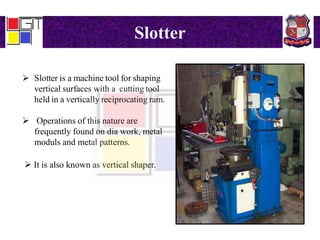
 Slotter is a machine tool for shaping
vertical surfaces with a cutting tool
held in a vertically reciprocating ram.
 Operations of this nature are
frequently found on dia work, metal
moduls and metal patterns.
 It is also known as vertical shaper.
Classification
i. Puncher slotters
ii. General production slotters
iii. Precision tool room slotters
iv. Keyseaters
Slotter Drive Mechanisms
 Slotted disc mechanisms
 Variable speed reversible motor drive
 Hydraulic drive
 Slotted link drive
Slotter Feed Mechanism
 As mentioned earlier the slotter table is given feed in three directions :
 The circular feed is accomplished by a revolving work table equipped
with an indexing mechanism.
 The manual feed to the table is provided through bolt and nut drives.
 Longitudinal rotary feed gets its motion from a cam groove cut on the
face of the bull gear.
 Longitudinal
 Cross
 Circular
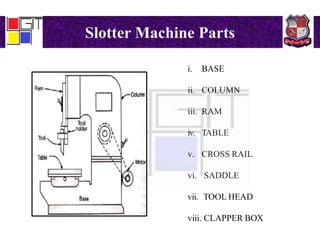
Slotter Machine Parts
i. BASE
ii. COLUMN
iii. RAM
iv. TABLE
v. CROSS RAIL
vi. SADDLE
vii. TOOL HEAD
viii. CLAPPER BOX
Operations done on a Slotter
 The following operations can be performed on the Slotter :
 Cutting of internal grooves or key ways
 Cutting of internal gears
 Cutting of recesses
Planer
 Planer is a machine with a cutting tool that makes repeated
horizontal strokes across the surface of a workpiece used to cut
flat surfaces into metal.
 Planing is much less efficient than other basic
machining processes, such as milling, that will produce such
surfaces.
Classification
i. Double Housing Planer
ii. Open Side Planer
iii. Plate or Edge Type Planer
iv. Divide Table Planer
v. Pit Type Planer
vi. Universal Planer
Planer Drive Mechanisms
 The different mechanisms used to drive the planer table include the
following :
i. Open and crossed belt drive
ii. Reversible motor drive
Planer Feed Mechanism
 The feed in a planer is provided intermittently between the two strokes.
 In the planer both the cross feed and down feed are given to the tools on
the cross rail.
 The automatic feed drive for a planer may be provided by two methods :
i. By friction disc
ii. By electric drive
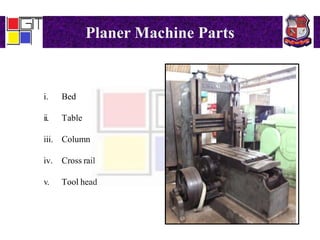
Planer Machine Parts
i. Bed
ii. Table
iii. Column
iv. Cross rail
v. Tool head
Operations done on a Planer
 The following operations can be performed on the Planer :
 Planing of horizontal flat surface
 Planing of vertical flat surfaces
 Planing at an angle
 Planing curved surfaces
 Planing different types of slots, grooves etc.
Thank You

Planer & Slotter

  • 1.
    GANDHINAGAR INSTITUTE OF TECHONOLOGY(012) SUBJECT: Manufacturing Processes-I (2131903) Active Learning Assignment on the topic of “Planer & Slotter” Prepared By: Guided By : Prof.
  • 2.
    OVERVIEW  Introduction  Classificationof Planer/Slotter  Planer/Slotter machine part  Operation done on a Planer/Slotter
  • 3.
    Slotter  Slotter isa machine tool for shaping vertical surfaces with a cutting tool held in a vertically reciprocating ram.  Operations of this nature are frequently found on dia work, metal moduls and metal patterns.  It is also known as vertical shaper.
  • 4.
    Classification i. Puncher slotters ii.General production slotters iii. Precision tool room slotters iv. Keyseaters
  • 5.
    Slotter Drive Mechanisms Slotted disc mechanisms  Variable speed reversible motor drive  Hydraulic drive  Slotted link drive
  • 6.
    Slotter Feed Mechanism As mentioned earlier the slotter table is given feed in three directions :  The circular feed is accomplished by a revolving work table equipped with an indexing mechanism.  The manual feed to the table is provided through bolt and nut drives.  Longitudinal rotary feed gets its motion from a cam groove cut on the face of the bull gear.  Longitudinal  Cross  Circular
  • 7.
    Slotter Machine Parts i.BASE ii. COLUMN iii. RAM iv. TABLE v. CROSS RAIL vi. SADDLE vii. TOOL HEAD viii. CLAPPER BOX
  • 8.
    Operations done ona Slotter  The following operations can be performed on the Slotter :  Cutting of internal grooves or key ways  Cutting of internal gears  Cutting of recesses
  • 9.
    Planer  Planer isa machine with a cutting tool that makes repeated horizontal strokes across the surface of a workpiece used to cut flat surfaces into metal.  Planing is much less efficient than other basic machining processes, such as milling, that will produce such surfaces.
  • 10.
    Classification i. Double HousingPlaner ii. Open Side Planer iii. Plate or Edge Type Planer iv. Divide Table Planer v. Pit Type Planer vi. Universal Planer
  • 11.
    Planer Drive Mechanisms The different mechanisms used to drive the planer table include the following : i. Open and crossed belt drive ii. Reversible motor drive
  • 12.
    Planer Feed Mechanism The feed in a planer is provided intermittently between the two strokes.  In the planer both the cross feed and down feed are given to the tools on the cross rail.  The automatic feed drive for a planer may be provided by two methods : i. By friction disc ii. By electric drive
  • 13.
    Planer Machine Parts i.Bed ii. Table iii. Column iv. Cross rail v. Tool head
  • 14.
    Operations done ona Planer  The following operations can be performed on the Planer :  Planing of horizontal flat surface  Planing of vertical flat surfaces  Planing at an angle  Planing curved surfaces  Planing different types of slots, grooves etc.
  • 15.