Unit–V: Nanomaterials
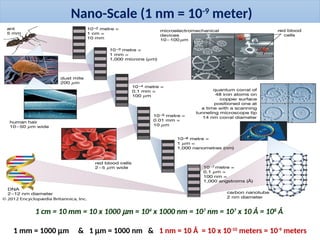
Nano-Scale (1 nm = 10-9
meter)
1 cm = 10 mm = 10 x 1000 mm = 104
x 1000 nm = 107
nm = 107
x 10 Å = 108
Å
1 mm = 1000 mm & 1 mm = 1000 nm & 1 nm = 10 Å = 10 x 10-10
meters = 10-9
meters
Unit–V: Nanomaterials
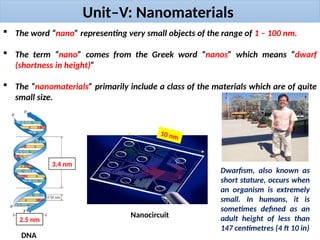
 The word “nano” representing very small objects of the range of 1 – 100 nm.
 The term “nano” comes from the Greek word “nanos” which means “dwarf
(shortness in height)”
 The “nanomaterials” primarily include a class of the materials which are of quite
small size.
3.4 nm
2.5 nm
10 nm
Dwarfism, also known as
short stature, occurs when
an organism is extremely
small. In humans, it is
sometimes defined as an
adult height of less than
147 centimetres (4 ft 10 in)
DNA
Nanocircuit
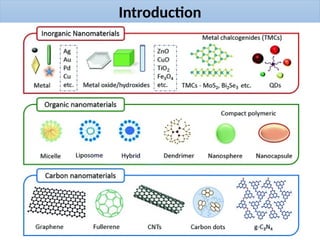
Introduction
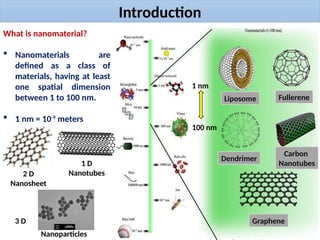
What is nanomaterial?
 Nanomaterials are
defined as a class of
materials, having at least
one spatial dimension
between 1 to 100 nm.
 1 nm = 10-9
meters
1 nm
Dendrimer
Graphene
Carbon
Nanotubes
Fullerene
Liposome
100 nm
2 D
Nanosheet
1 D
Nanotubes
3 D
Nanoparticles
Introduction
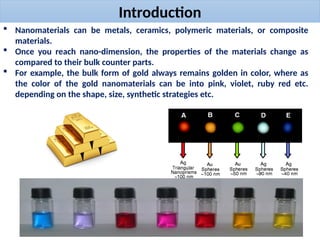
 Nanomaterials can be metals, ceramics, polymeric materials, or composite
materials.
 Once you reach nano-dimension, the properties of the materials change as
compared to their bulk counter parts.
 For example, the bulk form of gold always remains golden in color, where as
the color of the gold nanomaterials can be into pink, violet, ruby red etc.
depending on the shape, size, synthetic strategies etc.
Introduction
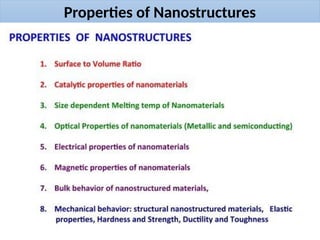
Properties of Nanostructures
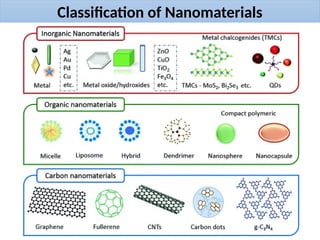
Classification of Nanomaterials
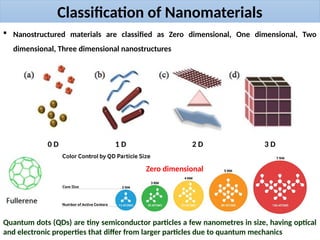
 Nanostructured materials are classified as Zero dimensional, One dimensional, Two
dimensional, Three dimensional nanostructures
0 D 1 D 2 D 3 D
Quantum dots (QDs) are tiny semiconductor particles a few nanometres in size, having optical
and electronic properties that differ from larger particles due to quantum mechanics
Zero dimensional
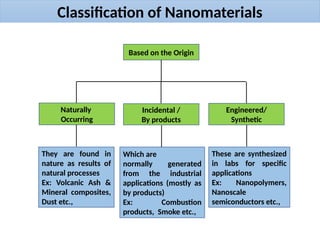
Classification of Nanomaterials
Based on the Origin
Naturally
Occurring
Incidental /
By products
Engineered/
Synthetic
They are found in
nature as results of
natural processes
Ex: Volcanic Ash &
Mineral composites,
Dust etc.,
Which are
normally generated
from the industrial
applications (mostly as
by products)
Ex: Combustion
products, Smoke etc.,
These are synthesized
in labs for specific
applications
Ex: Nanopolymers,
Nanoscale
semiconductors etc.,
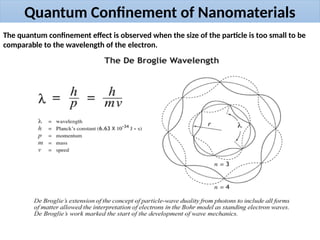
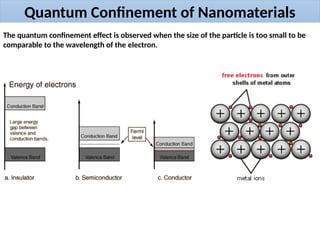
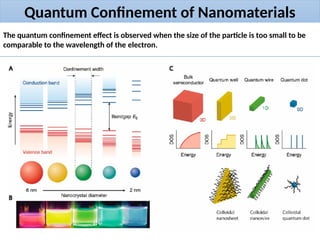
Quantum Confinement of Nanomaterials
The quantum confinement effect is observed when the size of the particle is too small to be
comparable to the wavelength of the electron.
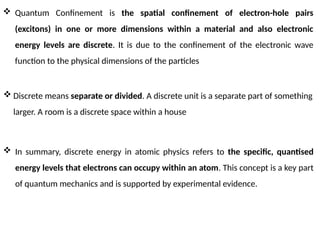
 Quantum Confinement is the spatial confinement of electron-hole pairs
(excitons) in one or more dimensions within a material and also electronic
energy levels are discrete. It is due to the confinement of the electronic wave
function to the physical dimensions of the particles
 In summary, discrete energy in atomic physics refers to the specific, quantised
energy levels that electrons can occupy within an atom. This concept is a key part
of quantum mechanics and is supported by experimental evidence.
 Discrete means separate or divided. A discrete unit is a separate part of something
larger. A room is a discrete space within a house
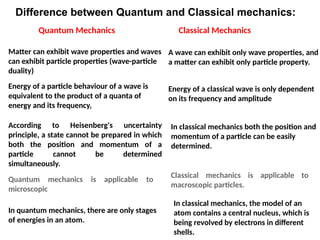
Difference between Quantum and Classical mechanics:
Quantum Mechanics Classical Mechanics
Matter can exhibit wave properties and waves
can exhibit particle properties (wave-particle
duality)
A wave can exhibit only wave properties, and
a matter can exhibit only particle property.
Energy of a particle behaviour of a wave is
equivalent to the product of a quanta of
energy and its frequency,
Energy of a classical wave is only dependent
on its frequency and amplitude
According to Heisenberg's uncertainty
principle, a state cannot be prepared in which
both the position and momentum of a
particle cannot be determined
simultaneously.
In classical mechanics both the position and
momentum of a particle can be easily
determined.
Quantum mechanics is applicable to
microscopic
Classical mechanics is applicable to
macroscopic particles.
In quantum mechanics, there are only stages
of energies in an atom.
In classical mechanics, the model of an
atom contains a central nucleus, which is
being revolved by electrons in different
shells.
Quantum Confinement of Nanomaterials
The quantum confinement effect is observed when the size of the particle is too small to be
comparable to the wavelength of the electron.
Quantum Confinement of Nanomaterials
The quantum confinement effect is observed when the size of the particle is too small to be
comparable to the wavelength of the electron.
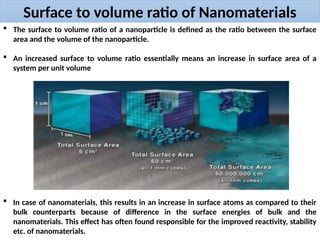
Surface to volume ratio of Nanomaterials
 The surface to volume ratio of a nanoparticle is defined as the ratio between the surface
area and the volume of the nanoparticle.
 An increased surface to volume ratio essentially means an increase in surface area of a
system per unit volume
 In case of nanomaterials, this results in an increase in surface atoms as compared to their
bulk counterparts because of difference in the surface energies of bulk and the
nanomaterials. This effect has often found responsible for the improved reactivity, stability
etc. of nanomaterials.
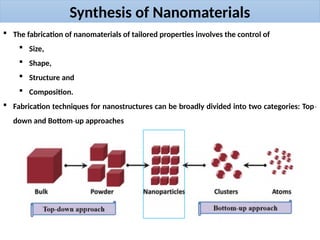
Synthesis of Nanomaterials
 The fabrication of nanomaterials of tailored properties involves the control of
 Size,
 Shape,
 Structure and
 Composition.
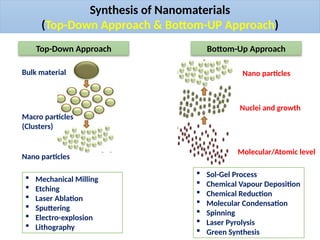
 Fabrication techniques for nanostructures can be broadly divided into two categories: Top‐
down and Bottom up approaches
‐
Synthesis of Nanomaterials
(Top-Down Approach & Bottom-UP Approach)
Top-Down Approach Bottom-Up Approach
Bulk material
Macro particles
(Clusters)
Nano particles
Molecular/Atomic level
Nuclei and growth
Nano particles
 Mechanical Milling
 Etching
 Laser Ablation
 Sputtering
 Electro-explosion
 Lithography
 Sol-Gel Process
 Chemical Vapour Deposition
 Chemical Reduction
 Molecular Condensation
 Spinning
 Laser Pyrolysis
 Green Synthesis
Synthesis of Nanomaterials
(Top-Down Approach)
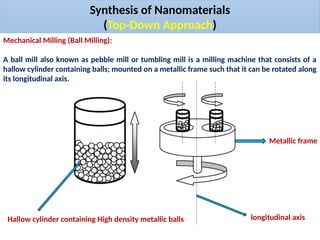
Mechanical Milling (Ball Milling):
A ball mill also known as pebble mill or tumbling mill is a milling machine that consists of a
hallow cylinder containing balls; mounted on a metallic frame such that it can be rotated along
its longitudinal axis.
Hallow cylinder containing High density metallic balls longitudinal axis
Metallic frame
Synthesis of Nanomaterials
(Top-Down Approach)
Mechanical Milling (Ball Milling):
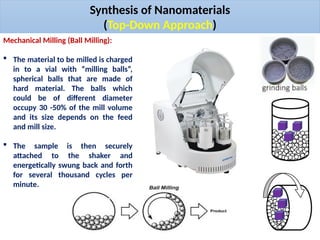
 The material to be milled is charged
in to a vial with “milling balls”,
spherical balls that are made of
hard material. The balls which
could be of different diameter
occupy 30 -50% of the mill volume
and its size depends on the feed
and mill size.
 The sample is then securely
attached to the shaker and
energetically swung back and forth
for several thousand cycles per
minute.
Synthesis of Nanomaterials
(Top-Down Approach)
Mechanical Milling (Ball Milling):
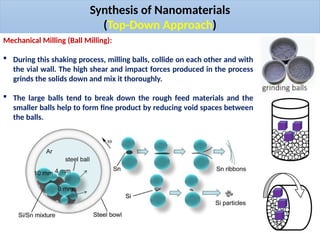
 During this shaking process, milling balls, collide on each other and with
the vial wall. The high shear and impact forces produced in the process
grinds the solids down and mix it thoroughly.
 The large balls tend to break down the rough feed materials and the
smaller balls help to form fine product by reducing void spaces between
the balls.
Synthesis of Nanomaterials
(Top-Down Approach)
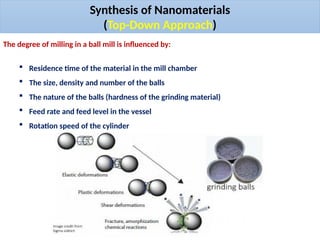
The degree of milling in a ball mill is influenced by:
 Residence time of the material in the mill chamber
 The size, density and number of the balls
 The nature of the balls (hardness of the grinding material)
 Feed rate and feed level in the vessel
 Rotation speed of the cylinder
Advantages
 It produces very fine powder (particle size less than or equal to 10 microns).
 It is suitable for milling toxic materials since it can be used in a completely enclosed form.
 Has a wide application.
 It can be used for continuous operation.
 It is used in milling highly abrasive materials.
Disadvantages
 Contamination of product may occur as a result of wear and tear which occurs principally
from the balls and partially from the casing.
 High machine noise level especially if the hollow cylinder is made of metal, but much less if
rubber is used.
 Relatively long milling time.
 It is difficult to clean the machine after use.
Synthesis of Nanomaterials
(Top-Down Approach)
Synthesis of Nanomaterials
(Bottom-Up Approach)
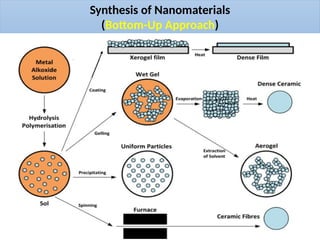
Sol-Gel method:
 Sol–gel method is one of the well-established synthetic approaches to prepare novel metal
oxide “Nanoparticles” as well as mixed oxide “Nano-composites”.
 This method has potential control over the textural and surface properties of the materials.
 Sol–gel method mainly undergoes in few steps to deliver the final metal oxide protocols
and those are hydrolysis, condensation, and drying process.
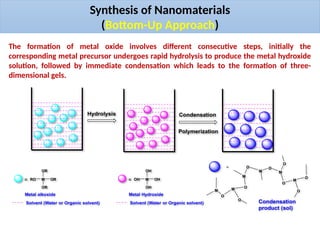
 The formation of metal oxide involves different consecutive steps, initially the
corresponding metal precursor undergoes rapid hydrolysis to produce the metal hydroxide
solution, followed by immediate condensation which leads to the formation of three-
dimensional gels.
 Afterward, obtained gel is subjected to drying process, and the resulting product is readily
converted to Xerogel or Aerogel based on the mode of drying.
 Sol–gel method can be classified into two routes, such as aqueous sol–gel and nonaqueous
sol–gel method depending on the nature of the solvent utilized.
Synthesis of Nanomaterials
(Bottom-Up Approach)
M OR
OR
RO
OR
=
Metal alkoxide
Solvent (Water or Organic solvent)
Hydrolysis
M OH
OH
OH
OH
=
Metal Hydroxide
Solvent (Water or Organic solvent)
O
O
O
O
O
O
M
O
M
M
M
M
M
O
O
Condensation
product (sol)
Condensation
Polymerization
=
The formation of metal oxide involves different consecutive steps, initially the
corresponding metal precursor undergoes rapid hydrolysis to produce the metal hydroxide
solution, followed by immediate condensation which leads to the formation of three-
dimensional gels.
Synthesis of Nanomaterials
(Bottom-Up Approach)
Synthesis of Nanomaterials
(Bottom-Up Approach)
Advantages
 As the process is based on chemical reactions in liquid phase, it is very simple technique.
 It is also cost-effective, as very simple accessories are required for the chemical reaction
and deposition procedures.
 As the deposition is done in liquid phase, the process is versatile enough to produce a large
form of materials starting from aerogel, xerogel, ceramic materials, micro-/nano-powders,
nanostructured thin films, nano- · particles/nano-wires/nano-rods/nano-pillars, etc.
 Due to the chemistry involved in the process, a large range of materials can be deposited
by this procedure.
 Due to the liquid phase deposition, large and complex shaped substrates can also be coated
by this process.
 Possibility of high purity of starting material can also be achieved.
 Precise control over the doping level is also easier in this process.
Synthesis of Nanomaterials
(Bottom-Up Approach)
Disadvantages
 The process is not very ‘clean’. As the process involves chemical reactions between several
ingredients in solution, it contains undesired atoms, molecules, ions, etc., in the required
material, which deteriorates the electrical as well as optical properties of the deposited
material. Therefore, this technique is not compatible with the modern solid-state device
fabrication technique, which is the primary manufacturing process for electronic and
photonic devices.
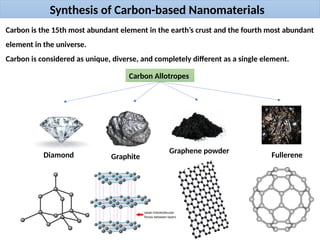
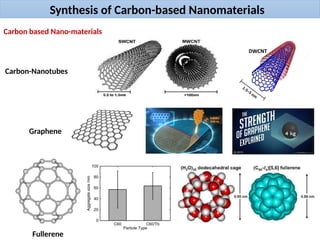
Synthesis of Carbon-based Nanomaterials
Carbon is the 15th most abundant element in the earth’s crust and the fourth most abundant
element in the universe.
Carbon is considered as unique, diverse, and completely different as a single element.
Carbon Allotropes
Diamond Graphite
Graphene powder
Fullerene
Synthesis of Carbon-based Nanomaterials
Carbon based Nano-materials
Carbon-Nanotubes
Graphene
Fullerene
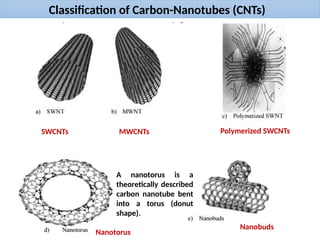
Classification of Carbon-Nanotubes (CNTs)
SWCNTs MWCNTs Polymerized SWCNTs
Nanotorus
Nanobuds
A nanotorus is a
theoretically described
carbon nanotube bent
into a torus (donut
shape).
Synthesis of Carbon-Nanotubes (CNTs)
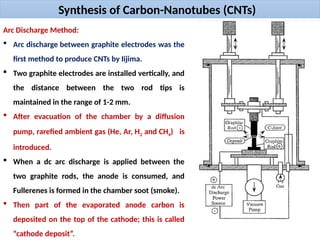
Arc Discharge Method:
 Arc discharge between graphite electrodes was the
first method to produce CNTs by Iijima.
 Two graphite electrodes are installed vertically, and
the distance between the two rod tips is
maintained in the range of 1-2 mm.
 After evacuation of the chamber by a diffusion
pump, rarefied ambient gas (He, Ar, H2 and CH4) is
introduced.
 When a dc arc discharge is applied between the
two graphite rods, the anode is consumed, and
Fullerenes is formed in the chamber soot (smoke).
 Then part of the evaporated anode carbon is
deposited on the top of the cathode; this is called
“cathode deposit”.
Synthesis of Carbon-Nanotubes (CNTs)
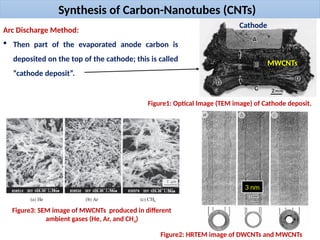
Arc Discharge Method:
 Then part of the evaporated anode carbon is
deposited on the top of the cathode; this is called
“cathode deposit”.
Figure1: Optical Image (TEM image) of Cathode deposit.
Cathode
MWCNTs
Figure2: HRTEM image of DWCNTs and MWCNTs
3 nm
Figure3: SEM image of MWCNTs produced in different
ambient gases (He, Ar, and CH4)
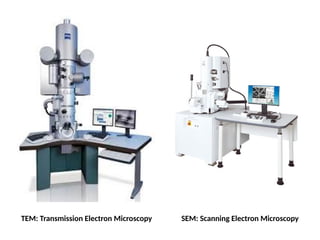
TEM: Transmission Electron Microscopy SEM: Scanning Electron Microscopy
Synthesis of Carbon-Nanotubes (CNTs)
Arc Discharge Method:
 Then part of the evaporated anode carbon is deposited on the top of the cathode; this is
called “cathode deposit”.
 The addition of a catalyst like Fe, Y, S, Ni and Mo leads to the formation of the single-walled
carbon nanotubes (SWCNTs).
Factors influencing the size and structure of CNTs by Arc Discharge Method:
 A number of variables such as
 Temperature of the chamber,
 The composition and concentration of the catalyst
 The presence of ambient gases, etc., influence their size and structure
Advantages of Arc Discharge Method:
 MWCNTs doped with boron and nitrogen can be produced by using the arc discharge
method.
 SWCNT–SWCNT hybrids can be produced by arc discharge in open air at less cost.
Synthesis of Carbon-Nanotubes (CNTs)
Laser Ablation method:
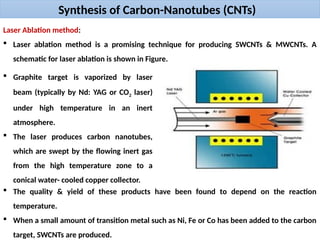
 Laser ablation method is a promising technique for producing SWCNTs & MWCNTs. A
schematic for laser ablation is shown in Figure.
 Graphite target is vaporized by laser
beam (typically by Nd: YAG or CO2 laser)
under high temperature in an inert
atmosphere.
 The laser produces carbon nanotubes,
which are swept by the flowing inert gas
from the high temperature zone to a
conical water- cooled copper collector.
 The quality & yield of these products have been found to depend on the reaction
temperature.
 When a small amount of transition metal such as Ni, Fe or Co has been added to the carbon
target, SWCNTs are produced.
Properties of Carbon-Nanotubes (CNTs)
 Carbon nanotubes have the strongest tensile strength of any material known. It also has
the highest modulus of elasticity.
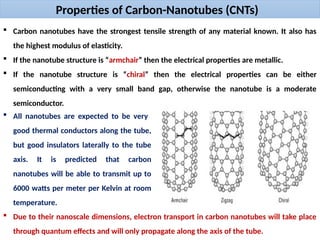
 If the nanotube structure is “armchair” then the electrical properties are metallic.
 If the nanotube structure is “chiral” then the electrical properties can be either
semiconducting with a very small band gap, otherwise the nanotube is a moderate
semiconductor.
 All nanotubes are expected to be very
good thermal conductors along the tube,
but good insulators laterally to the tube
axis. It is predicted that carbon
nanotubes will be able to transmit up to
6000 watts per meter per Kelvin at room
temperature.
 Due to their nanoscale dimensions, electron transport in carbon nanotubes will take place
through quantum effects and will only propagate along the axis of the tube.
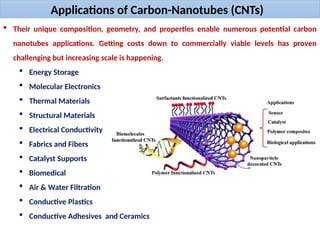
Applications of Carbon-Nanotubes (CNTs)
 Their unique composition, geometry, and properties enable numerous potential carbon
nanotubes applications. Getting costs down to commercially viable levels has proven
challenging but increasing scale is happening.
 Energy Storage
 Molecular Electronics
 Thermal Materials
 Structural Materials
 Electrical Conductivity
 Fabrics and Fibers
 Catalyst Supports
 Biomedical
 Air & Water Filtration
 Conductive Plastics
 Conductive Adhesives and Ceramics
Synthesis of Fullerenes
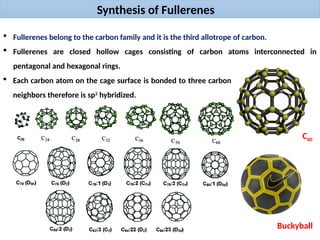
 Fullerenes belong to the carbon family and it is the third allotrope of carbon.
 Fullerenes are closed hollow cages consisting of carbon atoms interconnected in
pentagonal and hexagonal rings.
 Each carbon atom on the cage surface is bonded to three carbon
neighbors therefore is sp2
hybridized.
C60
Buckyball
properties of Fullerenes
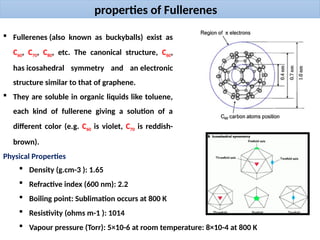
 Fullerenes (also known as buckyballs) exist as
C60, C70, C80, etc. The canonical structure, C60,
has icosahedral symmetry and an electronic
structure similar to that of graphene.
 They are soluble in organic liquids like toluene,
each kind of fullerene giving a solution of a
different color (e.g. C60 is violet, C70 is reddish-
brown).
Physical Properties
 Density (g.cm-3 ): 1.65
 Refractive index (600 nm): 2.2
 Boiling point: Sublimation occurs at 800 K
 Resistivity (ohms m-1 ): 1014
 Vapour pressure (Torr): 5×10⁻⁶ at room temperature: 8×10⁻⁴ at 800 K
Synthesis of Fullerenes
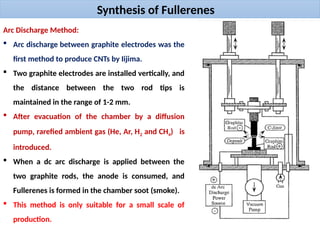
Arc Discharge Method:
 Arc discharge between graphite electrodes was the
first method to produce CNTs by Iijima.
 Two graphite electrodes are installed vertically, and
the distance between the two rod tips is
maintained in the range of 1-2 mm.
 After evacuation of the chamber by a diffusion
pump, rarefied ambient gas (He, Ar, H2 and CH4) is
introduced.
 When a dc arc discharge is applied between the
two graphite rods, the anode is consumed, and
Fullerenes is formed in the chamber soot (smoke).
 This method is only suitable for a small scale of
production.
Synthesis of Fullerenes
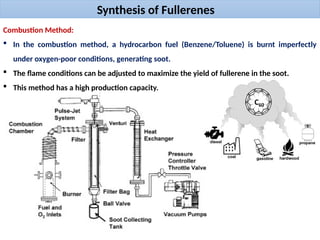
Combustion Method:
 In the combustion method, a hydrocarbon fuel (Benzene/Toluene) is burnt imperfectly
under oxygen-poor conditions, generating soot.
 The flame conditions can be adjusted to maximize the yield of fullerene in the soot.
 This method has a high production capacity.
Applications of Fullerenes
Fullerene (either itself or as a combination with other materials) can be utilized in diverse
applications which majorly include:
 Artificial photosynthesis
 Cosmetics (Personal
Care Products)
 Surface coatings
 Military armor
 Powerful anti-oxidant
 Anti-allergic
 Chemical sensors
 Inhibitor of HIV
 Hollow success–cancer treatment
 Drug/Antibody/Gene-delivery system
 MRI contrast agents
 Photodynamic therapy and X-ray contrast reagents
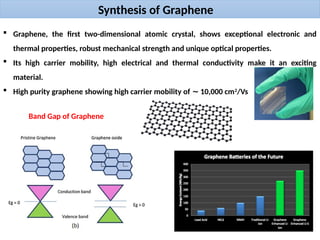
Synthesis of Graphene
 Graphene, the first two-dimensional atomic crystal, shows exceptional electronic and
thermal properties, robust mechanical strength and unique optical properties.
 Its high carrier mobility, high electrical and thermal conductivity make it an exciting
material.
 High purity graphene showing high carrier mobility of 10,000 cm
∼ 2
/Vs
Band Gap of Graphene
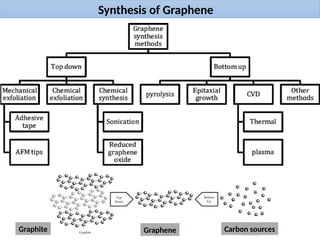
Synthesis of Graphene
Carbon sources
Graphene
Graphite
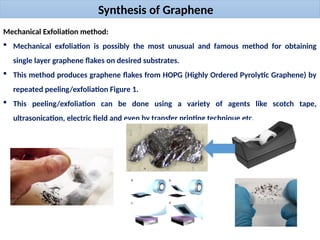
Synthesis of Graphene
Mechanical Exfoliation method:
 Mechanical exfoliation is possibly the most unusual and famous method for obtaining
single layer graphene flakes on desired substrates.
 This method produces graphene flakes from HOPG (Highly Ordered Pyrolytic Graphene) by
repeated peeling/exfoliation Figure 1.
 This peeling/exfoliation can be done using a variety of agents like scotch tape,
ultrasonication, electric field and even by transfer printing technique etc.
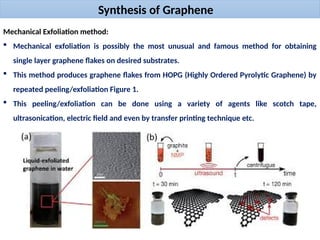
Synthesis of Graphene
Mechanical Exfoliation method:
 Mechanical exfoliation is possibly the most unusual and famous method for obtaining
single layer graphene flakes on desired substrates.
 This method produces graphene flakes from HOPG (Highly Ordered Pyrolytic Graphene) by
repeated peeling/exfoliation Figure 1.
 This peeling/exfoliation can be done using a variety of agents like scotch tape,
ultrasonication, electric field and even by transfer printing technique etc.
Synthesis of Graphene
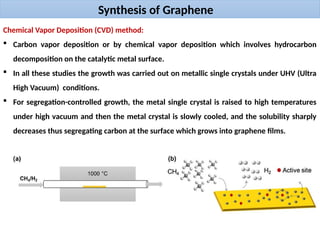
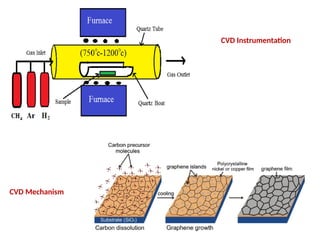
Chemical Vapor Deposition (CVD) method:
 Carbon vapor deposition or by chemical vapor deposition which involves hydrocarbon
decomposition on the catalytic metal surface.
 In all these studies the growth was carried out on metallic single crystals under UHV (Ultra
High Vacuum) conditions.
 For segregation-controlled growth, the metal single crystal is raised to high temperatures
under high vacuum and then the metal crystal is slowly cooled, and the solubility sharply
decreases thus segregating carbon at the surface which grows into graphene films.
CVD Instrumentation
CVD Mechanism
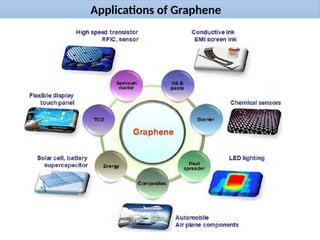
Applications of Graphene
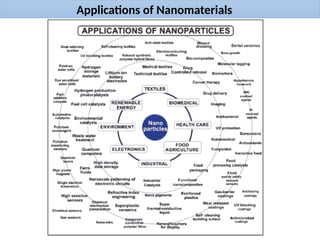
Applications of Nanomaterials

Unit-II Nanomaterials study materi .pptx

  • 1.
  • 2.
    Nano-Scale (1 nm= 10-9 meter) 1 cm = 10 mm = 10 x 1000 mm = 104 x 1000 nm = 107 nm = 107 x 10 Å = 108 Å 1 mm = 1000 mm & 1 mm = 1000 nm & 1 nm = 10 Å = 10 x 10-10 meters = 10-9 meters
  • 3.
    Unit–V: Nanomaterials  Theword “nano” representing very small objects of the range of 1 – 100 nm.  The term “nano” comes from the Greek word “nanos” which means “dwarf (shortness in height)”  The “nanomaterials” primarily include a class of the materials which are of quite small size. 3.4 nm 2.5 nm 10 nm Dwarfism, also known as short stature, occurs when an organism is extremely small. In humans, it is sometimes defined as an adult height of less than 147 centimetres (4 ft 10 in) DNA Nanocircuit
  • 4.
    Introduction What is nanomaterial? Nanomaterials are defined as a class of materials, having at least one spatial dimension between 1 to 100 nm.  1 nm = 10-9 meters 1 nm Dendrimer Graphene Carbon Nanotubes Fullerene Liposome 100 nm 2 D Nanosheet 1 D Nanotubes 3 D Nanoparticles
  • 5.
    Introduction  Nanomaterials canbe metals, ceramics, polymeric materials, or composite materials.  Once you reach nano-dimension, the properties of the materials change as compared to their bulk counter parts.  For example, the bulk form of gold always remains golden in color, where as the color of the gold nanomaterials can be into pink, violet, ruby red etc. depending on the shape, size, synthetic strategies etc.
  • 6.
  • 7.
  • 8.
    Classification of Nanomaterials Nanostructured materials are classified as Zero dimensional, One dimensional, Two dimensional, Three dimensional nanostructures 0 D 1 D 2 D 3 D Quantum dots (QDs) are tiny semiconductor particles a few nanometres in size, having optical and electronic properties that differ from larger particles due to quantum mechanics Zero dimensional
  • 9.
  • 10.
    Classification of Nanomaterials Basedon the Origin Naturally Occurring Incidental / By products Engineered/ Synthetic They are found in nature as results of natural processes Ex: Volcanic Ash & Mineral composites, Dust etc., Which are normally generated from the industrial applications (mostly as by products) Ex: Combustion products, Smoke etc., These are synthesized in labs for specific applications Ex: Nanopolymers, Nanoscale semiconductors etc.,
  • 11.
    Quantum Confinement ofNanomaterials The quantum confinement effect is observed when the size of the particle is too small to be comparable to the wavelength of the electron.
  • 12.
     Quantum Confinementis the spatial confinement of electron-hole pairs (excitons) in one or more dimensions within a material and also electronic energy levels are discrete. It is due to the confinement of the electronic wave function to the physical dimensions of the particles  In summary, discrete energy in atomic physics refers to the specific, quantised energy levels that electrons can occupy within an atom. This concept is a key part of quantum mechanics and is supported by experimental evidence.  Discrete means separate or divided. A discrete unit is a separate part of something larger. A room is a discrete space within a house
  • 13.
    Difference between Quantumand Classical mechanics: Quantum Mechanics Classical Mechanics Matter can exhibit wave properties and waves can exhibit particle properties (wave-particle duality) A wave can exhibit only wave properties, and a matter can exhibit only particle property. Energy of a particle behaviour of a wave is equivalent to the product of a quanta of energy and its frequency, Energy of a classical wave is only dependent on its frequency and amplitude According to Heisenberg's uncertainty principle, a state cannot be prepared in which both the position and momentum of a particle cannot be determined simultaneously. In classical mechanics both the position and momentum of a particle can be easily determined. Quantum mechanics is applicable to microscopic Classical mechanics is applicable to macroscopic particles. In quantum mechanics, there are only stages of energies in an atom. In classical mechanics, the model of an atom contains a central nucleus, which is being revolved by electrons in different shells.
  • 14.
    Quantum Confinement ofNanomaterials The quantum confinement effect is observed when the size of the particle is too small to be comparable to the wavelength of the electron.
  • 15.
    Quantum Confinement ofNanomaterials The quantum confinement effect is observed when the size of the particle is too small to be comparable to the wavelength of the electron.
  • 16.
    Surface to volumeratio of Nanomaterials  The surface to volume ratio of a nanoparticle is defined as the ratio between the surface area and the volume of the nanoparticle.  An increased surface to volume ratio essentially means an increase in surface area of a system per unit volume  In case of nanomaterials, this results in an increase in surface atoms as compared to their bulk counterparts because of difference in the surface energies of bulk and the nanomaterials. This effect has often found responsible for the improved reactivity, stability etc. of nanomaterials.
  • 17.
    Synthesis of Nanomaterials The fabrication of nanomaterials of tailored properties involves the control of  Size,  Shape,  Structure and  Composition.  Fabrication techniques for nanostructures can be broadly divided into two categories: Top‐ down and Bottom up approaches ‐
  • 18.
    Synthesis of Nanomaterials (Top-DownApproach & Bottom-UP Approach) Top-Down Approach Bottom-Up Approach Bulk material Macro particles (Clusters) Nano particles Molecular/Atomic level Nuclei and growth Nano particles  Mechanical Milling  Etching  Laser Ablation  Sputtering  Electro-explosion  Lithography  Sol-Gel Process  Chemical Vapour Deposition  Chemical Reduction  Molecular Condensation  Spinning  Laser Pyrolysis  Green Synthesis
  • 19.
    Synthesis of Nanomaterials (Top-DownApproach) Mechanical Milling (Ball Milling): A ball mill also known as pebble mill or tumbling mill is a milling machine that consists of a hallow cylinder containing balls; mounted on a metallic frame such that it can be rotated along its longitudinal axis. Hallow cylinder containing High density metallic balls longitudinal axis Metallic frame
  • 20.
    Synthesis of Nanomaterials (Top-DownApproach) Mechanical Milling (Ball Milling):  The material to be milled is charged in to a vial with “milling balls”, spherical balls that are made of hard material. The balls which could be of different diameter occupy 30 -50% of the mill volume and its size depends on the feed and mill size.  The sample is then securely attached to the shaker and energetically swung back and forth for several thousand cycles per minute.
  • 21.
    Synthesis of Nanomaterials (Top-DownApproach) Mechanical Milling (Ball Milling):  During this shaking process, milling balls, collide on each other and with the vial wall. The high shear and impact forces produced in the process grinds the solids down and mix it thoroughly.  The large balls tend to break down the rough feed materials and the smaller balls help to form fine product by reducing void spaces between the balls.
  • 22.
    Synthesis of Nanomaterials (Top-DownApproach) The degree of milling in a ball mill is influenced by:  Residence time of the material in the mill chamber  The size, density and number of the balls  The nature of the balls (hardness of the grinding material)  Feed rate and feed level in the vessel  Rotation speed of the cylinder
  • 23.
    Advantages  It producesvery fine powder (particle size less than or equal to 10 microns).  It is suitable for milling toxic materials since it can be used in a completely enclosed form.  Has a wide application.  It can be used for continuous operation.  It is used in milling highly abrasive materials. Disadvantages  Contamination of product may occur as a result of wear and tear which occurs principally from the balls and partially from the casing.  High machine noise level especially if the hollow cylinder is made of metal, but much less if rubber is used.  Relatively long milling time.  It is difficult to clean the machine after use. Synthesis of Nanomaterials (Top-Down Approach)
  • 24.
    Synthesis of Nanomaterials (Bottom-UpApproach) Sol-Gel method:  Sol–gel method is one of the well-established synthetic approaches to prepare novel metal oxide “Nanoparticles” as well as mixed oxide “Nano-composites”.  This method has potential control over the textural and surface properties of the materials.  Sol–gel method mainly undergoes in few steps to deliver the final metal oxide protocols and those are hydrolysis, condensation, and drying process.  The formation of metal oxide involves different consecutive steps, initially the corresponding metal precursor undergoes rapid hydrolysis to produce the metal hydroxide solution, followed by immediate condensation which leads to the formation of three- dimensional gels.  Afterward, obtained gel is subjected to drying process, and the resulting product is readily converted to Xerogel or Aerogel based on the mode of drying.  Sol–gel method can be classified into two routes, such as aqueous sol–gel and nonaqueous sol–gel method depending on the nature of the solvent utilized.
  • 25.
    Synthesis of Nanomaterials (Bottom-UpApproach) M OR OR RO OR = Metal alkoxide Solvent (Water or Organic solvent) Hydrolysis M OH OH OH OH = Metal Hydroxide Solvent (Water or Organic solvent) O O O O O O M O M M M M M O O Condensation product (sol) Condensation Polymerization = The formation of metal oxide involves different consecutive steps, initially the corresponding metal precursor undergoes rapid hydrolysis to produce the metal hydroxide solution, followed by immediate condensation which leads to the formation of three- dimensional gels.
  • 26.
  • 27.
    Synthesis of Nanomaterials (Bottom-UpApproach) Advantages  As the process is based on chemical reactions in liquid phase, it is very simple technique.  It is also cost-effective, as very simple accessories are required for the chemical reaction and deposition procedures.  As the deposition is done in liquid phase, the process is versatile enough to produce a large form of materials starting from aerogel, xerogel, ceramic materials, micro-/nano-powders, nanostructured thin films, nano- · particles/nano-wires/nano-rods/nano-pillars, etc.  Due to the chemistry involved in the process, a large range of materials can be deposited by this procedure.  Due to the liquid phase deposition, large and complex shaped substrates can also be coated by this process.  Possibility of high purity of starting material can also be achieved.  Precise control over the doping level is also easier in this process.
  • 28.
    Synthesis of Nanomaterials (Bottom-UpApproach) Disadvantages  The process is not very ‘clean’. As the process involves chemical reactions between several ingredients in solution, it contains undesired atoms, molecules, ions, etc., in the required material, which deteriorates the electrical as well as optical properties of the deposited material. Therefore, this technique is not compatible with the modern solid-state device fabrication technique, which is the primary manufacturing process for electronic and photonic devices.
  • 29.
    Synthesis of Carbon-basedNanomaterials Carbon is the 15th most abundant element in the earth’s crust and the fourth most abundant element in the universe. Carbon is considered as unique, diverse, and completely different as a single element. Carbon Allotropes Diamond Graphite Graphene powder Fullerene
  • 30.
    Synthesis of Carbon-basedNanomaterials Carbon based Nano-materials Carbon-Nanotubes Graphene Fullerene
  • 31.
    Classification of Carbon-Nanotubes(CNTs) SWCNTs MWCNTs Polymerized SWCNTs Nanotorus Nanobuds A nanotorus is a theoretically described carbon nanotube bent into a torus (donut shape).
  • 32.
    Synthesis of Carbon-Nanotubes(CNTs) Arc Discharge Method:  Arc discharge between graphite electrodes was the first method to produce CNTs by Iijima.  Two graphite electrodes are installed vertically, and the distance between the two rod tips is maintained in the range of 1-2 mm.  After evacuation of the chamber by a diffusion pump, rarefied ambient gas (He, Ar, H2 and CH4) is introduced.  When a dc arc discharge is applied between the two graphite rods, the anode is consumed, and Fullerenes is formed in the chamber soot (smoke).  Then part of the evaporated anode carbon is deposited on the top of the cathode; this is called “cathode deposit”.
  • 33.
    Synthesis of Carbon-Nanotubes(CNTs) Arc Discharge Method:  Then part of the evaporated anode carbon is deposited on the top of the cathode; this is called “cathode deposit”. Figure1: Optical Image (TEM image) of Cathode deposit. Cathode MWCNTs Figure2: HRTEM image of DWCNTs and MWCNTs 3 nm Figure3: SEM image of MWCNTs produced in different ambient gases (He, Ar, and CH4)
  • 34.
    TEM: Transmission ElectronMicroscopy SEM: Scanning Electron Microscopy
  • 35.
    Synthesis of Carbon-Nanotubes(CNTs) Arc Discharge Method:  Then part of the evaporated anode carbon is deposited on the top of the cathode; this is called “cathode deposit”.  The addition of a catalyst like Fe, Y, S, Ni and Mo leads to the formation of the single-walled carbon nanotubes (SWCNTs). Factors influencing the size and structure of CNTs by Arc Discharge Method:  A number of variables such as  Temperature of the chamber,  The composition and concentration of the catalyst  The presence of ambient gases, etc., influence their size and structure Advantages of Arc Discharge Method:  MWCNTs doped with boron and nitrogen can be produced by using the arc discharge method.  SWCNT–SWCNT hybrids can be produced by arc discharge in open air at less cost.
  • 36.
    Synthesis of Carbon-Nanotubes(CNTs) Laser Ablation method:  Laser ablation method is a promising technique for producing SWCNTs & MWCNTs. A schematic for laser ablation is shown in Figure.  Graphite target is vaporized by laser beam (typically by Nd: YAG or CO2 laser) under high temperature in an inert atmosphere.  The laser produces carbon nanotubes, which are swept by the flowing inert gas from the high temperature zone to a conical water- cooled copper collector.  The quality & yield of these products have been found to depend on the reaction temperature.  When a small amount of transition metal such as Ni, Fe or Co has been added to the carbon target, SWCNTs are produced.
  • 37.
    Properties of Carbon-Nanotubes(CNTs)  Carbon nanotubes have the strongest tensile strength of any material known. It also has the highest modulus of elasticity.  If the nanotube structure is “armchair” then the electrical properties are metallic.  If the nanotube structure is “chiral” then the electrical properties can be either semiconducting with a very small band gap, otherwise the nanotube is a moderate semiconductor.  All nanotubes are expected to be very good thermal conductors along the tube, but good insulators laterally to the tube axis. It is predicted that carbon nanotubes will be able to transmit up to 6000 watts per meter per Kelvin at room temperature.  Due to their nanoscale dimensions, electron transport in carbon nanotubes will take place through quantum effects and will only propagate along the axis of the tube.
  • 38.
    Applications of Carbon-Nanotubes(CNTs)  Their unique composition, geometry, and properties enable numerous potential carbon nanotubes applications. Getting costs down to commercially viable levels has proven challenging but increasing scale is happening.  Energy Storage  Molecular Electronics  Thermal Materials  Structural Materials  Electrical Conductivity  Fabrics and Fibers  Catalyst Supports  Biomedical  Air & Water Filtration  Conductive Plastics  Conductive Adhesives and Ceramics
  • 39.
    Synthesis of Fullerenes Fullerenes belong to the carbon family and it is the third allotrope of carbon.  Fullerenes are closed hollow cages consisting of carbon atoms interconnected in pentagonal and hexagonal rings.  Each carbon atom on the cage surface is bonded to three carbon neighbors therefore is sp2 hybridized. C60 Buckyball
  • 40.
    properties of Fullerenes Fullerenes (also known as buckyballs) exist as C60, C70, C80, etc. The canonical structure, C60, has icosahedral symmetry and an electronic structure similar to that of graphene.  They are soluble in organic liquids like toluene, each kind of fullerene giving a solution of a different color (e.g. C60 is violet, C70 is reddish- brown). Physical Properties  Density (g.cm-3 ): 1.65  Refractive index (600 nm): 2.2  Boiling point: Sublimation occurs at 800 K  Resistivity (ohms m-1 ): 1014  Vapour pressure (Torr): 5×10⁻⁶ at room temperature: 8×10⁻⁴ at 800 K
  • 41.
    Synthesis of Fullerenes ArcDischarge Method:  Arc discharge between graphite electrodes was the first method to produce CNTs by Iijima.  Two graphite electrodes are installed vertically, and the distance between the two rod tips is maintained in the range of 1-2 mm.  After evacuation of the chamber by a diffusion pump, rarefied ambient gas (He, Ar, H2 and CH4) is introduced.  When a dc arc discharge is applied between the two graphite rods, the anode is consumed, and Fullerenes is formed in the chamber soot (smoke).  This method is only suitable for a small scale of production.
  • 42.
    Synthesis of Fullerenes CombustionMethod:  In the combustion method, a hydrocarbon fuel (Benzene/Toluene) is burnt imperfectly under oxygen-poor conditions, generating soot.  The flame conditions can be adjusted to maximize the yield of fullerene in the soot.  This method has a high production capacity.
  • 43.
    Applications of Fullerenes Fullerene(either itself or as a combination with other materials) can be utilized in diverse applications which majorly include:  Artificial photosynthesis  Cosmetics (Personal Care Products)  Surface coatings  Military armor  Powerful anti-oxidant  Anti-allergic  Chemical sensors  Inhibitor of HIV  Hollow success–cancer treatment  Drug/Antibody/Gene-delivery system  MRI contrast agents  Photodynamic therapy and X-ray contrast reagents
  • 44.
    Synthesis of Graphene Graphene, the first two-dimensional atomic crystal, shows exceptional electronic and thermal properties, robust mechanical strength and unique optical properties.  Its high carrier mobility, high electrical and thermal conductivity make it an exciting material.  High purity graphene showing high carrier mobility of 10,000 cm ∼ 2 /Vs Band Gap of Graphene
  • 45.
    Synthesis of Graphene Carbonsources Graphene Graphite
  • 46.
    Synthesis of Graphene MechanicalExfoliation method:  Mechanical exfoliation is possibly the most unusual and famous method for obtaining single layer graphene flakes on desired substrates.  This method produces graphene flakes from HOPG (Highly Ordered Pyrolytic Graphene) by repeated peeling/exfoliation Figure 1.  This peeling/exfoliation can be done using a variety of agents like scotch tape, ultrasonication, electric field and even by transfer printing technique etc.
  • 47.
    Synthesis of Graphene MechanicalExfoliation method:  Mechanical exfoliation is possibly the most unusual and famous method for obtaining single layer graphene flakes on desired substrates.  This method produces graphene flakes from HOPG (Highly Ordered Pyrolytic Graphene) by repeated peeling/exfoliation Figure 1.  This peeling/exfoliation can be done using a variety of agents like scotch tape, ultrasonication, electric field and even by transfer printing technique etc.
  • 48.
    Synthesis of Graphene ChemicalVapor Deposition (CVD) method:  Carbon vapor deposition or by chemical vapor deposition which involves hydrocarbon decomposition on the catalytic metal surface.  In all these studies the growth was carried out on metallic single crystals under UHV (Ultra High Vacuum) conditions.  For segregation-controlled growth, the metal single crystal is raised to high temperatures under high vacuum and then the metal crystal is slowly cooled, and the solubility sharply decreases thus segregating carbon at the surface which grows into graphene films.
  • 49.
  • 50.
  • 51.