GANDHINAGAR INSTITUTE OF
TECHONOLOGY(012)
SUBJECT : Production Technology
(2161909)
Active Learning Assignment on the topic of
“Laser Beam Machining”
BE Mechanical
Prepared By:
Guided By : Prof. Chintan Barelwala
OVERVIEW
 Introduction of LBM
 Operations
 Advantages
 Disadvantages
 Reference
What is LASER?
 LASER stands for Light Amplified Stimulated Emission of
Radiation.
 Laser is a device which generates or amplifies light.
 Stimulated emission of electromagnetic radiation.
 Coherent, monochromatic, directional and high power laser
beam is used.
Laser Beam Machining
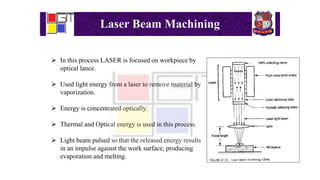
 In this process LASER is focused on workpiece by
optical lance.
 Used light energy from a laser to remove material by
vaporization.
 Energy is concentrated optically.
 Thermal and Optical energy is used in this process.
 Light beam pulsed so that the released energy results
in an impulse against the work surface, producing
evaporation and melting.
Operation: Laser Cutting
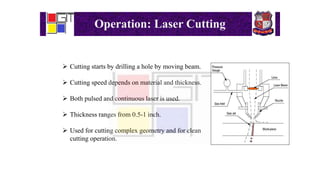
 Cutting starts by drilling a hole by moving beam.
 Cutting speed depends on material and thickness.
 Both pulsed and continuous laser is used.
 Thickness ranges from 0.5-1 inch.
 Used for cutting complex geometry and for clean
cutting operation.
Operation: Laser Welding
 For welding ceramics and dissimilar materials like
steel and aluminium.
 Produces maximum penetration and minimum
distortion in materials.
 Beam can be easily shaped, focused and directed.
 Application:
 Razor Blade
 Electronic Circuit
Operation: Laser Cladding
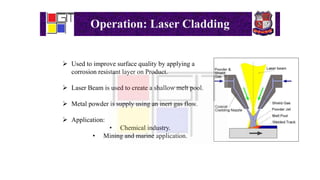
 Used to improve surface quality by applying a
corrosion resistant layer on Product.
 Laser Beam is used to create a shallow melt pool.
 Metal powder is supply using an inert gas flow.
 Application:
• Chemical industry.
• Mining and marine application.
Advantages
 Non Contact.
 No solvent chemical.
 Machining of Hard & soft material.
 Flexibility.
 Fully automated.
Disadvantages
 Requires specially trained operators.
 This process is very slow.
 Expensive equipment.
 Consumes much energy.
Thank You

Laser beam machining

  • 1.
    GANDHINAGAR INSTITUTE OF TECHONOLOGY(012) SUBJECT: Production Technology (2161909) Active Learning Assignment on the topic of “Laser Beam Machining” BE Mechanical Prepared By: Guided By : Prof. Chintan Barelwala
  • 2.
    OVERVIEW  Introduction ofLBM  Operations  Advantages  Disadvantages  Reference
  • 3.
    What is LASER? LASER stands for Light Amplified Stimulated Emission of Radiation.  Laser is a device which generates or amplifies light.  Stimulated emission of electromagnetic radiation.  Coherent, monochromatic, directional and high power laser beam is used.
  • 4.
    Laser Beam Machining In this process LASER is focused on workpiece by optical lance.  Used light energy from a laser to remove material by vaporization.  Energy is concentrated optically.  Thermal and Optical energy is used in this process.  Light beam pulsed so that the released energy results in an impulse against the work surface, producing evaporation and melting.
  • 5.
    Operation: Laser Cutting Cutting starts by drilling a hole by moving beam.  Cutting speed depends on material and thickness.  Both pulsed and continuous laser is used.  Thickness ranges from 0.5-1 inch.  Used for cutting complex geometry and for clean cutting operation.
  • 6.
    Operation: Laser Welding For welding ceramics and dissimilar materials like steel and aluminium.  Produces maximum penetration and minimum distortion in materials.  Beam can be easily shaped, focused and directed.  Application:  Razor Blade  Electronic Circuit
  • 7.
    Operation: Laser Cladding Used to improve surface quality by applying a corrosion resistant layer on Product.  Laser Beam is used to create a shallow melt pool.  Metal powder is supply using an inert gas flow.  Application: • Chemical industry. • Mining and marine application.
  • 8.
    Advantages  Non Contact. No solvent chemical.  Machining of Hard & soft material.  Flexibility.  Fully automated.
  • 9.
    Disadvantages  Requires speciallytrained operators.  This process is very slow.  Expensive equipment.  Consumes much energy.
  • 10.