UNIVERSITY OF GONDAR
SCHOOL OF TECHNOLOGY
MECHANICAL DEPARTMENT
INSTRUMENTATION AND MEASUREMENT
MEng3261 Cr-3hr
1
CHAPTER-1
INTRODUCTION
2
1.1 INTRODUCTION TO MEASUREMENT
 Measurements has become a natural part of our
everyday life.
 Taking measurements in industry constitute 10-15%
of production cost.
 It is well-known saying that knowledge about
anything is complete only when it can be expressed
in numbers & something is known about it.
3
1. INTRODUCTION
1. INTRODUCTION….
WHAT IS MEASUREMENT:
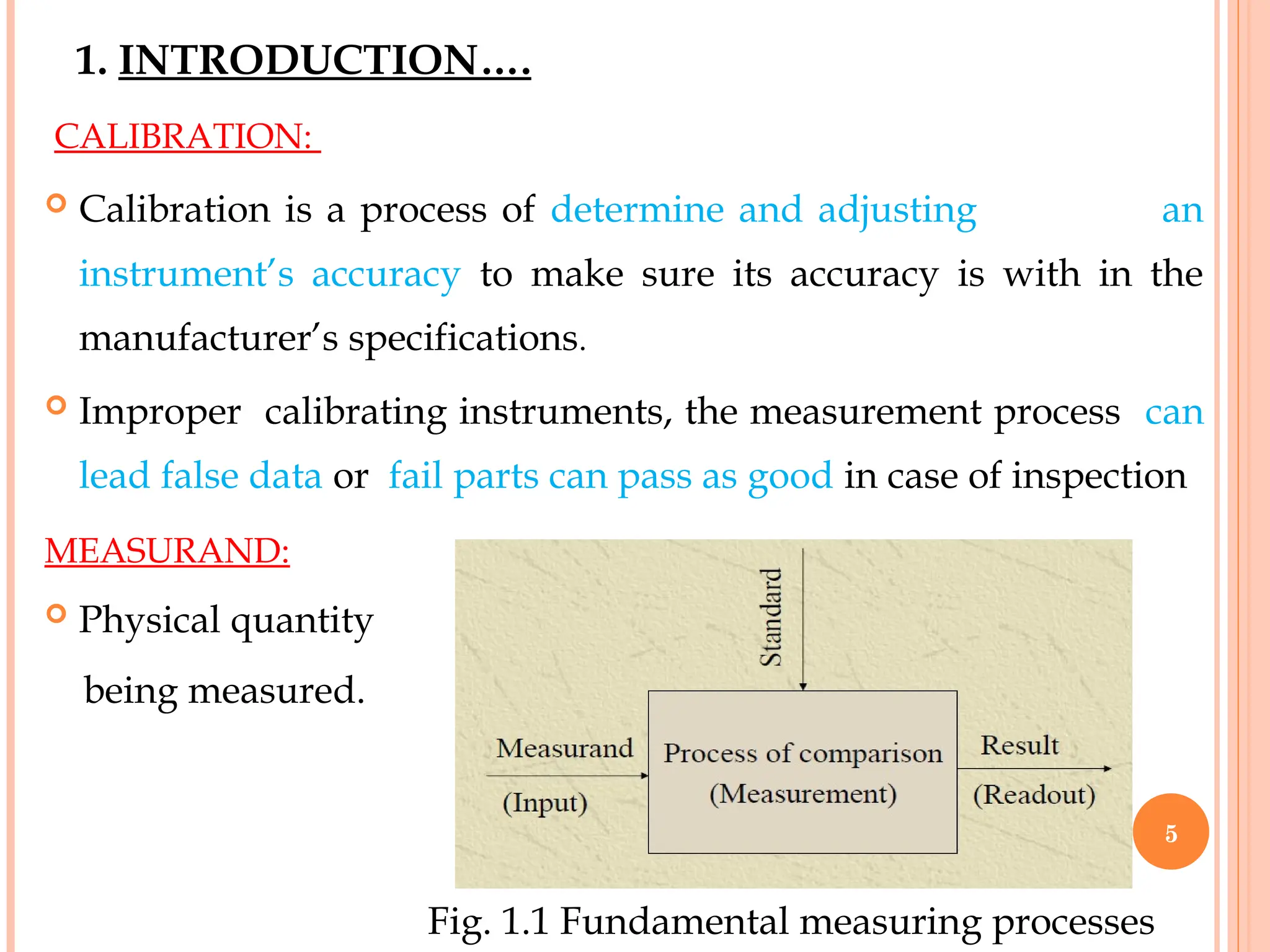
 Measurement is a procedure in which an unknown quantity is compared
with a known standard, using an accepted and consistent system of units.
 Measurement is a word used to tell us about physical quantities such as
length, weight, temperature, pressure, force, etc…
 In modern technology, the measurement quantity are not necessarily
carried out only by mechanical means, it involves the use of electrical
and electronic techniques.
4
1. INTRODUCTION….
CALIBRATION:
 Calibration is a process of determine and adjusting an
instrument’s accuracy to make sure its accuracy is with in the
manufacturer’s specifications.
 Improper calibrating instruments, the measurement process can
lead false data or fail parts can pass as good in case of inspection
MEASURAND:
 Physical quantity
being measured.
Fig. 1.1 Fundamental measuring processes
5
 To study some basic laws of nature
 To check the limitation of theory in practical situation.
 To meet the interchangeability of manufacture.
 To provide customer satisfaction by ensuring that no faulty product
reaches the customers.
 To judge the possibility of making some of the defective parts
acceptable after minor repairs.
 To coordinate the functions of quality control, production,
procurement & other departments of the organization.
1.2 NEED FOR MEASUREMENT
6
1.3 SIGNIFICANCE OF MEASUREMENT
 Measurement provides the fundamental basis for research and
development activities. In research activity, the experimental part is
based on measurement.
 Measurement is fundamental element of any automatic control
system.
 Measurement is used to evaluate the performance of any plant or
process.
 Measurement is also the basis for commercial activities such as
production, pricing, sale and purchase.
7
 A known accurate measure of physical quantity is termed as
standard.
 Different standards have been developed for various units
including fundamental as well as derived units.
 The standards of measurement are classified
1. International standards
2. Primary standards
3. Secondary standards
4. Working standards
1.4 STANDARD OF MEASUREMENT
8
1. International standards
o International Standard are defined by international
agreements.
o These international standards are not available to
ordinary uses like measurement and calibrations.
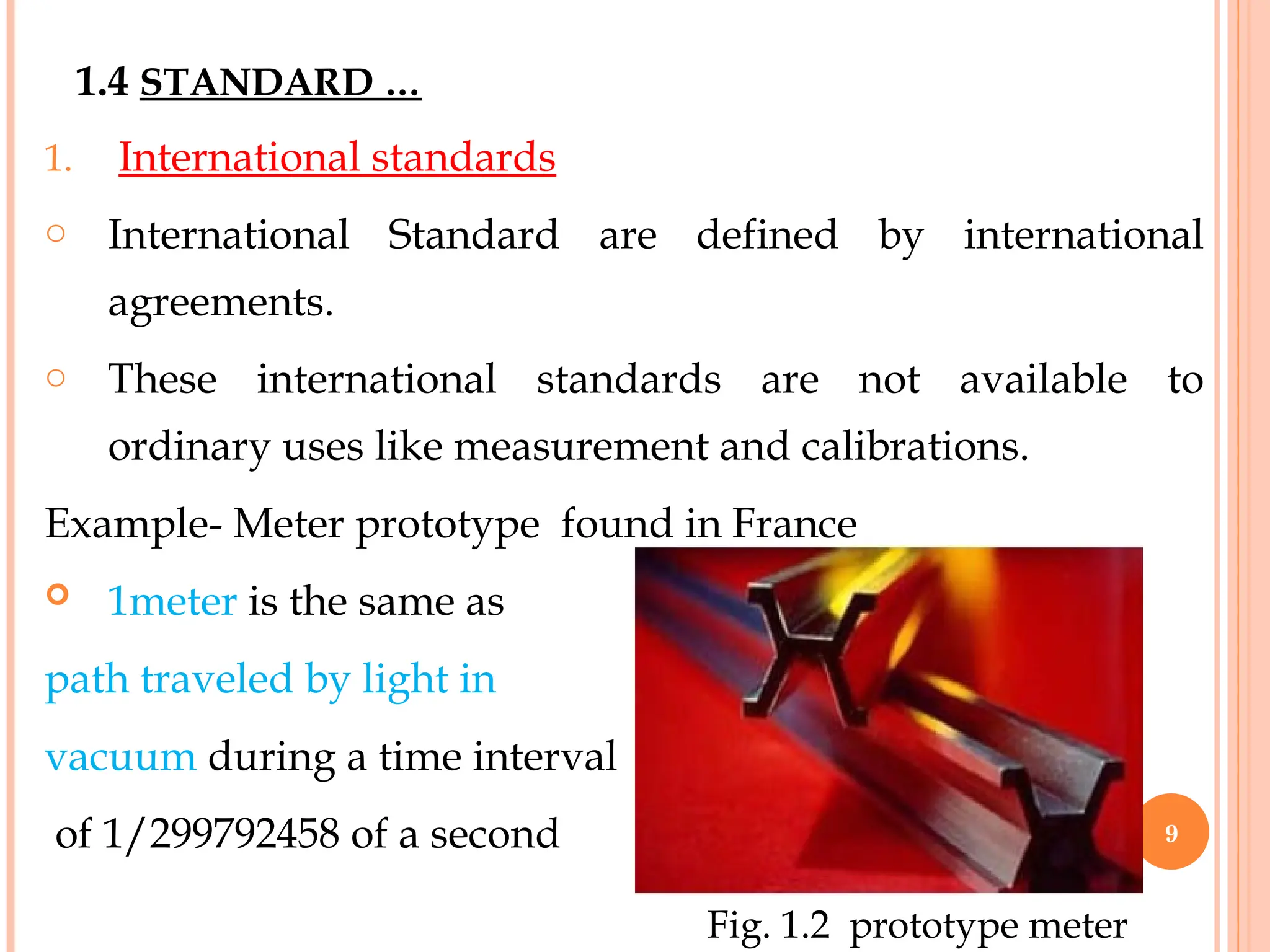
Example- Meter prototype found in France
 1meter is the same as
path traveled by light in
vacuum during a time interval
of 1/299792458 of a second
1.4 STANDARD …
Fig. 1.2 prototype meter
9
2. Primary standards
 These standards are copies of international prototype
and kept throughout the world in national standard
laboratory. The primary standards are not available for
use outside the national laboratories.
 The primary standard used as a reference for the
purpose of verification and calibration of secondary
standards.
 The characteristics of primary standards are long time
stability, rigidity of construction, accuracy of machining.
1.4 STANDARD …
10
3. Secondary standards
 The secondary standard designed and calibrated from
primary standards.
 These standards periodically sent to the national standard
laboratories for their calibration. After comparison and
calibration, the national standards laboratory returns the
secondary standards to the particular industrial laboratory
with certification.
 These standards are kept by the measurement laboratories
and the industrial organization to check and calibrate the
general tools for their accuracy and precision.
1.4 STANDARD …
11
4. Working standards
 Working standards are the main tools of a measuring
laboratory. These standards are used to check and
calibrate the laboratory instruments for accuracy and
performance.
 These standards are used by the worker and the
technicians who actually carry out the measurements.
1.4 STANDARD …
12
1.4 STANDARD …
Fig.1.3 Hierarchy of standards
13
The two broad classification of method of measurement
1. Direct comparison method:
In this method the parameter to be measured is
directly compared with either a primary or secondary
standards. Direct method is common for the
measurement of physical quantities like length, mass,
time etc.
1.5 METHODS OF MEASUREMENT
14
2. Indirect comparison method:
o Indirect method for measurements are used in those
cases where the direct measurement is difficult.
o Indirect comparison use some form of transducing
device which converts the quantity to be measured in
to analogous signal. The analogous signal is then
processed by intermediate device and displayed on the
output device.
1.4 METHODS …
15
Some other method of measurement
3. Comparative comparison method:
In this method, the quantity to be measured is compared with other known value
Example: comparator
4. Contact comparison method:
the sensor or measuring tip of the instrument touches the area, diameter or surface
to be measured
Example: Vernier caliper
1.4 METHODS …
16
5. Complementary comparison method:
The value of the quantity to be measured is combined with a known value of
the same quantity,
Example: Determination of the volume of a solid by
liquid displacement
6. Deflection comparison method:
the value to be measured is directly indicated by a deflection of pointer
Example: pressure measurement
1.4 METHODS …
17
Measurements may be classified as primary, secondary &
tertiary based on the complexity of the measurement system
1. Primary measurement: any physical parameter are measured by comparing directly with reference standards.
Example: -Measurements of time by counting the no. of
strokes a clock.
-Matching of two lengths when determining the
length of an object with a meter road.
- Matching of two weights when determining
the mass of items.
1.5 MODES OF MEASUREMENT
18
2. Secondary measurement: A secondary measurement involves only one
translation to be done on the quantity under the measurement.
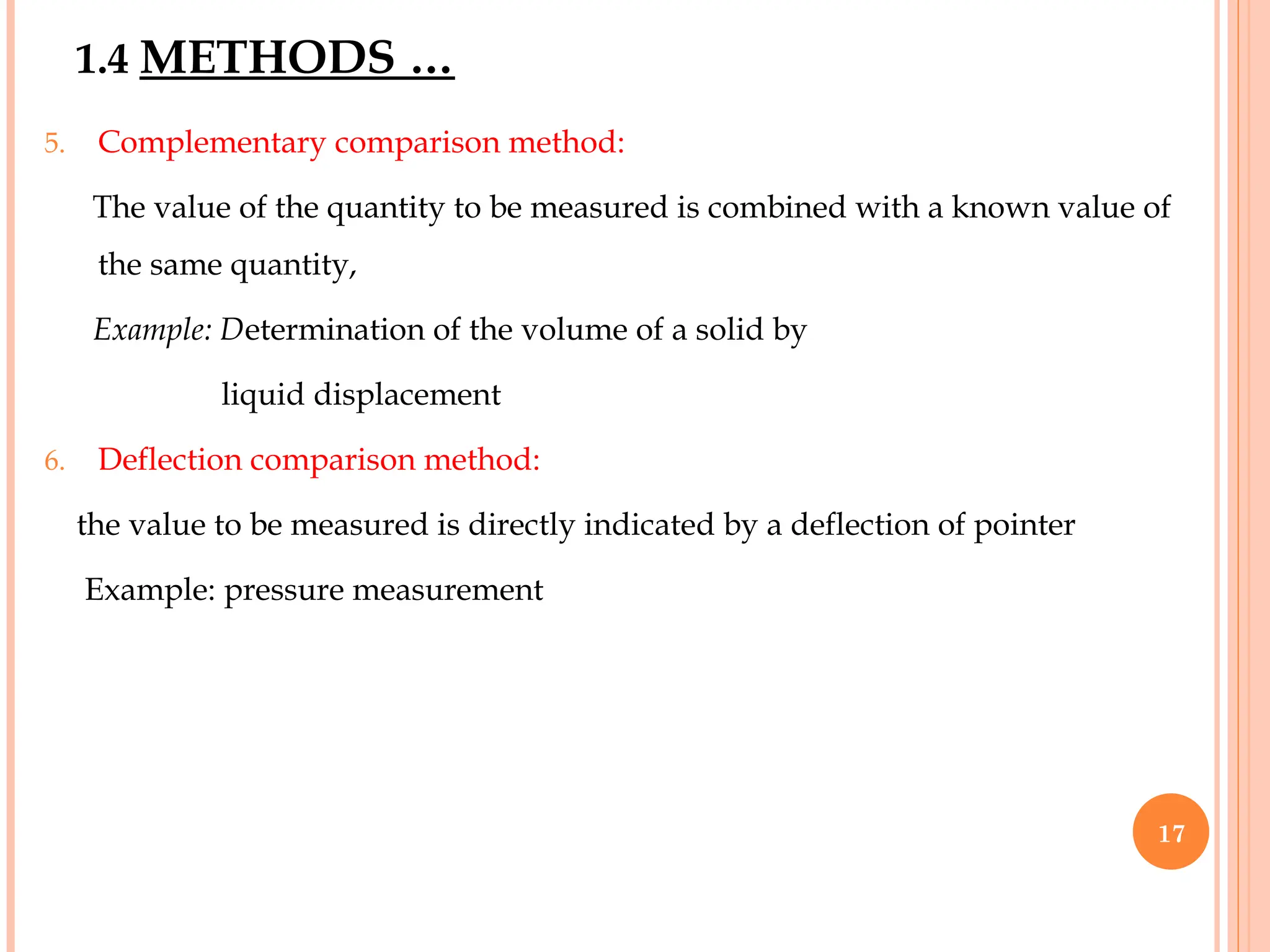
Example: if we want to measure the pressure of a gas in a container, it
may not be observable. Therefore it requires. - An instrument
to convert pressure in to displacement &
- The change in displacement units equivalent to known
change in pressure.
1.5 MODES OF…
Fig. 1.4 U Tube manometer
19
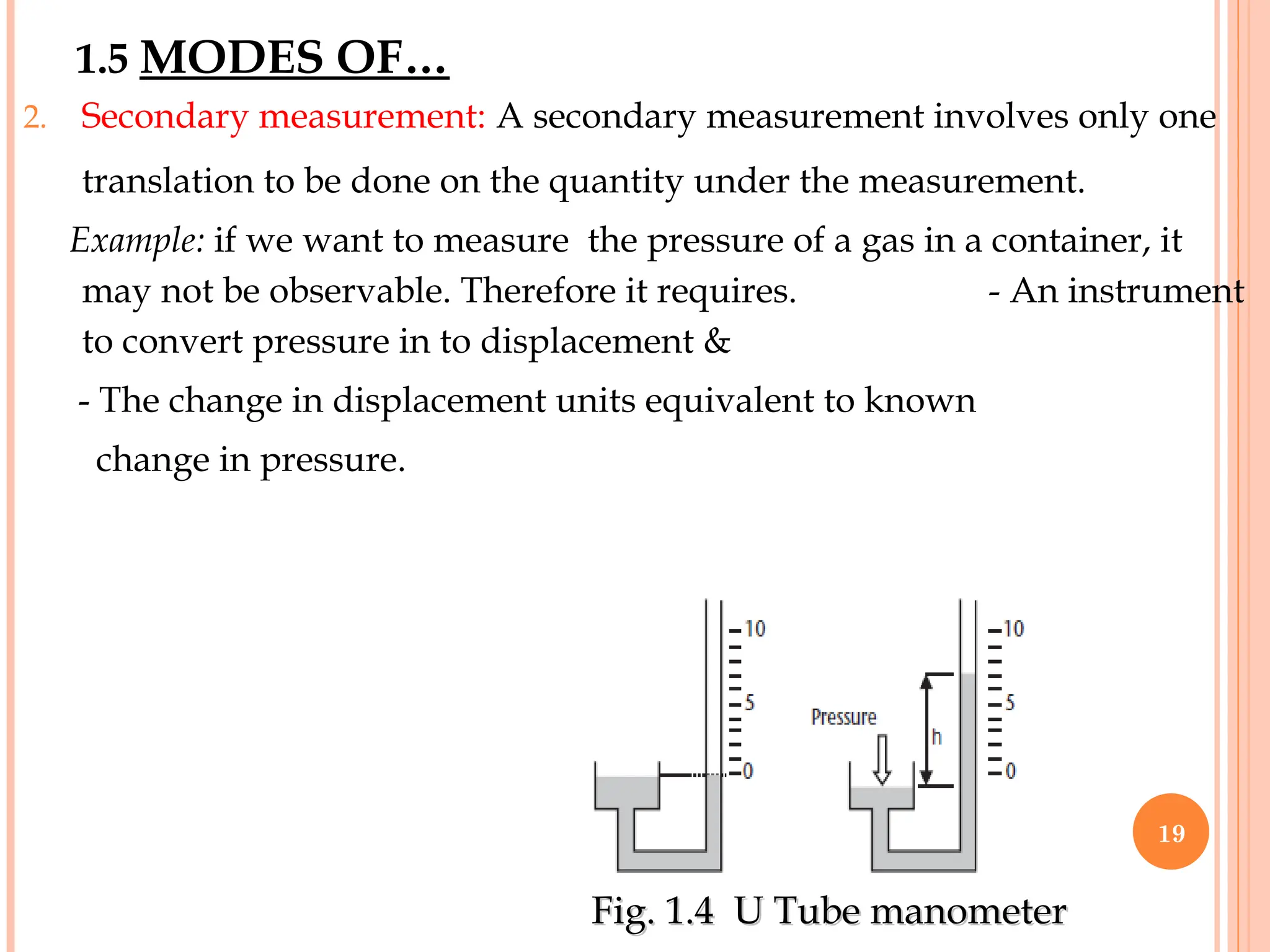
3. Tertiary measurement: A tertiary measurement involves two
translations.
-The measurement of static pressure by bourdon tube pressure
gauge. During the measurement of pressure, the free end
deflects slightly. This small deflection is made larger by using
rack and pinion arrangement for better displaying and
reading.
1.5 MODES OF…
Fig. 1.5 Bourdon tube
20
1.6 UNITS OF MEASUREMENT
 To specify and perform calculations with physical quantities, the
physical quantities must be defined both in kind and magnitude.
The standard measuring of each kind of physical quantity is the
unit.
 There are different system of units available in different countries
but for the sake of uniformity units all over the world, S.I units
(system international units ) has been developed. The S.I units are
divided in to three categories
1. Fundamental units
2. Supplementary units
3. Derived units 21
1.6 UNITS OF...
1. Fundamental units: fundamental units are not dependent
on any other units. It is also call as base unit. The seven
fundamental units.
Table1.1 Fundamental units
22
No. Quantities standard unit symbol
1. Length meter m
2. Mass kilogram kg
3. Time second s
4. Electric current ampere A
5. Temperature kelvin K
6. Amount of substance mole mol
7. Luminous intensity candela cd
1.6 UNITS OF...
1. Fundamental units: fundamental units are not dependent
on any other units. It is also call as base unit. The seven
fundamental units.
Table1.1 Fundamental units
No. Quantities standard unit symbol
1. Length meter m
2. Mass kilogram kg
3. Time second s
4. Electric current ampere A
5. Temperature kelvin K
6. Amount of substance mole mol
7. Luminous intensity candela cd
23
1.6 UNITS OF...
2. Supplementary units: there are two supplementary units
added to the S.I. unit system in addition to fundamental
units
Table1.2 Supplementary units
No. Quantities Standard unit Symbol
1. Plane angle radian rad
2. Solid angle steradian sr
24
1.6 UNITS OF...
3. Derived units: The derived units are expressed in terms of
the fundamental and supplementary units by defining
equations. These derived units can be categorized as follows.
Table1.3 Derived units
No. Quantities Standard unit Symbol
1. Area Square meter m2
2. Volume Cubic meter m2
3. Velocity Meter per second m/s
4. Density Kilogram per cubic meter Kg/m3
5. Force Newton N
6. pressure Pascal Pa
7. Work, Energy Joule J(N.m)
25
1.7 MEASURING INSTRUMENTS
 Instruments classified based on their application, mode of
operation, manner of energy conversion, and the nature of
output signal is given below
1. Deflection and null type instruments
2. Analog and digital instruments
3. Active and passive type instruments
4. Manual and automatic instruments
5. Absolute and secondary instruments
6. Contacting and non-contacting instruments
26
1.6 MEASURING ...
1. Deflection and null type instruments
 In a deflection type instrument, the measured quantity generates
some effect which can be ultimately related by the deflection of a
pointer displayed as a number, to its magnitude.
 Consider simple example of measuring the weight.
The weight of the object is indicated by the
deflection or movement of a pointer on a
graduated scale. In this case the weight of
the object generates the effect of elongation
of spring which is indicated by a pointer
on scale
Fig. 1.7 Spring balance
27
1.6 MEASURING ...
1. Deflection and null type instruments
 In null type instruments, the effect caused by the quantity to be
measured is nullified. The required nullifying effect provides a
measure of the magnitude quantity being measured.
 Consider the measurement of weight by beam balance
The unknown weight placed in one side
causes the beam and the pointer to deflect.
Weights of known value are placed on the
other side till a balanced or null condition
is indicated by the pointer.
Null type instrument more accurate and
sensitive than deflective type instruments.
Fig. 1.8 Beam balance
28
1.6 MEASURING ...
2. Analog and Digital instruments
 The analog instrument gives the output which varies in a continuous
manner as the quantity being measured changes, and can take infinite
values in a given range.
Example: voltmeter, ammeter, pressure gauge , fuel gauge etc
 The digital instrument give the output which varies in a discrete steps
and can take only finite number of values in a given range. The output
of a digital instrument is generally displayed numerically as digits.
 The digital devices have the following advantage
 High accuracy, Elimination of observational error etc…
29
1.6 MEASURING ...
3. Active and passive type instruments
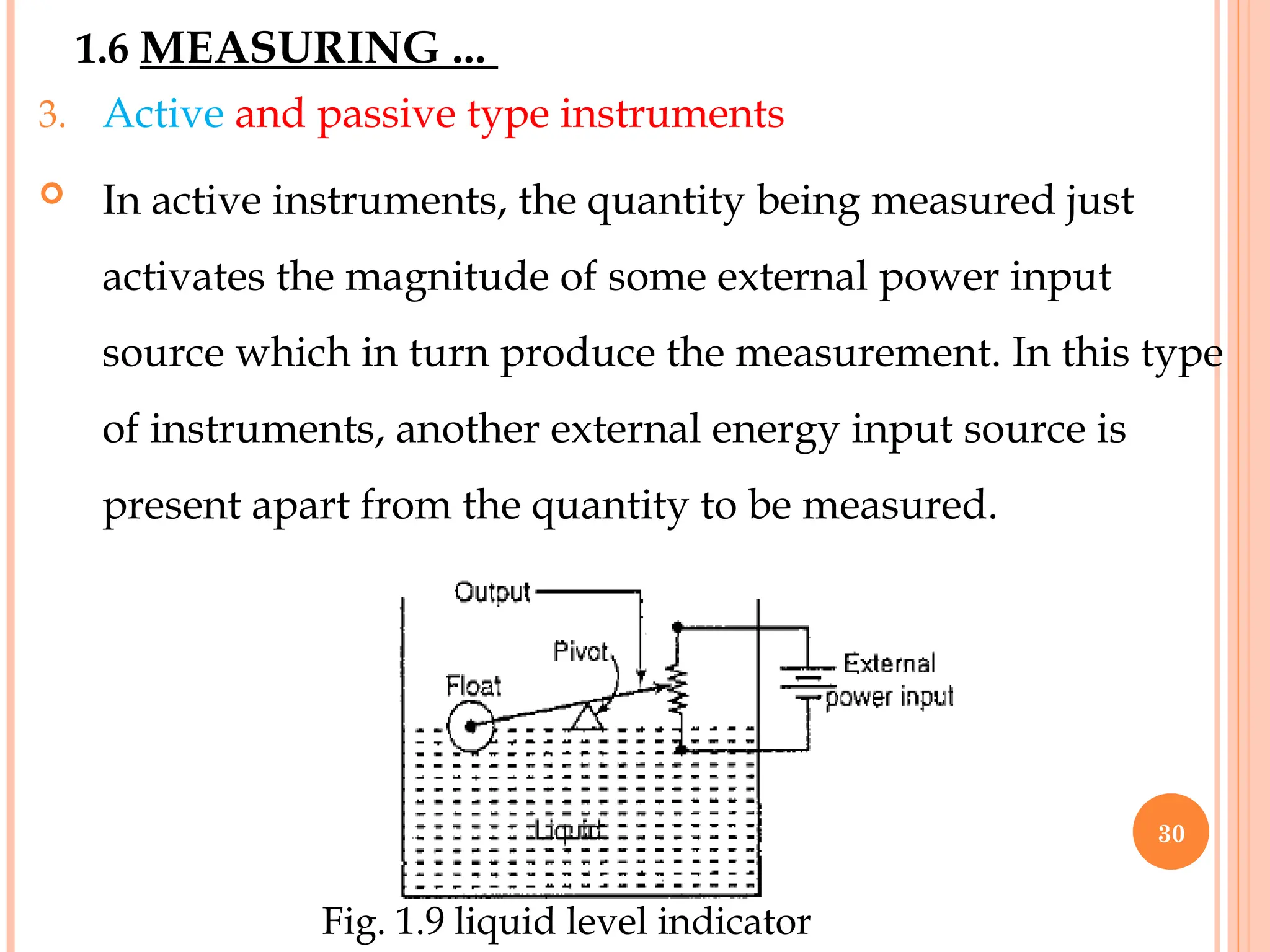
 In active instruments, the quantity being measured just
activates the magnitude of some external power input
source which in turn produce the measurement. In this type
of instruments, another external energy input source is
present apart from the quantity to be measured.
Fig. 1.9 liquid level indicator
30
1.6 MEASURING ...
3. Active and passive type instruments
 In passive type instruments, output is produced entirely
by quantity being measured. The resolution of the passive
instrument is less and cannot increased easily.
 But in the case of active
instrument, the control
over resolution can be
achieved by adjusting
the magnitude of the
external energy input
Fig. 1.9 liquid level indicator
31
THANK YOU!!
32

instrumentation and Measurement chapters

  • 1.
    UNIVERSITY OF GONDAR SCHOOLOF TECHNOLOGY MECHANICAL DEPARTMENT INSTRUMENTATION AND MEASUREMENT MEng3261 Cr-3hr 1
  • 2.
  • 3.
    1.1 INTRODUCTION TOMEASUREMENT  Measurements has become a natural part of our everyday life.  Taking measurements in industry constitute 10-15% of production cost.  It is well-known saying that knowledge about anything is complete only when it can be expressed in numbers & something is known about it. 3 1. INTRODUCTION
  • 4.
    1. INTRODUCTION…. WHAT ISMEASUREMENT:  Measurement is a procedure in which an unknown quantity is compared with a known standard, using an accepted and consistent system of units.  Measurement is a word used to tell us about physical quantities such as length, weight, temperature, pressure, force, etc…  In modern technology, the measurement quantity are not necessarily carried out only by mechanical means, it involves the use of electrical and electronic techniques. 4
  • 5.
    1. INTRODUCTION…. CALIBRATION:  Calibrationis a process of determine and adjusting an instrument’s accuracy to make sure its accuracy is with in the manufacturer’s specifications.  Improper calibrating instruments, the measurement process can lead false data or fail parts can pass as good in case of inspection MEASURAND:  Physical quantity being measured. Fig. 1.1 Fundamental measuring processes 5
  • 6.
     To studysome basic laws of nature  To check the limitation of theory in practical situation.  To meet the interchangeability of manufacture.  To provide customer satisfaction by ensuring that no faulty product reaches the customers.  To judge the possibility of making some of the defective parts acceptable after minor repairs.  To coordinate the functions of quality control, production, procurement & other departments of the organization. 1.2 NEED FOR MEASUREMENT 6
  • 7.
    1.3 SIGNIFICANCE OFMEASUREMENT  Measurement provides the fundamental basis for research and development activities. In research activity, the experimental part is based on measurement.  Measurement is fundamental element of any automatic control system.  Measurement is used to evaluate the performance of any plant or process.  Measurement is also the basis for commercial activities such as production, pricing, sale and purchase. 7
  • 8.
     A knownaccurate measure of physical quantity is termed as standard.  Different standards have been developed for various units including fundamental as well as derived units.  The standards of measurement are classified 1. International standards 2. Primary standards 3. Secondary standards 4. Working standards 1.4 STANDARD OF MEASUREMENT 8
  • 9.
    1. International standards oInternational Standard are defined by international agreements. o These international standards are not available to ordinary uses like measurement and calibrations. Example- Meter prototype found in France  1meter is the same as path traveled by light in vacuum during a time interval of 1/299792458 of a second 1.4 STANDARD … Fig. 1.2 prototype meter 9
  • 10.
    2. Primary standards These standards are copies of international prototype and kept throughout the world in national standard laboratory. The primary standards are not available for use outside the national laboratories.  The primary standard used as a reference for the purpose of verification and calibration of secondary standards.  The characteristics of primary standards are long time stability, rigidity of construction, accuracy of machining. 1.4 STANDARD … 10
  • 11.
    3. Secondary standards The secondary standard designed and calibrated from primary standards.  These standards periodically sent to the national standard laboratories for their calibration. After comparison and calibration, the national standards laboratory returns the secondary standards to the particular industrial laboratory with certification.  These standards are kept by the measurement laboratories and the industrial organization to check and calibrate the general tools for their accuracy and precision. 1.4 STANDARD … 11
  • 12.
    4. Working standards Working standards are the main tools of a measuring laboratory. These standards are used to check and calibrate the laboratory instruments for accuracy and performance.  These standards are used by the worker and the technicians who actually carry out the measurements. 1.4 STANDARD … 12
  • 13.
    1.4 STANDARD … Fig.1.3Hierarchy of standards 13
  • 14.
    The two broadclassification of method of measurement 1. Direct comparison method: In this method the parameter to be measured is directly compared with either a primary or secondary standards. Direct method is common for the measurement of physical quantities like length, mass, time etc. 1.5 METHODS OF MEASUREMENT 14
  • 15.
    2. Indirect comparisonmethod: o Indirect method for measurements are used in those cases where the direct measurement is difficult. o Indirect comparison use some form of transducing device which converts the quantity to be measured in to analogous signal. The analogous signal is then processed by intermediate device and displayed on the output device. 1.4 METHODS … 15
  • 16.
    Some other methodof measurement 3. Comparative comparison method: In this method, the quantity to be measured is compared with other known value Example: comparator 4. Contact comparison method: the sensor or measuring tip of the instrument touches the area, diameter or surface to be measured Example: Vernier caliper 1.4 METHODS … 16
  • 17.
    5. Complementary comparisonmethod: The value of the quantity to be measured is combined with a known value of the same quantity, Example: Determination of the volume of a solid by liquid displacement 6. Deflection comparison method: the value to be measured is directly indicated by a deflection of pointer Example: pressure measurement 1.4 METHODS … 17
  • 18.
    Measurements may beclassified as primary, secondary & tertiary based on the complexity of the measurement system 1. Primary measurement: any physical parameter are measured by comparing directly with reference standards. Example: -Measurements of time by counting the no. of strokes a clock. -Matching of two lengths when determining the length of an object with a meter road. - Matching of two weights when determining the mass of items. 1.5 MODES OF MEASUREMENT 18
  • 19.
    2. Secondary measurement:A secondary measurement involves only one translation to be done on the quantity under the measurement. Example: if we want to measure the pressure of a gas in a container, it may not be observable. Therefore it requires. - An instrument to convert pressure in to displacement & - The change in displacement units equivalent to known change in pressure. 1.5 MODES OF… Fig. 1.4 U Tube manometer Fig. 1.4 U Tube manometer 19
  • 20.
    3. Tertiary measurement:A tertiary measurement involves two translations. -The measurement of static pressure by bourdon tube pressure gauge. During the measurement of pressure, the free end deflects slightly. This small deflection is made larger by using rack and pinion arrangement for better displaying and reading. 1.5 MODES OF… Fig. 1.5 Bourdon tube 20
  • 21.
    1.6 UNITS OFMEASUREMENT  To specify and perform calculations with physical quantities, the physical quantities must be defined both in kind and magnitude. The standard measuring of each kind of physical quantity is the unit.  There are different system of units available in different countries but for the sake of uniformity units all over the world, S.I units (system international units ) has been developed. The S.I units are divided in to three categories 1. Fundamental units 2. Supplementary units 3. Derived units 21
  • 22.
    1.6 UNITS OF... 1.Fundamental units: fundamental units are not dependent on any other units. It is also call as base unit. The seven fundamental units. Table1.1 Fundamental units 22 No. Quantities standard unit symbol 1. Length meter m 2. Mass kilogram kg 3. Time second s 4. Electric current ampere A 5. Temperature kelvin K 6. Amount of substance mole mol 7. Luminous intensity candela cd
  • 23.
    1.6 UNITS OF... 1.Fundamental units: fundamental units are not dependent on any other units. It is also call as base unit. The seven fundamental units. Table1.1 Fundamental units No. Quantities standard unit symbol 1. Length meter m 2. Mass kilogram kg 3. Time second s 4. Electric current ampere A 5. Temperature kelvin K 6. Amount of substance mole mol 7. Luminous intensity candela cd 23
  • 24.
    1.6 UNITS OF... 2.Supplementary units: there are two supplementary units added to the S.I. unit system in addition to fundamental units Table1.2 Supplementary units No. Quantities Standard unit Symbol 1. Plane angle radian rad 2. Solid angle steradian sr 24
  • 25.
    1.6 UNITS OF... 3.Derived units: The derived units are expressed in terms of the fundamental and supplementary units by defining equations. These derived units can be categorized as follows. Table1.3 Derived units No. Quantities Standard unit Symbol 1. Area Square meter m2 2. Volume Cubic meter m2 3. Velocity Meter per second m/s 4. Density Kilogram per cubic meter Kg/m3 5. Force Newton N 6. pressure Pascal Pa 7. Work, Energy Joule J(N.m) 25
  • 26.
    1.7 MEASURING INSTRUMENTS Instruments classified based on their application, mode of operation, manner of energy conversion, and the nature of output signal is given below 1. Deflection and null type instruments 2. Analog and digital instruments 3. Active and passive type instruments 4. Manual and automatic instruments 5. Absolute and secondary instruments 6. Contacting and non-contacting instruments 26
  • 27.
    1.6 MEASURING ... 1.Deflection and null type instruments  In a deflection type instrument, the measured quantity generates some effect which can be ultimately related by the deflection of a pointer displayed as a number, to its magnitude.  Consider simple example of measuring the weight. The weight of the object is indicated by the deflection or movement of a pointer on a graduated scale. In this case the weight of the object generates the effect of elongation of spring which is indicated by a pointer on scale Fig. 1.7 Spring balance 27
  • 28.
    1.6 MEASURING ... 1.Deflection and null type instruments  In null type instruments, the effect caused by the quantity to be measured is nullified. The required nullifying effect provides a measure of the magnitude quantity being measured.  Consider the measurement of weight by beam balance The unknown weight placed in one side causes the beam and the pointer to deflect. Weights of known value are placed on the other side till a balanced or null condition is indicated by the pointer. Null type instrument more accurate and sensitive than deflective type instruments. Fig. 1.8 Beam balance 28
  • 29.
    1.6 MEASURING ... 2.Analog and Digital instruments  The analog instrument gives the output which varies in a continuous manner as the quantity being measured changes, and can take infinite values in a given range. Example: voltmeter, ammeter, pressure gauge , fuel gauge etc  The digital instrument give the output which varies in a discrete steps and can take only finite number of values in a given range. The output of a digital instrument is generally displayed numerically as digits.  The digital devices have the following advantage  High accuracy, Elimination of observational error etc… 29
  • 30.
    1.6 MEASURING ... 3.Active and passive type instruments  In active instruments, the quantity being measured just activates the magnitude of some external power input source which in turn produce the measurement. In this type of instruments, another external energy input source is present apart from the quantity to be measured. Fig. 1.9 liquid level indicator 30
  • 31.
    1.6 MEASURING ... 3.Active and passive type instruments  In passive type instruments, output is produced entirely by quantity being measured. The resolution of the passive instrument is less and cannot increased easily.  But in the case of active instrument, the control over resolution can be achieved by adjusting the magnitude of the external energy input Fig. 1.9 liquid level indicator 31
  • 32.

Editor's Notes

  • #4 Mechanical:- These instruments are very reliable for static and stable conditions. But their disadvantage is that they are unable to respond rapidly to measurements of dynamic and transient conditions. Electrical:-indicating the output are rapid than mechanical methods. But it depends on the mechanical movement of the meters. Electronic:- It is more reliable than other system. It uses semiconductor devices and weak signal can also be detected
  • #5 Measurand: Temptrature Measurement:- 30ºc Instrument: Thermometer