WARM HUMID
CLIMATE
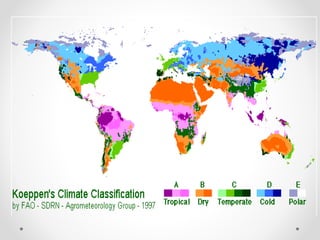
• A tropical climate is a kind of climate typically in the tropics
• Defined as non-arid climate in which all 12 months have
mean temperature above 64.4 °F (18.0 °C)
• Cover the largest area of earth (20% of land surface and 43%
of ocean surface) - the home to almost half of the world ’s
population
South Florida, The Caribbean, Central Africa, Coastal
India, Southeast Asia, North Queensland, Hawaii,
Central America, or most of Brazil.
CLASSIFICATION
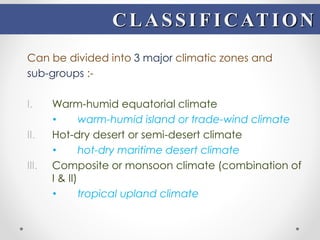
Can be divided into 3 major climatic zones and
sub-groups :-
I. Warm-humid equatorial climate
• warm-humid island or trade-wind climate
II. Hot-dry desert or semi-desert climate
• hot-dry maritime desert climate
III. Composite or monsoon climate (combination of
I & II)
• tropical upland climate
CLASSIFICATION
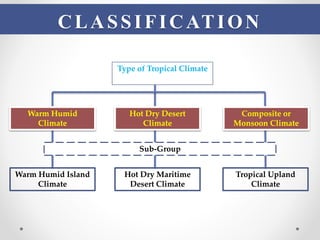
Type of Tropical Climate
Warm Humid Island
Climate
Hot Dry Maritime
Desert Climate
Tropical Upland
Climate
Warm Humid
Climate
Hot Dry Desert
Climate
Composite or
Monsoon Climate
CLASSIFICATION
Sub-Group
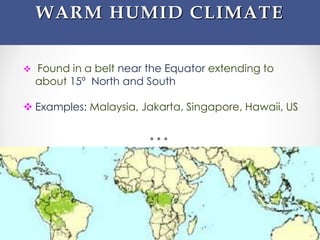
 Found in a belt near the Equator extending to
about 15º North and South
 Examples: Malaysia, Jakarta, Singapore, Hawaii, US
WARM HUMID CLIMATE
• Air Temperature
• Humidity
• Vapour Pressure
• Precipitation
• Sky Condition
• Solar Radiation
• Wind
• Vegetation
WARM HUMID CLIMATE
|ELEMENTS|
AIR TEMPERATURE :
• Air temperature is an objective comparative measure of hot or cold air.
• At any point near the ground the air temperature is dependent upon the
amount of heat gained or lost at the earth’s surface and any other surfaces with
which the air has recently been in contact.
• It is measured in fahrenheit or celsius or kelvin. Using dry bulb thermometer.
HUMIDITY :
• The relative humidity depends as much on the air temperature as on the
actual amount of water vapour present in the air.
The following situation is likely to arise, if the air is still
at ground at 2 m
___________________________________________________________________________
• Temperature high lower
• Relative humidity low higher
• Absolute humidity high lower
• A device used to measure humidity is called psychrometer or hygrometer.
VAPOUR PRESSURE :
• Vapour pressure defined as the pressure exerted by a vapour in
thermodynamic equilibrium with its condensed phases (solid or liquid) at a
given temperature in a closed system. The equilibrium vapour pressure is an
indication of a liquid's evaporation rate.
PRECIPITATION :
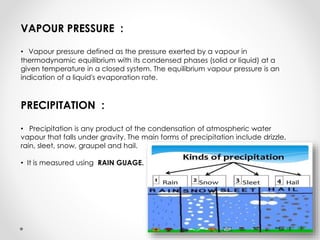
• Precipitation is any product of the condensation of atmospheric water
vapour that falls under gravity. The main forms of precipitation include drizzle,
rain, sleet, snow, graupel and hail.
• It is measured using RAIN GUAGE.
WARM HUMID CLIMATE
SINGAPORE
• LOCATION:
Lies just north of the Equator near Latitude 1.5 deg N and Longitude
104 deg E.
• TEMPERATURE:
Diurnal range: Minimum 23 to 26°C and Maximum 31 to 34°C
Extremes: Minimum of 19.4°C and Maximum of 36.0°C
• RELATIVE HUMIDITY:
Mean value is 84%, During prolonged heavy rain, relative humidity
often reaches 100 %
• VAPOUR PRESSURE:
Diurnal pressure variation of 4hPa. Maximum pressure usually
occurring at 1100 and 2400 Local Time and minimum pressure
occurring at 0500 and 1700 Local Time. Extreme pressures recorded
are 1018.0hPa and 1002.5hPa.
SOLAR RADIATION:
• Since Singapore is near the equator, the length of its day is
relatively constant throughout the year, and thus so is the
amount of sunshine it receives.
•Daily sunshine hours are mainly influenced by the presence or
absence of cloud cover.
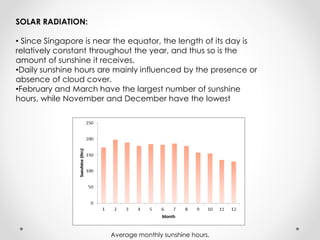
•February and March have the largest number of sunshine
hours, while November and December have the lowest
Average monthly sunshine hours.
RAINFALL:
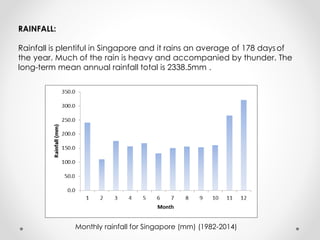
Rainfall is plentiful in Singapore and it rains an average of 178 daysof
the year. Much of the rain is heavy and accompanied by thunder. The
long-term mean annual rainfall total is 2338.5mm .
Monthly rainfall for Singapore (mm) (1982-2014)
WIND:
•Winds throughout the year show a diurnal variation, with lighter winds
during the night and stronger winds during the day.
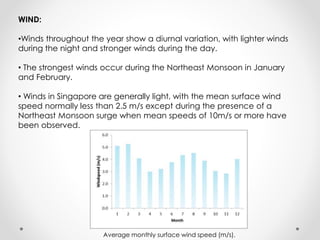
• The strongest winds occur during the Northeast Monsoon in January
and February.
• Winds in Singapore are generally light, with the mean surface wind
speed normally less than 2.5 m/s except during the presence of a
Northeast Monsoon surge when mean speeds of 10m/s or more have
been observed.
Average monthly surface wind speed (m/s).
VEGETATION:
Singapore has very little crop-suitable land but otherwise has
abundant plant life. Much of the soil in Singapore is clay,
although the origins and processes that formed the clay vary
by area.
SPECIAL CHARACTERISTICS:
Thunderstorms are also a very regular phenomenon, occurring
on roughly 40% of all days year-round but particularly common
during the Southeast Monsoon.
WARM HUMID CLIMATE
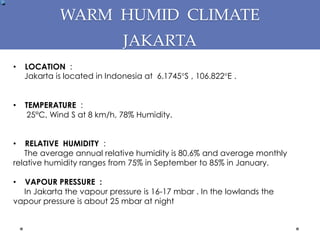
JAKARTA
• LOCATION :
Jakarta is located in Indonesia at 6.1745°S , 106.822°E .
• TEMPERATURE :
25°C, Wind S at 8 km/h, 78% Humidity.
• RELATIVE HUMIDITY :
The average annual relative humidity is 80.6% and average monthly
relative humidity ranges from 75% in September to 85% in January.
• VAPOUR PRESSURE :
In Jakarta the vapour pressure is 16-17 mbar . In the lowlands the
vapour pressure is about 25 mbar at night
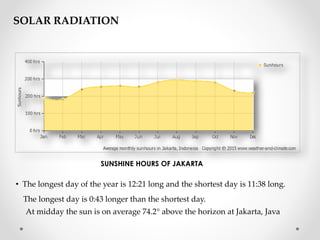
SOLAR RADIATION
SUNSHINE HOURS OF JAKARTA
• The longest day of the year is 12:21 long and the shortest day is 11:38 long.
The longest day is 0:43 longer than the shortest day.
At midday the sun is on average 74.2° above the horizon at Jakarta, Java
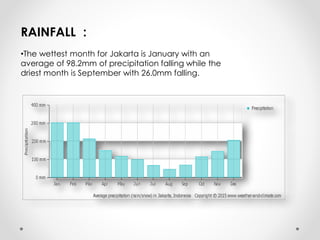
RAINFALL :
•The wettest month for Jakarta is January with an
average of 98.2mm of precipitation falling while the
driest month is September with 26.0mm falling.
WIND :
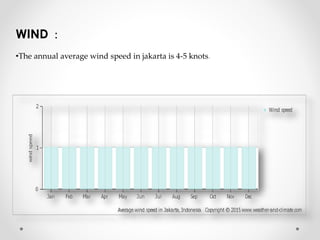
•The annual average wind speed in jakarta is 4-5 knots.
WARM HUMID CLIMATE
COLOMBO
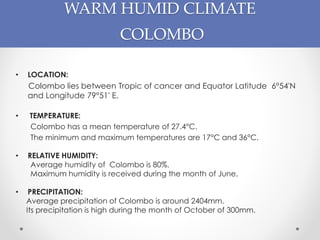
• LOCATION:
Colombo lies between Tropic of cancer and Equator Latitude 6°54'N
and Longitude 79°51' E.
• TEMPERATURE:
Colombo has a mean temperature of 27.4°C.
The minimum and maximum temperatures are 17°C and 36°C.
• RELATIVE HUMIDITY:
Average humidity of Colombo is 80%.
Maximum humidity is received during the month of June.
• PRECIPITATION:
Average precipitation of Colombo is around 2404mm.
Its precipitation is high during the month of October of 300mm.
RAINFALL
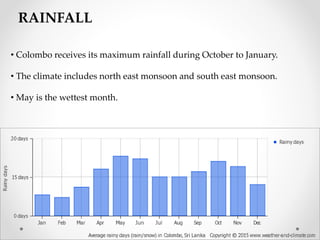
• Colombo receives its maximum rainfall during October to January.
• The climate includes north east monsoon and south east monsoon.
• May is the wettest month.
HUMIDITY
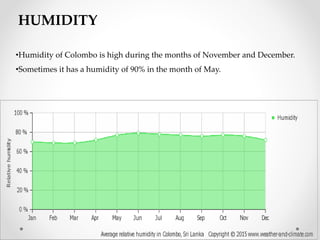
•Humidity of Colombo is high during the months of November and December.
•Sometimes it has a humidity of 90% in the month of May.

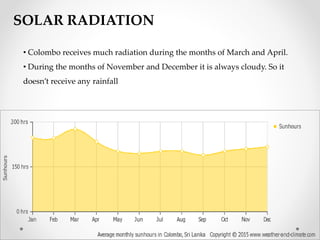
SOLAR RADIATION
• Colombo receives much radiation during the months of March and April.
• During the months of November and December it is always cloudy. So it
doesn’t receive any rainfall
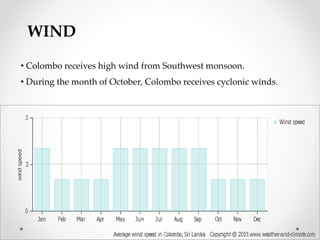
WIND
• Colombo receives high wind from Southwest monsoon.
• During the month of October, Colombo receives cyclonic winds.
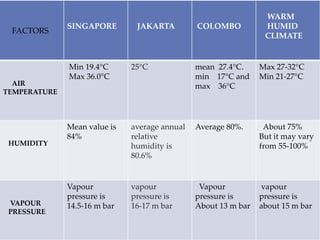
WARM HUMID CLIMATE – CITIES CLIMATE
COMPARISION
SINGAPORE JAKARTA COLOMBO
WARM
HUMID
CLIMATE
AIR
TEMPERATURE
Min 19.4°C
Max 36.0°C
25°C mean 27.4°C.
min 17°C and
max 36°C
Max 27-32°C
Min 21-27°C
HUMIDITY
Mean value is
84%
average annual
relative
humidity is
80.6%
Average 80%. About 75%
But it may vary
from 55-100%
VAPOUR
PRESSURE
Vapour
pressure is
14.5-16 m bar
vapour
pressure is
16-17 m bar
Vapour
pressure is
About 13 m bar
vapour
pressure is
about 15 m bar
FACTORS
SINGAPORE JAKARTA COLOMBO
WARM
HUMID
CLIMATE
PRECIPITATION
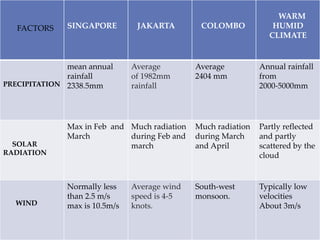
mean annual
rainfall
2338.5mm
Average
of 1982mm
rainfall
Average
2404 mm
Annual rainfall
from
2000-5000mm
SOLAR
RADIATION
Max in Feb and
March
Much radiation
during Feb and
march
Much radiation
during March
and April
Partly reflected
and partly
scattered by the
cloud
WIND
Normally less
than 2.5 m/s
max is 10.5m/s
Average wind
speed is 4-5
knots.
South-west
monsoon.
Typically low
velocities
About 3m/s
FACTORS
BUILDING DESIGN
WARM-HUMID CLIMATE
Provide maximum ventilation and free air movement by large
openings.
Provide maximum shading of direct and diffuse solar
radiation.
Avoid heat storage.
Use reflective outer surfaces.
Use ventilated double roofs.
Use vegetation to moderate the solar impact
BUILDING DESIGN IN WARM-HUMID ZONES
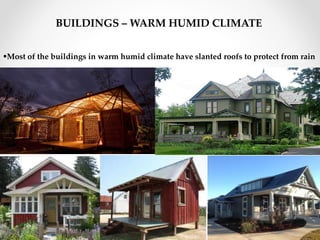
Most of the buildings in warm humid climate have slanted roofs to protect from rain
BUILDINGS – WARM HUMID CLIMATE
COMPARISON TABLE OF WARM
HUMID CLIMATES WITH OTHER
CLIMATES
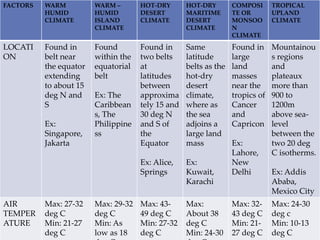
FACTORS WARM
HUMID
CLIMATE
WARM –
HUMID
ISLAND
CLIMATE
HOT-DRY
DESERT
CLIMATE
HOT-DRY
MARITIME
DESERT
CLIMATE
COMPOSI
TE OR
MONSOO
N
CLIMATE
TROPICAL
UPLAND
CLIMATE
LOCATI
ON
Found in
belt near
the equator
extending
to about 15
deg N and
S
Ex:
Singapore,
Jakarta
Found
within the
equatorial
belt
Ex: The
Caribbean
s, The
Philippine
ss
Found in
two belts
at
latitudes
between
approxima
tely 15 and
30 deg N
and S of
the
Equator
Ex: Alice,
Springs
Same
latitude
belts as the
hot-dry
desert
climate,
where as
the sea
adjoins a
large land
mass
Ex:
Kuwait,
Karachi
Found in
large
land
masses
near the
tropics of
Cancer
and
Capricon
Ex:
Lahore,
New
Delhi
Mountainou
s regions
and
plateaux
more than
900 to
1200m
above sea-
level
between the
two 20 deg
C isotherms.
Ex: Addis
Ababa,
Mexico City
AIR
TEMPER
ATURE
Max: 27-32
deg C
Min: 21-27
deg C
Max: 29-32
deg C
Min: As
low as 18
Max: 43-
49 deg C
Min: 27-32
deg C
Max:
About 38
deg C
Min: 24-30
Max: 32-
43 deg C
Min: 21-
27 deg C
Max: 24-30
deg c
Min: 10-13
deg C
FACTORS WARM
HUMID
CLIMATE
WARM –
HUMID
ISLAND
CLIMATE
HOT-DRY
DESERT
CLIMATE
HOT-DRY
MARITIME
DESERT
CLIMATE
COMPOSITE
OR
MONSOON
CLIMATE
TROPICAL
UPLAND
CLIMATE
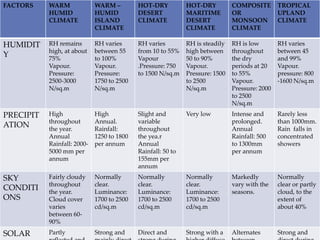
HUMIDIT
Y
RH remains
high, at about
75%
Vapour.
Pressure:
2500-3000
N/sq.m
RH varies
between 55
to 100%
Vapour.
Pressure:
1750 to 2500
N/sq.m
RH varies
from 10 to 55%
Vapour
.Pressure: 750
to 1500 N/sq.m
RH is steadily
high between
50 to 90%
Vapour.
Pressure: 1500
to 2500
N/sq.m
RH is low
throughout
the dry
periods at 20
to 55%
Vapour.
Pressure: 2000
to 2500
N/sq.m
RH varies
between 45
and 99%
Vapour.
pressure: 800
-1600 N/sq.m
PRECIPIT
ATION
High
throughout
the year.
Annual
Rainfall: 2000-
5000 mm per
annum
High
Annual.
Rainfall:
1250 to 1800
per annum
Slight and
variable
throughout
the yea.r
Annual
Rainfall: 50 to
155mm per
annum
Very low Intense and
prolonged.
Annual
Rainfall: 500
to 1300mm
per annum
Rarely less
than 1000mm.
Rain falls in
concentrated
showers
SKY
CONDITI
ONS
Fairly cloudy
throughout
the year.
Cloud cover
varies
between 60-
90%
Normally
clear.
Luminance:
1700 to 2500
cd/sq.m
Normally
clear.
Luminance:
1700 to 2500
cd/sq.m
Normally
clear.
Luminance:
1700 to 2500
cd/sq.m
Markedly
vary with the
seasons.
Normally
clear or partly
cloud, to the
extent of
about 40%
SOLAR Partly Strong and Direct and Strong with a Alternates Strong and
HUMID
CLIMATE
HUMID
ISLAND
CLIMATE
DESERT
CLIMATE
MARITIME
DESERT
CLIMATE
OR
MONSOON
CLIMATE
UPLAND
CLIMATE
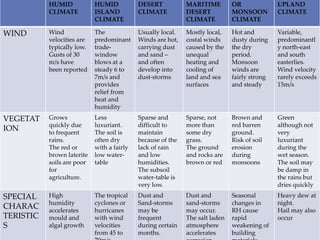
WIND Wind
velocities are
typically low.
Gusts of 30
m/s have
been reported
The
predominant
trade-
window
blows at a
steady 6 to
7m/s and
provides
relief from
heat and
humidity
Usually local.
Winds are hot,
carrying dust
and sand –
and often
develop into
dust-storms
Mostly local,
costal winds
caused by the
unequal
heating and
cooling of
land and sea
surfaces
Hot and
dusty during
the dry
period.
Monsoon
winds are
fairly strong
and steady
Variable,
predominantl
y north-east
and south
easterlies.
Wind velocity
rarely exceeds
15m/s
VEGETAT
ION
Grows
quickly due
to frequent
rains.
The red or
brown laterite
soils are poor
for
agriculture.
Less
luxuriant.
The soil is
often dry
with a fairly
low water-
table
Sparse and
difficult to
maintain
because of the
lack of rain
and low
humidities.
The subsoil
water-table is
very low.
Sparse, not
more than
some dry
grass.
The ground
and rocks are
brown or red
Brown and
red barren
ground.
Risk of soil
erosion
during
monsoons
Green
although not
very
luxuriant
during the
wet season.
The soil may
be damp in
the rains but
dries quickly
SPECIAL
CHARAC
TERISTIC
S
High
humidity
accelerates
mould and
algal growth
The tropical
cyclones or
hurricanes
with wind
velocities
from 45 to
Dust and
Sand-storms
may be
frequent
during certain
months.
Dust and
sand-storms
may occur.
The salt laden
atmosphere
accelerates
Seasonal
changes in
RH cause
rapid
weakening of
building
Heavy dew at
night.
Hail may also
occur
REFERENCES:
Koinesberger, Manual of tropical housing and building
en.wikipedia.org
www.colomboclimate.com
www.singaporetourism.com
www.jakarta.com/climate
Google images
Koppenclassification.org
THANK YOU

Warm humid climate

  • 1.
  • 2.
    • A tropicalclimate is a kind of climate typically in the tropics • Defined as non-arid climate in which all 12 months have mean temperature above 64.4 °F (18.0 °C) • Cover the largest area of earth (20% of land surface and 43% of ocean surface) - the home to almost half of the world ’s population South Florida, The Caribbean, Central Africa, Coastal India, Southeast Asia, North Queensland, Hawaii, Central America, or most of Brazil. CLASSIFICATION
  • 4.
    Can be dividedinto 3 major climatic zones and sub-groups :- I. Warm-humid equatorial climate • warm-humid island or trade-wind climate II. Hot-dry desert or semi-desert climate • hot-dry maritime desert climate III. Composite or monsoon climate (combination of I & II) • tropical upland climate CLASSIFICATION
  • 5.
    Type of TropicalClimate Warm Humid Island Climate Hot Dry Maritime Desert Climate Tropical Upland Climate Warm Humid Climate Hot Dry Desert Climate Composite or Monsoon Climate CLASSIFICATION Sub-Group
  • 6.
     Found ina belt near the Equator extending to about 15º North and South  Examples: Malaysia, Jakarta, Singapore, Hawaii, US WARM HUMID CLIMATE
  • 7.
    • Air Temperature •Humidity • Vapour Pressure • Precipitation • Sky Condition • Solar Radiation • Wind • Vegetation WARM HUMID CLIMATE |ELEMENTS|
  • 8.
    AIR TEMPERATURE : •Air temperature is an objective comparative measure of hot or cold air. • At any point near the ground the air temperature is dependent upon the amount of heat gained or lost at the earth’s surface and any other surfaces with which the air has recently been in contact. • It is measured in fahrenheit or celsius or kelvin. Using dry bulb thermometer. HUMIDITY : • The relative humidity depends as much on the air temperature as on the actual amount of water vapour present in the air. The following situation is likely to arise, if the air is still at ground at 2 m ___________________________________________________________________________ • Temperature high lower • Relative humidity low higher • Absolute humidity high lower • A device used to measure humidity is called psychrometer or hygrometer.
  • 9.
    VAPOUR PRESSURE : •Vapour pressure defined as the pressure exerted by a vapour in thermodynamic equilibrium with its condensed phases (solid or liquid) at a given temperature in a closed system. The equilibrium vapour pressure is an indication of a liquid's evaporation rate. PRECIPITATION : • Precipitation is any product of the condensation of atmospheric water vapour that falls under gravity. The main forms of precipitation include drizzle, rain, sleet, snow, graupel and hail. • It is measured using RAIN GUAGE.
  • 10.
    WARM HUMID CLIMATE SINGAPORE •LOCATION: Lies just north of the Equator near Latitude 1.5 deg N and Longitude 104 deg E. • TEMPERATURE: Diurnal range: Minimum 23 to 26°C and Maximum 31 to 34°C Extremes: Minimum of 19.4°C and Maximum of 36.0°C • RELATIVE HUMIDITY: Mean value is 84%, During prolonged heavy rain, relative humidity often reaches 100 % • VAPOUR PRESSURE: Diurnal pressure variation of 4hPa. Maximum pressure usually occurring at 1100 and 2400 Local Time and minimum pressure occurring at 0500 and 1700 Local Time. Extreme pressures recorded are 1018.0hPa and 1002.5hPa.
  • 11.
    SOLAR RADIATION: • SinceSingapore is near the equator, the length of its day is relatively constant throughout the year, and thus so is the amount of sunshine it receives. •Daily sunshine hours are mainly influenced by the presence or absence of cloud cover. •February and March have the largest number of sunshine hours, while November and December have the lowest Average monthly sunshine hours.
  • 12.
    RAINFALL: Rainfall is plentifulin Singapore and it rains an average of 178 daysof the year. Much of the rain is heavy and accompanied by thunder. The long-term mean annual rainfall total is 2338.5mm . Monthly rainfall for Singapore (mm) (1982-2014)
  • 13.
    WIND: •Winds throughout theyear show a diurnal variation, with lighter winds during the night and stronger winds during the day. • The strongest winds occur during the Northeast Monsoon in January and February. • Winds in Singapore are generally light, with the mean surface wind speed normally less than 2.5 m/s except during the presence of a Northeast Monsoon surge when mean speeds of 10m/s or more have been observed. Average monthly surface wind speed (m/s).
  • 14.
    VEGETATION: Singapore has verylittle crop-suitable land but otherwise has abundant plant life. Much of the soil in Singapore is clay, although the origins and processes that formed the clay vary by area. SPECIAL CHARACTERISTICS: Thunderstorms are also a very regular phenomenon, occurring on roughly 40% of all days year-round but particularly common during the Southeast Monsoon.
  • 15.
    WARM HUMID CLIMATE JAKARTA •LOCATION : Jakarta is located in Indonesia at 6.1745°S , 106.822°E . • TEMPERATURE : 25°C, Wind S at 8 km/h, 78% Humidity. • RELATIVE HUMIDITY : The average annual relative humidity is 80.6% and average monthly relative humidity ranges from 75% in September to 85% in January. • VAPOUR PRESSURE : In Jakarta the vapour pressure is 16-17 mbar . In the lowlands the vapour pressure is about 25 mbar at night
  • 16.
    SOLAR RADIATION SUNSHINE HOURSOF JAKARTA • The longest day of the year is 12:21 long and the shortest day is 11:38 long. The longest day is 0:43 longer than the shortest day. At midday the sun is on average 74.2° above the horizon at Jakarta, Java
  • 17.
    RAINFALL : •The wettestmonth for Jakarta is January with an average of 98.2mm of precipitation falling while the driest month is September with 26.0mm falling.
  • 18.
    WIND : •The annualaverage wind speed in jakarta is 4-5 knots.
  • 19.
    WARM HUMID CLIMATE COLOMBO •LOCATION: Colombo lies between Tropic of cancer and Equator Latitude 6°54'N and Longitude 79°51' E. • TEMPERATURE: Colombo has a mean temperature of 27.4°C. The minimum and maximum temperatures are 17°C and 36°C. • RELATIVE HUMIDITY: Average humidity of Colombo is 80%. Maximum humidity is received during the month of June. • PRECIPITATION: Average precipitation of Colombo is around 2404mm. Its precipitation is high during the month of October of 300mm.
  • 20.
    RAINFALL • Colombo receivesits maximum rainfall during October to January. • The climate includes north east monsoon and south east monsoon. • May is the wettest month.
  • 21.
    HUMIDITY •Humidity of Colombois high during the months of November and December. •Sometimes it has a humidity of 90% in the month of May.
  • 22.
    SOLAR RADIATION • Colomboreceives much radiation during the months of March and April. • During the months of November and December it is always cloudy. So it doesn’t receive any rainfall
  • 23.
    WIND • Colombo receiveshigh wind from Southwest monsoon. • During the month of October, Colombo receives cyclonic winds.
  • 24.
    WARM HUMID CLIMATE– CITIES CLIMATE COMPARISION
  • 25.
    SINGAPORE JAKARTA COLOMBO WARM HUMID CLIMATE AIR TEMPERATURE Min19.4°C Max 36.0°C 25°C mean 27.4°C. min 17°C and max 36°C Max 27-32°C Min 21-27°C HUMIDITY Mean value is 84% average annual relative humidity is 80.6% Average 80%. About 75% But it may vary from 55-100% VAPOUR PRESSURE Vapour pressure is 14.5-16 m bar vapour pressure is 16-17 m bar Vapour pressure is About 13 m bar vapour pressure is about 15 m bar FACTORS
  • 26.
    SINGAPORE JAKARTA COLOMBO WARM HUMID CLIMATE PRECIPITATION meanannual rainfall 2338.5mm Average of 1982mm rainfall Average 2404 mm Annual rainfall from 2000-5000mm SOLAR RADIATION Max in Feb and March Much radiation during Feb and march Much radiation during March and April Partly reflected and partly scattered by the cloud WIND Normally less than 2.5 m/s max is 10.5m/s Average wind speed is 4-5 knots. South-west monsoon. Typically low velocities About 3m/s FACTORS
  • 27.
  • 28.
    Provide maximum ventilationand free air movement by large openings. Provide maximum shading of direct and diffuse solar radiation. Avoid heat storage. Use reflective outer surfaces. Use ventilated double roofs. Use vegetation to moderate the solar impact BUILDING DESIGN IN WARM-HUMID ZONES
  • 29.
    Most of thebuildings in warm humid climate have slanted roofs to protect from rain BUILDINGS – WARM HUMID CLIMATE
  • 30.
    COMPARISON TABLE OFWARM HUMID CLIMATES WITH OTHER CLIMATES
  • 31.
    FACTORS WARM HUMID CLIMATE WARM – HUMID ISLAND CLIMATE HOT-DRY DESERT CLIMATE HOT-DRY MARITIME DESERT CLIMATE COMPOSI TEOR MONSOO N CLIMATE TROPICAL UPLAND CLIMATE LOCATI ON Found in belt near the equator extending to about 15 deg N and S Ex: Singapore, Jakarta Found within the equatorial belt Ex: The Caribbean s, The Philippine ss Found in two belts at latitudes between approxima tely 15 and 30 deg N and S of the Equator Ex: Alice, Springs Same latitude belts as the hot-dry desert climate, where as the sea adjoins a large land mass Ex: Kuwait, Karachi Found in large land masses near the tropics of Cancer and Capricon Ex: Lahore, New Delhi Mountainou s regions and plateaux more than 900 to 1200m above sea- level between the two 20 deg C isotherms. Ex: Addis Ababa, Mexico City AIR TEMPER ATURE Max: 27-32 deg C Min: 21-27 deg C Max: 29-32 deg C Min: As low as 18 Max: 43- 49 deg C Min: 27-32 deg C Max: About 38 deg C Min: 24-30 Max: 32- 43 deg C Min: 21- 27 deg C Max: 24-30 deg c Min: 10-13 deg C
  • 32.
    FACTORS WARM HUMID CLIMATE WARM – HUMID ISLAND CLIMATE HOT-DRY DESERT CLIMATE HOT-DRY MARITIME DESERT CLIMATE COMPOSITE OR MONSOON CLIMATE TROPICAL UPLAND CLIMATE HUMIDIT Y RHremains high, at about 75% Vapour. Pressure: 2500-3000 N/sq.m RH varies between 55 to 100% Vapour. Pressure: 1750 to 2500 N/sq.m RH varies from 10 to 55% Vapour .Pressure: 750 to 1500 N/sq.m RH is steadily high between 50 to 90% Vapour. Pressure: 1500 to 2500 N/sq.m RH is low throughout the dry periods at 20 to 55% Vapour. Pressure: 2000 to 2500 N/sq.m RH varies between 45 and 99% Vapour. pressure: 800 -1600 N/sq.m PRECIPIT ATION High throughout the year. Annual Rainfall: 2000- 5000 mm per annum High Annual. Rainfall: 1250 to 1800 per annum Slight and variable throughout the yea.r Annual Rainfall: 50 to 155mm per annum Very low Intense and prolonged. Annual Rainfall: 500 to 1300mm per annum Rarely less than 1000mm. Rain falls in concentrated showers SKY CONDITI ONS Fairly cloudy throughout the year. Cloud cover varies between 60- 90% Normally clear. Luminance: 1700 to 2500 cd/sq.m Normally clear. Luminance: 1700 to 2500 cd/sq.m Normally clear. Luminance: 1700 to 2500 cd/sq.m Markedly vary with the seasons. Normally clear or partly cloud, to the extent of about 40% SOLAR Partly Strong and Direct and Strong with a Alternates Strong and
  • 33.
    HUMID CLIMATE HUMID ISLAND CLIMATE DESERT CLIMATE MARITIME DESERT CLIMATE OR MONSOON CLIMATE UPLAND CLIMATE WIND Wind velocities are typicallylow. Gusts of 30 m/s have been reported The predominant trade- window blows at a steady 6 to 7m/s and provides relief from heat and humidity Usually local. Winds are hot, carrying dust and sand – and often develop into dust-storms Mostly local, costal winds caused by the unequal heating and cooling of land and sea surfaces Hot and dusty during the dry period. Monsoon winds are fairly strong and steady Variable, predominantl y north-east and south easterlies. Wind velocity rarely exceeds 15m/s VEGETAT ION Grows quickly due to frequent rains. The red or brown laterite soils are poor for agriculture. Less luxuriant. The soil is often dry with a fairly low water- table Sparse and difficult to maintain because of the lack of rain and low humidities. The subsoil water-table is very low. Sparse, not more than some dry grass. The ground and rocks are brown or red Brown and red barren ground. Risk of soil erosion during monsoons Green although not very luxuriant during the wet season. The soil may be damp in the rains but dries quickly SPECIAL CHARAC TERISTIC S High humidity accelerates mould and algal growth The tropical cyclones or hurricanes with wind velocities from 45 to Dust and Sand-storms may be frequent during certain months. Dust and sand-storms may occur. The salt laden atmosphere accelerates Seasonal changes in RH cause rapid weakening of building Heavy dew at night. Hail may also occur
  • 34.
    REFERENCES: Koinesberger, Manual oftropical housing and building en.wikipedia.org www.colomboclimate.com www.singaporetourism.com www.jakarta.com/climate Google images Koppenclassification.org
  • 35.