BASIC CONCEPT
OF GEOGRAPHY
What is
Geography
?
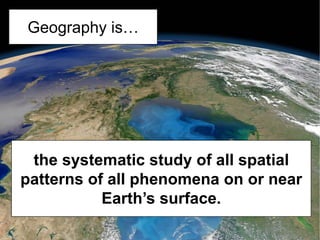
Geography is…
the systematic study of all spatial
patterns of all phenomena on or near
Earth’s surface.
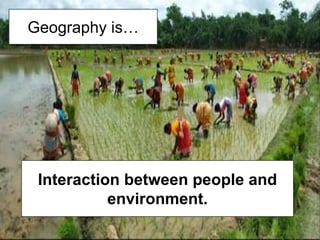
Geography is…
Interaction between people and
environment.
A. THEMES
OF
GEOGRAPHY
THEMES OF GEOGRAPHY
• The study of geography includes
specific topic such as landforms,
climates, population and culture.
Geography also entails a number of
unifying interrelated concepts.
Among the most important concepts
are the five themes of geography.
• As the historians organize time the
geographers organize space in much. To
help organize space, geographers are
concerned with asking three important
questions about things in world.
 Where is it?
 Why is there?
 What are the consequences of its being
there?
THE FIVE
THEMES OF
GEOGRAPHY
• No one theme can be
understood with the
others. The themes are
connected with one
another, as are all
components of our
world. No part of our
world can be understood
in isolation
1. Location
2. Place
3.Human-
Environmenta
l interaction
4. Movement
5. Region
1. LOCATION
• Where something can be found on the
Earth.
• Geographers want to know where things
are located, both by themselves and in
relation to other things
• Location has also 2 types the ABSOLUTE
& RELATIVE Location
A. ABSOLUTE LOCATION
• Shows the exact point on the Earth’s
surface where something is located.
• It is identified as a grid coordinate as the
surface of the Earth.
A. Address
B. Longitude/ Latitude
B. RELATIVE LOCATION
• Explains where something is in relation
to another.
A. Cardinal direction (North, South, East
& West)
B. Next to, Down from
2. PLACE
• This theme considers the
characteristics that make one place
different from all places on Earth.
• It describes what a location looks like.
• Place is describe according to
PHYSICAL & HUMAN Characteristic.
A. PHYSICAL
CHARACTERISTIC
• Include anything that is native made
from geological, hydrological,
atmospheric and biological process.
A. Landforms
B. Bodies of water
C. Trees, shrubs
D. Rocks
B. HUMAN CHARACTERISTIC
• Include anything that is human made.
• It comes from human ideas and actions
1. Building, roads, cars
2. Human culture, language, customs
3. HUMAN/ENVIRONMENTAL
INTERACTION
• How people interact with the
environment.
• People interact in three ways: MODIFY,
ADAPT & DEPEND.
MODIFY
• Means that human change the
environment.
• Humans modify the natural environment
to meet their needs
1. Build house
2. Dam, cut trees
ADAPT
• Means humans change their life to live/
survive in the environment.
1. Air-conditioning, heat
2. Sunglasses
DEPEND
• Human rely on the environment for their
basic needs
1. fishing, crops
2. oxygen
4. MOVEMENT
• How people, goods and ideas move
between places.
• Movement has 3 spatial interaction:
Movements of GOODS, PEOPLE &
IDEAS.
• Movement of Goods
1. truck, ship
2. plane, train
• Movement of People
1. bus, car
2. walking, bike
• Movement of Ideas
1. internet, e-mail
2. phone, letters
5. REGION
• The basic unit of geographic study.
• It is defined as an area that has unifying
characteristics (two or more places)
• There are 2 types of region: PHYSICAL
& POLITICAL Regions
• Physical Region
1. Desserts
2. Mountains
3. Lakes
4. Rivers
• Political Region
1. States
2. Countries
B. BRANCHES
OF
GEOGRAPHY
Branches of
Geography
Human Geography Physical Geography
Economic
Geography
Population
Geography
Medical
Geography
Geomorphology
Hydrology, etc.
Geography is divided
into two main
branches: HUMAN
GEOGRAPHY and
PHYSICAL
GEOGRAPHY.
A. HUMAN GEOGRAPHY
•This is a main branch in geography
and it mainly covers studies of the
human race. This normally involves
their backgrounds, how they
interact and the perceptions that
they have for various ideologies
affecting them.
A. ECONOMIC GEOGRAPHY
• Geographers under this branch
normally study the manner in which
products are usually produced and
consequently distributed in their
respective niche markets. In addition to
this, they also study the way in which
wealth is distributed in various regions
over the planet.
B. POPULATION GEOGRAPHY
• In most cases, scholars usually equate
population geography to demography
even though this is usually not the case.
This is mainly owing to the reason that
population geography is deeper than
the study of the patterns of a group of
people with regards to birth, marriage &
death as is the case with demography.
Dot Map Isoline Map
Choropleth MapDensity Map
C. MEDICAL GEOGRAPHY
• In this branch, geographers normally
study the patterns in which particular
diseases spread. This means that
pandemics & epidemics are usually
studied here as well as common
illnesses, general health care and death
as well.
B. PHYSICAL GEOGRAPHY
• is the branch of natural science which
deals with the study of processes and
patterns in the natural environment.
• is one of the two primary branches of
geography. Listed here are sub-
branches or sub-fields of physical
geography. These sub-fields of
physical geography study processes
and patterns in the natural environment.
EXAMPLES OF PHYSICAL
GEOGRAPHY
• Geomorphology- is the field concerned with
understanding the surface of the Earth and the
processes by which it is shaped, both at the present
as well as in the past.
DESER
T
• Hydrology- is predominantly concerned with
the amounts and quality of water moving and
accumulating on the land surface and in the
soils and rocks near the surface and is
typified by the hydrological cycle.
OCEAN
• Glaciology- is the study of glacier and ice
sheets, or more commonly
the cryospehere or ice and phenomena that
involve ice.
GLACIER
S
• Climatology- is the study of
the climate, scientifically defined as
weather conditions averaged over a
long period of time.
CLIMATE
CHANGE
• Meteorology- is the interdisciplinary
scientific study of the atmosphere that
focuses on weather processes and
short term forecasting.
STORM
• Pedology- is the study of soils in
their natural environment.
SOIL
C. COMMON
METHOD OF
GEOGRAPHY
Common Method of
Geography
1. Quantitative
Method
2. Qualitative
Method
Data
Collection
Analysis
Presentation,
etc.
Case Study
Conclusion, etc.
1. QUANTITATIVE METHOD
• can be used to verify which of such
hypotheses are true
• Geographers use quantitative
approaches to describe, understand,
and assess geographic phenomena
DATA COLLECTION
• is the process of gathering and
measuring information on targeted
variables in an established systematic
fashion, which then enables one to
answer relevant questions and evaluate
outcomes.
ANALYSIS
• a detailed examination of anything
complex in order to understand its
nature or to determine its essential
features
PRESENTATION
• Symbol or image that represents
something.
• Something offered or given
VISUALIZATION
• the act or process of interpreting in
visual terms or of putting into visible
form.
MAPPING
• is the creation of maps, a graphic
symbolic representation of the
significant features of a part of the
surface of the Earth.
CARTOGRAPHY
• the science or practice of drawing maps
STATISTICS
• the practice or science of collecting and
analyzing numerical data in large
quantities geographic information
system.
GEOGRAPHIC INFORMATION
SYSTEM (OR GIS)
• is a system designed to capture, store,
manipulate, analyze, manage, and
present spatial or geographic data.
2. QUALITATIVE METHOD
• produce information only on the particular
cases studied, and any more general
conclusions are only hypotheses.
• Qualitative research is often used to gain a
general sense of phenomena and to form
theories that can be tested using further
quantitative research.
DIFFERENCES BETWEEN QUANTITATIVE
AND QUALITATIVE METHOD
Qualitative Methods Quantitative Methods
Methods include focus groups,
in-depth interviews, and
reviews of documents for types
of themes
Surveys, structured interviews &
observations, and reviews of
records or documents for numeric
information
Primarily inductive process
used to formulate theory or
hypotheses
Primarily deductive process used
to test pre-specified concepts,
constructs, and hypotheses that
make up a theory
More subjective: describes a
problem or condition from the
point of view of those
experiencing it
More objective: provides
observed effects (interpreted by
researchers) of a program on a
problem or condition
Text-based Number-based
More in-depth information on a few
cases
Less in-depth but more breadth of
information across a large number of
cases
Unstructured or semi-structured
response options
Fixed response options
No statistical tests Statistical tests are used for analysis
Can be valid and reliable: largely
depends on skill and rigor of the
researcher
Can be valid and reliable: largely
depends on the measurement device
or instrument used
Time expenditure lighter on the
planning end and heavier during
the analysis phase
Time expenditure heavier on the
planning phase and lighter on the
analysis phase
Less generalizable More generalizable
Thank You & God Bless!

Basic Concept of Geography

  • 1.
  • 2.
  • 3.
    Geography is… the systematicstudy of all spatial patterns of all phenomena on or near Earth’s surface.
  • 4.
    Geography is… Interaction betweenpeople and environment.
  • 5.
  • 6.
    THEMES OF GEOGRAPHY •The study of geography includes specific topic such as landforms, climates, population and culture. Geography also entails a number of unifying interrelated concepts. Among the most important concepts are the five themes of geography.
  • 7.
    • As thehistorians organize time the geographers organize space in much. To help organize space, geographers are concerned with asking three important questions about things in world.  Where is it?  Why is there?  What are the consequences of its being there?
  • 8.
    THE FIVE THEMES OF GEOGRAPHY •No one theme can be understood with the others. The themes are connected with one another, as are all components of our world. No part of our world can be understood in isolation 1. Location 2. Place 3.Human- Environmenta l interaction 4. Movement 5. Region
  • 9.
    1. LOCATION • Wheresomething can be found on the Earth. • Geographers want to know where things are located, both by themselves and in relation to other things • Location has also 2 types the ABSOLUTE & RELATIVE Location
  • 10.
    A. ABSOLUTE LOCATION •Shows the exact point on the Earth’s surface where something is located. • It is identified as a grid coordinate as the surface of the Earth. A. Address B. Longitude/ Latitude
  • 11.
    B. RELATIVE LOCATION •Explains where something is in relation to another. A. Cardinal direction (North, South, East & West) B. Next to, Down from
  • 12.
    2. PLACE • Thistheme considers the characteristics that make one place different from all places on Earth. • It describes what a location looks like. • Place is describe according to PHYSICAL & HUMAN Characteristic.
  • 13.
    A. PHYSICAL CHARACTERISTIC • Includeanything that is native made from geological, hydrological, atmospheric and biological process. A. Landforms B. Bodies of water C. Trees, shrubs D. Rocks
  • 14.
    B. HUMAN CHARACTERISTIC •Include anything that is human made. • It comes from human ideas and actions 1. Building, roads, cars 2. Human culture, language, customs
  • 15.
    3. HUMAN/ENVIRONMENTAL INTERACTION • Howpeople interact with the environment. • People interact in three ways: MODIFY, ADAPT & DEPEND.
  • 16.
    MODIFY • Means thathuman change the environment. • Humans modify the natural environment to meet their needs 1. Build house 2. Dam, cut trees
  • 17.
    ADAPT • Means humanschange their life to live/ survive in the environment. 1. Air-conditioning, heat 2. Sunglasses
  • 18.
    DEPEND • Human relyon the environment for their basic needs 1. fishing, crops 2. oxygen
  • 19.
    4. MOVEMENT • Howpeople, goods and ideas move between places. • Movement has 3 spatial interaction: Movements of GOODS, PEOPLE & IDEAS.
  • 20.
    • Movement ofGoods 1. truck, ship 2. plane, train • Movement of People 1. bus, car 2. walking, bike • Movement of Ideas 1. internet, e-mail 2. phone, letters
  • 21.
    5. REGION • Thebasic unit of geographic study. • It is defined as an area that has unifying characteristics (two or more places) • There are 2 types of region: PHYSICAL & POLITICAL Regions
  • 22.
    • Physical Region 1.Desserts 2. Mountains 3. Lakes 4. Rivers • Political Region 1. States 2. Countries
  • 23.
  • 24.
    Branches of Geography Human GeographyPhysical Geography Economic Geography Population Geography Medical Geography Geomorphology Hydrology, etc.
  • 25.
    Geography is divided intotwo main branches: HUMAN GEOGRAPHY and PHYSICAL GEOGRAPHY.
  • 26.
    A. HUMAN GEOGRAPHY •Thisis a main branch in geography and it mainly covers studies of the human race. This normally involves their backgrounds, how they interact and the perceptions that they have for various ideologies affecting them.
  • 27.
    A. ECONOMIC GEOGRAPHY •Geographers under this branch normally study the manner in which products are usually produced and consequently distributed in their respective niche markets. In addition to this, they also study the way in which wealth is distributed in various regions over the planet.
  • 28.
    B. POPULATION GEOGRAPHY •In most cases, scholars usually equate population geography to demography even though this is usually not the case. This is mainly owing to the reason that population geography is deeper than the study of the patterns of a group of people with regards to birth, marriage & death as is the case with demography.
  • 29.
    Dot Map IsolineMap Choropleth MapDensity Map
  • 30.
    C. MEDICAL GEOGRAPHY •In this branch, geographers normally study the patterns in which particular diseases spread. This means that pandemics & epidemics are usually studied here as well as common illnesses, general health care and death as well.
  • 31.
    B. PHYSICAL GEOGRAPHY •is the branch of natural science which deals with the study of processes and patterns in the natural environment. • is one of the two primary branches of geography. Listed here are sub- branches or sub-fields of physical geography. These sub-fields of physical geography study processes and patterns in the natural environment.
  • 32.
    EXAMPLES OF PHYSICAL GEOGRAPHY •Geomorphology- is the field concerned with understanding the surface of the Earth and the processes by which it is shaped, both at the present as well as in the past. DESER T
  • 33.
    • Hydrology- ispredominantly concerned with the amounts and quality of water moving and accumulating on the land surface and in the soils and rocks near the surface and is typified by the hydrological cycle. OCEAN
  • 34.
    • Glaciology- isthe study of glacier and ice sheets, or more commonly the cryospehere or ice and phenomena that involve ice. GLACIER S
  • 35.
    • Climatology- isthe study of the climate, scientifically defined as weather conditions averaged over a long period of time. CLIMATE CHANGE
  • 36.
    • Meteorology- isthe interdisciplinary scientific study of the atmosphere that focuses on weather processes and short term forecasting. STORM
  • 37.
    • Pedology- isthe study of soils in their natural environment. SOIL
  • 38.
  • 39.
    Common Method of Geography 1.Quantitative Method 2. Qualitative Method Data Collection Analysis Presentation, etc. Case Study Conclusion, etc.
  • 40.
    1. QUANTITATIVE METHOD •can be used to verify which of such hypotheses are true • Geographers use quantitative approaches to describe, understand, and assess geographic phenomena
  • 41.
    DATA COLLECTION • isthe process of gathering and measuring information on targeted variables in an established systematic fashion, which then enables one to answer relevant questions and evaluate outcomes.
  • 42.
    ANALYSIS • a detailedexamination of anything complex in order to understand its nature or to determine its essential features
  • 43.
    PRESENTATION • Symbol orimage that represents something. • Something offered or given
  • 44.
    VISUALIZATION • the actor process of interpreting in visual terms or of putting into visible form.
  • 45.
    MAPPING • is thecreation of maps, a graphic symbolic representation of the significant features of a part of the surface of the Earth.
  • 46.
    CARTOGRAPHY • the scienceor practice of drawing maps
  • 47.
    STATISTICS • the practiceor science of collecting and analyzing numerical data in large quantities geographic information system.
  • 48.
    GEOGRAPHIC INFORMATION SYSTEM (ORGIS) • is a system designed to capture, store, manipulate, analyze, manage, and present spatial or geographic data.
  • 49.
    2. QUALITATIVE METHOD •produce information only on the particular cases studied, and any more general conclusions are only hypotheses. • Qualitative research is often used to gain a general sense of phenomena and to form theories that can be tested using further quantitative research.
  • 50.
    DIFFERENCES BETWEEN QUANTITATIVE ANDQUALITATIVE METHOD Qualitative Methods Quantitative Methods Methods include focus groups, in-depth interviews, and reviews of documents for types of themes Surveys, structured interviews & observations, and reviews of records or documents for numeric information Primarily inductive process used to formulate theory or hypotheses Primarily deductive process used to test pre-specified concepts, constructs, and hypotheses that make up a theory More subjective: describes a problem or condition from the point of view of those experiencing it More objective: provides observed effects (interpreted by researchers) of a program on a problem or condition
  • 51.
    Text-based Number-based More in-depthinformation on a few cases Less in-depth but more breadth of information across a large number of cases Unstructured or semi-structured response options Fixed response options No statistical tests Statistical tests are used for analysis Can be valid and reliable: largely depends on skill and rigor of the researcher Can be valid and reliable: largely depends on the measurement device or instrument used Time expenditure lighter on the planning end and heavier during the analysis phase Time expenditure heavier on the planning phase and lighter on the analysis phase Less generalizable More generalizable
  • 52.
    Thank You &God Bless!