Module-2
Topic name
Introduction to Hematology
Volume, Serum, Plasma
Sub code: BMLT1002
Sub Name: General physiology – (T)
Department: Department of MLT, SMAS
Faculty: A. Vamsi Kumar
Designation : Assistant professor
Course outcomes
On completion of this course, the student can be
able to:
• Perform ESR, PCV, & Teach blood cell functions
Learning outcomes
On completion of this course, the student can be
able to:
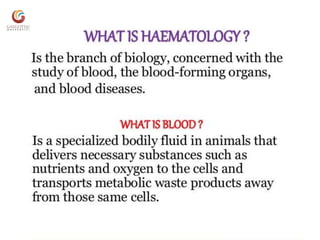
• Define Hematology
• Classify the branches of hematology
• Types of Laboratory tests in done in
laboratory
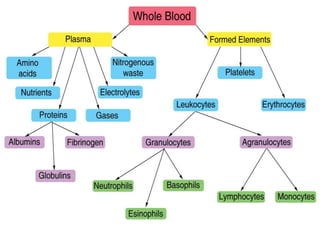
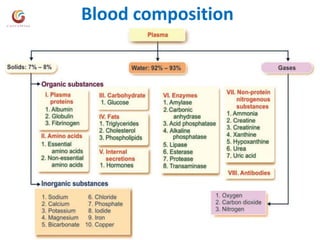
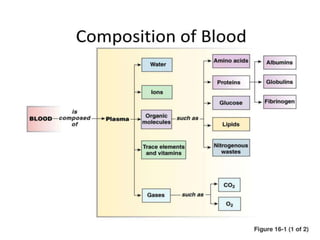
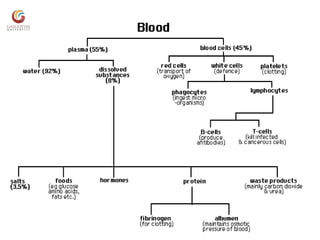
• Composition of blood &
• Components of Blood
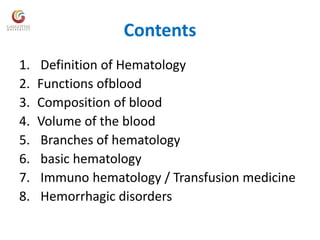
Contents
1. Definition of Hematology
2. Functions ofblood
3. Composition of blood
4. Volume of the blood
5. Branches of hematology
6. basic hematology
7. Immuno hematology / Transfusion medicine
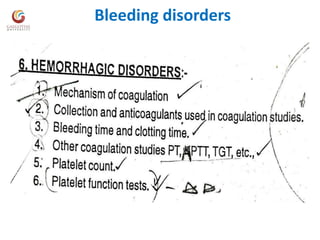
8. Hemorrhagic disorders
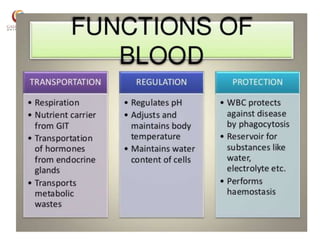
Functions of blood
1. Gas transport – blood carries oxygen from lung to the tissues
and carbon dioxide in reverse direction.
2. Transport of nutritional substances for all cells
(glucose, amino acids, fatty acids, vitamins, ketone bodies,
microelements etc.). Blood carries final products of metabolism
(urea, uric acid, bilirubin, creatinin etc.) from tissues to kidney,
where from they excreted with urine.
3. Regulation of different processes. Blood creates and
carries local hormones (hormonoids) to the target organs.
Functions of blood
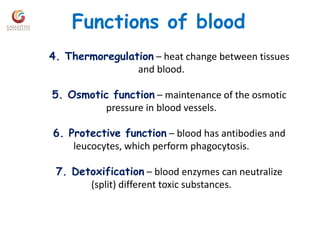
4. Thermoregulation – heat change between tissues
and blood.
5. Osmotic function – maintenance of the osmotic
pressure in blood vessels.
6. Protective function – blood has antibodies and
leucocytes, which perform phagocytosis.
7. Detoxification – blood enzymes can neutralize
(split) different toxic substances.
PROPERTIES OF BLOOD
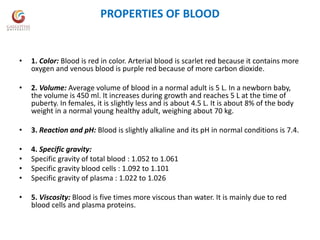
• 1. Color: Blood is red in color. Arterial blood is scarlet red because it contains more
oxygen and venous blood is purple red because of more carbon dioxide.
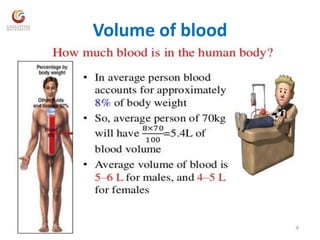
• 2. Volume: Average volume of blood in a normal adult is 5 L. In a newborn baby,
the volume is 450 ml. It increases during growth and reaches 5 L at the time of
puberty. In females, it is slightly less and is about 4.5 L. It is about 8% of the body
weight in a normal young healthy adult, weighing about 70 kg.
• 3. Reaction and pH: Blood is slightly alkaline and its pH in normal conditions is 7.4.
• 4. Specific gravity:
• Specific gravity of total blood : 1.052 to 1.061
• Specific gravity blood cells : 1.092 to 1.101
• Specific gravity of plasma : 1.022 to 1.026
• 5. Viscosity: Blood is five times more viscous than water. It is mainly due to red
blood cells and plasma proteins.
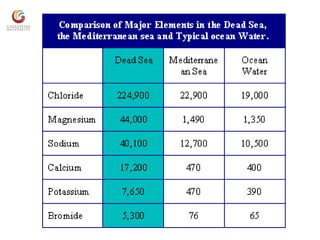
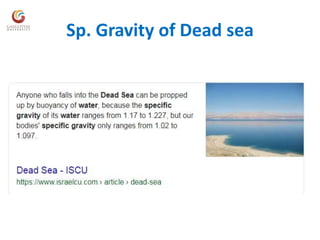
Sp. Gravity of Dead sea
Volume of blood
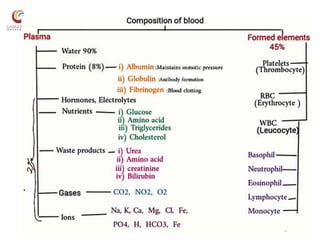
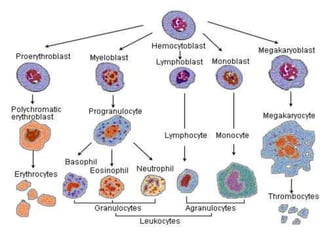
Composition of blood
Blood composition
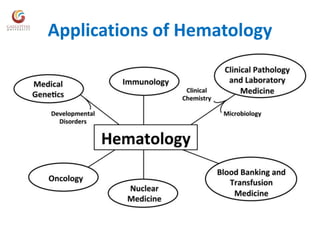
Applications of Hematology
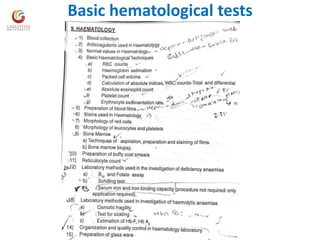
Basic hematological tests
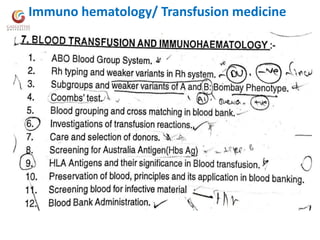
Immuno hematology/ Transfusion medicine
Bleeding disorders
Properties of RBC
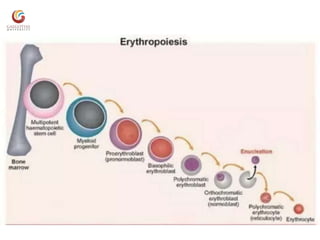
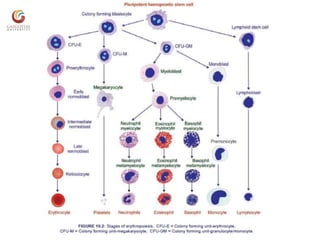
Erythropoisis
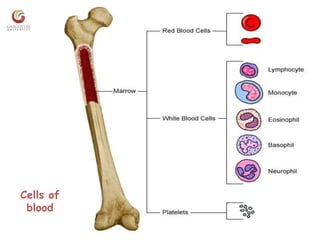
Cells of
blood
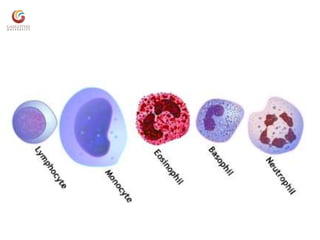
Quantity of leukocytes and their
changes
• White cells are nucleated and somewhat variable
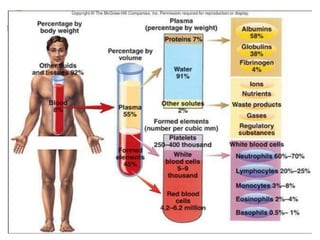
in size and shape. Their number is 4-9•Giga per
liter. The number of lymphocytes are – 18-37 %,
• monocytes – 3-11 %,
• eosinophils –0,5-5 %,
• basophils – 0-1 %,
• juvenile neutrophile – 0-1 %,
• relating to stab (rod-shaped) neutrophil – 1-6 %,
• segmented neutrophil – 47-72 %.
• The number of leukocytes may increase or
decrease.
Blood cells
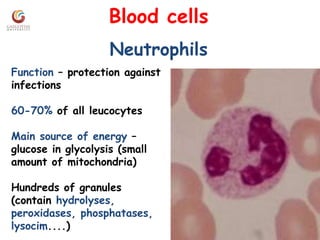
Neutrophils
Function – protection against
infections
60-70% of all leucocytes
Main source of energy –
glucose in glycolysis (small
amount of mitochondria)
Hundreds of granules
(contain hydrolyses,
peroxidases, phosphatases,
lysocim....)
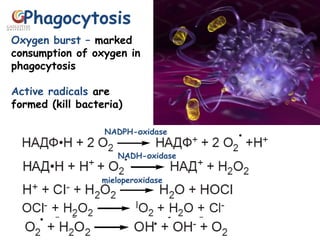
Phagocytosis
Oxygen burst – marked
consumption of oxygen in
phagocytosis
Active radicals are
formed (kill bacteria)
NАDPН-оxidase
NADН-оxidase
mieloperoxidase
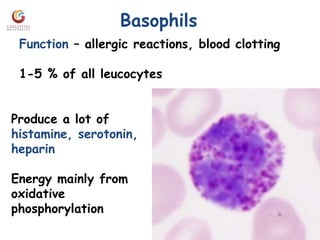
Basophils
Produce a lot of
histamine, serotonin,
heparin
Energy mainly from
oxidative
phosphorylation
Function – allergic reactions, blood clotting
1-5 % of all leucocytes
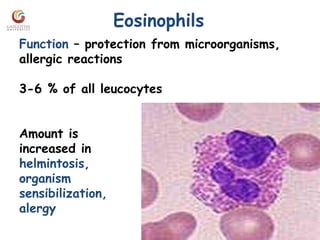
Eosinophils
Amount is
increased in
helmintosis,
organism
sensibilization,
alergy
Function – protection from microorganisms,
allergic reactions
3-6 % of all leucocytes
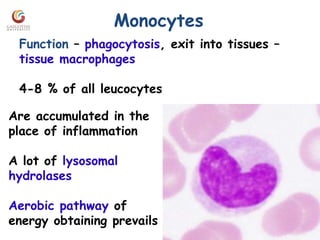
Monocytes
Function – phagocytosis, exit into tissues –
tissue macrophages
4-8 % of all leucocytes
Are accumulated in the
place of inflammation
A lot of lysosomal
hydrolases
Aerobic pathway of
energy obtaining prevails
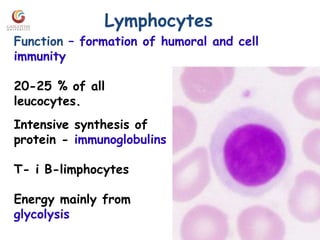
Lymphocytes
Function – formation of humoral and cell
immunity
20-25 % of all
leucocytes.
Intensive synthesis of
protein - immunoglobulins
Т- і В-limphocytes
Energy mainly from
glycolysis
Lymphocytes
• Physiological role of T-lymphocytes (There are
receptors to antigens on the membrane of T-
lymphocytes, which helps to distinguish genetic
heterologous substances.)
• Functional significance of B-lymphocytes (B-
lymphocytes syntheses the immunoglobulins such as
IgM, IgN, IgA, IgG, IgB, IgE.)
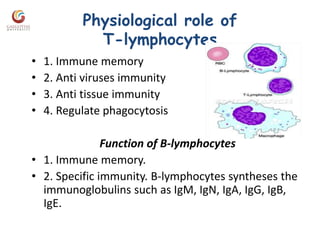
Physiological role of
T-lymphocytes
• 1. Immune memory
• 2. Anti viruses immunity
• 3. Anti tissue immunity
• 4. Regulate phagocytosis
Function of В-lymphocytes
• 1. Immune memory.
• 2. Specific immunity. B-lymphocytes syntheses the
immunoglobulins such as IgM, IgN, IgA, IgG, IgB,
IgE.
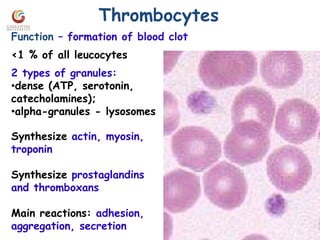
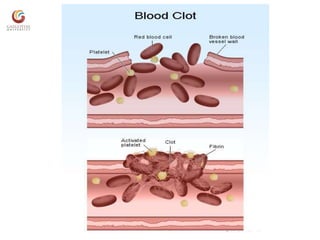
Thrombocytes
Function – formation of blood clot
<1 % of all leucocytes
2 types of granules:
•dense (АТP, serotonin,
catecholamines);
•аlpha-granules - lysosomes
Synthesize actin, myosin,
troponin
Synthesize prostaglandins
and thromboxans
Main reactions: adhesion,
aggregation, secretion
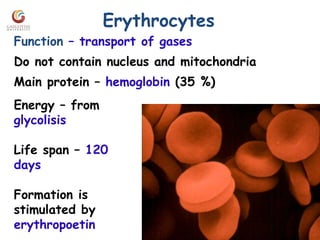
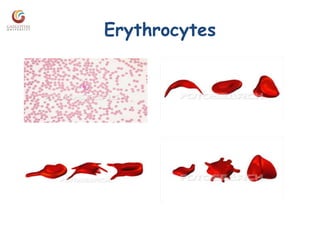
Erythrocytes
Function – transport of gases
Do not contain nucleus and mitochondria
Main protein – hemoglobin (35 %)
Energy – from
glycolisis
Life span – 120
days
Formation is
stimulated by
erythropoetin
Erythrocytes
Reference
• https://www.slideshare.net/VamsiIntellectual/
introduction-to-hematology-173160503
• Dr. NTR university of health sciences B.Sc. MLT
syllabus
Youtube videos
• https://www.youtube.com/watch?v=6-
hm3pdr8UA
• https://www.youtube.com/watch?v=HQWlcSp
9Sls
• https://www.youtube.com/watch?v=XVWOlK
dpF_I
Introduction to hematology

Introduction to hematology

  • 1.
    Module-2 Topic name Introduction toHematology Volume, Serum, Plasma Sub code: BMLT1002 Sub Name: General physiology – (T) Department: Department of MLT, SMAS Faculty: A. Vamsi Kumar Designation : Assistant professor
  • 2.
    Course outcomes On completionof this course, the student can be able to: • Perform ESR, PCV, & Teach blood cell functions
  • 3.
    Learning outcomes On completionof this course, the student can be able to: • Define Hematology • Classify the branches of hematology • Types of Laboratory tests in done in laboratory • Composition of blood & • Components of Blood
  • 4.
    Contents 1. Definition ofHematology 2. Functions ofblood 3. Composition of blood 4. Volume of the blood 5. Branches of hematology 6. basic hematology 7. Immuno hematology / Transfusion medicine 8. Hemorrhagic disorders
  • 7.
    Functions of blood 1.Gas transport – blood carries oxygen from lung to the tissues and carbon dioxide in reverse direction. 2. Transport of nutritional substances for all cells (glucose, amino acids, fatty acids, vitamins, ketone bodies, microelements etc.). Blood carries final products of metabolism (urea, uric acid, bilirubin, creatinin etc.) from tissues to kidney, where from they excreted with urine. 3. Regulation of different processes. Blood creates and carries local hormones (hormonoids) to the target organs.
  • 8.
    Functions of blood 4.Thermoregulation – heat change between tissues and blood. 5. Osmotic function – maintenance of the osmotic pressure in blood vessels. 6. Protective function – blood has antibodies and leucocytes, which perform phagocytosis. 7. Detoxification – blood enzymes can neutralize (split) different toxic substances.
  • 9.
    PROPERTIES OF BLOOD •1. Color: Blood is red in color. Arterial blood is scarlet red because it contains more oxygen and venous blood is purple red because of more carbon dioxide. • 2. Volume: Average volume of blood in a normal adult is 5 L. In a newborn baby, the volume is 450 ml. It increases during growth and reaches 5 L at the time of puberty. In females, it is slightly less and is about 4.5 L. It is about 8% of the body weight in a normal young healthy adult, weighing about 70 kg. • 3. Reaction and pH: Blood is slightly alkaline and its pH in normal conditions is 7.4. • 4. Specific gravity: • Specific gravity of total blood : 1.052 to 1.061 • Specific gravity blood cells : 1.092 to 1.101 • Specific gravity of plasma : 1.022 to 1.026 • 5. Viscosity: Blood is five times more viscous than water. It is mainly due to red blood cells and plasma proteins.
  • 12.
  • 13.
  • 15.
  • 16.
  • 18.
  • 22.
  • 23.
  • 24.
  • 25.
  • 28.
  • 32.
  • 35.
  • 37.
    Quantity of leukocytesand their changes • White cells are nucleated and somewhat variable in size and shape. Their number is 4-9•Giga per liter. The number of lymphocytes are – 18-37 %, • monocytes – 3-11 %, • eosinophils –0,5-5 %, • basophils – 0-1 %, • juvenile neutrophile – 0-1 %, • relating to stab (rod-shaped) neutrophil – 1-6 %, • segmented neutrophil – 47-72 %. • The number of leukocytes may increase or decrease.
  • 39.
    Blood cells Neutrophils Function –protection against infections 60-70% of all leucocytes Main source of energy – glucose in glycolysis (small amount of mitochondria) Hundreds of granules (contain hydrolyses, peroxidases, phosphatases, lysocim....)
  • 40.
    Phagocytosis Oxygen burst –marked consumption of oxygen in phagocytosis Active radicals are formed (kill bacteria) NАDPН-оxidase NADН-оxidase mieloperoxidase
  • 41.
    Basophils Produce a lotof histamine, serotonin, heparin Energy mainly from oxidative phosphorylation Function – allergic reactions, blood clotting 1-5 % of all leucocytes
  • 42.
    Eosinophils Amount is increased in helmintosis, organism sensibilization, alergy Function– protection from microorganisms, allergic reactions 3-6 % of all leucocytes
  • 43.
    Monocytes Function – phagocytosis,exit into tissues – tissue macrophages 4-8 % of all leucocytes Are accumulated in the place of inflammation A lot of lysosomal hydrolases Aerobic pathway of energy obtaining prevails
  • 44.
    Lymphocytes Function – formationof humoral and cell immunity 20-25 % of all leucocytes. Intensive synthesis of protein - immunoglobulins Т- і В-limphocytes Energy mainly from glycolysis
  • 45.
    Lymphocytes • Physiological roleof T-lymphocytes (There are receptors to antigens on the membrane of T- lymphocytes, which helps to distinguish genetic heterologous substances.) • Functional significance of B-lymphocytes (B- lymphocytes syntheses the immunoglobulins such as IgM, IgN, IgA, IgG, IgB, IgE.)
  • 46.
    Physiological role of T-lymphocytes •1. Immune memory • 2. Anti viruses immunity • 3. Anti tissue immunity • 4. Regulate phagocytosis Function of В-lymphocytes • 1. Immune memory. • 2. Specific immunity. B-lymphocytes syntheses the immunoglobulins such as IgM, IgN, IgA, IgG, IgB, IgE.
  • 47.
    Thrombocytes Function – formationof blood clot <1 % of all leucocytes 2 types of granules: •dense (АТP, serotonin, catecholamines); •аlpha-granules - lysosomes Synthesize actin, myosin, troponin Synthesize prostaglandins and thromboxans Main reactions: adhesion, aggregation, secretion
  • 49.
    Erythrocytes Function – transportof gases Do not contain nucleus and mitochondria Main protein – hemoglobin (35 %) Energy – from glycolisis Life span – 120 days Formation is stimulated by erythropoetin
  • 50.
  • 51.
  • 52.
    Youtube videos • https://www.youtube.com/watch?v=6- hm3pdr8UA •https://www.youtube.com/watch?v=HQWlcSp 9Sls • https://www.youtube.com/watch?v=XVWOlK dpF_I