WHAT IS HAEMATOLOGY ?
Is the branch of biology, concerned with the
study of blood, the blood-forming organs,
and blood diseases.
WHATIS BLOOD?
Is a specialized bodily fluid in animals that
delivers necessary substances such as
nutrients and oxygen to the cells and
transports metabolic waste products away
from those same cells.
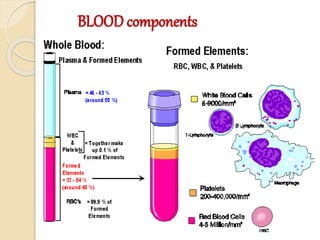
BLOOD components
COMPLETE BLOOD PICTURE
RED BLOOD CELLS
 also known as erythrocytes.
 mature red blood cells are
flexible biconcave disks.
 has a disk diameter of 6–8 µm
and a thickness of 2 µm.
 Male: 4.50–6.50 x 10⁶/µL
 Female: 3.80–4.80 x 10⁶/µL
 Life span:- 120 days.
RED BLOOD CELL INDICES:-
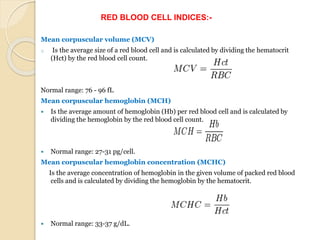
Mean corpuscular volume (MCV)
o Is the average size of a red blood cell and is calculated by dividing the hematocrit
(Hct) by the red blood cell count.
Normal range: 76 - 96 fL
Mean corpuscular hemoglobin (MCH)
 Is the average amount of hemoglobin (Hb) per red blood cell and is calculated by
dividing the hemoglobin by the red blood cell count.
 Normal range: 27-31 pg/cell.
Mean corpuscular hemoglobin concentration (MCHC)
Is the average concentration of hemoglobin in the given volume of packed red blood
cells and is calculated by dividing the hemoglobin by the hematocrit.
 Normal range: 33-37 g/dL.
PLATELET(Thrombocytes)
 are small, irregularly shaped
clear cell fragments (i.e. cells
that do not have a nucleus
containing DNA)
 Diameter :- 2–3 µm .
 Life span:- 7 – 14 days.
 Thrombocytosis: elevated
platelet count > 4.5 lakhs.
 Causes: infection, malignancy,
inflammatory disease.
 Deep venous thrombosis.
 Thrombocytopenia : decreased
platelet count
 < 1.5 lakhs.
 Causes: bone marrow
dysfunction, malignancy,
auto-immune response,
medication, chemotherapy.
 Haemophilia
HEMOGLOBIN
 Is the iron-containing oxygen-transport
metalloprotein in the red blood cells.
 Male:- 13.0 – 17.0 g/dL
 Female:- 12.0 – 15.0 g/dL
 Childerns:- 11.5 – 15.5 g/dL
 Increased Hemoglobin :-Polycythemia
 Decreased Hemoglobin :- Anemia
Hematocrit:-
is the percentage (%) of the concentration of
red blood cells in blood.
Male:- 42.0 – 52.0%, Female :-37.0 – 47.0 %
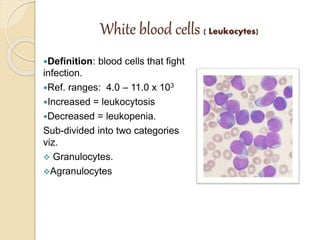
White blood cells ( Leukocytes)
Definition: blood cells that fight
infection.
Ref. ranges: 4.0 – 11.0 x 10³
Increased = leukocytosis
Decreased = leukopenia.
Sub-divided into two categories
viz.
 Granulocytes.
Agranulocytes
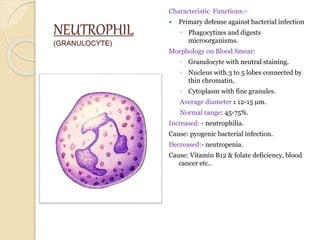
NEUTROPHIL
(GRANULOCYTE)
Characteristic Functions:-
 Primary defense against bacterial infection
◦ Phagocytizes and digests
microorganisms.
Morphology on Blood Smear:
◦ Granulocyte with neutral staining.
◦ Nucleus with 3 to 5 lobes connected by
thin chromatin,
◦ Cytoplasm with fine granules.
Average diameter : 12-15 µm.
Normal range: 45-75%.
Increased: - neutrophilia.
Cause: pyogenic bacterial infection.
Decreased:- neutropenia.
Cause: Vitamin B12 & folate deficiency, blood
cancer etc..
EOSINOPHIL
(GRANULOCYTE)
Characteristic Functions:
Response to Allergic and Parasitic Infection
Morphology on Blood Smear:
◦ Granular leukocytes with a nucleus
that usually has two lobes connected
by a slender thread of chromatin.
◦ cytoplasm containing coarse, round
granules that are uniform in size and
stainable by eosin.
Average diameter: 12-17 µm
Normal Range: 2 - 6%.
Increased: . eosinophilia.
Cause: asthama, hypersensitivity reaction.
Decreased : eosinopenia.
Cause: alcohol intoxication, over
production of steroids in body
(Cortisols).
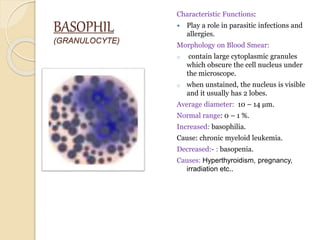
BASOPHIL
(GRANULOCYTE)
Characteristic Functions:
 Play a role in parasitic infections and
allergies.
Morphology on Blood Smear:
o contain large cytoplasmic granules
which obscure the cell nucleus under
the microscope.
o when unstained, the nucleus is visible
and it usually has 2 lobes.
Average diameter: 10 – 14 µm.
Normal range: 0 – 1 %.
Increased: basophilia.
Cause: chronic myeloid leukemia.
Decreased:- : basopenia.
Causes: Hyperthyroidism, pregnancy,
irradiation etc..
MONOCYTE
Characteristic Functions:
 Phagocytizes dead or damaged cells
◦ Monocytes move into tissue and
become Macrophages
◦ Macrophages directly perform the
phagocytosis
Morphology on Blood smear:
◦ Mononuclear Leukocyte
◦ Slightly larger than a Lymphocyte
◦ Kidney shaped nucleus
Average diameter: 10 - 30 µm.
Normal Range: 2-8% of White Blood Cells.
Increased : Monocytosis
Cause: tuberculosis, malaria, typhoid &
Kala azar.
Decreased: Monocytopenia
Cause: Aplastic anemia, Lymphocytic
Anemia, Glucocorticoids.
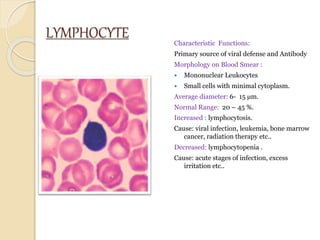
LYMPHOCYTE Characteristic Functions:
Primary source of viral defense and Antibody
Morphology on Blood Smear :
 Mononuclear Leukocytes
 Small cells with minimal cytoplasm.
Average diameter: 6- 15 µm.
Normal Range: 20 – 45 %.
Increased : lymphocytosis.
Cause: viral infection, leukemia, bone marrow
cancer, radiation therapy etc..
Decreased: lymphocytopenia .
Cause: acute stages of infection, excess
irritation etc..
INTERPRETATION
Type of Cell Increase Decrease
Red Blood Cell
(RBC)
Erythrocytosis or
Polycythemia
Anemia or
erythroblastopenia
White Blood Cells
(WBC):
leukocytosis Leukopenia
Lymphocytes lymphocytosis lymphocytopenia
Granulocytes Granulocytosis
Granulocytopenia or
agranulocytosi s
Neutrophils Neutrophilia neutropenia
Eosinophils Eosinophilia Eosinopenia
Basophils Basophilia Basopenia
Platelets Thrombocytosis Thrombocytopenia
All cell lines - Pancytopenia
 Syed
Basheer

Basic Hematology

  • 2.
    WHAT IS HAEMATOLOGY? Is the branch of biology, concerned with the study of blood, the blood-forming organs, and blood diseases. WHATIS BLOOD? Is a specialized bodily fluid in animals that delivers necessary substances such as nutrients and oxygen to the cells and transports metabolic waste products away from those same cells.
  • 3.
  • 4.
  • 5.
    RED BLOOD CELLS also known as erythrocytes.  mature red blood cells are flexible biconcave disks.  has a disk diameter of 6–8 µm and a thickness of 2 µm.  Male: 4.50–6.50 x 10⁶/µL  Female: 3.80–4.80 x 10⁶/µL  Life span:- 120 days.
  • 6.
    RED BLOOD CELLINDICES:- Mean corpuscular volume (MCV) o Is the average size of a red blood cell and is calculated by dividing the hematocrit (Hct) by the red blood cell count. Normal range: 76 - 96 fL Mean corpuscular hemoglobin (MCH)  Is the average amount of hemoglobin (Hb) per red blood cell and is calculated by dividing the hemoglobin by the red blood cell count.  Normal range: 27-31 pg/cell. Mean corpuscular hemoglobin concentration (MCHC) Is the average concentration of hemoglobin in the given volume of packed red blood cells and is calculated by dividing the hemoglobin by the hematocrit.  Normal range: 33-37 g/dL.
  • 7.
    PLATELET(Thrombocytes)  are small,irregularly shaped clear cell fragments (i.e. cells that do not have a nucleus containing DNA)  Diameter :- 2–3 µm .  Life span:- 7 – 14 days.  Thrombocytosis: elevated platelet count > 4.5 lakhs.  Causes: infection, malignancy, inflammatory disease.  Deep venous thrombosis.  Thrombocytopenia : decreased platelet count  < 1.5 lakhs.  Causes: bone marrow dysfunction, malignancy, auto-immune response, medication, chemotherapy.  Haemophilia
  • 8.
    HEMOGLOBIN  Is theiron-containing oxygen-transport metalloprotein in the red blood cells.  Male:- 13.0 – 17.0 g/dL  Female:- 12.0 – 15.0 g/dL  Childerns:- 11.5 – 15.5 g/dL  Increased Hemoglobin :-Polycythemia  Decreased Hemoglobin :- Anemia Hematocrit:- is the percentage (%) of the concentration of red blood cells in blood. Male:- 42.0 – 52.0%, Female :-37.0 – 47.0 %
  • 9.
    White blood cells( Leukocytes) Definition: blood cells that fight infection. Ref. ranges: 4.0 – 11.0 x 10³ Increased = leukocytosis Decreased = leukopenia. Sub-divided into two categories viz.  Granulocytes. Agranulocytes
  • 10.
    NEUTROPHIL (GRANULOCYTE) Characteristic Functions:-  Primarydefense against bacterial infection ◦ Phagocytizes and digests microorganisms. Morphology on Blood Smear: ◦ Granulocyte with neutral staining. ◦ Nucleus with 3 to 5 lobes connected by thin chromatin, ◦ Cytoplasm with fine granules. Average diameter : 12-15 µm. Normal range: 45-75%. Increased: - neutrophilia. Cause: pyogenic bacterial infection. Decreased:- neutropenia. Cause: Vitamin B12 & folate deficiency, blood cancer etc..
  • 11.
    EOSINOPHIL (GRANULOCYTE) Characteristic Functions: Response toAllergic and Parasitic Infection Morphology on Blood Smear: ◦ Granular leukocytes with a nucleus that usually has two lobes connected by a slender thread of chromatin. ◦ cytoplasm containing coarse, round granules that are uniform in size and stainable by eosin. Average diameter: 12-17 µm Normal Range: 2 - 6%. Increased: . eosinophilia. Cause: asthama, hypersensitivity reaction. Decreased : eosinopenia. Cause: alcohol intoxication, over production of steroids in body (Cortisols).
  • 12.
    BASOPHIL (GRANULOCYTE) Characteristic Functions:  Playa role in parasitic infections and allergies. Morphology on Blood Smear: o contain large cytoplasmic granules which obscure the cell nucleus under the microscope. o when unstained, the nucleus is visible and it usually has 2 lobes. Average diameter: 10 – 14 µm. Normal range: 0 – 1 %. Increased: basophilia. Cause: chronic myeloid leukemia. Decreased:- : basopenia. Causes: Hyperthyroidism, pregnancy, irradiation etc..
  • 13.
    MONOCYTE Characteristic Functions:  Phagocytizesdead or damaged cells ◦ Monocytes move into tissue and become Macrophages ◦ Macrophages directly perform the phagocytosis Morphology on Blood smear: ◦ Mononuclear Leukocyte ◦ Slightly larger than a Lymphocyte ◦ Kidney shaped nucleus Average diameter: 10 - 30 µm. Normal Range: 2-8% of White Blood Cells. Increased : Monocytosis Cause: tuberculosis, malaria, typhoid & Kala azar. Decreased: Monocytopenia Cause: Aplastic anemia, Lymphocytic Anemia, Glucocorticoids.
  • 14.
    LYMPHOCYTE Characteristic Functions: Primarysource of viral defense and Antibody Morphology on Blood Smear :  Mononuclear Leukocytes  Small cells with minimal cytoplasm. Average diameter: 6- 15 µm. Normal Range: 20 – 45 %. Increased : lymphocytosis. Cause: viral infection, leukemia, bone marrow cancer, radiation therapy etc.. Decreased: lymphocytopenia . Cause: acute stages of infection, excess irritation etc..
  • 15.
    INTERPRETATION Type of CellIncrease Decrease Red Blood Cell (RBC) Erythrocytosis or Polycythemia Anemia or erythroblastopenia White Blood Cells (WBC): leukocytosis Leukopenia Lymphocytes lymphocytosis lymphocytopenia Granulocytes Granulocytosis Granulocytopenia or agranulocytosi s Neutrophils Neutrophilia neutropenia Eosinophils Eosinophilia Eosinopenia Basophils Basophilia Basopenia Platelets Thrombocytosis Thrombocytopenia All cell lines - Pancytopenia
  • 17.