Financial Reporting and Control
Introduction to
Financial Reporting
Understanding Business
             Organisations

Provide Goods and Services to earn Profit
Types and forms of business organisations
Cash Machine
Importance of Information
Accounting as the language of business
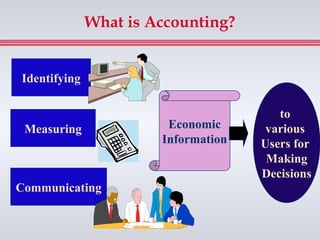
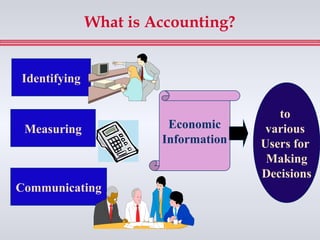
What is Accounting?


Identifying

                                        to
 Measuring              Economic      various
                       Information   Users for
                                      Making
                                     Decisions
Communicating
Definition of Accounting

 “The process of identifying, measuring,
  and communicating economic
  information to permit informed
  judgements and decisions by users of
  the information.”
     —American Accounting Association
      (AAA)
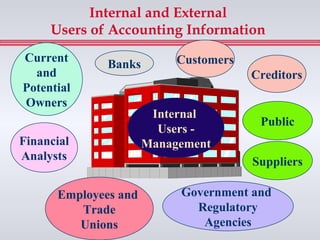
Internal and External
     Users of Accounting Information
Current                    Customers
              Banks
  and                                  Creditors
Potential
Owners
                       Internal
                                        Public
                        Users -
Financial             Management
Analysts                               Suppliers

      Employees and        Government and
         Trade               Regulatory
         Unions               Agencies
Accounting Information System
What is an AIS?

 A system is a set of two or more interrelated
  components that interact to achieve a goal.
 Systems are almost always composed of
  smaller subsystems, each performing a
  specific function supportive of the larger
  system.
 An accounting information system (AIS)
  consists of:
    People
    Procedures
    Data
    Software
    Information technology
3 Basic Functions of AIS

1. Collecting and processing data about the
   organization business activities efficiently
   and effectively
2. Providing information useful for decision
   making
3. Establishing adequate controls to ensure
   that data about business activities are
   recorded and processed accurately and to
   safeguard both that data and other
   organizational assets
Basic Subsystems in the AIS

1 The expenditure cycle: involves activities of
  buying and paying for goods or services used
  by the organization.
2 The production cycle: involves activities
  converting raw materials and labor into
  finished goods.
3 The human resources/payroll cycle: involves
  activities of hiring and paying employees.
Basic Subsystems in the AIS

4 The revenue cycle: involves activities of
  selling goods or services and collecting
  payment for those sales.
5 The financing cycle: involves activities
  of obtaining necessary funds to run the
  organization, repay creditors, and
  distribute profits to investors.
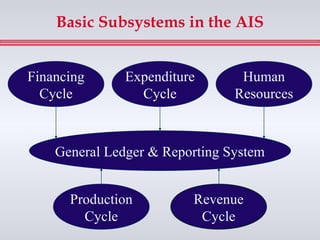
Basic Subsystems in the AIS


Financing      Expenditure       Human
  Cycle          Cycle          Resources


    General Ledger & Reporting System


      Production         Revenue
        Cycle             Cycle
How An AIS Can Add Value
     To An Organization

 An AIS adds value...
– by providing accurate and timely
  information so that five primary value
  chain activities can be performed
  more effectively and efficiently. This
  is done by:
  – improving the quality and reducing the costs
    of products or services.
How An AIS Can Add Value
     To An Organization


An AIS can…
– improve efficiency.
– improve decision making capabilities.
– increase the sharing of knowledge.
 A well-designed AIS can also help
  an organization profit by improving
  the efficiency and effectiveness of
  its supply chain.
The Value Chain


 The ultimate goal of any business is
  to provide value to its customers.
 A business will be profitable if the
  value it creates is greater than the
  cost of producing its products or
  services.
The Value Chain


 An organization’s value chain consists of
  nine interrelated activities that
  collectively describe everything it does.
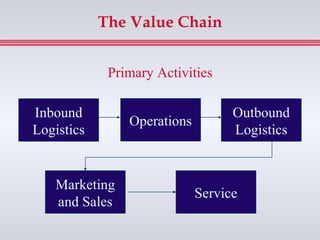
 The five primary activities consist of the
  activities performed in order to create,
  market, and deliver products and
  services to customers and also to
  provide post-sales services and support.
The Value Chain


             Primary Activities

Inbound                            Outbound
                Operations
Logistics                          Logistics


   Marketing
                             Service
   and Sales
The Value Chain


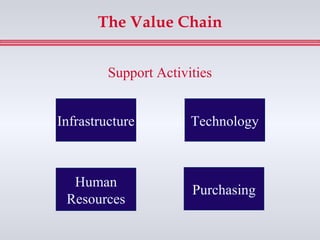
 The four support activities in the
  value chain make it possible for the
  primary activities to be performed
  efficiently and effectively.
The Value Chain


         Support Activities


Infrastructure         Technology


  Human
                       Purchasing
 Resources
The Value System


 The value chain concept can be
  extended by recognizing that
  organizations must interact with
  suppliers, distributors, and
  customers.
 An organization’s value chain and
  the value chains of its suppliers,
  distributors, and customers
  collectively form a value system.
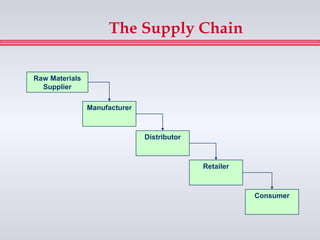
The Supply Chain

Raw Materials
  Supplier

                Manufacturer


                               Distributor


                                             Retailer


                                                        Consumer
Information and Decision Making


  What is information?
  The term data refers to any and all
   of the facts that are collected,
   stored, and processed by an
   information system.
  Information is data that has been
   organized and processed so that it
   is meaningful.
Information and Decision Making


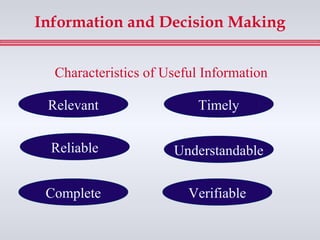
  Characteristics of Useful Information

 Relevant                 Timely


  Reliable            Understandable


 Complete                Verifiable
Value of Information

 The value of information is the benefit
  produced by the information minus the
  cost of producing it.
Information and Decision Making

 What is decision making?
 Decision making involves the following
  steps:
1 Identify the problem.
2 Select a method for solving the problem.
3 Collect data needed to execute the decision
  model.
4 Interpret the outputs of the model.
Information and Decision Making

5 Evaluate the merits of each alternative.
6 Choose and execute the preferred solution.
 Decisions can be categorized in terms of the
  degree of structure that exists
Decision Structure

 Structured decisions are repetitive,
  routine, and understood well enough
  that they can be delegated to lower-
  level employees in the organization.
 An example is:
    Extending credit to customers.
Decision Structure

 Semi-structured decisions are
  characterized by incomplete rules for
  making the decision and the need for
  subjective assessments and judgments
  to supplement formal data analysis.
 An example is:
   Setting a marketing budget for a new
   product.
Decision Structure

 Unstructured decisions are
  nonrecurring and non routine.
 An example is:
    Choosing the cover for a magazine.
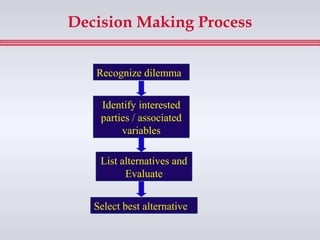
Decision Making Process


   Recognize dilemma


    Identify interested
    parties / associated
         variables

    List alternatives and
          Evaluate


   Select best alternative
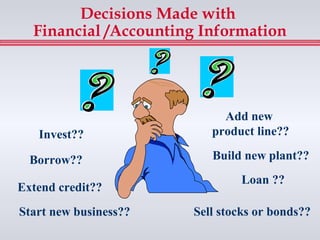
Decisions Made with
  Financial /Accounting Information


                            Add new
   Invest??               product line??

  Borrow??                Build new plant??
                               Loan ??
Extend credit??
Start new business??   Sell stocks or bonds??
The Future of AIS

 The Internet makes strategy more
    important than ever
 Enterprise resource planning (ERP)
  systems are a recent development that
  integrate all aspects of a company’s
  operations with its traditional AIS.
 The important point underlying ERP
  systems is the need for and value of cross-
  functional integration of financial data and
  other non financial operating data.
What is Accounting?


Identifying

                                        to
 Measuring              Economic      various
                       Information   Users for
                                      Making
                                     Decisions
Communicating
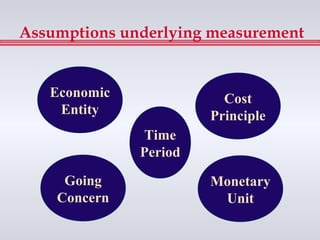
Assumptions underlying measurement


   Economic              Cost
    Entity             Principle
              Time
              Period

     Going             Monetary
    Concern             Unit
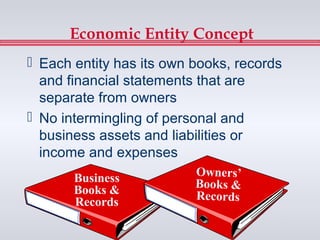
Economic Entity Concept
 Each entity has its own books, records
  and financial statements that are
  separate from owners
 No intermingling of personal and
  business assets and liabilities or
  income and expenses
                          Owners’
       Business           Books &
       Books &            Records
       Records
Cost Principle
 Record assets at cost paid
  to acquire them
 Continue to value assets at
  historical cost until sold
 More objective than market
  value
Going Concern
 Assume business
  will continue
  indefinitely into the
  foreseeable future
 Justifies use of
  historical cost
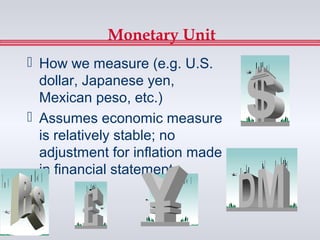
Monetary Unit
 How we measure (e.g. U.S.
  dollar, Japanese yen,
  Mexican peso, etc.)
 Assumes economic measure
  is relatively stable; no
  adjustment for inflation made
  in financial statements
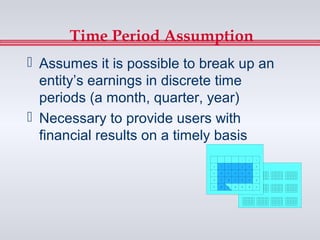
Time Period Assumption
 Assumes it is possible to break up an
  entity’s earnings in discrete time
  periods (a month, quarter, year)
 Necessary to provide users with
  financial results on a timely basis
                                                 1    2    3


                             4    5    6    7    8    9    10


                             11   12   13   14   15   16   17


                             18   19   20   21   22   23   24


                             25   26   27   28   29   30   31
Generally Accepted Accounting Principles

  Generally Accepted Accounting Principles
  known as GAAP are the commonly
  understood and accepted conventions,
  rules and procedures for gathering,
  organizing, and reporting the financial
  history of an organization.
Generally Accepted Accounting Principles

 Generally GAAP applies to one or more of
 the following three broad areas:

    Accounting Valuation

    Recognition

    Disclosure
Generally Accepted Accounting Principles

 Accounting Valuation - GAAP helps to
  specify the value of the items reported. It
  provides guidance and restrictions on the
  accounting values used in the financial
  statements.
Generally Accepted Accounting Principles

  Recognition – How should an item be
  treated in the accounting records? Should
  an item be treated as an asset or an
  expense? For instance, does an
  advertising campaign have future benefits?
Generally Accepted Accounting Principles

  Disclosure – The act of providing
  information about the organization and
  construction of its accounting reports.
  GAAP requires the disclosure of
  measurement methods, assumptions, etc.,
  that add to the information content of the
  annual report.
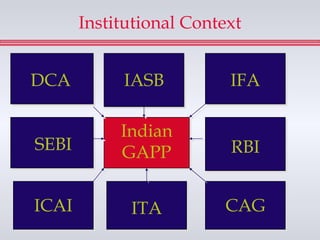
Institutional Context


DCA         IASB          IFA

            Indian
SEBI        GAPP          RBI


ICAI         ITA         CAG
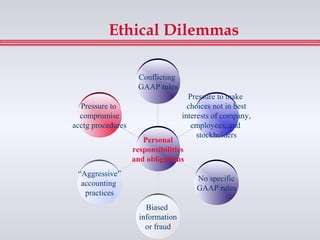
Ethical Dilemmas

                    Conflicting
                    GAAP rules
                                     Pressure to make
  Pressure to                        choices not in best
  compromise                       interests of company,
acctg procedures                      employees, and
                                        stockholders
                      Personal
                   responsibilities
                   and obligations
 “Aggressive”
                                       No specific
  accounting
                                       GAAP rules
   practices
                       Biased
                     information
                       or fraud
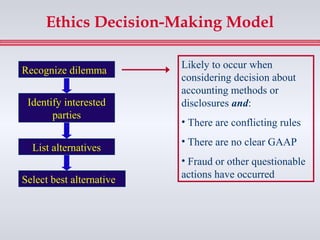
Ethics Decision-Making Model

                          Likely to occur when
Recognize dilemma
                          considering decision about
                          accounting methods or
 Identify interested      disclosures and:
       parties
                          • There are conflicting rules
                          • There are no clear GAAP
  List alternatives
                          • Fraud or other questionable
                          actions have occurred
Select best alternative
Ethics Decision-Making Model

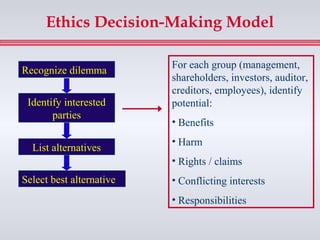
                          For each group (management,
Recognize dilemma
                          shareholders, investors, auditor,
                          creditors, employees), identify
 Identify interested      potential:
       parties
                          • Benefits
                          • Harm
  List alternatives
                          • Rights / claims
Select best alternative   • Conflicting interests
                          • Responsibilities
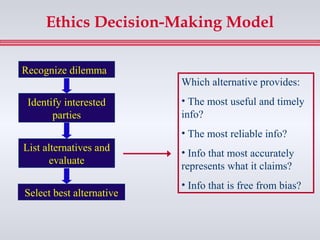
Ethics Decision-Making Model

Recognize dilemma
                          Which alternative provides:
 Identify interested      • The most useful and timely
       parties            info?
                          • The most reliable info?
List alternatives and     • Info that most accurately
       evaluate
                          represents what it claims?
                          • Info that is free from bias?
Select best alternative
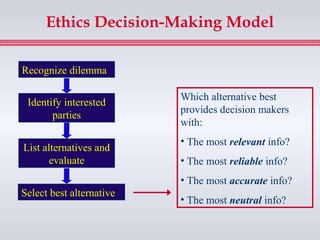
Ethics Decision-Making Model

Recognize dilemma

                          Which alternative best
 Identify interested
                          provides decision makers
       parties
                          with:
                          • The most relevant info?
List alternatives and
       evaluate           • The most reliable info?
                          • The most accurate info?
Select best alternative
                          • The most neutral info?
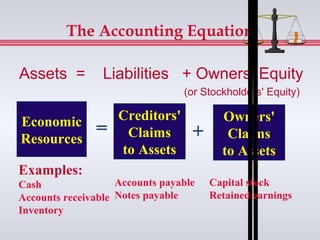
The Accounting Equation

Assets =         Liabilities + Owners’ Equity
                                 (or Stockholders' Equity)

Economic            Creditors'           Owners'
Resources
               =     Claims        +      Claims
                    to Assets            to Assets
Examples:
Cash                Accounts payable   Capital stock
Accounts receivable Notes payable      Retained earnings
Inventory
Financial Statements
    Balance Sheet
    Income Statement
    Statement of Cash Flows
Financial Statements
The financial statements are part of a
comprehensive financial report referred to
as the annual report.
Balance Sheet

 Shows relationship between assets
  liabilities and equities--on a particular date
  (i.e., point in time).


 Assets and liabilities and stockholders'
  equity must balance.
Balance Sheet

 Assets – A probable future economic benefit
  obtained by entering into a transaction. The
  resources owned by the business.

 Liabilities – The probable future sacrifice of
  economic benefits arising from an entity’s
  obligation to transfer assets or provide services for
  a past transaction. Creditors claims on total assets
  (obligations or debts of the business).
Balance Sheet (continued)

 Stockholders' Equity – The difference
 between an entity’s assets and liabilities.
 The owners’ claim on total assets.
Income Statement

 Reports success or failure of the
  company's operations during the period.

 Summarizes all revenue and expenses for
  period--month, quarter, or year. If
  revenues exceed expenses, the result is a
  net income. If expenses exceed revenue,
  the result is a (net loss).
Income Statement (continued)

 Revenues – increases in net assets
  resulting from an entity’s operation over a
  period of time.
 Expenses – decreases in net assets
  resulting from an entity’s operation over a
  period of time.

 Net Income - the excess of revenues over
  expenses.
Cash Flow Statement
The Cash Flow Statement - describes the flow
of cash into and out of an organization during an
accounting period. These flows are classified in
three categories:
Operating activities – The change in cash
resulting from actions intended to generate net
income.
Investing activities – The change in cash
resulting from actions taken to acquire or
dispose of productive company assets.
Cash Flow Statement (continued)
Financing activities – The change in cash
resulting from payments to or receipts
from suppliers of money to the firm (e.g.,
common shareholders or debt holders).
Other Elements of Annual Reports

 Management Discussion and Analysis

 Notes to Financial Statements

 Auditor's Report
Management Discussion and Analysis

Covers three aspects of a company:
   liquidity - ability to pay near-term
   obligations
   capital resources - ability to fund
   operations and expansions
   results of operation - profitability and
   efficiency
Notes to Financial Statements
 Provide additional information not included in
  body of statements
 Does not have to be numeric
 Examples:
    Description of accounting policies or
    explanation of uncertainties and
    contingencies
     Company statistics (e.g., market share,
    percentage of international sales, etc.)
Auditor's Report
 Auditor, a professional accountant who
  conducts an independent examination of the
  financial accounting data presented by a
  company.

 Auditor gives an unqualified opinion if the
  financial statements present the financial
  position, results of operations, and cash
  flows in accordance with GAAP.

Introduction to frc

  • 1.
  • 4.
  • 5.
    Understanding Business Organisations Provide Goods and Services to earn Profit Types and forms of business organisations Cash Machine Importance of Information Accounting as the language of business
  • 6.
    What is Accounting? Identifying to Measuring Economic various Information Users for Making Decisions Communicating
  • 7.
    Definition of Accounting “The process of identifying, measuring, and communicating economic information to permit informed judgements and decisions by users of the information.” —American Accounting Association (AAA)
  • 8.
    Internal and External Users of Accounting Information Current Customers Banks and Creditors Potential Owners Internal Public Users - Financial Management Analysts Suppliers Employees and Government and Trade Regulatory Unions Agencies
  • 9.
  • 10.
    What is anAIS?  A system is a set of two or more interrelated components that interact to achieve a goal.  Systems are almost always composed of smaller subsystems, each performing a specific function supportive of the larger system.  An accounting information system (AIS) consists of: People Procedures Data Software Information technology
  • 11.
    3 Basic Functionsof AIS 1. Collecting and processing data about the organization business activities efficiently and effectively 2. Providing information useful for decision making 3. Establishing adequate controls to ensure that data about business activities are recorded and processed accurately and to safeguard both that data and other organizational assets
  • 12.
    Basic Subsystems inthe AIS 1 The expenditure cycle: involves activities of buying and paying for goods or services used by the organization. 2 The production cycle: involves activities converting raw materials and labor into finished goods. 3 The human resources/payroll cycle: involves activities of hiring and paying employees.
  • 13.
    Basic Subsystems inthe AIS 4 The revenue cycle: involves activities of selling goods or services and collecting payment for those sales. 5 The financing cycle: involves activities of obtaining necessary funds to run the organization, repay creditors, and distribute profits to investors.
  • 14.
    Basic Subsystems inthe AIS Financing Expenditure Human Cycle Cycle Resources General Ledger & Reporting System Production Revenue Cycle Cycle
  • 15.
    How An AISCan Add Value To An Organization  An AIS adds value... – by providing accurate and timely information so that five primary value chain activities can be performed more effectively and efficiently. This is done by: – improving the quality and reducing the costs of products or services.
  • 16.
    How An AISCan Add Value To An Organization An AIS can… – improve efficiency. – improve decision making capabilities. – increase the sharing of knowledge.  A well-designed AIS can also help an organization profit by improving the efficiency and effectiveness of its supply chain.
  • 17.
    The Value Chain The ultimate goal of any business is to provide value to its customers.  A business will be profitable if the value it creates is greater than the cost of producing its products or services.
  • 18.
    The Value Chain An organization’s value chain consists of nine interrelated activities that collectively describe everything it does.  The five primary activities consist of the activities performed in order to create, market, and deliver products and services to customers and also to provide post-sales services and support.
  • 19.
    The Value Chain Primary Activities Inbound Outbound Operations Logistics Logistics Marketing Service and Sales
  • 20.
    The Value Chain The four support activities in the value chain make it possible for the primary activities to be performed efficiently and effectively.
  • 21.
    The Value Chain Support Activities Infrastructure Technology Human Purchasing Resources
  • 22.
    The Value System The value chain concept can be extended by recognizing that organizations must interact with suppliers, distributors, and customers.  An organization’s value chain and the value chains of its suppliers, distributors, and customers collectively form a value system.
  • 23.
    The Supply Chain RawMaterials Supplier Manufacturer Distributor Retailer Consumer
  • 24.
    Information and DecisionMaking  What is information?  The term data refers to any and all of the facts that are collected, stored, and processed by an information system.  Information is data that has been organized and processed so that it is meaningful.
  • 25.
    Information and DecisionMaking Characteristics of Useful Information Relevant Timely Reliable Understandable Complete Verifiable
  • 26.
    Value of Information The value of information is the benefit produced by the information minus the cost of producing it.
  • 27.
    Information and DecisionMaking  What is decision making?  Decision making involves the following steps: 1 Identify the problem. 2 Select a method for solving the problem. 3 Collect data needed to execute the decision model. 4 Interpret the outputs of the model.
  • 28.
    Information and DecisionMaking 5 Evaluate the merits of each alternative. 6 Choose and execute the preferred solution.  Decisions can be categorized in terms of the degree of structure that exists
  • 29.
    Decision Structure  Structureddecisions are repetitive, routine, and understood well enough that they can be delegated to lower- level employees in the organization.  An example is: Extending credit to customers.
  • 30.
    Decision Structure  Semi-structureddecisions are characterized by incomplete rules for making the decision and the need for subjective assessments and judgments to supplement formal data analysis.  An example is: Setting a marketing budget for a new product.
  • 31.
    Decision Structure  Unstructureddecisions are nonrecurring and non routine.  An example is: Choosing the cover for a magazine.
  • 32.
    Decision Making Process Recognize dilemma Identify interested parties / associated variables List alternatives and Evaluate Select best alternative
  • 33.
    Decisions Made with Financial /Accounting Information Add new Invest?? product line?? Borrow?? Build new plant?? Loan ?? Extend credit?? Start new business?? Sell stocks or bonds??
  • 34.
    The Future ofAIS  The Internet makes strategy more important than ever  Enterprise resource planning (ERP) systems are a recent development that integrate all aspects of a company’s operations with its traditional AIS.  The important point underlying ERP systems is the need for and value of cross- functional integration of financial data and other non financial operating data.
  • 35.
    What is Accounting? Identifying to Measuring Economic various Information Users for Making Decisions Communicating
  • 36.
    Assumptions underlying measurement Economic Cost Entity Principle Time Period Going Monetary Concern Unit
  • 37.
    Economic Entity Concept Each entity has its own books, records and financial statements that are separate from owners  No intermingling of personal and business assets and liabilities or income and expenses Owners’ Business Books & Books & Records Records
  • 38.
    Cost Principle  Recordassets at cost paid to acquire them  Continue to value assets at historical cost until sold  More objective than market value
  • 39.
    Going Concern  Assumebusiness will continue indefinitely into the foreseeable future  Justifies use of historical cost
  • 40.
    Monetary Unit  Howwe measure (e.g. U.S. dollar, Japanese yen, Mexican peso, etc.)  Assumes economic measure is relatively stable; no adjustment for inflation made in financial statements
  • 41.
    Time Period Assumption Assumes it is possible to break up an entity’s earnings in discrete time periods (a month, quarter, year)  Necessary to provide users with financial results on a timely basis 1 2 3 4 5 6 7 8 9 10 11 12 13 14 15 16 17 18 19 20 21 22 23 24 25 26 27 28 29 30 31
  • 42.
    Generally Accepted AccountingPrinciples Generally Accepted Accounting Principles known as GAAP are the commonly understood and accepted conventions, rules and procedures for gathering, organizing, and reporting the financial history of an organization.
  • 43.
    Generally Accepted AccountingPrinciples Generally GAAP applies to one or more of the following three broad areas: Accounting Valuation Recognition Disclosure
  • 44.
    Generally Accepted AccountingPrinciples Accounting Valuation - GAAP helps to specify the value of the items reported. It provides guidance and restrictions on the accounting values used in the financial statements.
  • 45.
    Generally Accepted AccountingPrinciples Recognition – How should an item be treated in the accounting records? Should an item be treated as an asset or an expense? For instance, does an advertising campaign have future benefits?
  • 46.
    Generally Accepted AccountingPrinciples Disclosure – The act of providing information about the organization and construction of its accounting reports. GAAP requires the disclosure of measurement methods, assumptions, etc., that add to the information content of the annual report.
  • 47.
    Institutional Context DCA IASB IFA Indian SEBI GAPP RBI ICAI ITA CAG
  • 48.
    Ethical Dilemmas Conflicting GAAP rules Pressure to make Pressure to choices not in best compromise interests of company, acctg procedures employees, and stockholders Personal responsibilities and obligations “Aggressive” No specific accounting GAAP rules practices Biased information or fraud
  • 49.
    Ethics Decision-Making Model Likely to occur when Recognize dilemma considering decision about accounting methods or Identify interested disclosures and: parties • There are conflicting rules • There are no clear GAAP List alternatives • Fraud or other questionable actions have occurred Select best alternative
  • 50.
    Ethics Decision-Making Model For each group (management, Recognize dilemma shareholders, investors, auditor, creditors, employees), identify Identify interested potential: parties • Benefits • Harm List alternatives • Rights / claims Select best alternative • Conflicting interests • Responsibilities
  • 51.
    Ethics Decision-Making Model Recognizedilemma Which alternative provides: Identify interested • The most useful and timely parties info? • The most reliable info? List alternatives and • Info that most accurately evaluate represents what it claims? • Info that is free from bias? Select best alternative
  • 52.
    Ethics Decision-Making Model Recognizedilemma Which alternative best Identify interested provides decision makers parties with: • The most relevant info? List alternatives and evaluate • The most reliable info? • The most accurate info? Select best alternative • The most neutral info?
  • 53.
    The Accounting Equation Assets= Liabilities + Owners’ Equity (or Stockholders' Equity) Economic Creditors' Owners' Resources = Claims + Claims to Assets to Assets Examples: Cash Accounts payable Capital stock Accounts receivable Notes payable Retained earnings Inventory
  • 54.
    Financial Statements Financial Statements Balance Sheet Income Statement Statement of Cash Flows
  • 55.
    Financial Statements The financialstatements are part of a comprehensive financial report referred to as the annual report.
  • 56.
    Balance Sheet  Showsrelationship between assets liabilities and equities--on a particular date (i.e., point in time).  Assets and liabilities and stockholders' equity must balance.
  • 57.
    Balance Sheet  Assets– A probable future economic benefit obtained by entering into a transaction. The resources owned by the business.  Liabilities – The probable future sacrifice of economic benefits arising from an entity’s obligation to transfer assets or provide services for a past transaction. Creditors claims on total assets (obligations or debts of the business).
  • 58.
    Balance Sheet (continued) Stockholders' Equity – The difference between an entity’s assets and liabilities. The owners’ claim on total assets.
  • 59.
    Income Statement  Reportssuccess or failure of the company's operations during the period.  Summarizes all revenue and expenses for period--month, quarter, or year. If revenues exceed expenses, the result is a net income. If expenses exceed revenue, the result is a (net loss).
  • 60.
    Income Statement (continued) Revenues – increases in net assets resulting from an entity’s operation over a period of time.  Expenses – decreases in net assets resulting from an entity’s operation over a period of time.  Net Income - the excess of revenues over expenses.
  • 61.
    Cash Flow Statement TheCash Flow Statement - describes the flow of cash into and out of an organization during an accounting period. These flows are classified in three categories: Operating activities – The change in cash resulting from actions intended to generate net income. Investing activities – The change in cash resulting from actions taken to acquire or dispose of productive company assets.
  • 62.
    Cash Flow Statement(continued) Financing activities – The change in cash resulting from payments to or receipts from suppliers of money to the firm (e.g., common shareholders or debt holders).
  • 63.
    Other Elements ofAnnual Reports  Management Discussion and Analysis  Notes to Financial Statements  Auditor's Report
  • 64.
    Management Discussion andAnalysis Covers three aspects of a company: liquidity - ability to pay near-term obligations capital resources - ability to fund operations and expansions results of operation - profitability and efficiency
  • 65.
    Notes to FinancialStatements  Provide additional information not included in body of statements  Does not have to be numeric  Examples: Description of accounting policies or explanation of uncertainties and contingencies Company statistics (e.g., market share, percentage of international sales, etc.)
  • 66.
    Auditor's Report  Auditor,a professional accountant who conducts an independent examination of the financial accounting data presented by a company.  Auditor gives an unqualified opinion if the financial statements present the financial position, results of operations, and cash flows in accordance with GAAP.

Editor's Notes