1-1


Accounting Foundations:
Information for Decisions


  Chapter 1
  Accounting and organisations
1-2


Accounting Scandals
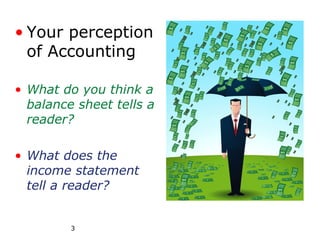
• Your perception
  of Accounting

• What do you think a
  balance sheet tells a
  reader?

• What does the
  income statement
  tell a reader?


         3
Initial questions
1. What role does Accounting serve?
  Basic: to help people in organisations
  make decisions about economic activities
2. Does Accounting have economic
   consequences?
  Yes: it affects organisation plans,
  employment, future value (like share
  prices)
3. Are Ethics important in Accounting?
  Very important. Unethical accounting
  practices can ruin the fortunes of
  employees, suppliers and investors
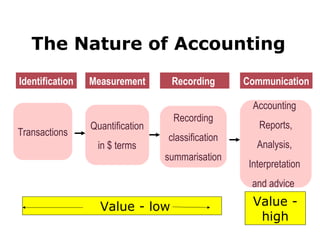
The Nature of Accounting
Identification   Measurement       Recording        Communication

                                                      Accounting
                                                      Accounting
                                    Recording
                                    Recording
                 Quantification
                 Quantification                        Reports,
                                                       Reports,
Transactions
 Transactions                     classification
                  in $ terms       classification      Analysis,
                   in $ terms                          Analysis,
                                  summarisation
                                   summarisation     Interpretation
                                                      Interpretation
                                                     and advice
                                                      and advice
                   Value - low                        Value -
                                                       high
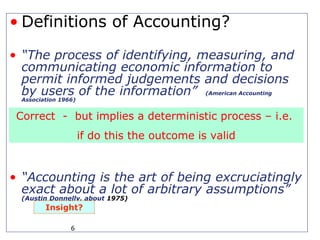
• Definitions of Accounting?

• “The process of identifying, measuring, and
  communicating economic information to
  permit informed judgements and decisions
  by users of the information” (American Accounting
  Association 1966)


 Correct - but implies a deterministic process – i.e.
                      if do this the outcome is valid


• “Accounting is the art of being excruciatingly
  exact about a lot of arbitrary assumptions”
  (Austin Donnelly, about 1975)
         Insight?

                 6
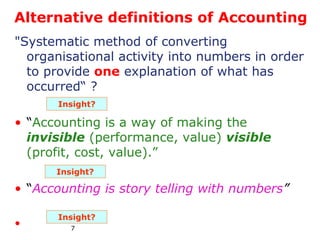
Alternative definitions of Accounting
"Systematic method of converting
  organisational activity into numbers in order
  to provide one explanation of what has
  occurred“ ?
       Insight?

• “Accounting is a way of making the
  invisible (performance, value) visible
  (profit, cost, value).”
      Insight?

• “Accounting is story telling with numbers”

       Insight?
•        7
                  31 January 2013
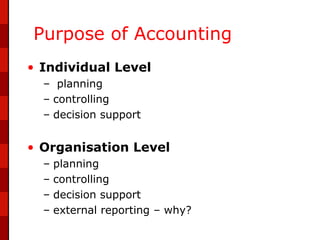
Purpose of Accounting
• Individual Level
  – planning
  – controlling
  – decision support


• Organisation Level
  –   planning
  –   controlling
  –   decision support
  –   external reporting – why?
Accounting &

Questions                                     Financial
                                     Management

                                                   Unit
                                                     2


• Who are the stakeholders affected by
  managerial choices around accounting and
  financial reporting practices?
•
• What purposes should drive the manager’s
  decisions around accounting and financial
  reporting practices?


         9
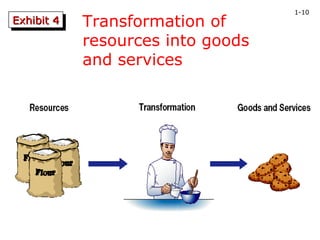
1-10
Exhibit 4
Exhibit 4   Transformation of
            resources into goods
            and services
1-11


 If the transformation of
  If the transformation of
resources meets a need of
   society, it creates value
   society, it creates value
  because more people are
  because more people are
      better off after the
      better off after the
transformation than before.
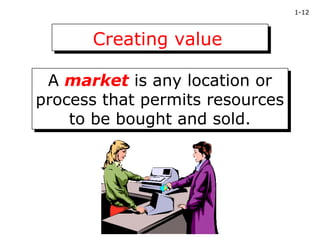
1-12


      Creating value
      Creating value

 A market is any location or
  A market is any location or
process that permits resources
    to be bought and sold.
    to be bought and sold.
1-13


      Creating value
      Creating value

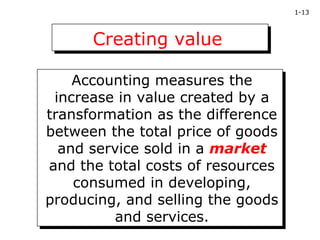
    Accounting measures the
     Accounting measures the
 increase in value created by a
  increase in value created by a
transformation as the difference
between the total price of goods
  and service sold in a market
   and service sold in a market
and the total costs of resources
 and the total costs of resources
    consumed in developing,
     consumed in developing,
producing, and selling the goods
          and services.
          and services.
1-14

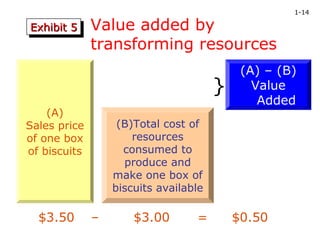
Exhibit 5
Exhibit 5     Value added by
              transforming resources
                                            (A) – (B)
                                       }      Value
                                               Added
    (A)
Sales price        (B)Total cost of
of one box            resources
of biscuits         consumed to
                    produce and
                  make one box of
                  biscuits available

  $3.50       –       $3.00       =        $0.50
1-15


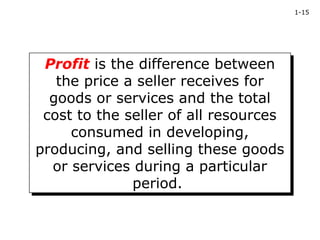
 Profit is the difference between
  Profit is the difference between
   the price a seller receives for
    the price a seller receives for
  goods or services and the total
  goods or services and the total
 cost to the seller of all resources
 cost to the seller of all resources
      consumed in developing,
      consumed in developing,
producing, and selling these goods
   or services during a particular
   or services during a particular
               period.
               period.
1-16

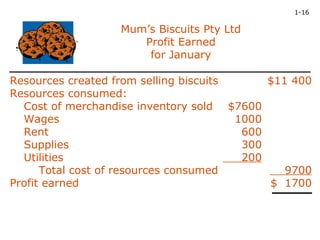
                   Mum’s Biscuits Pty Ltd
                      Profit Earned
                       for January

Resources created from selling biscuits      $11 400
Resources consumed:
  Cost of merchandise inventory sold $7600
  Wages                                 1000
  Rent                                   600
  Supplies                               300
  Utilities                              200
      Total cost of resources consumed          9700
Profit earned                                $ 1700
1-17


Risk
Accounting involves risk. It will
be used to calculate the amount
of profit a business will earn.

It relies on a number of
assumptions and constraints
which, if they don’t turn out to
be valid, may mean that the
profit calculation is misleading
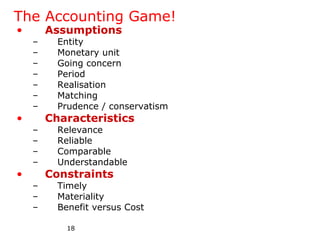
The Accounting Game!
•       Assumptions
    –     Entity
    –     Monetary unit
    –     Going concern
    –     Period
    –     Realisation
    –     Matching
    –     Prudence / conservatism
•       Characteristics
    –     Relevance
    –     Reliable
    –     Comparable
    –     Understandable
•       Constraints
    –     Timely
    –     Materiality
    –     Benefit versus Cost

            18
1-19


  The role of accounting in
  The role of accounting in
   business organisations
   business organisations


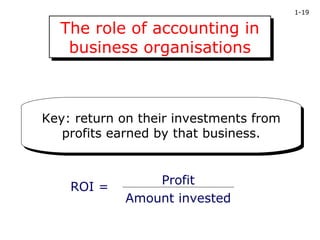
Key: return on their investments from
   profits earned by that business.
   profits earned by that business.


                Profit
    ROI =
            Amount invested
1-20


   The role of accounting in
   The role of accounting in
    business organisations
    business organisations

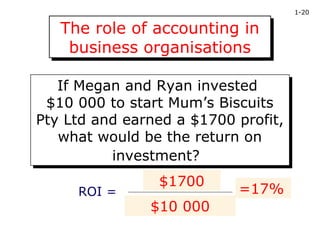
   If Megan and Ryan invested
   If Megan and Ryan invested
 $10 000 to start Mum’s Biscuits
  $10 000 to start Mum’s Biscuits
Pty Ltd and earned a $1700 profit,
   what would be the return on
    what would be the return on
          investment?
           investment?
                 $1700
                  Profit
     ROI =                     =17%
             Amount Invested
               $10 000
1-21


     The role of effectiveness
     The role of effectiveness
          and efficiency
          and efficiency

An effective business
An efficient business
Choice of Accounting
Systems
• Must consider
 – organisational goals
 – organisational structure
 – size of the organisation
 – information needs of management
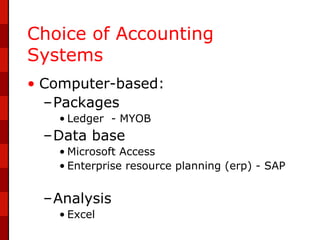
Choice of Accounting
Systems
• Computer-based:
  –Packages
   • Ledger - MYOB
 –Data base
   • Microsoft Access
   • Enterprise resource planning (erp) - SAP


 –Analysis
   • Excel
Economic Consequences
1. Management’s accounting policies
   affect the numbers that appear in
   financial statements.

2. Financial statements affect wealth
   of owners / lenders/ managers /
   society via:
  – management compensation plans
  – debt contracts
  – political costs
Economic Consequences
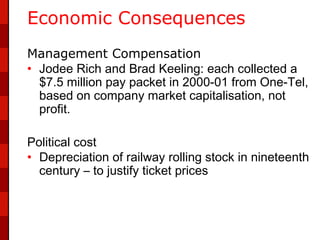
Management Compensation
• Jodee Rich and Brad Keeling: each collected a
  $7.5 million pay packet in 2000-01 from One-Tel,
  based on company market capitalisation, not
  profit.

Political cost
• Depreciation of railway rolling stock in nineteenth
  century – to justify ticket prices
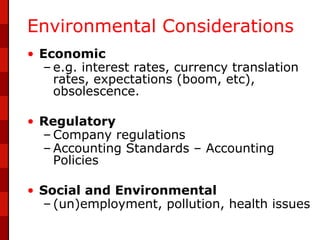
Environmental Considerations
• Economic
  – e.g. interest rates, currency translation
    rates, expectations (boom, etc),
    obsolescence.

• Regulatory
  – Company regulations
  – Accounting Standards – Accounting
    Policies

• Social and Environmental
  – (un)employment, pollution, health issues
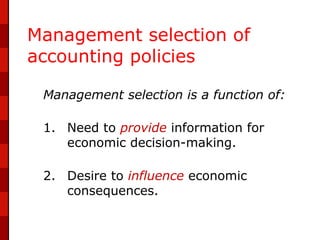
Management selection of
accounting policies

 Management selection is a function of:

 1. Need to provide information for
    economic decision-making.

 2. Desire to influence economic
    consequences.
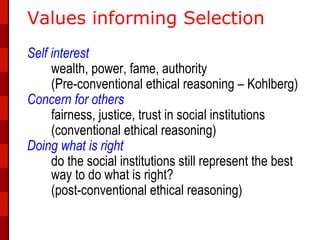
Values informing Selection
Self interest
     wealth, power, fame, authority
     (Pre-conventional ethical reasoning – Kohlberg)
Concern for others
     fairness, justice, trust in social institutions
     (conventional ethical reasoning)
Doing what is right
     do the social institutions still represent the best
     way to do what is right?
     (post-conventional ethical reasoning)
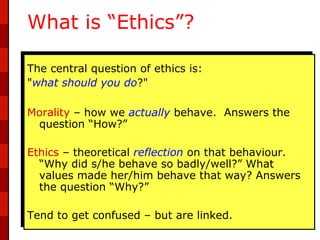
What is “Ethics”?

The central question of ethics is:
 The central question of ethics is:
"what should you do?"
 "what should you do?"

Morality – how we actually behave. Answers the
 question “How?”
  question “How?”

Ethics – theoretical reflection on that behaviour.
  “Why did s/he behave so badly/well?” What
   “Why did s/he behave so badly/well?” What
  values made her/him behave that way? Answers
   values made her/him behave that way? Answers
  the question “Why?”
   the question “Why?”

Tend to get confused – but are linked.

Session 01 Accounting and organisations

  • 1.
    1-1 Accounting Foundations: Information forDecisions Chapter 1 Accounting and organisations
  • 2.
  • 3.
    • Your perception of Accounting • What do you think a balance sheet tells a reader? • What does the income statement tell a reader? 3
  • 4.
    Initial questions 1. Whatrole does Accounting serve? Basic: to help people in organisations make decisions about economic activities 2. Does Accounting have economic consequences? Yes: it affects organisation plans, employment, future value (like share prices) 3. Are Ethics important in Accounting? Very important. Unethical accounting practices can ruin the fortunes of employees, suppliers and investors
  • 5.
    The Nature ofAccounting Identification Measurement Recording Communication Accounting Accounting Recording Recording Quantification Quantification Reports, Reports, Transactions Transactions classification in $ terms classification Analysis, in $ terms Analysis, summarisation summarisation Interpretation Interpretation and advice and advice Value - low Value - high
  • 6.
    • Definitions ofAccounting? • “The process of identifying, measuring, and communicating economic information to permit informed judgements and decisions by users of the information” (American Accounting Association 1966) Correct - but implies a deterministic process – i.e. if do this the outcome is valid • “Accounting is the art of being excruciatingly exact about a lot of arbitrary assumptions” (Austin Donnelly, about 1975) Insight? 6
  • 7.
    Alternative definitions ofAccounting "Systematic method of converting organisational activity into numbers in order to provide one explanation of what has occurred“ ? Insight? • “Accounting is a way of making the invisible (performance, value) visible (profit, cost, value).” Insight? • “Accounting is story telling with numbers” Insight? • 7 31 January 2013
  • 8.
    Purpose of Accounting •Individual Level – planning – controlling – decision support • Organisation Level – planning – controlling – decision support – external reporting – why?
  • 9.
    Accounting & Questions Financial Management Unit 2 • Who are the stakeholders affected by managerial choices around accounting and financial reporting practices? • • What purposes should drive the manager’s decisions around accounting and financial reporting practices? 9
  • 10.
    1-10 Exhibit 4 Exhibit 4 Transformation of resources into goods and services
  • 11.
    1-11 If thetransformation of If the transformation of resources meets a need of resources meets a need of society, it creates value society, it creates value because more people are because more people are better off after the better off after the transformation than before. transformation than before.
  • 12.
    1-12 Creating value Creating value A market is any location or A market is any location or process that permits resources process that permits resources to be bought and sold. to be bought and sold.
  • 13.
    1-13 Creating value Creating value Accounting measures the Accounting measures the increase in value created by a increase in value created by a transformation as the difference transformation as the difference between the total price of goods between the total price of goods and service sold in a market and service sold in a market and the total costs of resources and the total costs of resources consumed in developing, consumed in developing, producing, and selling the goods producing, and selling the goods and services. and services.
  • 14.
    1-14 Exhibit 5 Exhibit 5 Value added by transforming resources (A) – (B) } Value Added (A) Sales price (B)Total cost of of one box resources of biscuits consumed to produce and make one box of biscuits available $3.50 – $3.00 = $0.50
  • 15.
    1-15 Profit isthe difference between Profit is the difference between the price a seller receives for the price a seller receives for goods or services and the total goods or services and the total cost to the seller of all resources cost to the seller of all resources consumed in developing, consumed in developing, producing, and selling these goods producing, and selling these goods or services during a particular or services during a particular period. period.
  • 16.
    1-16 Mum’s Biscuits Pty Ltd Profit Earned for January Resources created from selling biscuits $11 400 Resources consumed: Cost of merchandise inventory sold $7600 Wages 1000 Rent 600 Supplies 300 Utilities 200 Total cost of resources consumed 9700 Profit earned $ 1700
  • 17.
    1-17 Risk Accounting involves risk.It will be used to calculate the amount of profit a business will earn. It relies on a number of assumptions and constraints which, if they don’t turn out to be valid, may mean that the profit calculation is misleading
  • 18.
    The Accounting Game! • Assumptions – Entity – Monetary unit – Going concern – Period – Realisation – Matching – Prudence / conservatism • Characteristics – Relevance – Reliable – Comparable – Understandable • Constraints – Timely – Materiality – Benefit versus Cost 18
  • 19.
    1-19 Therole of accounting in The role of accounting in business organisations business organisations Key: return on their investments from Key: return on their investments from profits earned by that business. profits earned by that business. Profit ROI = Amount invested
  • 20.
    1-20 The role of accounting in The role of accounting in business organisations business organisations If Megan and Ryan invested If Megan and Ryan invested $10 000 to start Mum’s Biscuits $10 000 to start Mum’s Biscuits Pty Ltd and earned a $1700 profit, Pty Ltd and earned a $1700 profit, what would be the return on what would be the return on investment? investment? $1700 Profit ROI = =17% Amount Invested $10 000
  • 21.
    1-21 The role of effectiveness The role of effectiveness and efficiency and efficiency An effective business An effective business An efficient business An efficient business
  • 22.
    Choice of Accounting Systems •Must consider – organisational goals – organisational structure – size of the organisation – information needs of management
  • 23.
    Choice of Accounting Systems •Computer-based: –Packages • Ledger - MYOB –Data base • Microsoft Access • Enterprise resource planning (erp) - SAP –Analysis • Excel
  • 24.
    Economic Consequences 1. Management’saccounting policies affect the numbers that appear in financial statements. 2. Financial statements affect wealth of owners / lenders/ managers / society via: – management compensation plans – debt contracts – political costs
  • 25.
    Economic Consequences Management Compensation •Jodee Rich and Brad Keeling: each collected a $7.5 million pay packet in 2000-01 from One-Tel, based on company market capitalisation, not profit. Political cost • Depreciation of railway rolling stock in nineteenth century – to justify ticket prices
  • 26.
    Environmental Considerations • Economic – e.g. interest rates, currency translation rates, expectations (boom, etc), obsolescence. • Regulatory – Company regulations – Accounting Standards – Accounting Policies • Social and Environmental – (un)employment, pollution, health issues
  • 27.
    Management selection of accountingpolicies Management selection is a function of: 1. Need to provide information for economic decision-making. 2. Desire to influence economic consequences.
  • 28.
    Values informing Selection Selfinterest wealth, power, fame, authority (Pre-conventional ethical reasoning – Kohlberg) Concern for others fairness, justice, trust in social institutions (conventional ethical reasoning) Doing what is right do the social institutions still represent the best way to do what is right? (post-conventional ethical reasoning)
  • 29.
    What is “Ethics”? Thecentral question of ethics is: The central question of ethics is: "what should you do?" "what should you do?" Morality – how we actually behave. Answers the Morality – how we actually behave. Answers the question “How?” question “How?” Ethics – theoretical reflection on that behaviour. Ethics – theoretical reflection on that behaviour. “Why did s/he behave so badly/well?” What “Why did s/he behave so badly/well?” What values made her/him behave that way? Answers values made her/him behave that way? Answers the question “Why?” the question “Why?” Tend to get confused – but are linked. Tend to get confused – but are linked.