Health System Mergers and Acquisitions:
Considerations for IT
Presented By:
Clifton Jay, President
Mary Ann Keane, RN, MS, Executive VP/COO
Health System Mergers & Acquisitions - October 2018 1
1990 Massachusetts S Corp.
MBE Certified
Dedicated to Healthcare
Over 100 clients
Independent & Knowledge of
Major Software Products
 Purpose & Objective
– Educate and provide understanding on the importance and impact that IT has on
the wave of healthcare provider mergers, affiliations and acquisitions
– The focus is on healthcare systems (hospitals and ambulatory practices), not
pharma or payer such as CVS/Aetna
 Intended Audience - Health system leadership
– IT
– All Disciplines
 What Attendees will Learn
– Overview of the merger, affiliation, acquisition landscape and trends on news-
worthy examples
– What IT needs to consider in an M&A situation
– “Over-the-counter information” on merger examples (the challenges)
– Tutorial on: Six IT Considerations for an M&A
 Expected Takeaway
– Bring knowledge and perspective back your health systems
Today’s Program
Health System Mergers & Acquisitions - October 2018 2
Hospital and Health System M&A Activity, 2000-2017
https://www.kaufmanhall.com/sites/default/files/2017-in-Review_The-Year-that-Shook-Healthcare.pdf
By the Numbers
Health System Mergers & Acquisitions - October 2018 3
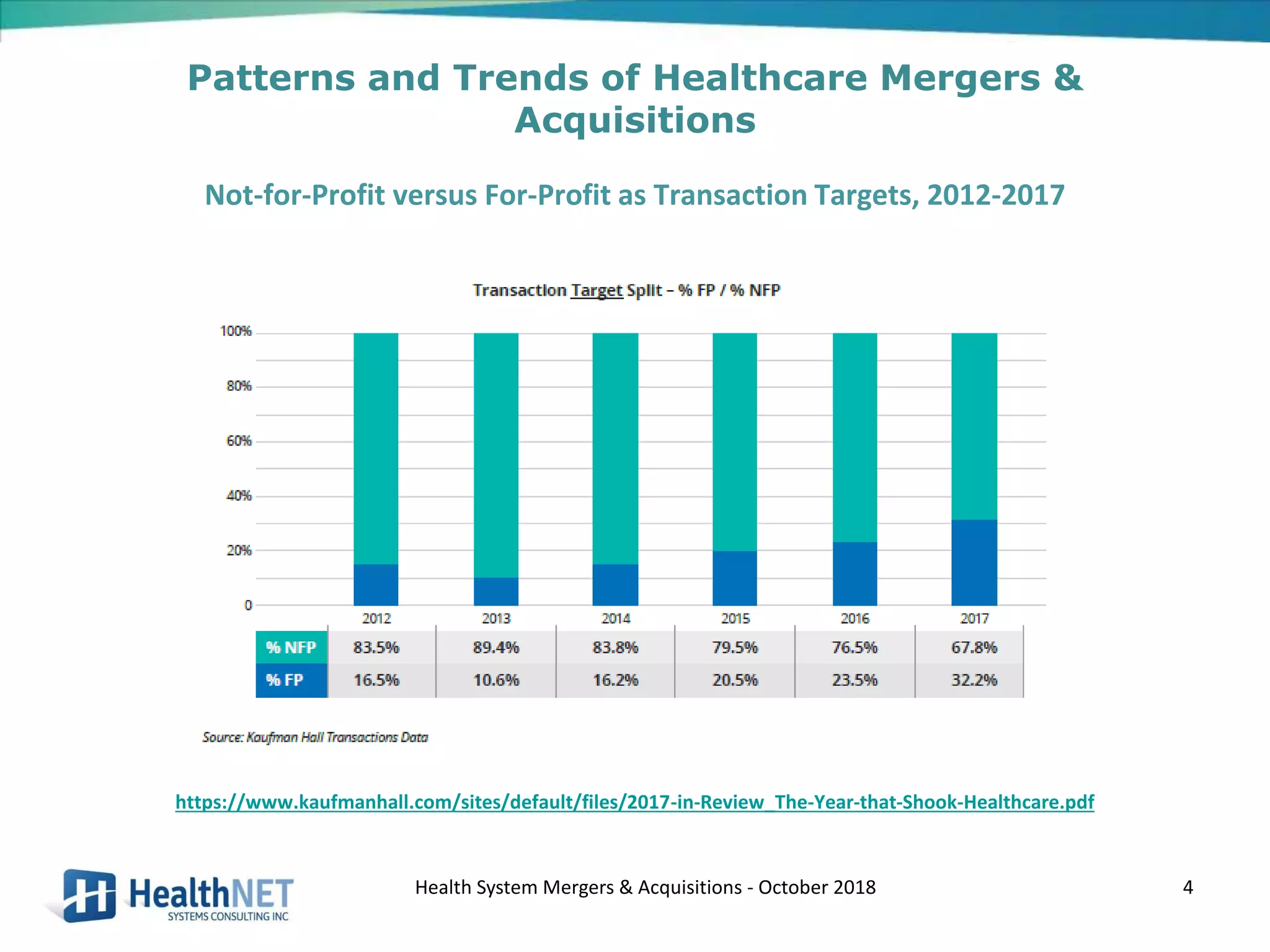
Patterns and Trends of Healthcare Mergers &
Acquisitions
Health System Mergers & Acquisitions - October 2018 4
Not-for-Profit versus For-Profit as Transaction Targets, 2012-2017
https://www.kaufmanhall.com/sites/default/files/2017-in-Review_The-Year-that-Shook-Healthcare.pdf
Not-For-Profit Health System Mega-Mergers
Health System Mergers & Acquisitions - October 2018 5
Will be the largest NFP health
system in the U.S. at 139 hospitals-
$28.4B in revenue
Revenue $1.5-2 Billion
Combined revenues over $5
Billion- second largest health
system in the state of MA
Divestitures
Health System Mergers & Acquisitions - October 2018 6
As of March 2018- received over $550M of cash from hospital
divestitures. Goal of $900M to $1B proceeds from total
divestitures.
CHS sold 40+ hospitals in the past 18 months-
following several difficult years of shouldering the
debt of FL-based HMA (Health Management
Associates )in 2004
Public Healthcare Companies
 2017 10 of 31 total FP acquisitions involved publicly traded companies and 9 included HCA
 HCA growth doesn’t seem to be slowing down
 Recent notable transactions
– Purchase of Memorial Health in Savannah
– Purchase of 3 Tenet Hospitals
– Plans to acquire Mission Health System in Ashville, NC
Private Healthcare Companies
 Now the largest private company
 Acquired 8 CHS hospitals
 Acquired 16 IASIS hospitals
For-Profit Acquisitions
Health System Mergers & Acquisitions - October 2018 7
Health System Mergers & Acquisitions - October 2018 9
HIMSS Enterprise Information Systems SC Merger & Acquisition Framework
Define target audiences and engage keystakeholders
Assess informationneeds
Define key messages and appropriatechannels
Determineappropriate timingfor messaging
Developfeedbackmechanisms
Explorethe use of socialmedia
DevelopFAQ’s
Define newbehaviors
Develop change management
plan including plans for cultural
harmonization
Develop high level project
timelines
Define projectperformance
metrics
Define adoptionmetrics
Define team roles and
responsibilities(internal and
external)
Develop high level training
plans
Stakeholderidentification and
analysis(includeunions,
physicians)
Identify internalchange
agents‐ changeambassadors
Develop stakeholder
management plan (including
issue trackingandresolution
planning)
Define survey and
engagementforums
Develop governance
structures
Develop resourceplan,
includingInternal and external
staffingneeds
Consider impactof strategic
objectives acrossIT initiatives
Assessapplication
portfolios
Assessinfrastructure(s)
Inventory IT contracts
Assess life‐cycle
requirements for allsystems
Assess InflightProjects
Assess ITleadership
Assess CultureRelatedto
IT
Engage in financial
assessmentsandmodelling
Analyze workflowand
integrationimplicationsof
M/A
Assess factorsthat may
impact scopeor timing of
M/A or M/A projects
Assess legal implicationsof
M/A
Define workflowteamsand
structures
Define “as‐is”processand
workflows
Conductorganizationalrisk
assessment
Develop IssueTracking
Methods
Conductoperationalimpact
analysis
Conductjob impactanalysis
Createnew job roles&
responsibilities
Communication
Vision,
Leadership &
Goals
Analysis & Due
Diligence
Stakeholder
Management
Planning
Execution and
Change
Management
Business &
Operational
Readiness
DefineVision
Articulatebusiness
case for change
Articulatecurrent
state/futurestate
expectations
Articulatesuccess
criteria
Articulatehigh level
workflowexpectations
Define pre –M&A
team roles and
responsibilities
Source: Adapted from HIMSS Mergers & Acquisitions Technology Framework,
Produced by the HIMSS Enterprise Information System Steering Committee
IT Plans for M&A
Key Topics
1. IT Strategy
 Centralized Model vs
 Local Systems
2. Tactics
 Migrate over time
 Rip & Replace
3. IT Governance
4. Data Governance
Considerations
 Value Proposition
 Integrated Patient Record
 Patient Cross-over/Referrals
 Population Health
 Economies of Scale
 Priorities – ERP? EMR?
 Existing Contracts
 Life Cycle/Aging
 Archive/sunset
 Needs to be somewhat consensus
based
 Workgroups - IT, ERP, Clinical EMR,
Ancillaries, Revenue Cycle
 Standardization of data for metrics,
reporting and benchmarking
Health System Mergers & Acquisitions - October 2018 10
IT Plans for M&A (2)
Key Topics
5. IT Organization & Resources
6. Timeframe
7. Funding & Cost Allocation
Considerations
 For System-level & Local IT:
 IT Leadership/CIOs - Revisit
roles/responsibilities
 Applications
 Technology
 Customer Service
 Cultural Differences
 Big Bang or Stagger?
 Multiple Years
 Capital investment
 TCO for capital and operating by FY
 Method for cost allocation by facility
and providers
Health System Mergers & Acquisitions - October 2018 11
IT Strategies Are All Unique
Health System Mergers & Acquisitions - October 2018
Hackensack (Epic)
Meridian (Cerner/Siemens)
(Meditech)
BI Lahey Wellforce
Hackensack
Meridian
Great Lakes
1. IT Strategy
2. IT Tactical Plan
3. IT Governance
4. Data Governance
5. IT Organization
6. Timeframe
7. Costs
BIDMC (custom)
BIDMC Community (Meditech)
Lahey (Epic)
Mt. Auburn (Epic)
A. Jaques (Meditech)
NE Baptist (Cerner Soarian)
Lowell (Cerner)
Tufts NEMC (Cerner/Siemens)
Melrose (Meditech)
Kaleida (Cerner)
Erie County (3-Meditech, CPSI)
So. Tier (4- Meditech)
Source: “Over the counter” information
on Hospital Information System Vendors
IT Assessment & Planning – M&A
Health System Mergers & Acquisitions - October 2018 13
MAJOR FACTORS PLANNING FOR IMPACT
Software Licenses for common and specialty local software
Technology Infrastructure Common data centers, virtualized servers, network, desktops
Operational Define common and local operations, e.g. consolidated business
office, lab, supply chain, accounting, HR, etc.
Implementation What’s common, e.g. clinical content, workflows, alerts, niche
systems, charge master, etc.
Interfaces, Data Conversions,
Archives
MPI’s, patient clinical record and data, notes, accounts receivable….
Training Reduced productivity
Customer Service Common help desk
Organization & Staffing Revamping to blend of consolidated staff and local staff
Governance Common and local
Cost TCO for capital and operating expense
Acquisitions are Similar to Mergers
 Asset Purchase Agreement
 Deal Close
 Tax ID’s and Provider Numbers
 Contracts – Managed Care, Services, Software, Support, GPO, etc.
Six Things IT Should Know for M&A
1. IT Becomes a Vanguard
2. TSA
3. Who Does What?
4. Software - Beyond the EHR
5. Conversion & Consolidation
6. Total Cost of Ownership (TCO)
Acquisitions
Health System Mergers & Acquisitions - October 2018 15
Consolidating IT is one of the first merger/acquisition activities, so IT is sometimes
put in a position of “fielding” questions beyond their purview. Preparing IT can help
in assimilating organizational cultures and communications; and defining the future
IT organization is beneficial to melding the organizations.
 How to prepare the IT staff on fielding questions for things that
 Are yet to be determined
 Way outside of “their pay grade,” understanding and purview
 What methods or vehicles of communication can help?
 Leadership/Management
 Physicians
 Employees
 How could an organization plan for melding the organizational cultures?
 How to handle the anxiety about job security, re-organization, responsibility
changes, etc.
#1 - IT Becomes a Vanguard
Health System Mergers & Acquisitions - October 2018 16
Acquisitions often include a TSA because switching core systems can extend beyond
the close. There are also systems that will be converted at the close, e.g. payroll,
website, regulatory reporting, security, email. Read the TSA carefully.
 Can a TSA be avoided?
 Merger vs. Acquisition
 Could the services be bought directly with service providers vs. the facility
seller?
 What other operational or contractual services relate to the IT TSA?
 Central business office
 Pre-arrival services
 Coding, transcription, etc.
 How to synch up the business and IT TSA
 How long do you need for a TSA?
 Conversion time for new system
 Business/operations
 Contracts
#2 - Transition Service Agreement (TSA)
Health System Mergers & Acquisitions - October 2018 17
Operational procedures and responsibilities will differ between organizations and in
some cases corporate; be prepared for adaptation – either system or process or
both. Examples: CBO, pre-arrival services, GPO, payroll processing.
 Determine what changes will happen to Roles & Responsibilities
 Changes in job descriptions
 Changes in department responsibilities
 Changes in authorized abilities to do tasks
 Role-based security
 Procedures and operations
 Are there procedural and operational standards at one organization that
will “rule” and endure?
 How to ID the impact of major operational changes, e.g. combining
departments, e.g. CBO, lab, or functions, e.g. radiology readings
 Coverage – normal and after-hours
 How does IT figure out security and roles-based access for things that are
undefined, and maybe at the last minute?
#3 – Who Does What?
Health System Mergers & Acquisitions - October 2018 18
The spotlight for the merger of IT is mostly on the core inpatient and ambulatory
systems - EHR, revenue cycle and ERP. We have found that the specialty/niche
systems can be a large number (~200) and may require re-contracting for licenses
and subscriptions.
 Core Systems, e.g. EHR, PFS, and ERP
 Who and how to decide whether to keep or rip/replace?
 When?
 Specialty/Niche/Departmental Systems
 How to inventory the various niche systems and shadow IT department
system? Under an acquisition, how to handle access and understanding
 For specialty/departmental systems, who decides on whether to Keep or
Replace?
 Interfaces – How to determine a moving target?
 Contracts – Who’s going to track down all these scattered contracts?
#4 - Software - Beyond the EHR
Health System Mergers & Acquisitions - October 2018 19
Prioritize contract needs and completion based on timeline and work effort
Definitions of tiers based on priority (1-high, 5-low)
1. Interfaces/application implementation critical to Epic go-live
2. Interface / applications implementation non-critical to Epic go-live
3. Non interfaced, clinical application, and conversions
4. Contract re-extensions or extension only, post-Epic implementations
5. Data archive projects, terminations, projects completed day-one, Epic
replacements (assuming build in Epic project only and not conversions
related to the application or contract extensions required pre-Epic)
Example - Software - Beyond the EHR Strategies
Health System Mergers & Acquisitions - October 2018 20
Workstreams, TCO, and Checklist
Health System Mergers & Acquisitions - October 2018 21
IT strategies vary depending upon several factors, e.g. existing systems, organizational
strategy for standardized deployment, geographic/patient synergy, and capital
requirements. Tactics can range from cloning existing systems to full system
implementations and conversions. Don’t forget patient identifiers and clinical data.
Check standards and compliance for technology and security. Re-provisioning can be a
tedious job.
 Approach & Options
 Rip/Replace
 Keep – What about integration as a health system for (a) operational systems,
and (b) data aggregation?
 Does your organization have “standard issue” systems – EHR, PFS, ERP, other
administrative and infrastructure?
 What about “content” standards and tools, e.g. clinical content, or claim scrubber?
 Governance – Will there be common governance, e.g. IT, medical informatics.
#5 - Conversion & Consolidation
Health System Mergers & Acquisitions - October 2018 22
 Security Standards – What about security standards that “should” be
standardized?
 Timing and Upgrades – What are the timing issues for upgrades, etc. for both
sides?
 Strategies for data conversion – patient records, financial records, even email?
 What about sunsetting and archiving for outgoing systems? Keep it spinning,
view only, archive?
 Will there be procedural and operational consolidations, e.g. ROI, central
laboratory, CBO, supply chain?
#5 - Conversion & Consolidation – cont’d
Health System Mergers & Acquisitions - October 2018 23
As with all investments a TCO is a must. Determine the incremental costs of IT for
the various phases of consolidation/ conversion. Also be mindful of differences on
where IT costs are budgeted – user areas or IT.
 Do you invest in IT for a hospital or practice that you might close, sell, or re-
configure?
#6 - Total Cost of Ownership (TCO)
Health System Mergers & Acquisitions - October 2018 24
Example – TCO Tracking Format
Health System Mergers & Acquisitions - October 2018 25
Project Budget Tracking by
Month & To Date
COMMITTED SPEND
Committed
To Date
Budget Budget (Overage)/
Reserve
Sum of PO Amount
2018 Grand Total Grand Total
Jan Feb Mar Apr May Jun FY18 Total 5 Years
CAP 18422
2.00 Other Systems $428,080 $428,080 $428,080
3.00 Software - EHR $3,860,000 $561,517 $1,392,234 $1,130,968 $1,456,423 $8,401,142 $6,956,053 $24,334,253 $15,933,111
4.00 Implementation $7,036,050 $64,000 ########### $698,957 $26,453,207 $10,722,725 $56,835,580 $30,382,373
6.00 IT Infrastructure $868,967 $92,242 $800,512 $2,695,251 $48,008 $4,504,980 $18,330,416 $32,385,162 $27,880,182
7.00 Labor - Ongoing Costs
8.00 Contingency $2,750,000 $5,500,000
CAP 18422 Total $7,905,017 $3,924,000 ########### $2,192,746 $3,826,219 $2,203,388 $39,359,329 $39,187,274 $119,483,075 $80,123,746
OPX
2.00 Other Systems $582,057 $582,057
3.00 Software - EHR $88,891 $197,261 $144,215 $2,340,300 $2,770,667 $37,995 $19,269,151 $16,498,484
4.00 Implementation $452,200 $80,000 $532,200 $10,576,800 $10,044,600
6.00 IT Infrastructure $486,838 $194,320 $346,670 $1,027,828 $2,078,258 $3,792,749 $2,764,921
7.00 Labor - Ongoing Costs $424,436 $86,478 $160,950 $671,864 $490,000 $7,333,222 $6,661,358
8.00 Contingency $603,487 $1,664,223
OPX Total $452,200 $88,891 $1,108,535 $425,013 $2,927,920 $5,002,559 $3,209,740 $43,218,201 $36,551,419
Grand Total $8,357,217 $3,924,000 ########### $3,301,281 $4,251,232 $5,131,308 $44,361,888 $42,397,014 $162,701,276 $118,339,388
BUDGETED & ACTUAL SPEND
2018 To Date Total Budget
Jan Feb Mar Apr May Jun JAN - JUN 18 FY18 FY18-22
PROJECTED SPEND (BUDGETED)
Capital $8,172,409 $1,904,455 $3,994,853 $2,163,955 ########### $5,114,789 $34,887,298 $39,187,274 $119,483,075
Operating $192,216 $192,216 $192,216 $243,216 $294,216 $532,022 $1,646,102 $3,209,740 $43,218,201
TOTAL $8,364,625 $2,096,671 $4,187,069 $2,407,171 ########### $5,646,811 $36,533,401 $42,397,014 $162,701,276
ACTUAL SPEND
Capital $440,329 $5,407,785 $6,172,491 $4,869,607 $16,890,212 $16,890,212 $16,890,212
Operating $9,113 $55,510 $71,003 $762,427 $323,113 $1,221,166 $1,221,166 $1,221,166
TOTAL $9,113 $495,839 $5,478,788 $6,934,918 $5,192,720 $18,111,378 $18,111,378 $18,111,378
VARIANCE
Capital $8,172,409 $1,904,455 $3,554,524 ($3,243,829) $7,364,345 $245,182 $17,997,087 $22,297,062 $102,592,863
Operating $192,216 $183,104 $136,706 $172,213 ($468,211) $208,909 $424,936 $1,988,574 $41,997,035
TOTAL $8,364,625 $2,087,559 $3,691,230 ($3,071,617) $6,896,134 $454,091 $18,422,023 $24,285,636 $144,589,898
Tracking
 Committed Spend
 Actual Spend
Thank you
Mary Ann Keane – makeane@healthnetconsulting.com
Clifton Jay – cliftonjay@healthnetconsulting.com
Q&A - Discussion
Health System Mergers & Acquisitions - October 2018 26

Health System Mergers & Acquisitions: Considerations for IT

  • 1.
    Health System Mergersand Acquisitions: Considerations for IT Presented By: Clifton Jay, President Mary Ann Keane, RN, MS, Executive VP/COO
  • 2.
    Health System Mergers& Acquisitions - October 2018 1 1990 Massachusetts S Corp. MBE Certified Dedicated to Healthcare Over 100 clients Independent & Knowledge of Major Software Products
  • 3.
     Purpose &Objective – Educate and provide understanding on the importance and impact that IT has on the wave of healthcare provider mergers, affiliations and acquisitions – The focus is on healthcare systems (hospitals and ambulatory practices), not pharma or payer such as CVS/Aetna  Intended Audience - Health system leadership – IT – All Disciplines  What Attendees will Learn – Overview of the merger, affiliation, acquisition landscape and trends on news- worthy examples – What IT needs to consider in an M&A situation – “Over-the-counter information” on merger examples (the challenges) – Tutorial on: Six IT Considerations for an M&A  Expected Takeaway – Bring knowledge and perspective back your health systems Today’s Program Health System Mergers & Acquisitions - October 2018 2
  • 4.
    Hospital and HealthSystem M&A Activity, 2000-2017 https://www.kaufmanhall.com/sites/default/files/2017-in-Review_The-Year-that-Shook-Healthcare.pdf By the Numbers Health System Mergers & Acquisitions - October 2018 3
  • 5.
    Patterns and Trendsof Healthcare Mergers & Acquisitions Health System Mergers & Acquisitions - October 2018 4 Not-for-Profit versus For-Profit as Transaction Targets, 2012-2017 https://www.kaufmanhall.com/sites/default/files/2017-in-Review_The-Year-that-Shook-Healthcare.pdf
  • 6.
    Not-For-Profit Health SystemMega-Mergers Health System Mergers & Acquisitions - October 2018 5 Will be the largest NFP health system in the U.S. at 139 hospitals- $28.4B in revenue Revenue $1.5-2 Billion Combined revenues over $5 Billion- second largest health system in the state of MA
  • 7.
    Divestitures Health System Mergers& Acquisitions - October 2018 6 As of March 2018- received over $550M of cash from hospital divestitures. Goal of $900M to $1B proceeds from total divestitures. CHS sold 40+ hospitals in the past 18 months- following several difficult years of shouldering the debt of FL-based HMA (Health Management Associates )in 2004
  • 8.
    Public Healthcare Companies 2017 10 of 31 total FP acquisitions involved publicly traded companies and 9 included HCA  HCA growth doesn’t seem to be slowing down  Recent notable transactions – Purchase of Memorial Health in Savannah – Purchase of 3 Tenet Hospitals – Plans to acquire Mission Health System in Ashville, NC Private Healthcare Companies  Now the largest private company  Acquired 8 CHS hospitals  Acquired 16 IASIS hospitals For-Profit Acquisitions Health System Mergers & Acquisitions - October 2018 7
  • 10.
    Health System Mergers& Acquisitions - October 2018 9 HIMSS Enterprise Information Systems SC Merger & Acquisition Framework Define target audiences and engage keystakeholders Assess informationneeds Define key messages and appropriatechannels Determineappropriate timingfor messaging Developfeedbackmechanisms Explorethe use of socialmedia DevelopFAQ’s Define newbehaviors Develop change management plan including plans for cultural harmonization Develop high level project timelines Define projectperformance metrics Define adoptionmetrics Define team roles and responsibilities(internal and external) Develop high level training plans Stakeholderidentification and analysis(includeunions, physicians) Identify internalchange agents‐ changeambassadors Develop stakeholder management plan (including issue trackingandresolution planning) Define survey and engagementforums Develop governance structures Develop resourceplan, includingInternal and external staffingneeds Consider impactof strategic objectives acrossIT initiatives Assessapplication portfolios Assessinfrastructure(s) Inventory IT contracts Assess life‐cycle requirements for allsystems Assess InflightProjects Assess ITleadership Assess CultureRelatedto IT Engage in financial assessmentsandmodelling Analyze workflowand integrationimplicationsof M/A Assess factorsthat may impact scopeor timing of M/A or M/A projects Assess legal implicationsof M/A Define workflowteamsand structures Define “as‐is”processand workflows Conductorganizationalrisk assessment Develop IssueTracking Methods Conductoperationalimpact analysis Conductjob impactanalysis Createnew job roles& responsibilities Communication Vision, Leadership & Goals Analysis & Due Diligence Stakeholder Management Planning Execution and Change Management Business & Operational Readiness DefineVision Articulatebusiness case for change Articulatecurrent state/futurestate expectations Articulatesuccess criteria Articulatehigh level workflowexpectations Define pre –M&A team roles and responsibilities Source: Adapted from HIMSS Mergers & Acquisitions Technology Framework, Produced by the HIMSS Enterprise Information System Steering Committee
  • 11.
    IT Plans forM&A Key Topics 1. IT Strategy  Centralized Model vs  Local Systems 2. Tactics  Migrate over time  Rip & Replace 3. IT Governance 4. Data Governance Considerations  Value Proposition  Integrated Patient Record  Patient Cross-over/Referrals  Population Health  Economies of Scale  Priorities – ERP? EMR?  Existing Contracts  Life Cycle/Aging  Archive/sunset  Needs to be somewhat consensus based  Workgroups - IT, ERP, Clinical EMR, Ancillaries, Revenue Cycle  Standardization of data for metrics, reporting and benchmarking Health System Mergers & Acquisitions - October 2018 10
  • 12.
    IT Plans forM&A (2) Key Topics 5. IT Organization & Resources 6. Timeframe 7. Funding & Cost Allocation Considerations  For System-level & Local IT:  IT Leadership/CIOs - Revisit roles/responsibilities  Applications  Technology  Customer Service  Cultural Differences  Big Bang or Stagger?  Multiple Years  Capital investment  TCO for capital and operating by FY  Method for cost allocation by facility and providers Health System Mergers & Acquisitions - October 2018 11
  • 13.
    IT Strategies AreAll Unique Health System Mergers & Acquisitions - October 2018 Hackensack (Epic) Meridian (Cerner/Siemens) (Meditech) BI Lahey Wellforce Hackensack Meridian Great Lakes 1. IT Strategy 2. IT Tactical Plan 3. IT Governance 4. Data Governance 5. IT Organization 6. Timeframe 7. Costs BIDMC (custom) BIDMC Community (Meditech) Lahey (Epic) Mt. Auburn (Epic) A. Jaques (Meditech) NE Baptist (Cerner Soarian) Lowell (Cerner) Tufts NEMC (Cerner/Siemens) Melrose (Meditech) Kaleida (Cerner) Erie County (3-Meditech, CPSI) So. Tier (4- Meditech) Source: “Over the counter” information on Hospital Information System Vendors
  • 14.
    IT Assessment &Planning – M&A Health System Mergers & Acquisitions - October 2018 13 MAJOR FACTORS PLANNING FOR IMPACT Software Licenses for common and specialty local software Technology Infrastructure Common data centers, virtualized servers, network, desktops Operational Define common and local operations, e.g. consolidated business office, lab, supply chain, accounting, HR, etc. Implementation What’s common, e.g. clinical content, workflows, alerts, niche systems, charge master, etc. Interfaces, Data Conversions, Archives MPI’s, patient clinical record and data, notes, accounts receivable…. Training Reduced productivity Customer Service Common help desk Organization & Staffing Revamping to blend of consolidated staff and local staff Governance Common and local Cost TCO for capital and operating expense
  • 16.
    Acquisitions are Similarto Mergers  Asset Purchase Agreement  Deal Close  Tax ID’s and Provider Numbers  Contracts – Managed Care, Services, Software, Support, GPO, etc. Six Things IT Should Know for M&A 1. IT Becomes a Vanguard 2. TSA 3. Who Does What? 4. Software - Beyond the EHR 5. Conversion & Consolidation 6. Total Cost of Ownership (TCO) Acquisitions Health System Mergers & Acquisitions - October 2018 15
  • 17.
    Consolidating IT isone of the first merger/acquisition activities, so IT is sometimes put in a position of “fielding” questions beyond their purview. Preparing IT can help in assimilating organizational cultures and communications; and defining the future IT organization is beneficial to melding the organizations.  How to prepare the IT staff on fielding questions for things that  Are yet to be determined  Way outside of “their pay grade,” understanding and purview  What methods or vehicles of communication can help?  Leadership/Management  Physicians  Employees  How could an organization plan for melding the organizational cultures?  How to handle the anxiety about job security, re-organization, responsibility changes, etc. #1 - IT Becomes a Vanguard Health System Mergers & Acquisitions - October 2018 16
  • 18.
    Acquisitions often includea TSA because switching core systems can extend beyond the close. There are also systems that will be converted at the close, e.g. payroll, website, regulatory reporting, security, email. Read the TSA carefully.  Can a TSA be avoided?  Merger vs. Acquisition  Could the services be bought directly with service providers vs. the facility seller?  What other operational or contractual services relate to the IT TSA?  Central business office  Pre-arrival services  Coding, transcription, etc.  How to synch up the business and IT TSA  How long do you need for a TSA?  Conversion time for new system  Business/operations  Contracts #2 - Transition Service Agreement (TSA) Health System Mergers & Acquisitions - October 2018 17
  • 19.
    Operational procedures andresponsibilities will differ between organizations and in some cases corporate; be prepared for adaptation – either system or process or both. Examples: CBO, pre-arrival services, GPO, payroll processing.  Determine what changes will happen to Roles & Responsibilities  Changes in job descriptions  Changes in department responsibilities  Changes in authorized abilities to do tasks  Role-based security  Procedures and operations  Are there procedural and operational standards at one organization that will “rule” and endure?  How to ID the impact of major operational changes, e.g. combining departments, e.g. CBO, lab, or functions, e.g. radiology readings  Coverage – normal and after-hours  How does IT figure out security and roles-based access for things that are undefined, and maybe at the last minute? #3 – Who Does What? Health System Mergers & Acquisitions - October 2018 18
  • 20.
    The spotlight forthe merger of IT is mostly on the core inpatient and ambulatory systems - EHR, revenue cycle and ERP. We have found that the specialty/niche systems can be a large number (~200) and may require re-contracting for licenses and subscriptions.  Core Systems, e.g. EHR, PFS, and ERP  Who and how to decide whether to keep or rip/replace?  When?  Specialty/Niche/Departmental Systems  How to inventory the various niche systems and shadow IT department system? Under an acquisition, how to handle access and understanding  For specialty/departmental systems, who decides on whether to Keep or Replace?  Interfaces – How to determine a moving target?  Contracts – Who’s going to track down all these scattered contracts? #4 - Software - Beyond the EHR Health System Mergers & Acquisitions - October 2018 19
  • 21.
    Prioritize contract needsand completion based on timeline and work effort Definitions of tiers based on priority (1-high, 5-low) 1. Interfaces/application implementation critical to Epic go-live 2. Interface / applications implementation non-critical to Epic go-live 3. Non interfaced, clinical application, and conversions 4. Contract re-extensions or extension only, post-Epic implementations 5. Data archive projects, terminations, projects completed day-one, Epic replacements (assuming build in Epic project only and not conversions related to the application or contract extensions required pre-Epic) Example - Software - Beyond the EHR Strategies Health System Mergers & Acquisitions - October 2018 20
  • 22.
    Workstreams, TCO, andChecklist Health System Mergers & Acquisitions - October 2018 21
  • 23.
    IT strategies varydepending upon several factors, e.g. existing systems, organizational strategy for standardized deployment, geographic/patient synergy, and capital requirements. Tactics can range from cloning existing systems to full system implementations and conversions. Don’t forget patient identifiers and clinical data. Check standards and compliance for technology and security. Re-provisioning can be a tedious job.  Approach & Options  Rip/Replace  Keep – What about integration as a health system for (a) operational systems, and (b) data aggregation?  Does your organization have “standard issue” systems – EHR, PFS, ERP, other administrative and infrastructure?  What about “content” standards and tools, e.g. clinical content, or claim scrubber?  Governance – Will there be common governance, e.g. IT, medical informatics. #5 - Conversion & Consolidation Health System Mergers & Acquisitions - October 2018 22
  • 24.
     Security Standards– What about security standards that “should” be standardized?  Timing and Upgrades – What are the timing issues for upgrades, etc. for both sides?  Strategies for data conversion – patient records, financial records, even email?  What about sunsetting and archiving for outgoing systems? Keep it spinning, view only, archive?  Will there be procedural and operational consolidations, e.g. ROI, central laboratory, CBO, supply chain? #5 - Conversion & Consolidation – cont’d Health System Mergers & Acquisitions - October 2018 23
  • 25.
    As with allinvestments a TCO is a must. Determine the incremental costs of IT for the various phases of consolidation/ conversion. Also be mindful of differences on where IT costs are budgeted – user areas or IT.  Do you invest in IT for a hospital or practice that you might close, sell, or re- configure? #6 - Total Cost of Ownership (TCO) Health System Mergers & Acquisitions - October 2018 24
  • 26.
    Example – TCOTracking Format Health System Mergers & Acquisitions - October 2018 25 Project Budget Tracking by Month & To Date COMMITTED SPEND Committed To Date Budget Budget (Overage)/ Reserve Sum of PO Amount 2018 Grand Total Grand Total Jan Feb Mar Apr May Jun FY18 Total 5 Years CAP 18422 2.00 Other Systems $428,080 $428,080 $428,080 3.00 Software - EHR $3,860,000 $561,517 $1,392,234 $1,130,968 $1,456,423 $8,401,142 $6,956,053 $24,334,253 $15,933,111 4.00 Implementation $7,036,050 $64,000 ########### $698,957 $26,453,207 $10,722,725 $56,835,580 $30,382,373 6.00 IT Infrastructure $868,967 $92,242 $800,512 $2,695,251 $48,008 $4,504,980 $18,330,416 $32,385,162 $27,880,182 7.00 Labor - Ongoing Costs 8.00 Contingency $2,750,000 $5,500,000 CAP 18422 Total $7,905,017 $3,924,000 ########### $2,192,746 $3,826,219 $2,203,388 $39,359,329 $39,187,274 $119,483,075 $80,123,746 OPX 2.00 Other Systems $582,057 $582,057 3.00 Software - EHR $88,891 $197,261 $144,215 $2,340,300 $2,770,667 $37,995 $19,269,151 $16,498,484 4.00 Implementation $452,200 $80,000 $532,200 $10,576,800 $10,044,600 6.00 IT Infrastructure $486,838 $194,320 $346,670 $1,027,828 $2,078,258 $3,792,749 $2,764,921 7.00 Labor - Ongoing Costs $424,436 $86,478 $160,950 $671,864 $490,000 $7,333,222 $6,661,358 8.00 Contingency $603,487 $1,664,223 OPX Total $452,200 $88,891 $1,108,535 $425,013 $2,927,920 $5,002,559 $3,209,740 $43,218,201 $36,551,419 Grand Total $8,357,217 $3,924,000 ########### $3,301,281 $4,251,232 $5,131,308 $44,361,888 $42,397,014 $162,701,276 $118,339,388 BUDGETED & ACTUAL SPEND 2018 To Date Total Budget Jan Feb Mar Apr May Jun JAN - JUN 18 FY18 FY18-22 PROJECTED SPEND (BUDGETED) Capital $8,172,409 $1,904,455 $3,994,853 $2,163,955 ########### $5,114,789 $34,887,298 $39,187,274 $119,483,075 Operating $192,216 $192,216 $192,216 $243,216 $294,216 $532,022 $1,646,102 $3,209,740 $43,218,201 TOTAL $8,364,625 $2,096,671 $4,187,069 $2,407,171 ########### $5,646,811 $36,533,401 $42,397,014 $162,701,276 ACTUAL SPEND Capital $440,329 $5,407,785 $6,172,491 $4,869,607 $16,890,212 $16,890,212 $16,890,212 Operating $9,113 $55,510 $71,003 $762,427 $323,113 $1,221,166 $1,221,166 $1,221,166 TOTAL $9,113 $495,839 $5,478,788 $6,934,918 $5,192,720 $18,111,378 $18,111,378 $18,111,378 VARIANCE Capital $8,172,409 $1,904,455 $3,554,524 ($3,243,829) $7,364,345 $245,182 $17,997,087 $22,297,062 $102,592,863 Operating $192,216 $183,104 $136,706 $172,213 ($468,211) $208,909 $424,936 $1,988,574 $41,997,035 TOTAL $8,364,625 $2,087,559 $3,691,230 ($3,071,617) $6,896,134 $454,091 $18,422,023 $24,285,636 $144,589,898 Tracking  Committed Spend  Actual Spend
  • 27.
    Thank you Mary AnnKeane – makeane@healthnetconsulting.com Clifton Jay – cliftonjay@healthnetconsulting.com Q&A - Discussion Health System Mergers & Acquisitions - October 2018 26

Editor's Notes

  • #5 Hospital-announced transactions slowed in Q 2 2018 Acquisitions by 16 not-for-profit organizations versus 5 for profit organizations. Not for profit goal – “expand organizational base and presence to expand to larger geographical areas.” https://www.kaufmanhall.com/news/hospital-merger-and-acquisition-activity-continues-rise-according-kaufman-hall-analysis For profit divestiture decrease in Q 2 CHS, HCA, Tenet, and physician owned hospitals CHS announced three deals (OK, FL, and WV) with a not for profit acquirer. Q2 divestitures included 37% of transactions Q1 divestitures included 44% transactions. For profit acquisition decrease in Q 2 RHCC Healthcare Partners was the only for profit acquisition. Physician medical group acquisitions remained steady for Q 2 Totaled 53 in Q2 and 55 in Q 1 http://www.hfma.org/Content.aspx?id=61506 2018 Patterns and Trends “Desire to better integrate care across the continuum and manage patient care more efficiently and effectively was ranked as the strongest driver of M&A activity” – Premier Survey Financial impacts discussed by HFMA Navigant analysis 104 largest health systems in U.S. found declines of greater than $100 million from FY15 to FY17 Moody’s Investor’s Service Margins for not-for-profit and public hospitals below levels of the 2008-09 recession American Hospital Association analysis Increase in hospitals with negative total and operating margins in 2016 (considered recession-era levels) Leadership at health systems “contemplating new partnerships for new capabilities, lower overall cost structure, and stay relevant in the face of well-funded new with the competitors.” – Kaufman Hall https://www.kaufmanhall.com/resources/blog/defining-endgame-consolidation-lessons-banking http://www.hfma.org/Content.aspx?id=61506 https://www.premierinc.com/downloads/c-suite-survey-drivers-for-merges-and-acquisitions-7-18.pdf