Computerized Accounting System
INTRODUCTION The world is  changing faster  than ever before  The accounting profession is in a mode of serious  introspection Facing criticism about the profession Challenge ourselves to improve the  quality  of information products and services Requires an  active participant  in the evolution of accounting information systems Propose a  different philosophy  underlying the design, use, and evaluation of accounting information systems
Current Business Environment A very competitive, changing environment in which companies that   add the most value and respond quickly   succeed. Information  is becoming one of an organization’s most important  resources. Advances in  information  technology  have been much more rapid than in any other industry.
The Calls for Change “ The world that is fast emerging from the clash of new values and technologies, new geopolitical relationships, new life-styles and modes of communication, demands wholly  new ideas and analogies,  classifications and concepts.”  Alvin Tofler
The Call for Change Many organizations are reconsidering how they operate and create value. Some organizations are implementing change by  reengineering business processes The accounting profession must  reinvent  how information is  gathered, stored and provided to  users or be replaced by a new yet  to emerge profession. The profession can not continue to rely on  audit and tax services
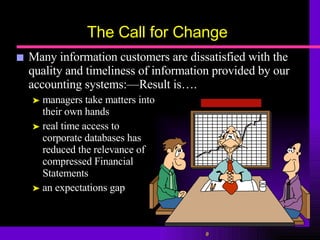
The Call for Change Many information customers are dissatisfied with the quality and timeliness of information provided by our accounting systems:—Result is…. managers take matters into  their own hands real time access to  corporate databases has  reduced the relevance of  compressed Financial Statements an expectations gap
A Changing World Al Pipkin, controller for Coors Brewing Company, observes that IT is: . . . bringing about a total transformation of the controller’s [accounting] staff, and a re‑definition of the overall financial system.  Technology is changing the culture of the controller’s organization just as it is impacting the entire business.  In the 21st century, there will be fewer accountants on the controller’s staff, but they will perform in totally new and exciting ways. Controller The individual or function responsible for using, designing, and evaluating an organizations financial information system.  The controller is typically an accounting executive responsible for developing and maintaining an organizations financial records.
Accounting Quotes “ The globalization of the economy, the explosion of technology, the complexity of business transactions and other forces have thrust the financial system into a new age. As the pace of economic change accelerates, so does the need for reliable and relevant information…”  “ To stay the best, our  financial reporting system must be as dynamic as the financial markets themselves …”  “ Financial reporting is without value if the user does not perceive it to be sound.”  — American Institute of Certified Public Accountants ( AICPA)
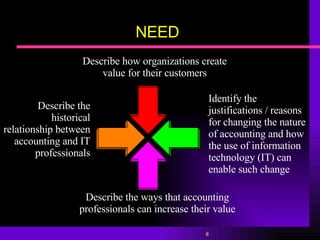
NEED Describe how organizations create value for their customers Describe the historical relationship between accounting and IT professionals Describe the ways that accounting professionals can increase their value Identify the justifications / reasons for changing the nature of accounting and how the use of information technology (IT) can enable such change
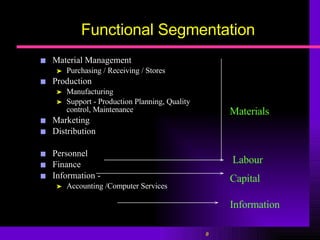
Functional Segmentation Material Management Purchasing / Receiving / Stores Production Manufacturing  Support - Production Planning, Quality control, Maintenance Marketing Distribution Personnel Finance Information - Accounting /Computer Services Materials Labour Capital Information
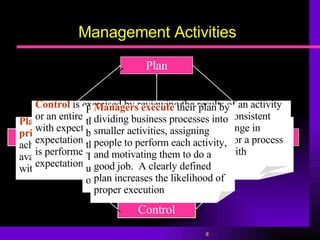
Management Activities Plan Evaluate Execute Control Information System Planning  requires leaders to define the  business objectives , to  prioritize  business processes, and to provide a blueprint for achieving the objectives.  They must identify  opportunities  available to the organization as well as assess the  risk  associated with each opportunity.  Control  is exercised by reviewing the results of an activity or an entire business process to see if they are consistent with expectations.  The review may cause a change in expectations or a change in the way an activity or a process is performed to bring the actual results in line with expectations. Periodically, managers  evaluate  the operating results to see if the business processes are achieving the organization's objectives.  The results of the evaluation are used to modify the plans, objective, or expectations. Managers execute  their plan by dividing business processes into smaller activities, assigning people to perform each activity, and motivating them to do a good job.  A clearly defined plan increases the likelihood of proper execution
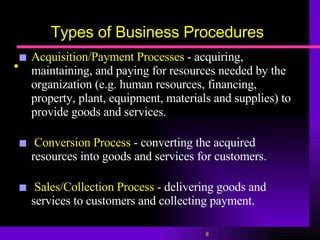
Types of Business Procedures Acquisition/Payment Processes  - acquiring, maintaining, and paying for resources needed by the organization (e.g. human resources, financing, property, plant, equipment, materials and supplies) to provide goods and services. Conversion Process  - converting the acquired resources into goods and services for customers. Sales/Collection Process  - delivering goods and services to customers and collecting payment.
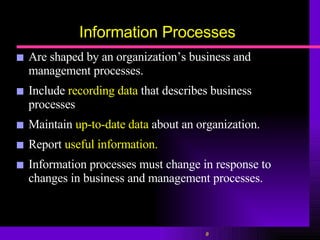
Information Processes Are shaped by an organization’s business and management processes. Include  recording data  that describes business processes Maintain  up-to-date data  about an organization. Report  useful information. Information processes must change in response to  changes in business and management processes.
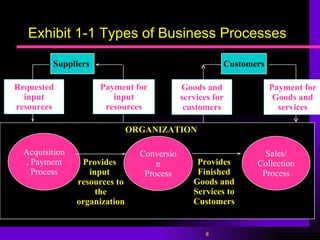
Exhibit 1-1 Types of Business Processes ORGANIZATION Conversion Process Customers Provides Finished Goods and Services to Customers Sales/ Collection Process Goods and services for customers Payment for Goods and services Suppliers  Acquisition, Payment Process Provides  input  resources to the organization Requested input resources Payment for input resources
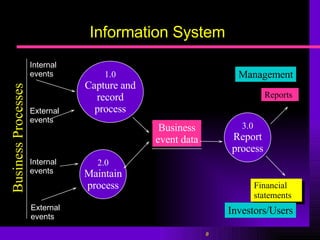
Information System Business event data Business Processes 1.0 Capture and record process Internal  events External events 2.0 Maintain process External events Internal  events 3.0 Report process Financial statements Reports  Management Investors/Users
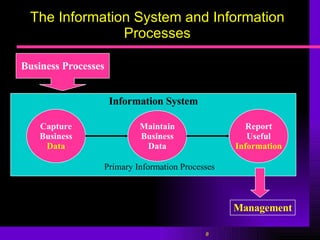
The Information System and Information Processes Business Processes Information System Primary Information Processes Management Capture Business Data Maintain Business Data Report Useful Information
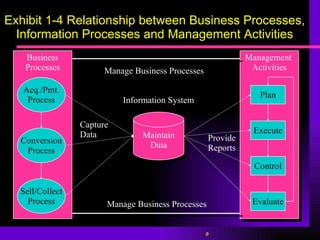
Exhibit 1-4 Relationship between Business Processes, Information Processes and Management Activities Maintain Data Information System Management  Activities Plan Execute Control Evaluate Business Processes Acq./Pmt. Process Conversion Process Sell/Collect Process Manage Business Processes Manage Business Processes Capture Data Provide Reports
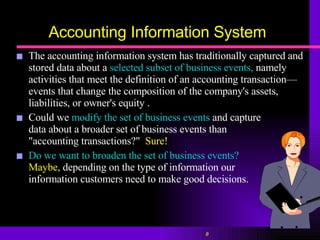
Accounting Information System The accounting information system has traditionally captured and stored data about a  selected subset of business events,  namely activities that meet the definition of an accounting transaction—events that change the composition of the company's assets, liabilities, or owner's equity . Could we  modify the set of business events  and capture  data about a broader set of business events than  "accounting transactions?"  Sure!   Do we want to broaden the set of business events?   Maybe,  depending on the type of information our  information customers need to make good decisions.
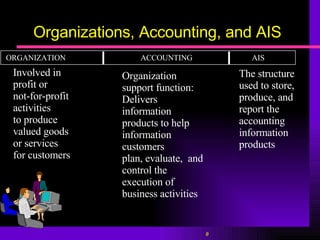
Organizations, Accounting, and AIS Involved in profit or not-for-profit activities to produce valued goods or services for customers Organization  support function: Delivers information products to help  information customers plan, evaluate,  and control the execution of business activities The structure used to store, produce, and report the accounting information products ORGANIZATION  ACCOUNTING    AIS
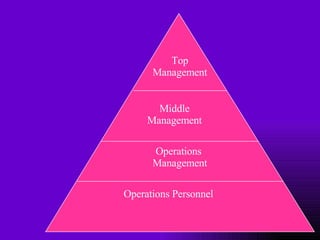
Top Management Middle Management Operations  Management Operations Personnel
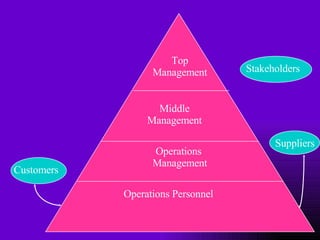
Top Management Middle Management Operations  Management Operations Personnel Customers Suppliers Stakeholders
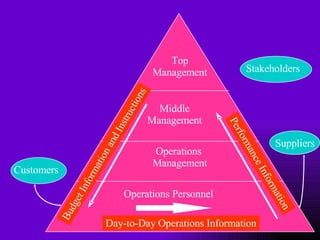
Top Management Middle Management Operations  Management Operations Personnel Day-to-Day Operations Information Customers Suppliers Stakeholders Performance Information Budget Information and Instructions
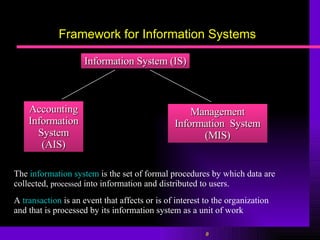
Framework for Information Systems Information System (IS) Accounting Information System (AIS) Management Information  System (MIS) The  information system  is the set of formal procedures by which data are collected,  processed  into information and distributed to users. A  transaction  is an event that affects or is of interest to the organization and that is processed by its information system as a unit of work
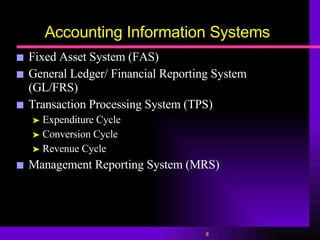
Accounting Information Systems Fixed Asset System (FAS) General Ledger/ Financial Reporting System (GL/FRS) Transaction Processing System (TPS) Expenditure Cycle Conversion Cycle Revenue Cycle Management Reporting System (MRS)
Accounting Information Systems
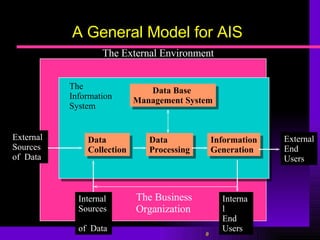
A General Model for AIS The External Environment The Information System Data Base  Management System Data Collection Data Processing Information Generation External  Sources  of  Data External End Users Internal  Sources  of  Data Internal End Users The Business Organization
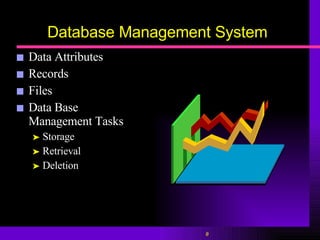
Database Management System Data Attributes Records Files Data Base  Management Tasks Storage  Retrieval Deletion
Information Generation Relevance Timeliness Accuracy Completeness Summarization
Attributes of Information Systems Efficiency Effectiveness Flexibility
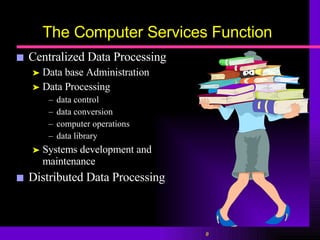
The Computer Services Function Centralized Data Processing Data base Administration Data Processing data control data conversion computer operations data library Systems development and  maintenance Distributed Data Processing
Status of AIS Accounting systems are based on pre-computer thinking.  (Robert Mednick) Information customers are dissatisfied with the timeliness and quality of information.   (R. Green & K Barrett) Traditional financial statements are extremely compressed and not released in a timely manner.  (R. K. Elliott)

Computerised Accounting System

  • 1.
  • 2.
    INTRODUCTION The worldis changing faster than ever before The accounting profession is in a mode of serious introspection Facing criticism about the profession Challenge ourselves to improve the quality of information products and services Requires an active participant in the evolution of accounting information systems Propose a different philosophy underlying the design, use, and evaluation of accounting information systems
  • 3.
    Current Business EnvironmentA very competitive, changing environment in which companies that add the most value and respond quickly succeed. Information is becoming one of an organization’s most important resources. Advances in information technology have been much more rapid than in any other industry.
  • 4.
    The Calls forChange “ The world that is fast emerging from the clash of new values and technologies, new geopolitical relationships, new life-styles and modes of communication, demands wholly new ideas and analogies, classifications and concepts.” Alvin Tofler
  • 5.
    The Call forChange Many organizations are reconsidering how they operate and create value. Some organizations are implementing change by reengineering business processes The accounting profession must reinvent how information is gathered, stored and provided to users or be replaced by a new yet to emerge profession. The profession can not continue to rely on audit and tax services
  • 6.
    The Call forChange Many information customers are dissatisfied with the quality and timeliness of information provided by our accounting systems:—Result is…. managers take matters into their own hands real time access to corporate databases has reduced the relevance of compressed Financial Statements an expectations gap
  • 7.
    A Changing WorldAl Pipkin, controller for Coors Brewing Company, observes that IT is: . . . bringing about a total transformation of the controller’s [accounting] staff, and a re‑definition of the overall financial system. Technology is changing the culture of the controller’s organization just as it is impacting the entire business. In the 21st century, there will be fewer accountants on the controller’s staff, but they will perform in totally new and exciting ways. Controller The individual or function responsible for using, designing, and evaluating an organizations financial information system. The controller is typically an accounting executive responsible for developing and maintaining an organizations financial records.
  • 8.
    Accounting Quotes “The globalization of the economy, the explosion of technology, the complexity of business transactions and other forces have thrust the financial system into a new age. As the pace of economic change accelerates, so does the need for reliable and relevant information…” “ To stay the best, our financial reporting system must be as dynamic as the financial markets themselves …” “ Financial reporting is without value if the user does not perceive it to be sound.” — American Institute of Certified Public Accountants ( AICPA)
  • 9.
    NEED Describe howorganizations create value for their customers Describe the historical relationship between accounting and IT professionals Describe the ways that accounting professionals can increase their value Identify the justifications / reasons for changing the nature of accounting and how the use of information technology (IT) can enable such change
  • 10.
    Functional Segmentation MaterialManagement Purchasing / Receiving / Stores Production Manufacturing Support - Production Planning, Quality control, Maintenance Marketing Distribution Personnel Finance Information - Accounting /Computer Services Materials Labour Capital Information
  • 11.
    Management Activities PlanEvaluate Execute Control Information System Planning requires leaders to define the business objectives , to prioritize business processes, and to provide a blueprint for achieving the objectives. They must identify opportunities available to the organization as well as assess the risk associated with each opportunity. Control is exercised by reviewing the results of an activity or an entire business process to see if they are consistent with expectations. The review may cause a change in expectations or a change in the way an activity or a process is performed to bring the actual results in line with expectations. Periodically, managers evaluate the operating results to see if the business processes are achieving the organization's objectives. The results of the evaluation are used to modify the plans, objective, or expectations. Managers execute their plan by dividing business processes into smaller activities, assigning people to perform each activity, and motivating them to do a good job. A clearly defined plan increases the likelihood of proper execution
  • 12.
    Types of BusinessProcedures Acquisition/Payment Processes - acquiring, maintaining, and paying for resources needed by the organization (e.g. human resources, financing, property, plant, equipment, materials and supplies) to provide goods and services. Conversion Process - converting the acquired resources into goods and services for customers. Sales/Collection Process - delivering goods and services to customers and collecting payment.
  • 13.
    Information Processes Areshaped by an organization’s business and management processes. Include recording data that describes business processes Maintain up-to-date data about an organization. Report useful information. Information processes must change in response to changes in business and management processes.
  • 14.
    Exhibit 1-1 Typesof Business Processes ORGANIZATION Conversion Process Customers Provides Finished Goods and Services to Customers Sales/ Collection Process Goods and services for customers Payment for Goods and services Suppliers Acquisition, Payment Process Provides input resources to the organization Requested input resources Payment for input resources
  • 15.
    Information System Businessevent data Business Processes 1.0 Capture and record process Internal events External events 2.0 Maintain process External events Internal events 3.0 Report process Financial statements Reports Management Investors/Users
  • 16.
    The Information Systemand Information Processes Business Processes Information System Primary Information Processes Management Capture Business Data Maintain Business Data Report Useful Information
  • 17.
    Exhibit 1-4 Relationshipbetween Business Processes, Information Processes and Management Activities Maintain Data Information System Management Activities Plan Execute Control Evaluate Business Processes Acq./Pmt. Process Conversion Process Sell/Collect Process Manage Business Processes Manage Business Processes Capture Data Provide Reports
  • 18.
    Accounting Information SystemThe accounting information system has traditionally captured and stored data about a selected subset of business events, namely activities that meet the definition of an accounting transaction—events that change the composition of the company's assets, liabilities, or owner's equity . Could we modify the set of business events and capture data about a broader set of business events than "accounting transactions?" Sure! Do we want to broaden the set of business events? Maybe, depending on the type of information our information customers need to make good decisions.
  • 19.
    Organizations, Accounting, andAIS Involved in profit or not-for-profit activities to produce valued goods or services for customers Organization support function: Delivers information products to help information customers plan, evaluate, and control the execution of business activities The structure used to store, produce, and report the accounting information products ORGANIZATION ACCOUNTING AIS
  • 20.
    Top Management MiddleManagement Operations Management Operations Personnel
  • 21.
    Top Management MiddleManagement Operations Management Operations Personnel Customers Suppliers Stakeholders
  • 22.
    Top Management MiddleManagement Operations Management Operations Personnel Day-to-Day Operations Information Customers Suppliers Stakeholders Performance Information Budget Information and Instructions
  • 23.
    Framework for InformationSystems Information System (IS) Accounting Information System (AIS) Management Information System (MIS) The information system is the set of formal procedures by which data are collected, processed into information and distributed to users. A transaction is an event that affects or is of interest to the organization and that is processed by its information system as a unit of work
  • 24.
    Accounting Information SystemsFixed Asset System (FAS) General Ledger/ Financial Reporting System (GL/FRS) Transaction Processing System (TPS) Expenditure Cycle Conversion Cycle Revenue Cycle Management Reporting System (MRS)
  • 25.
  • 26.
    A General Modelfor AIS The External Environment The Information System Data Base Management System Data Collection Data Processing Information Generation External Sources of Data External End Users Internal Sources of Data Internal End Users The Business Organization
  • 27.
    Database Management SystemData Attributes Records Files Data Base Management Tasks Storage Retrieval Deletion
  • 28.
    Information Generation RelevanceTimeliness Accuracy Completeness Summarization
  • 29.
    Attributes of InformationSystems Efficiency Effectiveness Flexibility
  • 30.
    The Computer ServicesFunction Centralized Data Processing Data base Administration Data Processing data control data conversion computer operations data library Systems development and maintenance Distributed Data Processing
  • 31.
    Status of AISAccounting systems are based on pre-computer thinking. (Robert Mednick) Information customers are dissatisfied with the timeliness and quality of information. (R. Green & K Barrett) Traditional financial statements are extremely compressed and not released in a timely manner. (R. K. Elliott)