ACCOUNTING
INFORMATION   AIS
    SYSTEMS
LEARNING OBJECTIVES
1.   Explain what an accounting information system (AIS) is.
2.   Explain why studying AIS is important.
3.   Discuss the role played by the AIS in a company’s value
     chain and explain how the AIS can add value to a
     business.
4.   Explain the three basic functions performed by an
     accounting information system (AIS).
5.   Discuss the types of information that can be provided
     by an AIS.
LEARNING OBJECTIVE 1


Explain what an accounting
information system (AIS) is.
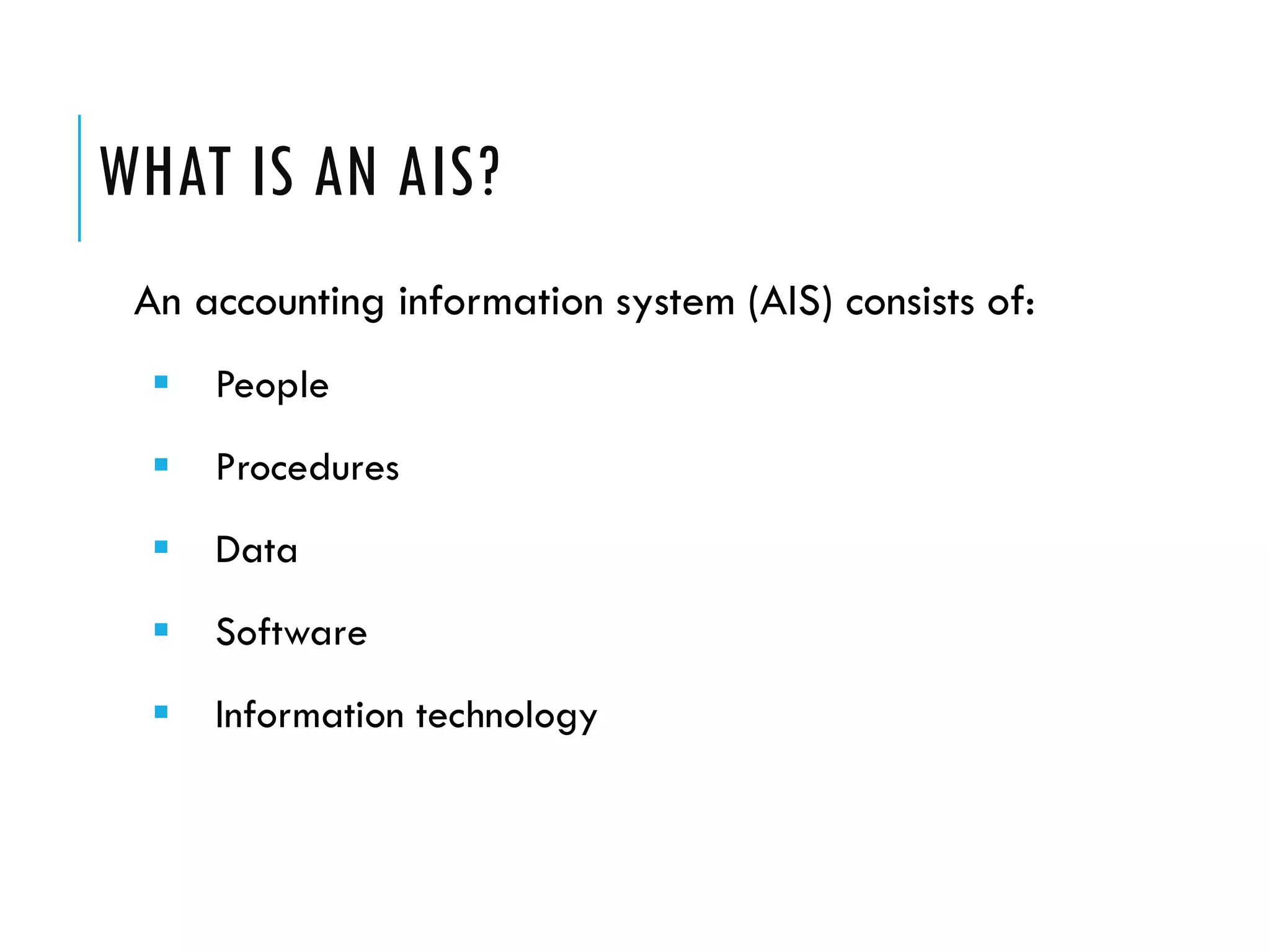
WHAT IS AN AIS?
 An accounting information system (AIS) consists of:
     People
     Procedures
     Data
     Software
     Information technology
WHAT IS AN AIS?
What important functions does the AIS perform in an
organization?
1. It collects and stores data about activities and transactions.
2. It processes data into information that is useful for making
   decisions.
3. It provides adequate controls to safeguard the organization’s
   assets.
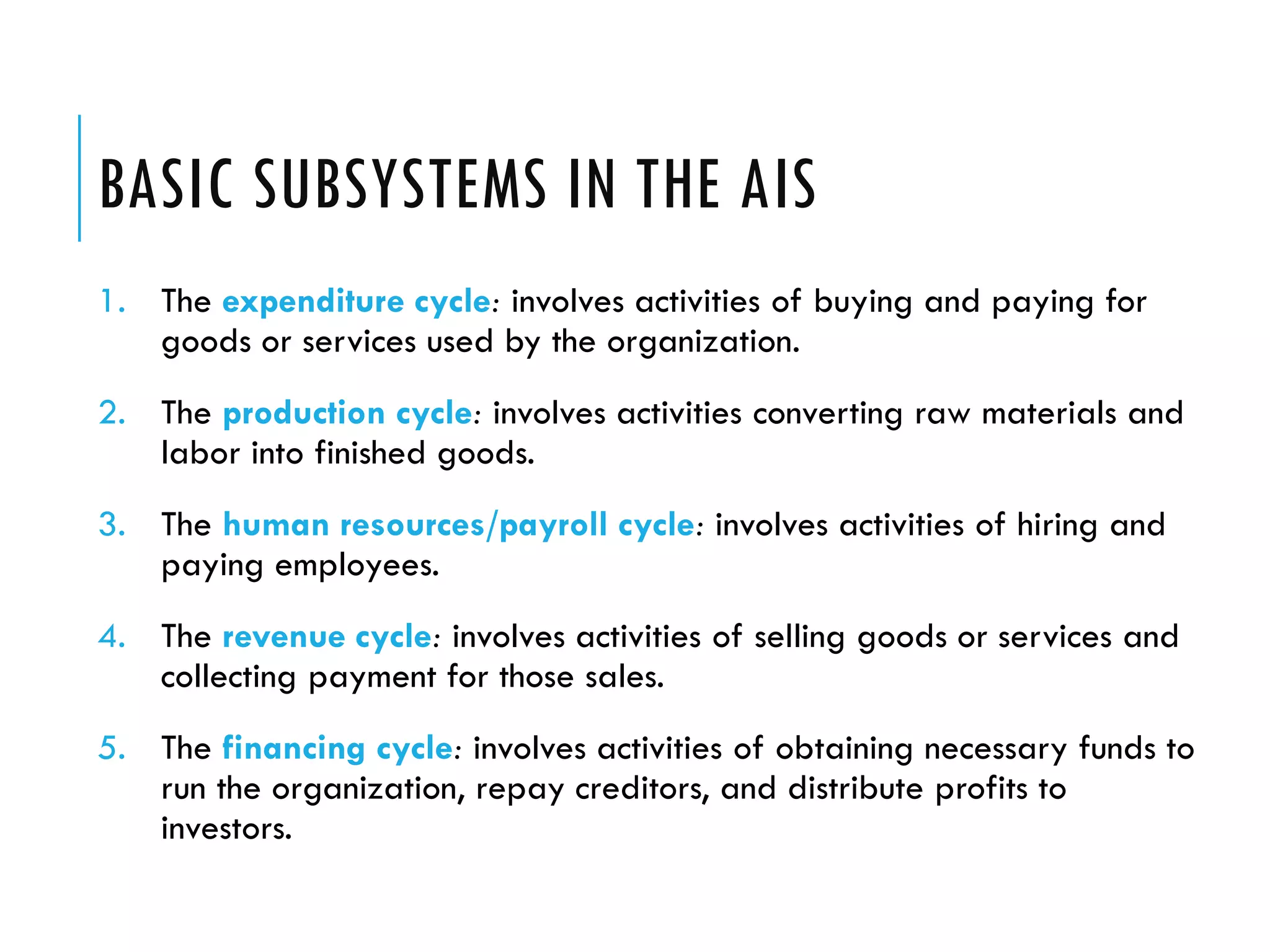
BASIC SUBSYSTEMS IN THE AIS
1. The expenditure cycle: involves activities of buying and paying for
   goods or services used by the organization.
2. The production cycle: involves activities converting raw materials and
   labor into finished goods.
3. The human resources/payroll cycle: involves activities of hiring and
   paying employees.
4. The revenue cycle: involves activities of selling goods or services and
   collecting payment for those sales.
5. The financing cycle: involves activities of obtaining necessary funds to
   run the organization, repay creditors, and distribute profits to
   investors.
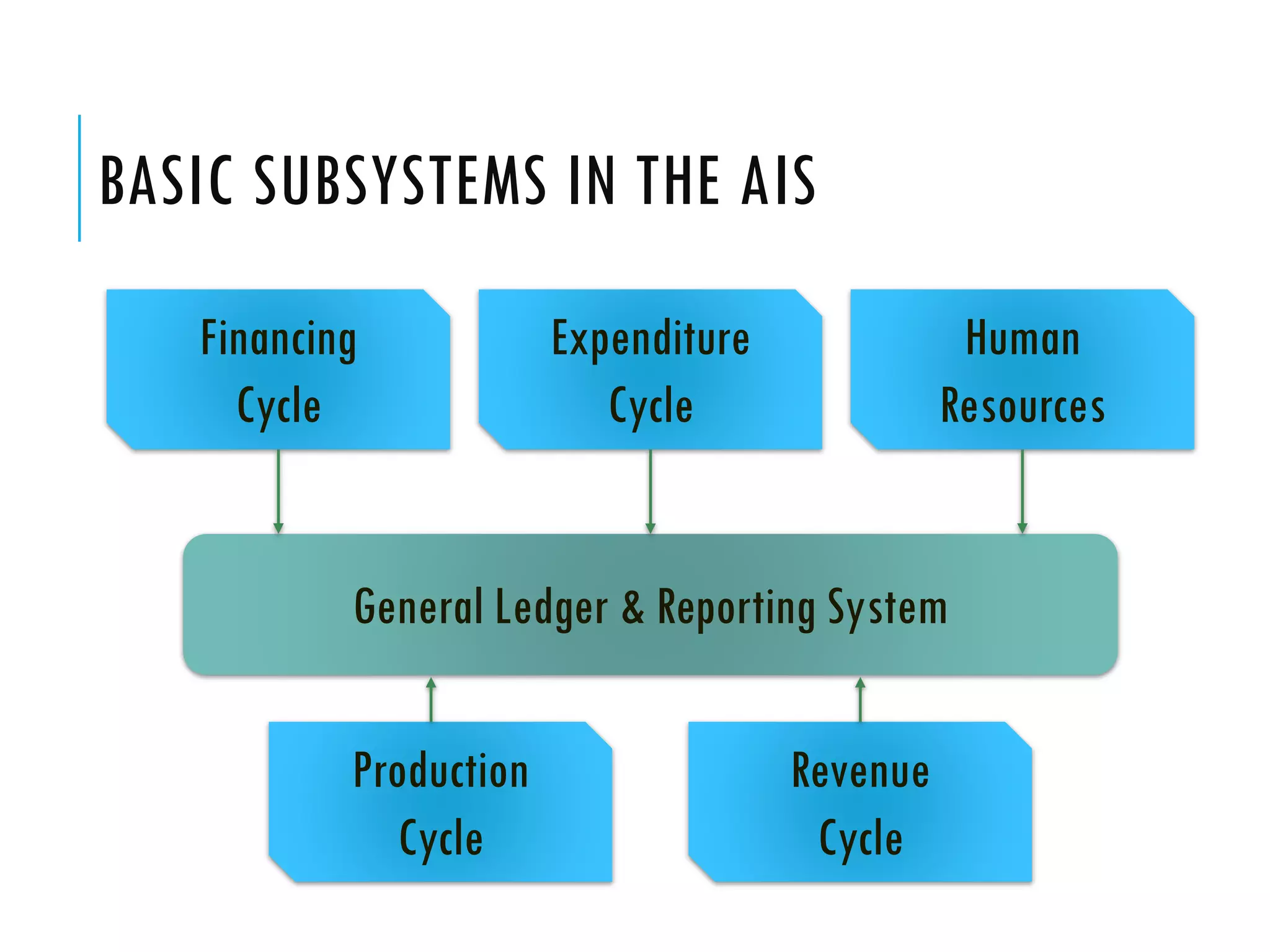
BASIC SUBSYSTEMS IN THE AIS
   Financing            Expenditure              Human
     Cycle                 Cycle                Resources


           General Ledger & Reporting System

           Production                 Revenue
              Cycle                    Cycle
LEARNING OBJECTIVE 2


Explain why studying AIS is important.
WHY STUDY AIS?
Because :
 Accounting is defined as an information system.

 The primary objective of accounting is to provide information
  useful to decision makers.

 Accounting is about information identification, development,
  measurement, and communication process, and...

 Financial information reporting.
WHY STUDY AIS?
To understand how the accounting system works.
  How to collect data about an organization’s activities and
   transactions

  How to transform that data into information that
   management can use to run the organization

  How to ensure the availability, reliability, and accuracy of
   that information
WHY STUDY AIS?
 Auditors need to understand the systems that are used to
  produce a company’s financial statements.

 Tax professionals need to understand enough about the
  client’s AIS to be confident that the information used for tax
  planning and compliance work is complete and accurate.

 A survey conducted by the Institute of Management
  Accountants (IMA) indicates that work relating to accounting
  systems was the single most important activity performed by
  corporate accountants.
INFORMATION TECHNOLOGY
AND CORPORATE STRATEGY
 The same survey conducted by the Institute of Management
  Accountants (IMA) also indicates that the second most
  important job activity of corporate accountants is long-term
  strategic planning.

 One important aspect of this topic is how to align information
  technology (IT) with an organization’s strategy.
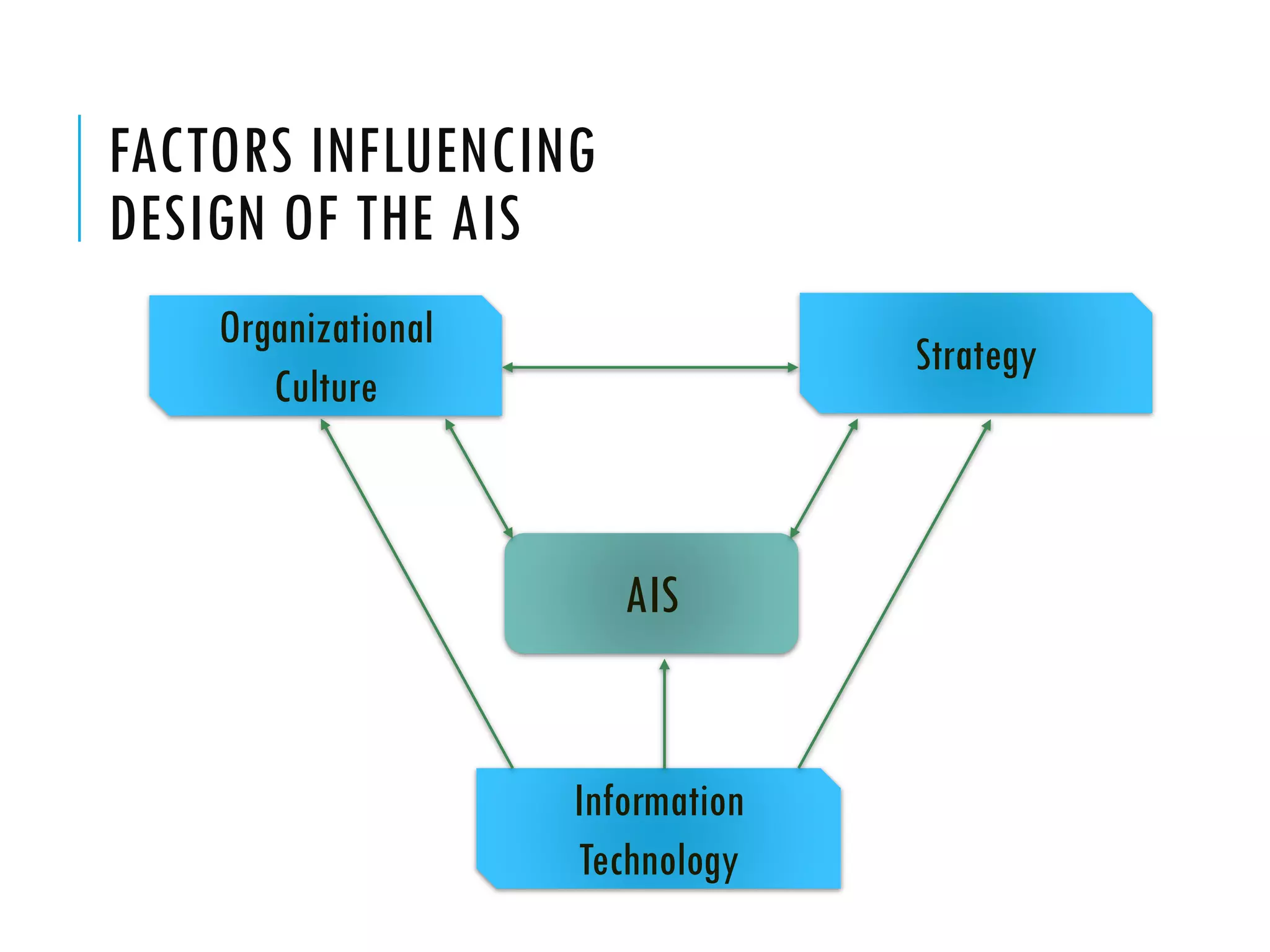
FACTORS INFLUENCING
DESIGN OF THE AIS
    Organizational
                                   Strategy
       Culture


                        AIS


                     Information
                     Technology
LEARNING OBJECTIVE 3

Discuss the role played by the AIS in a
company’s value chain and explain
how the AIS can add value to a
business.
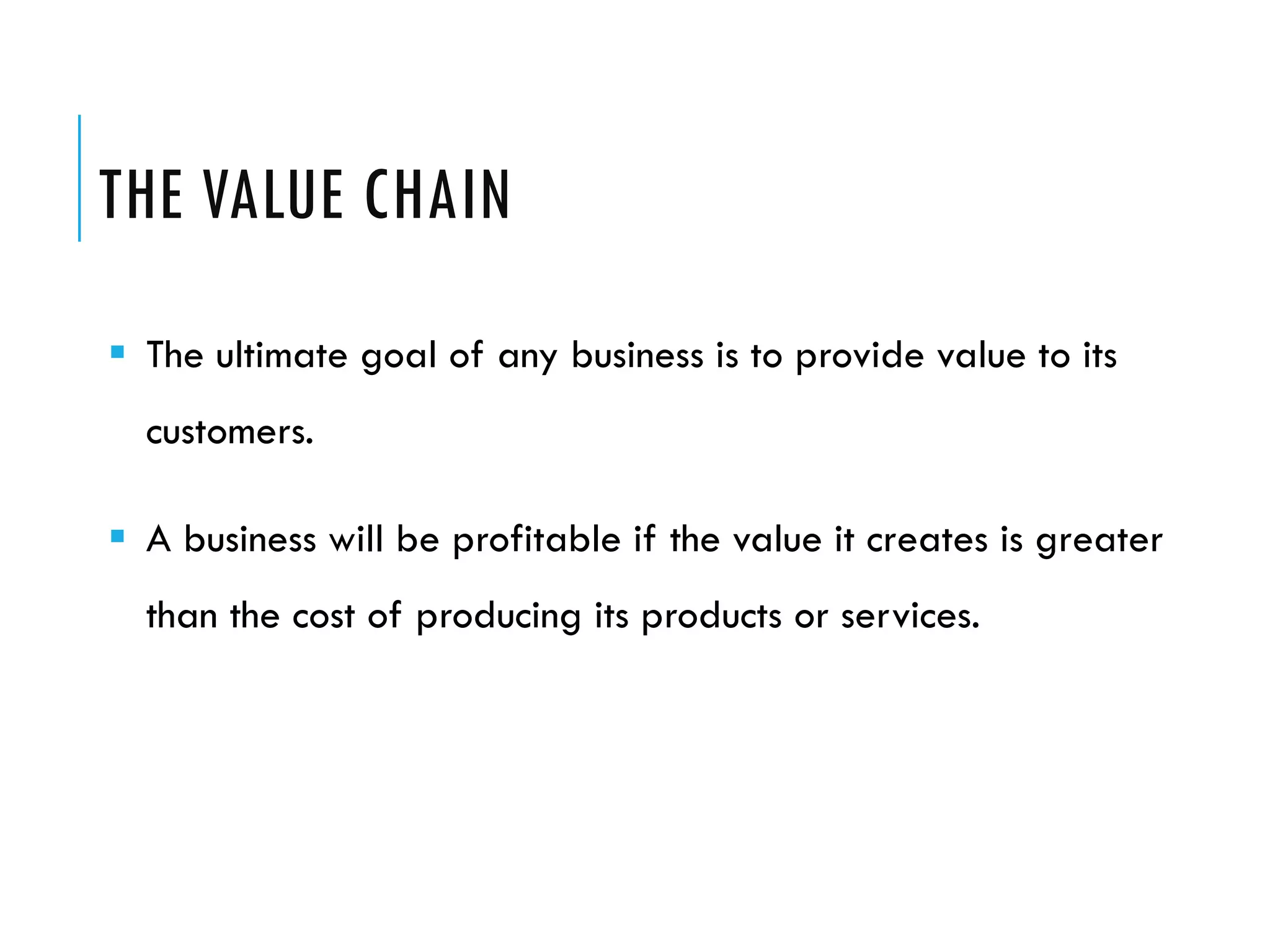
THE VALUE CHAIN
 The ultimate goal of any business is to provide value to its
  customers.

 A business will be profitable if the value it creates is greater
  than the cost of producing its products or services.
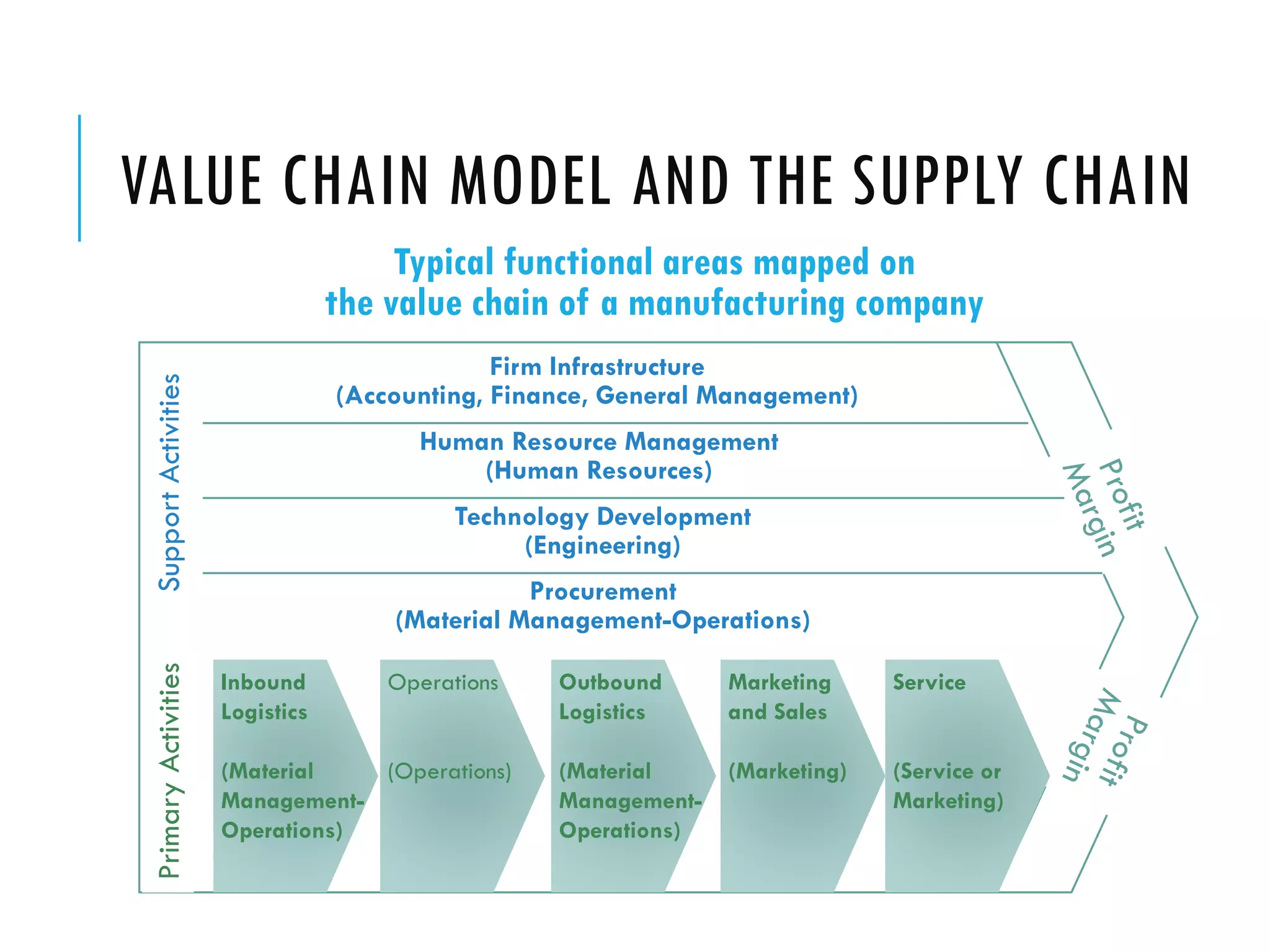
VALUE CHAIN MODEL AND THE SUPPLY CHAIN
                                       Typical functional areas mapped on
                                  the value chain of a manufacturing company
                                               Firm Infrastructure
 Support Activities


                                  (Accounting, Finance, General Management)
                                        Human Resource Management
                                            (Human Resources)
                                            Technology Development
                                                 (Engineering)
                                                 Procurement
                                      (Material Management-Operations)
 Primary Activities


                      Inbound         Operations   Outbound      Marketing     Service
                      Logistics                    Logistics     and Sales

                      (Material   (Operations)     (Material     (Marketing)   (Service or
                      Management-                  Management-                 Marketing)
                      Operations)                  Operations)
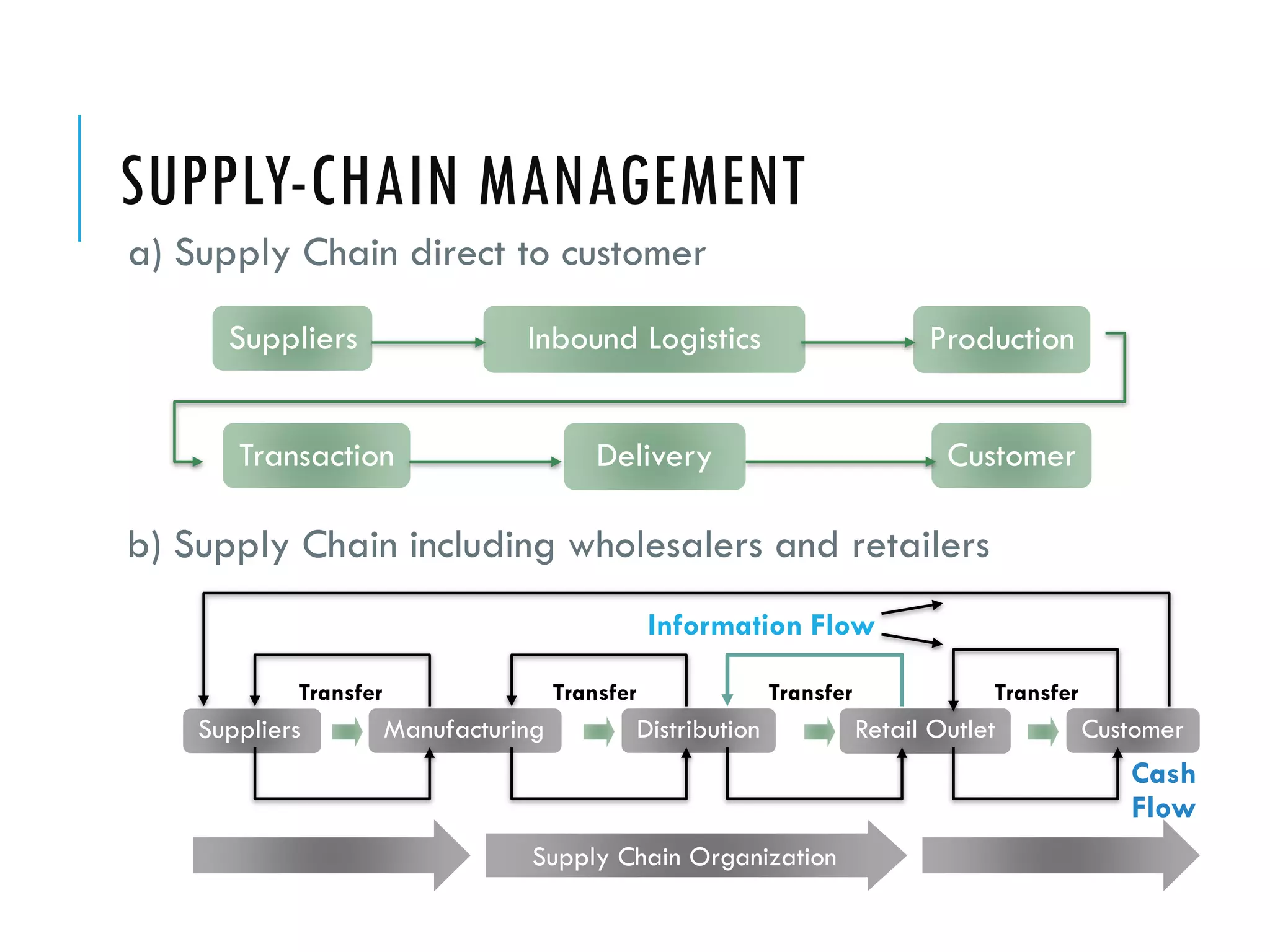
SUPPLY-CHAIN MANAGEMENT
a) Supply Chain direct to customer
      Suppliers                   Inbound Logistics                           Production


       Transaction                         Delivery                             Customer

b) Supply Chain including wholesalers and retailers
                                                  Information Flow

            Transfer                   Transfer              Transfer               Transfer
    Suppliers          Manufacturing          Distribution              Retail Outlet          Customer
                                                                                                  Cash
                                                                                                  Flow
                                  Supply Chain Organization
HOW AN AIS CAN ADD VALUE
TO AN ORGANIZATION

An AIS adds value by providing accurate and timely
information so that five primary value chain activities
can be performed more effectively and efficiently.
This is done by: improving the quality and reducing the
costs of products or services.
HOW AN AIS CAN ADD VALUE
TO AN ORGANIZATION
An AIS can…

   improve efficiency.

   improve decision making capabilities.

   increase the sharing of knowledge.

A well-designed AIS can also help an organization profit by
improving the efficiency and effectiveness of its supply chain.
INFORMATION TECHNOLOGY
AND CORPORATE STRATEGY
Develop a basic understanding of…
   corporate strategies.
   how IT developments can be used to implement existing
    organizational strategies.
   how IT developments can be used to create an opportunity
    to modify existing strategies.
Because an AIS functions within an organization, it should be
designed to reflect the values of that organizational culture.
STRATEGY AND STRATEGIC POSITIONS
What role does the AIS play in helping organizations adopt and
maintain a strategic position?

  Data collection about each activity

  Transforming data into information that can be used by
   management to coordinate those activities
LEARNING OBJECTIVE 4


Explain the three basic functions
performed by an accounting
information system (AIS).
THE THREE BASIC FUNCTIONS PERFORMED BY
AN AIS
1. The efficient and effective processing of data about a
   company’s transactions:
     Capture transaction data on source documents.
     Record transaction data in journals, which present a
      chronological record of what occurred.
     Post data from journals to ledgers, which sort data by
      account type.
THE THREE BASIC FUNCTIONS PERFORMED BY
AN AIS
2. To provide management with information useful for decision
   making:
     In manual systems, this information is provided in the
      form of reports that fall into two main categories:
       • Financial statements
       • Managerial reports
THE THREE BASIC FUNCTIONS PERFORMED BY
AN AIS
3. To provide adequate internal controls:
     Ensure that the information produced by the system is
      reliable.
     Ensure that business activities are performed efficiently
      and in accordance with management’s objectives.
     Safeguard organizational assets.
LEARNING OBJECTIVE 5


Discuss the types of information that
can be provided by an AIS.
FINANCIAL STATEMENTS
The next function of the AIS is to provide management with
information useful for decision making.
The preparation of financial statements consists of a sequence
of activities.
What are these activities?
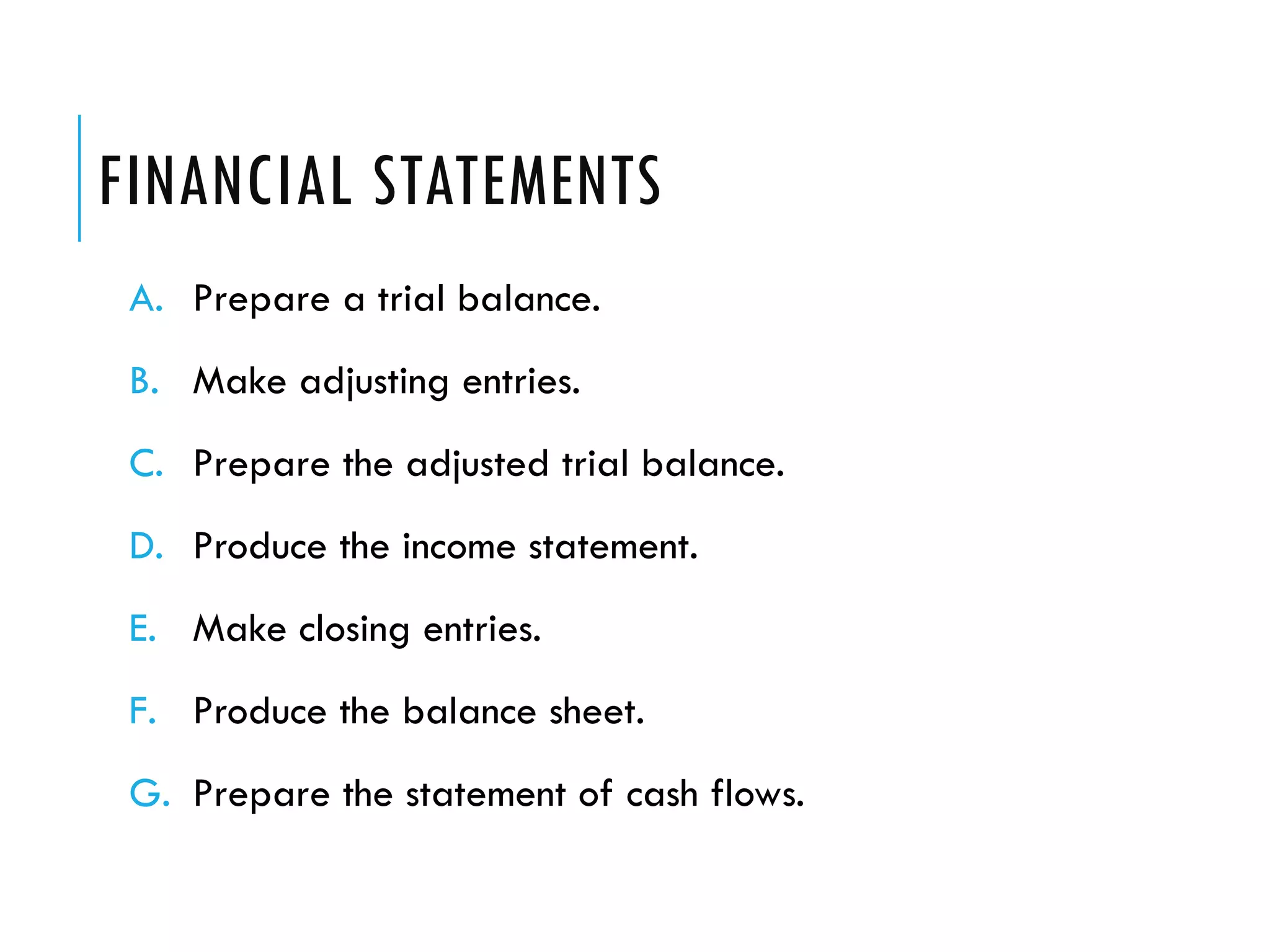
FINANCIAL STATEMENTS
 A. Prepare a trial balance.
 B. Make adjusting entries.
 C. Prepare the adjusted trial balance.
 D. Produce the income statement.
 E. Make closing entries.
 F. Produce the balance sheet.
 G. Prepare the statement of cash flows.
MANAGERIAL REPORTS
The AIS must also be able to provide managers with detailed
operational information about the organization’s performance.
What reports does management need?
  A. Inventory status
  B. Budgets
  C. Performance reports
INTERNAL CONTROL CONSIDERATIONS
Another main function of an AIS is to provide
adequate internal controls to accomplish three basic
objectives:
  Ensure that the information is reliable.
  Ensure that business activities are performed
   efficiently.
  Safeguard organizational assets.
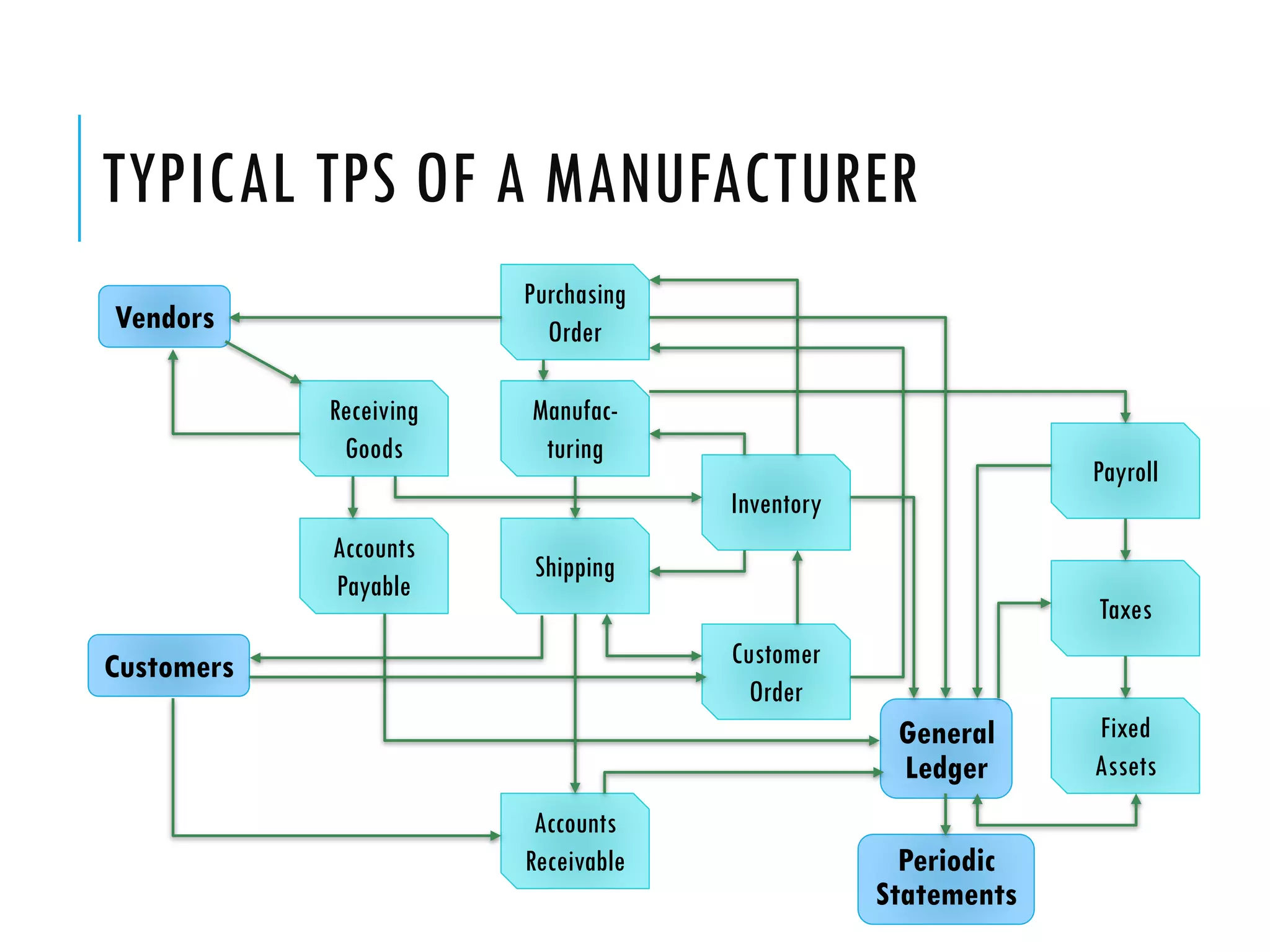
TYPICAL TPS OF A MANUFACTURER
                        Purchasing
Vendors                   Order

            Receiving   Manufac-
             Goods       turing
                                                              Payroll
                                     Inventory
            Accounts
                         Shipping
            Payable
                                                              Taxes
Customers                            Customer
                                       Order
                                                  General     Fixed
                                                  Ledger      Assets
                         Accounts
                        Receivable                 Periodic
                                                 Statements
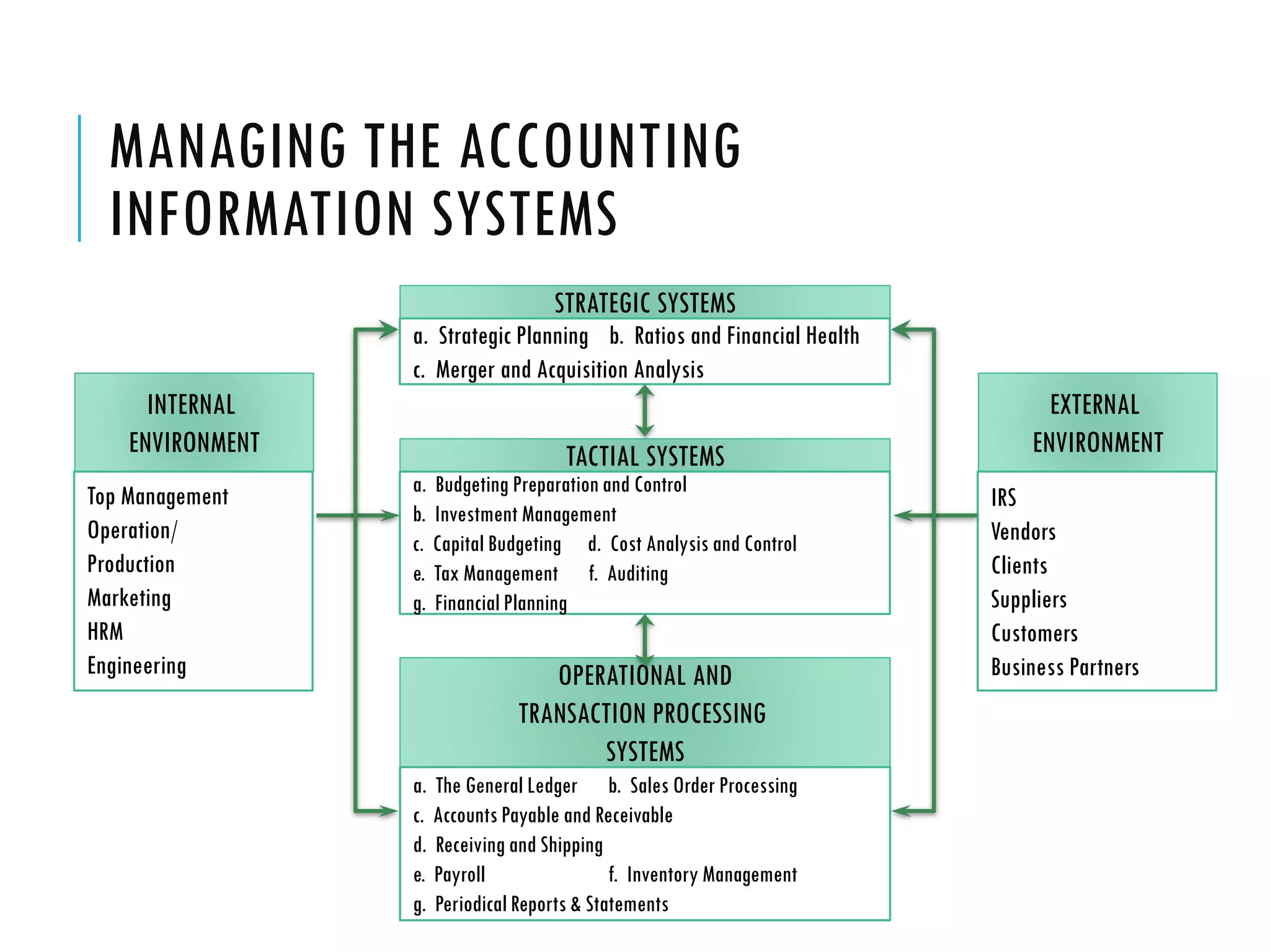
MANAGING THE ACCOUNTING
INFORMATION SYSTEMS
                Strategic Systems


  Internal       Tactical Systems        External
Environment                            Environment


                 Operational and
              Transaction Processing
                     System
MANAGING THE ACCOUNTING
  INFORMATION SYSTEMS
                                    STRATEGIC SYSTEMS
                  a. Strategic Planning b. Ratios and Financial Health
                  c. Merger and Acquisition Analysis
      INTERNAL                                                                 EXTERNAL
    ENVIRONMENT                      TACTIAL SYSTEMS                         ENVIRONMENT
                  a. Budgeting Preparation and Control
Top Management                                                           IRS
                  b. Investment Management
Operation/        c. Capital Budgeting d. Cost Analysis and Control      Vendors
Production        e. Tax Management f. Auditing                          Clients
Marketing         g. Financial Planning                                  Suppliers
HRM                                                                      Customers
Engineering                       OPERATIONAL AND                        Business Partners
                               TRANSACTION PROCESSING
                                      SYSTEMS
                  a. The General Ledger b. Sales Order Processing
                  c. Accounts Payable and Receivable
                  d. Receiving and Shipping
                  e. Payroll                 f. Inventory Management
                  g. Periodical Reports & Statements
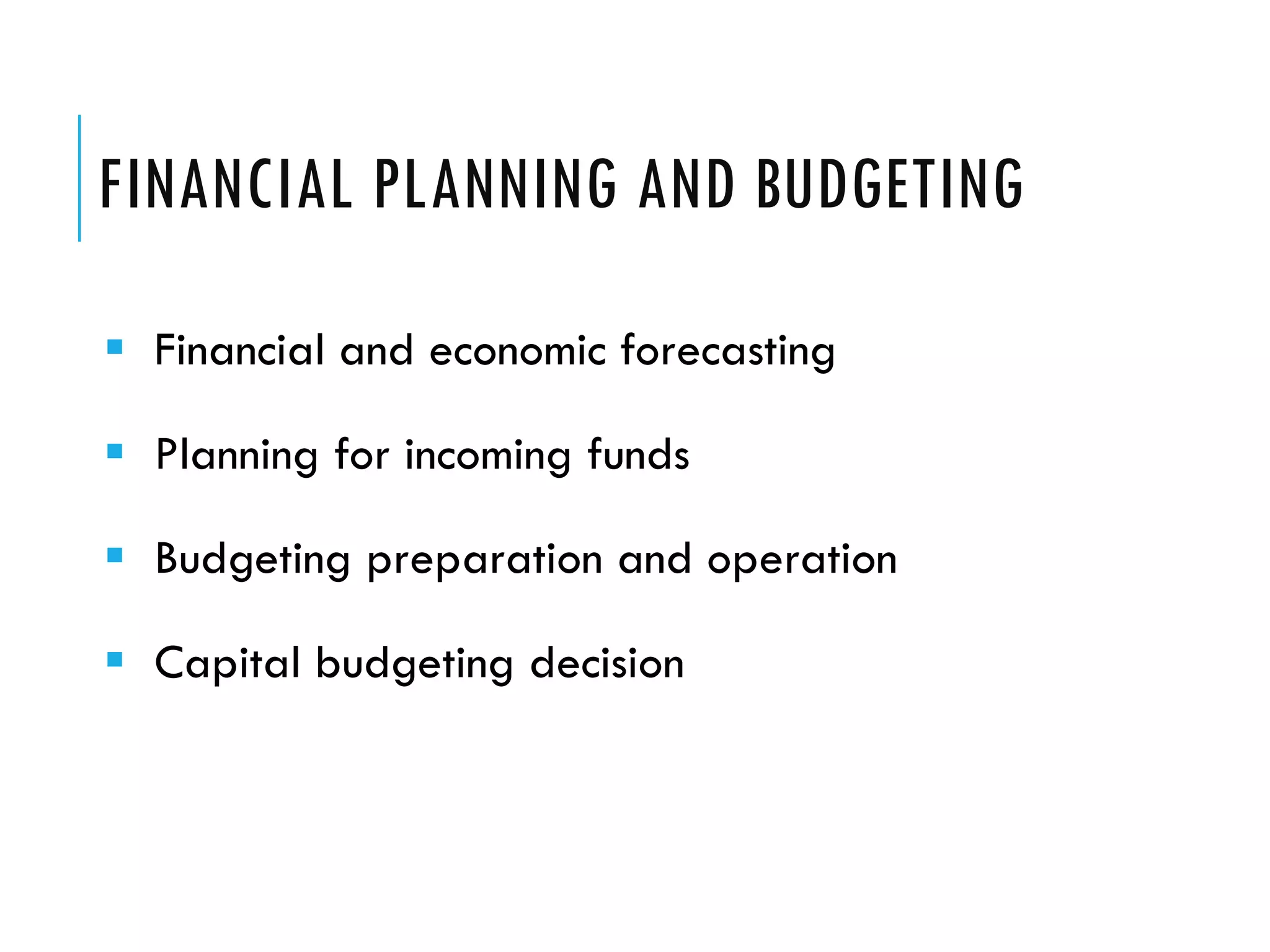
FINANCIAL PLANNING AND BUDGETING

 Financial and economic forecasting

 Planning for incoming funds

 Budgeting preparation and operation

 Capital budgeting decision
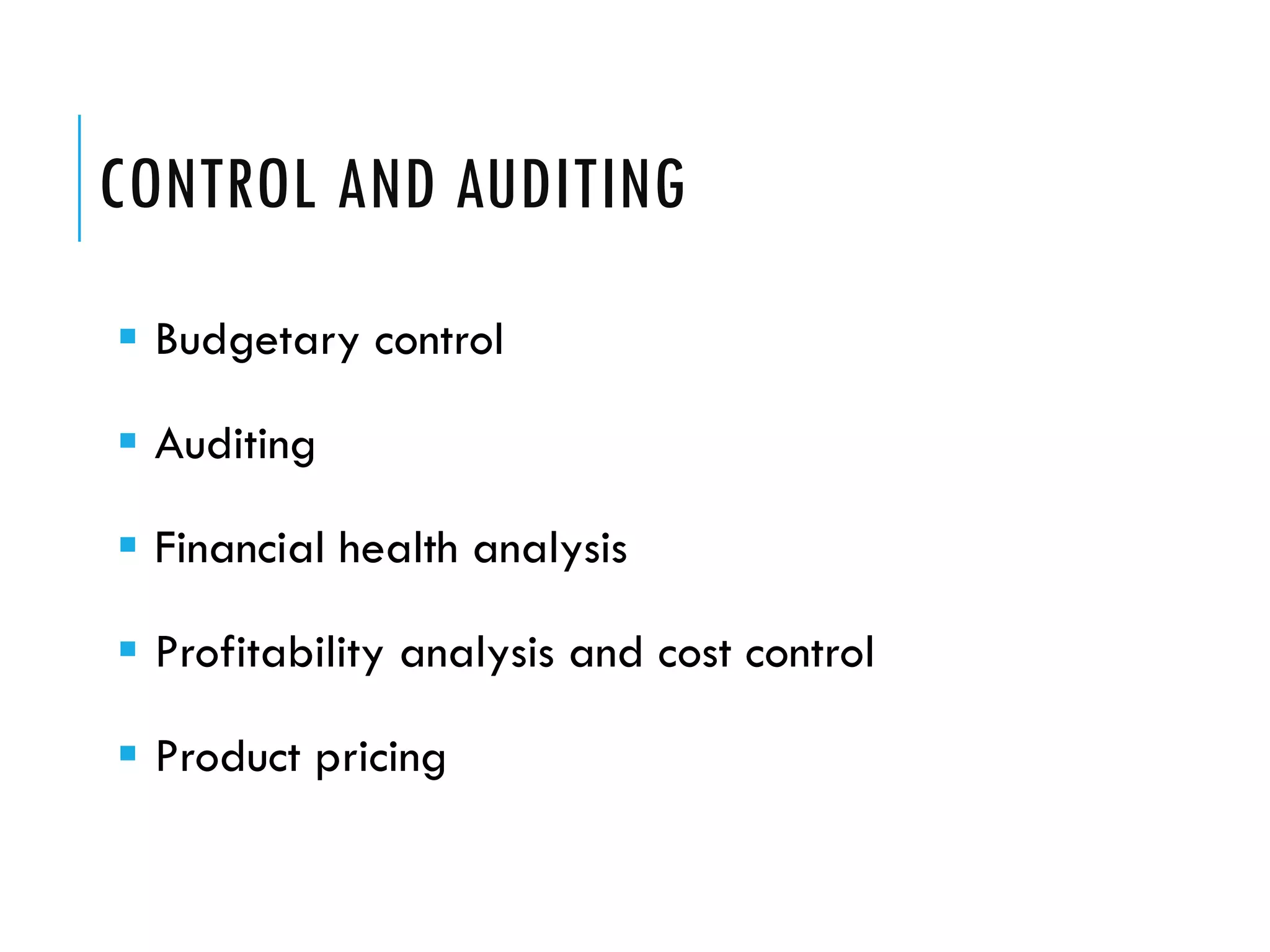
CONTROL AND AUDITING
 Budgetary control

 Auditing

 Financial health analysis

 Profitability analysis and cost control

 Product pricing
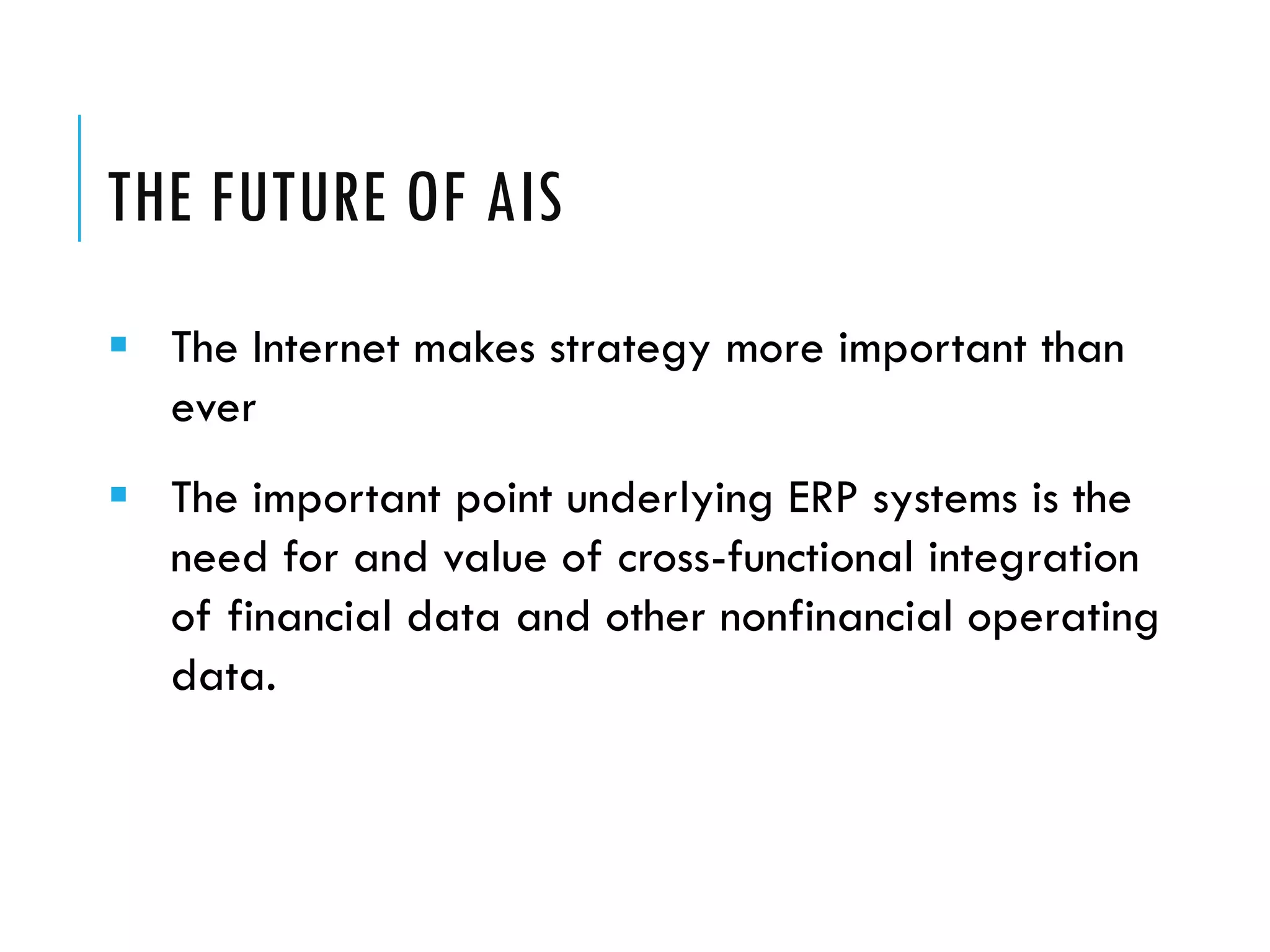
THE FUTURE OF AIS
 The Internet makes strategy more important than
  ever
 The important point underlying ERP systems is the
  need for and value of cross-functional integration
  of financial data and other nonfinancial operating
  data.
THANK YOU!   VIVEK K. SINGH
             WIWECK@GMAIL.COM

Accounting information system

  • 1.
  • 2.
    LEARNING OBJECTIVES 1. Explain what an accounting information system (AIS) is. 2. Explain why studying AIS is important. 3. Discuss the role played by the AIS in a company’s value chain and explain how the AIS can add value to a business. 4. Explain the three basic functions performed by an accounting information system (AIS). 5. Discuss the types of information that can be provided by an AIS.
  • 3.
    LEARNING OBJECTIVE 1 Explainwhat an accounting information system (AIS) is.
  • 4.
    WHAT IS ANAIS? An accounting information system (AIS) consists of:  People  Procedures  Data  Software  Information technology
  • 5.
    WHAT IS ANAIS? What important functions does the AIS perform in an organization? 1. It collects and stores data about activities and transactions. 2. It processes data into information that is useful for making decisions. 3. It provides adequate controls to safeguard the organization’s assets.
  • 6.
    BASIC SUBSYSTEMS INTHE AIS 1. The expenditure cycle: involves activities of buying and paying for goods or services used by the organization. 2. The production cycle: involves activities converting raw materials and labor into finished goods. 3. The human resources/payroll cycle: involves activities of hiring and paying employees. 4. The revenue cycle: involves activities of selling goods or services and collecting payment for those sales. 5. The financing cycle: involves activities of obtaining necessary funds to run the organization, repay creditors, and distribute profits to investors.
  • 7.
    BASIC SUBSYSTEMS INTHE AIS Financing Expenditure Human Cycle Cycle Resources General Ledger & Reporting System Production Revenue Cycle Cycle
  • 8.
    LEARNING OBJECTIVE 2 Explainwhy studying AIS is important.
  • 9.
    WHY STUDY AIS? Because:  Accounting is defined as an information system.  The primary objective of accounting is to provide information useful to decision makers.  Accounting is about information identification, development, measurement, and communication process, and...  Financial information reporting.
  • 10.
    WHY STUDY AIS? Tounderstand how the accounting system works.  How to collect data about an organization’s activities and transactions  How to transform that data into information that management can use to run the organization  How to ensure the availability, reliability, and accuracy of that information
  • 11.
    WHY STUDY AIS? Auditors need to understand the systems that are used to produce a company’s financial statements.  Tax professionals need to understand enough about the client’s AIS to be confident that the information used for tax planning and compliance work is complete and accurate.  A survey conducted by the Institute of Management Accountants (IMA) indicates that work relating to accounting systems was the single most important activity performed by corporate accountants.
  • 12.
    INFORMATION TECHNOLOGY AND CORPORATESTRATEGY  The same survey conducted by the Institute of Management Accountants (IMA) also indicates that the second most important job activity of corporate accountants is long-term strategic planning.  One important aspect of this topic is how to align information technology (IT) with an organization’s strategy.
  • 13.
    FACTORS INFLUENCING DESIGN OFTHE AIS Organizational Strategy Culture AIS Information Technology
  • 14.
    LEARNING OBJECTIVE 3 Discussthe role played by the AIS in a company’s value chain and explain how the AIS can add value to a business.
  • 15.
    THE VALUE CHAIN The ultimate goal of any business is to provide value to its customers.  A business will be profitable if the value it creates is greater than the cost of producing its products or services.
  • 16.
    VALUE CHAIN MODELAND THE SUPPLY CHAIN Typical functional areas mapped on the value chain of a manufacturing company Firm Infrastructure Support Activities (Accounting, Finance, General Management) Human Resource Management (Human Resources) Technology Development (Engineering) Procurement (Material Management-Operations) Primary Activities Inbound Operations Outbound Marketing Service Logistics Logistics and Sales (Material (Operations) (Material (Marketing) (Service or Management- Management- Marketing) Operations) Operations)
  • 17.
    SUPPLY-CHAIN MANAGEMENT a) SupplyChain direct to customer Suppliers Inbound Logistics Production Transaction Delivery Customer b) Supply Chain including wholesalers and retailers Information Flow Transfer Transfer Transfer Transfer Suppliers Manufacturing Distribution Retail Outlet Customer Cash Flow Supply Chain Organization
  • 18.
    HOW AN AISCAN ADD VALUE TO AN ORGANIZATION An AIS adds value by providing accurate and timely information so that five primary value chain activities can be performed more effectively and efficiently. This is done by: improving the quality and reducing the costs of products or services.
  • 19.
    HOW AN AISCAN ADD VALUE TO AN ORGANIZATION An AIS can…  improve efficiency.  improve decision making capabilities.  increase the sharing of knowledge. A well-designed AIS can also help an organization profit by improving the efficiency and effectiveness of its supply chain.
  • 20.
    INFORMATION TECHNOLOGY AND CORPORATESTRATEGY Develop a basic understanding of…  corporate strategies.  how IT developments can be used to implement existing organizational strategies.  how IT developments can be used to create an opportunity to modify existing strategies. Because an AIS functions within an organization, it should be designed to reflect the values of that organizational culture.
  • 21.
    STRATEGY AND STRATEGICPOSITIONS What role does the AIS play in helping organizations adopt and maintain a strategic position?  Data collection about each activity  Transforming data into information that can be used by management to coordinate those activities
  • 22.
    LEARNING OBJECTIVE 4 Explainthe three basic functions performed by an accounting information system (AIS).
  • 23.
    THE THREE BASICFUNCTIONS PERFORMED BY AN AIS 1. The efficient and effective processing of data about a company’s transactions:  Capture transaction data on source documents.  Record transaction data in journals, which present a chronological record of what occurred.  Post data from journals to ledgers, which sort data by account type.
  • 24.
    THE THREE BASICFUNCTIONS PERFORMED BY AN AIS 2. To provide management with information useful for decision making:  In manual systems, this information is provided in the form of reports that fall into two main categories: • Financial statements • Managerial reports
  • 25.
    THE THREE BASICFUNCTIONS PERFORMED BY AN AIS 3. To provide adequate internal controls:  Ensure that the information produced by the system is reliable.  Ensure that business activities are performed efficiently and in accordance with management’s objectives.  Safeguard organizational assets.
  • 26.
    LEARNING OBJECTIVE 5 Discussthe types of information that can be provided by an AIS.
  • 27.
    FINANCIAL STATEMENTS The nextfunction of the AIS is to provide management with information useful for decision making. The preparation of financial statements consists of a sequence of activities. What are these activities?
  • 28.
    FINANCIAL STATEMENTS A.Prepare a trial balance. B. Make adjusting entries. C. Prepare the adjusted trial balance. D. Produce the income statement. E. Make closing entries. F. Produce the balance sheet. G. Prepare the statement of cash flows.
  • 29.
    MANAGERIAL REPORTS The AISmust also be able to provide managers with detailed operational information about the organization’s performance. What reports does management need? A. Inventory status B. Budgets C. Performance reports
  • 30.
    INTERNAL CONTROL CONSIDERATIONS Anothermain function of an AIS is to provide adequate internal controls to accomplish three basic objectives:  Ensure that the information is reliable.  Ensure that business activities are performed efficiently.  Safeguard organizational assets.
  • 31.
    TYPICAL TPS OFA MANUFACTURER Purchasing Vendors Order Receiving Manufac- Goods turing Payroll Inventory Accounts Shipping Payable Taxes Customers Customer Order General Fixed Ledger Assets Accounts Receivable Periodic Statements
  • 32.
    MANAGING THE ACCOUNTING INFORMATIONSYSTEMS Strategic Systems Internal Tactical Systems External Environment Environment Operational and Transaction Processing System
  • 33.
    MANAGING THE ACCOUNTING INFORMATION SYSTEMS STRATEGIC SYSTEMS a. Strategic Planning b. Ratios and Financial Health c. Merger and Acquisition Analysis INTERNAL EXTERNAL ENVIRONMENT TACTIAL SYSTEMS ENVIRONMENT a. Budgeting Preparation and Control Top Management IRS b. Investment Management Operation/ c. Capital Budgeting d. Cost Analysis and Control Vendors Production e. Tax Management f. Auditing Clients Marketing g. Financial Planning Suppliers HRM Customers Engineering OPERATIONAL AND Business Partners TRANSACTION PROCESSING SYSTEMS a. The General Ledger b. Sales Order Processing c. Accounts Payable and Receivable d. Receiving and Shipping e. Payroll f. Inventory Management g. Periodical Reports & Statements
  • 34.
    FINANCIAL PLANNING ANDBUDGETING  Financial and economic forecasting  Planning for incoming funds  Budgeting preparation and operation  Capital budgeting decision
  • 35.
    CONTROL AND AUDITING Budgetary control  Auditing  Financial health analysis  Profitability analysis and cost control  Product pricing
  • 36.
    THE FUTURE OFAIS  The Internet makes strategy more important than ever  The important point underlying ERP systems is the need for and value of cross-functional integration of financial data and other nonfinancial operating data.
  • 37.
    THANK YOU! VIVEK K. SINGH WIWECK@GMAIL.COM