An information system that integrates data
 from various departments it serves and
 provides operations and management with
 information they require is called
 management information system.

          An MIS provides managers with
 information and support for effective
 decision making and provides daily
 operations.
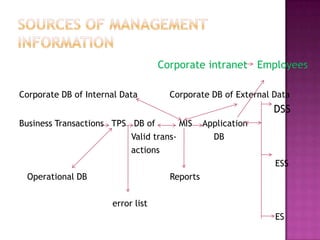
Corporate intranet Employees

Corporate DB of Internal Data        Corporate DB of External Data
                                                              DSS
Business Transactions TPS DB of        MIS     Application
                          Valid trans-           DB
                          actions
                                                              ESS
 Operational DB                      Reports

                      error list
                                                              ES
 Provides reports with fixed and standard
  formats.
 Use internal data stored in the computer system
 End users can develop custom reports.
 Requires formal requests from users.
MIS for competitive Advantage
 Provides support to managers as they work to
  achieve corporate goals.
 Enables managers to compare results to
  established company goals and identify problem
  areas and opportunities for improvement.
 Data may be made available from MIS on a
  company’s intranet.
 Employees can use browsers and their PC to
  gain access to data.
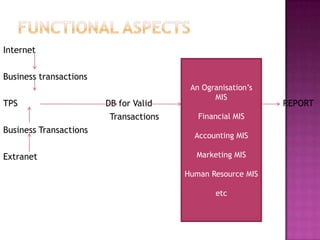
Internet

Business transactions
                                         An Ogranisation’s
                                               MIS
TPS                     DB for Valid                         REPORT
                         Transactions      Financial MIS
Business Transactions
                                          Accounting MIS

Extranet                                  Marketing MIS

                                        Human Resource MIS

                                               etc
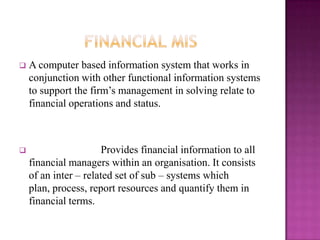
   A computer based information system that works in
    conjunction with other functional information systems
    to support the firm’s management in solving relate to
    financial operations and status.


                      Provides financial information to all
    financial managers within an organisation. It consists
    of an inter – related set of sub – systems which
    plan, process, report resources and quantify them in
    financial terms.
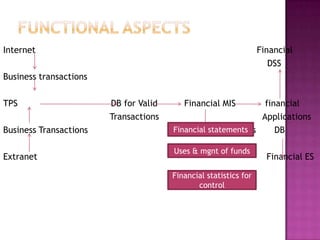
Internet                                                          Financial
                                                                     DSS
Business transactions

TPS                     DB for Valid      Financial MIS      financial
                        Transactions                        Applications
Business Transactions                  Financialstatements
                                       Financial statements     DB

                                       Uses & mgnt of funds
Extranet                                                            Financial ES

                                       Financial statistics for
                                              control
Inputs to the financial information System:
 Strategic plans or corporate policies.
 Contains major financial objectives and often projects
  financial needs.
 Transaction processing system ( TPS)
 Important financial information collected from almost
  every TPS – payroll, inventory control, order processing,
  accounts payable, accounts receivable, general ledger.
 External Sources
 Annual reports and financial statements of competitors
  and general news items.
   Financial subsystems
    Profit/loss and cost systems
   Auditing subsystems
   Internal Auditing
   External Auditing
   Uses and management of funds.
1.   Accounting System

2.   Budgeting System

3.   Cash Management System

4.   Receivable Management System

5.   Internal Control System
A Marketing Information System is a routine, planned,
  gathering, sorting, storage and retrieval system for
  market information relevant to the operation of a
  particular business.
              It supports managerial activities in product
  development, distribution, pricing decisions and
  promotional effectiveness.
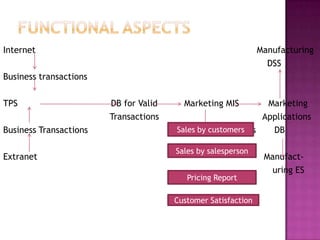
Internet                                                       Manufacturing
                                                                 DSS
Business transactions

TPS                     DB for Valid     Marketing MIS       Marketing
                        Transactions                        Applications
Business Transactions                  Financialcustomers
                                        Sales by statements   DB

                                       Sales by salesperson
Extranet                                                        Manufact-
                                                                 uring ES
                                          Pricing Report

                                       Customer Satisfaction
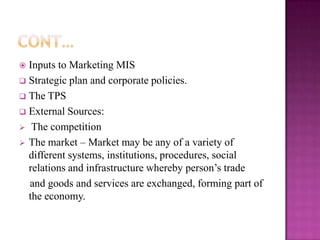
 Inputs to Marketing MIS
 Strategic plan and corporate policies.
 The TPS
 External Sources:
 The competition
 The market – Market may be any of a variety of
  different systems, institutions, procedures, social
  relations and infrastructure whereby person’s trade
  and goods and services are exchanged, forming part of
  the economy.
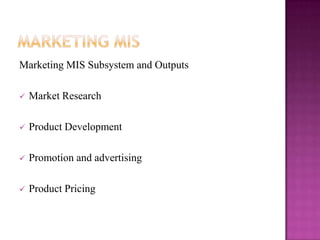
Marketing MIS Subsystem and Outputs

   Market Research

   Product Development

   Promotion and advertising

   Product Pricing
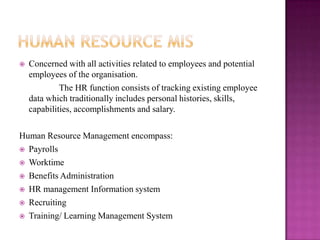
   Concerned with all activities related to employees and potential
    employees of the organisation.
             The HR function consists of tracking existing employee
    data which traditionally includes personal histories, skills,
    capabilities, accomplishments and salary.

Human Resource Management encompass:
 Payrolls

 Worktime

 Benefits Administration

 HR management Information system

 Recruiting

 Training/ Learning Management System
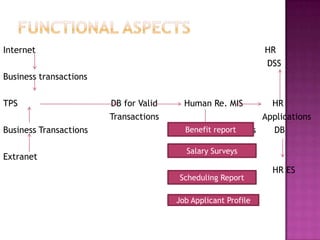
Internet                                                       HR
                                                               DSS
Business transactions

TPS                     DB for Valid     Human Re. MIS        HR
                        Transactions                        Applications
Business Transactions                  Financial statements
                                          Benefit report      DB

                                          Salary Surveys
Extranet
                                                                HR ES
                                        Scheduling Report

                                       Job Applicant Profile
 Input to Human Resource MIS
 The TPS
 Payroll data
 Order processing data
 Personal data
o External sources
Manufacturing Information System
is an integrated system of all functional activities
required for manufacturing products. It is a set of
computer – based integrated applications which
provide manufacturers with a common framework and
a single access and control mechanism for all items of
information, both hardware and software.
                Inventory control programs can forecast
future production, automatically reorder items when a
certain threshold is met, determine manufacturing costs
and develop resource requirements plans from the
production schedule.
Technologies have been developed to
control and streamline the manufacturing process.
Computers can directly control manufacturing
equipment using computer – assisted manufacturing
software. Computer – integrated manufacturing
software connects all aspects of production together,
including order processing, product design,
manufacturing, quality control, and shipping.
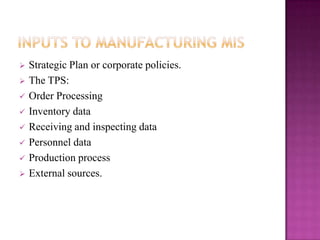
   Strategic Plan or corporate policies.
   The TPS:
   Order Processing
   Inventory data
   Receiving and inspecting data
   Personnel data
   Production process
   External sources.
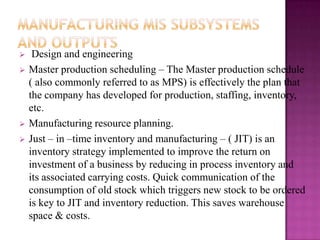
    Design and engineering
   Master production scheduling – The Master production schedule
    ( also commonly referred to as MPS) is effectively the plan that
    the company has developed for production, staffing, inventory,
    etc.
   Manufacturing resource planning.
   Just – in –time inventory and manufacturing – ( JIT) is an
    inventory strategy implemented to improve the return on
    investment of a business by reducing in process inventory and
    its associated carrying costs. Quick communication of the
    consumption of old stock which triggers new stock to be ordered
    is key to JIT and inventory reduction. This saves warehouse
    space & costs.
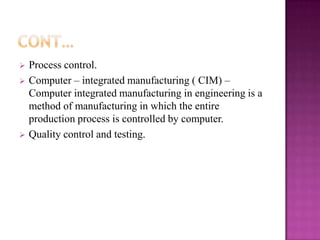
   Process control.
   Computer – integrated manufacturing ( CIM) –
    Computer integrated manufacturing in engineering is a
    method of manufacturing in which the entire
    production process is controlled by computer.
   Quality control and testing.
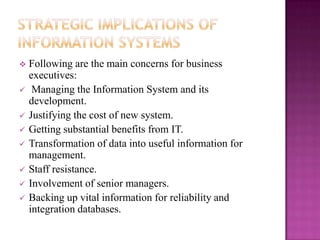
   Following are the main concerns for business
    executives:
    Managing the Information System and its
    development.
   Justifying the cost of new system.
   Getting substantial benefits from IT.
   Transformation of data into useful information for
    management.
   Staff resistance.
   Involvement of senior managers.
   Backing up vital information for reliability and
    integration databases.
   Keeping information about the latest trends and
    developments in IT.
   Planning technology up gradation.
   Availability and attitude of IT professionals.
   Taking care of legal, audit and other regulatory
    requirements.
Management information system

Management information system

  • 2.
    An information systemthat integrates data from various departments it serves and provides operations and management with information they require is called management information system. An MIS provides managers with information and support for effective decision making and provides daily operations.
  • 3.
    Corporate intranet Employees CorporateDB of Internal Data Corporate DB of External Data DSS Business Transactions TPS DB of MIS Application Valid trans- DB actions ESS Operational DB Reports error list ES
  • 4.
     Provides reportswith fixed and standard formats.  Use internal data stored in the computer system  End users can develop custom reports.  Requires formal requests from users. MIS for competitive Advantage  Provides support to managers as they work to achieve corporate goals.  Enables managers to compare results to established company goals and identify problem areas and opportunities for improvement.
  • 5.
     Data maybe made available from MIS on a company’s intranet.  Employees can use browsers and their PC to gain access to data.
  • 6.
    Internet Business transactions An Ogranisation’s MIS TPS DB for Valid REPORT Transactions Financial MIS Business Transactions Accounting MIS Extranet Marketing MIS Human Resource MIS etc
  • 7.
    A computer based information system that works in conjunction with other functional information systems to support the firm’s management in solving relate to financial operations and status.  Provides financial information to all financial managers within an organisation. It consists of an inter – related set of sub – systems which plan, process, report resources and quantify them in financial terms.
  • 8.
    Internet Financial DSS Business transactions TPS DB for Valid Financial MIS financial Transactions Applications Business Transactions Financialstatements Financial statements DB Uses & mgnt of funds Extranet Financial ES Financial statistics for control
  • 9.
    Inputs to thefinancial information System:  Strategic plans or corporate policies.  Contains major financial objectives and often projects financial needs.  Transaction processing system ( TPS)  Important financial information collected from almost every TPS – payroll, inventory control, order processing, accounts payable, accounts receivable, general ledger.  External Sources  Annual reports and financial statements of competitors and general news items.
  • 10.
    Financial subsystems  Profit/loss and cost systems  Auditing subsystems  Internal Auditing  External Auditing  Uses and management of funds.
  • 11.
    1. Accounting System 2. Budgeting System 3. Cash Management System 4. Receivable Management System 5. Internal Control System
  • 12.
    A Marketing InformationSystem is a routine, planned, gathering, sorting, storage and retrieval system for market information relevant to the operation of a particular business. It supports managerial activities in product development, distribution, pricing decisions and promotional effectiveness.
  • 13.
    Internet Manufacturing DSS Business transactions TPS DB for Valid Marketing MIS Marketing Transactions Applications Business Transactions Financialcustomers Sales by statements DB Sales by salesperson Extranet Manufact- uring ES Pricing Report Customer Satisfaction
  • 14.
     Inputs toMarketing MIS  Strategic plan and corporate policies.  The TPS  External Sources:  The competition  The market – Market may be any of a variety of different systems, institutions, procedures, social relations and infrastructure whereby person’s trade and goods and services are exchanged, forming part of the economy.
  • 15.
    Marketing MIS Subsystemand Outputs  Market Research  Product Development  Promotion and advertising  Product Pricing
  • 16.
    Concerned with all activities related to employees and potential employees of the organisation. The HR function consists of tracking existing employee data which traditionally includes personal histories, skills, capabilities, accomplishments and salary. Human Resource Management encompass:  Payrolls  Worktime  Benefits Administration  HR management Information system  Recruiting  Training/ Learning Management System
  • 17.
    Internet HR DSS Business transactions TPS DB for Valid Human Re. MIS HR Transactions Applications Business Transactions Financial statements Benefit report DB Salary Surveys Extranet HR ES Scheduling Report Job Applicant Profile
  • 18.
     Input toHuman Resource MIS  The TPS  Payroll data  Order processing data  Personal data o External sources
  • 19.
    Manufacturing Information System isan integrated system of all functional activities required for manufacturing products. It is a set of computer – based integrated applications which provide manufacturers with a common framework and a single access and control mechanism for all items of information, both hardware and software. Inventory control programs can forecast future production, automatically reorder items when a certain threshold is met, determine manufacturing costs and develop resource requirements plans from the production schedule.
  • 20.
    Technologies have beendeveloped to control and streamline the manufacturing process. Computers can directly control manufacturing equipment using computer – assisted manufacturing software. Computer – integrated manufacturing software connects all aspects of production together, including order processing, product design, manufacturing, quality control, and shipping.
  • 21.
    Strategic Plan or corporate policies.  The TPS:  Order Processing  Inventory data  Receiving and inspecting data  Personnel data  Production process  External sources.
  • 22.
    Design and engineering  Master production scheduling – The Master production schedule ( also commonly referred to as MPS) is effectively the plan that the company has developed for production, staffing, inventory, etc.  Manufacturing resource planning.  Just – in –time inventory and manufacturing – ( JIT) is an inventory strategy implemented to improve the return on investment of a business by reducing in process inventory and its associated carrying costs. Quick communication of the consumption of old stock which triggers new stock to be ordered is key to JIT and inventory reduction. This saves warehouse space & costs.
  • 23.
    Process control.  Computer – integrated manufacturing ( CIM) – Computer integrated manufacturing in engineering is a method of manufacturing in which the entire production process is controlled by computer.  Quality control and testing.
  • 24.
    Following are the main concerns for business executives:  Managing the Information System and its development.  Justifying the cost of new system.  Getting substantial benefits from IT.  Transformation of data into useful information for management.  Staff resistance.  Involvement of senior managers.  Backing up vital information for reliability and integration databases.
  • 25.
    Keeping information about the latest trends and developments in IT.  Planning technology up gradation.  Availability and attitude of IT professionals.  Taking care of legal, audit and other regulatory requirements.