ENVIRONMENTAL SCIENCE & ENGINEERING
HONCULADA, A.M.
NORSU-CEA
INTRODUCTION TO
ENVIRONMENTAL
SCIENCE & ENGINEERING
ENVIRONMENTAL SCIENCE & ENGINEERING
HONCULADA, A.M.
NORSU-CEA
ENVIRONMENT
(from the French environner: to encircle or surround)
-the circumstances or conditions that surround an
organism or group of organisms.
-the complex of social or cultural conditions that
affect an individual or community.
- the sum total of all conditions and influences
which affect the development and life of all
organisms on earth.
ENVIRONMENTAL SCIENCE & ENGINEERING
HONCULADA, A.M.
NORSU-CEA
ENVIRONMENTAL SCIENCE
- the systematic study of our environment and
our proper place in it. Environmental science is
interdisciplinary, integrating natural sciences,
social sciences, and humanities in a broad,
holistic study of the world around us.
- focuses on understanding and resolving
problems in our natural environment, such as
pollution or lost biodiversity.
- includes discussion of policy, population,
economics, and urbanization.
ENVIRONMENTAL SCIENCE & ENGINEERING
HONCULADA, A.M.
NORSU-CEA
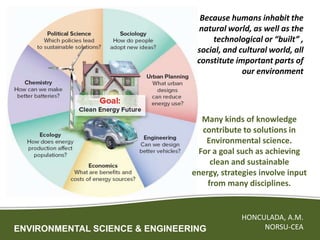
Because humans inhabit the
natural world, as well as the
technological or “built” ,
social, and cultural world, all
constitute important parts of
our environment
Many kinds of knowledge
contribute to solutions in
Environmental science.
For a goal such as achieving
clean and sustainable
energy, strategies involve input
from many disciplines.
ENVIRONMENTAL SCIENCE & ENGINEERING
HONCULADA, A.M.
NORSU-CEA
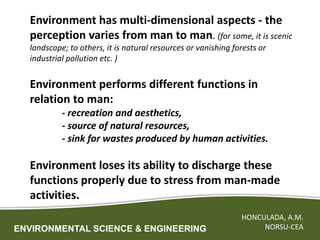
Environment has multi-dimensional aspects - the
perception varies from man to man. (for some, it is scenic
landscape; to others, it is natural resources or vanishing forests or
industrial pollution etc. )
Environment performs different functions in
relation to man:
- recreation and aesthetics,
- source of natural resources,
- sink for wastes produced by human activities.
Environment loses its ability to discharge these
functions properly due to stress from man-made
activities.
ENVIRONMENTAL SCIENCE & ENGINEERING
HONCULADA, A.M.
NORSU-CEA
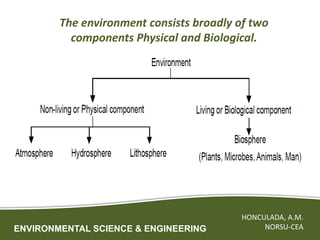
The environment consists broadly of two
components Physical and Biological.
ENVIRONMENTAL SCIENCE & ENGINEERING
HONCULADA, A.M.
NORSU-CEA
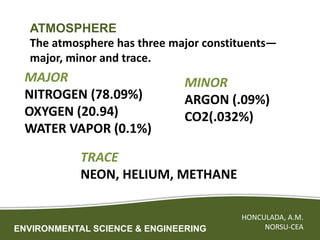
ATMOSPHERE
The atmosphere has three major constituents—
major, minor and trace.
MAJOR
NITROGEN (78.09%)
OXYGEN (20.94)
WATER VAPOR (0.1%)
MINOR
ARGON (.09%)
CO2(.032%)
TRACE
NEON, HELIUM, METHANE
ENVIRONMENTAL SCIENCE & ENGINEERING
HONCULADA, A.M.
NORSU-CEA
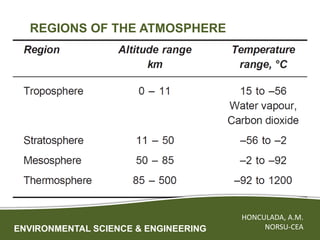
REGIONS OF THE ATMOSPHERE
ENVIRONMENTAL SCIENCE & ENGINEERING
HONCULADA, A.M.
NORSU-CEA
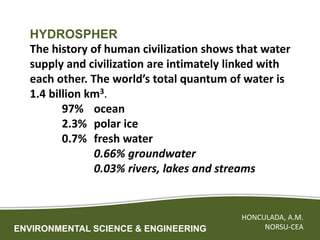
HYDROSPHER
The history of human civilization shows that water
supply and civilization are intimately linked with
each other. The world’s total quantum of water is
1.4 billion km3.
97% ocean
2.3% polar ice
0.7% fresh water
0.66% groundwater
0.03% rivers, lakes and streams
ENVIRONMENTAL SCIENCE & ENGINEERING
HONCULADA, A.M.
NORSU-CEA
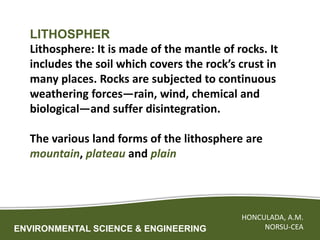
LITHOSPHER
Lithosphere: It is made of the mantle of rocks. It
includes the soil which covers the rock’s crust in
many places. Rocks are subjected to continuous
weathering forces—rain, wind, chemical and
biological—and suffer disintegration.
The various land forms of the lithosphere are
mountain, plateau and plain
ENVIRONMENTAL SCIENCE & ENGINEERING
HONCULADA, A.M.
NORSU-CEA
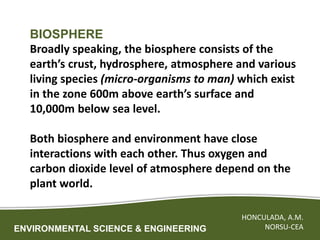
BIOSPHERE
Broadly speaking, the biosphere consists of the
earth’s crust, hydrosphere, atmosphere and various
living species (micro-organisms to man) which exist
in the zone 600m above earth’s surface and
10,000m below sea level.
Both biosphere and environment have close
interactions with each other. Thus oxygen and
carbon dioxide level of atmosphere depend on the
plant world.
ENVIRONMENTAL SCIENCE & ENGINEERING
HONCULADA, A.M.
NORSU-CEA
ENVIRONMENTAL ENGINEERING
- is the branch of engineering that is concerned with
protecting people from the effects of
adverse environmental effects, such as pollution, as well
as improving environmental quality
- the application of science and engineering principles to
improve the environment (air, water, and/or land resources), to
provide healthful water, air, and land for human
habitation and for other organisms, and to remediate
polluted sites.

Introduction to environmental science and engineering

  • 1.
    ENVIRONMENTAL SCIENCE &ENGINEERING HONCULADA, A.M. NORSU-CEA INTRODUCTION TO ENVIRONMENTAL SCIENCE & ENGINEERING
  • 2.
    ENVIRONMENTAL SCIENCE &ENGINEERING HONCULADA, A.M. NORSU-CEA ENVIRONMENT (from the French environner: to encircle or surround) -the circumstances or conditions that surround an organism or group of organisms. -the complex of social or cultural conditions that affect an individual or community. - the sum total of all conditions and influences which affect the development and life of all organisms on earth.
  • 3.
    ENVIRONMENTAL SCIENCE &ENGINEERING HONCULADA, A.M. NORSU-CEA ENVIRONMENTAL SCIENCE - the systematic study of our environment and our proper place in it. Environmental science is interdisciplinary, integrating natural sciences, social sciences, and humanities in a broad, holistic study of the world around us. - focuses on understanding and resolving problems in our natural environment, such as pollution or lost biodiversity. - includes discussion of policy, population, economics, and urbanization.
  • 4.
    ENVIRONMENTAL SCIENCE &ENGINEERING HONCULADA, A.M. NORSU-CEA Because humans inhabit the natural world, as well as the technological or “built” , social, and cultural world, all constitute important parts of our environment Many kinds of knowledge contribute to solutions in Environmental science. For a goal such as achieving clean and sustainable energy, strategies involve input from many disciplines.
  • 5.
    ENVIRONMENTAL SCIENCE &ENGINEERING HONCULADA, A.M. NORSU-CEA Environment has multi-dimensional aspects - the perception varies from man to man. (for some, it is scenic landscape; to others, it is natural resources or vanishing forests or industrial pollution etc. ) Environment performs different functions in relation to man: - recreation and aesthetics, - source of natural resources, - sink for wastes produced by human activities. Environment loses its ability to discharge these functions properly due to stress from man-made activities.
  • 6.
    ENVIRONMENTAL SCIENCE &ENGINEERING HONCULADA, A.M. NORSU-CEA The environment consists broadly of two components Physical and Biological.
  • 7.
    ENVIRONMENTAL SCIENCE &ENGINEERING HONCULADA, A.M. NORSU-CEA ATMOSPHERE The atmosphere has three major constituents— major, minor and trace. MAJOR NITROGEN (78.09%) OXYGEN (20.94) WATER VAPOR (0.1%) MINOR ARGON (.09%) CO2(.032%) TRACE NEON, HELIUM, METHANE
  • 8.
    ENVIRONMENTAL SCIENCE &ENGINEERING HONCULADA, A.M. NORSU-CEA REGIONS OF THE ATMOSPHERE
  • 9.
    ENVIRONMENTAL SCIENCE &ENGINEERING HONCULADA, A.M. NORSU-CEA HYDROSPHER The history of human civilization shows that water supply and civilization are intimately linked with each other. The world’s total quantum of water is 1.4 billion km3. 97% ocean 2.3% polar ice 0.7% fresh water 0.66% groundwater 0.03% rivers, lakes and streams
  • 10.
    ENVIRONMENTAL SCIENCE &ENGINEERING HONCULADA, A.M. NORSU-CEA LITHOSPHER Lithosphere: It is made of the mantle of rocks. It includes the soil which covers the rock’s crust in many places. Rocks are subjected to continuous weathering forces—rain, wind, chemical and biological—and suffer disintegration. The various land forms of the lithosphere are mountain, plateau and plain
  • 11.
    ENVIRONMENTAL SCIENCE &ENGINEERING HONCULADA, A.M. NORSU-CEA BIOSPHERE Broadly speaking, the biosphere consists of the earth’s crust, hydrosphere, atmosphere and various living species (micro-organisms to man) which exist in the zone 600m above earth’s surface and 10,000m below sea level. Both biosphere and environment have close interactions with each other. Thus oxygen and carbon dioxide level of atmosphere depend on the plant world.
  • 12.
    ENVIRONMENTAL SCIENCE &ENGINEERING HONCULADA, A.M. NORSU-CEA ENVIRONMENTAL ENGINEERING - is the branch of engineering that is concerned with protecting people from the effects of adverse environmental effects, such as pollution, as well as improving environmental quality - the application of science and engineering principles to improve the environment (air, water, and/or land resources), to provide healthful water, air, and land for human habitation and for other organisms, and to remediate polluted sites.