Global Warming Dr. Gunwant Joshi Chief Chemist Regional Laboratory, Indore M. P. Pollution Control Board and Climate Change
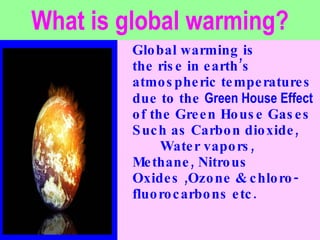
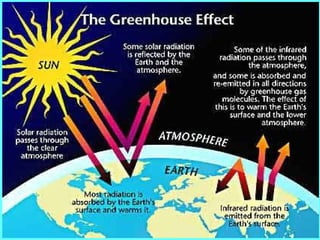
What is global warming? Global warming is  the rise in earth’s  atmospheric temperatures due to the  Green House Effect  of the Green House Gases  Such as Carbon dioxide,  Water vapors, Methane, Nitrous Oxides ,Ozone & chloro-fluorocarbons etc.
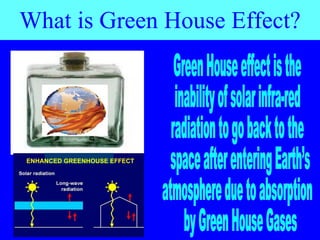
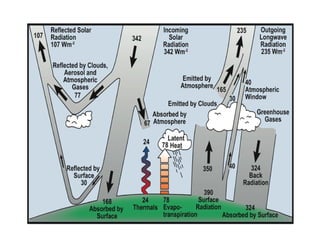
What is Green House Effect? Green House effect is the  inability of solar infra-red  radiation to go back to the space after entering Earth’s  atmosphere due to absorption by Green House Gases ENHANCED GREENHOUSE EFFECT
 
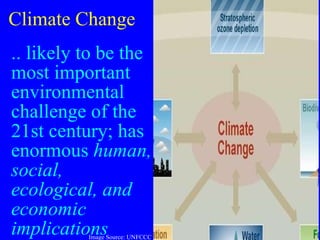
Climate Change .. likely to be the most important environmental challenge of the 21st century; has enormous  human, social, ecological, and economic implications Image Source: UNFCCC
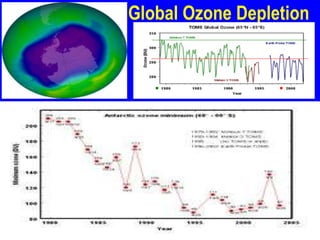
Global Ozone Depletion
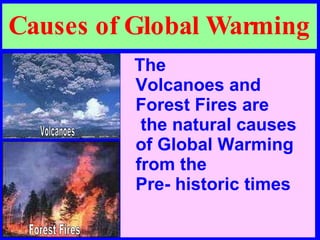
Causes of Global Warming The  Volcanoes and  Forest Fires are  the natural causes  of Global Warming from the  Pre- historic times Volcanoes Forest Fires
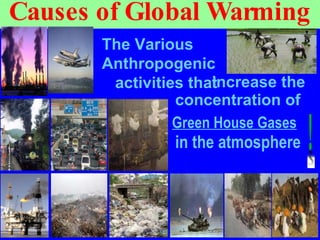
Causes of Global Warming increase the concentration of Green House Gases   in the atmosphere The Various Anthropogenic  activities that
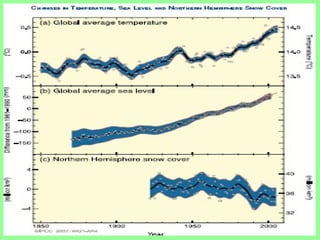
Evidence of global warming A: Physical Evidence Rise in atmospheric temperature (land & sea) Shifting and shrinking of cooling period with prolonged warmer duration and hastened spring season Rise in sea water level and melting of glaciers Occurrence of climatic extreme & natural disaster Spatial pattern of climate (rain fall & temperature) has changed markedly Number of cloudy days have reduced drastically pH of sea water has decreased by 0.13-0.35.
Evidence of global warming B: Biological Evidence Early blossoming of trees—mango,cherry Appearance of grasses in Antarctic Changes in cropping pattern from wheat to maize  Geographical shifting of temperate fruits toward high latitude Causality in Europe due to high temperature Vulnerability of frog to devastating fungus Killing of large Dimb tree population in Senegal Spatial shifting of marine fish population Northward movement of ticks and bleaching of corals
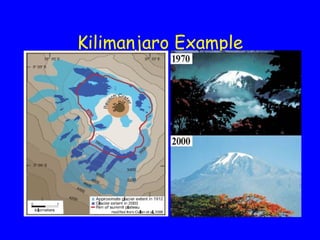
Kilimanjaro Example
 
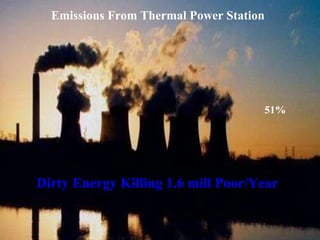
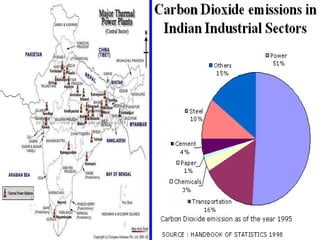
Emissions From Thermal Power Station 51% Dirty Energy Killing 1.6 mill Poor/Year
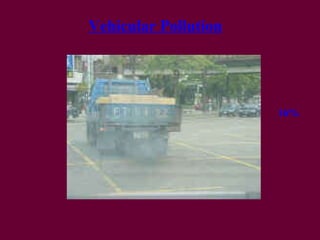
Vehicular Pollution 16%
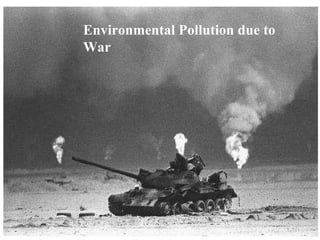
Environmental Pollution due to War
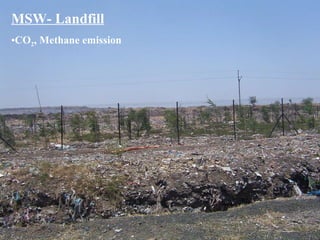
MSW- Landfill CO 2 , Methane emission
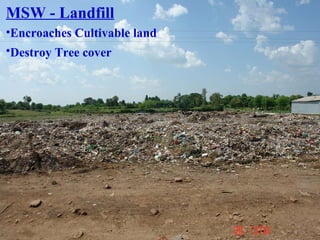
MSW - Landfill Encroaches Cultivable land Destroy Tree cover
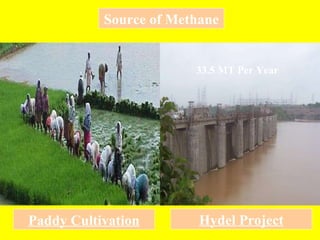
Paddy Cultivation Source of Methane 33.5 MT Per Year Hydel Project
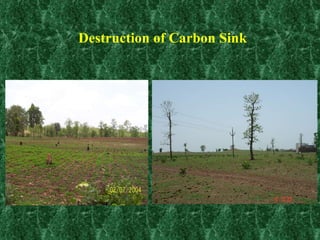
Destruction of Carbon Sink
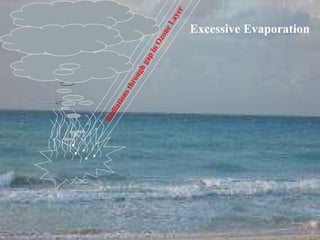
Excessive Evaporation Radiations through gap in Ozone Layer
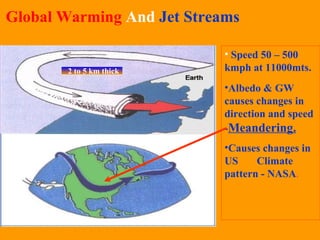
Global Warming  And  Jet Streams   Speed 50 – 500 kmph at 11000mts. Albedo & GW causes changes in direction and speed - Meandering. Causes changes in  US  Climate pattern - NASA . 2 to 5 km thick
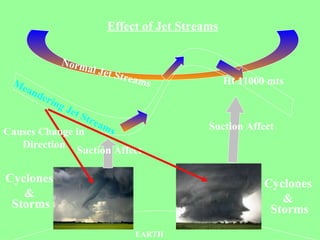
Effect of Jet Streams EARTH Meandering Jet Streams Suction Affect Suction Affect Causes Change in Direction Ht 11000 mts Normal Jet Streams Cyclones & Storms Cyclones & Storms
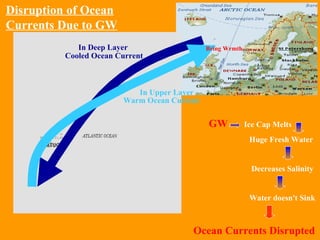
Warm Ocean Current In Deep Layer  Cooled Ocean Current GW   Ice Cap Melts  Huge Fresh Water Decreases Salinity Water doesn't Sink Ocean Currents Disrupted In Upper Layer Disruption of Ocean Currents Due to GW Bring Wrmth
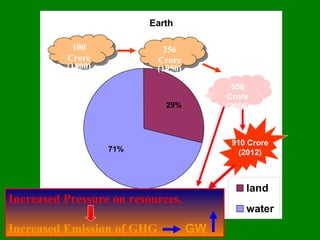
910 Crore (2012) 650 Crore (2006) 256 Crore (1950) 100 Crore (1800) 2.5X 6.5X 9.1X Increased Pressure on resources. Increased Emission of GHG   GW
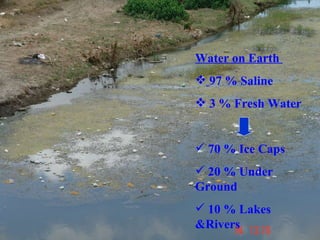
Water on Earth  97 % Saline 3 % Fresh Water 70 % Ice Caps 20 % Under Ground 10 % Lakes &Rivers
 
Types of impacts due to Global warming: Spreading of disease   Early and late arrival of seasons   Plant/animal range & pop. changes   Downpours, heavy snowfalls Droughts and Forest fires
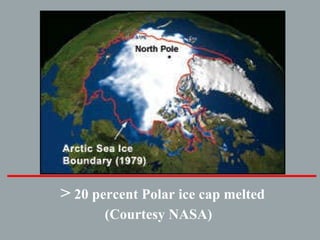
>  20 percent Polar ice cap melted  (Courtesy NASA)
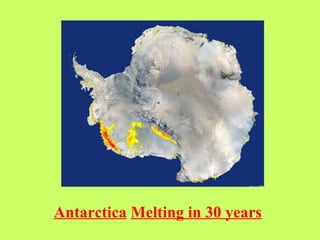
Antarctica   Melting in 30 years
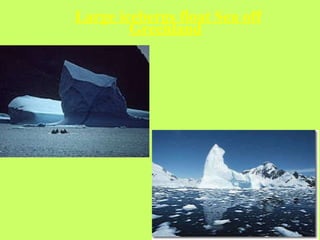
Large icebergs float Sea off Greenland
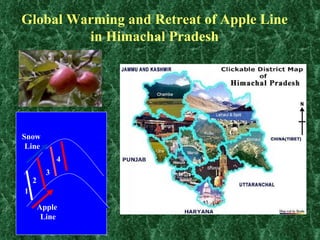
Global Warming and Retreat of Apple Line in Himachal Pradesh                                        1 2 3 4 Snow  Line Apple  Line
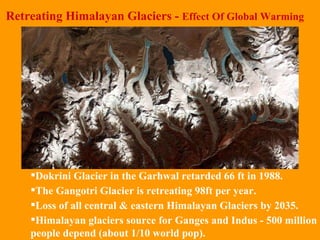
Retreating Himalayan Glaciers -  Effect Of Global Warming Dokrini Glacier in the Garhwal retarded 66 ft in 1988.  The Gangotri Glacier is retreating 98ft per year.  Loss of all central & eastern Himalayan Glaciers by 2035. Himalayan glaciers source for Ganges and Indus - 500 million people depend (about 1/10 world pop).
Water Availability will be reduced by 33%
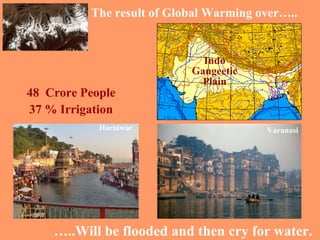
… ..Will be flooded and then cry for water. Haridwar Varanasi Indo Gangeetic Plain The result of Global Warming over….. 48  Crore People 37 % Irrigation
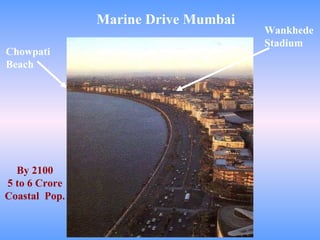
Marine Drive Mumbai Chowpati Beach Wankhede Stadium By 2100 5 to 6 Crore Coastal  Pop.
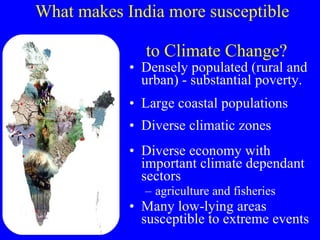
What makes India more susceptible    to Climate Change? Densely populated (rural and urban) - substantial poverty.  Large coastal populations Diverse climatic zones Diverse economy with important climate dependant sectors agriculture and fisheries Many low-lying areas susceptible to extreme events
Why should We be So much Concerned about Global Warming? Global Warming will cause Rise in atmospheric temperatures making climate harsher. Melting of Polar ice caps causing Sea level rise of about a  meter. Change the Seasonal cycles and Cropping patterns permanently. 01
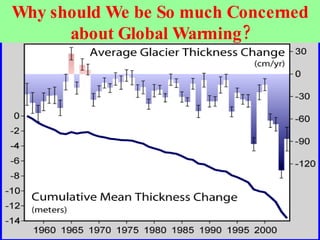
Why should We be So much Concerned about Global Warming? Glaciers to recede backwards reducing the flow of snow fed rivers. Sea level rise will cause many great cities such as New York & Mumbai to submerge under the sea. Many Iceland nations such Vanuatu,  Maldives and Fiji  will vanish.  Colorful coral bleach to death.   02
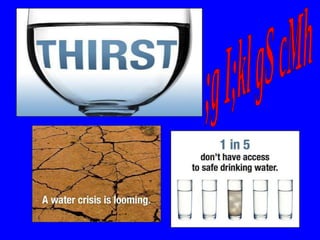
;g I;kl gS cMh
Report written by Sir Nicholas Stern for the UK government   (published 2006) CO ²  and temperature rise Carbon emissions have raised global temperatures by 0.5°C. There is a 50 % chance that global temperatures could rise by 5°C. Environmental impact Melting glaciers will increase flood risk, then drought. Crop yields will decline, particularly in Africa. Rising sea levels could displace 200 million people. Up to 40% of species could become extinct. There will be more frequent extreme weather patterns. Economic impact A rise of  2-3°C  could reduce global GDP by 3%. A rise of 5 °C  could cost up to 10% of global GDP.  The poorest countries would lose disproportionately more.
What should be  our Strategy? to meet the Chalange!
What is meant by Strategy?
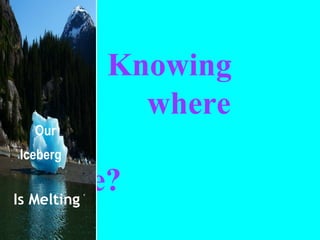
  Knowing    where    you are? Our Iceberg   Is Melting
  where you   want to go Knowing go g reen
  having the    capability to    respond to change    on the way Knowing    how you are going to  get there
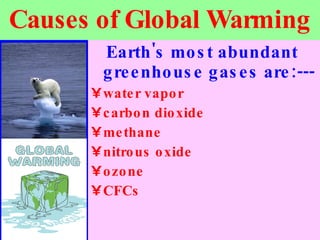
Causes of Global Warming Earth's most abundant greenhouse gases are:--- water vapor   carbon dioxide   methane   nitrous oxide   ozone   CFCs
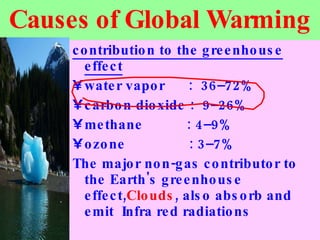
Causes of Global Warming contribution to the greenhouse effect water vapor  :  36–72%  carbon dioxide :  9–26%  methane  : 4–9%  ozone  : 3–7%  The major non-gas contributor to the Earth's greenhouse effect, Clouds , also absorb and emit  Infra red radiations
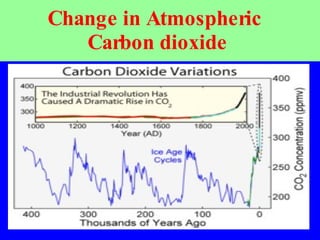
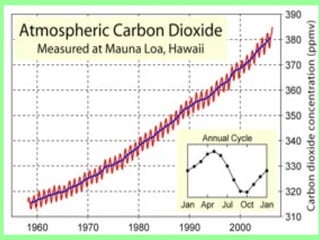
Change in Atmospheric  Carbon dioxide
 
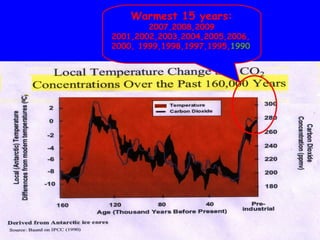
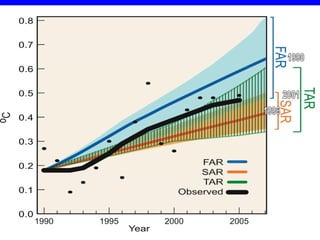
Warmest 15 years: 2007,2008,2009 2001,2002,2003,2004,2005,2006, 2000, 1999,1998,1997,1995, 1990
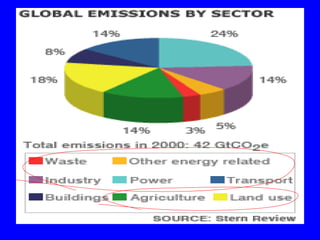
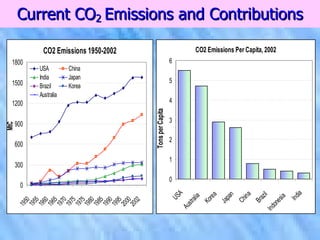
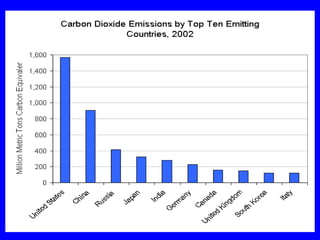
Current CO 2   Emissions and Contributions


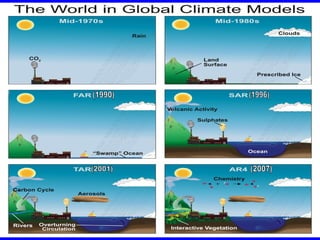
1990 1996 2001
(2007) (1996) (2001) (1990)
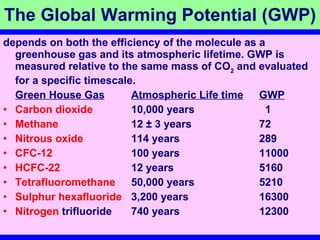
The Global Warming Potential (GWP) depends on both the efficiency of the molecule as a greenhouse gas and its atmospheric lifetime. GWP is measured relative to the same mass of CO 2  and evaluated for a specific timescale.  Green House Gas Atmospheric Life time GWP Carbon dioxide   10,000 years   1  Methane   12 ± 3 years  72  Nitrous oxide   114 years  289 CFC-12   100 years  11000 HCFC-22   12 years  5160 Tetrafluoromethane   50,000 years  5210 Sulphur hexafluoride   3,200 years  16300 Nitrogen  trifluoride   740 years  12300
 
Why should We be So much Concerned about Global Warming?
How to contain    Global Warming? Only way to meet this challenge is  to Cap & reduce the emission of Green House Gases
How to reduce GHG? Cut on the Sources:   Industries, Vehicular Emissions,  Paddy fields, Wetlands, Live stocks,  Increase the Sinks: Forests, Grasslands,Oceans
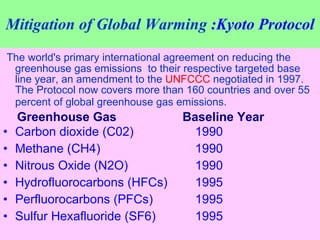
Mitigation of Global Warming  :Kyoto Protocol The world's primary international agreement on reducing the greenhouse gas emissions  to their respective targeted base line year, an amendment to the  UNFCCC  negotiated in 1997. The Protocol now covers more than 160 countries and over 55 percent of global greenhouse gas emissions.   Greenhouse Gas  Baseline Year Carbon dioxide (C02)   1990  Methane (CH4)  1990  Nitrous Oxide (N2O)   1990  Hydrofluorocarbons (HFCs)  1995  Perfluorocarbons (PFCs)  1995  Sulfur Hexafluoride (SF6)  1995
Adaptation to Global Warming A wide variety of measures have been suggested    such as the installation of Air-conditioning equipment up to  major infrastructure projects Abandonment of settlements threatened by sea level rise. Measures including Water Conservation   Changes to Agricultural Practices   Construction of Flood Defenses  Changes to medical care     Interventions to protect threatened species
Some emerging trends in fighting Global Warming? Save Energy by technology options Carbon Trading Carbon sequestration Cleaner Technology of Production Reuse of Wastes & Waste Energy Carbon Di Oxide Capture & Storage [Mineral Carbonation, Ocean  Storage, Geological Storage] Clean Development Mechanism!
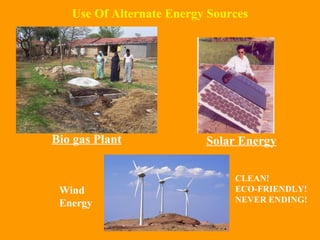
Use Of Alternate Energy Sources Bio gas Plant Solar Energy CLEAN! ECO-FRIENDLY! NEVER ENDING! Wind Energy
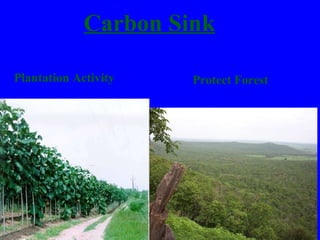
Carbon Sink Plantation Activity Protect Forest
The IPCC Special Report on  Carbon dioxide Capture and Storage
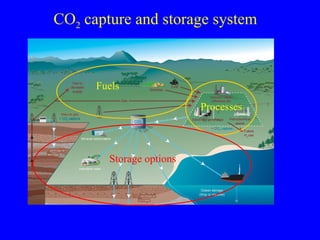
CO 2  capture and storage system Fuels Processes Storage options
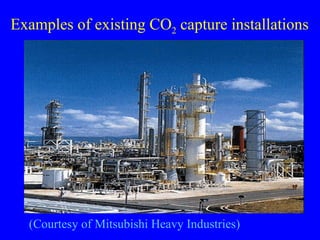
Examples of existing CO 2  capture installations (Courtesy of Mitsubishi Heavy Industries)
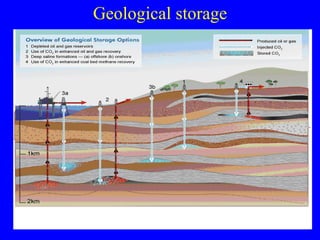
Geological storage
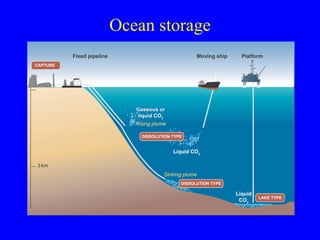
Ocean storage
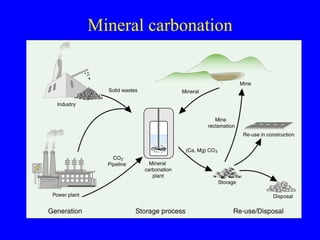
Mineral carbonation
Global Warming   It’s Worse Than We Thought Conservative Estimates Scientists are temperamentally conservative  •  Almost all their original estimates about the effects of global warming have underplayed the actual measured consequences •  When their original estimates have been re- measured against actual changes, the effects have most often been more dire than they originally predicted
green planet !
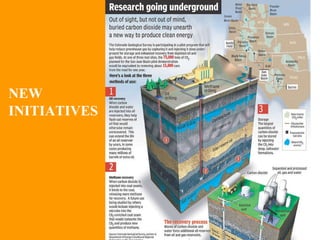
NEW INITIATIVES
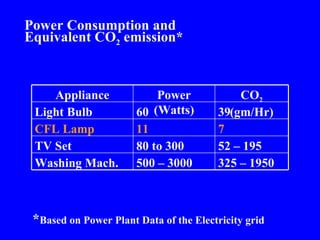
Power Consumption and  Equivalent CO 2  emission* * Based on Power Plant Data of the Electricity grid 325 – 1950 500 – 3000 Washing Mach. 52 – 195 80 to 300 TV Set 7 11 CFL Lamp 39 60 Light Bulb CO 2  (gm/Hr) Power (Watts) Appliance
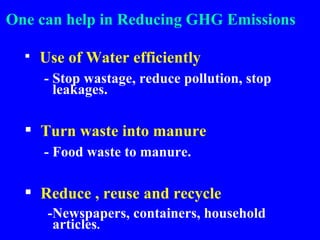
One can help in Reducing GHG Emissions Use of Water efficiently - Stop wastage, reduce pollution, stop leakages. Turn waste into manure - Food waste to manure. Reduce , reuse and recycle -Newspapers, containers, household articles .
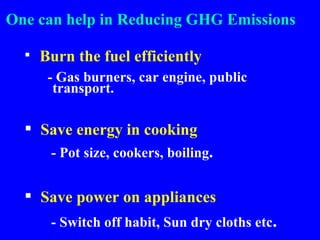
Burn the fuel efficiently - Gas burners, car engine, public transport. Save energy in cooking - Pot size, cookers, boiling . Save power on appliances - Switch off habit, Sun dry cloths etc . One can help in Reducing GHG Emissions
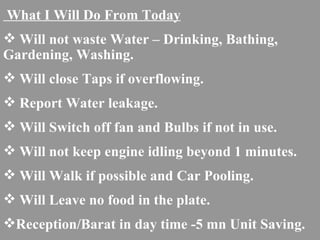
What I Will Do From Today Will not waste Water – Drinking, Bathing,  Gardening, Washing. Will close Taps if overflowing. Report Water leakage. Will Switch off fan and Bulbs if not in use. Will not keep engine idling beyond 1 minutes. Will Walk if possible and Car Pooling. Will Leave no food in the plate. Reception/Barat in day time -5 mn Unit Saving.
 
Press harder and faster
 
Any Doubts ?
Any Doubts ?
Any Doubts ?
About IPCC Founded 1988 by UNEP and WMO No research, no monitoring, no recommendations Only assessment of  peer-reviewed  literature Authors  academic, industrial and NGO  experts Reviews by independent Experts  and   Governments Policy relevant, but  NOT  policy prescriptive Full report and technical summary:  accepted by governments without change Summary for policymakers:  government approval
Aftermath of Kyoto Protocol At the Kyoto meeting on Global Climate Change, the United States which is the largest emitter of GHG, agreed to reduce emissions of six greenhouses gases from a given base line.  The U.S. is ready to reduce by 7% the average annual tons of carbon equivalent released during the 5-year period 2008-2012 which is not confirming to the targeted levels Only two omissions :   US & Kazakhstan   The treaty expires in 2012. International talks began in May 2007 on a future treaty to succeed the current one. The UN negotiations  schedule a key meeting at   Copenhagen in December 2009.
Mitigation of Global Warming Many environmental groups encourage  Individual action as well as community and regional actions.  Others suggest a  quota   on worldwide fossil fuel production looking to direct link between fossil fuel production and CO 2  emissions There has also been  business action on Climate change use of alternative fuel.  EU Emission Trading Scheme Australia announced its‘ Carbon Pollution Reduction Scheme’  in   2008 US President  Barack Obama  has announced plans to introduce an ‘ economy wide  Cap and trade’
Mitigation of Global Warming The IPCC's Working Group III is responsible for crafting reports on mitigation of global warming and the costs and benefits of different approaches.  The 2007  IPCC Fourth Assessment Report  concludes that no one technology or sector can be completely responsible for mitigating future warming.  There are key practices and technologies in various sectors, such as  energy supply   transportation   industry agriculture  that should be implemented  It is estimated that stabilization of Carbon dioxide equivalents between 445 and 710 ppm by 2030 will result in between a 0.6 percent increase and three percent decrease in global  gross domestic product
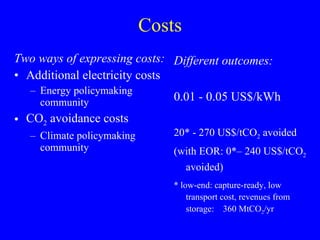
Costs Two ways of expressing costs: Additional electricity costs  Energy policymaking community CO 2  avoidance costs Climate policymaking community Different outcomes: 0.01 - 0.05 US$/kWh 20* - 270 US$/tCO 2  avoided (with EOR: 0*– 240 US$/tCO 2  avoided) * low-end: capture-ready, low transport cost, revenues from storage:  360 MtCO 2 /yr
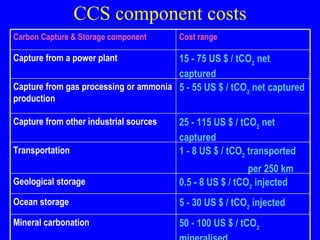
CCS component costs 50 - 100  US $ / tCO 2   mineralised Mineral carbonation 5 - 30  US $ / tCO 2   injected Ocean storage 0.5 - 8 US $ / tCO 2  injected Geological storage 1 - 8 US $ / tCO 2  transported  per 250 km Transportation 25 - 115 US $ / tCO 2  net captured Capture from other industrial sources 5 - 55 US $ / tCO 2  net captured Capture from gas processing or ammonia production 15 - 75 US $ / tCO 2  net captured Capture from a power plant Cost range Carbon Capture & Storage component
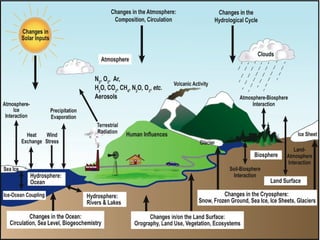
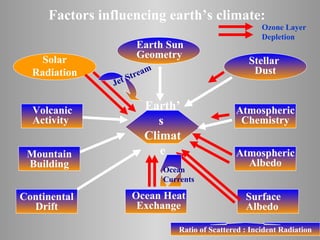
Factors influencing earth’s climate: Earth’s  Climate Solar Radiation Earth Sun  Geometry Stellar  Dust Volcanic Activity Mountain Building Continental Drift Ocean Heat Exchange Atmospheric Chemistry Atmospheric Albedo Surface Albedo Jet Stream Ratio of Scattered : Incident Radiation Ocean Currents Ozone Layer Depletion
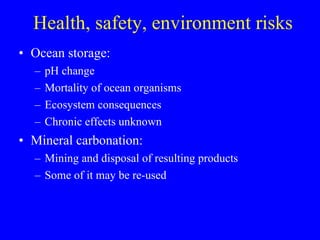
Health, safety, environment risks Ocean storage: pH change Mortality of ocean organisms Ecosystem consequences Chronic effects unknown Mineral carbonation: Mining and disposal of resulting products Some of it may be re-used
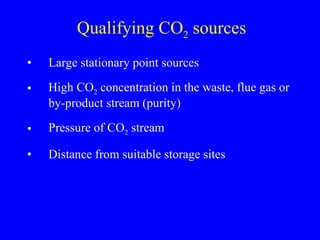
Qualifying CO 2  sources Large stationary point sources High CO 2  concentration in the waste, flue gas or by-product stream (purity) Pressure of CO 2  stream Distance from suitable storage sites
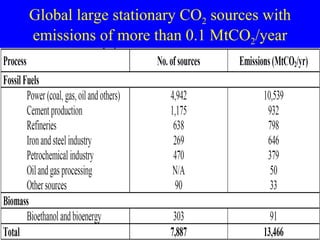
Global large stationary CO 2  sources with emissions of more than 0.1 MtCO 2 /year
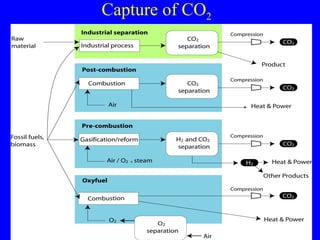
Capture of CO 2
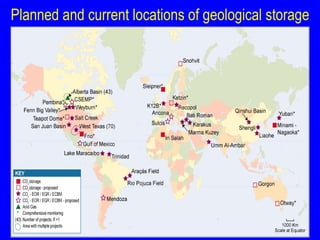
Planned and current locations of geological storage
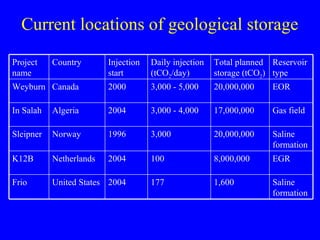
Current locations of geological storage Saline formation 1,600 177 2004 United States Frio EGR 8,000,000 100  2004 Netherlands K12B Saline formation 20,000,000 3,000 1996 Norway Sleipner Gas field 17,000,000 3,000 - 4,000 2004 Algeria In Salah EOR 20,000,000 3,000 - 5,000 2000 Canada Weyburn Reservoir type Total planned storage (tCO 2 ) Daily injection (tCO 2 /day) Injection start Country Project name
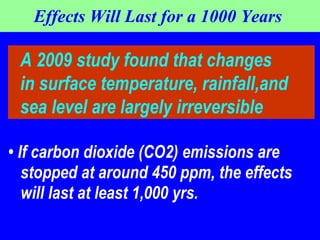
Effects Will Last for a 1000 Years  •  If carbon dioxide (CO2) emissions are stopped at around 450 ppm, the effects will last at least 1,000 yrs.  A 2009 study found that changes in surface temperature, rainfall,and  sea level are largely irreversible
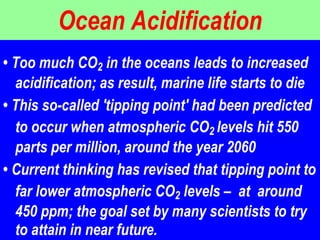
Ocean Acidification •  Too much CO 2  in the oceans leads to increased acidification; as result, marine life starts to die  •  This so-called 'tipping point' had been predicted to occur when atmospheric CO 2  levels hit 550 parts per million, around the year 2060  •  Current thinking has revised that tipping point to far lower atmospheric CO 2  levels –  at  around 450 ppm; the goal set by many scientists to try to attain in near future.
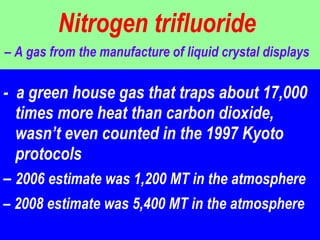
Nitrogen trifluoride  – A gas from the manufacture of liquid crystal displays   -  a green house gas that traps about 17,000 times more heat than carbon dioxide, wasn’t even counted in the 1997 Kyoto protocols –  2006 estimate was 1,200 MT in the atmosphere –  2008 estimate was 5,400 MT in the atmosphere
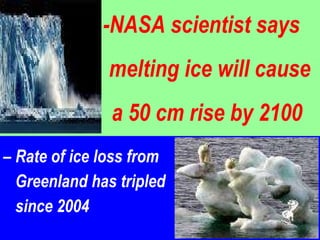
-NASA scientist says    melting ice will cause    a 50 cm rise by 2100 –  Rate of ice loss from  Greenland has tripled since 2004
Dr. James Hansen   (NASA)     world's leading climate scientist  in   October 2008   •  EU and its international partners must urgently rethink their targets for cutting carbon dioxide   •  scientists have grossly underestimated the scale of the problem •  “ The target we have all been aiming for is a disaster - a guaranteed disaster”   •  Arctic Ice is melting 20 years ahead of schedule
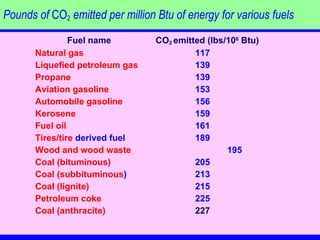
Pounds of  CO 2  emitted per million Btu of energy for various fuels Fuel name         CO 2  emitted (lbs/10 6  Btu)     Natural gas     117 Liquefied petroleum gas 139 Propane 139 Aviation gasoline 153 Automobile   gasoline 156 Kerosene 159 Fuel oil 161 Tires / tire  derived fuel 189 Wood   and wood waste 195 Coal (bituminous) 205 Coal ( subbituminous ) 213 Coal (lignite) 215 Petroleum coke 225 Coal (anthracite) 227

Gw Final

  • 1.
    Global Warming Dr.Gunwant Joshi Chief Chemist Regional Laboratory, Indore M. P. Pollution Control Board and Climate Change
  • 2.
    What is globalwarming? Global warming is the rise in earth’s atmospheric temperatures due to the Green House Effect of the Green House Gases Such as Carbon dioxide, Water vapors, Methane, Nitrous Oxides ,Ozone & chloro-fluorocarbons etc.
  • 3.
    What is GreenHouse Effect? Green House effect is the inability of solar infra-red radiation to go back to the space after entering Earth’s atmosphere due to absorption by Green House Gases ENHANCED GREENHOUSE EFFECT
  • 4.
  • 5.
    Climate Change ..likely to be the most important environmental challenge of the 21st century; has enormous human, social, ecological, and economic implications Image Source: UNFCCC
  • 6.
  • 7.
    Causes of GlobalWarming The Volcanoes and Forest Fires are the natural causes of Global Warming from the Pre- historic times Volcanoes Forest Fires
  • 8.
    Causes of GlobalWarming increase the concentration of Green House Gases in the atmosphere The Various Anthropogenic activities that
  • 9.
    Evidence of globalwarming A: Physical Evidence Rise in atmospheric temperature (land & sea) Shifting and shrinking of cooling period with prolonged warmer duration and hastened spring season Rise in sea water level and melting of glaciers Occurrence of climatic extreme & natural disaster Spatial pattern of climate (rain fall & temperature) has changed markedly Number of cloudy days have reduced drastically pH of sea water has decreased by 0.13-0.35.
  • 10.
    Evidence of globalwarming B: Biological Evidence Early blossoming of trees—mango,cherry Appearance of grasses in Antarctic Changes in cropping pattern from wheat to maize Geographical shifting of temperate fruits toward high latitude Causality in Europe due to high temperature Vulnerability of frog to devastating fungus Killing of large Dimb tree population in Senegal Spatial shifting of marine fish population Northward movement of ticks and bleaching of corals
  • 11.
  • 12.
  • 13.
    Emissions From ThermalPower Station 51% Dirty Energy Killing 1.6 mill Poor/Year
  • 14.
  • 15.
  • 16.
    MSW- Landfill CO2 , Methane emission
  • 17.
    MSW - LandfillEncroaches Cultivable land Destroy Tree cover
  • 18.
    Paddy Cultivation Sourceof Methane 33.5 MT Per Year Hydel Project
  • 19.
  • 20.
    Excessive Evaporation Radiationsthrough gap in Ozone Layer
  • 21.
    Global Warming And Jet Streams Speed 50 – 500 kmph at 11000mts. Albedo & GW causes changes in direction and speed - Meandering. Causes changes in US Climate pattern - NASA . 2 to 5 km thick
  • 22.
    Effect of JetStreams EARTH Meandering Jet Streams Suction Affect Suction Affect Causes Change in Direction Ht 11000 mts Normal Jet Streams Cyclones & Storms Cyclones & Storms
  • 23.
    Warm Ocean CurrentIn Deep Layer Cooled Ocean Current GW Ice Cap Melts Huge Fresh Water Decreases Salinity Water doesn't Sink Ocean Currents Disrupted In Upper Layer Disruption of Ocean Currents Due to GW Bring Wrmth
  • 24.
    910 Crore (2012)650 Crore (2006) 256 Crore (1950) 100 Crore (1800) 2.5X 6.5X 9.1X Increased Pressure on resources. Increased Emission of GHG GW
  • 25.
    Water on Earth 97 % Saline 3 % Fresh Water 70 % Ice Caps 20 % Under Ground 10 % Lakes &Rivers
  • 26.
  • 27.
    Types of impactsdue to Global warming: Spreading of disease Early and late arrival of seasons Plant/animal range & pop. changes Downpours, heavy snowfalls Droughts and Forest fires
  • 28.
    > 20percent Polar ice cap melted (Courtesy NASA)
  • 29.
    Antarctica Melting in 30 years
  • 30.
    Large icebergs floatSea off Greenland
  • 31.
    Global Warming andRetreat of Apple Line in Himachal Pradesh                                        1 2 3 4 Snow Line Apple Line
  • 32.
    Retreating Himalayan Glaciers- Effect Of Global Warming Dokrini Glacier in the Garhwal retarded 66 ft in 1988. The Gangotri Glacier is retreating 98ft per year. Loss of all central & eastern Himalayan Glaciers by 2035. Himalayan glaciers source for Ganges and Indus - 500 million people depend (about 1/10 world pop).
  • 33.
    Water Availability willbe reduced by 33%
  • 34.
    … ..Will beflooded and then cry for water. Haridwar Varanasi Indo Gangeetic Plain The result of Global Warming over….. 48 Crore People 37 % Irrigation
  • 35.
    Marine Drive MumbaiChowpati Beach Wankhede Stadium By 2100 5 to 6 Crore Coastal Pop.
  • 36.
    What makes Indiamore susceptible to Climate Change? Densely populated (rural and urban) - substantial poverty. Large coastal populations Diverse climatic zones Diverse economy with important climate dependant sectors agriculture and fisheries Many low-lying areas susceptible to extreme events
  • 37.
    Why should Webe So much Concerned about Global Warming? Global Warming will cause Rise in atmospheric temperatures making climate harsher. Melting of Polar ice caps causing Sea level rise of about a meter. Change the Seasonal cycles and Cropping patterns permanently. 01
  • 38.
    Why should Webe So much Concerned about Global Warming? Glaciers to recede backwards reducing the flow of snow fed rivers. Sea level rise will cause many great cities such as New York & Mumbai to submerge under the sea. Many Iceland nations such Vanuatu, Maldives and Fiji will vanish. Colorful coral bleach to death. 02
  • 39.
  • 40.
    Report written bySir Nicholas Stern for the UK government (published 2006) CO ² and temperature rise Carbon emissions have raised global temperatures by 0.5°C. There is a 50 % chance that global temperatures could rise by 5°C. Environmental impact Melting glaciers will increase flood risk, then drought. Crop yields will decline, particularly in Africa. Rising sea levels could displace 200 million people. Up to 40% of species could become extinct. There will be more frequent extreme weather patterns. Economic impact A rise of 2-3°C could reduce global GDP by 3%. A rise of 5 °C could cost up to 10% of global GDP. The poorest countries would lose disproportionately more.
  • 41.
    What should be our Strategy? to meet the Chalange!
  • 42.
    What is meantby Strategy?
  • 43.
    Knowing where you are? Our Iceberg Is Melting
  • 44.
    whereyou want to go Knowing go g reen
  • 45.
    havingthe capability to respond to change on the way Knowing how you are going to get there
  • 46.
    Causes of GlobalWarming Earth's most abundant greenhouse gases are:--- water vapor carbon dioxide methane nitrous oxide ozone CFCs
  • 47.
    Causes of GlobalWarming contribution to the greenhouse effect water vapor : 36–72% carbon dioxide : 9–26% methane : 4–9% ozone : 3–7% The major non-gas contributor to the Earth's greenhouse effect, Clouds , also absorb and emit Infra red radiations
  • 48.
    Change in Atmospheric Carbon dioxide
  • 49.
  • 50.
    Warmest 15 years:2007,2008,2009 2001,2002,2003,2004,2005,2006, 2000, 1999,1998,1997,1995, 1990
  • 51.
    Current CO 2 Emissions and Contributions
  • 52.
  • 53.
  • 54.
  • 55.
  • 56.
  • 57.
  • 58.
    The Global WarmingPotential (GWP) depends on both the efficiency of the molecule as a greenhouse gas and its atmospheric lifetime. GWP is measured relative to the same mass of CO 2 and evaluated for a specific timescale. Green House Gas Atmospheric Life time GWP Carbon dioxide 10,000 years 1 Methane 12 ± 3 years 72 Nitrous oxide 114 years 289 CFC-12 100 years 11000 HCFC-22 12 years 5160 Tetrafluoromethane 50,000 years 5210 Sulphur hexafluoride 3,200 years 16300 Nitrogen trifluoride 740 years 12300
  • 59.
  • 60.
    Why should Webe So much Concerned about Global Warming?
  • 61.
    How to contain Global Warming? Only way to meet this challenge is to Cap & reduce the emission of Green House Gases
  • 62.
    How to reduceGHG? Cut on the Sources: Industries, Vehicular Emissions, Paddy fields, Wetlands, Live stocks, Increase the Sinks: Forests, Grasslands,Oceans
  • 63.
    Mitigation of GlobalWarming :Kyoto Protocol The world's primary international agreement on reducing the greenhouse gas emissions to their respective targeted base line year, an amendment to the UNFCCC negotiated in 1997. The Protocol now covers more than 160 countries and over 55 percent of global greenhouse gas emissions. Greenhouse Gas Baseline Year Carbon dioxide (C02) 1990 Methane (CH4) 1990 Nitrous Oxide (N2O) 1990 Hydrofluorocarbons (HFCs) 1995 Perfluorocarbons (PFCs) 1995 Sulfur Hexafluoride (SF6) 1995
  • 64.
    Adaptation to GlobalWarming A wide variety of measures have been suggested such as the installation of Air-conditioning equipment up to major infrastructure projects Abandonment of settlements threatened by sea level rise. Measures including Water Conservation Changes to Agricultural Practices Construction of Flood Defenses Changes to medical care Interventions to protect threatened species
  • 65.
    Some emerging trendsin fighting Global Warming? Save Energy by technology options Carbon Trading Carbon sequestration Cleaner Technology of Production Reuse of Wastes & Waste Energy Carbon Di Oxide Capture & Storage [Mineral Carbonation, Ocean Storage, Geological Storage] Clean Development Mechanism!
  • 66.
    Use Of AlternateEnergy Sources Bio gas Plant Solar Energy CLEAN! ECO-FRIENDLY! NEVER ENDING! Wind Energy
  • 67.
    Carbon Sink PlantationActivity Protect Forest
  • 68.
    The IPCC SpecialReport on Carbon dioxide Capture and Storage
  • 69.
    CO 2 capture and storage system Fuels Processes Storage options
  • 70.
    Examples of existingCO 2 capture installations (Courtesy of Mitsubishi Heavy Industries)
  • 71.
  • 72.
  • 73.
  • 74.
    Global Warming It’s Worse Than We Thought Conservative Estimates Scientists are temperamentally conservative • Almost all their original estimates about the effects of global warming have underplayed the actual measured consequences • When their original estimates have been re- measured against actual changes, the effects have most often been more dire than they originally predicted
  • 75.
  • 76.
  • 77.
    Power Consumption and Equivalent CO 2 emission* * Based on Power Plant Data of the Electricity grid 325 – 1950 500 – 3000 Washing Mach. 52 – 195 80 to 300 TV Set 7 11 CFL Lamp 39 60 Light Bulb CO 2 (gm/Hr) Power (Watts) Appliance
  • 78.
    One can helpin Reducing GHG Emissions Use of Water efficiently - Stop wastage, reduce pollution, stop leakages. Turn waste into manure - Food waste to manure. Reduce , reuse and recycle -Newspapers, containers, household articles .
  • 79.
    Burn the fuelefficiently - Gas burners, car engine, public transport. Save energy in cooking - Pot size, cookers, boiling . Save power on appliances - Switch off habit, Sun dry cloths etc . One can help in Reducing GHG Emissions
  • 80.
    What I WillDo From Today Will not waste Water – Drinking, Bathing, Gardening, Washing. Will close Taps if overflowing. Report Water leakage. Will Switch off fan and Bulbs if not in use. Will not keep engine idling beyond 1 minutes. Will Walk if possible and Car Pooling. Will Leave no food in the plate. Reception/Barat in day time -5 mn Unit Saving.
  • 81.
  • 82.
  • 83.
  • 84.
  • 85.
  • 86.
  • 87.
    About IPCC Founded1988 by UNEP and WMO No research, no monitoring, no recommendations Only assessment of peer-reviewed literature Authors academic, industrial and NGO experts Reviews by independent Experts and Governments Policy relevant, but NOT policy prescriptive Full report and technical summary: accepted by governments without change Summary for policymakers: government approval
  • 88.
    Aftermath of KyotoProtocol At the Kyoto meeting on Global Climate Change, the United States which is the largest emitter of GHG, agreed to reduce emissions of six greenhouses gases from a given base line. The U.S. is ready to reduce by 7% the average annual tons of carbon equivalent released during the 5-year period 2008-2012 which is not confirming to the targeted levels Only two omissions : US & Kazakhstan The treaty expires in 2012. International talks began in May 2007 on a future treaty to succeed the current one. The UN negotiations schedule a key meeting at Copenhagen in December 2009.
  • 89.
    Mitigation of GlobalWarming Many environmental groups encourage Individual action as well as community and regional actions. Others suggest a quota on worldwide fossil fuel production looking to direct link between fossil fuel production and CO 2 emissions There has also been business action on Climate change use of alternative fuel. EU Emission Trading Scheme Australia announced its‘ Carbon Pollution Reduction Scheme’ in 2008 US President Barack Obama has announced plans to introduce an ‘ economy wide Cap and trade’
  • 90.
    Mitigation of GlobalWarming The IPCC's Working Group III is responsible for crafting reports on mitigation of global warming and the costs and benefits of different approaches. The 2007 IPCC Fourth Assessment Report concludes that no one technology or sector can be completely responsible for mitigating future warming. There are key practices and technologies in various sectors, such as energy supply transportation industry agriculture that should be implemented It is estimated that stabilization of Carbon dioxide equivalents between 445 and 710 ppm by 2030 will result in between a 0.6 percent increase and three percent decrease in global gross domestic product
  • 91.
    Costs Two waysof expressing costs: Additional electricity costs Energy policymaking community CO 2 avoidance costs Climate policymaking community Different outcomes: 0.01 - 0.05 US$/kWh 20* - 270 US$/tCO 2 avoided (with EOR: 0*– 240 US$/tCO 2 avoided) * low-end: capture-ready, low transport cost, revenues from storage: 360 MtCO 2 /yr
  • 92.
    CCS component costs50 - 100 US $ / tCO 2 mineralised Mineral carbonation 5 - 30 US $ / tCO 2 injected Ocean storage 0.5 - 8 US $ / tCO 2 injected Geological storage 1 - 8 US $ / tCO 2 transported per 250 km Transportation 25 - 115 US $ / tCO 2 net captured Capture from other industrial sources 5 - 55 US $ / tCO 2 net captured Capture from gas processing or ammonia production 15 - 75 US $ / tCO 2 net captured Capture from a power plant Cost range Carbon Capture & Storage component
  • 93.
    Factors influencing earth’sclimate: Earth’s Climate Solar Radiation Earth Sun Geometry Stellar Dust Volcanic Activity Mountain Building Continental Drift Ocean Heat Exchange Atmospheric Chemistry Atmospheric Albedo Surface Albedo Jet Stream Ratio of Scattered : Incident Radiation Ocean Currents Ozone Layer Depletion
  • 94.
    Health, safety, environmentrisks Ocean storage: pH change Mortality of ocean organisms Ecosystem consequences Chronic effects unknown Mineral carbonation: Mining and disposal of resulting products Some of it may be re-used
  • 95.
    Qualifying CO 2 sources Large stationary point sources High CO 2 concentration in the waste, flue gas or by-product stream (purity) Pressure of CO 2 stream Distance from suitable storage sites
  • 96.
    Global large stationaryCO 2 sources with emissions of more than 0.1 MtCO 2 /year
  • 97.
  • 98.
    Planned and currentlocations of geological storage
  • 99.
    Current locations ofgeological storage Saline formation 1,600 177 2004 United States Frio EGR 8,000,000 100 2004 Netherlands K12B Saline formation 20,000,000 3,000 1996 Norway Sleipner Gas field 17,000,000 3,000 - 4,000 2004 Algeria In Salah EOR 20,000,000 3,000 - 5,000 2000 Canada Weyburn Reservoir type Total planned storage (tCO 2 ) Daily injection (tCO 2 /day) Injection start Country Project name
  • 100.
    Effects Will Lastfor a 1000 Years • If carbon dioxide (CO2) emissions are stopped at around 450 ppm, the effects will last at least 1,000 yrs. A 2009 study found that changes in surface temperature, rainfall,and sea level are largely irreversible
  • 101.
    Ocean Acidification • Too much CO 2 in the oceans leads to increased acidification; as result, marine life starts to die • This so-called 'tipping point' had been predicted to occur when atmospheric CO 2 levels hit 550 parts per million, around the year 2060 • Current thinking has revised that tipping point to far lower atmospheric CO 2 levels – at around 450 ppm; the goal set by many scientists to try to attain in near future.
  • 102.
    Nitrogen trifluoride – A gas from the manufacture of liquid crystal displays - a green house gas that traps about 17,000 times more heat than carbon dioxide, wasn’t even counted in the 1997 Kyoto protocols – 2006 estimate was 1,200 MT in the atmosphere – 2008 estimate was 5,400 MT in the atmosphere
  • 103.
    -NASA scientist says melting ice will cause a 50 cm rise by 2100 – Rate of ice loss from Greenland has tripled since 2004
  • 104.
    Dr. James Hansen (NASA) world's leading climate scientist in October 2008 • EU and its international partners must urgently rethink their targets for cutting carbon dioxide • scientists have grossly underestimated the scale of the problem • “ The target we have all been aiming for is a disaster - a guaranteed disaster” • Arctic Ice is melting 20 years ahead of schedule
  • 105.
    Pounds of CO 2 emitted per million Btu of energy for various fuels Fuel name   CO 2 emitted (lbs/10 6 Btu)   Natural gas 117 Liquefied petroleum gas 139 Propane 139 Aviation gasoline 153 Automobile gasoline 156 Kerosene 159 Fuel oil 161 Tires / tire derived fuel 189 Wood and wood waste 195 Coal (bituminous) 205 Coal ( subbituminous ) 213 Coal (lignite) 215 Petroleum coke 225 Coal (anthracite) 227
Editor's Notes

  • #69 The Intergovernmental Panel on Climate Change has recently published a Special Report on Carbon dioxide Capture and Storage. The report was officially approved by the Panel on September 26th, 2005. It was written by almost 100 authors and was reviewed by hundreds of experts and governments. The report was written under the responsibility of IPCC Working Group III on mitigation, co-chaired by Bert Metz of the Netherlands and Ogunlade Davidson of Sierra Leone.
  • #70 Overview picture of capture, transport and storage of CO2 (animated). Fuels can be coal, gas and oil, but also biomass which would lead to negative emissions Processes where CO2 is produced from these fuels is mainly electricity generation, but CO2 can also be captured from petrochemical plants, cement or steel plants. The IPCC SRCCS examined four storage options. Geological storage can be done in oil or gas fields, saline formations or in coal beds. Ocen storage can be done by direct injection in the water column, or by depositing the CO2 on the sea floor where it will be isolated from the atmosphere longer. Mineral carbonation can in principle also be done, but is still expensive both in terms of costs and of energy use. The CO2 can also be used in industrial facilities, but the potential for CO2 reduction for this is small.
  • #71 (left) CO 2 post-combustion capture at a plant in Malaysia. This plant employs a chemical absorption process to separate 0.2 MtCO 2 per year from the flue gas stream of a gas-fired power plant for urea production. (right) CO 2 pre-combustion capture at a coal gasification plant in North Dakota, USA. This plant employs a physical solvent process to separate 3.3 MtCO 2 per year from a gas stream to produce synthetic natural gas. Part of the captured CO 2 is used for an EOR project in Canada.
  • #72 Storage of CO 2 in deep, onshore or offshore geological formations uses many of the same technologies that have been developed by the oil and gas industry and has been proven to be economically feasible under specific conditions for oil and gas fields and saline formations, but not yet for storage in unminable coal beds. A coal bed that is unlikely to ever be mined – because it is too deep or too thin – may be potentially used for CO 2 storage. If subsequently mined, the stored CO 2 would be released. Enhanced Coal Bed Methane (ECBM) recovery could potentially increase methane production from coals while simultaneously storing CO 2 . If CO 2 is injected into suitable saline formations or oil or gas fields, at depths below 800 m, various physical and geochemical trapping mechanisms would prevent it from migrating to the surface. At depths below 800–1,000 m, CO 2 becomes supercritical and has a liquid-like density (about 500–800 kg/m 3 ) that provides the potential for efficient utilization of underground storage space and improves storage security. In general, an essential physical trapping mechanism is the presence of a caprock ( rock of very low permeability that acts as an upper seal to prevent fluid flow out of a reservoir) . Coal bed storage may take place at shallower depths and relies on the adsorption of CO 2 on the coal, but the technical feasibility largely depends on the permeability of the coal bed. The combination of CO 2 storage with Enhanced Oil or Gas Recovery or, potentially, Enhanced Coal Bed Methane recovery (ECBM) could lead to additional revenues from the oil or gas recovery. The produced methane would be used and not released to the atmosphere. Well-drilling technology, injection technology, computer simulation of storage reservoir performance and monitoring methods from existing applications are being developed further for utilization in the design and operation of geological storage projects.
  • #73 Ocean storage potentially could be done in two ways: by injecting and dissolving CO 2 into the water column (typically below 1,000 meters) via a fixed pipeline or a moving ship, or by depositing it via a fixed pipeline or an offshore platform onto the sea floor at depths below 3,000 m, where CO 2 is denser than water and is expected to form a “lake” that would delay dissolution of CO 2 into the surrounding environment (see Figure S.5). Ocean storage and its ecological impacts are still in the research phase. The dissolved and dispersed CO 2 would become part of the global carbon cycle and eventually equilibrate with the CO 2 in the atmosphere. In laboratory experiments, small-scale ocean experiments and model simulations, the technologies and associated physical and chemical phenomena, which include, notably, increases in acidity (lower pH) and their effect on marine ecosystems, have been studied for a range of ocean storage options
  • #74 The reaction of CO 2 with metal oxides, which are abundant in silicate minerals and available in small quantities in waste streams, produces stable carbonates. The technology is currently in the research stage, but certain applications in using waste streams are in the demonstration phase. The natural reaction is very slow and has to be enhanced by pre-treatment of the minerals, which at present is very energy intensive.
  • #88 The Intergovernmental Panel on Climate Change ( IPCC ) was founded in 1988 by the United Nations Environmental Programme and the World Meteorological Organisation to assess scientific, technical and socio-economic information on the science, impacts and mitigation of climate change. Its reports are broadly regarded as authorative and are influential in the climate policymaking process. The quality of the IPCC reports is guarded by an extensive and long process; it takes several years to publish a report. Only peer-reviewed literature is used as the basis for the assessment , the authors are from different disciplines, parts of the world, and work in different organisations (universities, industry, NGO’s, research institutes, international organisations) . The reports are reviewed in several steps: first internally, then by experts, then by experts and governments.The mantra of IPCC is that its reports must be policy relevant, but not policy prescriptive, and IPCC does not “favour” technologies or make recommendations on policies. The full report and technical summary are the responsibility of the authors and are accepted by governments without change. An important aspect is that the governments in the IPCC approve the SPM line by line and by doing that, acknowledge the results in that summary.
  • #92 In the SRCCS, we tried to serve both the energy community, which tends to think in costs per kWh or per GJ, and the climate community, which more commonly uses the avoidance costs as a cost indicator (in US$/tCO2 avoided). Combinations of capture and storage can be found where costs can be very low. Low-cost capture possibilities (in gas processing and in hydrogen and ammonia manufacture, where separation of CO 2 is already done) in combination with short (<50 km) transport distances and storage options that generate revenues (such as EOR) can lead to the limited storage of CO 2 (up to 360 MtCO 2 /yr) under circumstances of low or no incentives. Application of CCS to electricity production, under 2002 conditions, is estimated to increase electricity generation costs by about 0.01–0.05 US dollars per kilowatt hour (US$/kWh), depending on the fuel, the specific technology, the location and the national circumstances. Inclusion of the benefits of EOR would reduce additional electricity production costs due to CCS by around 0.01–0.02 US$/kWh. The data are based on oil prices of 15–20 US$ per barrel, as used in the available literature . Increases in market prices of fuels used for power generation would generally tend to increase the cost of CCS. The quantitative impact of oil price on CCS is uncertain. However, revenue from EOR would generally be higher with higher oil prices. While applying CCS to biomass-based power production at the current small scale would add substantially to the electricity costs, co-firing of biomass in a larger coal-fired power plant with CCS would be more cost-effective. Retrofitting existing plants with CO 2 capture is expected to lead to higher costs and significantly reduced overall efficiencies than for newly built power plants with capture. The cost disadvantages of retrofitting may be reduced in the case of some relatively new and highly efficient existing plants or where a plant is substantially upgraded or rebuilt.
  • #93 Costs for the various components of a CCS system vary widely, depending on the reference plant and the wide range in CO 2 source, transport and storage situations. In most CCS systems, the cost of capture (including compression) is the largest cost component. Transportation of 5 –40 MtCO2/year over 250 km costs between 1 and 8 US$/tCO 2 . Geological storage costs vary between 1 and 8US$ per tonne stored and exclude monitoring costs of 0.1 to 0.3 US$/tCO2. The costs for ocean storage are very uncertain at this point, but are estimated to vary between 5 and 30 US$/tCO2. Mineral carbonation costs are still very high. Over the next decade, the cost of capture could be reduced by 20–30%, and more should be achievable by new technologies that are still in the research or demonstration phase. The costs of transport and storage of CO 2 could decrease slowly as the technology matures further and the scale increases . NB These component cost cannot be added up, because total system costs need to be calculated for an integrated system.
  • #95 Adding CO 2 to the ocean or forming pools of liquid CO 2 on the ocean floor at industrial scales will alter the local chemical environment. Experiments have shown that sustained high concentrations of CO 2 would cause mortality of ocean organisms. CO 2 effects on marine organisms will have ecosystem consequences. The chronic effects of direct CO 2 injection into the ocean on ecosystems over large ocean areas and long time scales have not yet been studied. Model simulations, assuming a release from seven locations at an ocean depth of 3,000 m, where ocean storage provides 10% of the mitigation effort for stabilization at 550 ppmv CO 2 , resulted in acidity increases (pH decrease >0.4) over approximately 1% of the ocean volume. For comparison purposes: in such a stabilization case without ocean storage, a pH decrease >0.25 relative to pre-industrial levels at the entire ocean surface can be expected. A 0.2 to 0.4 pH decrease is significantly greater than pre-industrial variations in average ocean acidity. At these levels of pH change, some effects have been found in organisms that live near the ocean's surface, but chronic effects have not yet been studied. A better understanding of these impacts is required before a comprehensive risk assessment can be accomplished. There is no known mechanism for the sudden or catastrophic release of stored CO 2 from the ocean to the atmosphere. Gradual release is discussed in SPM paragraph 26. Conversion of molecular CO 2 to bicarbonates or hydrates before or during CO 2 release would reduce the pH effects and enhance the retention of CO 2 in the ocean, but this would also increase the costs and other environmental impacts. Environmental impacts of large-scale mineral carbonation would be a consequence of the required mining and disposal of resulting products that have no practical use. Industrial fixation of one tonne of CO 2 requires between 1.6 and 3.7 tonnes of silicate rock. The impacts of mineral carbonation are similar to those of large-scale surface mines. They include land-clearing, decreased local air quality and affected water and vegetation as a result of drilling, moving of earth and the grading and leaching of metals from mining residues, all of which indirectly may also result in habitat degradation. Most products of mineral carbonation need to be disposed of, which would require landfills and additional transport
  • #96 This sheet lists some qualifiers for CO2 sources suitable for capture.
  • #97 Large point sources of CO 2 include large fossil fuel or biomass energy facilities, major CO 2 -emitting industries, natural gas production, synthetic fuel plants and fossil fuel-based hydrogen production plants. Globally, emissions of CO2 from fossil-fuel use in the year 2000 totalled about 23.5 GtCO2/yr (6 GtC/yr). Of this, close to 60% was attributed to large (>0.1 MtCO2/yr) stationary emission sources However, not all of these sources are amenable to CO2 capture. Although the sources evaluated are distributed throughout the world, the database reveals four particular clusters of emissions: North America (midwest and eastern USA), Europe (northwest region), East Asia (eastern coast of China) and South Asia (Indian subcontinent). By contrast, large-scale biomass sources are much smaller in number and less globally distributed. Currently, the vast majority of large emission sources have CO2 concentrations of less than 15% (in some cases, substantially less). However, a small portion (less than 2%) of the fossil-fuel-based industrial sources have CO2 concentrations in excess of 95%. The high-concentration sources are potential candidates for the early implementation of CCS because only dehydration and compression would be required at the capture stage. Some biomass sources like bioethanol production also generate high-concentration CO2 sources which could also be used in similar applications.
  • #98 There are different types of CO 2 capture systems: post-combustion, pre-combustion and oxyfuel combustion. The concentration of CO 2 in the gas stream, the pressure of the gas stream and the fuel type (solid or gas) are important factors in selecting the capture system. Post-combustion capture of CO 2 in power plants is economically feasible under specific conditions. It is used to capture CO 2 from part of the flue gases from a number of existing power plants. Separation of CO 2 in the natural gas processing industry, which uses similar technology, operates in a mature market. The technology required for pre-combustion capture is widely applied in fertilizer manufacturing and in hydrogen production. Although the initial fuel conversion steps of pre-combustion are more elaborate and costly, the higher concentrations of CO 2 in the gas stream and the higher pressure make the separation easier. Oxyfuel combustion is in the demonstration phase and uses high purity oxygen. This results in high CO 2 concentrations in the gas stream and, hence, in easier separation of CO 2 and in increased energy requirements in the separation of oxygen from air
  • #99 Three industrial-scale ( on the order of 1 MtCO 2 per year) storage projects are in operation: the Sleipner project in an offshore saline formation in Norway, the Weyburn EOR project in Canada, and the In Salah project in a gas field in Algeria. Others are planned .
  • #100 Three industrial-scale ( on the order of 1 MtCO 2 per year) storage projects are in operation: the Sleipner project in an offshore saline formation in Norway, the Weyburn EOR project in Canada, and the In Salah project in a gas field in Algeria. Others are planned .