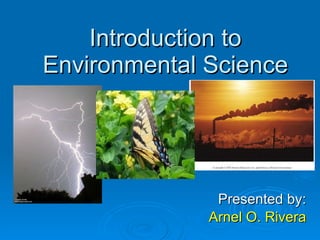
Introduction to Environmental Science Presented by: Arnel O. Rivera
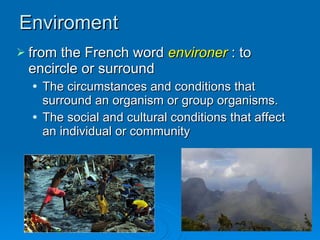
Enviroment from the French word  environer  : to encircle or surround The circumstances and conditions that surround an organism or group organisms. The social and cultural conditions that affect an individual or community
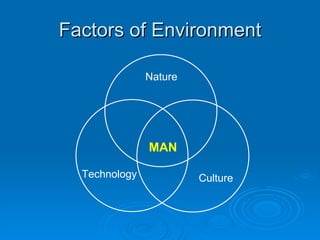
Factors of Environment Nature Technology Culture MAN
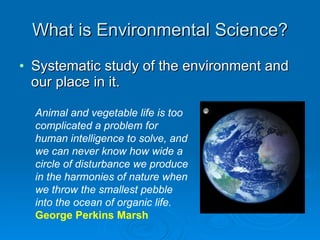
What is Environmental Science? Systematic study of the environment and our place in it. Animal and vegetable life is too complicated a problem for human intelligence to solve, and we can never know how wide a circle of disturbance we produce in the harmonies of nature when we throw the smallest pebble into the ocean of organic life.   George Perkins Marsh
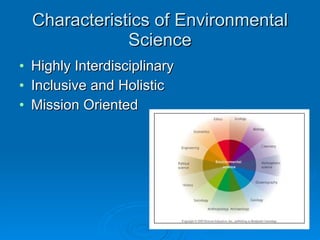
Characteristics of Environmental Science Highly Interdisciplinary Inclusive and Holistic Mission Oriented
Humans and Nature: An Overview “ The environmental crisis is an outward manifestation of a  crisis of mind and spirit .  There could be no greater misconception of its meaning than to believe it is concerned only with endangered wildlife, human-made ugliness, and pollution.  These are part of it, but more importantly, the crisis is concerned with the kind of creatures we are and what we must become in order to survive.” ~ Lynton K. Caldwell
Components of Environmental Science  (http://en.wikipedia.org/wiki/Environmental_science ) Atmospheric sciences  focuses on the Earth's atmosphere, with an emphasis upon its interrelation to other systems.  Ecology . An interdisciplinary analysis of an ecological system which is being impacted by one or more stressors might include several related environmental science fields.  Environmental chemistry  is the study of chemical alterations in the environment. Principal areas of study include soil contamination and water pollution.  Geosciences  include environmental   geology, environmental soil science, volcanic phenomena and evolution of the Earth's crust. In some classification systems this can also include hydrology, including oceanography.
To download this file, go to: http://www.slideshare.net/ArnelLPU Thank Y  u!

Intro. to Environmental Science

  • 1.
    Introduction to EnvironmentalScience Presented by: Arnel O. Rivera
  • 2.
    Enviroment from theFrench word environer : to encircle or surround The circumstances and conditions that surround an organism or group organisms. The social and cultural conditions that affect an individual or community
  • 3.
    Factors of EnvironmentNature Technology Culture MAN
  • 4.
    What is EnvironmentalScience? Systematic study of the environment and our place in it. Animal and vegetable life is too complicated a problem for human intelligence to solve, and we can never know how wide a circle of disturbance we produce in the harmonies of nature when we throw the smallest pebble into the ocean of organic life. George Perkins Marsh
  • 5.
    Characteristics of EnvironmentalScience Highly Interdisciplinary Inclusive and Holistic Mission Oriented
  • 6.
    Humans and Nature:An Overview “ The environmental crisis is an outward manifestation of a crisis of mind and spirit . There could be no greater misconception of its meaning than to believe it is concerned only with endangered wildlife, human-made ugliness, and pollution. These are part of it, but more importantly, the crisis is concerned with the kind of creatures we are and what we must become in order to survive.” ~ Lynton K. Caldwell
  • 7.
    Components of EnvironmentalScience (http://en.wikipedia.org/wiki/Environmental_science ) Atmospheric sciences  focuses on the Earth's atmosphere, with an emphasis upon its interrelation to other systems. Ecology . An interdisciplinary analysis of an ecological system which is being impacted by one or more stressors might include several related environmental science fields. Environmental chemistry  is the study of chemical alterations in the environment. Principal areas of study include soil contamination and water pollution. Geosciences  include environmental geology, environmental soil science, volcanic phenomena and evolution of the Earth's crust. In some classification systems this can also include hydrology, including oceanography.
  • 8.
    To download thisfile, go to: http://www.slideshare.net/ArnelLPU Thank Y u!