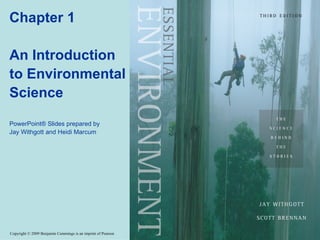
Chapter 1

An Introduction
to Environmental
Science

PowerPoint® Slides prepared by
Jay Withgott and Heidi Marcum


Copyright © 2009 Benjamin Cummings is an imprint of Pearson
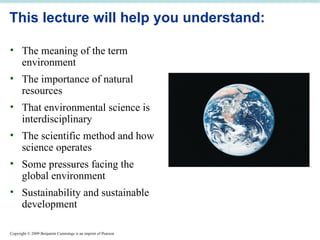
This lecture will help you understand:

• The meaning of the term
  environment
• The importance of natural
  resources
• That environmental science is
  interdisciplinary
• The scientific method and how
  science operates
• Some pressures facing the
  global environment
• Sustainability and sustainable
  development

Copyright © 2009 Benjamin Cummings is an imprint of Pearson
Environment: the total of our surroundings
         • All the things around us with which we
           interact:
                  • Living things
                           • Animals, plants, forests, fungi, etc.
                  • Non-living things
                           • Continents, oceans, clouds, soil, rocks
                  • Our built environment
                           • Buildings, human-created living
                             centers
                  • Social relationships and institutions
Copyright © 2009 Benjamin Cummings is an imprint of Pearson
Humans exist within the environment

 • Humans exist within the environment and are part of
   nature.
          - Our survival depends on a healthy, functioning
            planet.
 • The fundamental insight of environmental science is
   that we are part of the natural world.
          - Our interactions with its other parts matter a great
            deal.


Copyright © 2009 Benjamin Cummings is an imprint of Pearson
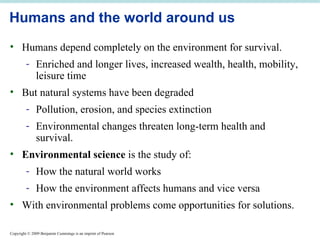
Humans and the world around us
• Humans depend completely on the environment for survival.
         - Enriched and longer lives, increased wealth, health, mobility,
           leisure time
• But natural systems have been degraded
         - Pollution, erosion, and species extinction
         - Environmental changes threaten long-term health and
           survival.
• Environmental science is the study of:
         - How the natural world works
         - How the environment affects humans and vice versa
• With environmental problems come opportunities for solutions.

Copyright © 2009 Benjamin Cummings is an imprint of Pearson
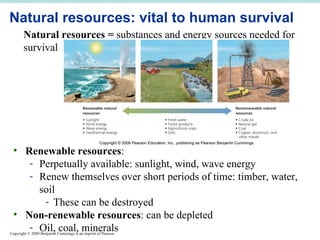
Natural resources: vital to human survival
       Natural resources = substances and energy sources needed for
       survival


 • Renewable resources:
    - Perpetually available: sunlight, wind, wave energy
    - Renew themselves over short periods of time: timber, water,
      soil
       - These can be destroyed
 • Non-renewable resources: can be depleted
    - Oil, coal, minerals
Copyright © 2009 Benjamin Cummings is an imprint of Pearson
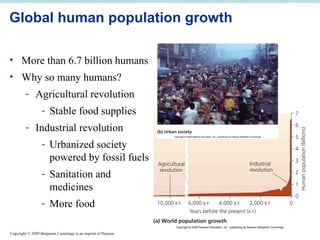
Global human population growth

• More than 6.7 billion humans
• Why so many humans?
        - Agricultural revolution
                 - Stable food supplies
        - Industrial revolution
                 - Urbanized society
                   powered by fossil fuels
                 - Sanitation and
                   medicines
                 - More food

Copyright © 2009 Benjamin Cummings is an imprint of Pearson
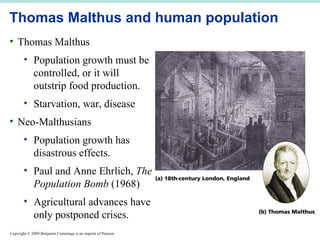
Thomas Malthus and human population
• Thomas Malthus
       • Population growth must be
         controlled, or it will
         outstrip food production.
       • Starvation, war, disease
• Neo-Malthusians
       • Population growth has
         disastrous effects.
       • Paul and Anne Ehrlich, The
         Population Bomb (1968)
       • Agricultural advances have
         only postponed crises.
Copyright © 2009 Benjamin Cummings is an imprint of Pearson
Resource consumption exerts impacts

               • Garret Hardin’s “tragedy of the commons” (1968)
                        • Unregulated exploitation causes resource depletion
                                 • Grazing lands, forests, air, water
                        • No one has the incentive to care for a resource.
                        • Everyone takes what he or she can until the
                          resource is depleted.
               • Solution?
                        • Private ownership?
                        • Voluntary organization to enforce responsible use?
                        • Governmental regulations?

Copyright © 2009 Benjamin Cummings is an imprint of Pearson
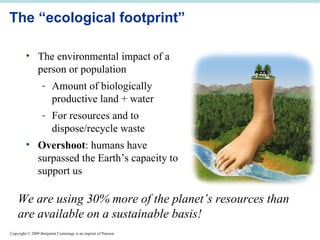
The “ecological footprint”

         • The environmental impact of a
           person or population
                  - Amount of biologically
                    productive land + water
                  - For resources and to
                    dispose/recycle waste
         • Overshoot: humans have
           surpassed the Earth’s capacity to
           support us

    We are using 30% more of the planet’s resources than
    are available on a sustainable basis!
Copyright © 2009 Benjamin Cummings is an imprint of Pearson
Environmental science
 • Can help us avoid mistakes made by past civilizations
          - Human survival depends on how we interact with our
            environment.
          - Our impacts are now global.
          - Many great civilizations have fallen after depleting their
            resources.

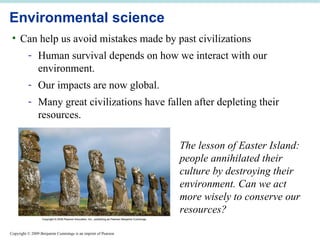
                                                              The lesson of Easter Island:
                                                              people annihilated their
                                                              culture by destroying their
                                                              environment. Can we act
                                                              more wisely to conserve our
                                                              resources?

Copyright © 2009 Benjamin Cummings is an imprint of Pearson
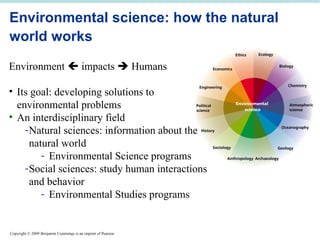
Environmental science: how the natural
world works

Environment  impacts  Humans

• Its goal: developing solutions to
  environmental problems
• An interdisciplinary field
    - Natural sciences: information about the
      natural world
         - Environmental Science programs
    - Social sciences: study human interactions
      and behavior
         - Environmental Studies programs


Copyright © 2009 Benjamin Cummings is an imprint of Pearson
Environmental science is not
environmentalism
   •Environmental science
            • The pursuit of knowledge
              about the natural world
            • Scientists try to remain
              objective
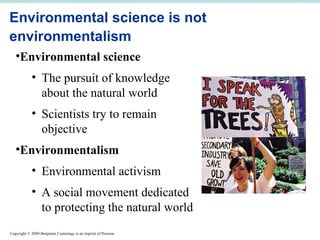
   •Environmentalism
            • Environmental activism
            • A social movement dedicated
              to protecting the natural world
Copyright © 2009 Benjamin Cummings is an imprint of Pearson
The nature of science

• Science:
        - A systematic process for learning about the world and
          testing our understanding of it
        - The accumulated body of knowledge that results from
          a dynamic process of observation, testing, and
          discovery
• Science is essential:
        - To sort fact from fiction
        - Develop solutions to the problems we face

Copyright © 2009 Benjamin Cummings is an imprint of Pearson
Applications of science
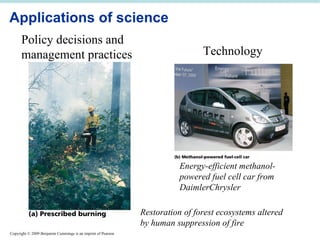
      Policy decisions and
      management practices                                                     Technology


                                                                         Energy-efficient methanol-
                                                                         powered fuel cell car from
                                                                         DaimlerChrysler

                                                              Restoration of forest ecosystems altered
                                                              by human suppression of fire
Copyright © 2009 Benjamin Cummings is an imprint of Pearson
Scientists test ideas

• Scientists examine how the world works by observing, measuring,
  and testing
   - Involves critical thinking and skepticism
• Observational (descriptive) science: scientists gather information
  about something not well known or that cannot be manipulated in
  experiments
   - Astronomy, paleontology, taxonomy, molecular biology
• Hypothesis-driven science: research that proceeds in a structured
  manner using experiments to test hypotheses through the scientific
  method


Copyright © 2009 Benjamin Cummings is an imprint of Pearson
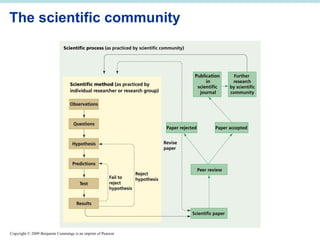
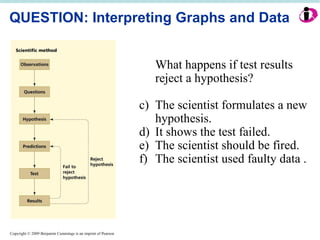
The scientific method

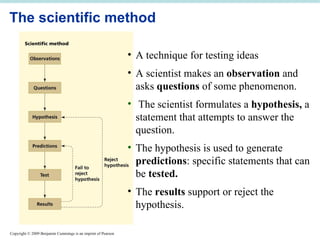
                                                              • A technique for testing ideas
                                                              • A scientist makes an observation and
                                                                asks questions of some phenomenon.
                                                              • The scientist formulates a hypothesis, a
                                                                statement that attempts to answer the
                                                                question.
                                                              • The hypothesis is used to generate
                                                                predictions: specific statements that can
                                                                be tested.
                                                              • The results support or reject the
                                                                hypothesis.

Copyright © 2009 Benjamin Cummings is an imprint of Pearson
Testing predictions

• Experiment: an activity that tests the validity of a hypothesis
• Variables: conditions that can be manipulated and/or measured
         - Independent variable: a condition that is manipulated
         - Dependent variable: a variable that is affected by the
           manipulation of the independent variable
• Controlled experiment: one in which all variables are controlled
         - Control: the unmanipulated point of comparison
         - Treatment: the manipulated point of comparison
• Data: information that is generally quantitative (numerical)


Copyright © 2009 Benjamin Cummings is an imprint of Pearson
Experiments test the validity of a hypothesis


• Manipulative experiments yield the strongest evidence
       - Provides the strongest type of evidence
       - Reveal causal relationships: changes in independent variables
         cause changes in dependent variables
       - But many things can’t be manipulated: long-term or large-
         scale questions (i.e., global climate change)
• Natural experiments show real-world complexity
       - Only feasible approach for ecosystem or planet-scale
       - Results are not so neat and clean, so answers aren’t simply
         black and white


Copyright © 2009 Benjamin Cummings is an imprint of Pearson
The scientific process is part of a larger process

Peer-review: other scientists provide comments and criticism
       • Guards against faulty science
• Conference presentations improve the quality of the science
       • Scientists interact with their colleagues
• Grants and funding come from private or government
  agencies.
       • Can lead to conflict of interest if the data show the funding
         source in an unfavorable light
       • The scientist may be reluctant to publish or doctor the
         results.


Copyright © 2009 Benjamin Cummings is an imprint of Pearson
The scientific community


Copyright © 2009 Benjamin Cummings is an imprint of Pearson
Theories and paradigms

• A consistently supported hypothesis becomes a theory, a widely
  accepted explanation of one or more cause-and-effect
  relationships
         • Has been extensively and rigorously tested, so confidence in a
           theory is extremely strong
                  • Darwin’s theory of evolution, atomic theory, cell theory,
                    big bang theory, plate tectonics, general relativity
         • Differs from the popular meaning of theory, which suggests a
           speculative idea without much substance
• With enough data, a paradigm shift — a change in the dominant
  view — can occur.

Copyright © 2009 Benjamin Cummings is an imprint of Pearson
Ethics
• Ethics: the study of good and bad, right and wrong
        - The set of moral principles or values held by a person
          or society that tells us how we ought to behave
        - People use criteria, standards, or rules when making
          judgments.
        - Different cultures or worldviews lead to different
          values, which lead to different actions.
• Relativists: ethics vary with social context
• Universalists: right and wrong remains the same across
  cultures and situations
Copyright © 2009 Benjamin Cummings is an imprint of Pearson
Ethical standards


• Ethical standards: criteria that help differentiate right
  from wrong
        - Classical standard = virtue
        - The golden rule: treat others as you want to be treated
        - Utility: something right produces the most benefits for
          the most people


Copyright © 2009 Benjamin Cummings is an imprint of Pearson
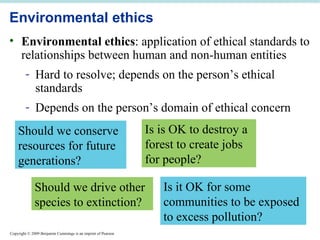
Environmental ethics
• Environmental ethics: application of ethical standards to
  relationships between human and non-human entities
        - Hard to resolve; depends on the person’s ethical
          standards
        - Depends on the person’s domain of ethical concern
    Should we conserve                                        Is is OK to destroy a
    resources for future                                      forest to create jobs
    generations?                                              for people?

             Should we drive other                               Is it OK for some
             species to extinction?                              communities to be exposed
                                                                 to excess pollution?
Copyright © 2009 Benjamin Cummings is an imprint of Pearson
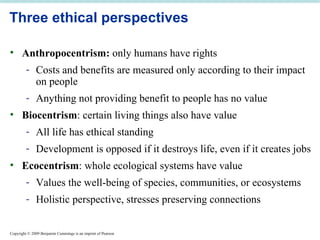
Three ethical perspectives

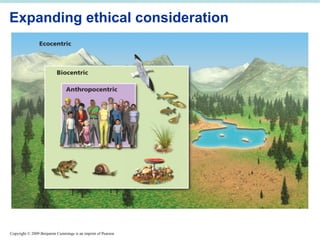
• Anthropocentrism: only humans have rights
         - Costs and benefits are measured only according to their impact
           on people
         - Anything not providing benefit to people has no value
• Biocentrism: certain living things also have value
         - All life has ethical standing
         - Development is opposed if it destroys life, even if it creates jobs
• Ecocentrism: whole ecological systems have value
         - Values the well-being of species, communities, or ecosystems
         - Holistic perspective, stresses preserving connections


Copyright © 2009 Benjamin Cummings is an imprint of Pearson
Expanding ethical consideration


Copyright © 2009 Benjamin Cummings is an imprint of Pearson
The preservation ethic


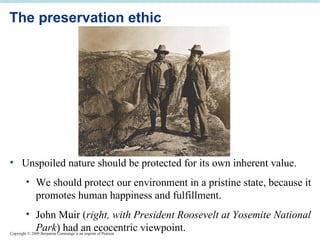
• Unspoiled nature should be protected for its own inherent value.
        • We should protect our environment in a pristine state, because it
          promotes human happiness and fulfillment.
        • John Muir (right, with President Roosevelt at Yosemite National
          Park) had an ecocentric viewpoint.
Copyright © 2009 Benjamin Cummings is an imprint of Pearson
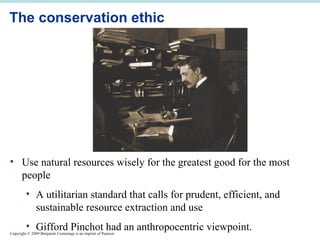
The conservation ethic


• Use natural resources wisely for the greatest good for the most
  people
         • A utilitarian standard that calls for prudent, efficient, and
           sustainable resource extraction and use
         • Gifford Pinchot had an anthropocentric viewpoint.
Copyright © 2009 Benjamin Cummings is an imprint of Pearson
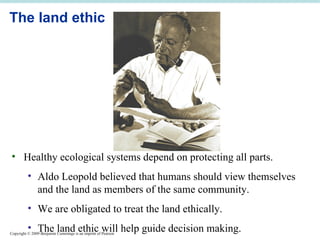
The land ethic


• Healthy ecological systems depend on protecting all parts.
          • Aldo Leopold believed that humans should view themselves
            and the land as members of the same community.
          • We are obligated to treat the land ethically.
          • The land ethic will help guide decision making.
Copyright © 2009 Benjamin Cummings is an imprint of Pearson
Ecofeminism

• In the 1960s and 1970s, feminist scholars saw parallels in
  how people treated nature and how men treated women.
         • Degradation, social oppression
• Ecofeminism: a patriarchal (male-dominated) society is a
  root cause of both social and environmental problems
         • Female worldview: interrelationships and cooperation
         • Male worldview: hierarchies, competition, domination,
           and conquest

Copyright © 2009 Benjamin Cummings is an imprint of Pearson
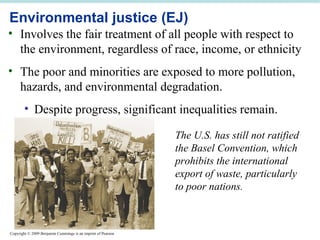
Environmental justice (EJ)
• Involves the fair treatment of all people with respect to
  the environment, regardless of race, income, or ethnicity
• The poor and minorities are exposed to more pollution,
  hazards, and environmental degradation.
        • Despite progress, significant inequalities remain.

                                                              The U.S. has still not ratified
                                                              the Basel Convention, which
                                                              prohibits the international
                                                              export of waste, particularly
                                                              to poor nations.


Copyright © 2009 Benjamin Cummings is an imprint of Pearson
Sustainability
   • A guiding principle of environmental science
   • Living within our planet’s means
            - The Earth can sustain humans AND other organisms
              for the future
            - Leaving our descendents with a rich, full world
            - Developing solutions that work in the long term
            - Requires keeping fully functioning ecological systems


Copyright © 2009 Benjamin Cummings is an imprint of Pearson
Sustainability
   • We are increasing our burden on the planet each year.
            - Population growth, affluence, consumption
   • Natural capital: the accumulated wealth of Earth
            - We are withdrawing our planet’s natural capital 30%
              faster than it is being produced
   • Natural capital = the accumulated wealth of Earth
            - We are withdrawing our planet’s natural capital 30%
              faster than it is being produced.


Copyright © 2009 Benjamin Cummings is an imprint of Pearson
We are increasing our burden on the planet
• Human population growth amplifies all environmental
  problems
         - The growth rate has slowed, but we still add over
           200,000 people to the planet each day.
• Our consumption of resources has risen even faster.
         - Life has become more pleasant for us so far.
         - However, rising consumption increases the demands
           we make on our environment.
         - The rise in affluence has not been equal. The gap
           between rich and poor has doubled in the past 40
           years.

Copyright © 2009 Benjamin Cummings is an imprint of Pearson
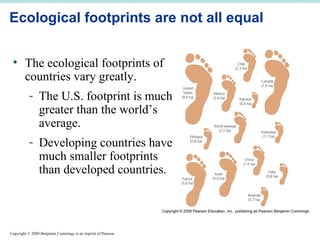
Ecological footprints are not all equal


 • The ecological footprints of
   countries vary greatly.
          - The U.S. footprint is much
            greater than the world’s
            average.
          - Developing countries have
            much smaller footprints
            than developed countries.


Copyright © 2009 Benjamin Cummings is an imprint of Pearson
The 2005 Millennium Ecosystem Assessment

 •          The most comprehensive scientific assessment of the
            condition of the world’s ecological systems
 •          Major findings:
          •          Humans have drastically altered ecosystems.
          •          These changes have contributed to human well-
                     being and economic development, but at a cost.
          •          Environmental degradation could get much worse.
          •          Degradation can be reversed, but it requires work.


Copyright © 2009 Benjamin Cummings is an imprint of Pearson
Sustainable solutions abound

• Sustainable development: using resources to satisfy current needs
  without compromising future availability of resources
• Sustainability involves:
   - Renewable energy sources
   - Soil conservation, high-efficiency irrigation, organic agriculture
   - Pollution reduction
   - Habitat and species protection
   - Recycling
   - Fighting global climate change

      Humanity’s challenge is to develop solutions that further our
      quality of life while protecting and restoring the environment.


Copyright © 2009 Benjamin Cummings is an imprint of Pearson
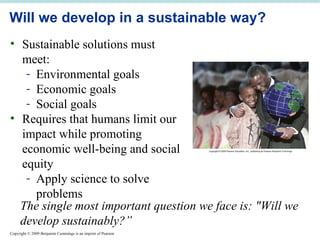
Will we develop in a sustainable way?
• Sustainable solutions must
  meet:
   - Environmental goals
   - Economic goals
   - Social goals
• Requires that humans limit our
  impact while promoting
  economic well-being and social
  equity
   - Apply science to solve
     problems
  The single most important question we face is: "Will we
  develop sustainably?”
Copyright © 2009 Benjamin Cummings is an imprint of Pearson
Conclusion
• Finding ways to live sustainably on Earth requires a solid
  ethical grounding and scientific understanding of our
  natural and social systems.
• Environmental science helps us understand our
  relationship with the environment and informs our
  attempts to solve and prevent problems.
• Identifying a problem is the first step in solving it.
• Solving environmental problems can move us toward
  health, longevity, peace, and prosperity.
         - Environmental science can help find balanced
           solutions to environmental problems.
Copyright © 2009 Benjamin Cummings is an imprint of Pearson
QUESTION: Review
      The term “environment” includes:

     a)        Living things, such as animals and plants
     b)        Non-living things, such as rivers and soil
     c)        Buildings and cities
     d)        All of the above are included in this term


Copyright © 2009 Benjamin Cummings is an imprint of Pearson
QUESTION: Review


           A Neo-Malthusian would say that predicted massive
           human starvation has not yet occurred because:

             a)        Diseases have been eradicated
             b)        Enough people are dying from war and conflict
             c)        Agriculture has postponed massive starvation
             d)        People are too dumb to limit their population
                       growth


Copyright © 2009 Benjamin Cummings is an imprint of Pearson
QUESTION: Review

         Which of the following is correct about the term
         “environmentalism”?

       a) It involves pursuing knowledge to understand the
          natural world.
       b) It is a social movement to protect the environment.
       c) It usually does not include advocacy for the
          environment.
       d) It requires trying to remain objective.


Copyright © 2009 Benjamin Cummings is an imprint of Pearson
QUESTION: Review


         Which is the correct order of the scientific method?

       a)         Observation, hypothesis, predictions, testing, results
       b)         Hypothesis, observation, testing, predictions, results
       c)         Observation, predictions, testing, results, hypothesis
       d)         Predictions, observation, hypothesis, testing, results


Copyright © 2009 Benjamin Cummings is an imprint of Pearson
QUESTION: Review


          An anthropocentric worldview would consider the
          impact of an action on:
            a) Plants only
            b) Animals only
            c) Humans only
            d) All living things
            e) All non-living things


Copyright © 2009 Benjamin Cummings is an imprint of Pearson
QUESTION: Review


        Which ethic holds that resources should be wisely used?

            a)          Preservation ethic
            b)          Land ethic
            c)          Conservation ethic
            d)          Deep ecology
            e)          Biocentrism


Copyright © 2009 Benjamin Cummings is an imprint of Pearson
QUESTION: Review


          What is the definition of “sustainable development”?

             a) Using resources to benefit future generations, even
                if it means lower availability now
             b) Letting future generations figure out their own
                problems
             c) Letting each country decide what is its best interest
             d) Using resources to satisfy current needs without
                compromising future availability


Copyright © 2009 Benjamin Cummings is an imprint of Pearson
QUESTION: Weighing the Issues


      Which do you think is the best way to protect
      commonly owned resources (i.e., air, water, fisheries)?

     b) Sell the resource to a private entity
     c) Let organizations themselves decide if they want to
        participate in protecting the resource
     d) Enact governmental regulations
     e) Do nothing and see what happens


Copyright © 2009 Benjamin Cummings is an imprint of Pearson
QUESTION: Weighing the Issues


      Do you think the rest of the world can have an
      ecological footprint as large as the footprint of the
      United States?

         a)            Yes, because we will find new technologies and
                       resources to overcome environmental problems.
         b)            Yes, because the footprint of the United States is
                       not really that large compared to other countries.
         c)            Definitely not. The world does not have that many
                       resources.
         d)            It does not matter. It’s not that important.

Copyright © 2009 Benjamin Cummings is an imprint of Pearson
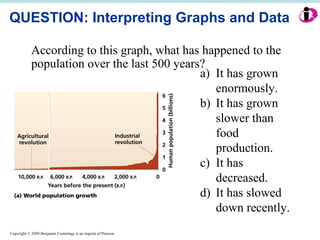
QUESTION: Interpreting Graphs and Data

            According to this graph, what has happened to the
            population over the last 500 years?
                                              a) It has grown
                                                 enormously.
                                              b) It has grown
                                                 slower than
                                                 food
                                                 production.
                                              c) It has
                                                 decreased.
                                              d) It has slowed
                                                 down recently.
Copyright © 2009 Benjamin Cummings is an imprint of Pearson
QUESTION: Interpreting Graphs and Data


                                                                 What happens if test results
                                                                 reject a hypothesis?

                                                              c) The scientist formulates a new
                                                                 hypothesis.
                                                              d) It shows the test failed.
                                                              e) The scientist should be fired.
                                                              f) The scientist used faulty data .


Copyright © 2009 Benjamin Cummings is an imprint of Pearson

Introduction to Environmental Science

  • 1.
    Chapter 1 An Introduction toEnvironmental Science PowerPoint® Slides prepared by Jay Withgott and Heidi Marcum Copyright © 2009 Benjamin Cummings is an imprint of Pearson
  • 2.
    This lecture willhelp you understand: • The meaning of the term environment • The importance of natural resources • That environmental science is interdisciplinary • The scientific method and how science operates • Some pressures facing the global environment • Sustainability and sustainable development Copyright © 2009 Benjamin Cummings is an imprint of Pearson
  • 3.
    Environment: the totalof our surroundings • All the things around us with which we interact: • Living things • Animals, plants, forests, fungi, etc. • Non-living things • Continents, oceans, clouds, soil, rocks • Our built environment • Buildings, human-created living centers • Social relationships and institutions Copyright © 2009 Benjamin Cummings is an imprint of Pearson
  • 4.
    Humans exist withinthe environment • Humans exist within the environment and are part of nature. - Our survival depends on a healthy, functioning planet. • The fundamental insight of environmental science is that we are part of the natural world. - Our interactions with its other parts matter a great deal. Copyright © 2009 Benjamin Cummings is an imprint of Pearson
  • 5.
    Humans and theworld around us • Humans depend completely on the environment for survival. - Enriched and longer lives, increased wealth, health, mobility, leisure time • But natural systems have been degraded - Pollution, erosion, and species extinction - Environmental changes threaten long-term health and survival. • Environmental science is the study of: - How the natural world works - How the environment affects humans and vice versa • With environmental problems come opportunities for solutions. Copyright © 2009 Benjamin Cummings is an imprint of Pearson
  • 6.
    Natural resources: vitalto human survival Natural resources = substances and energy sources needed for survival • Renewable resources: - Perpetually available: sunlight, wind, wave energy - Renew themselves over short periods of time: timber, water, soil - These can be destroyed • Non-renewable resources: can be depleted - Oil, coal, minerals Copyright © 2009 Benjamin Cummings is an imprint of Pearson
  • 7.
    Global human populationgrowth • More than 6.7 billion humans • Why so many humans? - Agricultural revolution - Stable food supplies - Industrial revolution - Urbanized society powered by fossil fuels - Sanitation and medicines - More food Copyright © 2009 Benjamin Cummings is an imprint of Pearson
  • 8.
    Thomas Malthus andhuman population • Thomas Malthus • Population growth must be controlled, or it will outstrip food production. • Starvation, war, disease • Neo-Malthusians • Population growth has disastrous effects. • Paul and Anne Ehrlich, The Population Bomb (1968) • Agricultural advances have only postponed crises. Copyright © 2009 Benjamin Cummings is an imprint of Pearson
  • 9.
    Resource consumption exertsimpacts • Garret Hardin’s “tragedy of the commons” (1968) • Unregulated exploitation causes resource depletion • Grazing lands, forests, air, water • No one has the incentive to care for a resource. • Everyone takes what he or she can until the resource is depleted. • Solution? • Private ownership? • Voluntary organization to enforce responsible use? • Governmental regulations? Copyright © 2009 Benjamin Cummings is an imprint of Pearson
  • 10.
    The “ecological footprint” • The environmental impact of a person or population - Amount of biologically productive land + water - For resources and to dispose/recycle waste • Overshoot: humans have surpassed the Earth’s capacity to support us We are using 30% more of the planet’s resources than are available on a sustainable basis! Copyright © 2009 Benjamin Cummings is an imprint of Pearson
  • 11.
    Environmental science •Can help us avoid mistakes made by past civilizations - Human survival depends on how we interact with our environment. - Our impacts are now global. - Many great civilizations have fallen after depleting their resources. The lesson of Easter Island: people annihilated their culture by destroying their environment. Can we act more wisely to conserve our resources? Copyright © 2009 Benjamin Cummings is an imprint of Pearson
  • 12.
    Environmental science: howthe natural world works Environment  impacts  Humans • Its goal: developing solutions to environmental problems • An interdisciplinary field - Natural sciences: information about the natural world - Environmental Science programs - Social sciences: study human interactions and behavior - Environmental Studies programs Copyright © 2009 Benjamin Cummings is an imprint of Pearson
  • 13.
    Environmental science isnot environmentalism •Environmental science • The pursuit of knowledge about the natural world • Scientists try to remain objective •Environmentalism • Environmental activism • A social movement dedicated to protecting the natural world Copyright © 2009 Benjamin Cummings is an imprint of Pearson
  • 14.
    The nature ofscience • Science: - A systematic process for learning about the world and testing our understanding of it - The accumulated body of knowledge that results from a dynamic process of observation, testing, and discovery • Science is essential: - To sort fact from fiction - Develop solutions to the problems we face Copyright © 2009 Benjamin Cummings is an imprint of Pearson
  • 15.
    Applications of science Policy decisions and management practices Technology Energy-efficient methanol- powered fuel cell car from DaimlerChrysler Restoration of forest ecosystems altered by human suppression of fire Copyright © 2009 Benjamin Cummings is an imprint of Pearson
  • 16.
    Scientists test ideas •Scientists examine how the world works by observing, measuring, and testing - Involves critical thinking and skepticism • Observational (descriptive) science: scientists gather information about something not well known or that cannot be manipulated in experiments - Astronomy, paleontology, taxonomy, molecular biology • Hypothesis-driven science: research that proceeds in a structured manner using experiments to test hypotheses through the scientific method Copyright © 2009 Benjamin Cummings is an imprint of Pearson
  • 17.
    The scientific method • A technique for testing ideas • A scientist makes an observation and asks questions of some phenomenon. • The scientist formulates a hypothesis, a statement that attempts to answer the question. • The hypothesis is used to generate predictions: specific statements that can be tested. • The results support or reject the hypothesis. Copyright © 2009 Benjamin Cummings is an imprint of Pearson
  • 18.
    Testing predictions • Experiment:an activity that tests the validity of a hypothesis • Variables: conditions that can be manipulated and/or measured - Independent variable: a condition that is manipulated - Dependent variable: a variable that is affected by the manipulation of the independent variable • Controlled experiment: one in which all variables are controlled - Control: the unmanipulated point of comparison - Treatment: the manipulated point of comparison • Data: information that is generally quantitative (numerical) Copyright © 2009 Benjamin Cummings is an imprint of Pearson
  • 19.
    Experiments test thevalidity of a hypothesis • Manipulative experiments yield the strongest evidence - Provides the strongest type of evidence - Reveal causal relationships: changes in independent variables cause changes in dependent variables - But many things can’t be manipulated: long-term or large- scale questions (i.e., global climate change) • Natural experiments show real-world complexity - Only feasible approach for ecosystem or planet-scale - Results are not so neat and clean, so answers aren’t simply black and white Copyright © 2009 Benjamin Cummings is an imprint of Pearson
  • 20.
    The scientific processis part of a larger process Peer-review: other scientists provide comments and criticism • Guards against faulty science • Conference presentations improve the quality of the science • Scientists interact with their colleagues • Grants and funding come from private or government agencies. • Can lead to conflict of interest if the data show the funding source in an unfavorable light • The scientist may be reluctant to publish or doctor the results. Copyright © 2009 Benjamin Cummings is an imprint of Pearson
  • 21.
    The scientific community Copyright© 2009 Benjamin Cummings is an imprint of Pearson
  • 22.
    Theories and paradigms •A consistently supported hypothesis becomes a theory, a widely accepted explanation of one or more cause-and-effect relationships • Has been extensively and rigorously tested, so confidence in a theory is extremely strong • Darwin’s theory of evolution, atomic theory, cell theory, big bang theory, plate tectonics, general relativity • Differs from the popular meaning of theory, which suggests a speculative idea without much substance • With enough data, a paradigm shift — a change in the dominant view — can occur. Copyright © 2009 Benjamin Cummings is an imprint of Pearson
  • 23.
    Ethics • Ethics: thestudy of good and bad, right and wrong - The set of moral principles or values held by a person or society that tells us how we ought to behave - People use criteria, standards, or rules when making judgments. - Different cultures or worldviews lead to different values, which lead to different actions. • Relativists: ethics vary with social context • Universalists: right and wrong remains the same across cultures and situations Copyright © 2009 Benjamin Cummings is an imprint of Pearson
  • 24.
    Ethical standards • Ethicalstandards: criteria that help differentiate right from wrong - Classical standard = virtue - The golden rule: treat others as you want to be treated - Utility: something right produces the most benefits for the most people Copyright © 2009 Benjamin Cummings is an imprint of Pearson
  • 25.
    Environmental ethics • Environmentalethics: application of ethical standards to relationships between human and non-human entities - Hard to resolve; depends on the person’s ethical standards - Depends on the person’s domain of ethical concern Should we conserve Is is OK to destroy a resources for future forest to create jobs generations? for people? Should we drive other Is it OK for some species to extinction? communities to be exposed to excess pollution? Copyright © 2009 Benjamin Cummings is an imprint of Pearson
  • 26.
    Three ethical perspectives •Anthropocentrism: only humans have rights - Costs and benefits are measured only according to their impact on people - Anything not providing benefit to people has no value • Biocentrism: certain living things also have value - All life has ethical standing - Development is opposed if it destroys life, even if it creates jobs • Ecocentrism: whole ecological systems have value - Values the well-being of species, communities, or ecosystems - Holistic perspective, stresses preserving connections Copyright © 2009 Benjamin Cummings is an imprint of Pearson
  • 27.
    Expanding ethical consideration Copyright© 2009 Benjamin Cummings is an imprint of Pearson
  • 28.
    The preservation ethic •Unspoiled nature should be protected for its own inherent value. • We should protect our environment in a pristine state, because it promotes human happiness and fulfillment. • John Muir (right, with President Roosevelt at Yosemite National Park) had an ecocentric viewpoint. Copyright © 2009 Benjamin Cummings is an imprint of Pearson
  • 29.
    The conservation ethic •Use natural resources wisely for the greatest good for the most people • A utilitarian standard that calls for prudent, efficient, and sustainable resource extraction and use • Gifford Pinchot had an anthropocentric viewpoint. Copyright © 2009 Benjamin Cummings is an imprint of Pearson
  • 30.
    The land ethic •Healthy ecological systems depend on protecting all parts. • Aldo Leopold believed that humans should view themselves and the land as members of the same community. • We are obligated to treat the land ethically. • The land ethic will help guide decision making. Copyright © 2009 Benjamin Cummings is an imprint of Pearson
  • 31.
    Ecofeminism • In the1960s and 1970s, feminist scholars saw parallels in how people treated nature and how men treated women. • Degradation, social oppression • Ecofeminism: a patriarchal (male-dominated) society is a root cause of both social and environmental problems • Female worldview: interrelationships and cooperation • Male worldview: hierarchies, competition, domination, and conquest Copyright © 2009 Benjamin Cummings is an imprint of Pearson
  • 32.
    Environmental justice (EJ) •Involves the fair treatment of all people with respect to the environment, regardless of race, income, or ethnicity • The poor and minorities are exposed to more pollution, hazards, and environmental degradation. • Despite progress, significant inequalities remain. The U.S. has still not ratified the Basel Convention, which prohibits the international export of waste, particularly to poor nations. Copyright © 2009 Benjamin Cummings is an imprint of Pearson
  • 33.
    Sustainability • A guiding principle of environmental science • Living within our planet’s means - The Earth can sustain humans AND other organisms for the future - Leaving our descendents with a rich, full world - Developing solutions that work in the long term - Requires keeping fully functioning ecological systems Copyright © 2009 Benjamin Cummings is an imprint of Pearson
  • 34.
    Sustainability • We are increasing our burden on the planet each year. - Population growth, affluence, consumption • Natural capital: the accumulated wealth of Earth - We are withdrawing our planet’s natural capital 30% faster than it is being produced • Natural capital = the accumulated wealth of Earth - We are withdrawing our planet’s natural capital 30% faster than it is being produced. Copyright © 2009 Benjamin Cummings is an imprint of Pearson
  • 35.
    We are increasingour burden on the planet • Human population growth amplifies all environmental problems - The growth rate has slowed, but we still add over 200,000 people to the planet each day. • Our consumption of resources has risen even faster. - Life has become more pleasant for us so far. - However, rising consumption increases the demands we make on our environment. - The rise in affluence has not been equal. The gap between rich and poor has doubled in the past 40 years. Copyright © 2009 Benjamin Cummings is an imprint of Pearson
  • 36.
    Ecological footprints arenot all equal • The ecological footprints of countries vary greatly. - The U.S. footprint is much greater than the world’s average. - Developing countries have much smaller footprints than developed countries. Copyright © 2009 Benjamin Cummings is an imprint of Pearson
  • 37.
    The 2005 MillenniumEcosystem Assessment • The most comprehensive scientific assessment of the condition of the world’s ecological systems • Major findings: • Humans have drastically altered ecosystems. • These changes have contributed to human well- being and economic development, but at a cost. • Environmental degradation could get much worse. • Degradation can be reversed, but it requires work. Copyright © 2009 Benjamin Cummings is an imprint of Pearson
  • 38.
    Sustainable solutions abound •Sustainable development: using resources to satisfy current needs without compromising future availability of resources • Sustainability involves: - Renewable energy sources - Soil conservation, high-efficiency irrigation, organic agriculture - Pollution reduction - Habitat and species protection - Recycling - Fighting global climate change Humanity’s challenge is to develop solutions that further our quality of life while protecting and restoring the environment. Copyright © 2009 Benjamin Cummings is an imprint of Pearson
  • 39.
    Will we developin a sustainable way? • Sustainable solutions must meet: - Environmental goals - Economic goals - Social goals • Requires that humans limit our impact while promoting economic well-being and social equity - Apply science to solve problems The single most important question we face is: "Will we develop sustainably?” Copyright © 2009 Benjamin Cummings is an imprint of Pearson
  • 40.
    Conclusion • Finding waysto live sustainably on Earth requires a solid ethical grounding and scientific understanding of our natural and social systems. • Environmental science helps us understand our relationship with the environment and informs our attempts to solve and prevent problems. • Identifying a problem is the first step in solving it. • Solving environmental problems can move us toward health, longevity, peace, and prosperity. - Environmental science can help find balanced solutions to environmental problems. Copyright © 2009 Benjamin Cummings is an imprint of Pearson
  • 41.
    QUESTION: Review The term “environment” includes: a) Living things, such as animals and plants b) Non-living things, such as rivers and soil c) Buildings and cities d) All of the above are included in this term Copyright © 2009 Benjamin Cummings is an imprint of Pearson
  • 42.
    QUESTION: Review A Neo-Malthusian would say that predicted massive human starvation has not yet occurred because: a) Diseases have been eradicated b) Enough people are dying from war and conflict c) Agriculture has postponed massive starvation d) People are too dumb to limit their population growth Copyright © 2009 Benjamin Cummings is an imprint of Pearson
  • 43.
    QUESTION: Review Which of the following is correct about the term “environmentalism”? a) It involves pursuing knowledge to understand the natural world. b) It is a social movement to protect the environment. c) It usually does not include advocacy for the environment. d) It requires trying to remain objective. Copyright © 2009 Benjamin Cummings is an imprint of Pearson
  • 44.
    QUESTION: Review Which is the correct order of the scientific method? a) Observation, hypothesis, predictions, testing, results b) Hypothesis, observation, testing, predictions, results c) Observation, predictions, testing, results, hypothesis d) Predictions, observation, hypothesis, testing, results Copyright © 2009 Benjamin Cummings is an imprint of Pearson
  • 45.
    QUESTION: Review An anthropocentric worldview would consider the impact of an action on: a) Plants only b) Animals only c) Humans only d) All living things e) All non-living things Copyright © 2009 Benjamin Cummings is an imprint of Pearson
  • 46.
    QUESTION: Review Which ethic holds that resources should be wisely used? a) Preservation ethic b) Land ethic c) Conservation ethic d) Deep ecology e) Biocentrism Copyright © 2009 Benjamin Cummings is an imprint of Pearson
  • 47.
    QUESTION: Review What is the definition of “sustainable development”? a) Using resources to benefit future generations, even if it means lower availability now b) Letting future generations figure out their own problems c) Letting each country decide what is its best interest d) Using resources to satisfy current needs without compromising future availability Copyright © 2009 Benjamin Cummings is an imprint of Pearson
  • 48.
    QUESTION: Weighing theIssues Which do you think is the best way to protect commonly owned resources (i.e., air, water, fisheries)? b) Sell the resource to a private entity c) Let organizations themselves decide if they want to participate in protecting the resource d) Enact governmental regulations e) Do nothing and see what happens Copyright © 2009 Benjamin Cummings is an imprint of Pearson
  • 49.
    QUESTION: Weighing theIssues Do you think the rest of the world can have an ecological footprint as large as the footprint of the United States? a) Yes, because we will find new technologies and resources to overcome environmental problems. b) Yes, because the footprint of the United States is not really that large compared to other countries. c) Definitely not. The world does not have that many resources. d) It does not matter. It’s not that important. Copyright © 2009 Benjamin Cummings is an imprint of Pearson
  • 50.
    QUESTION: Interpreting Graphsand Data According to this graph, what has happened to the population over the last 500 years? a) It has grown enormously. b) It has grown slower than food production. c) It has decreased. d) It has slowed down recently. Copyright © 2009 Benjamin Cummings is an imprint of Pearson
  • 51.
    QUESTION: Interpreting Graphsand Data What happens if test results reject a hypothesis? c) The scientist formulates a new hypothesis. d) It shows the test failed. e) The scientist should be fired. f) The scientist used faulty data . Copyright © 2009 Benjamin Cummings is an imprint of Pearson

Editor's Notes