!
Our environment is everything that
surrounds us, both natural and man-made.
• All the things around us with which
we interact:
• Living things
• Animals, plants, forests, fungi, etc.
• Nonliving things
• Continents, oceans, clouds, soil, rocks
• Our built environment
• Buildings, human-created living centers
• Social relationships and institutions
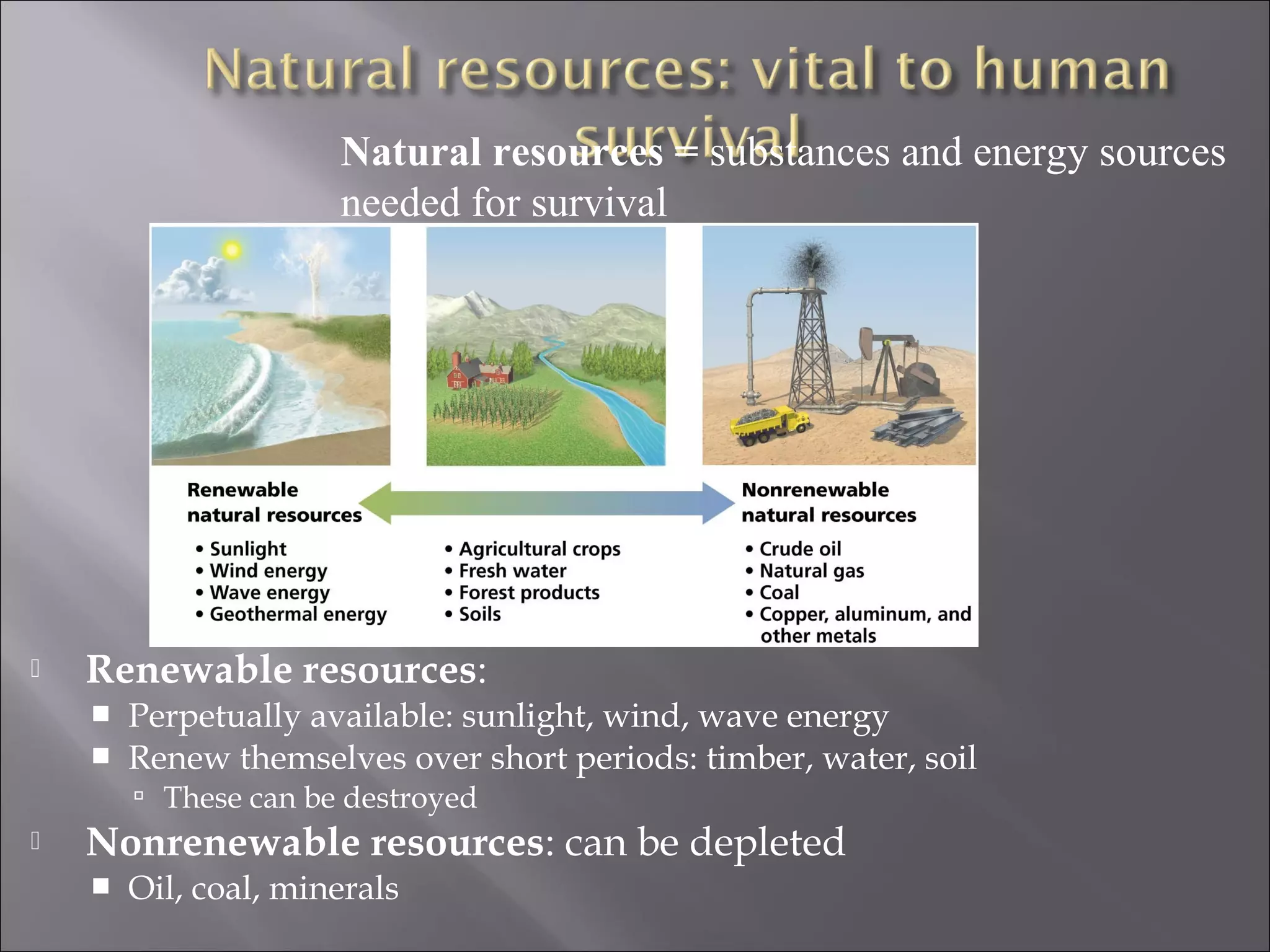
 Renewable resources:
 Perpetually available: sunlight, wind, wave energy
 Renew themselves over short periods: timber, water, soil
 These can be destroyed
 Nonrenewable resources: can be depleted
 Oil, coal, minerals
Natural resources = substances and energy sources
needed for survival
 “…the earth enables our people to survive, the
environment must be respected and maintained.
As long as the earth remains healthy, the people
remain healthy.” (Long and Fox, 1996)
 More than 6.7 billion
humans
 Why so many humans?
 Agricultural revolution
 Stable food supplies
 Industrial revolution
 Urbanized society powered
by fossil fuels
 Sanitation and medicines
 More food
 Human population growth
exacerbates all environmental
problems
 The growth rate has slowed…but we
still add more than 200,000 people to
the planet each day We depend
completely on the environment
for survival
 Life has become more pleasant
for us so far (Increased wealth,
health, mobility, leisure time)
 But…natural systems have been
degraded and environmental
changes threaten long-term
health and survival
 With your partner/group, brainstorm at least
10 ways in which destruction to the
environment and depletion of resources can
affect our overall well being as a population
Environment  impacts 
Humans
• It has an applied goal:
developing solutions to
environmental problems
 An interdisciplinary field
Natural sciences:
information about the world
Social sciences: values and
human behavior, politics,
economy, etc.
 The perception of what
constitutes a problem varies
between individuals and
societies
 Ex.: DDT, a pesticide
 In developing countries: welcome
because it kills malaria-carrying
mosquitoes
 In developed countries: not
welcome, due to health risks
•Environmental science
• The pursuit of knowledge
about the natural world
• Scientists try to remain
objective
•Environmentalism
• A social movement dedicated
to protecting the natural world
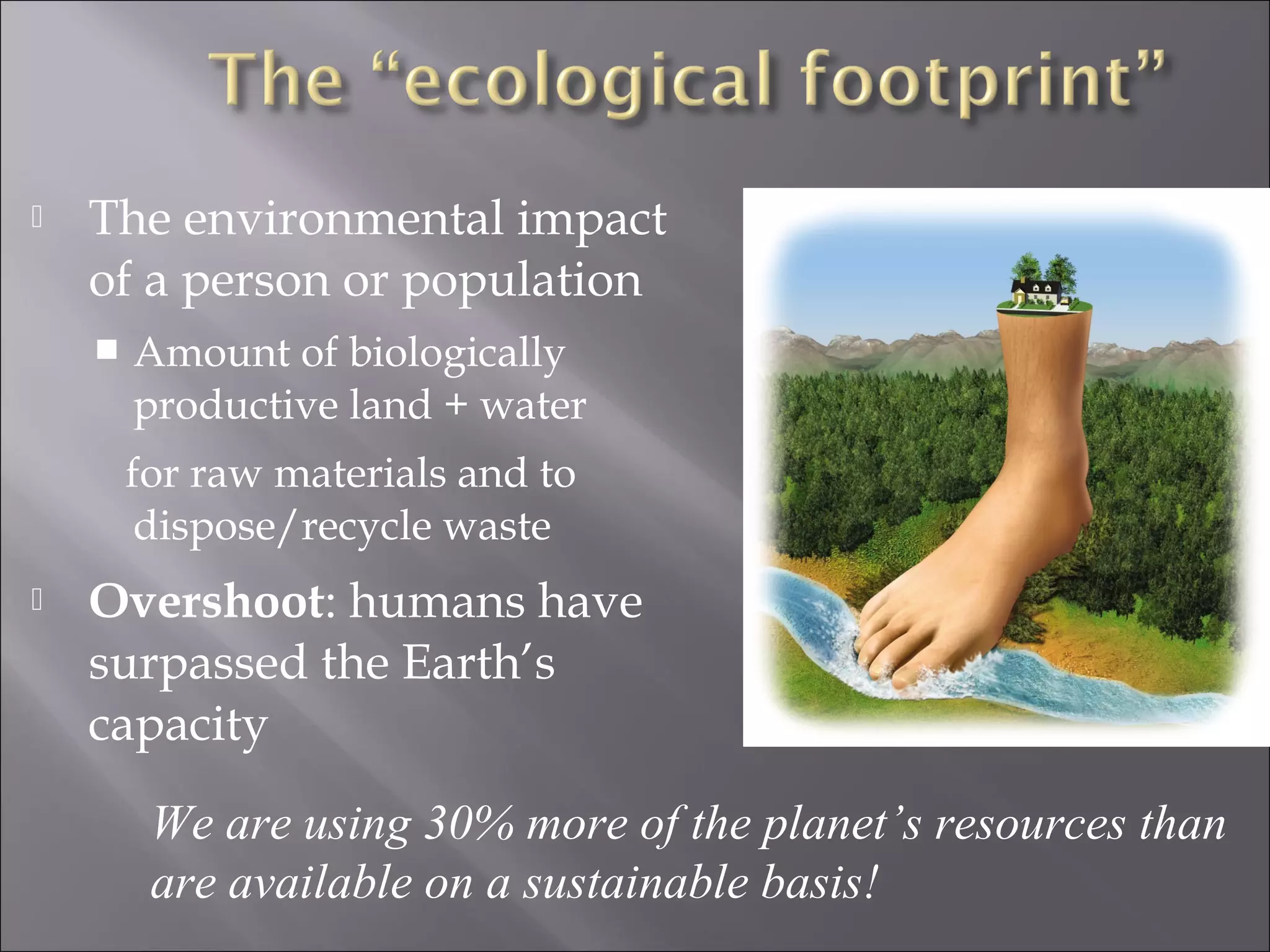
 The environmental impact
of a person or population
 Amount of biologically
productive land + water
for raw materials and to
dispose/recycle waste
 Overshoot: humans have
surpassed the Earth’s
capacity
We are using 30% more of the planet’s resources than
are available on a sustainable basis!
 The ecological footprints
of countries vary greatly
 The U.S. footprint is almost
5 times greater than the
world’s average
 Developing countries have
much smaller footprints
than developed countries
• Expanded food production led to
increased population and
consumption
• It’s one of humanity’s greatest
achievements, but at an enormous
environmental cost
• Nearly half of the planet’s land
surface is used for agriculture
• Chemical fertilizers
• Pesticides
• Erosion
• Changed natural systems
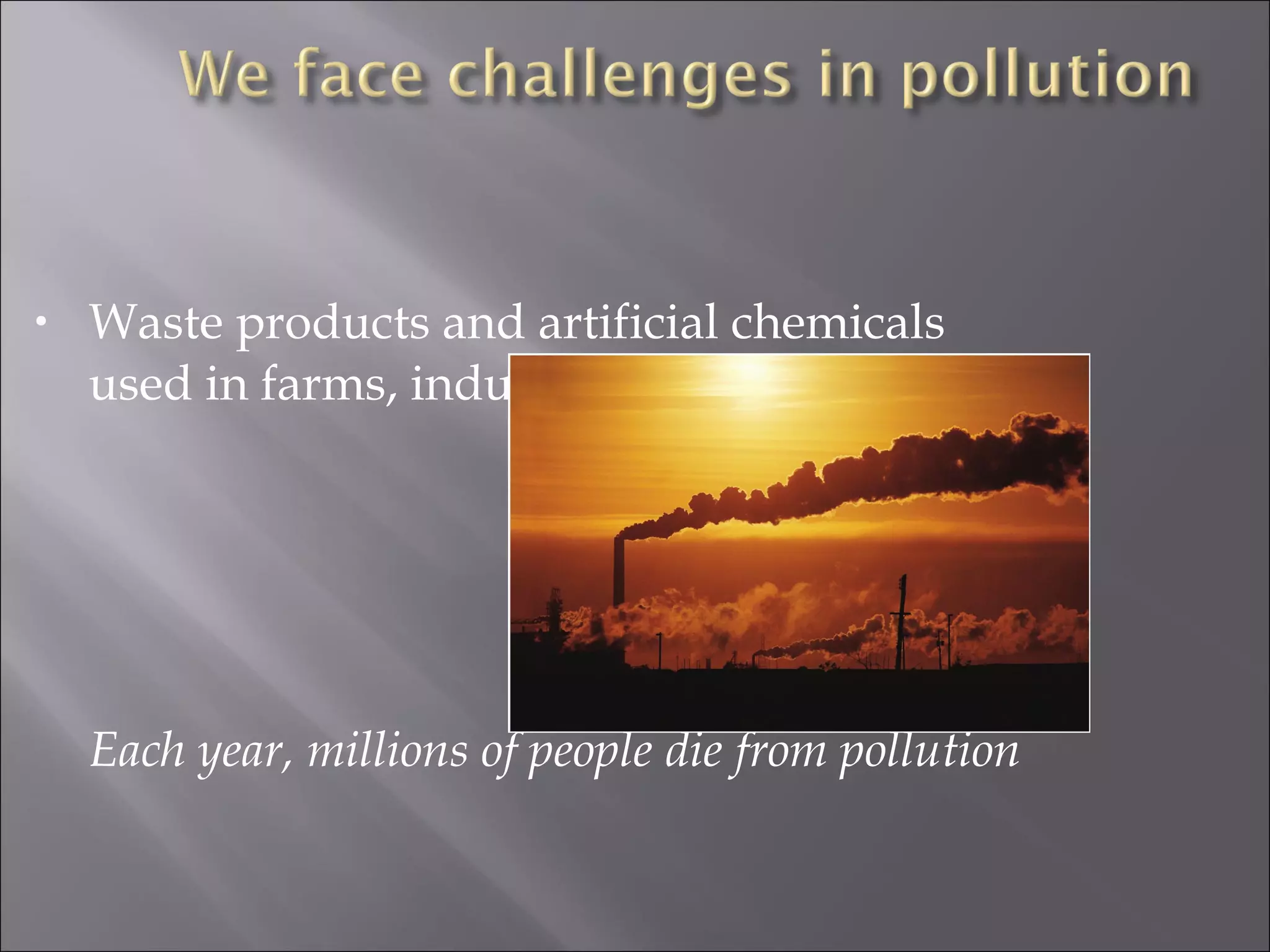
• Waste products and artificial chemicals
used in farms, industries, and households
Each year, millions of people die from pollution
• Scientists have firmly concluded that humans are
changing the composition of the atmosphere
• The Earth’s surface is warming
• Melting glaciers
• Rising sea levels
• Impacted wildlife and crops
• Increasingly destructive weather
Since the Industrial Revolution, atmospheric carbon dioxide
concentrations have risen by 37%, to the highest level in 650,000
years
• Human actions have driven many species extinct,
and biodiversity is declining dramatically
Biodiversity loss may be our biggest environmental
problem; once a species is extinct, it is gone forever
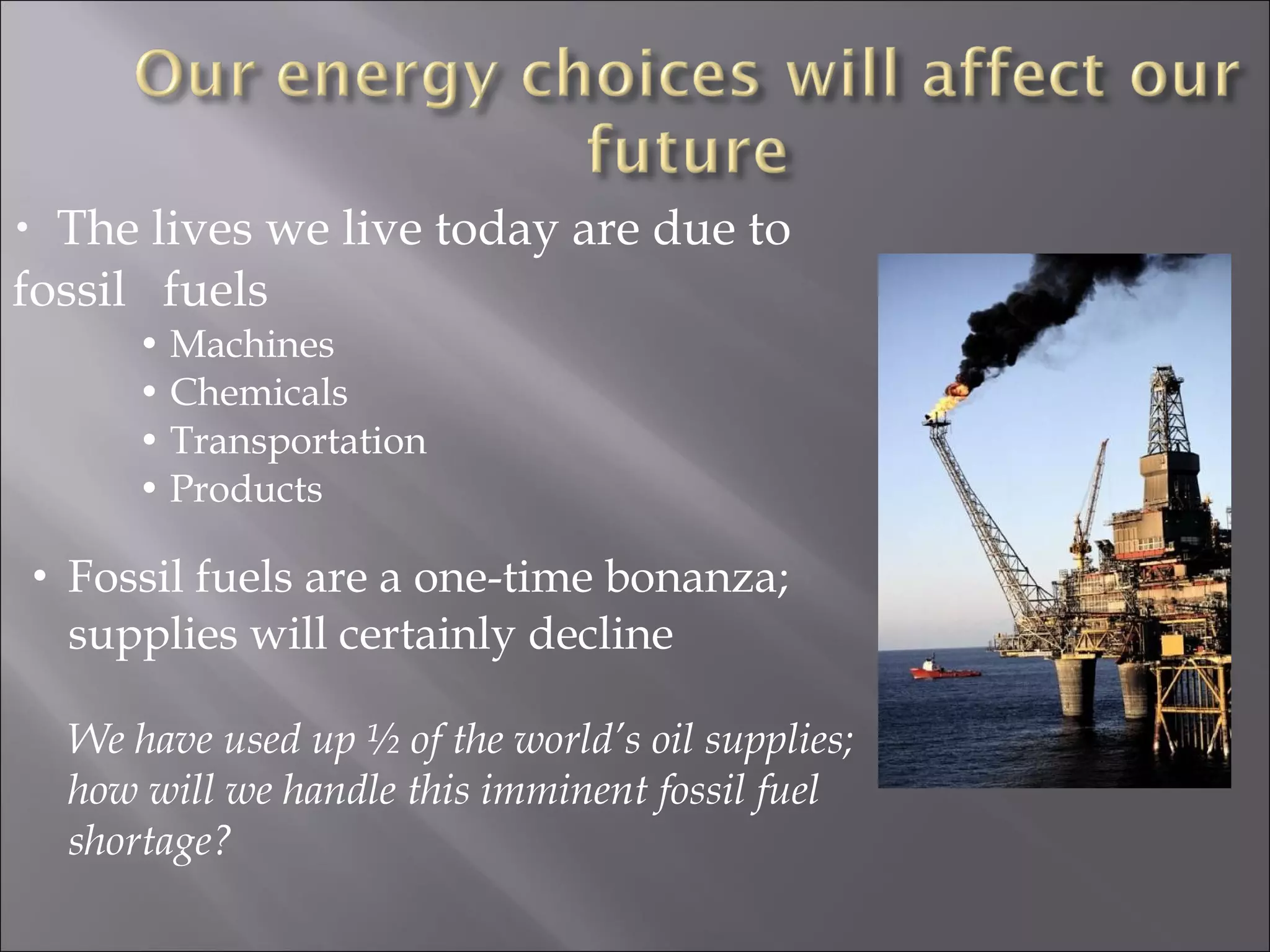
• The lives we live today are due to
fossil fuels
• Machines
• Chemicals
• Transportation
• Products
• Fossil fuels are a one-time bonanza;
supplies will certainly decline
We have used up ½ of the world’s oil supplies;
how will we handle this imminent fossil fuel
shortage?
 We must develop solutions that protect both our
quality of life and the environment
 Organic agriculture
 Technology
 Reduces pollution
 Biodiversity
 Protect species
 Waste disposal
 Recycling
 Alternative fuels
• Many people think environmental conditions are
better (Human ingenuity will solve any problem)
• Some think things are much worse in the world
(predict doom and disaster)
• How can you decide who is correct?
• Are the impacts limited to humans, or are other
organisms or systems involved?
• Are the proponents thinking in the long or short term?
• Are they considering all costs and benefits?
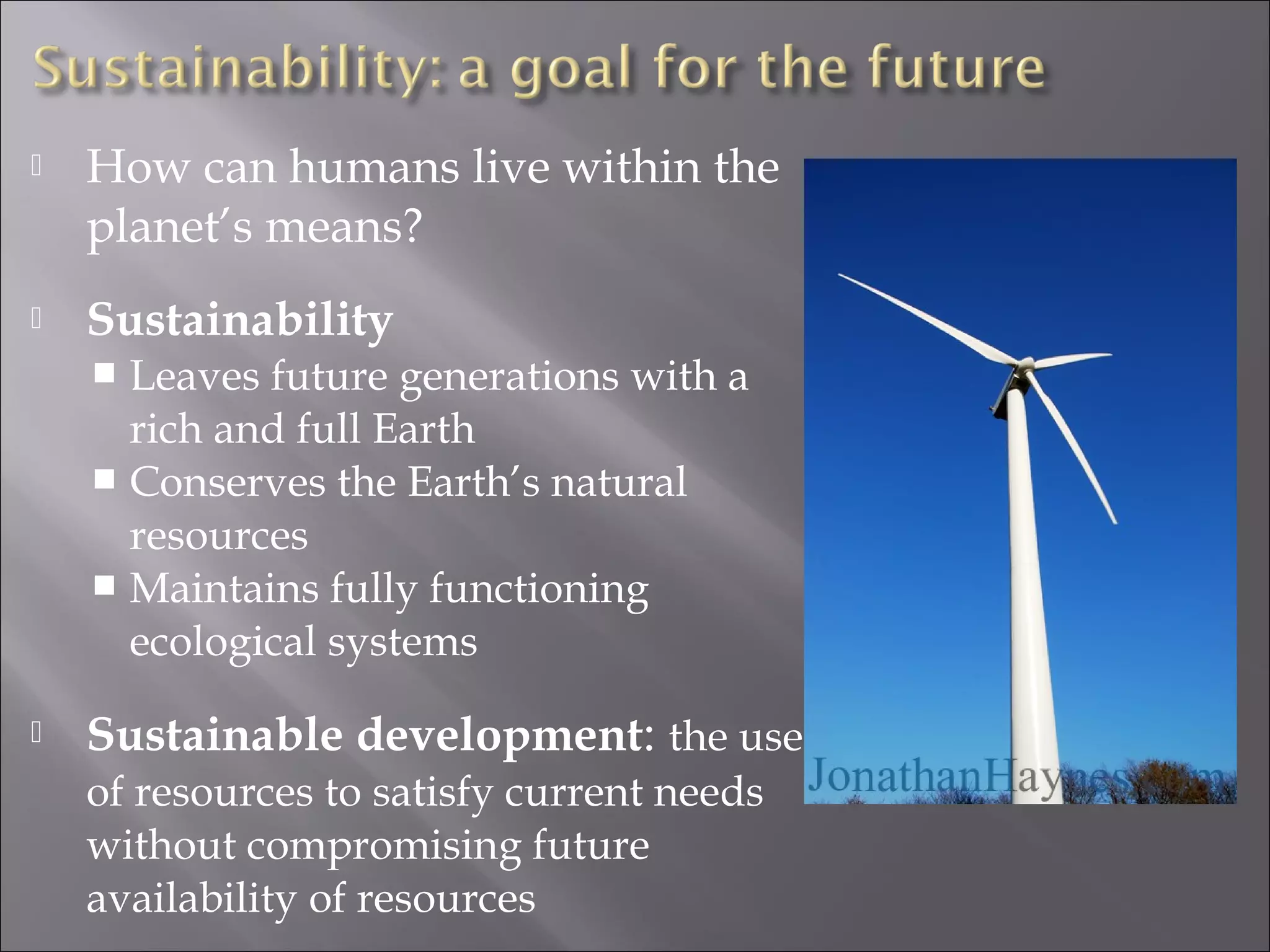
 How can humans live within the
planet’s means?
 Sustainability
 Leaves future generations with a
rich and full Earth
 Conserves the Earth’s natural
resources
 Maintains fully functioning
ecological systems
 Sustainable development: the use
of resources to satisfy current needs
without compromising future
availability of resources
 The triple bottom line:
sustainable solutions that
meet
 Environmental goals
 Economic goals
 Social goals
 Requires that humans
apply knowledge from the
sciences to
 Limit environmental impacts
 Maintain functioning
ecological systems
 Environmental science helps us understand our
relationship with the environment and informs our
attempts to solve and prevent problems.
 Solving environmental problems can move us
towards health, longevity, peace and prosperity
 Environmental science can help us find balanced
solutions to environmental problems

Environmental science

  • 1.
  • 2.
    Our environment iseverything that surrounds us, both natural and man-made.
  • 3.
    • All thethings around us with which we interact: • Living things • Animals, plants, forests, fungi, etc. • Nonliving things • Continents, oceans, clouds, soil, rocks • Our built environment • Buildings, human-created living centers • Social relationships and institutions
  • 4.
     Renewable resources: Perpetually available: sunlight, wind, wave energy  Renew themselves over short periods: timber, water, soil  These can be destroyed  Nonrenewable resources: can be depleted  Oil, coal, minerals Natural resources = substances and energy sources needed for survival
  • 5.
     “…the earthenables our people to survive, the environment must be respected and maintained. As long as the earth remains healthy, the people remain healthy.” (Long and Fox, 1996)
  • 6.
     More than6.7 billion humans  Why so many humans?  Agricultural revolution  Stable food supplies  Industrial revolution  Urbanized society powered by fossil fuels  Sanitation and medicines  More food
  • 7.
     Human populationgrowth exacerbates all environmental problems  The growth rate has slowed…but we still add more than 200,000 people to the planet each day We depend completely on the environment for survival  Life has become more pleasant for us so far (Increased wealth, health, mobility, leisure time)  But…natural systems have been degraded and environmental changes threaten long-term health and survival
  • 8.
     With yourpartner/group, brainstorm at least 10 ways in which destruction to the environment and depletion of resources can affect our overall well being as a population
  • 9.
    Environment  impacts Humans • It has an applied goal: developing solutions to environmental problems  An interdisciplinary field Natural sciences: information about the world Social sciences: values and human behavior, politics, economy, etc.
  • 10.
     The perceptionof what constitutes a problem varies between individuals and societies  Ex.: DDT, a pesticide  In developing countries: welcome because it kills malaria-carrying mosquitoes  In developed countries: not welcome, due to health risks
  • 11.
    •Environmental science • Thepursuit of knowledge about the natural world • Scientists try to remain objective •Environmentalism • A social movement dedicated to protecting the natural world
  • 12.
     The environmentalimpact of a person or population  Amount of biologically productive land + water for raw materials and to dispose/recycle waste  Overshoot: humans have surpassed the Earth’s capacity We are using 30% more of the planet’s resources than are available on a sustainable basis!
  • 13.
     The ecologicalfootprints of countries vary greatly  The U.S. footprint is almost 5 times greater than the world’s average  Developing countries have much smaller footprints than developed countries
  • 14.
    • Expanded foodproduction led to increased population and consumption • It’s one of humanity’s greatest achievements, but at an enormous environmental cost • Nearly half of the planet’s land surface is used for agriculture • Chemical fertilizers • Pesticides • Erosion • Changed natural systems
  • 15.
    • Waste productsand artificial chemicals used in farms, industries, and households Each year, millions of people die from pollution
  • 16.
    • Scientists havefirmly concluded that humans are changing the composition of the atmosphere • The Earth’s surface is warming • Melting glaciers • Rising sea levels • Impacted wildlife and crops • Increasingly destructive weather Since the Industrial Revolution, atmospheric carbon dioxide concentrations have risen by 37%, to the highest level in 650,000 years
  • 17.
    • Human actionshave driven many species extinct, and biodiversity is declining dramatically Biodiversity loss may be our biggest environmental problem; once a species is extinct, it is gone forever
  • 18.
    • The liveswe live today are due to fossil fuels • Machines • Chemicals • Transportation • Products • Fossil fuels are a one-time bonanza; supplies will certainly decline We have used up ½ of the world’s oil supplies; how will we handle this imminent fossil fuel shortage?
  • 19.
     We mustdevelop solutions that protect both our quality of life and the environment  Organic agriculture  Technology  Reduces pollution  Biodiversity  Protect species  Waste disposal  Recycling  Alternative fuels
  • 20.
    • Many peoplethink environmental conditions are better (Human ingenuity will solve any problem) • Some think things are much worse in the world (predict doom and disaster) • How can you decide who is correct? • Are the impacts limited to humans, or are other organisms or systems involved? • Are the proponents thinking in the long or short term? • Are they considering all costs and benefits?
  • 21.
     How canhumans live within the planet’s means?  Sustainability  Leaves future generations with a rich and full Earth  Conserves the Earth’s natural resources  Maintains fully functioning ecological systems  Sustainable development: the use of resources to satisfy current needs without compromising future availability of resources
  • 22.
     The triplebottom line: sustainable solutions that meet  Environmental goals  Economic goals  Social goals  Requires that humans apply knowledge from the sciences to  Limit environmental impacts  Maintain functioning ecological systems
  • 23.
     Environmental sciencehelps us understand our relationship with the environment and informs our attempts to solve and prevent problems.  Solving environmental problems can move us towards health, longevity, peace and prosperity  Environmental science can help us find balanced solutions to environmental problems