Introduction toIntroduction to
Environmental EngineeringEnvironmental Engineering
What is Environment?What is Environment?
• Definition: The word environment isDefinition: The word environment is
originated from environ, which mean thingsoriginated from environ, which mean things
that surrounds.that surrounds.
• So environment means all that environ usSo environment means all that environ us
like all physical and biological surroundingslike all physical and biological surroundings
i-e air, water, human, trees, plants, animals,i-e air, water, human, trees, plants, animals,
micro-organisms, road, building etc.micro-organisms, road, building etc.
• Broadly speaking environment is defined asBroadly speaking environment is defined as
sum of all conditions and influence , whichsum of all conditions and influence , which
affects development and life all organism onaffects development and life all organism on
earth.earth.
• The environment is collective term for allThe environment is collective term for all
condition, in which organism lives.condition, in which organism lives.
• Thus all factor such as light, temperature,Thus all factor such as light, temperature,
water, soil, air and organism constitutewater, soil, air and organism constitute
environment.environment.
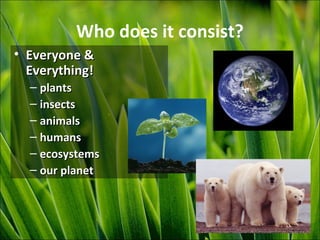
Who does it consist?
• Everyone &Everyone &
Everything!Everything!
– plantsplants
– insectsinsects
– animalsanimals
– humanshumans
– ecosystemsecosystems
– our planetour planet
• Ecology:
• It is the scientific analysis and study of
interactions and various relationship of living
organisms with each other and with their
environment.
• Population:
• The group of similar individual species that
live together in same area in same time ,in
ecological term form population.
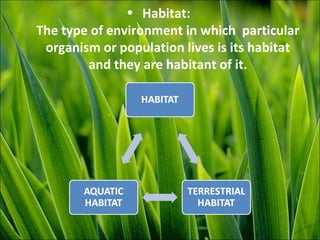
• Habitat:
The type of environment in which particular
organism or population lives is its habitat
and they are habitant of it.
• Biodiversity: it is a term we use to define
variety of life on earth like plants, animals etc.
• It refers to wide variety of ecosystem and
living organism and their habitats.
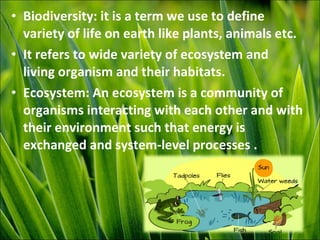
• Ecosystem: An ecosystem is a community of
organisms interacting with each other and with
their environment such that energy is
exchanged and system-level processes .
• Species:
• A group of living organisms consisting of
similar individuals having similar
characteristics and capable of interbreeding.
Endangered is an specie which is in danger of
extinction.
• Fauna: The animal of specified region or time.
• Flora: The plant of specified region or time.
• Bacteria:
• They are unicellular(single cell)
prokaryotic(lack of cell/membrane) living
micro organism. Their importance is that (1)
they change composition and shape of
organism.(2) Alimentary canal bacteria which
help us in digestion.(3) Medical bacteria help
us in medicine making.(4) industrial bacteria
which are harmful for living organisms.
• However bacteria which are harmful and
causes disease are termed as pathogenic
bacteria like industrial bacteria. And those
which do not cause disease are Non-
pathogenic bacteria.
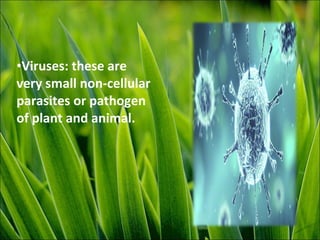
•Viruses: these are
very small non-cellular
parasites or pathogen
of plant and animal.
What is EnvironmentalWhat is Environmental
Engineering?Engineering?
Definition: The application of science andDefinition: The application of science and
engineering knowledge, concepts andengineering knowledge, concepts and
principles to improve ,or restore our naturalprinciples to improve ,or restore our natural
environment (air, water and land) and solveenvironment (air, water and land) and solve
environmental problems, in order to provideenvironmental problems, in order to provide
healthy environment for all living organism.healthy environment for all living organism.
• It involves management of waste water,It involves management of waste water,
pollution control, recycling waste disposal,pollution control, recycling waste disposal,
radiation protection, industrial hygiene,radiation protection, industrial hygiene,
environmental stability, and public healthenvironmental stability, and public health
issues as well as knowledge of environmentalissues as well as knowledge of environmental
laws.laws.
• It also includes study of the environmentalIt also includes study of the environmental
impacts of proposed construction projects.impacts of proposed construction projects.
Difference b/w EnvironmentalDifference b/w Environmental
Engineering and EnvironmentalEngineering and Environmental
science ?science ?
• Environmental science deals only with studyEnvironmental science deals only with study
of environmental issues which hazardsof environmental issues which hazards
environment, and environmental engineeringenvironment, and environmental engineering
deals with methods, techniques anddeals with methods, techniques and
application of engineering principles to solveapplication of engineering principles to solve
the environmental issues.the environmental issues.
What areWhat are
environmental issues?environmental issues?
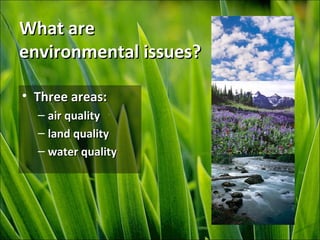
• Three areas:Three areas:
– air qualityair quality
– land qualityland quality
– water qualitywater quality
Element of Environment
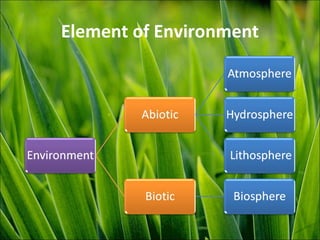
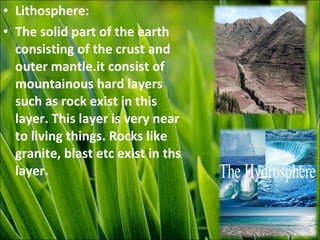
• Lithosphere:
• The solid part of the earth
consisting of the crust and
outer mantle.it consist of
mountainous hard layers
such as rock exist in this
layer. This layer is very near
to living things. Rocks like
granite, blast etc exist in ths
layer.
• lyer.Hydrosphere:
• the watery layer of the earth's surface;
includes water vapor etc.
• It consist of ocean, sea river etc. it covers 71%
of total earth in which 97% is saline water.
Atmosphere
• It cover whole area sorrounding the earth
upto 800km. It consist of different gases such
as nitrogen oxygen and co2. nitrogen cover
78%, in atmosphere, oxygen 21%. Co2 is
heavy gas and settle to lower layer atmos
• Atmos consist of following layers
• 1 Troposphere consist of clouds etc not
suitable for aircraft. 2 stratosphere which is
very stable and suitable for aircraft
• Mespsphere third layer 85km high from earth
surface here mixing of air takes place.
• Tratosphere part of atmos
• It is lower dense layer of atmos. It consist of cloud
etc and environmental or seasonal changes takes
place in this sphere uts height is 18km from earth
surface
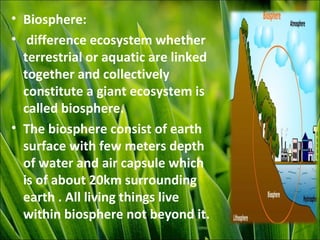
• Biosphere:
• difference ecosystem whether
terrestrial or aquatic are linked
together and collectively
constitute a giant ecosystem is
called biosphere.
• The biosphere consist of earth
surface with few meters depth
of water and air capsule which
is of about 20km surrounding
earth . All living things live
within biosphere not beyond it.
Types of Environmental
Engineering
• Environmental chemistry
• Environmental microbiology
• Environmental impact assessment
• Environmental hydrology
• Environmental health and safety
• Environmental quality of modeling and
monitoring
• Water and waste water treatment,
distribution and disposal
• Air pollution and its control.
• Noise pollution and its control.
• Solid and hazards waste management.

important terms related to environmental engineering

  • 1.
    Introduction toIntroduction to EnvironmentalEngineeringEnvironmental Engineering
  • 2.
    What is Environment?Whatis Environment? • Definition: The word environment isDefinition: The word environment is originated from environ, which mean thingsoriginated from environ, which mean things that surrounds.that surrounds. • So environment means all that environ usSo environment means all that environ us like all physical and biological surroundingslike all physical and biological surroundings i-e air, water, human, trees, plants, animals,i-e air, water, human, trees, plants, animals, micro-organisms, road, building etc.micro-organisms, road, building etc.
  • 3.
    • Broadly speakingenvironment is defined asBroadly speaking environment is defined as sum of all conditions and influence , whichsum of all conditions and influence , which affects development and life all organism onaffects development and life all organism on earth.earth. • The environment is collective term for allThe environment is collective term for all condition, in which organism lives.condition, in which organism lives. • Thus all factor such as light, temperature,Thus all factor such as light, temperature, water, soil, air and organism constitutewater, soil, air and organism constitute environment.environment.
  • 4.
    Who does itconsist? • Everyone &Everyone & Everything!Everything! – plantsplants – insectsinsects – animalsanimals – humanshumans – ecosystemsecosystems – our planetour planet
  • 5.
    • Ecology: • Itis the scientific analysis and study of interactions and various relationship of living organisms with each other and with their environment. • Population: • The group of similar individual species that live together in same area in same time ,in ecological term form population.
  • 6.
    • Habitat: The typeof environment in which particular organism or population lives is its habitat and they are habitant of it.
  • 7.
    • Biodiversity: itis a term we use to define variety of life on earth like plants, animals etc. • It refers to wide variety of ecosystem and living organism and their habitats. • Ecosystem: An ecosystem is a community of organisms interacting with each other and with their environment such that energy is exchanged and system-level processes .
  • 8.
    • Species: • Agroup of living organisms consisting of similar individuals having similar characteristics and capable of interbreeding. Endangered is an specie which is in danger of extinction. • Fauna: The animal of specified region or time. • Flora: The plant of specified region or time.
  • 9.
    • Bacteria: • Theyare unicellular(single cell) prokaryotic(lack of cell/membrane) living micro organism. Their importance is that (1) they change composition and shape of organism.(2) Alimentary canal bacteria which help us in digestion.(3) Medical bacteria help us in medicine making.(4) industrial bacteria which are harmful for living organisms.
  • 10.
    • However bacteriawhich are harmful and causes disease are termed as pathogenic bacteria like industrial bacteria. And those which do not cause disease are Non- pathogenic bacteria.
  • 11.
    •Viruses: these are verysmall non-cellular parasites or pathogen of plant and animal.
  • 12.
    What is EnvironmentalWhatis Environmental Engineering?Engineering? Definition: The application of science andDefinition: The application of science and engineering knowledge, concepts andengineering knowledge, concepts and principles to improve ,or restore our naturalprinciples to improve ,or restore our natural environment (air, water and land) and solveenvironment (air, water and land) and solve environmental problems, in order to provideenvironmental problems, in order to provide healthy environment for all living organism.healthy environment for all living organism.
  • 13.
    • It involvesmanagement of waste water,It involves management of waste water, pollution control, recycling waste disposal,pollution control, recycling waste disposal, radiation protection, industrial hygiene,radiation protection, industrial hygiene, environmental stability, and public healthenvironmental stability, and public health issues as well as knowledge of environmentalissues as well as knowledge of environmental laws.laws. • It also includes study of the environmentalIt also includes study of the environmental impacts of proposed construction projects.impacts of proposed construction projects.
  • 14.
    Difference b/w EnvironmentalDifferenceb/w Environmental Engineering and EnvironmentalEngineering and Environmental science ?science ? • Environmental science deals only with studyEnvironmental science deals only with study of environmental issues which hazardsof environmental issues which hazards environment, and environmental engineeringenvironment, and environmental engineering deals with methods, techniques anddeals with methods, techniques and application of engineering principles to solveapplication of engineering principles to solve the environmental issues.the environmental issues.
  • 15.
    What areWhat are environmentalissues?environmental issues? • Three areas:Three areas: – air qualityair quality – land qualityland quality – water qualitywater quality
  • 16.
  • 17.
    • Lithosphere: • Thesolid part of the earth consisting of the crust and outer mantle.it consist of mountainous hard layers such as rock exist in this layer. This layer is very near to living things. Rocks like granite, blast etc exist in ths layer.
  • 18.
    • lyer.Hydrosphere: • thewatery layer of the earth's surface; includes water vapor etc. • It consist of ocean, sea river etc. it covers 71% of total earth in which 97% is saline water.
  • 19.
    Atmosphere • It coverwhole area sorrounding the earth upto 800km. It consist of different gases such as nitrogen oxygen and co2. nitrogen cover 78%, in atmosphere, oxygen 21%. Co2 is heavy gas and settle to lower layer atmos • Atmos consist of following layers • 1 Troposphere consist of clouds etc not suitable for aircraft. 2 stratosphere which is very stable and suitable for aircraft
  • 20.
    • Mespsphere thirdlayer 85km high from earth surface here mixing of air takes place.
  • 21.
    • Tratosphere partof atmos • It is lower dense layer of atmos. It consist of cloud etc and environmental or seasonal changes takes place in this sphere uts height is 18km from earth surface
  • 22.
    • Biosphere: • differenceecosystem whether terrestrial or aquatic are linked together and collectively constitute a giant ecosystem is called biosphere. • The biosphere consist of earth surface with few meters depth of water and air capsule which is of about 20km surrounding earth . All living things live within biosphere not beyond it.
  • 23.
    Types of Environmental Engineering •Environmental chemistry • Environmental microbiology • Environmental impact assessment • Environmental hydrology • Environmental health and safety • Environmental quality of modeling and monitoring
  • 24.
    • Water andwaste water treatment, distribution and disposal • Air pollution and its control. • Noise pollution and its control. • Solid and hazards waste management.

Editor's Notes

  • #2 PowerPoint presentation for Introduction to Environmental Engineering lesson, TeachEngineering.org
  • #5 Image sources: Earth: Visible Earth Gallery, NASA, http://visibleearth.nasa.gov/view.php?id=57723 Plant: National Science Foundation, http://www.nsf.gov/news/special_reports/science_nation/popup/leafsensor/plant.jsp Polar Bears: US Fish & Wildlife Service, http://www.fws.gov/phmay2012.html
  • #16 Image sources: Sky: California Environmental Protection Agency, http://www.arb.ca.gov/research/research.htm Meadow: National Park Service, http://www.nps.gov/mora/planyourvisit/paradise.htm River: National Park Service, http://www.nps.gov/olym/naturescience/elwha-faq.htm