INTRODUCTION 
› Commerce is a division of trade or 
production which deals with the exchange of 
goods and services from producer to final 
consumer 
› E-commerce is the purchasing , selling & 
exchanging goods and services over 
computer network or internet through which 
transactions or terms of sale are performed 
electronically
TRADITIONAL BUSINESS SYSTEM 
Customer 
Distributor 
&Retailer 
10% 
MFG 
Unit 
90% 
E-Commerce system 
Company 
or 
Wholesaler 
Commission 
~5% Customers
EX- Flipkart 
Type of Business to Customer E-commerce. 
Its established in 2007 by Sachin and Binny Bansal. 
 It operates exclusively in India, where it is headquartered in 
Bangalore, Karnataka. It is registered in Singapore, and owned 
by a Singapore-based holding company. 
Legally, Flipkart is not an Indian company since it is registered 
in Singapore and majority of its shareholders are foreigners. 
Because foreign companies are not allowed to do multi-brand 
e-retailing in India, Flipkart sells goods in India through a 
company called WS Retail. Other third-party sellers or 
companies can also sell goods through the Flipkart platform.
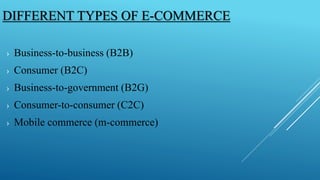
DIFFERENT TYPES OF E-COMMERCE 
› Business-to-business (B2B) 
› Consumer (B2C) 
› Business-to-government (B2G) 
› Consumer-to-consumer (C2C) 
› Mobile commerce (m-commerce)
WHAT IS B2B E-COMMERCE? 
› B2B e-commerce is simply defined as 
ecommerce between companies. About 80% of 
e-commerce is of this type. 
› Examples: 
› Intel selling processors to Asus.
WHAT IS B2C ECOMMERCE? 
› Business-to-consumer e-commerce, or 
commerce between companies and consumers, 
involves customers gathering information; 
purchasing physical goods or receiving 
products over an electronic network. 
› Example: 
› Asus selling laptops
WHAT IS B2G ECOMMERCE? 
› Business-to-government e-commerce or B2G 
is generally defined as commerce between 
companies and the public sector. It refers to the 
use of the Internet for public procurement, 
licensing procedures, and other government-related 
operations 
› Example: 
› Business pay taxes, file reports, or sell 
goods and services to Govt. agencies.
WHAT IS C2C ECOMMERCE? 
› Consumer-to-consumer e-commerce or C2C is 
simply commerce between private individuals 
or consumers. 
› Example: 
› Rahul buying an iPod from Tom on eBay 
› Me selling a cellphone to my neighbour
WHAT IS M-COMMERCE? 
› M-commerce (mobile commerce) is the buying and 
selling of goods and services through wireless 
technology-i.e., handheld devices such as cellular 
telephones 
› Mobile Ticketing 
› Information Services like Just Dial etc,, 
› Mobile Banking
Application 
or 
website 
Home Page 
Login 
Search for desire products 
Or offers 
Billing Address 
And contact details 
Payment Options 
Add to cart / place order 
Order Status 
Tracking order 
Delivered 
Process flow
E-R DIAGRAM
ADVANTAGES OF E-COMMERCE 
› Faster buying/selling procedure, as well as easy to find products. 
› Buying/selling 24/7. 
› More reach to customers, there is no geographic limitations. 
› Low operational costs and better quality of services. 
› No need of physical company set-ups. 
› Easy to start and manage a business. 
› Customers can easily select products from different providers.
ADVANTAGES OF E-COMMERCE 
› Lots of Choices 
› Easier to Compare Prices 
› No Need to Handle Currency Notes 
› Eliminate Travel Time and Cost 
› E-commerce helps organization to provide better 
customer services.
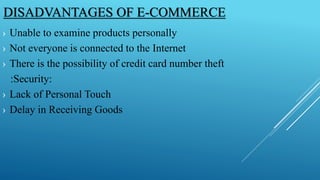
DISADVANTAGES OF E-COMMERCE 
› Unable to examine products personally 
› Not everyone is connected to the Internet 
› There is the possibility of credit card number theft 
:Security: 
› Lack of Personal Touch 
› Delay in Receiving Goods
CONCLUSION 
› E-commerce is generally very useful in day to 
day to life as it makes life faster and easy but 
with some disadvantages.

E commerce advantages,disadvantages,E-r diag,process flow

  • 2.
    INTRODUCTION › Commerceis a division of trade or production which deals with the exchange of goods and services from producer to final consumer › E-commerce is the purchasing , selling & exchanging goods and services over computer network or internet through which transactions or terms of sale are performed electronically
  • 3.
    TRADITIONAL BUSINESS SYSTEM Customer Distributor &Retailer 10% MFG Unit 90% E-Commerce system Company or Wholesaler Commission ~5% Customers
  • 4.
    EX- Flipkart Typeof Business to Customer E-commerce. Its established in 2007 by Sachin and Binny Bansal.  It operates exclusively in India, where it is headquartered in Bangalore, Karnataka. It is registered in Singapore, and owned by a Singapore-based holding company. Legally, Flipkart is not an Indian company since it is registered in Singapore and majority of its shareholders are foreigners. Because foreign companies are not allowed to do multi-brand e-retailing in India, Flipkart sells goods in India through a company called WS Retail. Other third-party sellers or companies can also sell goods through the Flipkart platform.
  • 5.
    DIFFERENT TYPES OFE-COMMERCE › Business-to-business (B2B) › Consumer (B2C) › Business-to-government (B2G) › Consumer-to-consumer (C2C) › Mobile commerce (m-commerce)
  • 6.
    WHAT IS B2BE-COMMERCE? › B2B e-commerce is simply defined as ecommerce between companies. About 80% of e-commerce is of this type. › Examples: › Intel selling processors to Asus.
  • 7.
    WHAT IS B2CECOMMERCE? › Business-to-consumer e-commerce, or commerce between companies and consumers, involves customers gathering information; purchasing physical goods or receiving products over an electronic network. › Example: › Asus selling laptops
  • 8.
    WHAT IS B2GECOMMERCE? › Business-to-government e-commerce or B2G is generally defined as commerce between companies and the public sector. It refers to the use of the Internet for public procurement, licensing procedures, and other government-related operations › Example: › Business pay taxes, file reports, or sell goods and services to Govt. agencies.
  • 9.
    WHAT IS C2CECOMMERCE? › Consumer-to-consumer e-commerce or C2C is simply commerce between private individuals or consumers. › Example: › Rahul buying an iPod from Tom on eBay › Me selling a cellphone to my neighbour
  • 10.
    WHAT IS M-COMMERCE? › M-commerce (mobile commerce) is the buying and selling of goods and services through wireless technology-i.e., handheld devices such as cellular telephones › Mobile Ticketing › Information Services like Just Dial etc,, › Mobile Banking
  • 11.
    Application or website Home Page Login Search for desire products Or offers Billing Address And contact details Payment Options Add to cart / place order Order Status Tracking order Delivered Process flow
  • 12.
  • 13.
    ADVANTAGES OF E-COMMERCE › Faster buying/selling procedure, as well as easy to find products. › Buying/selling 24/7. › More reach to customers, there is no geographic limitations. › Low operational costs and better quality of services. › No need of physical company set-ups. › Easy to start and manage a business. › Customers can easily select products from different providers.
  • 14.
    ADVANTAGES OF E-COMMERCE › Lots of Choices › Easier to Compare Prices › No Need to Handle Currency Notes › Eliminate Travel Time and Cost › E-commerce helps organization to provide better customer services.
  • 15.
    DISADVANTAGES OF E-COMMERCE › Unable to examine products personally › Not everyone is connected to the Internet › There is the possibility of credit card number theft :Security: › Lack of Personal Touch › Delay in Receiving Goods
  • 16.
    CONCLUSION › E-commerceis generally very useful in day to day to life as it makes life faster and easy but with some disadvantages.