Overview of Electronic Commerce
Learning Objectives
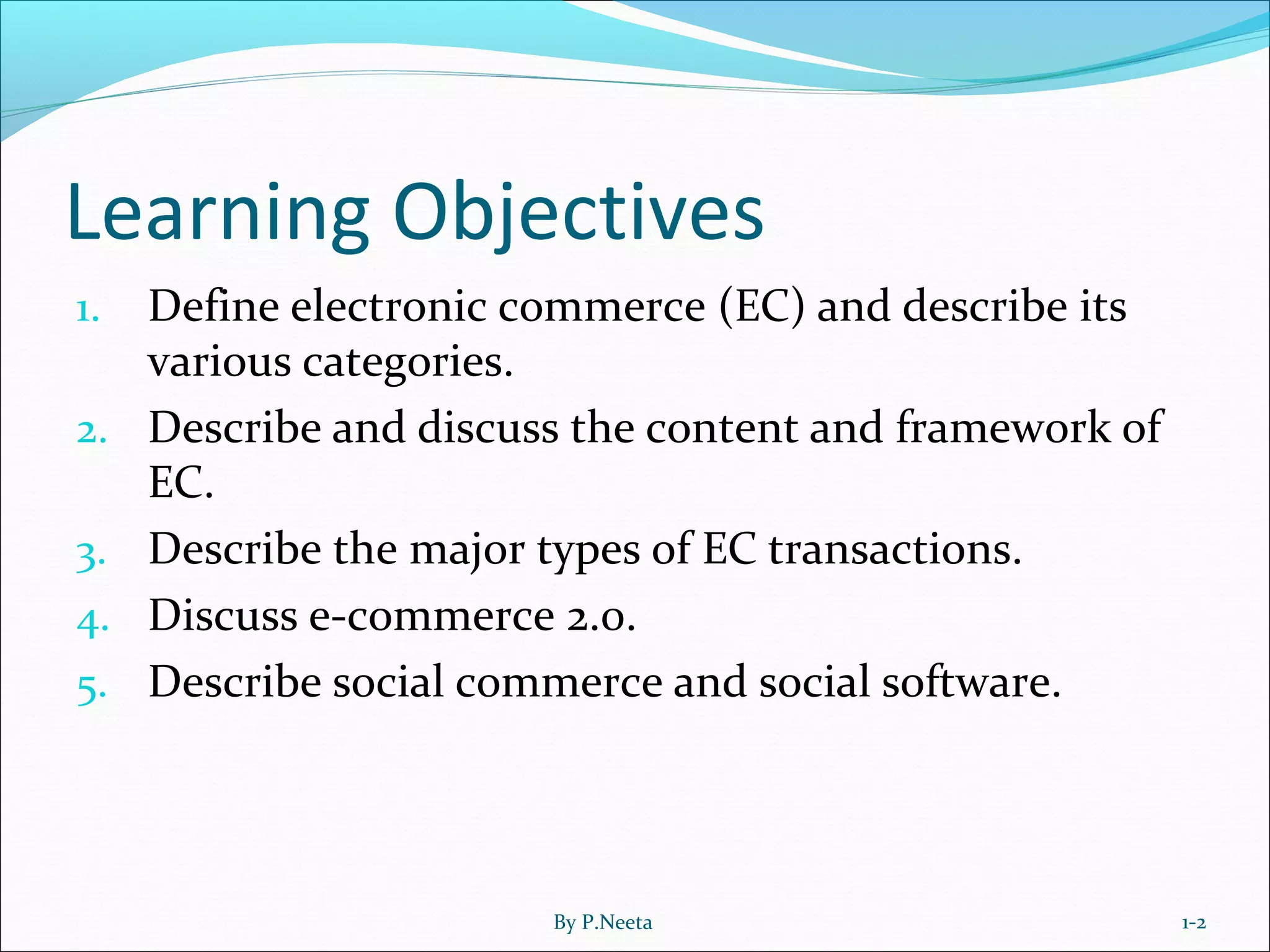
1. Define electronic commerce (EC) and describe its
various categories.
2. Describe and discuss the content and framework of
EC.
3. Describe the major types of EC transactions.
4. Discuss e-commerce 2.0.
5. Describe social commerce and social software.
1-2By P.Neeta
Learning Objectives
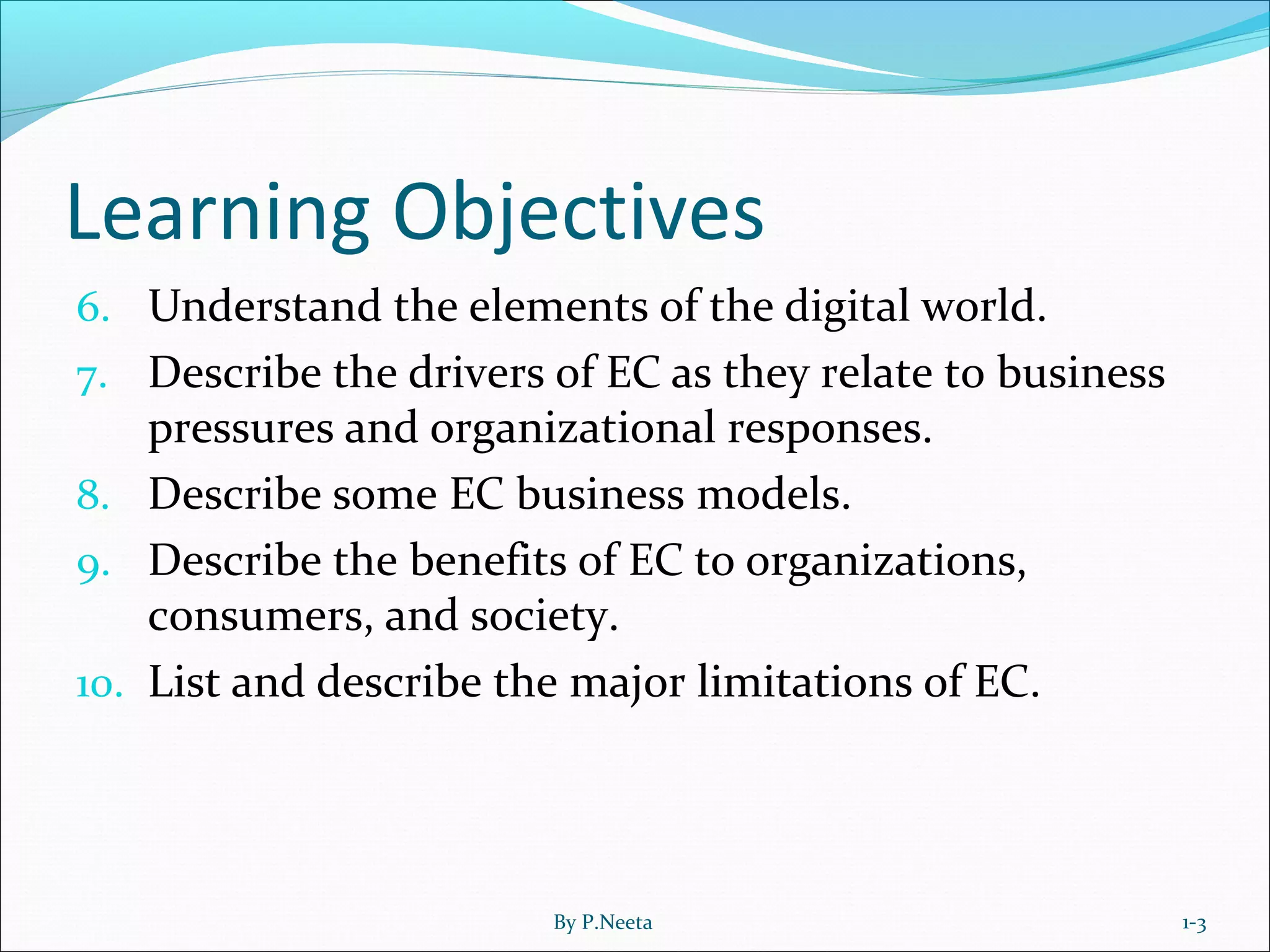
6. Understand the elements of the digital world.
7. Describe the drivers of EC as they relate to business
pressures and organizational responses.
8. Describe some EC business models.
9. Describe the benefits of EC to organizations,
consumers, and society.
10. List and describe the major limitations of EC.
1-3By P.Neeta
INTRODUCTION TO E-COMMERCE
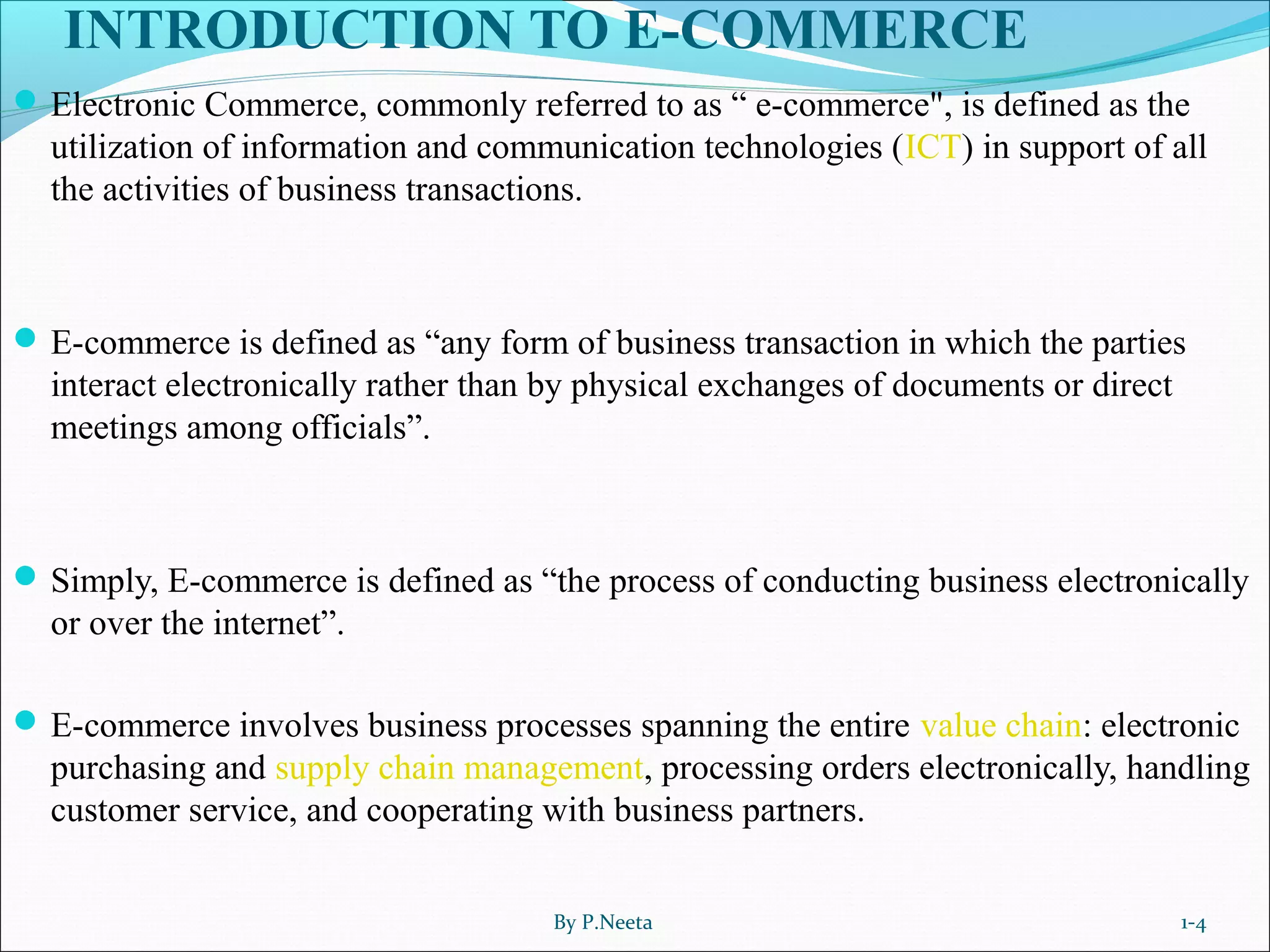
Electronic Commerce, commonly referred to as “ e-commerce", is defined as the
utilization of information and communication technologies (ICT) in support of all
the activities of business transactions.
E-commerce is defined as “any form of business transaction in which the parties
interact electronically rather than by physical exchanges of documents or direct
meetings among officials”.
Simply, E-commerce is defined as “the process of conducting business electronically
or over the internet”.
E-commerce involves business processes spanning the entire value chain: electronic
purchasing and supply chain management, processing orders electronically, handling
customer service, and cooperating with business partners.
By P.Neeta 1-4
ADVANTAGES OF E-COMMERCE:
Increased sales opportunities for seller
 Wider product availability to the buyers.
Decreased costs for sellers
Customized and personalized information and buying
options.
24 hours a day, 7 days a week sales for sellers and 24/7
shopping for buyers.
Access to global markets for sellers.
Increased speed and accuracy of information delivery.
Data collection and customer preferences tracking are
available through E-Business.
By P.Neeta 1-5
Advantages of E-commerce
Distances do not matter in carrying out trade.
Works 24 hours a day, 7 days a week, 365 days a year round the
clock.
Compared to retail store or office the cost of setting up an E-
commerce website is very low.
Flexibility to add and remove a product's in a website than in
catalogues or brouchers.
Gives exposure to previously untapped market segments.
Error reduction becoz,orders don't have to be re-keyed into order
entry systems and increased efficiencies through the automation of
the business processes.
Wider choice and no wastage of time
Can avail services such as financial services, legal services, medical advice etc.,
form appropriate portals.
 Large variety of goods accessible easily, without spending time and money by
personal visits and searching in various shops.
A website helps the business to reach out to a worldwide customer base at a very
local cost.
Reduction in order processing cost
All documents are exchanged electronically.
Funds transfer is faster.
Middlemen such as retailers can be eliminated as a manufacturer can reach out
directly to a customer.
Disadvantages of E-Commerce
Inability to touch and feel
Online store do not exsist for very long
No one to guide like a shopkeeper
Many companies do not know exactly how to set up a store,
resulting in a large group of annoyed and dissatisfied customers
No 100% safety. Hackers intercept transactions and cause problems
for both consumers and companies that operate on the internet.
Business on Internet will not reach women and elderly persons in a
developing nation.
Difficulty in identifying the location of the transaction activity.
Poses problems to sell products to target group.
Internet access is not widely available at present in Indian context.
Payment by credit card requires faith in the system security becoz hackers can steal
and misuse credit card info.
Small businesses may find it difficult to confirm to these standards.
De-personalize transactions.
Virus attacks and other problems.
Difficulty to contain e-commerce within a geographically defined
trade area.
Lack of security to information on the internet.
Electronic Commerce:
Definitions and Concepts
electronic commerce (EC)
The process of buying, selling, or exchanging products,
services, or information via computer
e-business
A broader definition of EC that includes not just the
buying and selling of goods and services, but also
servicing customers, collaborating with business
partners, and conducting electronic transactions within
an organization
1-10By P.Neeta
Electronic Commerce:
Definitions and Concepts
MAJOR EC CONCEPTS
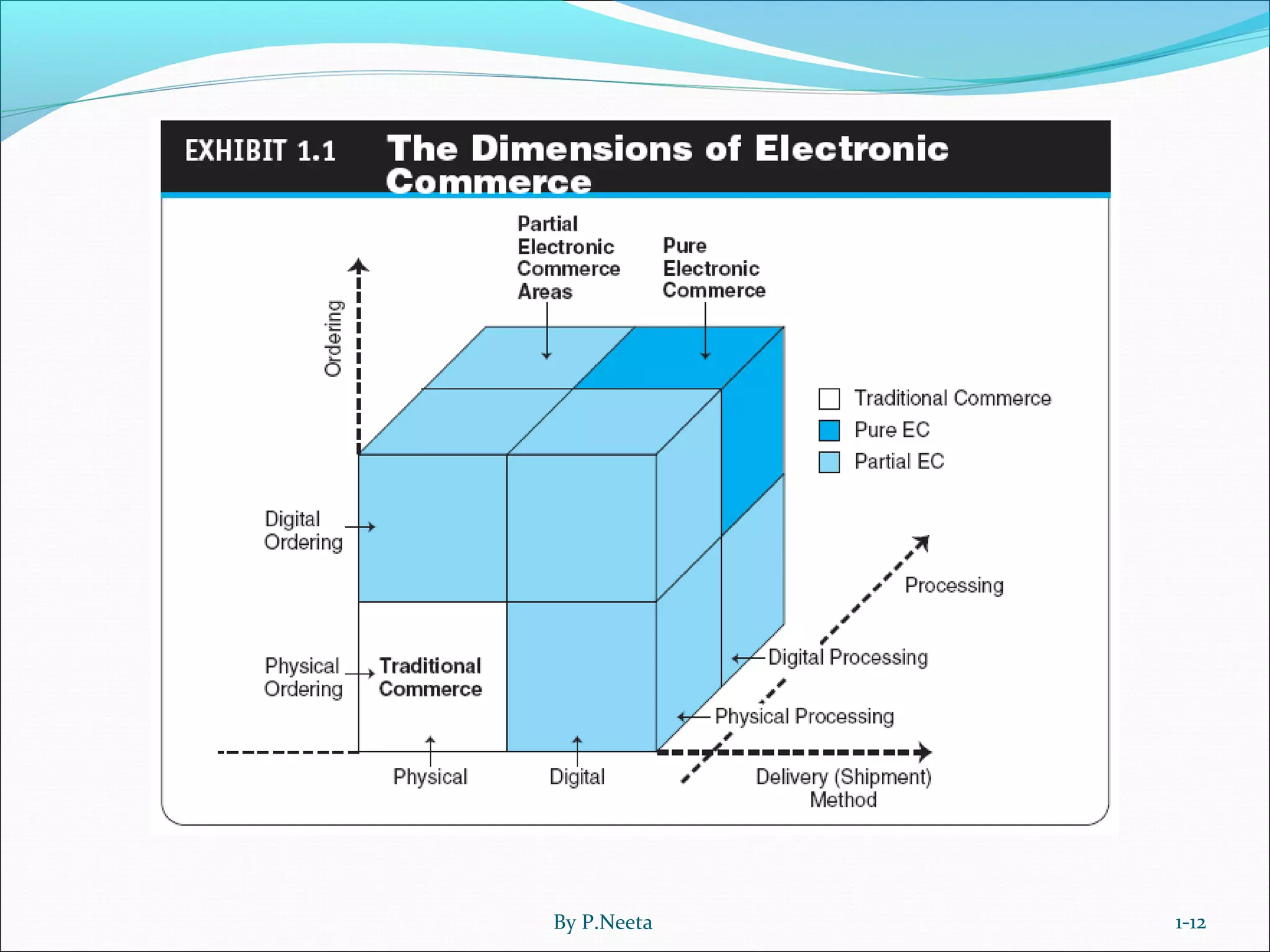
Pure Versus Partial EC
EC Organizations
 brick-and-mortar (old economy) organizations
Old-economy organizations (corporations) that perform their
primary business offline, selling physical products by means of
physical agents
 virtual (pure-play) organizations
Organizations that conduct their business activities solely online
 click-and-mortar (click-and-brick) organizations
Organizations that conduct some e-commerce activities, usually as an
additional marketing channel
1-11By P.Neeta
1-12By P.Neeta
Electronic Commerce:
Definitions and Concepts
ELECTRONIC MARKETS AND NETWORKS
electronic market (e-marketplace)
An online marketplace where buyers and sellers meet to
exchange goods, services, money, or information
intranet
An internal corporate or government network that uses
Internet tools, such as Web browsers, and Internet
protocols
extranet
A network that uses the Internet to link multiple intranets
1-13By P.Neeta
1-14By P.Neeta
Scope of E-Commerce
Marketing, sales and sales promotion
Pre-sales, subcontracts, supply
Financing and insurance
Commercial transactions: ordering, delivery, payment
Product service and maintenance
Co-operative product development
Distributed co-operative working
Use of public and private services
· Business-to-administrations (e.g. customs, etc)
· Transport and logistics
· Public procurement
· Automatic trading of digital goods
· Accounting
· Dispute resolution
By P.Neeta 1-15
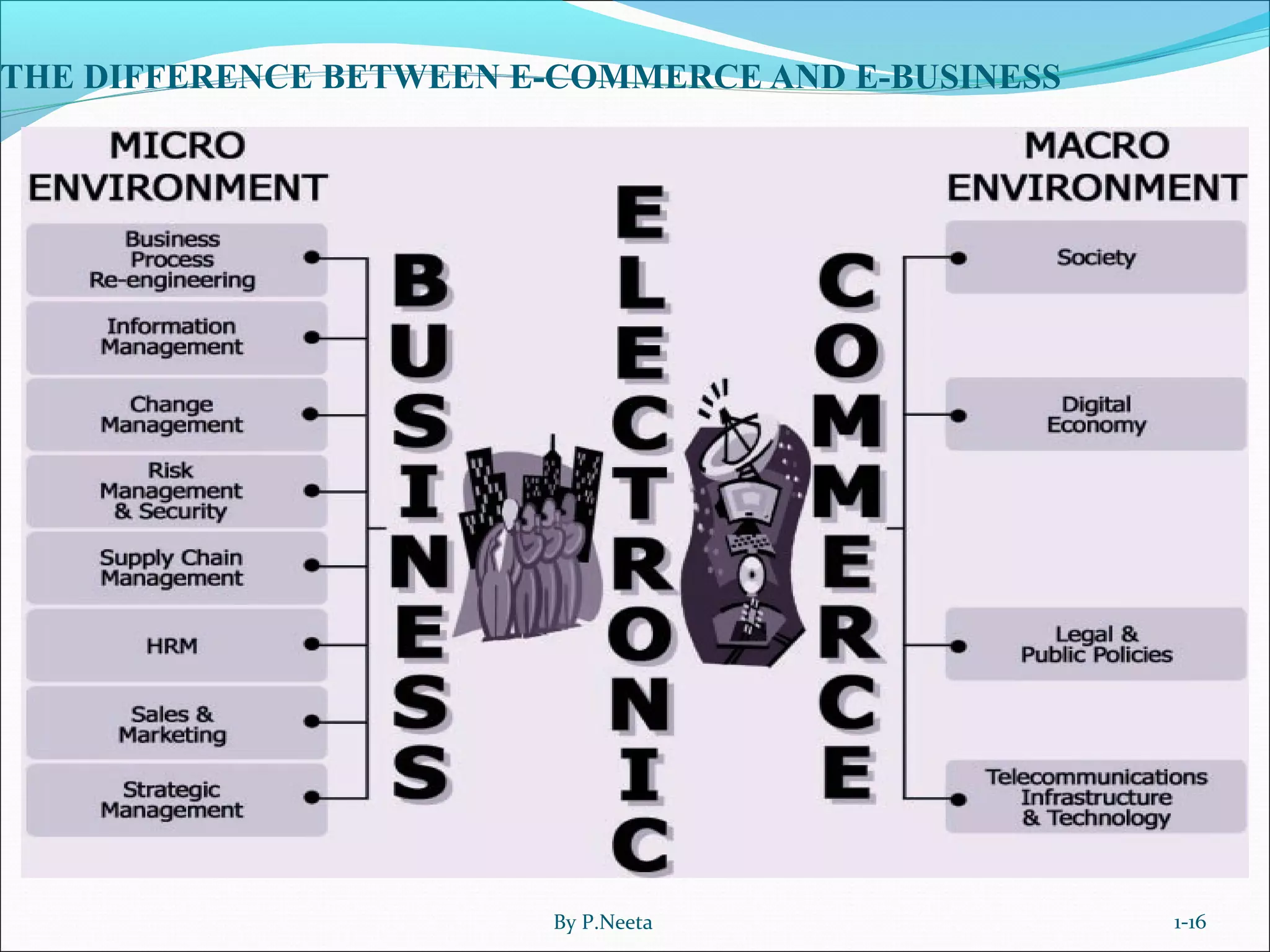
THE DIFFERENCE BETWEEN E-COMMERCE AND E-BUSINESS
By P.Neeta 1-16
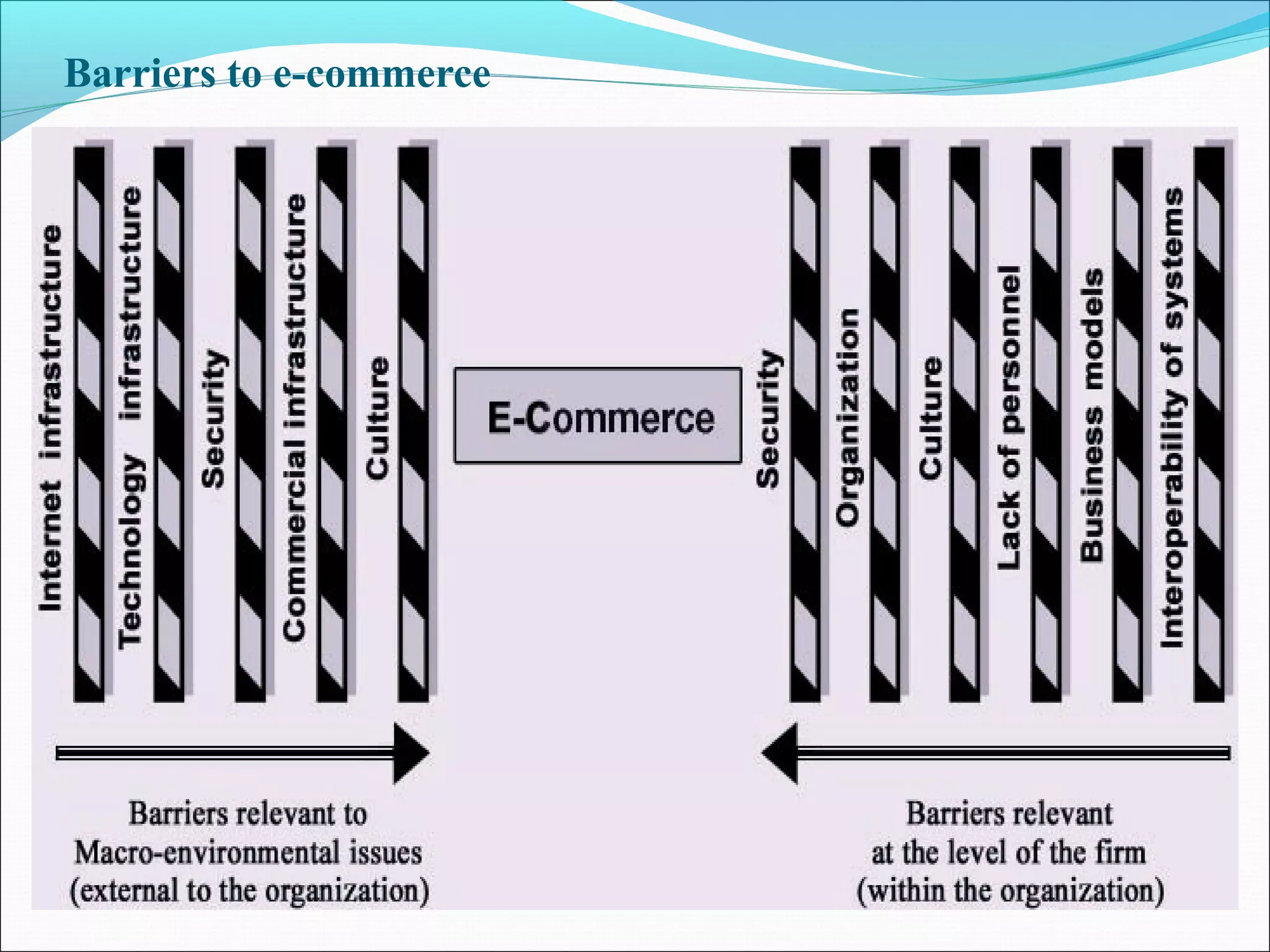
Barriers to e-commerce
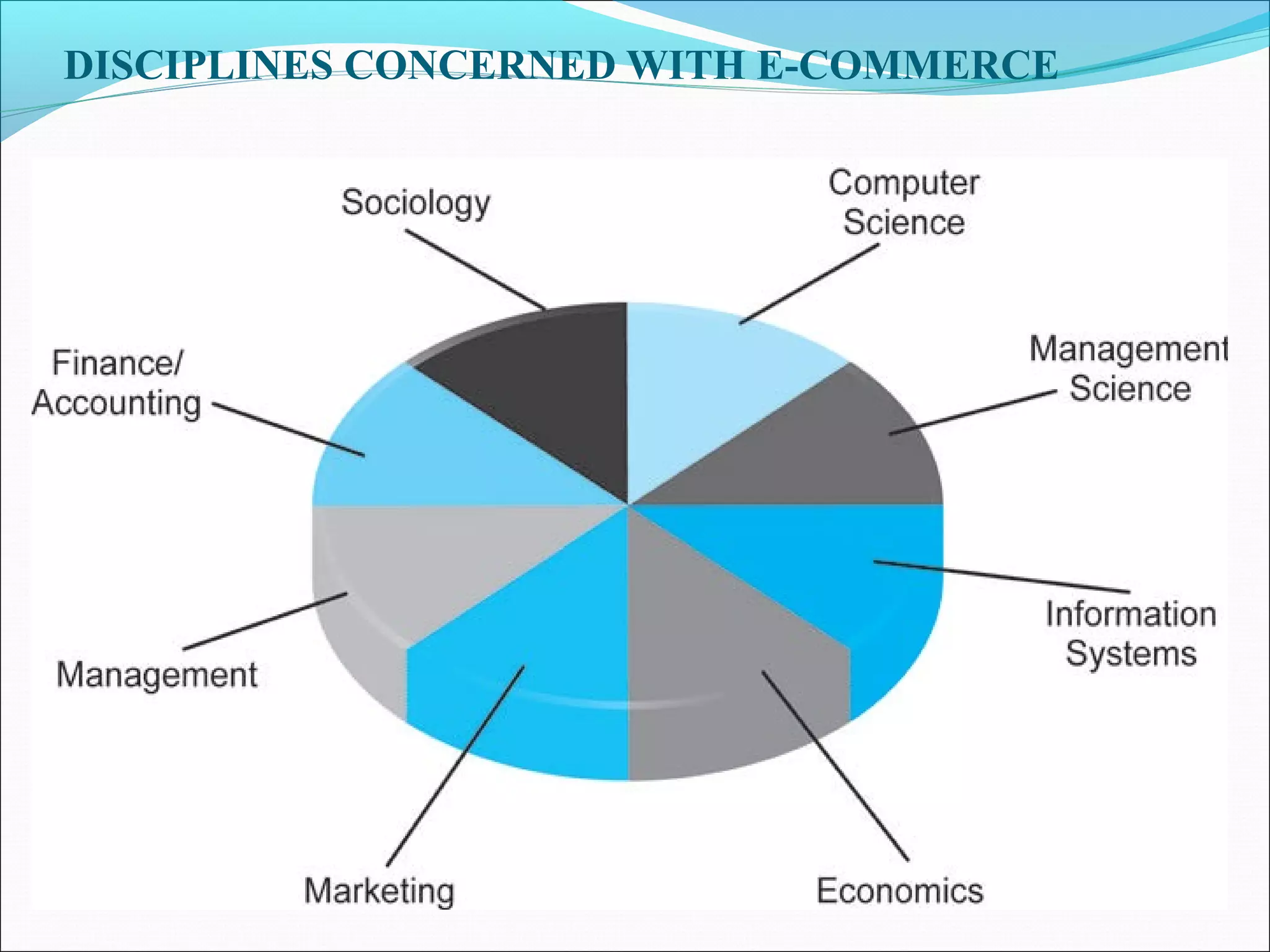
DISCIPLINES CONCERNED WITH E-COMMERCE
Goals of E-commerce
Reduce cost
Improving quality of goods
Faster customer response
Increase speed of service and delivery
Improve productivity and competitiveness
Providing wide access to an online global market place with
millions of customers and thousands of products and services
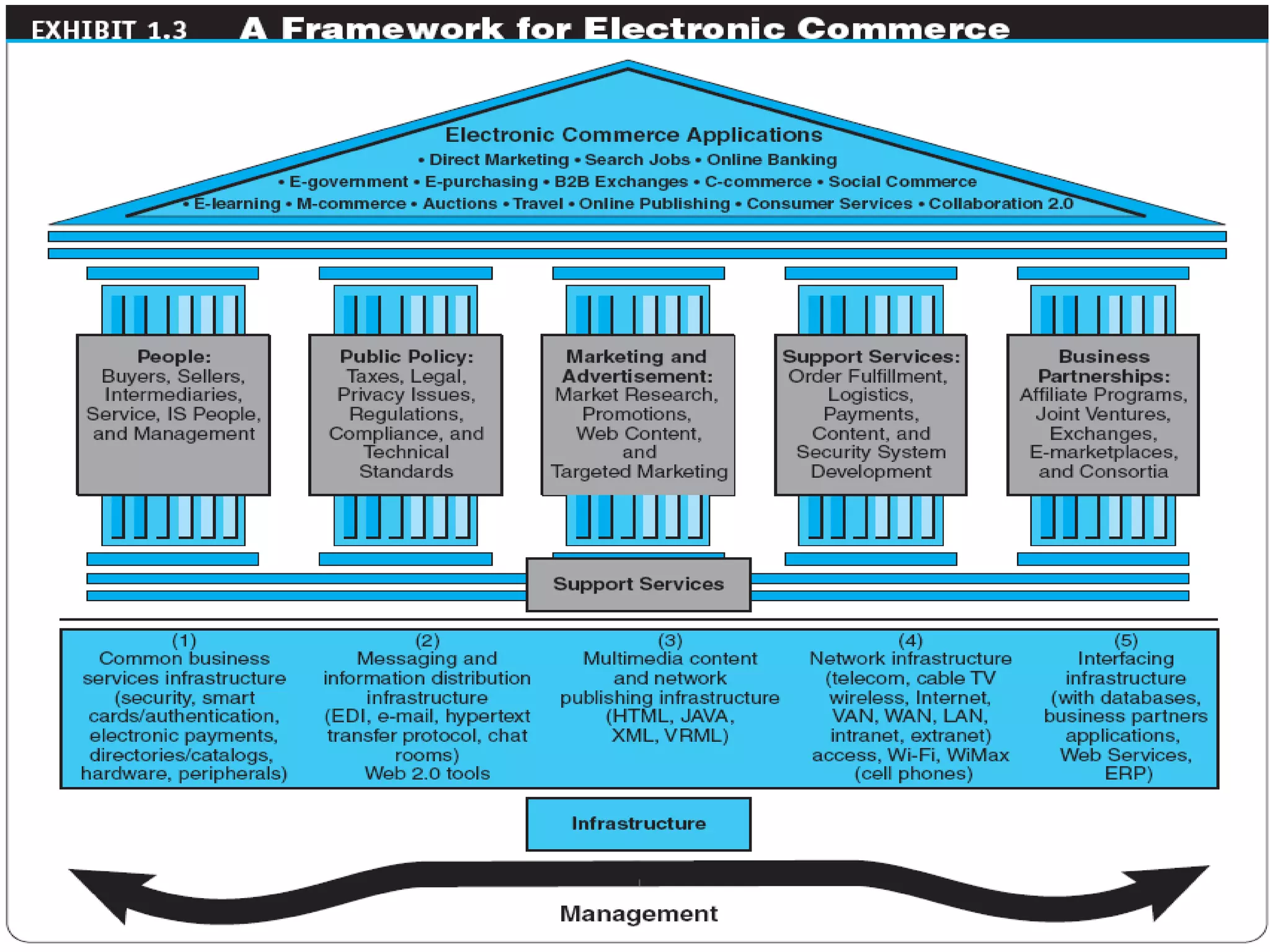
AN EC FRAMEWORK
EC applications are supported by infrastructure and by
the following five support areas:
1. People
2. Public policy
3. Marketing and advertising
4. Support services
5. Business partnerships
1-20By P.Neeta
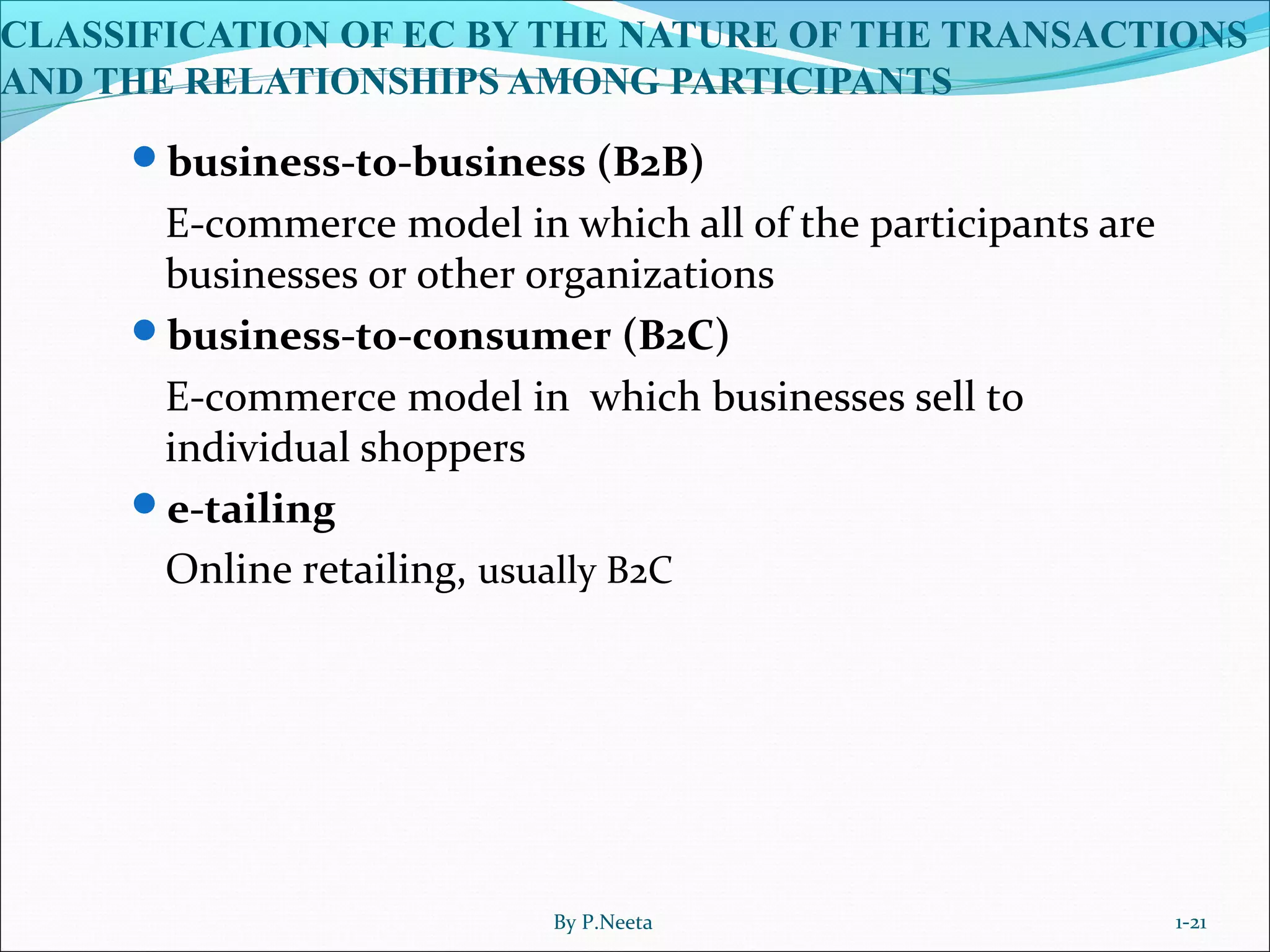
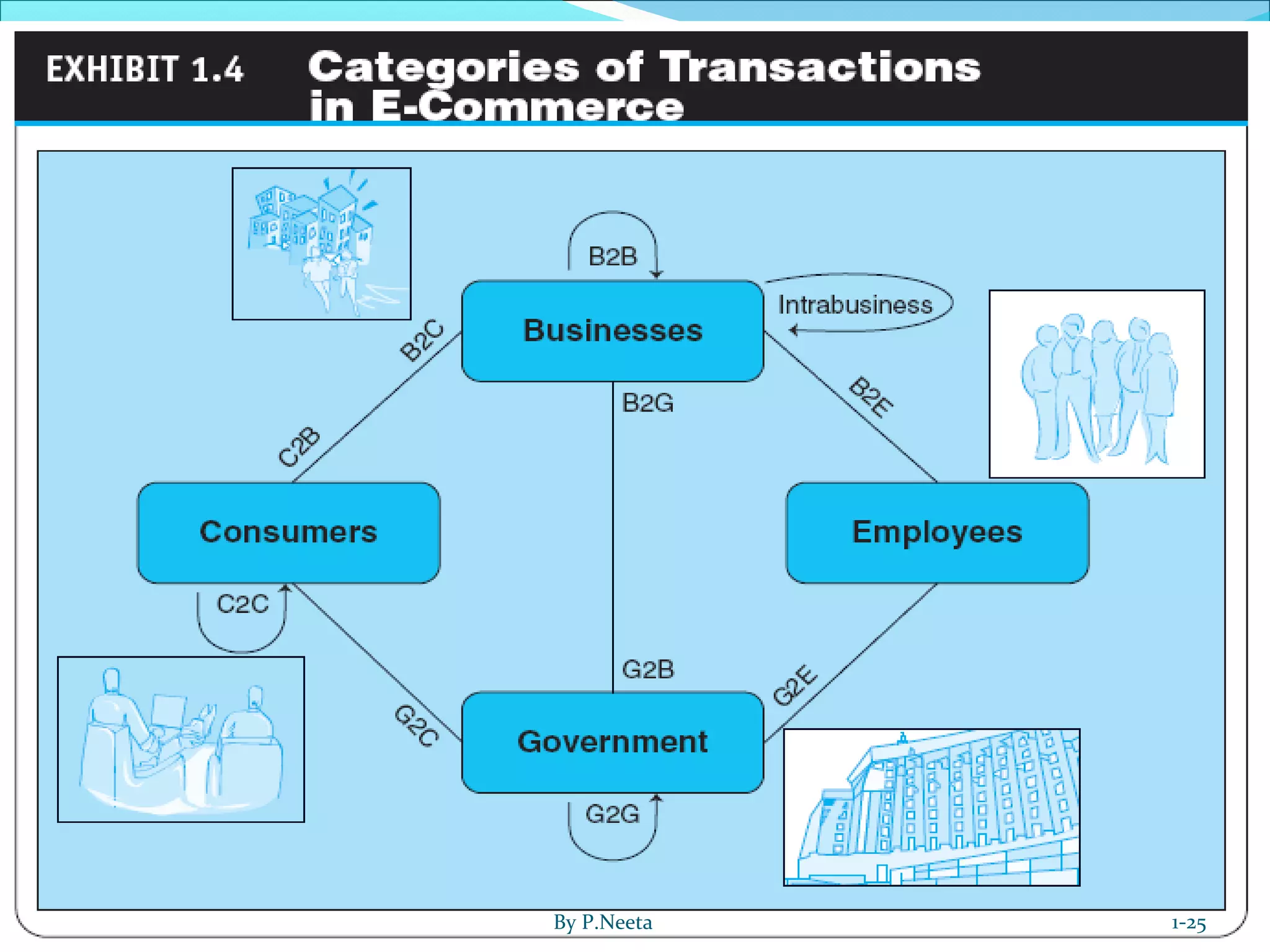
CLASSIFICATION OF EC BY THE NATURE OF THE TRANSACTIONS
AND THE RELATIONSHIPS AMONG PARTICIPANTS
business-to-business (B2B)
E-commerce model in which all of the participants are
businesses or other organizations
business-to-consumer (B2C)
E-commerce model in which businesses sell to
individual shoppers
e-tailing
Online retailing, usually B2C
1-21By P.Neeta
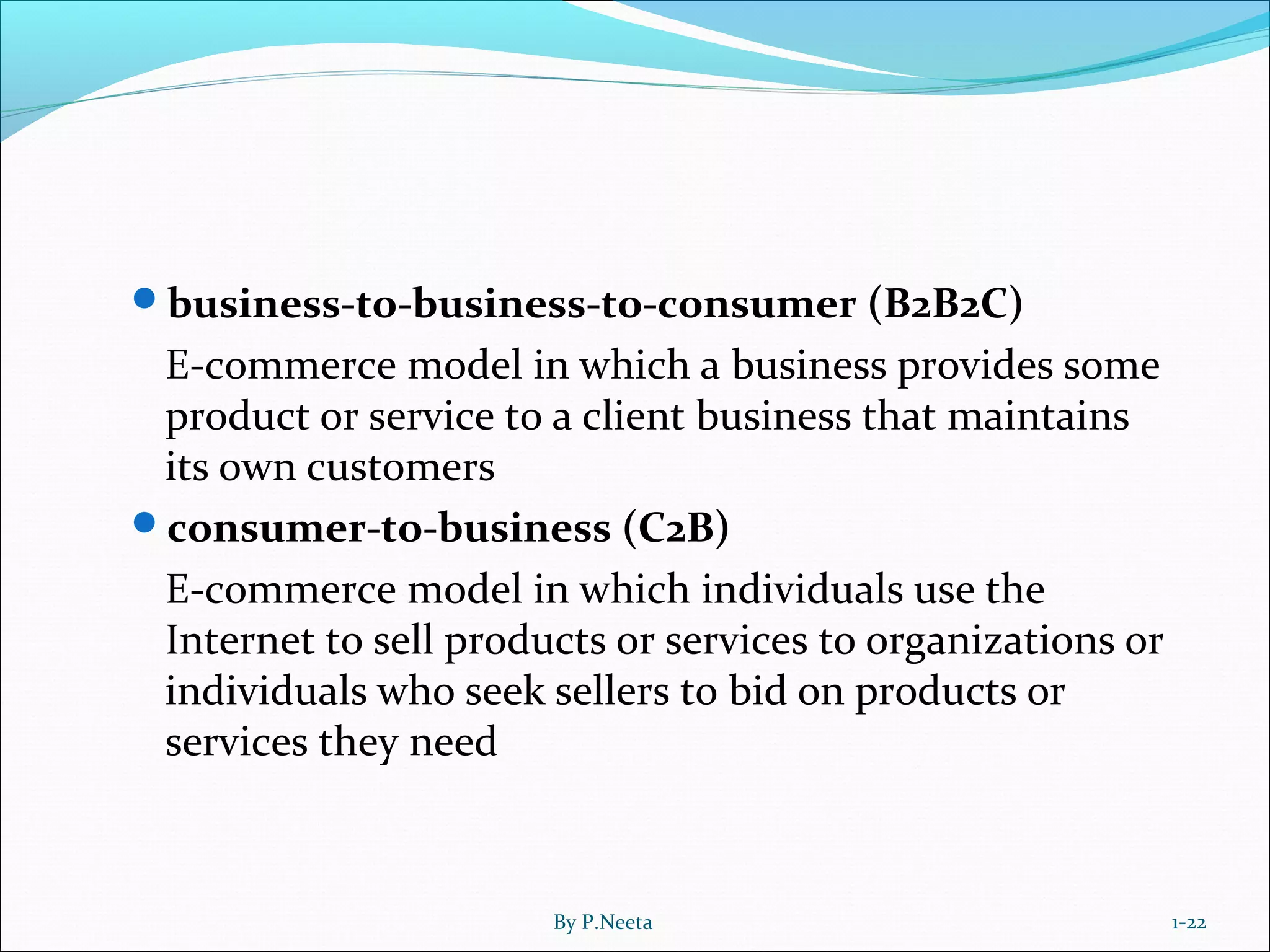
business-to-business-to-consumer (B2B2C)
E-commerce model in which a business provides some
product or service to a client business that maintains
its own customers
consumer-to-business (C2B)
E-commerce model in which individuals use the
Internet to sell products or services to organizations or
individuals who seek sellers to bid on products or
services they need
1-22By P.Neeta
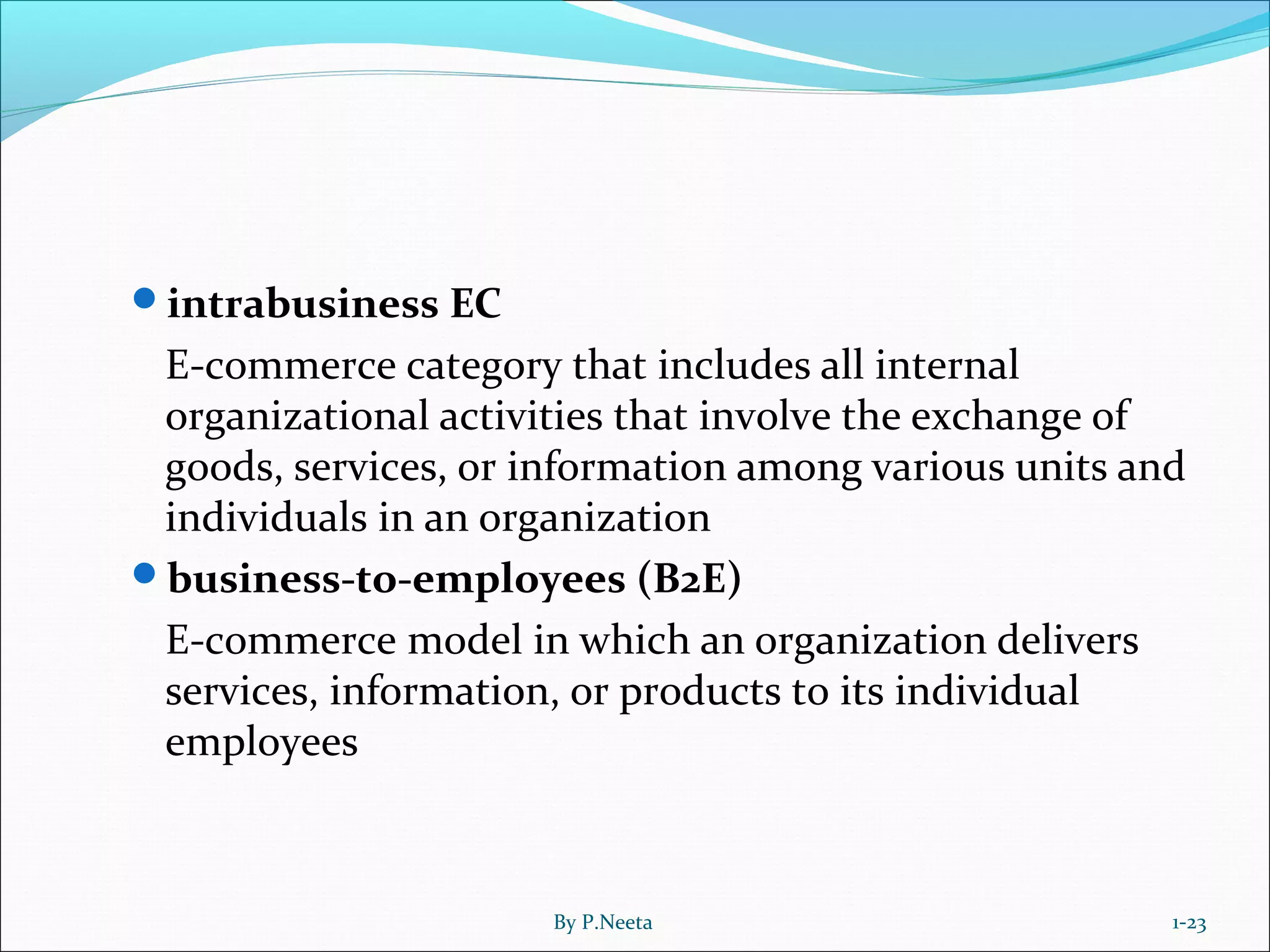
intrabusiness EC
E-commerce category that includes all internal
organizational activities that involve the exchange of
goods, services, or information among various units and
individuals in an organization
business-to-employees (B2E)
E-commerce model in which an organization delivers
services, information, or products to its individual
employees
1-23By P.Neeta
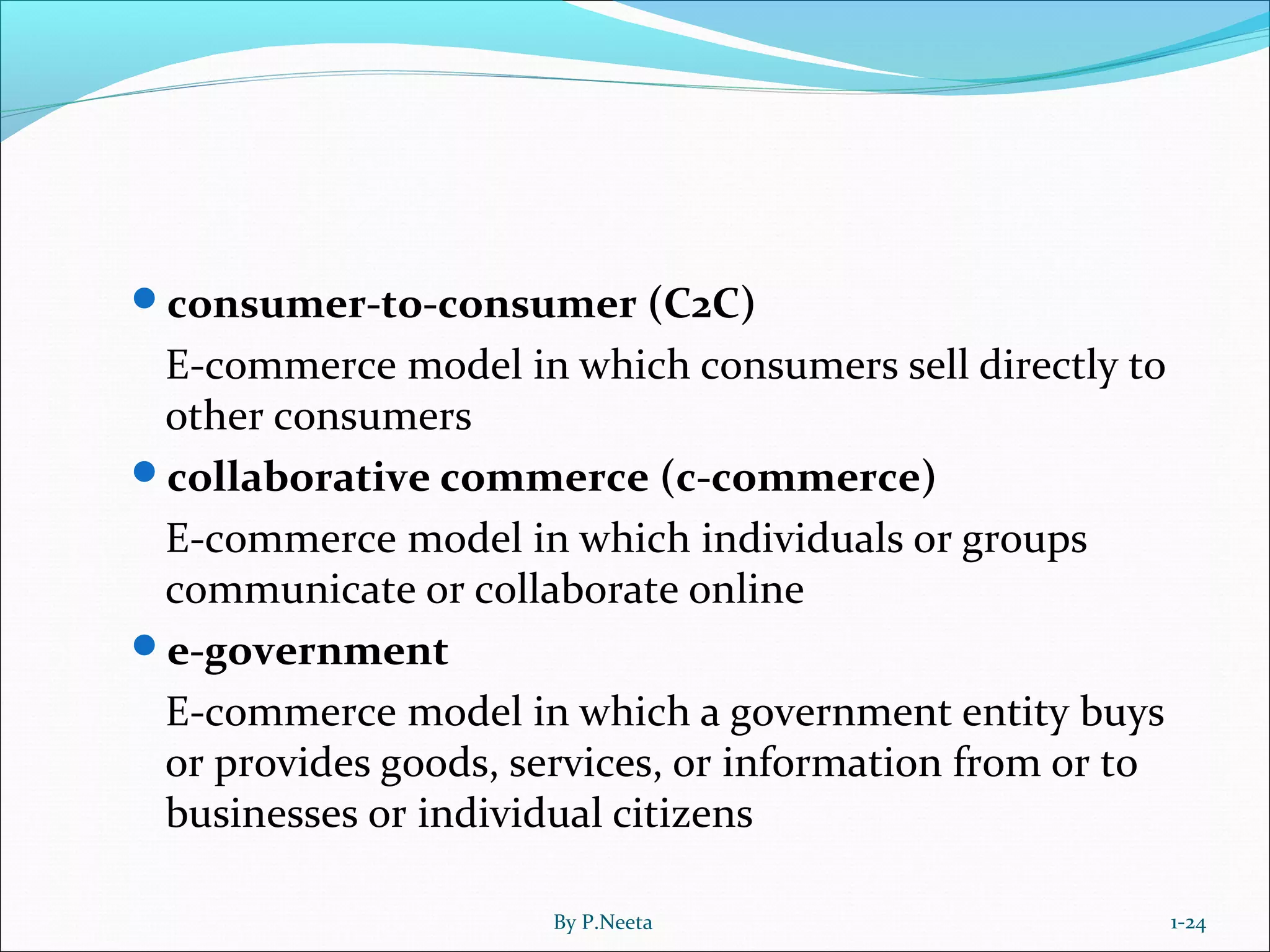
consumer-to-consumer (C2C)
E-commerce model in which consumers sell directly to
other consumers
collaborative commerce (c-commerce)
E-commerce model in which individuals or groups
communicate or collaborate online
e-government
E-commerce model in which a government entity buys
or provides goods, services, or information from or to
businesses or individual citizens
1-24By P.Neeta
1-25By P.Neeta
By P.Neeta 1-26
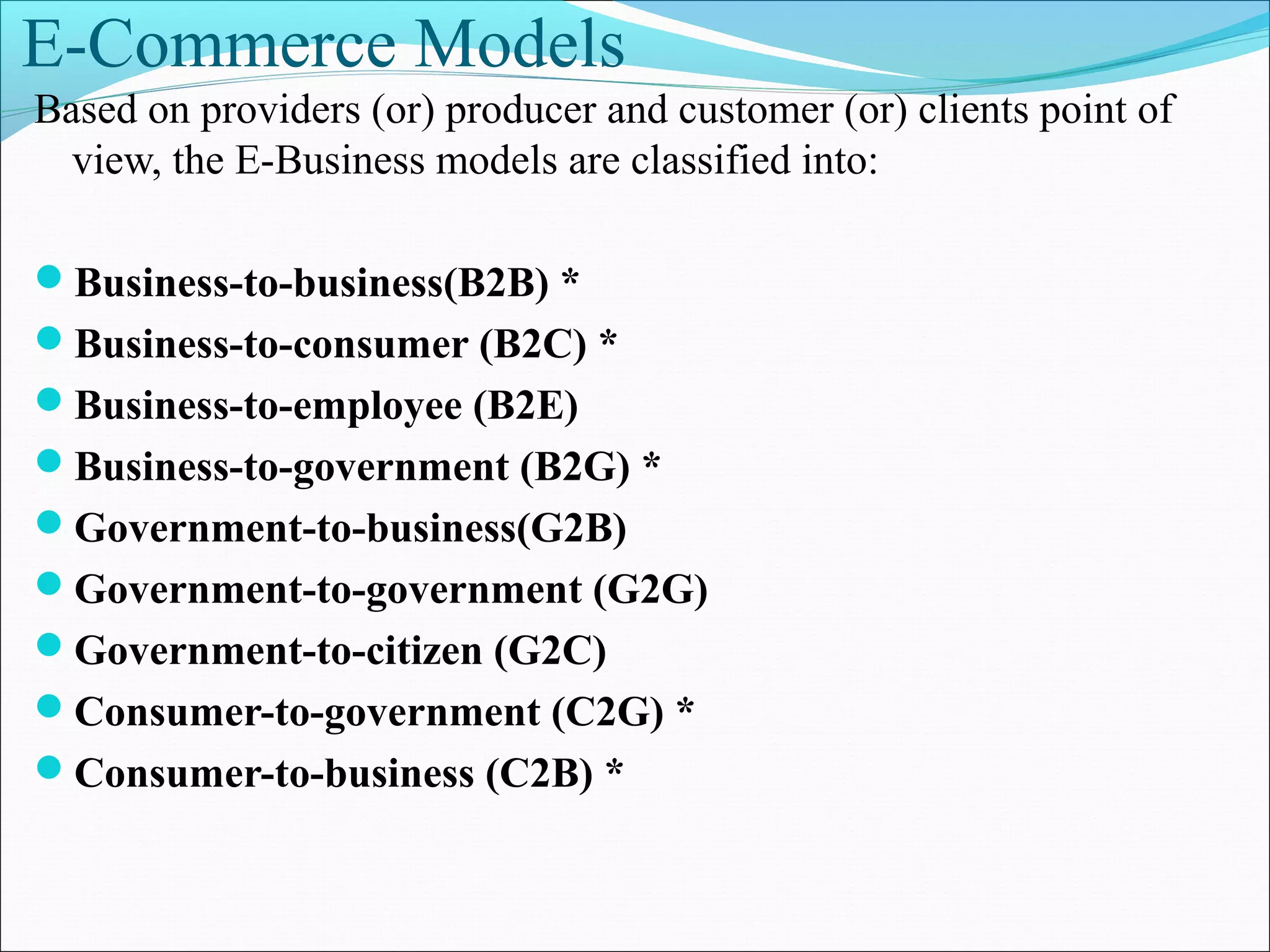
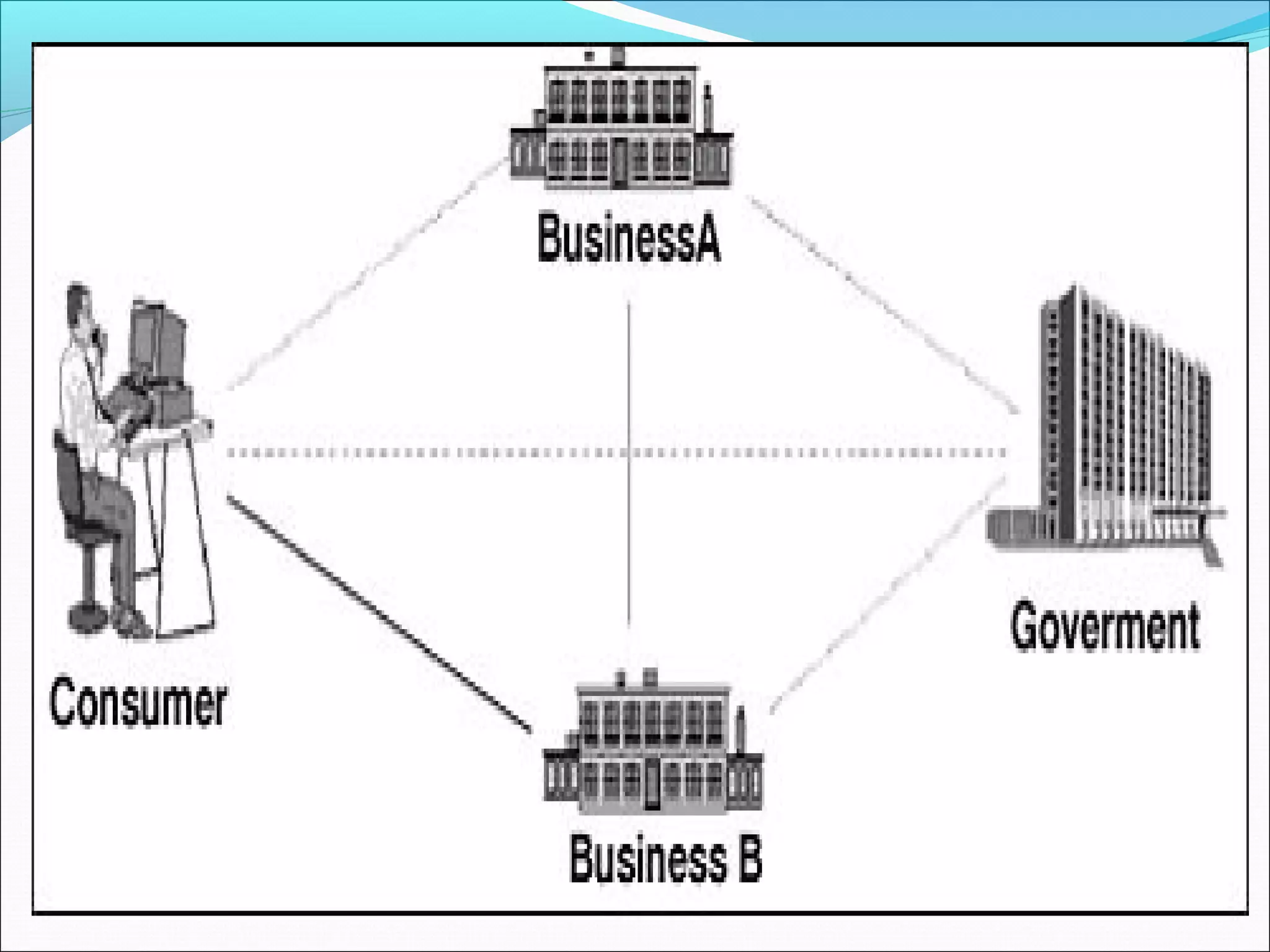
E-Commerce Models
Based on providers (or) producer and customer (or) clients point of
view, the E-Business models are classified into:
Business-to-business(B2B) *
Business-to-consumer (B2C) *
Business-to-employee (B2E)
Business-to-government (B2G) *
Government-to-business(G2B)
Government-to-government (G2G)
Government-to-citizen (G2C)
Consumer-to-government (C2G) *
Consumer-to-business (C2B) *
A BRIEF HISTORY OF EC
The Interdisciplinary Nature of EC
The Google Revolution
f-commerce
E-commerce activities conducted on Facebook or
influenced by the site
EC Failures
EC Successes
THE FUTURE OF EC
1-29By P.Neeta
E-Commerce 2.0:
From Social Commerce to Virtual Worlds
social computing
An approach aimed at making the human–computer
interface more natural
Web 2.0
The second generation of Internet-based services that
lets people collaborate and share information online
in new ways, such as social networking sites, wikis,
communication tools, and folksonomies
1-30By P.Neeta
E-Commerce 2.0:
From Social Commerce to Virtual Worlds
social network
A category of Internet applications that help connect
friends, business partners, or individuals with specific
interests by providing free services such as photo
presentation, e-mail, blogging, and so on using a
variety of tools
1-31By P.Neeta
E-Commerce 2.0:
From Social Commerce to Virtual Worlds
social networking service (SNS)
A service that builds online communities by providing
an online space for people to build free homepages and
that provides basic communication and support tools
for conducting different activities in the social network
social networking
The creation or sponsoring of a social network service and
any activity, such as blogging, done in a social network
(external or internal)
1-32By P.Neeta
E-Commerce 2.0:
From Social Commerce to Virtual Worlds
ENTERPRISE SOCIAL NETWORKS
social commerce
The e-commerce activities conducted in social
networks and/or by using social software (i.e., Web
2.0 tools)
1-33By P.Neeta
E-Commerce 2.0:
From Social Commerce to Virtual Worlds
VIRTUAL WORLDS AND SECOND LIFE
virtual world
A user-defined world in which people can interact, play,
and do business; the most publicized virtual world is
Second Life
How Students Make Money in a Virtual World
THE MAJOR TOOLS OF WEB 2.0
Wikis
RSS feeds
Blogs
Microblogs (e.g.,Twitter)
1-34By P.Neeta
The Digital World:
Economy, Enterprises, and Society
digital economy
An economy that is based on digital technologies,
including digital communication networks,
computers, software, and other related information
technologies; also called the Internet economy, the
new economy, or the Web economy
1-35By P.Neeta
The Digital World:
Economy, Enterprises, and Society
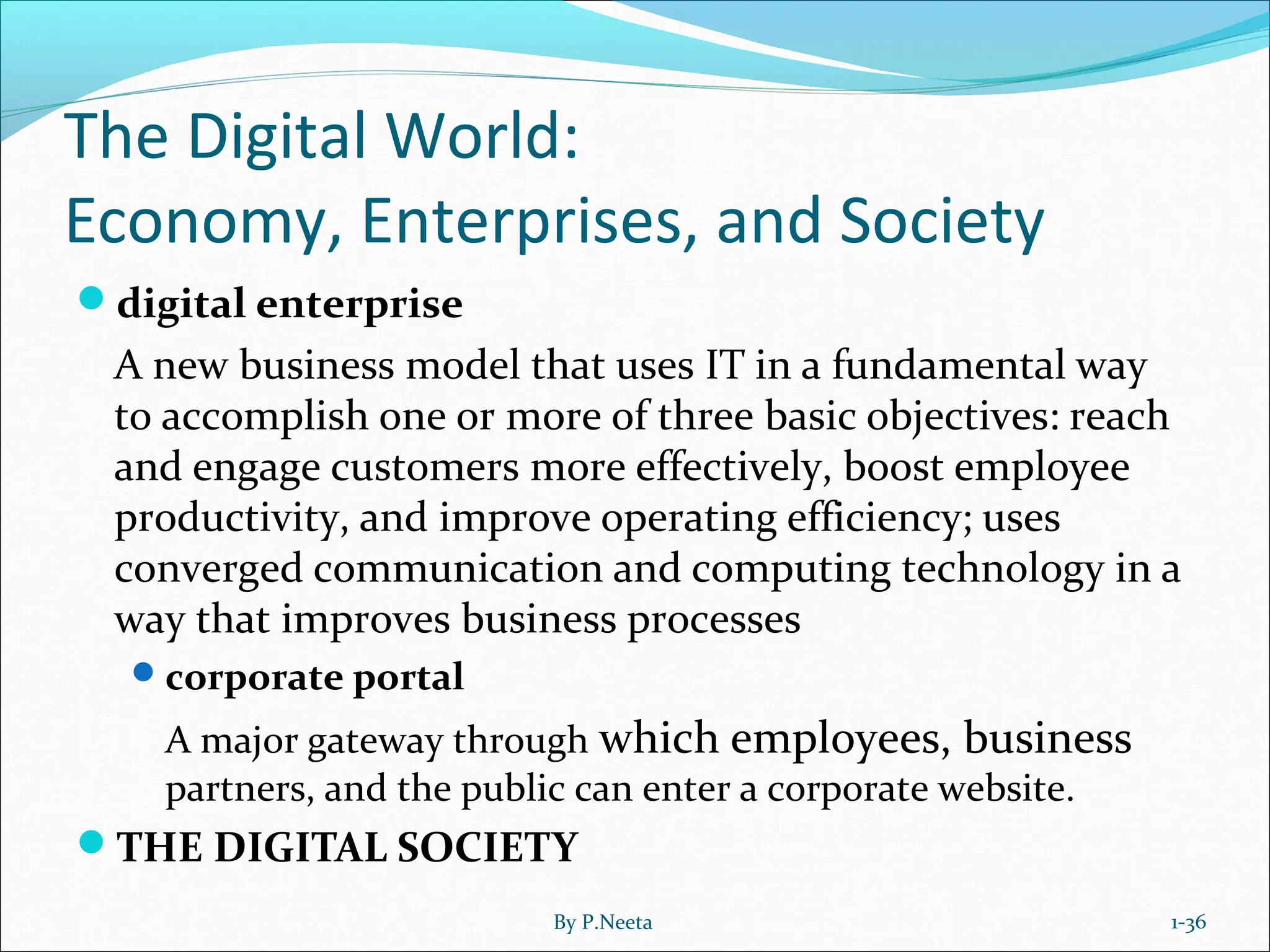
digital enterprise
A new business model that uses IT in a fundamental way
to accomplish one or more of three basic objectives: reach
and engage customers more effectively, boost employee
productivity, and improve operating efficiency; uses
converged communication and computing technology in a
way that improves business processes
corporate portal
A major gateway through which employees, business
partners, and the public can enter a corporate website.
THE DIGITAL SOCIETY
1-36By P.Neeta
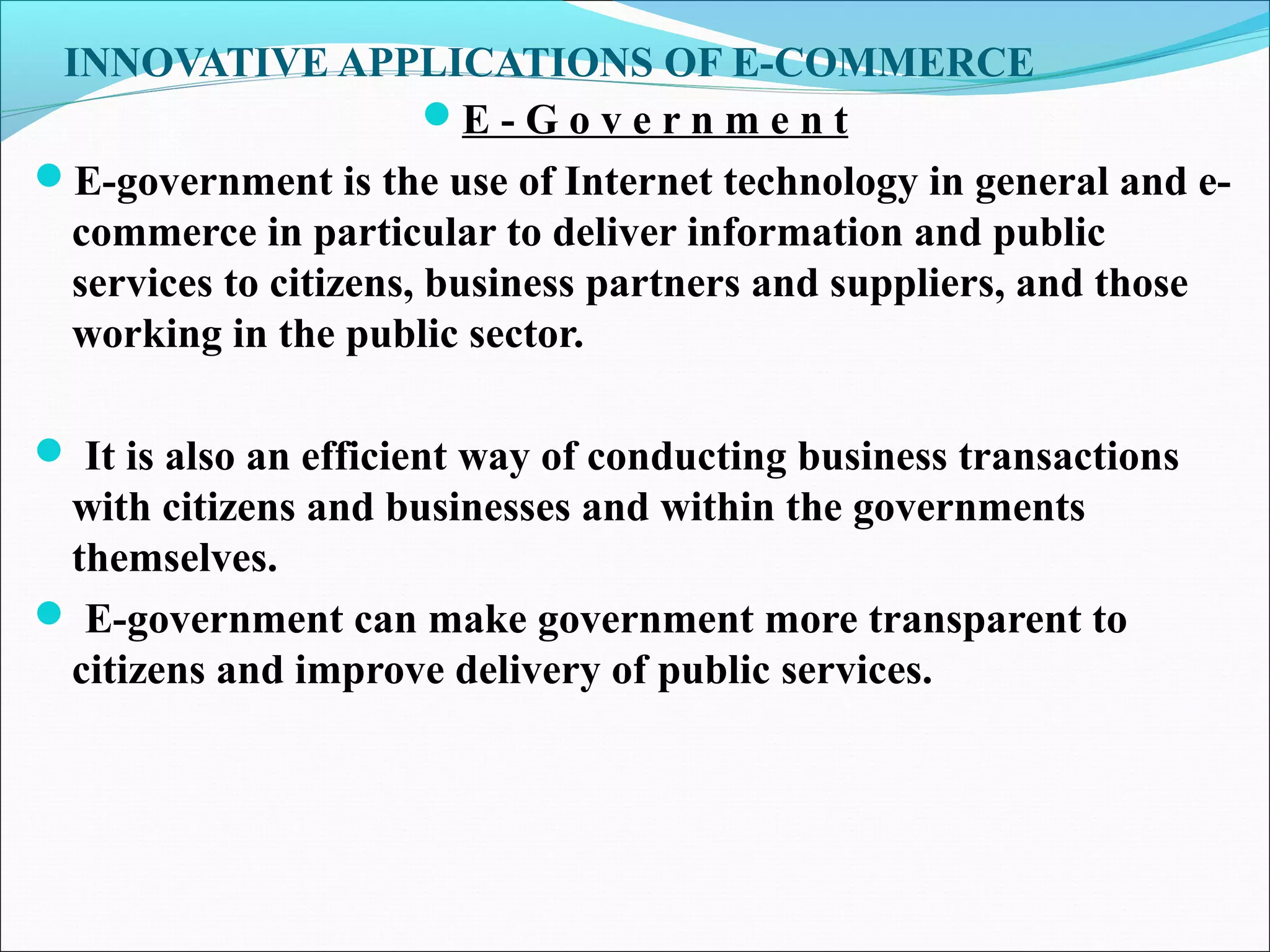
INNOVATIVE APPLICATIONS OF E-COMMERCE
E - G o v e r n m e n t
E-government is the use of Internet technology in general and e-
commerce in particular to deliver information and public
services to citizens, business partners and suppliers, and those
working in the public sector.
 It is also an efficient way of conducting business transactions
with citizens and businesses and within the governments
themselves.
 E-government can make government more transparent to
citizens and improve delivery of public services.
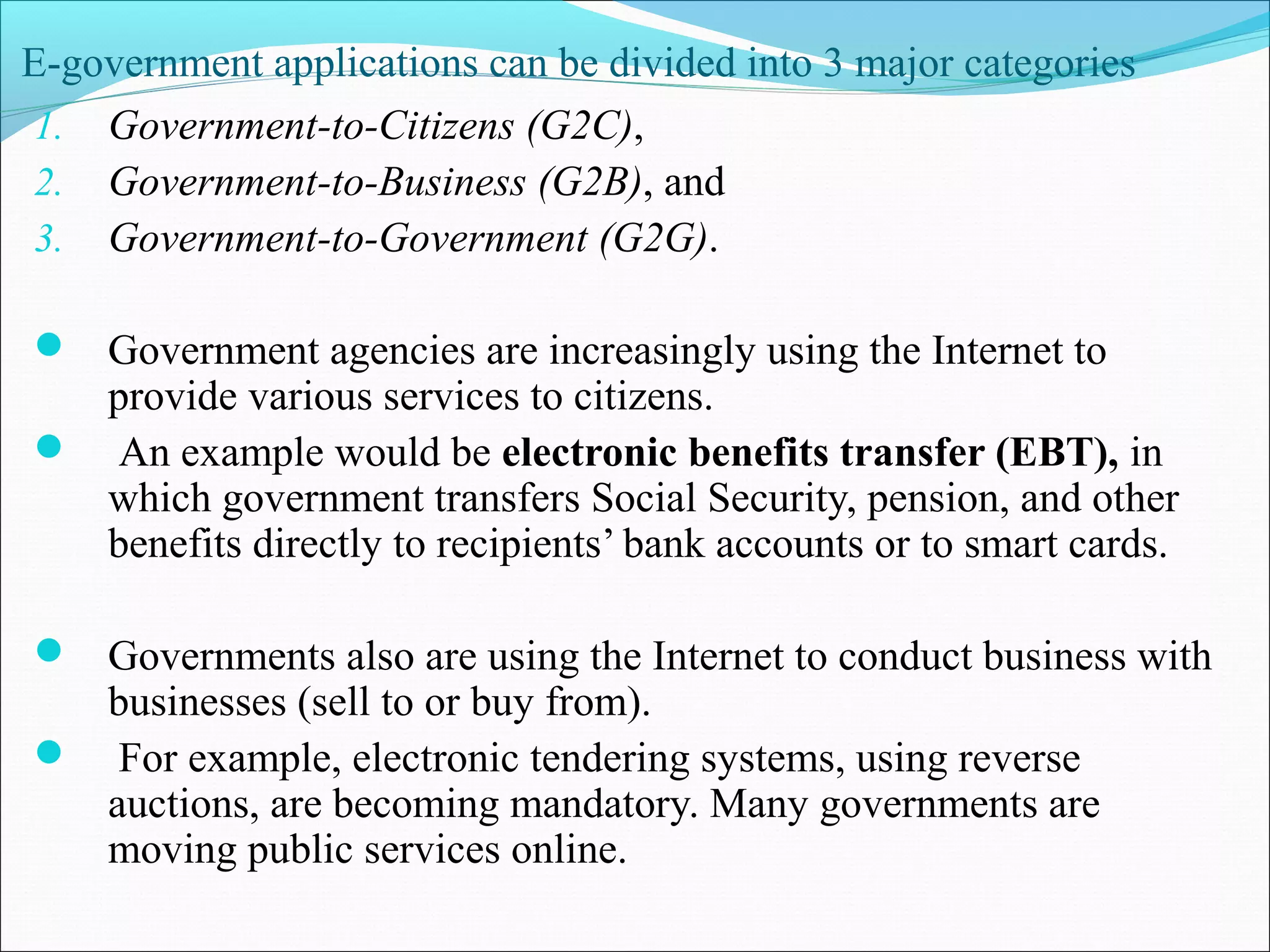
E-government applications can be divided into 3 major categories
1. Government-to-Citizens (G2C),
2. Government-to-Business (G2B), and
3. Government-to-Government (G2G).
 Government agencies are increasingly using the Internet to
provide various services to citizens.
 An example would be electronic benefits transfer (EBT), in
which government transfers Social Security, pension, and other
benefits directly to recipients’ bank accounts or to smart cards.
 Governments also are using the Internet to conduct business with
businesses (sell to or buy from).
 For example, electronic tendering systems, using reverse
auctions, are becoming mandatory. Many governments are
moving public services online.
Mobile Commerce (M-commerce)
Mobile commerce, or m-commerce, refers to the use of wireless
digital devices to enable transactions on the Web.
M-commerce involves the use of wireless networks to connect cell
phones, handheld devices such Blackberries, and personal
computers to the Web.
Once connected, mobile consumers can conduct transactions,
including stock trades, in-store price comparisons, banking, travel
reservations, and more.
Thus far, m-commerce is used most widely in Japan and Europe.
M-commerce is expected to grow rapidly in the coming years.
The advantages of M-Commerce
Two main characteristics are driving the interest in m-
commerce:
a) mobility and b) reachability.
Mobility implies that the Internet access travels with the
customer.
Reachability means that people can be contacted at any time,
which most people see as a convenience of modern life.
These two characteristics—mobility and reachability—break the
geographic and time barriers.
L-Commerce
Mobile devices make possible location-based commerce, also
known as L-commerce.
L-commerce delivers information about goods and services based
anywhere you (and your mobile device) are located.
For example, in San Francisco, Next Bus service knows, by the use
of global positioning systems (GPS), where the buses are, in real
time; when you call on your cell phone from a particular bus stop,
the system will compute when the bus will actually arrive there.
1-42By P.Neeta
1-43By P.Neeta
Electronic Commerce Business Models
business model
A method of doing business by which a company can
generate revenue to sustain itself
1-44By P.Neeta
Electronic Commerce Business Models
THE STRUCTURE AND PROPERTIES OF
BUSINESS MODELS
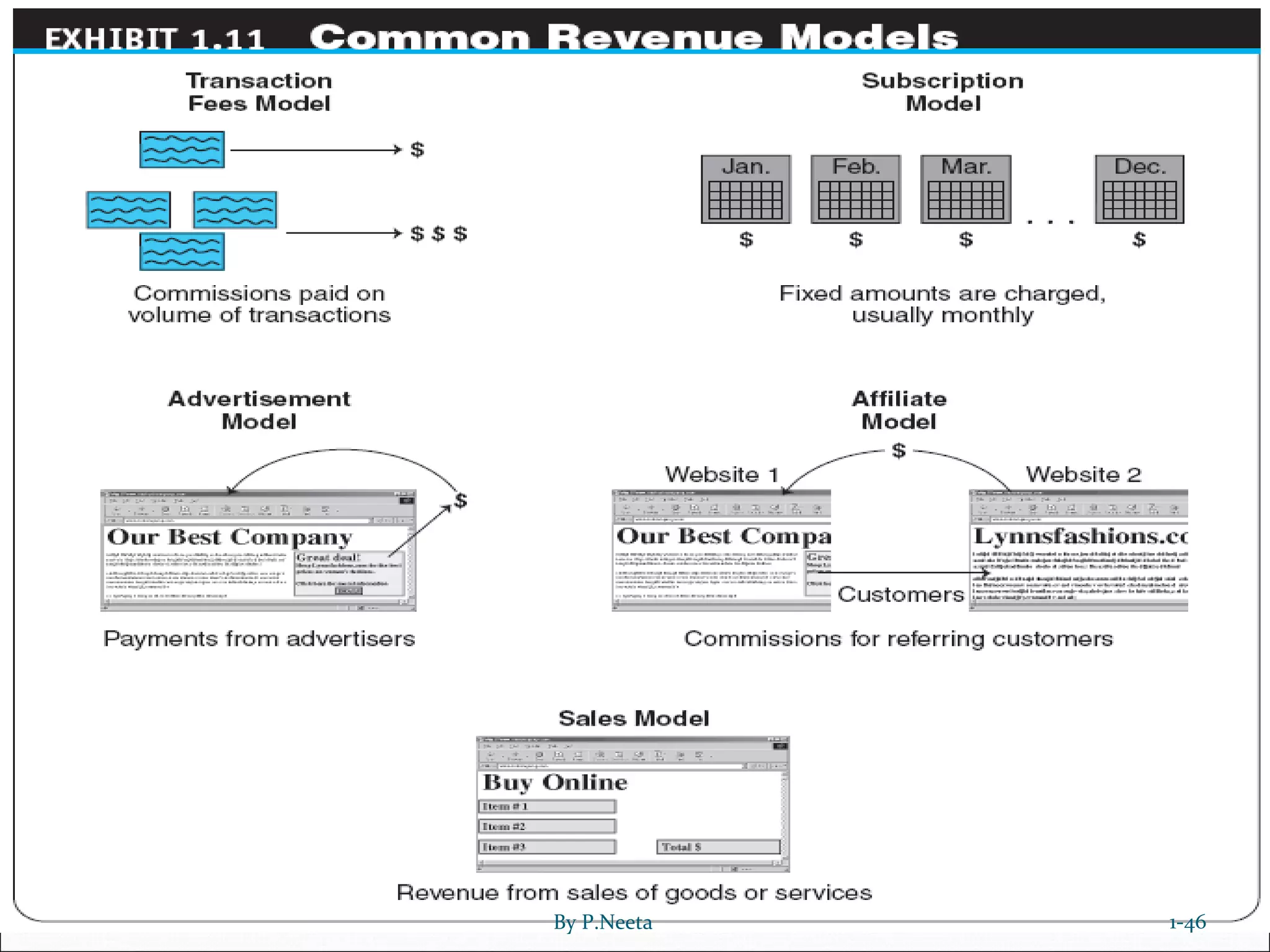
Revenue Models
value proposition
The benefits a company can derive from using EC
Functions of a Business Model
1-45By P.Neeta
1-46By P.Neeta
Electronic Commerce Business Models
TYPICAL EC BUSINESS MODELS
1. Online direct marketing
2. tendering (bidding) system
Model in which a buyer requests would-be sellers to
submit bids; the lowest bidder wins.
3. Electronic marketplaces and exchanges
4. Viral marketing
5. Group purchasing
1-47By P.Neeta
Benefits, Limitations,
and Impacts of Electronic Commerce
THE BENEFITS AND IMPACTS OF EC
EC as a Provider of Competitive Advantage
THE LIMITATIONS AND BARRIERS OF EC
ethics
The branch of philosophy that deals with what is
considered to be right and wrong
WHY STUDY E-COMMERCE?
1-48By P.Neeta
MAJOR LEGALAND ETHICAL ISSUES IN E- COMMERCE
- The ethical values are the moral principles which govern the
trustiness of e-ecommerce.
- Some of the issues which are need to be considered for the smooth
functioning of business transactions through e-commerce
applications are:
1. Privacy
2. Intellectual property
3. Computer crimes.
1. Privacy
 Privacy has become one of the worrying concerns for e-
commerce.
 The copy of the original document or video or any form can upset
the business of the mother companies.
 The privacy has also entered in many fields including media, film
and in duplication design of the products.
2. Intellectual Property:
Intellectual property refers to the ownership of
invention and rights.
The advancement in technology also created
duplication of innovations and such things created
problems to the owners of intellectual property.
By P.Neeta 1-51
3. Computer Crimes:
The computer crime or cyber crimes are also increasing with
the development of technology.
The misuse of data and information, duplication of innovations
created problems and the computer crimes are also increasing.
When buyers and sellers do not know each other and cannot
even see each other there is a chance that dishonest people will
commit fraud and other crimes over the Internet.
Unfortunately, fraudulent activities on the Internet are
increasing.
By P.Neeta 1-52
Legal Issues of E-commerce
Internet commerce raises legal issues through the provision of the
following services:
· Online marketing
· Online retailing ordering of products and services
· Financial services such as banking and trading in securities.
· Exchange of electronic messages and documents
· EDI, electronic filing, remote employee access, e-transactions.
Trade and commerce over the Internet give rise to several legal issues
as given below.
Copyright and the Internet
Issues Related to Jurisdicary
Service Provider liability
Formation of an Enforceable Online Contract
Mechanics for e-commerce:
The important mechanics for e-commerce include the following.
The internet
The world wide web(www)
Web architecture
1. The Internet
 With out the connection of internet, many applications of e-
commerce cannot function.
The internet has proven its credibility as majority of the
business transactions are presently performing with the help of
internet only.
For getting the internet connection, the following sources are
needed.
a). Routers
b). TCP/IP (Transmission Control Protocol and Internet Protocol)
c). Firewalls
d). Infrastructure
e). Network protocols
By P.Neeta 1-55
2.The world wide web(WWW)
The world wide web provide access to all the users through out the
world to share and get the information from all parts of the world.
3. Web architecture:
The web architecture is also a very important web architecture.
These include:
Client/server model
N-tier architecture, e.g., web servers, application servers, database
servers, scalability.
E-COMMERCE ARCHITECTURE
The e-commerce architecture means the synthesizing of various
existing resources like DBMS, data repository, computer languages,
software agent-based transactions, monitors or communication
protocols to facilitate the integration of data and software for better
applications.
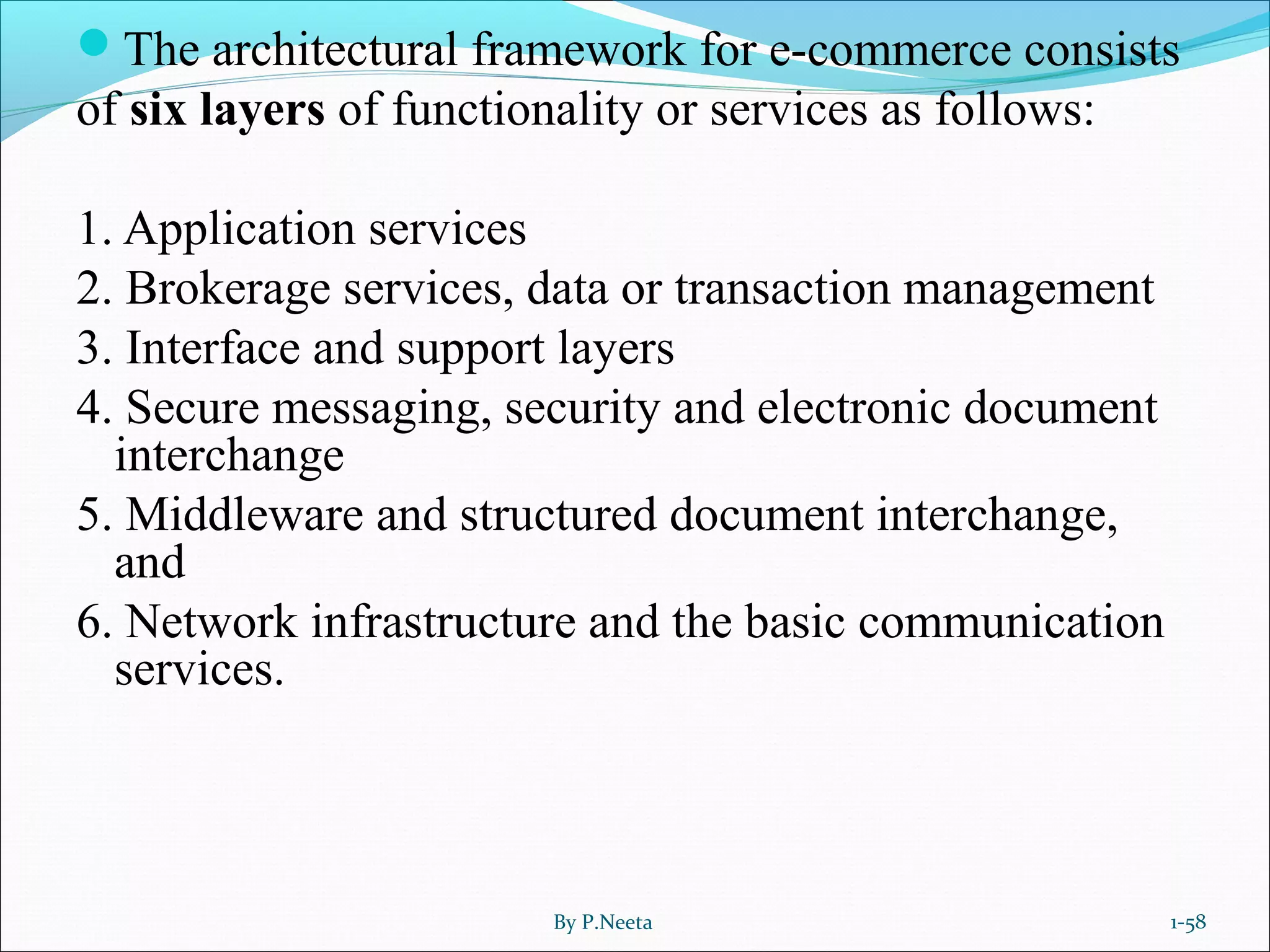
The architectural framework for e-commerce consists
of six layers of functionality or services as follows:
1. Application services
2. Brokerage services, data or transaction management
3. Interface and support layers
4. Secure messaging, security and electronic document
interchange
5. Middleware and structured document interchange,
and
6. Network infrastructure and the basic communication
services.
By P.Neeta 1-58
The e-commerce architecture can be of many types depending on
the type of client(s) and type of server.
Important forms of e-commerce architecture are:
1. Client server architecture
2. Multi client server architecture.
1. Client server architecture:
Typically the e-commerce customer is the client and the business
is the server.
In the client/server model single machine can be both client and the
server.
The client /server model utilises a database server in which
RDBMS user queries can be answered directly by the server.
The client/server architecture reduces network traffic by providing
a query response to the user rather than transferring total files.
The client/server model improves multi-user updating through a
graphical user interface (GUI) front and to the shared database.
In client/server architecture, client and server typically
communicate through statements made in structured query
TWO-TIER ARCHITECTURE
The user system interface is usually located in the
user’s desktop environment and the DBM services are
usually in a server that is a more powerful machine that
services many clients.
By P.Neeta 1-61
PROBLEMS AND PROSPECTS IN E-COMMERCE
These include:
Fraud
security
legal issues
lack of skilled personnel
lack of training and maintenance
misuse of information
high cost
 Fraud:
With the advancement of internet technology the people who are
becoming fraud and doing fraud transactions are increasing.
The misuse of business transactions are keep growing and give in a
tough question over the performance of e-commerce.
 Security:
The e-commerce applications are not typical in nature.
Hence, the security problems are arising.
The misuse of passwords and hacking the transactions are keep
growing.
The security is posing another important tough challenge to the e-
commerce applications.
 Legal Issues:
The cyber crimes are also posing threats to the advancement of e-
commerce.
The IT act 2000 is mainly enacted in order to restrict the cyber
crimes and the fraud and misuse of information are the
majority of the cases filed in the recent past.
 Lack of skilled personnel:
For countries, like in India, there is a huge demand for skilled
personnel.
Lack of skilled personnel is also a threat as majority of the
middle and old age personnel are not skilled in computers
and internet.
By P.Neeta 1-64
 Lack of training and maintenance:
Maintenance is also causing another worrying factor for the e-
commerce applications.
Proper expertise is needed in order to maintain the applications of
e-commerce and at present, majority of the companies are
suffering from the lack of proper trainers for the employees
and the companies spending for maintenance cost is also
increasing as they are hiring with the services of outsiders.
 High Cost:
For maintenance and installation of several packages and
programmes to run e-commerce applications create high
costs.
And the high costs will also generate to small companies to use
e-commerce technology for their business transactions.
By P.Neeta 1-65
TRADITIONAL COMMERCE VS E-COMMERCE
Cost: - Cost is greater due
to taxes, advertisement
and employees.
Market: - Product market
is limited because of geo-
graphical constraints.
Advertisement : - It
requires product
advertisement on various
mediums.
Time : - It requires more
time to go outside, to
choose, compare and
evaluate product.
Average cost is much
lower than traditional
type.
Product market is across
the world because of non-
physical aspects.
Developers of the
websites also makes adds
on domains.
It takes less time to
choose and make
comparison between
By P.Neeta 1-66
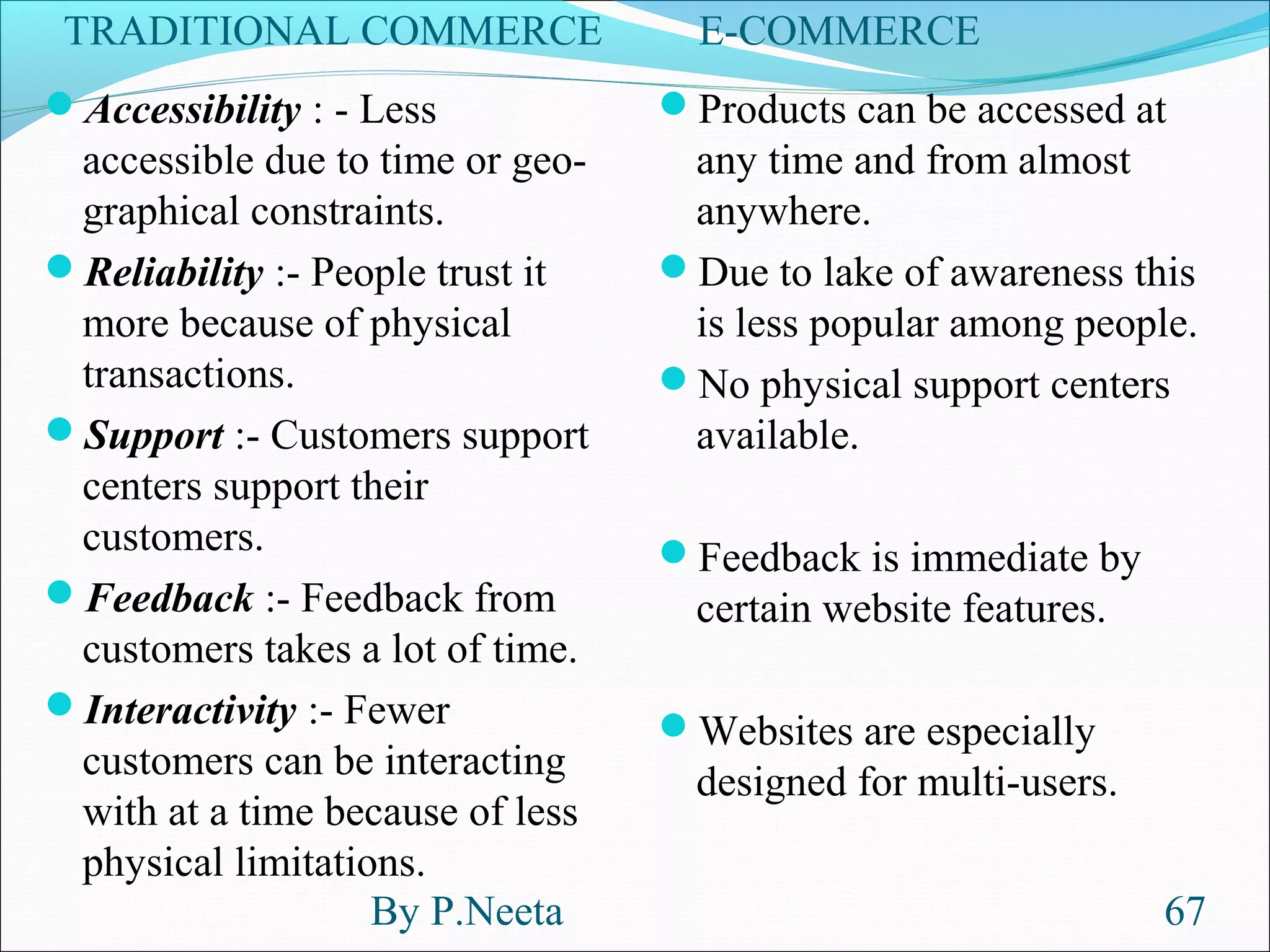
TRADITIONAL COMMERCE E-COMMERCE
Accessibility : - Less
accessible due to time or geo-
graphical constraints.
Reliability :- People trust it
more because of physical
transactions.
Support :- Customers support
centers support their
customers.
Feedback :- Feedback from
customers takes a lot of time.
Interactivity :- Fewer
customers can be interacting
with at a time because of less
physical limitations.
Products can be accessed at
any time and from almost
anywhere.
Due to lake of awareness this
is less popular among people.
No physical support centers
available.
Feedback is immediate by
certain website features.
Websites are especially
designed for multi-users.
By P.Neeta 67

Introduction to electronic commerce full

  • 1.
  • 2.
    Learning Objectives 1. Defineelectronic commerce (EC) and describe its various categories. 2. Describe and discuss the content and framework of EC. 3. Describe the major types of EC transactions. 4. Discuss e-commerce 2.0. 5. Describe social commerce and social software. 1-2By P.Neeta
  • 3.
    Learning Objectives 6. Understandthe elements of the digital world. 7. Describe the drivers of EC as they relate to business pressures and organizational responses. 8. Describe some EC business models. 9. Describe the benefits of EC to organizations, consumers, and society. 10. List and describe the major limitations of EC. 1-3By P.Neeta
  • 4.
    INTRODUCTION TO E-COMMERCE ElectronicCommerce, commonly referred to as “ e-commerce", is defined as the utilization of information and communication technologies (ICT) in support of all the activities of business transactions. E-commerce is defined as “any form of business transaction in which the parties interact electronically rather than by physical exchanges of documents or direct meetings among officials”. Simply, E-commerce is defined as “the process of conducting business electronically or over the internet”. E-commerce involves business processes spanning the entire value chain: electronic purchasing and supply chain management, processing orders electronically, handling customer service, and cooperating with business partners. By P.Neeta 1-4
  • 5.
    ADVANTAGES OF E-COMMERCE: Increasedsales opportunities for seller  Wider product availability to the buyers. Decreased costs for sellers Customized and personalized information and buying options. 24 hours a day, 7 days a week sales for sellers and 24/7 shopping for buyers. Access to global markets for sellers. Increased speed and accuracy of information delivery. Data collection and customer preferences tracking are available through E-Business. By P.Neeta 1-5
  • 6.
    Advantages of E-commerce Distancesdo not matter in carrying out trade. Works 24 hours a day, 7 days a week, 365 days a year round the clock. Compared to retail store or office the cost of setting up an E- commerce website is very low. Flexibility to add and remove a product's in a website than in catalogues or brouchers. Gives exposure to previously untapped market segments. Error reduction becoz,orders don't have to be re-keyed into order entry systems and increased efficiencies through the automation of the business processes.
  • 7.
    Wider choice andno wastage of time Can avail services such as financial services, legal services, medical advice etc., form appropriate portals.  Large variety of goods accessible easily, without spending time and money by personal visits and searching in various shops. A website helps the business to reach out to a worldwide customer base at a very local cost. Reduction in order processing cost All documents are exchanged electronically. Funds transfer is faster. Middlemen such as retailers can be eliminated as a manufacturer can reach out directly to a customer.
  • 8.
    Disadvantages of E-Commerce Inabilityto touch and feel Online store do not exsist for very long No one to guide like a shopkeeper Many companies do not know exactly how to set up a store, resulting in a large group of annoyed and dissatisfied customers No 100% safety. Hackers intercept transactions and cause problems for both consumers and companies that operate on the internet. Business on Internet will not reach women and elderly persons in a developing nation. Difficulty in identifying the location of the transaction activity.
  • 9.
    Poses problems tosell products to target group. Internet access is not widely available at present in Indian context. Payment by credit card requires faith in the system security becoz hackers can steal and misuse credit card info. Small businesses may find it difficult to confirm to these standards. De-personalize transactions. Virus attacks and other problems. Difficulty to contain e-commerce within a geographically defined trade area. Lack of security to information on the internet.
  • 10.
    Electronic Commerce: Definitions andConcepts electronic commerce (EC) The process of buying, selling, or exchanging products, services, or information via computer e-business A broader definition of EC that includes not just the buying and selling of goods and services, but also servicing customers, collaborating with business partners, and conducting electronic transactions within an organization 1-10By P.Neeta
  • 11.
    Electronic Commerce: Definitions andConcepts MAJOR EC CONCEPTS Pure Versus Partial EC EC Organizations  brick-and-mortar (old economy) organizations Old-economy organizations (corporations) that perform their primary business offline, selling physical products by means of physical agents  virtual (pure-play) organizations Organizations that conduct their business activities solely online  click-and-mortar (click-and-brick) organizations Organizations that conduct some e-commerce activities, usually as an additional marketing channel 1-11By P.Neeta
  • 12.
  • 13.
    Electronic Commerce: Definitions andConcepts ELECTRONIC MARKETS AND NETWORKS electronic market (e-marketplace) An online marketplace where buyers and sellers meet to exchange goods, services, money, or information intranet An internal corporate or government network that uses Internet tools, such as Web browsers, and Internet protocols extranet A network that uses the Internet to link multiple intranets 1-13By P.Neeta
  • 14.
  • 15.
    Scope of E-Commerce Marketing,sales and sales promotion Pre-sales, subcontracts, supply Financing and insurance Commercial transactions: ordering, delivery, payment Product service and maintenance Co-operative product development Distributed co-operative working Use of public and private services · Business-to-administrations (e.g. customs, etc) · Transport and logistics · Public procurement · Automatic trading of digital goods · Accounting · Dispute resolution By P.Neeta 1-15
  • 16.
    THE DIFFERENCE BETWEENE-COMMERCE AND E-BUSINESS By P.Neeta 1-16
  • 17.
  • 18.
  • 19.
    Goals of E-commerce Reducecost Improving quality of goods Faster customer response Increase speed of service and delivery Improve productivity and competitiveness Providing wide access to an online global market place with millions of customers and thousands of products and services
  • 20.
    AN EC FRAMEWORK ECapplications are supported by infrastructure and by the following five support areas: 1. People 2. Public policy 3. Marketing and advertising 4. Support services 5. Business partnerships 1-20By P.Neeta
  • 21.
    CLASSIFICATION OF ECBY THE NATURE OF THE TRANSACTIONS AND THE RELATIONSHIPS AMONG PARTICIPANTS business-to-business (B2B) E-commerce model in which all of the participants are businesses or other organizations business-to-consumer (B2C) E-commerce model in which businesses sell to individual shoppers e-tailing Online retailing, usually B2C 1-21By P.Neeta
  • 22.
    business-to-business-to-consumer (B2B2C) E-commerce modelin which a business provides some product or service to a client business that maintains its own customers consumer-to-business (C2B) E-commerce model in which individuals use the Internet to sell products or services to organizations or individuals who seek sellers to bid on products or services they need 1-22By P.Neeta
  • 23.
    intrabusiness EC E-commerce categorythat includes all internal organizational activities that involve the exchange of goods, services, or information among various units and individuals in an organization business-to-employees (B2E) E-commerce model in which an organization delivers services, information, or products to its individual employees 1-23By P.Neeta
  • 24.
    consumer-to-consumer (C2C) E-commerce modelin which consumers sell directly to other consumers collaborative commerce (c-commerce) E-commerce model in which individuals or groups communicate or collaborate online e-government E-commerce model in which a government entity buys or provides goods, services, or information from or to businesses or individual citizens 1-24By P.Neeta
  • 25.
  • 26.
  • 27.
    E-Commerce Models Based onproviders (or) producer and customer (or) clients point of view, the E-Business models are classified into: Business-to-business(B2B) * Business-to-consumer (B2C) * Business-to-employee (B2E) Business-to-government (B2G) * Government-to-business(G2B) Government-to-government (G2G) Government-to-citizen (G2C) Consumer-to-government (C2G) * Consumer-to-business (C2B) *
  • 29.
    A BRIEF HISTORYOF EC The Interdisciplinary Nature of EC The Google Revolution f-commerce E-commerce activities conducted on Facebook or influenced by the site EC Failures EC Successes THE FUTURE OF EC 1-29By P.Neeta
  • 30.
    E-Commerce 2.0: From SocialCommerce to Virtual Worlds social computing An approach aimed at making the human–computer interface more natural Web 2.0 The second generation of Internet-based services that lets people collaborate and share information online in new ways, such as social networking sites, wikis, communication tools, and folksonomies 1-30By P.Neeta
  • 31.
    E-Commerce 2.0: From SocialCommerce to Virtual Worlds social network A category of Internet applications that help connect friends, business partners, or individuals with specific interests by providing free services such as photo presentation, e-mail, blogging, and so on using a variety of tools 1-31By P.Neeta
  • 32.
    E-Commerce 2.0: From SocialCommerce to Virtual Worlds social networking service (SNS) A service that builds online communities by providing an online space for people to build free homepages and that provides basic communication and support tools for conducting different activities in the social network social networking The creation or sponsoring of a social network service and any activity, such as blogging, done in a social network (external or internal) 1-32By P.Neeta
  • 33.
    E-Commerce 2.0: From SocialCommerce to Virtual Worlds ENTERPRISE SOCIAL NETWORKS social commerce The e-commerce activities conducted in social networks and/or by using social software (i.e., Web 2.0 tools) 1-33By P.Neeta
  • 34.
    E-Commerce 2.0: From SocialCommerce to Virtual Worlds VIRTUAL WORLDS AND SECOND LIFE virtual world A user-defined world in which people can interact, play, and do business; the most publicized virtual world is Second Life How Students Make Money in a Virtual World THE MAJOR TOOLS OF WEB 2.0 Wikis RSS feeds Blogs Microblogs (e.g.,Twitter) 1-34By P.Neeta
  • 35.
    The Digital World: Economy,Enterprises, and Society digital economy An economy that is based on digital technologies, including digital communication networks, computers, software, and other related information technologies; also called the Internet economy, the new economy, or the Web economy 1-35By P.Neeta
  • 36.
    The Digital World: Economy,Enterprises, and Society digital enterprise A new business model that uses IT in a fundamental way to accomplish one or more of three basic objectives: reach and engage customers more effectively, boost employee productivity, and improve operating efficiency; uses converged communication and computing technology in a way that improves business processes corporate portal A major gateway through which employees, business partners, and the public can enter a corporate website. THE DIGITAL SOCIETY 1-36By P.Neeta
  • 37.
    INNOVATIVE APPLICATIONS OFE-COMMERCE E - G o v e r n m e n t E-government is the use of Internet technology in general and e- commerce in particular to deliver information and public services to citizens, business partners and suppliers, and those working in the public sector.  It is also an efficient way of conducting business transactions with citizens and businesses and within the governments themselves.  E-government can make government more transparent to citizens and improve delivery of public services.
  • 38.
    E-government applications canbe divided into 3 major categories 1. Government-to-Citizens (G2C), 2. Government-to-Business (G2B), and 3. Government-to-Government (G2G).  Government agencies are increasingly using the Internet to provide various services to citizens.  An example would be electronic benefits transfer (EBT), in which government transfers Social Security, pension, and other benefits directly to recipients’ bank accounts or to smart cards.  Governments also are using the Internet to conduct business with businesses (sell to or buy from).  For example, electronic tendering systems, using reverse auctions, are becoming mandatory. Many governments are moving public services online.
  • 39.
    Mobile Commerce (M-commerce) Mobilecommerce, or m-commerce, refers to the use of wireless digital devices to enable transactions on the Web. M-commerce involves the use of wireless networks to connect cell phones, handheld devices such Blackberries, and personal computers to the Web. Once connected, mobile consumers can conduct transactions, including stock trades, in-store price comparisons, banking, travel reservations, and more. Thus far, m-commerce is used most widely in Japan and Europe. M-commerce is expected to grow rapidly in the coming years.
  • 40.
    The advantages ofM-Commerce Two main characteristics are driving the interest in m- commerce: a) mobility and b) reachability. Mobility implies that the Internet access travels with the customer. Reachability means that people can be contacted at any time, which most people see as a convenience of modern life. These two characteristics—mobility and reachability—break the geographic and time barriers.
  • 41.
    L-Commerce Mobile devices makepossible location-based commerce, also known as L-commerce. L-commerce delivers information about goods and services based anywhere you (and your mobile device) are located. For example, in San Francisco, Next Bus service knows, by the use of global positioning systems (GPS), where the buses are, in real time; when you call on your cell phone from a particular bus stop, the system will compute when the bus will actually arrive there.
  • 42.
  • 43.
  • 44.
    Electronic Commerce BusinessModels business model A method of doing business by which a company can generate revenue to sustain itself 1-44By P.Neeta
  • 45.
    Electronic Commerce BusinessModels THE STRUCTURE AND PROPERTIES OF BUSINESS MODELS Revenue Models value proposition The benefits a company can derive from using EC Functions of a Business Model 1-45By P.Neeta
  • 46.
  • 47.
    Electronic Commerce BusinessModels TYPICAL EC BUSINESS MODELS 1. Online direct marketing 2. tendering (bidding) system Model in which a buyer requests would-be sellers to submit bids; the lowest bidder wins. 3. Electronic marketplaces and exchanges 4. Viral marketing 5. Group purchasing 1-47By P.Neeta
  • 48.
    Benefits, Limitations, and Impactsof Electronic Commerce THE BENEFITS AND IMPACTS OF EC EC as a Provider of Competitive Advantage THE LIMITATIONS AND BARRIERS OF EC ethics The branch of philosophy that deals with what is considered to be right and wrong WHY STUDY E-COMMERCE? 1-48By P.Neeta
  • 49.
    MAJOR LEGALAND ETHICALISSUES IN E- COMMERCE - The ethical values are the moral principles which govern the trustiness of e-ecommerce. - Some of the issues which are need to be considered for the smooth functioning of business transactions through e-commerce applications are: 1. Privacy 2. Intellectual property 3. Computer crimes.
  • 50.
    1. Privacy  Privacyhas become one of the worrying concerns for e- commerce.  The copy of the original document or video or any form can upset the business of the mother companies.  The privacy has also entered in many fields including media, film and in duplication design of the products.
  • 51.
    2. Intellectual Property: Intellectualproperty refers to the ownership of invention and rights. The advancement in technology also created duplication of innovations and such things created problems to the owners of intellectual property. By P.Neeta 1-51
  • 52.
    3. Computer Crimes: Thecomputer crime or cyber crimes are also increasing with the development of technology. The misuse of data and information, duplication of innovations created problems and the computer crimes are also increasing. When buyers and sellers do not know each other and cannot even see each other there is a chance that dishonest people will commit fraud and other crimes over the Internet. Unfortunately, fraudulent activities on the Internet are increasing. By P.Neeta 1-52
  • 53.
    Legal Issues ofE-commerce Internet commerce raises legal issues through the provision of the following services: · Online marketing · Online retailing ordering of products and services · Financial services such as banking and trading in securities. · Exchange of electronic messages and documents · EDI, electronic filing, remote employee access, e-transactions. Trade and commerce over the Internet give rise to several legal issues as given below. Copyright and the Internet Issues Related to Jurisdicary Service Provider liability Formation of an Enforceable Online Contract
  • 54.
    Mechanics for e-commerce: Theimportant mechanics for e-commerce include the following. The internet The world wide web(www) Web architecture
  • 55.
    1. The Internet With out the connection of internet, many applications of e- commerce cannot function. The internet has proven its credibility as majority of the business transactions are presently performing with the help of internet only. For getting the internet connection, the following sources are needed. a). Routers b). TCP/IP (Transmission Control Protocol and Internet Protocol) c). Firewalls d). Infrastructure e). Network protocols By P.Neeta 1-55
  • 56.
    2.The world wideweb(WWW) The world wide web provide access to all the users through out the world to share and get the information from all parts of the world. 3. Web architecture: The web architecture is also a very important web architecture. These include: Client/server model N-tier architecture, e.g., web servers, application servers, database servers, scalability.
  • 57.
    E-COMMERCE ARCHITECTURE The e-commercearchitecture means the synthesizing of various existing resources like DBMS, data repository, computer languages, software agent-based transactions, monitors or communication protocols to facilitate the integration of data and software for better applications.
  • 58.
    The architectural frameworkfor e-commerce consists of six layers of functionality or services as follows: 1. Application services 2. Brokerage services, data or transaction management 3. Interface and support layers 4. Secure messaging, security and electronic document interchange 5. Middleware and structured document interchange, and 6. Network infrastructure and the basic communication services. By P.Neeta 1-58
  • 59.
    The e-commerce architecturecan be of many types depending on the type of client(s) and type of server. Important forms of e-commerce architecture are: 1. Client server architecture 2. Multi client server architecture.
  • 60.
    1. Client serverarchitecture: Typically the e-commerce customer is the client and the business is the server. In the client/server model single machine can be both client and the server. The client /server model utilises a database server in which RDBMS user queries can be answered directly by the server. The client/server architecture reduces network traffic by providing a query response to the user rather than transferring total files. The client/server model improves multi-user updating through a graphical user interface (GUI) front and to the shared database. In client/server architecture, client and server typically communicate through statements made in structured query
  • 61.
    TWO-TIER ARCHITECTURE The usersystem interface is usually located in the user’s desktop environment and the DBM services are usually in a server that is a more powerful machine that services many clients. By P.Neeta 1-61
  • 62.
    PROBLEMS AND PROSPECTSIN E-COMMERCE These include: Fraud security legal issues lack of skilled personnel lack of training and maintenance misuse of information high cost
  • 63.
     Fraud: With theadvancement of internet technology the people who are becoming fraud and doing fraud transactions are increasing. The misuse of business transactions are keep growing and give in a tough question over the performance of e-commerce.  Security: The e-commerce applications are not typical in nature. Hence, the security problems are arising. The misuse of passwords and hacking the transactions are keep growing. The security is posing another important tough challenge to the e- commerce applications.
  • 64.
     Legal Issues: Thecyber crimes are also posing threats to the advancement of e- commerce. The IT act 2000 is mainly enacted in order to restrict the cyber crimes and the fraud and misuse of information are the majority of the cases filed in the recent past.  Lack of skilled personnel: For countries, like in India, there is a huge demand for skilled personnel. Lack of skilled personnel is also a threat as majority of the middle and old age personnel are not skilled in computers and internet. By P.Neeta 1-64
  • 65.
     Lack oftraining and maintenance: Maintenance is also causing another worrying factor for the e- commerce applications. Proper expertise is needed in order to maintain the applications of e-commerce and at present, majority of the companies are suffering from the lack of proper trainers for the employees and the companies spending for maintenance cost is also increasing as they are hiring with the services of outsiders.  High Cost: For maintenance and installation of several packages and programmes to run e-commerce applications create high costs. And the high costs will also generate to small companies to use e-commerce technology for their business transactions. By P.Neeta 1-65
  • 66.
    TRADITIONAL COMMERCE VSE-COMMERCE Cost: - Cost is greater due to taxes, advertisement and employees. Market: - Product market is limited because of geo- graphical constraints. Advertisement : - It requires product advertisement on various mediums. Time : - It requires more time to go outside, to choose, compare and evaluate product. Average cost is much lower than traditional type. Product market is across the world because of non- physical aspects. Developers of the websites also makes adds on domains. It takes less time to choose and make comparison between By P.Neeta 1-66
  • 67.
    TRADITIONAL COMMERCE E-COMMERCE Accessibility: - Less accessible due to time or geo- graphical constraints. Reliability :- People trust it more because of physical transactions. Support :- Customers support centers support their customers. Feedback :- Feedback from customers takes a lot of time. Interactivity :- Fewer customers can be interacting with at a time because of less physical limitations. Products can be accessed at any time and from almost anywhere. Due to lake of awareness this is less popular among people. No physical support centers available. Feedback is immediate by certain website features. Websites are especially designed for multi-users. By P.Neeta 67