E-Commerce Security
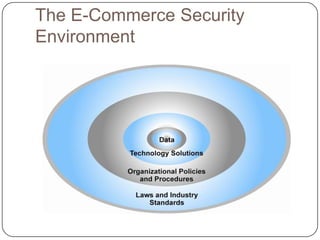
The E-Commerce Security
Environment
 For most law-abiding citizens, the Internet holds
    the promise of a huge and convenient global
    marketplace
   For criminals, the Internet has created entirely
    new – and profitable – ways to steal from the
    more than one billion Internet consumers
    worldwide
   From products to services to cash to information,
    it’s all there for the taking on the Internet
   It’s also less risky to steal online
   For example, rather than rob a bank in person,
    the Internet makes it possible to rob people
The Scope of the Problem
 Cybercrime is becoming a more significant
  problem for both organizations and consumers
 Bot networks, DDoS attacks, Trojans, phishing,
  data theft, identify theft, credit card fraud, and
  spyware are just some of the threats that are
  making daily headlines
 Even social networking sites have had security
  breaches
 For example, an individual hacked into Britney
  Spears’ Twitter account and began sending
  messages saying the singer had died
The Scope of the Problem (cont.)
 One source of cybercrime information is the
  Internet Crime Complaint Center (IC3)
 In 2010, the IC3 processed more than 303,000
  Internet crime complaints and it was estimated
  that in 2009 the total dollar loss for all referred
  crimes was $559 million
 In the past, auction fraud constituted over 70% of
  complaints, but in 2010 it was only 10%,
  displaced by non payment/delivery (21%) and
  identity theft (16%)
 The Computer Security Institute’s annual
  Computer Crime and Security Survey is another
  source of information
Types of
Attacks
Against
Compute
r
Systems
(Figure)
The Underground Economy Marketplace:
The Value of Stolen Information
 Criminals who steal information on the Internet do
  not always use this information themselves, but
  instead derive value by selling the information to
  others
 Some recently observed prices for stolen
  information, which typically vary depending on the
  quantity being purchased
 Not every cybercriminal is necessary after money
 In some cases, such criminals aim to deface,
  vandalize, and/or disrupt a Web site, rather than
  actually steal goods or services
What is Good E-Commerce
Security?
 What is a secure commercial transaction?
 Anytime you go into a marketplace you take risks,
  including the loss of privacy
 E-commerce merchants and consumers face
  many of the same risks as participants in
  traditional commerce, although in a new digital
  environment
 Reducing risks in e-commerce is a complex
  process that involves new technologies,
  organizational policies and procedures, and new
  laws and industry standards that empower law
  enforcement officials to investigate and prosecute
  offenders
The E-Commerce Security
Environment
The Tension Between Security
and Other Values
 Can there be too much security? The answer is
  yes.
 Computer security adds overhead and expense
  to business operations
 Expanding computer security also has other
  downsides:
   Makes systems more difficult to use
   Slows down processors
   Increases data storage demands
   May reduce individual’s abilities to remain
   anonymous
Security Threats in the E-
Commerce Environment
 From a technological perspective, there are three
  key points of vulnerability when dealing with e-
  commerce: the client, the server, and the
  communications pipeline
 Figure 5.4 illustrates some of the things that can
  go wrong at each major vulnerability point in the
  transaction
A Typical E-Commerce
Transaction
Vulnerable Points in an E-
Commerce Transaction
Common E-Commerce Security
Threats
 Some of the most common and most damaging forms
 of security threats to e-commerce consumers and site
 operators include:
   Malicious code (malware) – virus, worm, Trojan horse,
      bots, etc.
     Unwanted programs (spyware)
     Phishing and identify theft – social engineering
     Hacking and cybervandalism
     Credit card fraud/theft
     Spoofing (pharming) and spam (junk) websites
     Denial of service (DoS) attacks
     Insider attacks
     Poorly designed server and client software
 Social networks and mobile devices greatly expand
 the security threats to organizations and individuals
Technology Solutions
 It might seem like there is not much that can be
  done about the onslaught of security breaches on
  the Internet
 But in fact a great deal of progress has been
  made by private security firms, corporate and
  home users, network administrators, technology
  firms, and government agencies
 Two lines of defense include:
   Technology solutions
   Policy solutions
Encryption
 Encryption is the process of transforming plain
  text or data into cipher text that cannot be read by
  anyone other than the sender and the receiver
 The purpose of encryption is to secure stored
  information and to secure information
  transmission
 One early encryption method was symmetric key
  encryption where both the sender and the
  receiver use the same key to encrypt and decrypt
  the message
 They had to send the key to each other over
  some communications media or in person
Public Key Cryptography
Limitations to Encryption
Solutions
 All forms of encryption have limitations
 It is not effective against insiders
 Protecting private keys may also be difficult
  because they are stored on insecure desktop and
  laptop computers
 Additional technology solutions exist for securing
  channels of communications, networks, and
  servers/clients
Communication Channel, Network,
 and Server/Client Security
 Technologies
 Communication channel security technologies:
   Secure Sockets Layer (SSL)
   Virtual Private Networks (VPNs)
 Network protection technologies:
   Firewalls
   Proxy servers
 Server/client protection technologies
   Operating system security enhancements
   Anti-virus software
Management Policies, Business
Procedures, and Public Laws
 US businesses and government agencies spend
  about 14% of their information technology
  budgets on security hardware, software, and
  services (about $35 billion in 2010)
 However, most CEOs and CIOs of existing e-
  commerce operations believe that technology is
  not the sole answer to managing the risk of e-
  commerce
 An e-commerce security plan would include a risk
  assessment, development of a security policy,
  implementation plan, creation of a security
  organization, and a security audit
 Implementation may involve expanded forms of
The Roles of Laws and Public
Policy
 The public policy environment today is very
  different fro the early days of e-commerce
 The net result is that the Internet is no longer an
  ungoverned, unsupervised, self-controlled
  technology juggernaut
 It is also apparent that legal and public policy
  solutions also need to be enacted globally
Government Policies and Controls on
Encryption Software
 An interesting example of the difficulties involved
  in enhancing security is the case of encryption
  software distribution
 Governments have required to restrict availability
  and export of encryption systems as a means of
  detecting and preventing crime and terrorism
 On one hand, restricting global distribution of
  advanced encryption systems may reduce the
  likelihood that they may be cracked
 But it also reduces global Internet security if
  different countries have different levels of
  protection

Ecommerce security

  • 1.
  • 2.
    The E-Commerce Security Environment For most law-abiding citizens, the Internet holds the promise of a huge and convenient global marketplace  For criminals, the Internet has created entirely new – and profitable – ways to steal from the more than one billion Internet consumers worldwide  From products to services to cash to information, it’s all there for the taking on the Internet  It’s also less risky to steal online  For example, rather than rob a bank in person, the Internet makes it possible to rob people
  • 3.
    The Scope ofthe Problem  Cybercrime is becoming a more significant problem for both organizations and consumers  Bot networks, DDoS attacks, Trojans, phishing, data theft, identify theft, credit card fraud, and spyware are just some of the threats that are making daily headlines  Even social networking sites have had security breaches  For example, an individual hacked into Britney Spears’ Twitter account and began sending messages saying the singer had died
  • 4.
    The Scope ofthe Problem (cont.)  One source of cybercrime information is the Internet Crime Complaint Center (IC3)  In 2010, the IC3 processed more than 303,000 Internet crime complaints and it was estimated that in 2009 the total dollar loss for all referred crimes was $559 million  In the past, auction fraud constituted over 70% of complaints, but in 2010 it was only 10%, displaced by non payment/delivery (21%) and identity theft (16%)  The Computer Security Institute’s annual Computer Crime and Security Survey is another source of information
  • 5.
  • 6.
    The Underground EconomyMarketplace: The Value of Stolen Information  Criminals who steal information on the Internet do not always use this information themselves, but instead derive value by selling the information to others  Some recently observed prices for stolen information, which typically vary depending on the quantity being purchased  Not every cybercriminal is necessary after money  In some cases, such criminals aim to deface, vandalize, and/or disrupt a Web site, rather than actually steal goods or services
  • 7.
    What is GoodE-Commerce Security?  What is a secure commercial transaction?  Anytime you go into a marketplace you take risks, including the loss of privacy  E-commerce merchants and consumers face many of the same risks as participants in traditional commerce, although in a new digital environment  Reducing risks in e-commerce is a complex process that involves new technologies, organizational policies and procedures, and new laws and industry standards that empower law enforcement officials to investigate and prosecute offenders
  • 8.
  • 10.
    The Tension BetweenSecurity and Other Values  Can there be too much security? The answer is yes.  Computer security adds overhead and expense to business operations  Expanding computer security also has other downsides:  Makes systems more difficult to use  Slows down processors  Increases data storage demands  May reduce individual’s abilities to remain anonymous
  • 11.
    Security Threats inthe E- Commerce Environment  From a technological perspective, there are three key points of vulnerability when dealing with e- commerce: the client, the server, and the communications pipeline  Figure 5.4 illustrates some of the things that can go wrong at each major vulnerability point in the transaction
  • 12.
  • 13.
    Vulnerable Points inan E- Commerce Transaction
  • 14.
    Common E-Commerce Security Threats Some of the most common and most damaging forms of security threats to e-commerce consumers and site operators include:  Malicious code (malware) – virus, worm, Trojan horse, bots, etc.  Unwanted programs (spyware)  Phishing and identify theft – social engineering  Hacking and cybervandalism  Credit card fraud/theft  Spoofing (pharming) and spam (junk) websites  Denial of service (DoS) attacks  Insider attacks  Poorly designed server and client software  Social networks and mobile devices greatly expand the security threats to organizations and individuals
  • 15.
    Technology Solutions  Itmight seem like there is not much that can be done about the onslaught of security breaches on the Internet  But in fact a great deal of progress has been made by private security firms, corporate and home users, network administrators, technology firms, and government agencies  Two lines of defense include:  Technology solutions  Policy solutions
  • 16.
    Encryption  Encryption isthe process of transforming plain text or data into cipher text that cannot be read by anyone other than the sender and the receiver  The purpose of encryption is to secure stored information and to secure information transmission  One early encryption method was symmetric key encryption where both the sender and the receiver use the same key to encrypt and decrypt the message  They had to send the key to each other over some communications media or in person
  • 17.
  • 18.
    Limitations to Encryption Solutions All forms of encryption have limitations  It is not effective against insiders  Protecting private keys may also be difficult because they are stored on insecure desktop and laptop computers  Additional technology solutions exist for securing channels of communications, networks, and servers/clients
  • 19.
    Communication Channel, Network, and Server/Client Security Technologies  Communication channel security technologies:  Secure Sockets Layer (SSL)  Virtual Private Networks (VPNs)  Network protection technologies:  Firewalls  Proxy servers  Server/client protection technologies  Operating system security enhancements  Anti-virus software
  • 20.
    Management Policies, Business Procedures,and Public Laws  US businesses and government agencies spend about 14% of their information technology budgets on security hardware, software, and services (about $35 billion in 2010)  However, most CEOs and CIOs of existing e- commerce operations believe that technology is not the sole answer to managing the risk of e- commerce  An e-commerce security plan would include a risk assessment, development of a security policy, implementation plan, creation of a security organization, and a security audit  Implementation may involve expanded forms of
  • 21.
    The Roles ofLaws and Public Policy  The public policy environment today is very different fro the early days of e-commerce  The net result is that the Internet is no longer an ungoverned, unsupervised, self-controlled technology juggernaut  It is also apparent that legal and public policy solutions also need to be enacted globally
  • 22.
    Government Policies andControls on Encryption Software  An interesting example of the difficulties involved in enhancing security is the case of encryption software distribution  Governments have required to restrict availability and export of encryption systems as a means of detecting and preventing crime and terrorism  On one hand, restricting global distribution of advanced encryption systems may reduce the likelihood that they may be cracked  But it also reduces global Internet security if different countries have different levels of protection