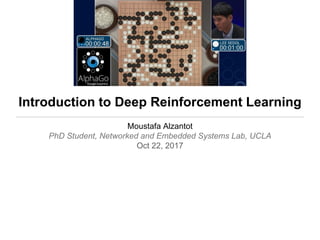
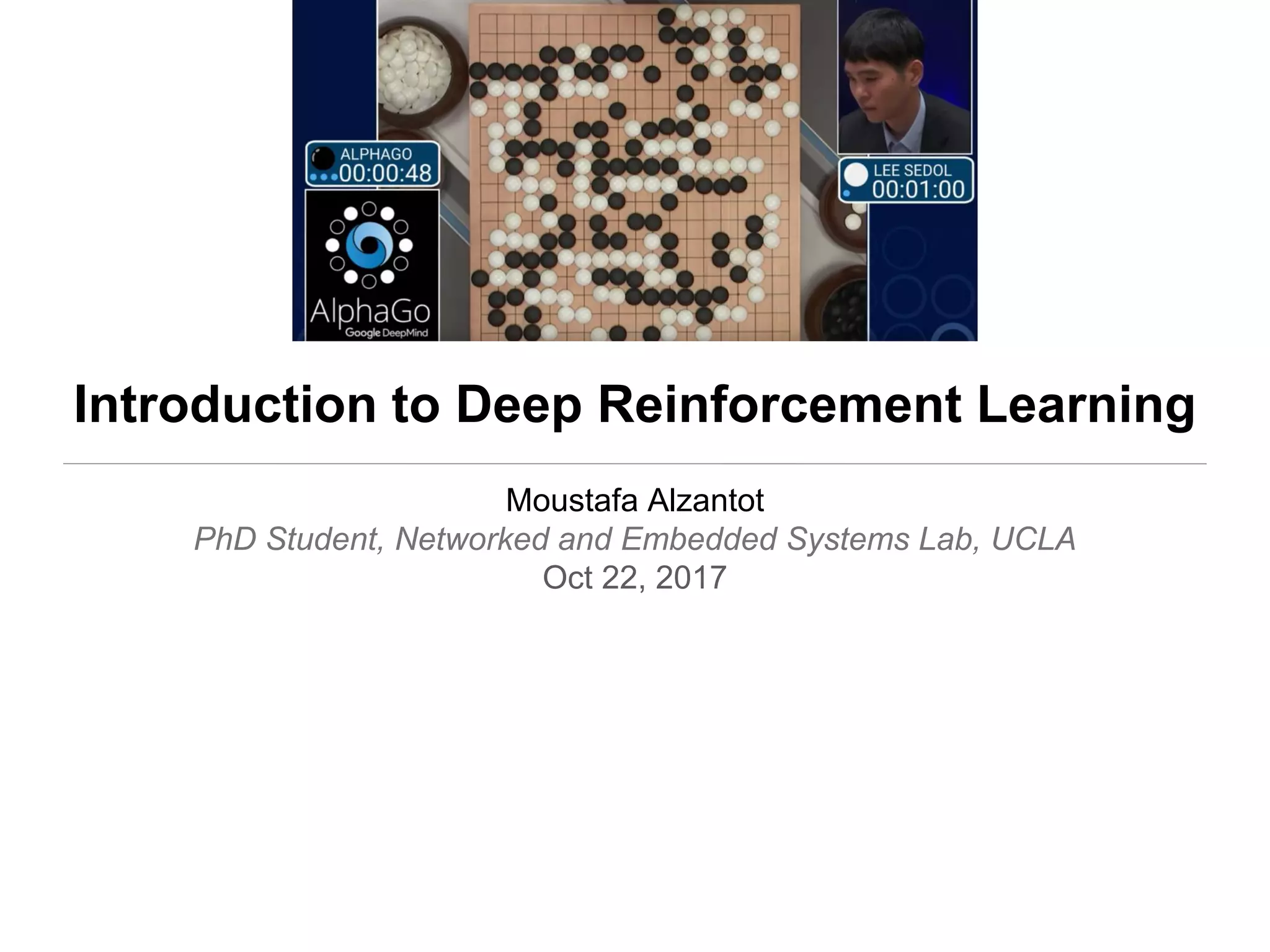
Introduction to Deep Reinforcement Learning
Moustafa Alzantot
PhD Student, Networked and Embedded Systems Lab, UCLA
Oct 22, 2017
Machine Learning
Computer programs can increase their performance on a given task
without being explicitly programmed for it, just by analyzing data !
Types Machine Learning
• Supervised Learning
• Given a set of labeled examples , predict the output label for new unseen
inputs.
• Unsupervised Learning
• Given unlabeled dataset, understand the structure of the data (e.g.
clustering, dimensionality reduction).
• Reinforcement Learning
• Branch of machine learning concerned with acting optimally in face of
uncertainty (i.e. learning to do ! )
Reinforcement Learning
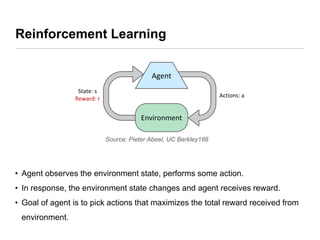
• Agent observes the environment state, performs some action.
• In response, the environment state changes and agent receives reward.
• Goal of agent is to pick actions that maximizes the total reward received from
environment.
Environment
Agent
Actions: a
State: s
Reward: r
Source: Pieter Abeel, UC Berkley188
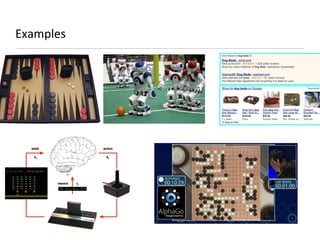
Examples
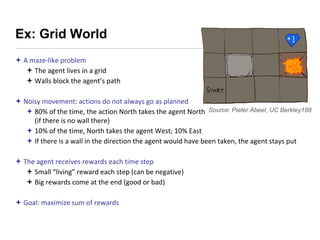
Ex: Grid World
 A maze-like problem
 The agent lives in a grid
 Walls block the agent’s path
 Noisy movement: actions do not always go as planned
 80% of the time, the action North takes the agent North
(if there is no wall there)
 10% of the time, North takes the agent West; 10% East
 If there is a wall in the direction the agent would have been taken, the agent stays put
 The agent receives rewards each time step
 Small “living” reward each step (can be negative)
 Big rewards come at the end (good or bad)
 Goal: maximize sum of rewards
Source: Pieter Abeel, UC Berkley188
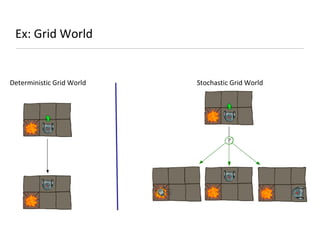
Ex: Grid World
Deterministic Grid World Stochastic Grid World
Markov Decision Process
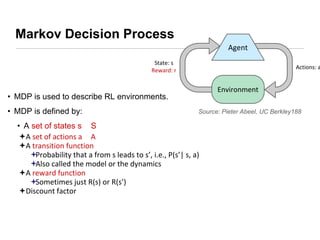
• MDP is used to describe RL environments.
• MDP is defined by:
• A set of states s S
A set of actions a A
A transition function
Probability that a from s leads to s’, i.e., P(s’| s, a)
Also called the model or the dynamics
A reward function
Sometimes just R(s) or R(s’)
Discount factor
Environment
Agent
Actions: a
State: s
Reward: r
Source: Pieter Abeel, UC Berkley188
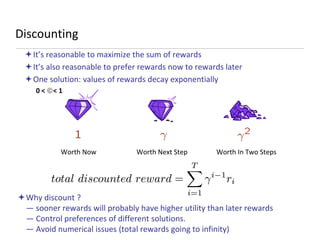
Discounting
It’s reasonable to maximize the sum of rewards
It’s also reasonable to prefer rewards now to rewards later
One solution: values of rewards decay exponentially
0 < < 1
Worth Now Worth Next Step Worth In Two Steps
Why discount ?
— sooner rewards will probably have higher utility than later rewards
— Control preferences of different solutions.
— Avoid numerical issues (total rewards going to infinity)
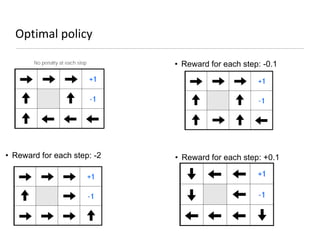
Optimal policy
No penalty at each step • Reward for each step: -0.1
• Reward for each step: -2 • Reward for each step: +0.1
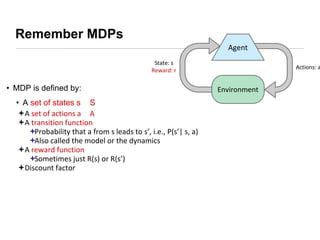
Remember MDPs
• MDP is defined by:
• A set of states s S
A set of actions a A
A transition function
Probability that a from s leads to s’, i.e., P(s’| s, a)
Also called the model or the dynamics
A reward function
Sometimes just R(s) or R(s’)
Discount factor
Environment
Agent
Actions: a
State: s
Reward: r
Solving MDPs
• If the MDP (environment model) is known, there are ways that are guaranteed
to find the optimal policy.
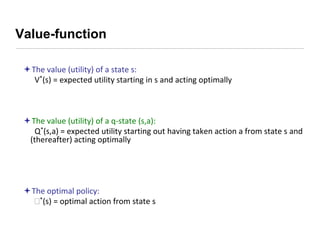
Value-function
The value (utility) of a state s:
V*(s) = expected utility starting in s and acting optimally
The value (utility) of a q-state (s,a):
Q*(s,a) = expected utility starting out having taken action a from state s and
(thereafter) acting optimally
The optimal policy:
*(s) = optimal action from state s
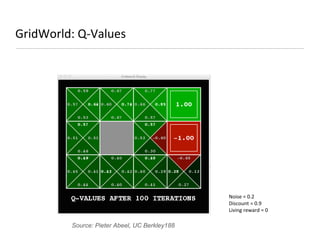
GridWorld: Q-Values
Noise = 0.2
Discount = 0.9
Living reward = 0
Source: Pieter Abeel, UC Berkley188
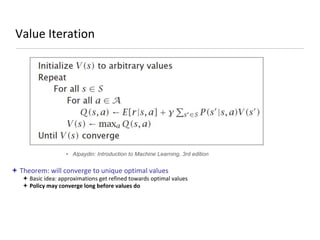
Value Iteration
 Theorem: will converge to unique optimal values
 Basic idea: approximations get refined towards optimal values
 Policy may converge long before values do
• Alpaydin: Introduction to Machine Learning, 3rd edition
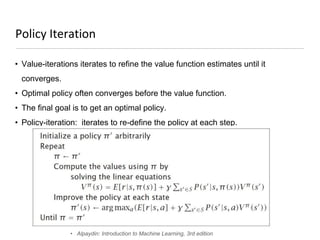
Policy Iteration
• Value-iterations iterates to refine the value function estimates until it
converges.
• Optimal policy often converges before the value function.
• The final goal is to get an optimal policy.
• Policy-iteration: iterates to re-define the policy at each step.
• Alpaydin: Introduction to Machine Learning, 3rd edition
Reinforcement Learning ?!
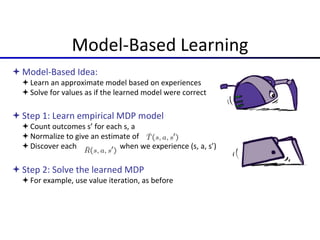
Model-Based Learning
Model-Based Idea:
Learn an approximate model based on experiences
Solve for values as if the learned model were correct
Step 1: Learn empirical MDP model
Count outcomes s’ for each s, a
Normalize to give an estimate of
Discover each when we experience (s, a, s’)
Step 2: Solve the learned MDP
For example, use value iteration, as before
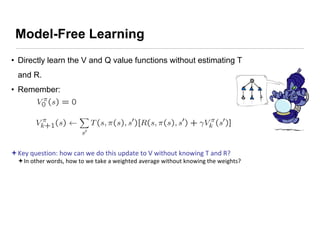
Model-Free Learning
• Directly learn the V and Q value functions without estimating T
and R.
• Remember:
Key question: how can we do this update to V without knowing T and R?
In other words, how to we take a weighted average without knowing the weights?
Q-Learning
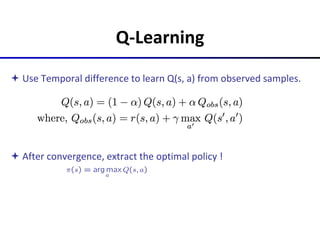
 Use Temporal difference to learn Q(s, a) from observed samples.
 After convergence, extract the optimal policy !
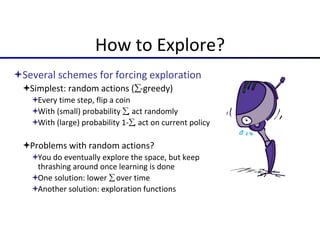
How to Explore?
Several schemes for forcing exploration
Simplest: random actions (-greedy)
Every time step, flip a coin
With (small) probability , act randomly
With (large) probability 1-, act on current policy
Problems with random actions?
You do eventually explore the space, but keep
thrashing around once learning is done
One solution: lower over time
Another solution: exploration functions
Demo: MountainCar using Q-Learning
https://www.youtube.com/watch?v=ByOdncJE5bE
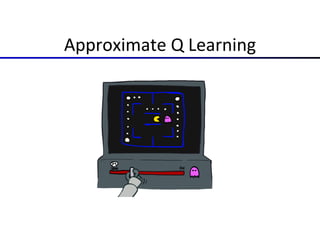
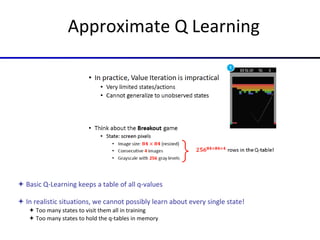
Approximate Q Learning
 Basic Q-Learning keeps a table of all q-values
 In realistic situations, we cannot possibly learn about every single state!
 Too many states to visit them all in training
 Too many states to hold the q-tables in memory
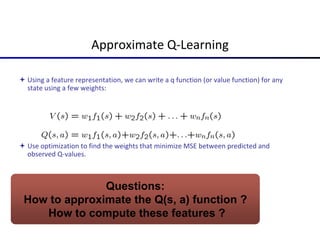
Approximate Q-Learning
 Using a feature representation, we can write a q function (or value function) for any
state using a few weights:
 Use optimization to find the weights that minimize MSE between predicted and
observed Q-values.
Questions:
How to approximate the Q(s, a) function ?
How to compute these features ?
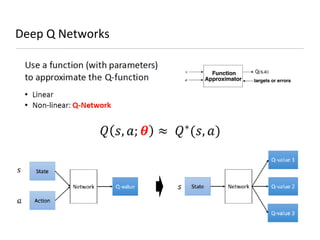
Deep Q Networks
Remember:
Universal approximation theorem:
Neural Network with 1 hidden layer can learn any
bounded continuous function!
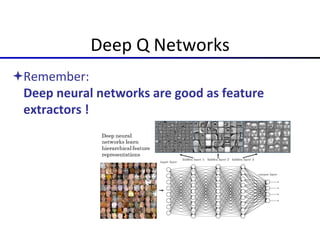
Deep Q Networks
Remember:
Deep neural networks are good as feature
extractors !
Deep Q Networks
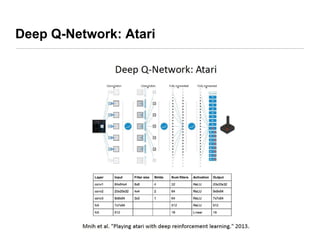
Deep Q-Network: Atari
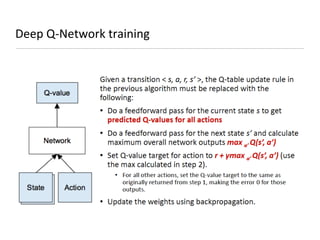
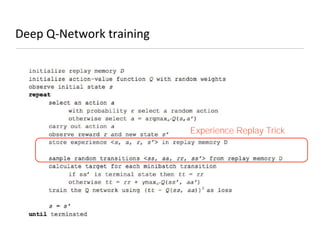
Deep Q-Network training
Experience Replay Trick
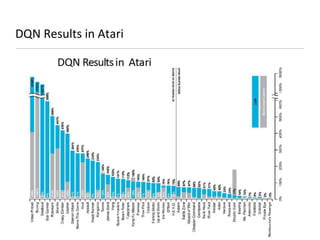
DQN Results in Atari
Resources
• Pieter Abeel, UC Berkley CS 188
• Alpaydin: Introduction to Machine Learning, 3rd edition
• David Silver, UCL Reinforcement Learning Course
• Yandex: Practical RL
• MIT: Deep Learning for self-driving cars !
• Stanford 234: Reinforcement Learning
Thanks
Send any question to
malzantot@ucla.edu

Introduction to Deep Reinforcement Learning

  • 1.
    Introduction to DeepReinforcement Learning Moustafa Alzantot PhD Student, Networked and Embedded Systems Lab, UCLA Oct 22, 2017
  • 2.
    Machine Learning Computer programscan increase their performance on a given task without being explicitly programmed for it, just by analyzing data !
  • 3.
    Types Machine Learning •Supervised Learning • Given a set of labeled examples , predict the output label for new unseen inputs. • Unsupervised Learning • Given unlabeled dataset, understand the structure of the data (e.g. clustering, dimensionality reduction). • Reinforcement Learning • Branch of machine learning concerned with acting optimally in face of uncertainty (i.e. learning to do ! )
  • 4.
    Reinforcement Learning • Agentobserves the environment state, performs some action. • In response, the environment state changes and agent receives reward. • Goal of agent is to pick actions that maximizes the total reward received from environment. Environment Agent Actions: a State: s Reward: r Source: Pieter Abeel, UC Berkley188
  • 5.
  • 6.
    Ex: Grid World A maze-like problem  The agent lives in a grid  Walls block the agent’s path  Noisy movement: actions do not always go as planned  80% of the time, the action North takes the agent North (if there is no wall there)  10% of the time, North takes the agent West; 10% East  If there is a wall in the direction the agent would have been taken, the agent stays put  The agent receives rewards each time step  Small “living” reward each step (can be negative)  Big rewards come at the end (good or bad)  Goal: maximize sum of rewards Source: Pieter Abeel, UC Berkley188
  • 7.
    Ex: Grid World DeterministicGrid World Stochastic Grid World
  • 8.
    Markov Decision Process •MDP is used to describe RL environments. • MDP is defined by: • A set of states s S A set of actions a A A transition function Probability that a from s leads to s’, i.e., P(s’| s, a) Also called the model or the dynamics A reward function Sometimes just R(s) or R(s’) Discount factor Environment Agent Actions: a State: s Reward: r Source: Pieter Abeel, UC Berkley188
  • 9.
    Discounting It’s reasonable tomaximize the sum of rewards It’s also reasonable to prefer rewards now to rewards later One solution: values of rewards decay exponentially 0 < < 1 Worth Now Worth Next Step Worth In Two Steps Why discount ? — sooner rewards will probably have higher utility than later rewards — Control preferences of different solutions. — Avoid numerical issues (total rewards going to infinity)
  • 10.
    Optimal policy No penaltyat each step • Reward for each step: -0.1 • Reward for each step: -2 • Reward for each step: +0.1
  • 11.
    Remember MDPs • MDPis defined by: • A set of states s S A set of actions a A A transition function Probability that a from s leads to s’, i.e., P(s’| s, a) Also called the model or the dynamics A reward function Sometimes just R(s) or R(s’) Discount factor Environment Agent Actions: a State: s Reward: r
  • 12.
    Solving MDPs • Ifthe MDP (environment model) is known, there are ways that are guaranteed to find the optimal policy.
  • 13.
    Value-function The value (utility)of a state s: V*(s) = expected utility starting in s and acting optimally The value (utility) of a q-state (s,a): Q*(s,a) = expected utility starting out having taken action a from state s and (thereafter) acting optimally The optimal policy: *(s) = optimal action from state s
  • 14.
    GridWorld: Q-Values Noise =0.2 Discount = 0.9 Living reward = 0 Source: Pieter Abeel, UC Berkley188
  • 15.
    Value Iteration  Theorem:will converge to unique optimal values  Basic idea: approximations get refined towards optimal values  Policy may converge long before values do • Alpaydin: Introduction to Machine Learning, 3rd edition
  • 16.
    Policy Iteration • Value-iterationsiterates to refine the value function estimates until it converges. • Optimal policy often converges before the value function. • The final goal is to get an optimal policy. • Policy-iteration: iterates to re-define the policy at each step. • Alpaydin: Introduction to Machine Learning, 3rd edition
  • 17.
  • 18.
    Model-Based Learning Model-Based Idea: Learnan approximate model based on experiences Solve for values as if the learned model were correct Step 1: Learn empirical MDP model Count outcomes s’ for each s, a Normalize to give an estimate of Discover each when we experience (s, a, s’) Step 2: Solve the learned MDP For example, use value iteration, as before
  • 19.
    Model-Free Learning • Directlylearn the V and Q value functions without estimating T and R. • Remember: Key question: how can we do this update to V without knowing T and R? In other words, how to we take a weighted average without knowing the weights?
  • 20.
    Q-Learning  Use Temporaldifference to learn Q(s, a) from observed samples.  After convergence, extract the optimal policy !
  • 21.
    How to Explore? Severalschemes for forcing exploration Simplest: random actions (-greedy) Every time step, flip a coin With (small) probability , act randomly With (large) probability 1-, act on current policy Problems with random actions? You do eventually explore the space, but keep thrashing around once learning is done One solution: lower over time Another solution: exploration functions
  • 22.
    Demo: MountainCar usingQ-Learning https://www.youtube.com/watch?v=ByOdncJE5bE
  • 23.
  • 24.
    Approximate Q Learning Basic Q-Learning keeps a table of all q-values  In realistic situations, we cannot possibly learn about every single state!  Too many states to visit them all in training  Too many states to hold the q-tables in memory
  • 25.
    Approximate Q-Learning  Usinga feature representation, we can write a q function (or value function) for any state using a few weights:  Use optimization to find the weights that minimize MSE between predicted and observed Q-values. Questions: How to approximate the Q(s, a) function ? How to compute these features ?
  • 26.
    Deep Q Networks Remember: Universalapproximation theorem: Neural Network with 1 hidden layer can learn any bounded continuous function!
  • 27.
    Deep Q Networks Remember: Deepneural networks are good as feature extractors !
  • 28.
  • 29.
  • 30.
  • 31.
  • 32.
  • 33.
    Resources • Pieter Abeel,UC Berkley CS 188 • Alpaydin: Introduction to Machine Learning, 3rd edition • David Silver, UCL Reinforcement Learning Course • Yandex: Practical RL • MIT: Deep Learning for self-driving cars ! • Stanford 234: Reinforcement Learning
  • 34.
    Thanks Send any questionto malzantot@ucla.edu