CS 221: Artificial Intelligence Reinforcement Learning Peter Norvig and Sebastian Thrun Slide credit: Dan Klein, Stuart Russell, Andrew Moore
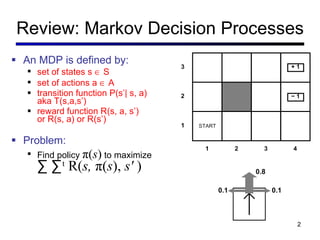
Review: Markov Decision Processes An MDP is defined by: set of states s    S set of actions a    A transition function P(s ’| s, a) aka T(s,a,s’) reward function R(s, a, s ’) or R(s, a) or R(s’) Problem: Find policy  π( s )  to maximize  ∑  𝛾 t  R( s,  π( s ),  s′  )
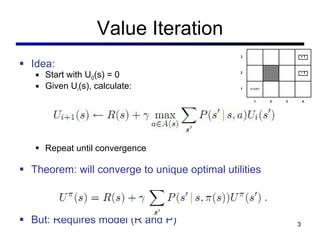
Value Iteration Idea: Start with U 0 (s) = 0 Given U i (s), calculate: Repeat until convergence Theorem: will converge to unique optimal utilities But: Requires model (R and P)
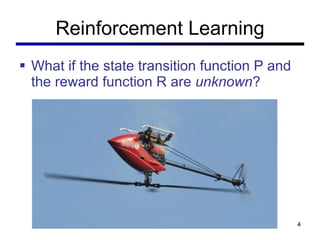
Reinforcement Learning What if the state transition function P and the reward function R are  unknown ?
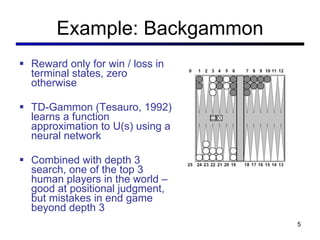
Example: Backgammon Reward only for win / loss in terminal states, zero otherwise TD-Gammon (Tesauro, 1992) learns a function approximation to U(s) using a neural network Combined with depth 3 search, one of the top 3 human players in the world – good at positional judgment, but mistakes in end game beyond depth 3
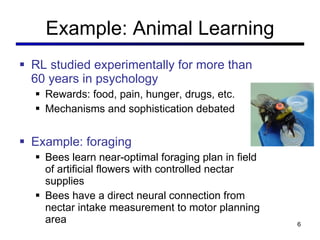
Example: Animal Learning RL studied experimentally for more than 60 years in psychology Rewards: food, pain, hunger, drugs, etc. Mechanisms and sophistication debated Example: foraging Bees learn near-optimal foraging plan in field of artificial flowers with controlled nectar supplies Bees have a direct neural connection from nectar intake measurement to motor planning area
What to Learn If you don’t know P, R, what you learn depends on what you want to do Utility-based agent:  learn U(s) Q-learning agent:  learn utility Q(s, a) Reflex agent:  learn policy  π (s) And on how patient/reckless you are Passive:  use a fixed policy  π Active:  modify policy as you go
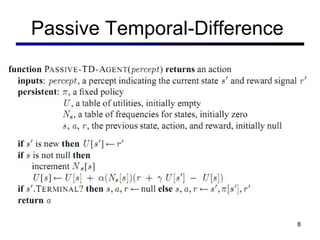
Passive Temporal-Difference
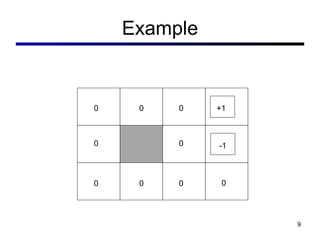
Example +1 -1 0 0 0 0 0 0 0 0 0
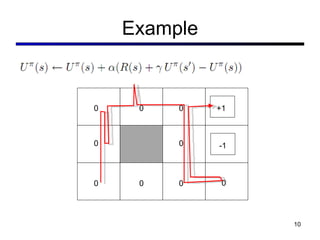
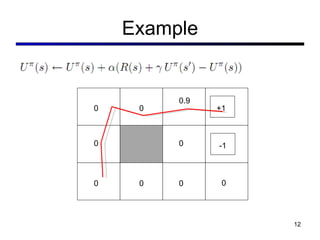
Example +1 -1 0 0 0 0 0 0 0.9 0 0
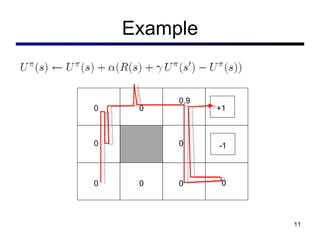
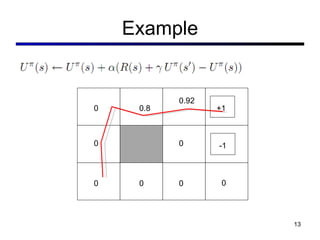
Example +1 -1 0 0 0 0 0 0.8 0.92 0 0
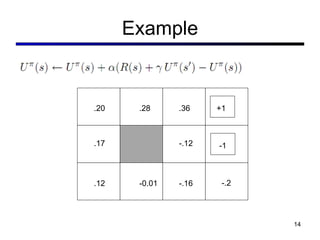
Example +1 -1 -0.01 -.16 .12 -.12 .17 .28 .36 .20 -.2
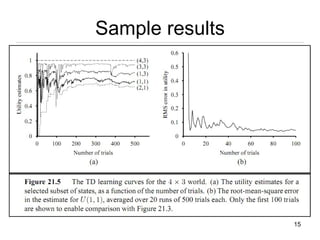
Sample results
Problem The problem Algorithm computes the value of one specific policy May never try the best moves May never visit some states May waste time computing unneeded utilities
Quiz Is there a fix? Can we explore different policies (active reinforcement learning), yet still learn the optimal policy?
Greedy TD-Agent Learn U with TD-Learning After each change to U, solve MDP to compute new optimal policy  π (s)  Continue learning with new policy
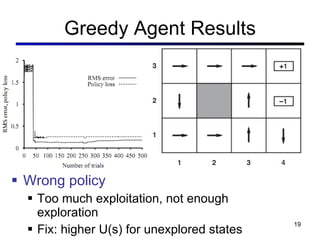
Greedy Agent Results Wrong policy Too much exploitation, not enough exploration Fix: higher U(s) for unexplored states
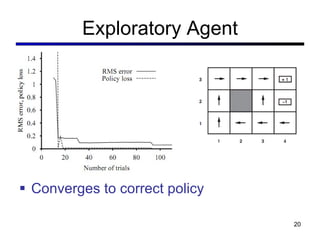
Exploratory Agent Converges to correct policy
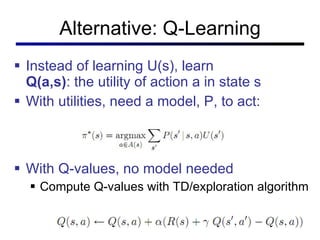
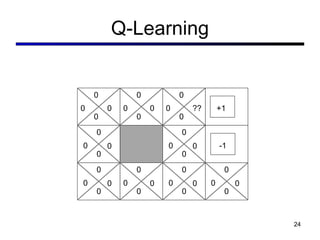
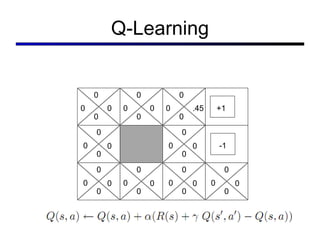
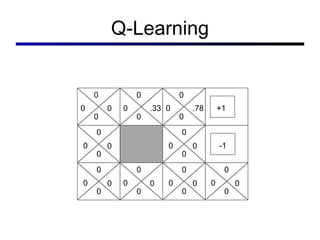
Alternative: Q-Learning Instead of learning U(s), learn Q(a,s) : the utility of action a in state s With utilities, need a model, P, to act: With Q-values, no model needed Compute Q-values with TD/exploration algorithm
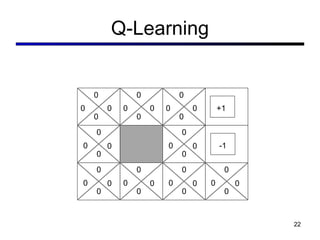
Q-Learning 0 0 0 +1 -1 0 0 0 0 0 0 0 0 0 0 0 0 0 0 0 0 0 0 0 0 0 0 0 0 0 0 0 0 0 0 0 0 0
Q-Learning 0 0 0 +1 -1 0 0 0 0 0 0 0 0 0 0 0 0 0 0 0 0 0 0 0 0 ?? 0 0 0 0 0 0 0 0 0 0 0 0
Q-Learning 0 0 0 +1 -1 0 0 0 0 0 0 0 0 0 0 0 0 0 0 0 0 0 0 0 0 .45 0 0 0 0 0 0 0 0 0 0 0 0
Q-Learning 0 0 0 +1 -1 0 0 0 0 0 0 0 0 0 0 0 0 0 0 0 0 0 0 0 .33 .78 0 0 0 0 0 0 0 0 0 0 0 0
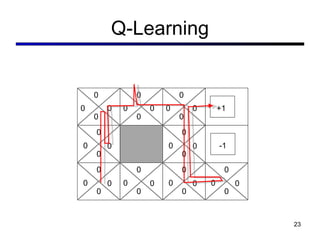
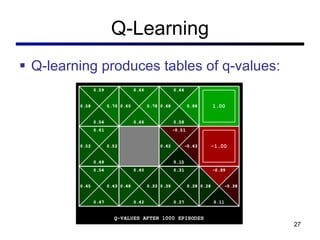
Q-Learning Q-learning produces tables of q-values:
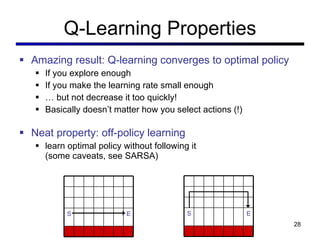
Q-Learning Properties Amazing result: Q-learning converges to optimal policy If you explore enough If you make the learning rate small enough …  but not decrease it too quickly! Basically doesn ’t matter how you select actions (!) Neat property: off-policy learning learn optimal policy without following it  (some caveats, see SARSA) S E S E
Practical Q-Learning In realistic situations, we cannot possibly learn about every single state! Too many states to visit them all in training Too many states to hold the q-tables in memory Instead, we want to generalize: Learn about some small number of training states from experience Generalize that experience to new, similar states This is a fundamental idea in machine learning, and we ’ll see it over and over again
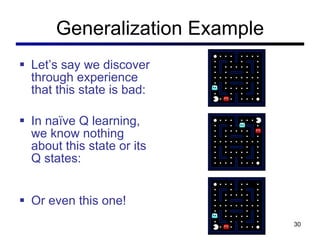
Generalization Example Let’ s say we discover through experience that this state is bad: In naïve Q learning, we know nothing about this state or its Q states: Or even this one!
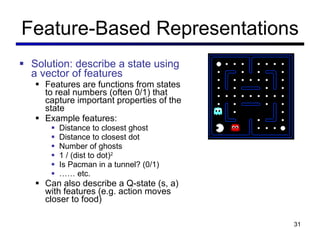
Feature-Based Representations Solution: describe a state using a vector of features Features are functions from states to real numbers (often 0/1) that capture important properties of the state Example features: Distance to closest ghost Distance to closest dot Number of ghosts 1 / (dist to dot) 2 Is Pacman in a tunnel? (0/1) ……  etc. Can also describe a Q-state (s, a) with features (e.g. action moves closer to food)
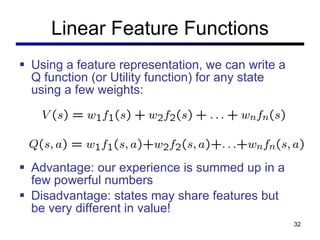
Linear Feature Functions Using a feature representation, we can write a Q function (or Utility function) for any state using a few weights: Advantage: our experience is summed up in a few powerful numbers Disadvantage: states may share features but be very different in value!
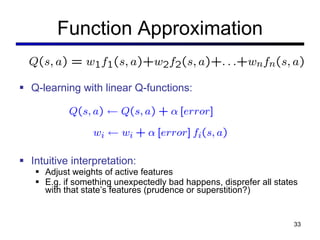
Function Approximation Q-learning with linear Q-functions: Intuitive interpretation: Adjust weights of active features E.g. if something unexpectedly bad happens, disprefer all states with that state’ s features (prudence or superstition?)
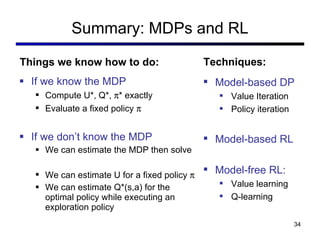
Summary: MDPs and RL If we know the MDP Compute U*, Q*,   * exactly Evaluate a fixed policy   If we don’ t know the MDP We can estimate the MDP then solve We can estimate U for a fixed policy   We can estimate Q*(s,a) for the optimal policy while executing an exploration policy Model-based DP Value Iteration Policy iteration Model-based RL Model-free RL: Value learning Q-learning Things we know how to do: Techniques:

Cs221 rl

  • 1.
    CS 221: ArtificialIntelligence Reinforcement Learning Peter Norvig and Sebastian Thrun Slide credit: Dan Klein, Stuart Russell, Andrew Moore
  • 2.
    Review: Markov DecisionProcesses An MDP is defined by: set of states s  S set of actions a  A transition function P(s ’| s, a) aka T(s,a,s’) reward function R(s, a, s ’) or R(s, a) or R(s’) Problem: Find policy π( s ) to maximize ∑ 𝛾 t R( s, π( s ), s′ )
  • 3.
    Value Iteration Idea:Start with U 0 (s) = 0 Given U i (s), calculate: Repeat until convergence Theorem: will converge to unique optimal utilities But: Requires model (R and P)
  • 4.
    Reinforcement Learning Whatif the state transition function P and the reward function R are unknown ?
  • 5.
    Example: Backgammon Rewardonly for win / loss in terminal states, zero otherwise TD-Gammon (Tesauro, 1992) learns a function approximation to U(s) using a neural network Combined with depth 3 search, one of the top 3 human players in the world – good at positional judgment, but mistakes in end game beyond depth 3
  • 6.
    Example: Animal LearningRL studied experimentally for more than 60 years in psychology Rewards: food, pain, hunger, drugs, etc. Mechanisms and sophistication debated Example: foraging Bees learn near-optimal foraging plan in field of artificial flowers with controlled nectar supplies Bees have a direct neural connection from nectar intake measurement to motor planning area
  • 7.
    What to LearnIf you don’t know P, R, what you learn depends on what you want to do Utility-based agent: learn U(s) Q-learning agent: learn utility Q(s, a) Reflex agent: learn policy π (s) And on how patient/reckless you are Passive: use a fixed policy π Active: modify policy as you go
  • 8.
  • 9.
    Example +1 -10 0 0 0 0 0 0 0 0
  • 10.
    Example +1 -10 0 0 0 0 0 0 0 0
  • 11.
    Example +1 -10 0 0 0 0 0 0.9 0 0
  • 12.
    Example +1 -10 0 0 0 0 0 0.9 0 0
  • 13.
    Example +1 -10 0 0 0 0 0.8 0.92 0 0
  • 14.
    Example +1 -1-0.01 -.16 .12 -.12 .17 .28 .36 .20 -.2
  • 15.
  • 16.
    Problem The problemAlgorithm computes the value of one specific policy May never try the best moves May never visit some states May waste time computing unneeded utilities
  • 17.
    Quiz Is therea fix? Can we explore different policies (active reinforcement learning), yet still learn the optimal policy?
  • 18.
    Greedy TD-Agent LearnU with TD-Learning After each change to U, solve MDP to compute new optimal policy π (s) Continue learning with new policy
  • 19.
    Greedy Agent ResultsWrong policy Too much exploitation, not enough exploration Fix: higher U(s) for unexplored states
  • 20.
    Exploratory Agent Convergesto correct policy
  • 21.
    Alternative: Q-Learning Insteadof learning U(s), learn Q(a,s) : the utility of action a in state s With utilities, need a model, P, to act: With Q-values, no model needed Compute Q-values with TD/exploration algorithm
  • 22.
    Q-Learning 0 00 +1 -1 0 0 0 0 0 0 0 0 0 0 0 0 0 0 0 0 0 0 0 0 0 0 0 0 0 0 0 0 0 0 0 0 0
  • 23.
    Q-Learning 0 00 +1 -1 0 0 0 0 0 0 0 0 0 0 0 0 0 0 0 0 0 0 0 0 0 0 0 0 0 0 0 0 0 0 0 0 0
  • 24.
    Q-Learning 0 00 +1 -1 0 0 0 0 0 0 0 0 0 0 0 0 0 0 0 0 0 0 0 0 ?? 0 0 0 0 0 0 0 0 0 0 0 0
  • 25.
    Q-Learning 0 00 +1 -1 0 0 0 0 0 0 0 0 0 0 0 0 0 0 0 0 0 0 0 0 .45 0 0 0 0 0 0 0 0 0 0 0 0
  • 26.
    Q-Learning 0 00 +1 -1 0 0 0 0 0 0 0 0 0 0 0 0 0 0 0 0 0 0 0 .33 .78 0 0 0 0 0 0 0 0 0 0 0 0
  • 27.
    Q-Learning Q-learning producestables of q-values:
  • 28.
    Q-Learning Properties Amazingresult: Q-learning converges to optimal policy If you explore enough If you make the learning rate small enough … but not decrease it too quickly! Basically doesn ’t matter how you select actions (!) Neat property: off-policy learning learn optimal policy without following it (some caveats, see SARSA) S E S E
  • 29.
    Practical Q-Learning Inrealistic situations, we cannot possibly learn about every single state! Too many states to visit them all in training Too many states to hold the q-tables in memory Instead, we want to generalize: Learn about some small number of training states from experience Generalize that experience to new, similar states This is a fundamental idea in machine learning, and we ’ll see it over and over again
  • 30.
    Generalization Example Let’s say we discover through experience that this state is bad: In naïve Q learning, we know nothing about this state or its Q states: Or even this one!
  • 31.
    Feature-Based Representations Solution:describe a state using a vector of features Features are functions from states to real numbers (often 0/1) that capture important properties of the state Example features: Distance to closest ghost Distance to closest dot Number of ghosts 1 / (dist to dot) 2 Is Pacman in a tunnel? (0/1) …… etc. Can also describe a Q-state (s, a) with features (e.g. action moves closer to food)
  • 32.
    Linear Feature FunctionsUsing a feature representation, we can write a Q function (or Utility function) for any state using a few weights: Advantage: our experience is summed up in a few powerful numbers Disadvantage: states may share features but be very different in value!
  • 33.
    Function Approximation Q-learningwith linear Q-functions: Intuitive interpretation: Adjust weights of active features E.g. if something unexpectedly bad happens, disprefer all states with that state’ s features (prudence or superstition?)
  • 34.
    Summary: MDPs andRL If we know the MDP Compute U*, Q*,  * exactly Evaluate a fixed policy  If we don’ t know the MDP We can estimate the MDP then solve We can estimate U for a fixed policy  We can estimate Q*(s,a) for the optimal policy while executing an exploration policy Model-based DP Value Iteration Policy iteration Model-based RL Model-free RL: Value learning Q-learning Things we know how to do: Techniques: