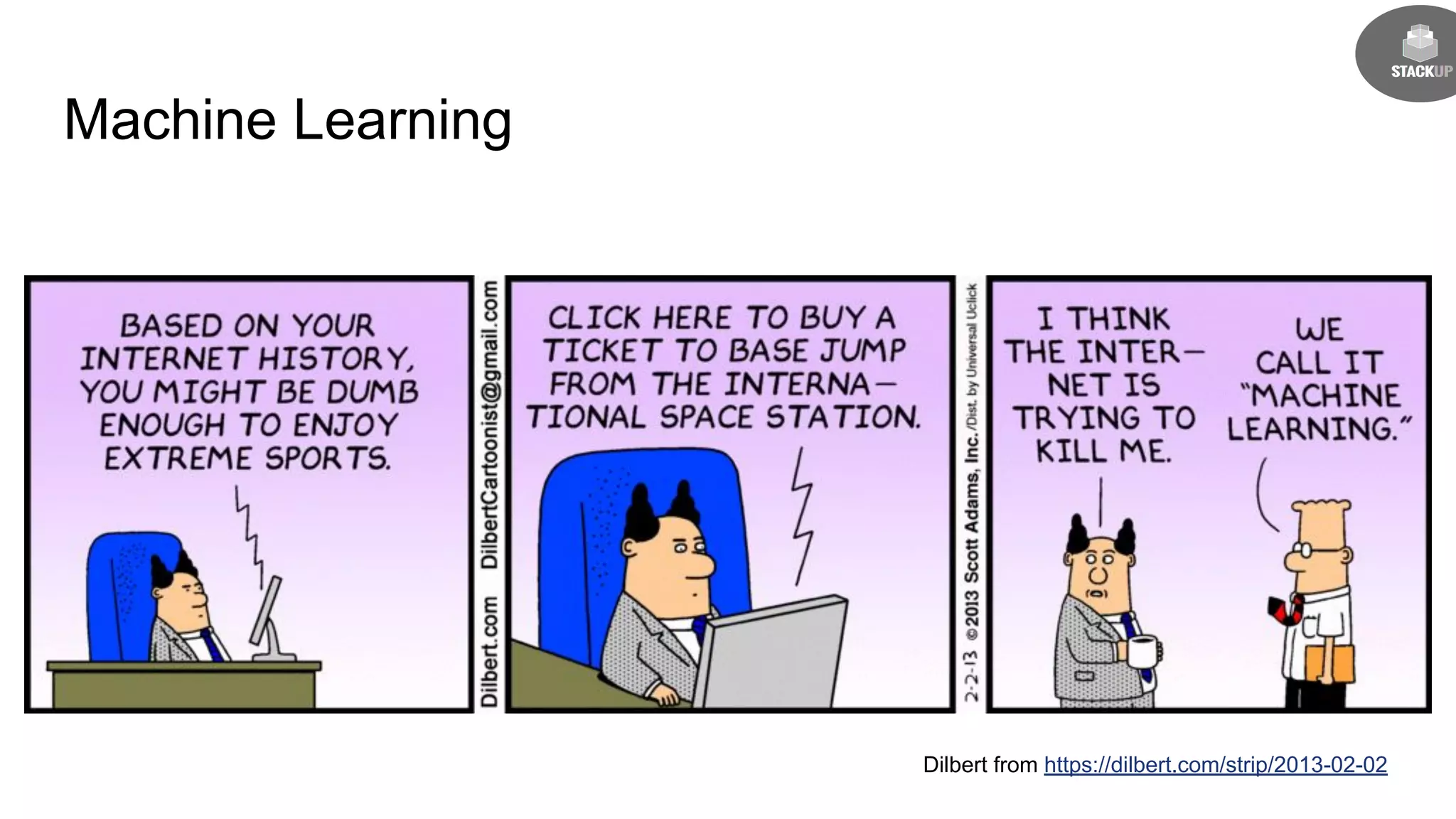
Machine Learning
Dilbert from https://dilbert.com/strip/2013-02-02
Introduction to
Reinforcement Learning
Lee Chuk Munn
Slides at http://bit.ly/ld2019_rl
Objective
Introduce Major
Reinforcement Learning
Concepts
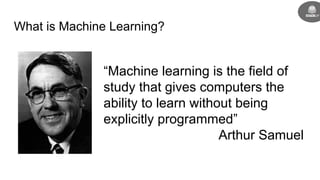
What is Machine Learning?
“Machine learning is the field of
study that gives computers the
ability to learn without being
explicitly programmed”
Arthur Samuel
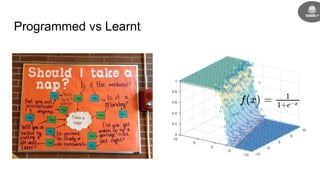
Programmed vs Learnt
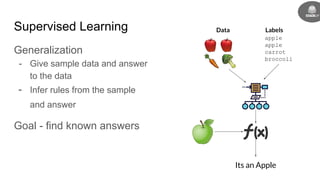
Supervised Learning
Generalization
- Give sample data and answer
to the data
- Infer rules from the sample
and answer
Goal - find known answers
apple
apple
carrot
broccoli
LabelsData
Its an Apple
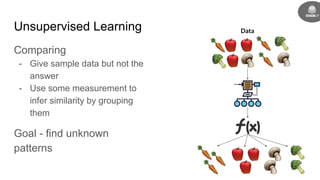
Unsupervised Learning
Comparing
- Give sample data but not the
answer
- Use some measurement to
infer similarity by grouping
them
Goal - find unknown
patterns
Data
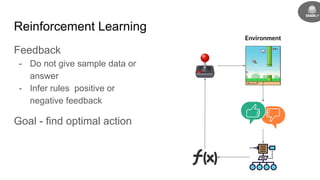
Reinforcement Learning
Feedback
- Do not give sample data or
answer
- Infer rules positive or
negative feedback
Goal - find optimal action
Environment
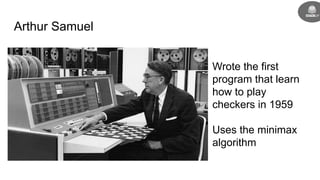
Wrote the first
program that learn
how to play
checkers in 1959
Uses the minimax
algorithm
Arthur Samuel
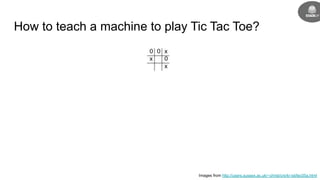
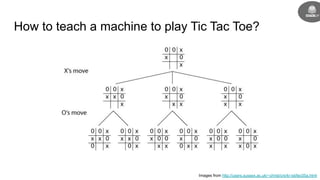
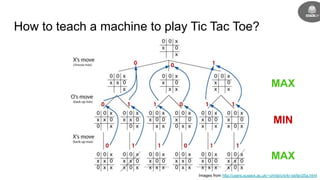
How to teach a machine to play Tic Tac Toe?
Images from http://users.sussex.ac.uk/~christ/crs/kr-ist/lec05a.html
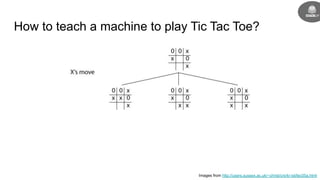
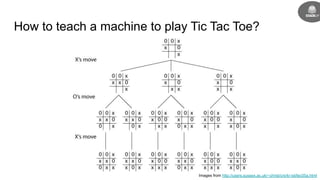
How to teach a machine to play Tic Tac Toe?
Images from http://users.sussex.ac.uk/~christ/crs/kr-ist/lec05a.html
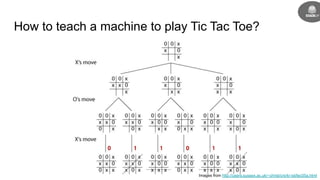
How to teach a machine to play Tic Tac Toe?
Images from http://users.sussex.ac.uk/~christ/crs/kr-ist/lec05a.html
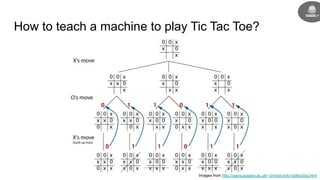
How to teach a machine to play Tic Tac Toe?
Images from http://users.sussex.ac.uk/~christ/crs/kr-ist/lec05a.html
How to teach a machine to play Tic Tac Toe?
Images from http://users.sussex.ac.uk/~christ/crs/kr-ist/lec05a.html
How to teach a machine to play Tic Tac Toe?
Images from http://users.sussex.ac.uk/~christ/crs/kr-ist/lec05a.html
How to teach a machine to play Tic Tac Toe?
Images from http://users.sussex.ac.uk/~christ/crs/kr-ist/lec05a.html
MAX
MIN
MAX
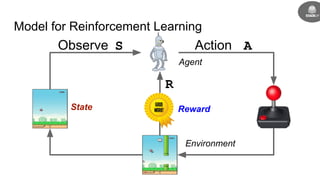
Model for Reinforcement Learning
ActionObserve
Agent
Environment
State Reward
S A
R
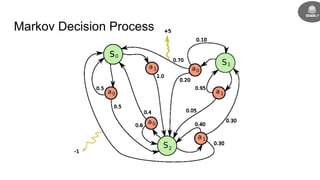
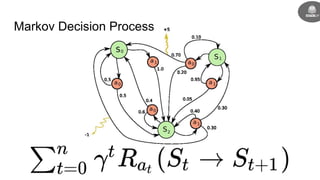
Markov Decision Process
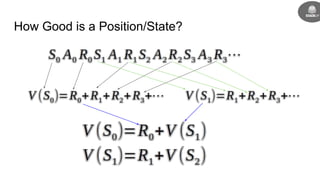
How Good is a Position/State?
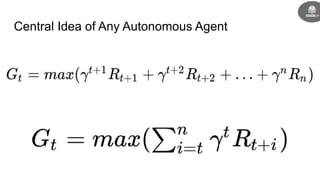
Central Idea of Any Autonomous Agent
Markov Decision Process
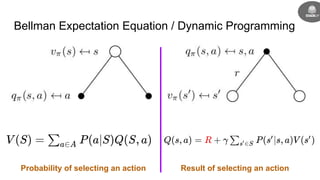
Bellman Expectation Equation / Dynamic Programming
Probability of selecting an action Result of selecting an action
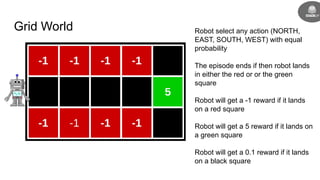
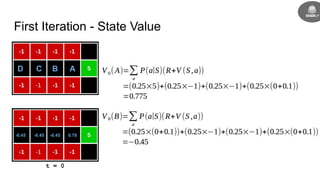
Grid World Robot select any action (NORTH,
EAST, SOUTH, WEST) with equal
probability
The episode ends if then robot lands
in either the red or or the green
square
Robot will get a -1 reward if it lands
on a red square
Robot will get a 5 reward if it lands on
a green square
Robot will get a 0.1 reward if it lands
on a black square
First Iteration - State Value
AB
0.78-0.45-0.45-0.45
t = 0
CD
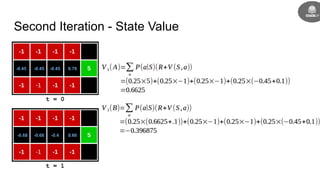
Second Iteration - State Value
0.66-0.4-0.68-0.68
0.78-0.45-0.45-0.45
t = 0
t = 1
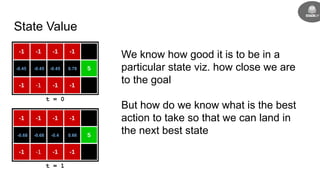
State Value
We know how good it is to be in a
particular state viz. how close we are
to the goal
But how do we know what is the best
action to take so that we can land in
the next best state0.66-0.4-0.68-0.68
0.78-0.45-0.45-0.45
t = 0
t = 1
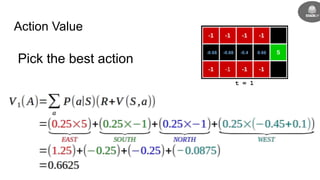
Action Value
Pick the best action
0.66-0.4-0.68-0.68
t = 1
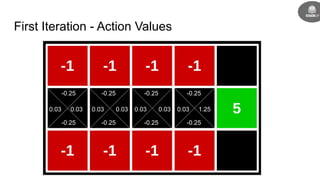
First Iteration - Action Values
1.250.03
-0.25
-0.25
0.030.03
-0.25
-0.25
0.030.03
-0.25
-0.25
0.030.03
-0.25
-0.25
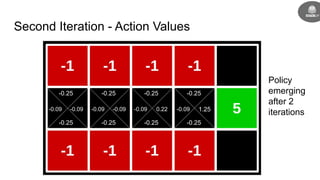
Second Iteration - Action Values
1.25-0.09
-0.25
-0.25
0.22
-0.25
-0.25
-0.09-0.09
-0.25
-0.25
-0.09-0.09
-0.25
-0.25
-0.09
Policy
emerging
after 2
iterations
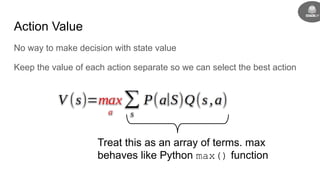
Action Value
No way to make decision with state value
Keep the value of each action separate so we can select the best action
Treat this as an array of terms. max
behaves like Python max() function
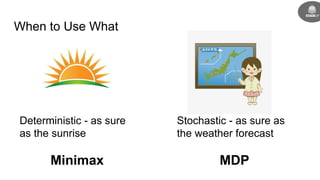
When to Use What
Deterministic - as sure
as the sunrise
Minimax
Stochastic - as sure as
the weather forecast
MDP
What happens when you get end up in
a totally alien environment?
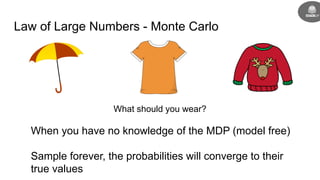
Law of Large Numbers - Monte Carlo
When you have no knowledge of the MDP (model free)
Sample forever, the probabilities will converge to their
true values
What should you wear?
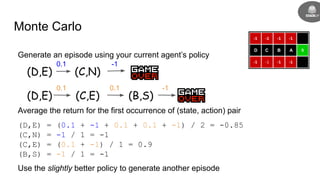
Monte Carlo
Generate an episode using your current agent’s policy
Average the return for the first occurrence of (state, action) pair
(D,E) = (0.1 + -1 + 0.1 + 0.1 + -1) / 2 = -0.85
(C,N) = -1 / 1 = -1
(C,E) = (0.1 + -1) / 1 = 0.9
(B,S) = -1 / 1 = -1
Use the slightly better policy to generate another episode
0.1 -1
(D,E) (C,N)
0.1 0.1 -1
(D,E) (C,E) (B,S)
ABCD
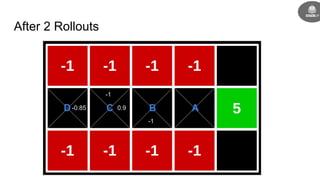
After 2 Rollouts
-0.85
-1
0.9
-1
ABCD
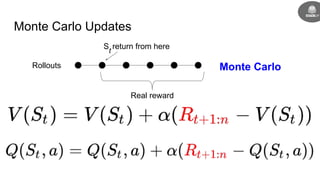
Monte Carlo Updates
Rollouts
S
t
return from here
Real reward
Monte Carlo
Going to Alpha Centauri
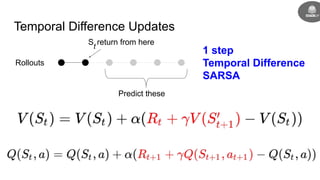
Temporal Difference Updates
S
t
return from here
Rollouts
Predict these
1 step
Temporal Difference
SARSA
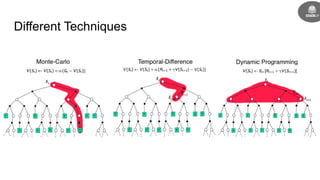
Different Techniques
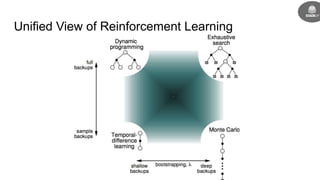
Unified View of Reinforcement Learning
Demo
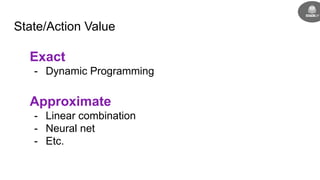
State/Action Value
Exact
- Dynamic Programming
Approximate
- Linear combination
- Neural net
- Etc.
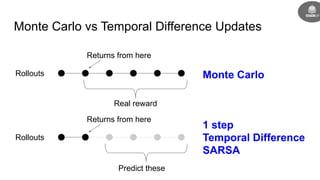
Monte Carlo vs Temporal Difference Updates
Rollouts
Returns from here
Real reward
Monte Carlo
Rollouts
Returns from here
Predict these
1 step
Temporal Difference
SARSA
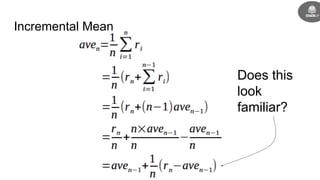
Incremental Mean
Does this
look
familiar?
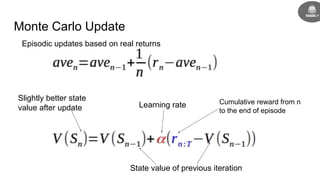
Monte Carlo Update
Learning rate
State value of previous iteration
Slightly better state
value after update
Cumulative reward from n
to the end of episode
Episodic updates based on real returns
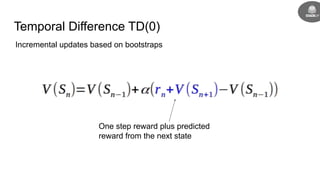
Temporal Difference TD(0)
Incremental updates based on bootstraps
One step reward plus predicted
reward from the next state
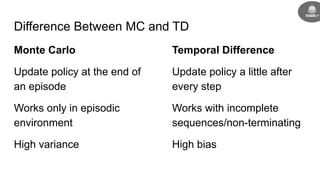
Difference Between MC and TD
Monte Carlo
Update policy at the end of
an episode
Works only in episodic
environment
High variance
Temporal Difference
Update policy a little after
every step
Works with incomplete
sequences/non-terminating
High bias
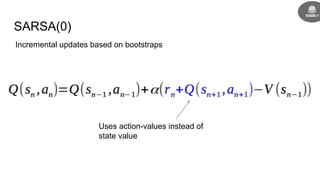
SARSA(0)
Incremental updates based on bootstraps
Uses action-values instead of
state value

NUS-ISS Learning Day 2019-Introduction to reinforcement learning

  • 1.
    Machine Learning Dilbert fromhttps://dilbert.com/strip/2013-02-02
  • 2.
    Introduction to Reinforcement Learning LeeChuk Munn Slides at http://bit.ly/ld2019_rl
  • 3.
  • 4.
    What is MachineLearning? “Machine learning is the field of study that gives computers the ability to learn without being explicitly programmed” Arthur Samuel
  • 5.
  • 6.
    Supervised Learning Generalization - Givesample data and answer to the data - Infer rules from the sample and answer Goal - find known answers apple apple carrot broccoli LabelsData Its an Apple
  • 7.
    Unsupervised Learning Comparing - Givesample data but not the answer - Use some measurement to infer similarity by grouping them Goal - find unknown patterns Data
  • 8.
    Reinforcement Learning Feedback - Donot give sample data or answer - Infer rules positive or negative feedback Goal - find optimal action Environment
  • 9.
    Wrote the first programthat learn how to play checkers in 1959 Uses the minimax algorithm Arthur Samuel
  • 10.
    How to teacha machine to play Tic Tac Toe? Images from http://users.sussex.ac.uk/~christ/crs/kr-ist/lec05a.html
  • 11.
    How to teacha machine to play Tic Tac Toe? Images from http://users.sussex.ac.uk/~christ/crs/kr-ist/lec05a.html
  • 12.
    How to teacha machine to play Tic Tac Toe? Images from http://users.sussex.ac.uk/~christ/crs/kr-ist/lec05a.html
  • 13.
    How to teacha machine to play Tic Tac Toe? Images from http://users.sussex.ac.uk/~christ/crs/kr-ist/lec05a.html
  • 14.
    How to teacha machine to play Tic Tac Toe? Images from http://users.sussex.ac.uk/~christ/crs/kr-ist/lec05a.html
  • 15.
    How to teacha machine to play Tic Tac Toe? Images from http://users.sussex.ac.uk/~christ/crs/kr-ist/lec05a.html
  • 16.
    How to teacha machine to play Tic Tac Toe? Images from http://users.sussex.ac.uk/~christ/crs/kr-ist/lec05a.html MAX MIN MAX
  • 17.
    Model for ReinforcementLearning ActionObserve Agent Environment State Reward S A R
  • 18.
  • 19.
    How Good isa Position/State?
  • 20.
    Central Idea ofAny Autonomous Agent
  • 21.
  • 22.
    Bellman Expectation Equation/ Dynamic Programming Probability of selecting an action Result of selecting an action
  • 23.
    Grid World Robotselect any action (NORTH, EAST, SOUTH, WEST) with equal probability The episode ends if then robot lands in either the red or or the green square Robot will get a -1 reward if it lands on a red square Robot will get a 5 reward if it lands on a green square Robot will get a 0.1 reward if it lands on a black square
  • 24.
    First Iteration -State Value AB 0.78-0.45-0.45-0.45 t = 0 CD
  • 25.
    Second Iteration -State Value 0.66-0.4-0.68-0.68 0.78-0.45-0.45-0.45 t = 0 t = 1
  • 26.
    State Value We knowhow good it is to be in a particular state viz. how close we are to the goal But how do we know what is the best action to take so that we can land in the next best state0.66-0.4-0.68-0.68 0.78-0.45-0.45-0.45 t = 0 t = 1
  • 27.
    Action Value Pick thebest action 0.66-0.4-0.68-0.68 t = 1
  • 28.
    First Iteration -Action Values 1.250.03 -0.25 -0.25 0.030.03 -0.25 -0.25 0.030.03 -0.25 -0.25 0.030.03 -0.25 -0.25
  • 29.
    Second Iteration -Action Values 1.25-0.09 -0.25 -0.25 0.22 -0.25 -0.25 -0.09-0.09 -0.25 -0.25 -0.09-0.09 -0.25 -0.25 -0.09 Policy emerging after 2 iterations
  • 30.
    Action Value No wayto make decision with state value Keep the value of each action separate so we can select the best action Treat this as an array of terms. max behaves like Python max() function
  • 31.
    When to UseWhat Deterministic - as sure as the sunrise Minimax Stochastic - as sure as the weather forecast MDP
  • 32.
    What happens whenyou get end up in a totally alien environment?
  • 33.
    Law of LargeNumbers - Monte Carlo When you have no knowledge of the MDP (model free) Sample forever, the probabilities will converge to their true values What should you wear?
  • 34.
    Monte Carlo Generate anepisode using your current agent’s policy Average the return for the first occurrence of (state, action) pair (D,E) = (0.1 + -1 + 0.1 + 0.1 + -1) / 2 = -0.85 (C,N) = -1 / 1 = -1 (C,E) = (0.1 + -1) / 1 = 0.9 (B,S) = -1 / 1 = -1 Use the slightly better policy to generate another episode 0.1 -1 (D,E) (C,N) 0.1 0.1 -1 (D,E) (C,E) (B,S) ABCD
  • 35.
  • 36.
    Monte Carlo Updates Rollouts S t returnfrom here Real reward Monte Carlo
  • 37.
  • 38.
    Temporal Difference Updates S t returnfrom here Rollouts Predict these 1 step Temporal Difference SARSA
  • 39.
  • 40.
    Unified View ofReinforcement Learning
  • 41.
  • 42.
    State/Action Value Exact - DynamicProgramming Approximate - Linear combination - Neural net - Etc.
  • 43.
    Monte Carlo vsTemporal Difference Updates Rollouts Returns from here Real reward Monte Carlo Rollouts Returns from here Predict these 1 step Temporal Difference SARSA
  • 44.
  • 45.
    Monte Carlo Update Learningrate State value of previous iteration Slightly better state value after update Cumulative reward from n to the end of episode Episodic updates based on real returns
  • 46.
    Temporal Difference TD(0) Incrementalupdates based on bootstraps One step reward plus predicted reward from the next state
  • 47.
    Difference Between MCand TD Monte Carlo Update policy at the end of an episode Works only in episodic environment High variance Temporal Difference Update policy a little after every step Works with incomplete sequences/non-terminating High bias
  • 48.
    SARSA(0) Incremental updates basedon bootstraps Uses action-values instead of state value