Learning Dexterous In-Hand Manipulation
(18.08)
Seungjae Ryan Lee
Human vs Robot
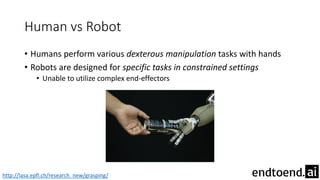
• Humans perform various dexterous manipulation tasks with hands
• Robots are designed for specific tasks in constrained settings
• Unable to utilize complex end-effectors
http://lasa.epfl.ch/research_new/grasping/
Robot with Hand
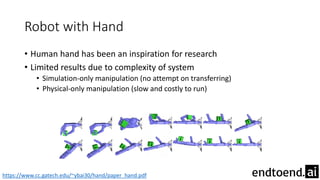
• Human hand has been an inspiration for research
• Limited results due to complexity of system
• Simulation-only manipulation (no attempt on transferring)
• Physical-only manipulation (slow and costly to run)
https://www.cc.gatech.edu/~ybai30/hand/paper_hand.pdf
The Task: In-Hand Object Reorientation
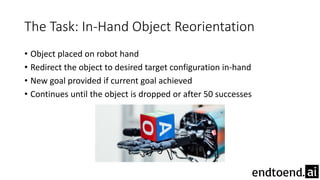
• Object placed on robot hand
• Redirect the object to desired target configuration in-hand
• New goal provided if current goal achieved
• Continues until the object is dropped or after 50 successes
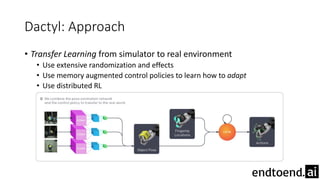
Dactyl: Approach
• Transfer Learning from simulator to real environment
• Use extensive randomization and effects
• Use memory augmented control policies to learn how to adapt
• Use distributed RL
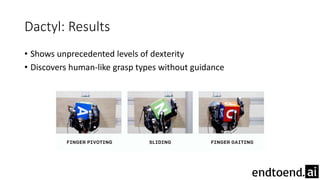
Dactyl: Results
• Shows unprecedented levels of dexterity
• Discovers human-like grasp types without guidance
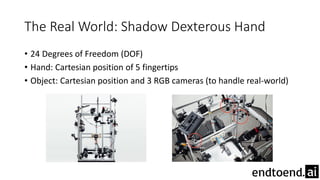
The Real World: Shadow Dexterous Hand
• 24 Degrees of Freedom (DOF)
• Hand: Cartesian position of 5 fingertips
• Object: Cartesian position and 3 RGB cameras (to handle real-world)
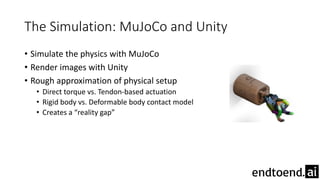
The Simulation: MuJoCo and Unity
• Simulate the physics with MuJoCo
• Render images with Unity
• Rough approximation of physical setup
• Direct torque vs. Tendon-based actuation
• Rigid body vs. Deformable body contact model
• Creates a “reality gap”
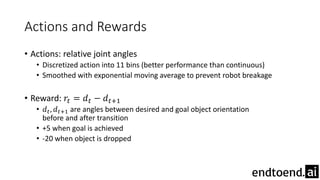
Actions and Rewards
• Actions: relative joint angles
• Discretized action into 11 bins (better performance than continuous)
• Smoothed with exponential moving average to prevent robot breakage
• Reward: 𝑟𝑡 = 𝑑 𝑡 − 𝑑 𝑡+1
• 𝑑 𝑡, 𝑑 𝑡+1 are angles between desired and goal object orientation
before and after transition
• +5 when goal is achieved
• -20 when object is dropped
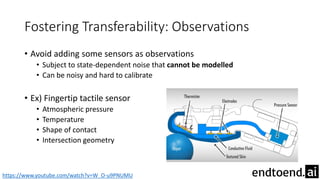
Fostering Transferability: Observations
• Avoid adding some sensors as observations
• Subject to state-dependent noise that cannot be modelled
• Can be noisy and hard to calibrate
• Ex) Fingertip tactile sensor
• Atmospheric pressure
• Temperature
• Shape of contact
• Intersection geometry
https://www.youtube.com/watch?v=W_O-u9PNUMU
Fostering Transferability: Randomization
• Robust: Less likely to overfit to the simulated environment
• More likely to transfer successfully to the physical robot
• Types of randomizations:
• Observation noise
• Physics randomizations
• Unmodeled effects
• Visual appearance randomizations
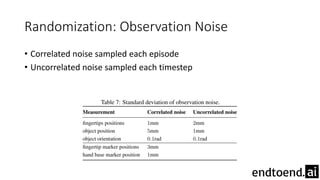
Randomization: Observation Noise
• Correlated noise sampled each episode
• Uncorrelated noise sampled each timestep
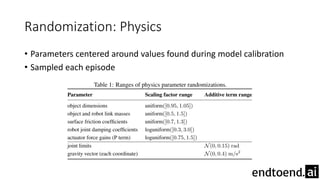
Randomization: Physics
• Parameters centered around values found during model calibration
• Sampled each episode
Randomization: Unmodeled effects
• Physical robot experiences effects not modeled in simulation
• Accommodated by simulating such effects
• Simulate motor backlash
• Simulate action delay and noise
• Simulate motion capture tracking errors
• Sometimes apply random forces on object
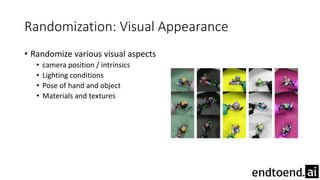
Randomization: Visual Appearance
• Randomize various visual aspects
• camera position / intrinsics
• Lighting conditions
• Pose of hand and object
• Materials and textures
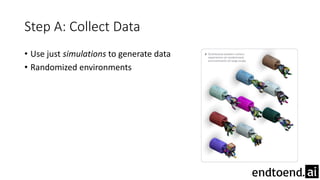
Step A: Collect Data
• Use just simulations to generate data
• Randomized environments
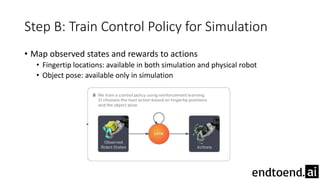
Step B: Train Control Policy for Simulation
• Map observed states and rewards to actions
• Fingertip locations: available in both simulation and physical robot
• Object pose: available only in simulation
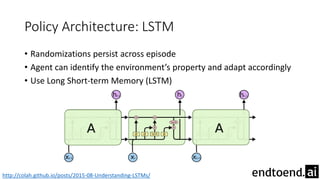
Policy Architecture: LSTM
• Randomizations persist across episode
• Agent can identify the environment’s property and adapt accordingly
• Use Long Short-term Memory (LSTM)
http://colah.github.io/posts/2015-08-Understanding-LSTMs/
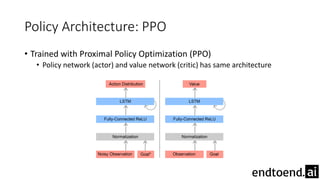
Policy Architecture: PPO
• Trained with Proximal Policy Optimization (PPO)
• Policy network (actor) and value network (critic) has same architecture
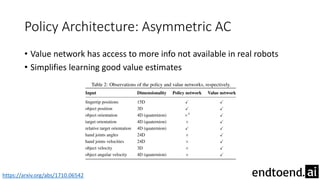
Policy Architecture: Asymmetric AC
• Value network has access to more info not available in real robots
• Simplifies learning good value estimates
https://arxiv.org/abs/1710.06542
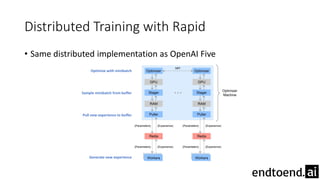
Distributed Training with Rapid
• Same distributed implementation as OpenAI Five
Optimize with minibatch
Sample minibatch from buffer
Pull new experience to buffer
Generate new experience
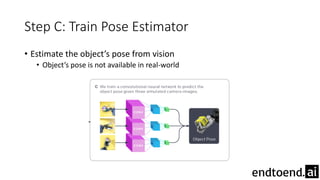
Step C: Train Pose Estimator
• Estimate the object’s pose from vision
• Object’s pose is not available in real-world
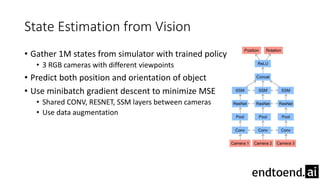
State Estimation from Vision
• Gather 1M states from simulator with trained policy
• 3 RGB cameras with different viewpoints
• Predict both position and orientation of object
• Use minibatch gradient descent to minimize MSE
• Shared CONV, RESNET, SSM layers between cameras
• Use data augmentation
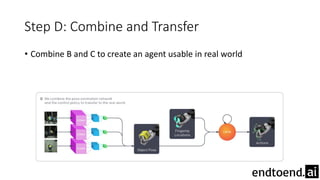
Step D: Combine and Transfer
• Combine B and C to create an agent usable in real world
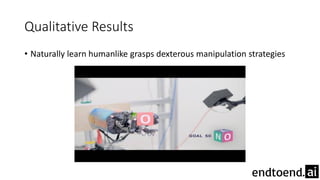
Qualitative Results
• Naturally learn humanlike grasps dexterous manipulation strategies
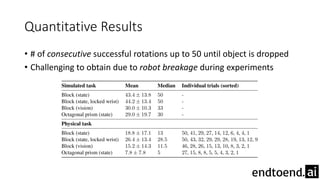
Quantitative Results
• # of consecutive successful rotations up to 50 until object is dropped
• Challenging to obtain due to robot breakage during experiments
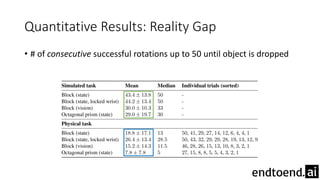
Quantitative Results: Reality Gap
• # of consecutive successful rotations up to 50 until object is dropped
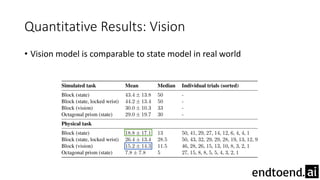
Quantitative Results: Vision
• Vision model is comparable to state model in real world
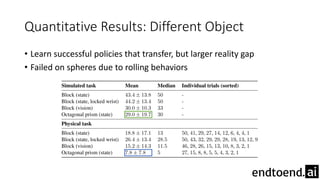
Quantitative Results: Different Object
• Learn successful policies that transfer, but larger reality gap
• Failed on spheres due to rolling behaviors
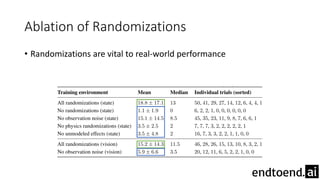
Ablation of Randomizations
• Randomizations are vital to real-world performance
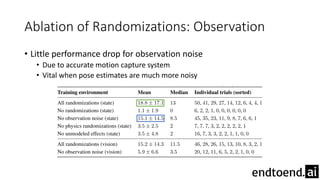
Ablation of Randomizations: Observation
• Little performance drop for observation noise
• Due to accurate motion capture system
• Vital when pose estimates are much more noisy
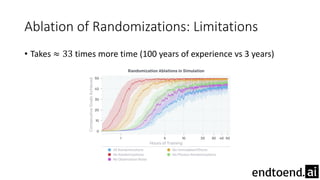
Ablation of Randomizations: Limitations
• Takes ≈ 33 times more time (100 years of experience vs 3 years)
Effect of Memory in Policies
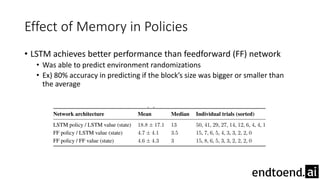
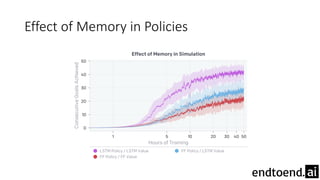
• LSTM achieves better performance than feedforward (FF) network
• Was able to predict environment randomizations
• Ex) 80% accuracy in predicting if the block’s size was bigger or smaller than
the average
Effect of Memory in Policies
Sample Complexity and Scale
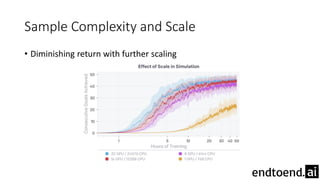
• Diminishing return with further scaling
Sample Complexity and Scale
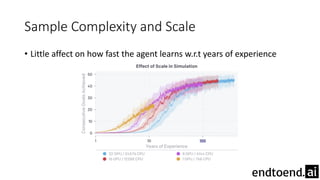
• Little affect on how fast the agent learns w.r.t years of experience
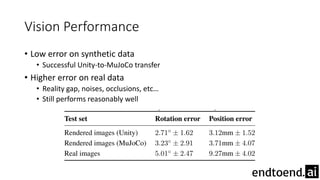
Vision Performance
• Low error on synthetic data
• Successful Unity-to-MuJoCo transfer
• Higher error on real data
• Reality gap, noises, occlusions, etc…
• Still performs reasonably well
What Surprised Us
1. Tactile sensing was not necessary
2. Randomization for one object generalized to similar objects
• System for a block worked well for an octagonal prism
• Had trouble with sphere due to its rolling behavior
3. System engineering is as important as good algorithm
• System without timing bug performed consistently better
What Didn’t Work
1. Faster reaction time ≠ Better Performance
• No noticeable difference between 40ms and 80ms
2. Using real data for training vision model did not work
• Latency and measurement error
• Hassle to collect due to configuration changes
Thank you!
Original Paper: https://arxiv.org/abs/1808.00177
Paper Recommendations:
• Using Simulation and Domain Adaptation to Improve Efficiency of
Deep Robotic Grasping
• Asymmetric Actor Critic for Image-Based Robot Learning
• Generalizing from Simulation
You can find more content in www.endtoend.ai/slides

[1808.00177] Learning Dexterous In-Hand Manipulation

  • 1.
    Learning Dexterous In-HandManipulation (18.08) Seungjae Ryan Lee
  • 2.
    Human vs Robot •Humans perform various dexterous manipulation tasks with hands • Robots are designed for specific tasks in constrained settings • Unable to utilize complex end-effectors http://lasa.epfl.ch/research_new/grasping/
  • 3.
    Robot with Hand •Human hand has been an inspiration for research • Limited results due to complexity of system • Simulation-only manipulation (no attempt on transferring) • Physical-only manipulation (slow and costly to run) https://www.cc.gatech.edu/~ybai30/hand/paper_hand.pdf
  • 4.
    The Task: In-HandObject Reorientation • Object placed on robot hand • Redirect the object to desired target configuration in-hand • New goal provided if current goal achieved • Continues until the object is dropped or after 50 successes
  • 5.
    Dactyl: Approach • TransferLearning from simulator to real environment • Use extensive randomization and effects • Use memory augmented control policies to learn how to adapt • Use distributed RL
  • 6.
    Dactyl: Results • Showsunprecedented levels of dexterity • Discovers human-like grasp types without guidance
  • 7.
    The Real World:Shadow Dexterous Hand • 24 Degrees of Freedom (DOF) • Hand: Cartesian position of 5 fingertips • Object: Cartesian position and 3 RGB cameras (to handle real-world)
  • 8.
    The Simulation: MuJoCoand Unity • Simulate the physics with MuJoCo • Render images with Unity • Rough approximation of physical setup • Direct torque vs. Tendon-based actuation • Rigid body vs. Deformable body contact model • Creates a “reality gap”
  • 9.
    Actions and Rewards •Actions: relative joint angles • Discretized action into 11 bins (better performance than continuous) • Smoothed with exponential moving average to prevent robot breakage • Reward: 𝑟𝑡 = 𝑑 𝑡 − 𝑑 𝑡+1 • 𝑑 𝑡, 𝑑 𝑡+1 are angles between desired and goal object orientation before and after transition • +5 when goal is achieved • -20 when object is dropped
  • 10.
    Fostering Transferability: Observations •Avoid adding some sensors as observations • Subject to state-dependent noise that cannot be modelled • Can be noisy and hard to calibrate • Ex) Fingertip tactile sensor • Atmospheric pressure • Temperature • Shape of contact • Intersection geometry https://www.youtube.com/watch?v=W_O-u9PNUMU
  • 11.
    Fostering Transferability: Randomization •Robust: Less likely to overfit to the simulated environment • More likely to transfer successfully to the physical robot • Types of randomizations: • Observation noise • Physics randomizations • Unmodeled effects • Visual appearance randomizations
  • 12.
    Randomization: Observation Noise •Correlated noise sampled each episode • Uncorrelated noise sampled each timestep
  • 13.
    Randomization: Physics • Parameterscentered around values found during model calibration • Sampled each episode
  • 14.
    Randomization: Unmodeled effects •Physical robot experiences effects not modeled in simulation • Accommodated by simulating such effects • Simulate motor backlash • Simulate action delay and noise • Simulate motion capture tracking errors • Sometimes apply random forces on object
  • 15.
    Randomization: Visual Appearance •Randomize various visual aspects • camera position / intrinsics • Lighting conditions • Pose of hand and object • Materials and textures
  • 16.
    Step A: CollectData • Use just simulations to generate data • Randomized environments
  • 17.
    Step B: TrainControl Policy for Simulation • Map observed states and rewards to actions • Fingertip locations: available in both simulation and physical robot • Object pose: available only in simulation
  • 18.
    Policy Architecture: LSTM •Randomizations persist across episode • Agent can identify the environment’s property and adapt accordingly • Use Long Short-term Memory (LSTM) http://colah.github.io/posts/2015-08-Understanding-LSTMs/
  • 19.
    Policy Architecture: PPO •Trained with Proximal Policy Optimization (PPO) • Policy network (actor) and value network (critic) has same architecture
  • 20.
    Policy Architecture: AsymmetricAC • Value network has access to more info not available in real robots • Simplifies learning good value estimates https://arxiv.org/abs/1710.06542
  • 21.
    Distributed Training withRapid • Same distributed implementation as OpenAI Five Optimize with minibatch Sample minibatch from buffer Pull new experience to buffer Generate new experience
  • 22.
    Step C: TrainPose Estimator • Estimate the object’s pose from vision • Object’s pose is not available in real-world
  • 23.
    State Estimation fromVision • Gather 1M states from simulator with trained policy • 3 RGB cameras with different viewpoints • Predict both position and orientation of object • Use minibatch gradient descent to minimize MSE • Shared CONV, RESNET, SSM layers between cameras • Use data augmentation
  • 24.
    Step D: Combineand Transfer • Combine B and C to create an agent usable in real world
  • 25.
    Qualitative Results • Naturallylearn humanlike grasps dexterous manipulation strategies
  • 26.
    Quantitative Results • #of consecutive successful rotations up to 50 until object is dropped • Challenging to obtain due to robot breakage during experiments
  • 27.
    Quantitative Results: RealityGap • # of consecutive successful rotations up to 50 until object is dropped
  • 28.
    Quantitative Results: Vision •Vision model is comparable to state model in real world
  • 29.
    Quantitative Results: DifferentObject • Learn successful policies that transfer, but larger reality gap • Failed on spheres due to rolling behaviors
  • 30.
    Ablation of Randomizations •Randomizations are vital to real-world performance
  • 31.
    Ablation of Randomizations:Observation • Little performance drop for observation noise • Due to accurate motion capture system • Vital when pose estimates are much more noisy
  • 32.
    Ablation of Randomizations:Limitations • Takes ≈ 33 times more time (100 years of experience vs 3 years)
  • 33.
    Effect of Memoryin Policies • LSTM achieves better performance than feedforward (FF) network • Was able to predict environment randomizations • Ex) 80% accuracy in predicting if the block’s size was bigger or smaller than the average
  • 34.
    Effect of Memoryin Policies
  • 35.
    Sample Complexity andScale • Diminishing return with further scaling
  • 36.
    Sample Complexity andScale • Little affect on how fast the agent learns w.r.t years of experience
  • 37.
    Vision Performance • Lowerror on synthetic data • Successful Unity-to-MuJoCo transfer • Higher error on real data • Reality gap, noises, occlusions, etc… • Still performs reasonably well
  • 38.
    What Surprised Us 1.Tactile sensing was not necessary 2. Randomization for one object generalized to similar objects • System for a block worked well for an octagonal prism • Had trouble with sphere due to its rolling behavior 3. System engineering is as important as good algorithm • System without timing bug performed consistently better
  • 39.
    What Didn’t Work 1.Faster reaction time ≠ Better Performance • No noticeable difference between 40ms and 80ms 2. Using real data for training vision model did not work • Latency and measurement error • Hassle to collect due to configuration changes
  • 40.
    Thank you! Original Paper:https://arxiv.org/abs/1808.00177 Paper Recommendations: • Using Simulation and Domain Adaptation to Improve Efficiency of Deep Robotic Grasping • Asymmetric Actor Critic for Image-Based Robot Learning • Generalizing from Simulation You can find more content in www.endtoend.ai/slides