Learning to Learn Model Behavior: How to use “human in
the loop” ?
Learn more at datascience.com  |  Empower Your Data Scientists
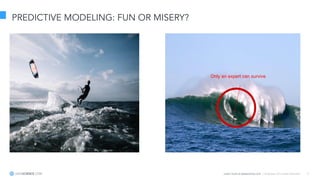
PREDICTIVE MODELING: FUN OR MISERY?
2
Only an expert can survive
Learn more at datascience.com  |  Empower Your Data Scientists 3
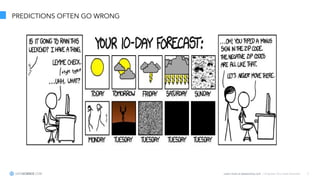
PREDICTIONS OFTEN GO WRONG
Learn more at datascience.com  |  Empower Your Data Scientists 4
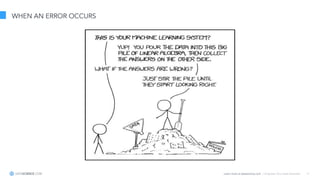
WHEN AN ERROR OCCURS
Learn more at datascience.com  |  Empower Your Data Scientists 5
ABOUT ME
I am a Lead data scientist at DataScience.com. I enjoy applying and optimizing classical (Machine
Learning) and Bayesian design strategy to solve real-world problems. Currently, I am exploring on
better ways to evaluate and explain Model learned decision policies. I am also a member of AAAI
and organizer of PyData So Cal meet-up group.
Pramit Choudhary
@MaverickPramit
https://www.linkedin.com/in/pramitc/
https://github.com/pramitchoudhary
Learn more at datascience.com  |  Empower Your Data Scientists 6
AGENDA
• DEFINE MODEL INTERPRETATION
• UNDERSTAND THE NEED FOR MODEL INTERPRETATION
• DISCUSS DICHOTOMY BETWEEN PERFORMANCE AND
INTERPRETATION
• INTRODUCE SKATER
• UNDERSTANDING ANALYTICAL WORKFLOW
• DEMO
• Q&A
Learn more at datascience.com  |  Empower Your Data Scientists
DEFINE INTERPRETATION
7
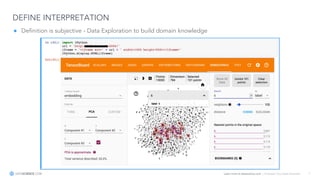
● Definition is subjective - Data Exploration to build domain knowledge
Learn more at datascience.com  |  Empower Your Data Scientists
DEFINE INTERPRETATION
8
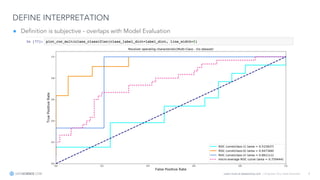
● Definition is subjective - overlaps with Model Evaluation
Learn more at datascience.com  |  Empower Your Data Scientists 9
WHAT IS MODEL INTERPRETATION?
● Model interpretation is an extension of Model Evaluation to help us understand machine learning/statistical
modeling behavior better if possible in a human interpretable way
● With model interpretation, one should be able to answer the following questions:
○ Why did the model behave in a certain way? What are the relevant variables driving a model’s outcome
- e.g. Customer's Lifetime Value, Fraud detection, Image Classification, Spam Detection ?
○ What other information can a model provide to avoid prediction errors ? What was the reason for a
false positive ?
○ How can we trust the predictions of a “black box” model ? Is the predictive model biased ?
● Focus: is in-regards to Supervised learning problems
Learn more at datascience.com  |  Empower Your Data Scientists
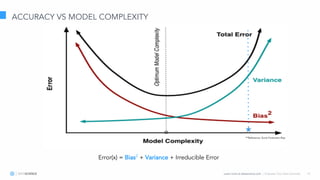
ACCURACY VS MODEL COMPLEXITY
10
Error(x) = Bias2
+ Variance + Irreducible Error
**Reference: Scott Fortmann-Roe
Learn more at datascience.com  |  Empower Your Data Scientists
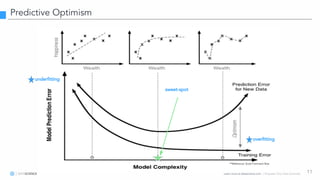
Predictive Optimism
11
overfitting
underfitting
**Reference: Scott Fortmann-Roe
sweet-spot
Learn more at datascience.com  |  Empower Your Data Scientists 12
WHY DO WE NEED MODEL INTERPRETATION?
● Helps in exploring and discovering latent or hidden feature interactions (useful for feature
engineering/selection)
● Helps in understanding model variability as the environment changes (once the model is operationalized
and is functional in a non-stationary environment)
● Helps in model comparison
● Helps an analyst or data scientist build domain knowledge about a particular use case by providing an
understanding of interactions
Learn more at datascience.com  |  Empower Your Data Scientists 13
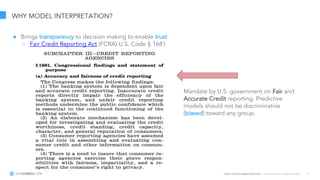
WHY MODEL INTERPRETATION?
● Brings transparency to decision making to enable trust
○ Fair Credit Reporting Act (FCRA) U.S. Code § 1681
Mandate by U.S. government on Fair and
Accurate Credit reporting. Predictive
models should not be discriminative
(biased) toward any group.
Learn more at datascience.com  |  Empower Your Data Scientists 14
Are all predictive models interpretable?
Does an interpretable model always provides the best model ?
Learn more at datascience.com  |  Empower Your Data Scientists
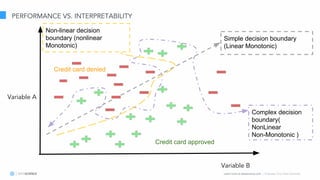
PERFORMANCE VS. INTERPRETABILITY
Variable B
Variable A
Simple decision boundary
(Linear Monotonic)
Complex decision
boundary(
NonLinear
Non-Monotonic )
Credit card approved
Credit card denied
Non-linear decision
boundary (nonlinear
Monotonic)
Learn more at datascience.com  |  Empower Your Data Scientists
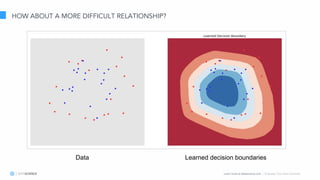
HOW ABOUT A MORE DIFFICULT RELATIONSHIP?
Data Learned decision boundaries
Learn more at datascience.com  |  Empower Your Data Scientists 17
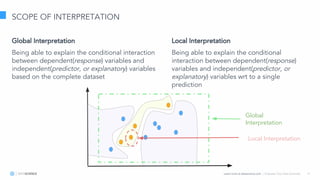
Local Interpretation
Being able to explain the conditional
interaction between dependent(response)
variables and independent(predictor, or
explanatory) variables wrt to a single
prediction
SCOPE OF INTERPRETATION
Global Interpretation
Being able to explain the conditional interaction
between dependent(response) variables and
independent(predictor, or explanatory) variables
based on the complete dataset
Global
Interpretation
Local Interpretation
Learn more at datascience.com  |  Empower Your Data Scientists 18
GLOBAL INTERPRETATION
● Relative Importance of Predictor Variable to evaluate Estimator’s behavior
○ Model-specific Feature importance - e.g.
■ Linear Model ( based on the absolute value of t-statistics )
■ Random Forest ( based permutation importance or Gini importance )
■ Recursive Feature Elimination(RFE) - recursively prune least important features
○ Model Independent Feature Importance - this will be our focus for today’s discussion
■ observing entropy of predictive performance based on random perturbation of feature set
■ observing entropy of model specific scoring metric
● Classification: f1-score, precision/recall
● Regression: mean squared error
● Usefulness
○ Helps in identifying important covariates contributing to target prediction enabling better
interpretability
○ Might help in improving accuracy and computation time by eliminating redundant or
unimportant features
Learn more at datascience.com  |  Empower Your Data Scientists 19
GLOBAL INTERPRETATION
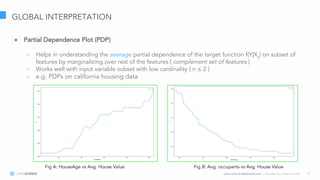
● Partial Dependence Plot (PDP)
○ Helps in understanding the average partial dependence of the target function f(Y|Xs
) on subset of
features by marginalizing over rest of the features ( complement set of features )
○ Works well with input variable subset with low cardinality ( n ≤ 2 )
○ e.g. PDPs on california housing data
Fig A: HouseAge vs Avg. House Value Fig B: Avg. occupants vs Avg. House Value
Learn more at datascience.com  |  Empower Your Data Scientists 20
PDP continues ...
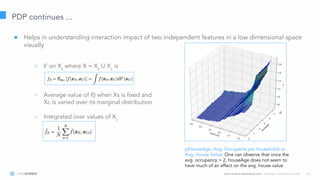
● Helps in understanding interaction impact of two independent features in a low dimensional space
visually
○ on Xs
where X = Xs
U Xc
is
○ Average value of f() when Xs is fixed and
Xc is varied over its marginal distribution
○ Integrated over values of Xc
p(HouseAge, Avg. Occupants per household) vs
Avg. House Value: One can observe that once the
avg. occupancy > 2, houseAge does not seem to
have much of an effect on the avg. house value
Learn more at datascience.com  |  Empower Your Data Scientists 21
PDP continues ...
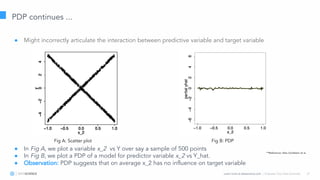
● Might incorrectly articulate the interaction between predictive variable and target variable
● In Fig A, we plot a variable x_2 vs Y over say a sample of 500 points
● In Fig B, we plot a PDP of a model for predictor variable x_2 vs Y_hat.
● Observation: PDP suggests that on average x_2 has no influence on target variable
Fig A: Scatter plot Fig B: PDP
**Reference: Alex Goldstein et al.
Learn more at datascience.com  |  Empower Your Data Scientists 22
LOCAL INTERPRETATION
● Ability to inspect and evaluate individual prediction in human interpretable format with the help of
surrogate models faithfully
○ ὲ : model explanation function
○ ℒ : measure of fidelity
○ ƒ : is the base model estimator
○ g ⊂ G : a set of interpretable models [ Linear Models, Decision Trees ]
○ ∏x
: proximity measure to define locality around an individual point
○ Ω : to regularize complexity e.g. depth of the tree, learning rate, non-zero weights for linear
models
Learn more at datascience.com  |  Empower Your Data Scientists
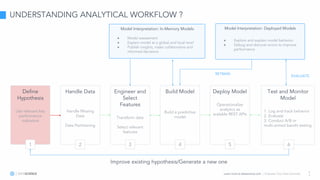
UNDERSTANDING ANALYTICAL WORKFLOW ?
2
3
Define
Hypothesis
Use relevant key
performance
indicators
Handle Data
Handle Missing
Data
Data Partitioning
Engineer and
Select
Features
Transform data
Select relevant
features
Build Model
Build a predictive
model
Deploy Model
Operationalize
analytics as
scalable REST APIs
Test and Monitor
Model
1. Log and track behavior
2. Evaluate
3. Conduct A/B or
multi-armed bandit testing
1 2 3 4 5 6
Model Interpretation: In-Memory Models
● Model assessment
● Explain model at a global and local level
● Publish insights, make collaborative and
informed decisions
Model Interpretation: Deployed Models
● Explore and explain model behavior
● Debug and discover errors to improve
performance
RETRAIN
EVALUATE
Improve existing hypothesis/Generate a new one
Learn more at datascience.com  |  Empower Your Data Scientists
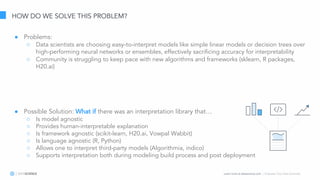
HOW DO WE SOLVE THIS PROBLEM?
● Problems:
○ Data scientists are choosing easy-to-interpret models like simple linear models or decision trees over
high-performing neural networks or ensembles, effectively sacrificing accuracy for interpretability
○ Community is struggling to keep pace with new algorithms and frameworks (sklearn, R packages,
H20.ai)
● Possible Solution: What if there was an interpretation library that…
○ Is model agnostic
○ Provides human-interpretable explanation
○ Is framework agnostic (scikit-learn, H20.ai, Vowpal Wabbit)
○ Is language agnostic (R, Python)
○ Allows one to interpret third-party models (Algorithmia, indico)
○ Supports interpretation both during modeling build process and post deployment
Learn more at datascience.com  |  Empower Your Data Scientists
INTRODUCING ...
Learn more at datascience.com  |  Empower Your Data Scientists 26
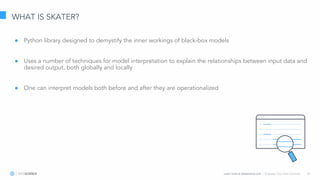
WHAT IS SKATER?
● Python library designed to demystify the inner workings of black-box models
● Uses a number of techniques for model interpretation to explain the relationships between input data and
desired output, both globally and locally
● One can interpret models both before and after they are operationalized
Learn more at datascience.com  |  Empower Your Data Scientists 27
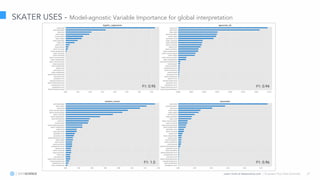
SKATER USES - Model-agnostic Variable Importance for global interpretation
F1: 1.0 F1: 0.96
F1: 0.94F1: 0.95
Learn more at datascience.com  |  Empower Your Data Scientists 28
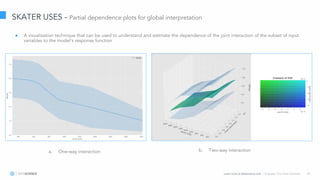
SKATER USES - Partial dependence plots for global interpretation
a. One-way interaction b. Two-way interaction
● A visualization technique that can be used to understand and estimate the dependence of the joint interaction of the subset of input
variables to the model's response function
Learn more at datascience.com  |  Empower Your Data Scientists 29
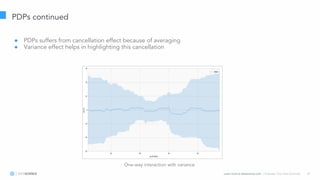
PDPs continued
● PDPs suffers from cancellation effect because of averaging
● Variance effect helps in highlighting this cancellation
One-way interaction with variance
Learn more at datascience.com  |  Empower Your Data Scientists 30
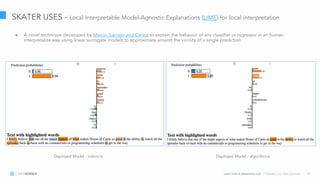
SKATER USES - Local Interpretable Model-Agnostic Explanations (LIME) for local interpretation
● A novel technique developed by Marco, Sameer and Carlos to explain the behavior of any classifier or regressor in an human
interpretable way using linear surrogate models to approximate around the vicinity of a single prediction
Deployed Model - indico.io Deployed Model - algorithmia
Learn more at datascience.com  |  Empower Your Data Scientists 31
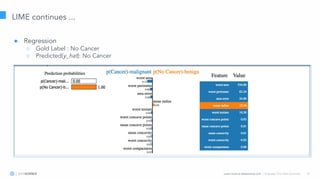
LIME continues ...
● Regression
○ Gold Label : No Cancer
○ Predicted(y_hat): No Cancer
Learn more at datascience.com  |  Empower Your Data Scientists 32
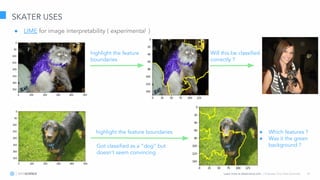
SKATER USES
● LIME for image interpretability ( experimental )
highlight the feature
boundaries
highlight the feature boundaries
Will this be classified
correctly ?
Got classified as a “dog” but
doesn’t seem convincing
● Which features ?
● Was it the green
background ?
Learn more at datascience.com  |  Empower Your Data Scientists
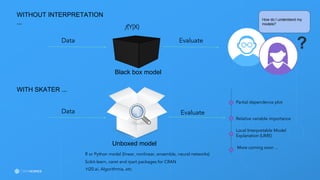
Evaluate
(Y|X)
Data
Data
Unboxed model
Evaluate
Partial dependence plot
Relative variable importance
Local Interpretable Model
Explanation (LIME)
R or Python model (linear, nonlinear, ensemble, neural networks)
Scikit-learn, caret and rpart packages for CRAN
H20.ai, Algorithmia, etc.
WITHOUT INTERPRETATION
...
WITH SKATER ...
Black box model
How do I understand my
models?
More coming soon ...
Learn more at datascience.com  |  Empower Your Data Scientists
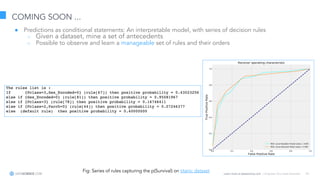
COMING SOON ...
34
● Predictions as conditional statements: An interpretable model, with series of decision rules
○ Given a dataset, mine a set of antecedents
○ Possible to observe and learn a manageable set of rules and their orders
Fig: Series of rules capturing the p(Survival) on titanic dataset
Learn more at datascience.com  |  Empower Your Data Scientists 35
JUPYTER’S INTERACTIVENESS
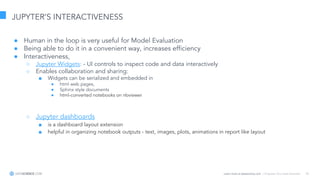
● Human in the loop is very useful for Model Evaluation
● Being able to do it in a convenient way, increases efficiency
● Interactiveness,
○ Jupyter Widgets: - UI controls to inspect code and data interactively
○ Enables collaboration and sharing:
■ Widgets can be serialized and embedded in
● html web pages,
● Sphinx style documents
● html-converted notebooks on nbviewer
○ Jupyter dashboards
■ is a dashboard layout extension
■ helpful in organizing notebook outputs - text, images, plots, animations in report like layout
Learn more at datascience.com  |  Empower Your Data Scientists
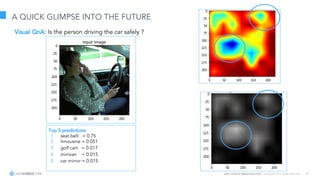
A QUICK GLIMPSE INTO THE FUTURE
36
Top 5 predictions:
1. seat belt = 0.75
2. limousine = 0.051
3. golf cart = 0.017
4. minivan = 0.015
5. car mirror = 0.015
Visual QnA: Is the person driving the car safely ?
Learn more at datascience.com  |  Empower Your Data Scientists 37
SPECIAL THANKS
● Special thanks to Aaron Kramer( one of the original authors of Skater ), Ben Van Dyke and rest
of the datascience.com teammates for helping out with Skater
● Thank you to IDEAS for providing us the opportunity to share our thoughts with a wider
community
Learn more at datascience.com  |  Empower Your Data Scientists
Q&A
info@datascience.com
pramit@datascience.com
@MaverickPramit
@DataScienceInc
Help wanted(Skater): https://tinyurl.com/yd6tnc7l
Learn more at datascience.com  |  Empower Your Data Scientists
Appendix
Learn more at datascience.com  |  Empower Your Data Scientists
40
References:
● A. Weller, "Challenges for Transparency": https://arxiv.org/abs/1708.01870
● Max Kuhn, Variable Importance Using The caret pkg:
http://ftp.uni-bayreuth.de/math/statlib/R/CRAN/doc/vignettes/caret/caretVarImp.pdf
● Friedman’ 01, Greedy Function Approximation: A gradient boosting machine:
https://statweb.stanford.edu/~jhf/ftp/trebst.pdf
● Recursive Feature Elimination: https://arxiv.org/pdf/1310.5726.pdf
● LIME: https://arxiv.org/pdf/1602.04938v1.pdf
● Nothing Else Matters: https://arxiv.org/pdf/1611.05817v1.pdf
● Peeking Inside the Black Box: https://arxiv.org/abs/1309.6392

Learning to learn Model Behavior: How to use "human-in-the-loop" to explain decisions.

  • 1.
    Learning to LearnModel Behavior: How to use “human in the loop” ?
  • 2.
    Learn more atdatascience.com  |  Empower Your Data Scientists PREDICTIVE MODELING: FUN OR MISERY? 2 Only an expert can survive
  • 3.
    Learn more atdatascience.com  |  Empower Your Data Scientists 3 PREDICTIONS OFTEN GO WRONG
  • 4.
    Learn more atdatascience.com  |  Empower Your Data Scientists 4 WHEN AN ERROR OCCURS
  • 5.
    Learn more atdatascience.com  |  Empower Your Data Scientists 5 ABOUT ME I am a Lead data scientist at DataScience.com. I enjoy applying and optimizing classical (Machine Learning) and Bayesian design strategy to solve real-world problems. Currently, I am exploring on better ways to evaluate and explain Model learned decision policies. I am also a member of AAAI and organizer of PyData So Cal meet-up group. Pramit Choudhary @MaverickPramit https://www.linkedin.com/in/pramitc/ https://github.com/pramitchoudhary
  • 6.
    Learn more atdatascience.com  |  Empower Your Data Scientists 6 AGENDA • DEFINE MODEL INTERPRETATION • UNDERSTAND THE NEED FOR MODEL INTERPRETATION • DISCUSS DICHOTOMY BETWEEN PERFORMANCE AND INTERPRETATION • INTRODUCE SKATER • UNDERSTANDING ANALYTICAL WORKFLOW • DEMO • Q&A
  • 7.
    Learn more atdatascience.com  |  Empower Your Data Scientists DEFINE INTERPRETATION 7 ● Definition is subjective - Data Exploration to build domain knowledge
  • 8.
    Learn more atdatascience.com  |  Empower Your Data Scientists DEFINE INTERPRETATION 8 ● Definition is subjective - overlaps with Model Evaluation
  • 9.
    Learn more atdatascience.com  |  Empower Your Data Scientists 9 WHAT IS MODEL INTERPRETATION? ● Model interpretation is an extension of Model Evaluation to help us understand machine learning/statistical modeling behavior better if possible in a human interpretable way ● With model interpretation, one should be able to answer the following questions: ○ Why did the model behave in a certain way? What are the relevant variables driving a model’s outcome - e.g. Customer's Lifetime Value, Fraud detection, Image Classification, Spam Detection ? ○ What other information can a model provide to avoid prediction errors ? What was the reason for a false positive ? ○ How can we trust the predictions of a “black box” model ? Is the predictive model biased ? ● Focus: is in-regards to Supervised learning problems
  • 10.
    Learn more atdatascience.com  |  Empower Your Data Scientists ACCURACY VS MODEL COMPLEXITY 10 Error(x) = Bias2 + Variance + Irreducible Error **Reference: Scott Fortmann-Roe
  • 11.
    Learn more atdatascience.com  |  Empower Your Data Scientists Predictive Optimism 11 overfitting underfitting **Reference: Scott Fortmann-Roe sweet-spot
  • 12.
    Learn more atdatascience.com  |  Empower Your Data Scientists 12 WHY DO WE NEED MODEL INTERPRETATION? ● Helps in exploring and discovering latent or hidden feature interactions (useful for feature engineering/selection) ● Helps in understanding model variability as the environment changes (once the model is operationalized and is functional in a non-stationary environment) ● Helps in model comparison ● Helps an analyst or data scientist build domain knowledge about a particular use case by providing an understanding of interactions
  • 13.
    Learn more atdatascience.com  |  Empower Your Data Scientists 13 WHY MODEL INTERPRETATION? ● Brings transparency to decision making to enable trust ○ Fair Credit Reporting Act (FCRA) U.S. Code § 1681 Mandate by U.S. government on Fair and Accurate Credit reporting. Predictive models should not be discriminative (biased) toward any group.
  • 14.
    Learn more atdatascience.com  |  Empower Your Data Scientists 14 Are all predictive models interpretable? Does an interpretable model always provides the best model ?
  • 15.
    Learn more atdatascience.com  |  Empower Your Data Scientists PERFORMANCE VS. INTERPRETABILITY Variable B Variable A Simple decision boundary (Linear Monotonic) Complex decision boundary( NonLinear Non-Monotonic ) Credit card approved Credit card denied Non-linear decision boundary (nonlinear Monotonic)
  • 16.
    Learn more atdatascience.com  |  Empower Your Data Scientists HOW ABOUT A MORE DIFFICULT RELATIONSHIP? Data Learned decision boundaries
  • 17.
    Learn more atdatascience.com  |  Empower Your Data Scientists 17 Local Interpretation Being able to explain the conditional interaction between dependent(response) variables and independent(predictor, or explanatory) variables wrt to a single prediction SCOPE OF INTERPRETATION Global Interpretation Being able to explain the conditional interaction between dependent(response) variables and independent(predictor, or explanatory) variables based on the complete dataset Global Interpretation Local Interpretation
  • 18.
    Learn more atdatascience.com  |  Empower Your Data Scientists 18 GLOBAL INTERPRETATION ● Relative Importance of Predictor Variable to evaluate Estimator’s behavior ○ Model-specific Feature importance - e.g. ■ Linear Model ( based on the absolute value of t-statistics ) ■ Random Forest ( based permutation importance or Gini importance ) ■ Recursive Feature Elimination(RFE) - recursively prune least important features ○ Model Independent Feature Importance - this will be our focus for today’s discussion ■ observing entropy of predictive performance based on random perturbation of feature set ■ observing entropy of model specific scoring metric ● Classification: f1-score, precision/recall ● Regression: mean squared error ● Usefulness ○ Helps in identifying important covariates contributing to target prediction enabling better interpretability ○ Might help in improving accuracy and computation time by eliminating redundant or unimportant features
  • 19.
    Learn more atdatascience.com  |  Empower Your Data Scientists 19 GLOBAL INTERPRETATION ● Partial Dependence Plot (PDP) ○ Helps in understanding the average partial dependence of the target function f(Y|Xs ) on subset of features by marginalizing over rest of the features ( complement set of features ) ○ Works well with input variable subset with low cardinality ( n ≤ 2 ) ○ e.g. PDPs on california housing data Fig A: HouseAge vs Avg. House Value Fig B: Avg. occupants vs Avg. House Value
  • 20.
    Learn more atdatascience.com  |  Empower Your Data Scientists 20 PDP continues ... ● Helps in understanding interaction impact of two independent features in a low dimensional space visually ○ on Xs where X = Xs U Xc is ○ Average value of f() when Xs is fixed and Xc is varied over its marginal distribution ○ Integrated over values of Xc p(HouseAge, Avg. Occupants per household) vs Avg. House Value: One can observe that once the avg. occupancy > 2, houseAge does not seem to have much of an effect on the avg. house value
  • 21.
    Learn more atdatascience.com  |  Empower Your Data Scientists 21 PDP continues ... ● Might incorrectly articulate the interaction between predictive variable and target variable ● In Fig A, we plot a variable x_2 vs Y over say a sample of 500 points ● In Fig B, we plot a PDP of a model for predictor variable x_2 vs Y_hat. ● Observation: PDP suggests that on average x_2 has no influence on target variable Fig A: Scatter plot Fig B: PDP **Reference: Alex Goldstein et al.
  • 22.
    Learn more atdatascience.com  |  Empower Your Data Scientists 22 LOCAL INTERPRETATION ● Ability to inspect and evaluate individual prediction in human interpretable format with the help of surrogate models faithfully ○ ὲ : model explanation function ○ ℒ : measure of fidelity ○ ƒ : is the base model estimator ○ g ⊂ G : a set of interpretable models [ Linear Models, Decision Trees ] ○ ∏x : proximity measure to define locality around an individual point ○ Ω : to regularize complexity e.g. depth of the tree, learning rate, non-zero weights for linear models
  • 23.
    Learn more atdatascience.com  |  Empower Your Data Scientists UNDERSTANDING ANALYTICAL WORKFLOW ? 2 3 Define Hypothesis Use relevant key performance indicators Handle Data Handle Missing Data Data Partitioning Engineer and Select Features Transform data Select relevant features Build Model Build a predictive model Deploy Model Operationalize analytics as scalable REST APIs Test and Monitor Model 1. Log and track behavior 2. Evaluate 3. Conduct A/B or multi-armed bandit testing 1 2 3 4 5 6 Model Interpretation: In-Memory Models ● Model assessment ● Explain model at a global and local level ● Publish insights, make collaborative and informed decisions Model Interpretation: Deployed Models ● Explore and explain model behavior ● Debug and discover errors to improve performance RETRAIN EVALUATE Improve existing hypothesis/Generate a new one
  • 24.
    Learn more atdatascience.com  |  Empower Your Data Scientists HOW DO WE SOLVE THIS PROBLEM? ● Problems: ○ Data scientists are choosing easy-to-interpret models like simple linear models or decision trees over high-performing neural networks or ensembles, effectively sacrificing accuracy for interpretability ○ Community is struggling to keep pace with new algorithms and frameworks (sklearn, R packages, H20.ai) ● Possible Solution: What if there was an interpretation library that… ○ Is model agnostic ○ Provides human-interpretable explanation ○ Is framework agnostic (scikit-learn, H20.ai, Vowpal Wabbit) ○ Is language agnostic (R, Python) ○ Allows one to interpret third-party models (Algorithmia, indico) ○ Supports interpretation both during modeling build process and post deployment
  • 25.
    Learn more atdatascience.com  |  Empower Your Data Scientists INTRODUCING ...
  • 26.
    Learn more atdatascience.com  |  Empower Your Data Scientists 26 WHAT IS SKATER? ● Python library designed to demystify the inner workings of black-box models ● Uses a number of techniques for model interpretation to explain the relationships between input data and desired output, both globally and locally ● One can interpret models both before and after they are operationalized
  • 27.
    Learn more atdatascience.com  |  Empower Your Data Scientists 27 SKATER USES - Model-agnostic Variable Importance for global interpretation F1: 1.0 F1: 0.96 F1: 0.94F1: 0.95
  • 28.
    Learn more atdatascience.com  |  Empower Your Data Scientists 28 SKATER USES - Partial dependence plots for global interpretation a. One-way interaction b. Two-way interaction ● A visualization technique that can be used to understand and estimate the dependence of the joint interaction of the subset of input variables to the model's response function
  • 29.
    Learn more atdatascience.com  |  Empower Your Data Scientists 29 PDPs continued ● PDPs suffers from cancellation effect because of averaging ● Variance effect helps in highlighting this cancellation One-way interaction with variance
  • 30.
    Learn more atdatascience.com  |  Empower Your Data Scientists 30 SKATER USES - Local Interpretable Model-Agnostic Explanations (LIME) for local interpretation ● A novel technique developed by Marco, Sameer and Carlos to explain the behavior of any classifier or regressor in an human interpretable way using linear surrogate models to approximate around the vicinity of a single prediction Deployed Model - indico.io Deployed Model - algorithmia
  • 31.
    Learn more atdatascience.com  |  Empower Your Data Scientists 31 LIME continues ... ● Regression ○ Gold Label : No Cancer ○ Predicted(y_hat): No Cancer
  • 32.
    Learn more atdatascience.com  |  Empower Your Data Scientists 32 SKATER USES ● LIME for image interpretability ( experimental ) highlight the feature boundaries highlight the feature boundaries Will this be classified correctly ? Got classified as a “dog” but doesn’t seem convincing ● Which features ? ● Was it the green background ?
  • 33.
    Learn more atdatascience.com  |  Empower Your Data Scientists Evaluate (Y|X) Data Data Unboxed model Evaluate Partial dependence plot Relative variable importance Local Interpretable Model Explanation (LIME) R or Python model (linear, nonlinear, ensemble, neural networks) Scikit-learn, caret and rpart packages for CRAN H20.ai, Algorithmia, etc. WITHOUT INTERPRETATION ... WITH SKATER ... Black box model How do I understand my models? More coming soon ...
  • 34.
    Learn more atdatascience.com  |  Empower Your Data Scientists COMING SOON ... 34 ● Predictions as conditional statements: An interpretable model, with series of decision rules ○ Given a dataset, mine a set of antecedents ○ Possible to observe and learn a manageable set of rules and their orders Fig: Series of rules capturing the p(Survival) on titanic dataset
  • 35.
    Learn more atdatascience.com  |  Empower Your Data Scientists 35 JUPYTER’S INTERACTIVENESS ● Human in the loop is very useful for Model Evaluation ● Being able to do it in a convenient way, increases efficiency ● Interactiveness, ○ Jupyter Widgets: - UI controls to inspect code and data interactively ○ Enables collaboration and sharing: ■ Widgets can be serialized and embedded in ● html web pages, ● Sphinx style documents ● html-converted notebooks on nbviewer ○ Jupyter dashboards ■ is a dashboard layout extension ■ helpful in organizing notebook outputs - text, images, plots, animations in report like layout
  • 36.
    Learn more atdatascience.com  |  Empower Your Data Scientists A QUICK GLIMPSE INTO THE FUTURE 36 Top 5 predictions: 1. seat belt = 0.75 2. limousine = 0.051 3. golf cart = 0.017 4. minivan = 0.015 5. car mirror = 0.015 Visual QnA: Is the person driving the car safely ?
  • 37.
    Learn more atdatascience.com  |  Empower Your Data Scientists 37 SPECIAL THANKS ● Special thanks to Aaron Kramer( one of the original authors of Skater ), Ben Van Dyke and rest of the datascience.com teammates for helping out with Skater ● Thank you to IDEAS for providing us the opportunity to share our thoughts with a wider community
  • 38.
    Learn more atdatascience.com  |  Empower Your Data Scientists Q&A info@datascience.com pramit@datascience.com @MaverickPramit @DataScienceInc Help wanted(Skater): https://tinyurl.com/yd6tnc7l
  • 39.
    Learn more atdatascience.com  |  Empower Your Data Scientists Appendix
  • 40.
    Learn more atdatascience.com  |  Empower Your Data Scientists 40 References: ● A. Weller, "Challenges for Transparency": https://arxiv.org/abs/1708.01870 ● Max Kuhn, Variable Importance Using The caret pkg: http://ftp.uni-bayreuth.de/math/statlib/R/CRAN/doc/vignettes/caret/caretVarImp.pdf ● Friedman’ 01, Greedy Function Approximation: A gradient boosting machine: https://statweb.stanford.edu/~jhf/ftp/trebst.pdf ● Recursive Feature Elimination: https://arxiv.org/pdf/1310.5726.pdf ● LIME: https://arxiv.org/pdf/1602.04938v1.pdf ● Nothing Else Matters: https://arxiv.org/pdf/1611.05817v1.pdf ● Peeking Inside the Black Box: https://arxiv.org/abs/1309.6392