Reinforcement Learning in Artificial
intelligence
PRESENTED BY
S.VIJAYALAKSHMI I- MSC (IT)
Nadar Saraswathi College of
arts and science, Theni
Department of CS &IT
Reinforcement learning
Overview
 Introduction to Reinforcement Learning
 Finite Markov Decision Processes
 Temporal-Difference Learning (SARSA, Q-learning, Deep Q-Networks)
 Policy Gradient Methods (Finite Difference Policy Gradient, REINFORCE, Actor-
Critic)
 Asynchronous Reinforcement Learning
Introduction to
Reinforcement Learning
Chapter 1 – Reinforcement Learning: An Introduction
Imitation Learning Lecture Slides from CMU Deep
Reinforcement Learning Course
What is Reinforcement Learning?
 Learning from interaction with an environment to achieve some long-term goal
that is related to the state of the environment
 The goal is defined by reward signal, which must be maximised
 Agent must be able to partially/fully sense the environment state and take action
to influence the environment state
 The state is typically described with a feature-vector
Exploration versus Exploitation
 We want a reinforcement learning agent to earn lots of reward
 The agent must prefer past actions that have been found to be effective at
producing reward
 The agent must exploit what it already knows to obtain reward
 The agent must select untested actions to discover reward-producing actions
 The agent must explore actions to make better action selections in the future
 Trade-off between exploration and exploitation
Reinforcement Learning Systems
 Reinforcement learning systems have 4 main elements:
 Policy
 Reward signal
 Value function
 Optional model of the environment
Policy
 A policy is a mapping from the perceived states of the environment to actio
be taken when in those states
 A reinforcement learning agent uses a policy to select actions given the curr
environment state
Reward Signal
 The reward signal defines the goal
 On each time step, the environment sends a single number called the reward to
the reinforcement learning agent
 The agent’s objective is to maximise the total reward that it receives over the long
run
 The reward signal is used to alter the policy
Value Function (1)
 The reward signal indicates what is good in the short run while the value function
indicates what is good in the long run
 The value of a state is the total amount of reward an agent can expect to
accumulate over the future, starting in that state
 Compute the value using the states that are likely to follow the current state and
the rewards available in those states
 Future rewards may be time-discounted with a factor in the interval [0, 1]
Value Function (2)
 Use the values to make and evaluate decisions
 Action choices are made based on value judgements
 Prefer actions that bring about states of highest value instead of highest reward
 Rewards are given directly by the environment
 Values must continually be re-estimated from the sequence of observations that
an agent makes over its lifetime
Model-free versus Model-based
 A model of the environment allows inferences to be made about how the environment
will behave
 Example: Given a state and an action to be taken while in that state, the model could
predict the next state and the next reward
 Models are used for planning, which means deciding on a course of action by
considering possible future situations before they are experienced
 Model-based methods use models and planning. Think of this as modelling the
dynamics p(s’ | s, a)
 Model-free methods learn exclusively from trial-and-error (i.e. no modelling of the
environment)
 This presentation focuses on model-free methods
On-policy versus Off-policy
 An on-policy agent learns only about the policy that it is executing
 An off-policy agent learns about a policy or policies different from the one t
is executing
Credit Assignment Problem
 Given a sequence of states and actions, and the final sum of time-discounted
future rewards, how do we infer which actions were effective at producing lots of
reward and which actions were not effective?
 How do we assign credit for the observed rewards given a sequence of actions
over time?
 Every reinforcement learning algorithm must address this problem
Reward Design
 We need rewards to guide the agent to achieve its goal
 Option 1: Hand-designed reward functions
 This is a black art
 Option 2: Learn rewards from demonstrations
 Instead of having a human expert tune a system to achieve the desired behaviour,
the expert can demonstrate desired behaviour and the robot can tune itself to
match the demonstration
What is Deep Reinforcement Learning?
 Deep reinforcement learning is standard reinforcement learning where a deep
neural network is used to approximate either a policy or a value function
 Deep neural networks require lots of real/simulated interaction with the
environment to learn
 Lots of trials/interactions is possible in simulated environments
 We can easily parallelise the trials/interaction in simulated environments
 We cannot do this with robotics (no simulations) because action execution takes
time, accidents/failures are expensive and there are safety concerns
Finite Markov Decision
Processes
Chapter 3 – Reinforcement Learning: An Introduction
Markov Decision Process (MDP)
 Set of states S
 Set of actions A
 State transition probabilities p(s’ | s, a). This is the probability distribution over the
state space given we take action a in state s
 Discount factor γ in [0, 1]
 Reward function R: S x A -> set of real numbers
 For simplicity, assume discrete rewards
 Finite MDP if both S and A are finite
Time Discounting
 The undiscounted formulation γ = 0 across episodes is appropriate for episodic
tasks in which agent-environment interaction breaks into episodes (multiple trials
to perform a task).
 Example: Playing Breakout (each run of the game is an episode)
 The discounted formulation 0 < γ <= 1 is appropriate for continuing tasks, in
which the interaction continues without limit
 Example: Vacuum cleaner robot
 This presentation focuses on episodic tasks
Agent-Environment Interaction (1)
 The agent and environment interact at each of a sequence of discrete time steps t
= {0, 1, 2, 3, …, T} where T can be infinite
 At each time step t, the agent receives some representation of the environment
state St in S and uses this to select an action At in the set A(St) of available actions
given that state
 One step later, the agent receives a numerical reward Rt+1 and finds itself in a new
state St+1
Agent-Environment Interaction (2)
 At each time step, the agent implements a stochastic policy or mapping from
states to probabilities of selecting each possible action
 The policy is denoted πt where πt(a | s) is the probability of taking action a when in
state s
 A policy is a stochastic rule by which the agent selects actions as a function of
states
 Reinforcement learning methods specify how the agent changes its policy using
its experience
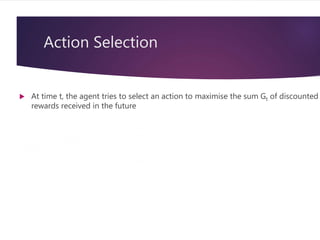
Action Selection
 At time t, the agent tries to select an action to maximise the sum Gt of discounted
rewards received in the future
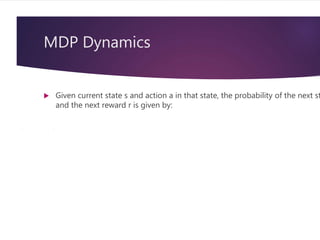
MDP Dynamics
 Given current state s and action a in that state, the probability of the next st
and the next reward r is given by:
State Transition Probabilities
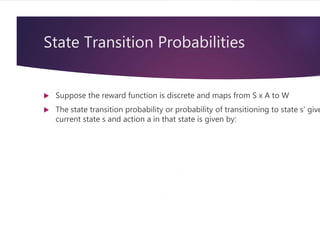
 Suppose the reward function is discrete and maps from S x A to W
 The state transition probability or probability of transitioning to state s’ give
current state s and action a in that state is given by:
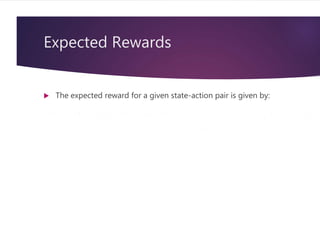
Expected Rewards
 The expected reward for a given state-action pair is given by:
State-Value Function (1)
 Value functions are defined with respect to particular policies because future
rewards depend on the agent’s actions
 Value functions give the expected return of a particular policy
 The value vπ(s) of a state s under a policy π is the expected return when starting in
state s and following the policy π from that state onwards
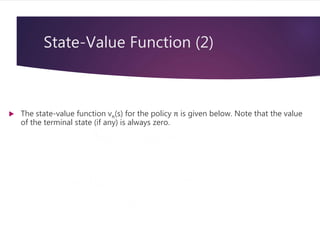
State-Value Function (2)
 The state-value function vπ(s) for the policy π is given below. Note that the value
of the terminal state (if any) is always zero.
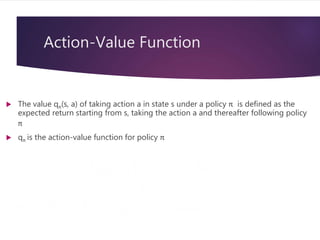
Action-Value Function
 The value qπ(s, a) of taking action a in state s under a policy π is defined as the
expected return starting from s, taking the action a and thereafter following policy
π
 qπ is the action-value function for policy π
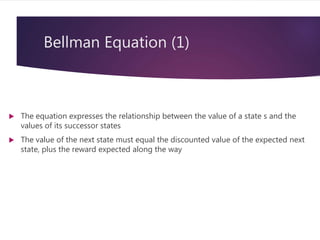
Bellman Equation (1)
 The equation expresses the relationship between the value of a state s and the
values of its successor states
 The value of the next state must equal the discounted value of the expected next
state, plus the reward expected along the way
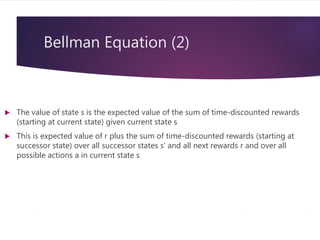
Bellman Equation (2)
 The value of state s is the expected value of the sum of time-discounted rewards
(starting at current state) given current state s
 This is expected value of r plus the sum of time-discounted rewards (starting at
successor state) over all successor states s’ and all next rewards r and over all
possible actions a in current state s
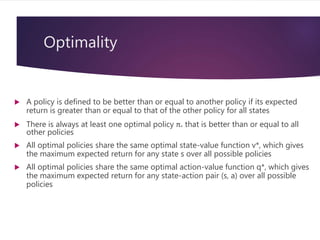
Optimality
 A policy is defined to be better than or equal to another policy if its expected
return is greater than or equal to that of the other policy for all states
 There is always at least one optimal policy π* that is better than or equal to all
other policies
 All optimal policies share the same optimal state-value function v*, which gives
the maximum expected return for any state s over all possible policies
 All optimal policies share the same optimal action-value function q*, which gives
the maximum expected return for any state-action pair (s, a) over all possible
policies
Temporal-Difference
Learning
Chapter 6 – Reinforcement Learning: An Introduction
Playing Atari with Deep Reinforcement Learning
Asynchronous Methods for Deep Reinforcement Learning
David Silver’s Tutorial on Deep Reinforcement Learning
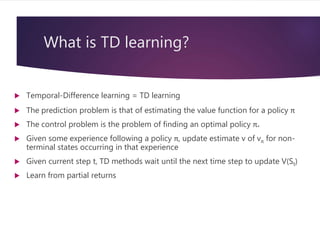
What is TD learning?
 Temporal-Difference learning = TD learning
 The prediction problem is that of estimating the value function for a policy π
 The control problem is the problem of finding an optimal policy π*
 Given some experience following a policy π, update estimate v of vπ for non-
terminal states occurring in that experience
 Given current step t, TD methods wait until the next time step to update V(St)
 Learn from partial returns
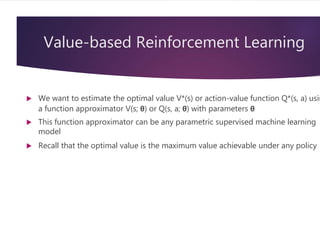
Value-based Reinforcement Learning
 We want to estimate the optimal value V*(s) or action-value function Q*(s, a) usin
a function approximator V(s; θ) or Q(s, a; θ) with parameters θ
 This function approximator can be any parametric supervised machine learning
model
 Recall that the optimal value is the maximum value achievable under any policy
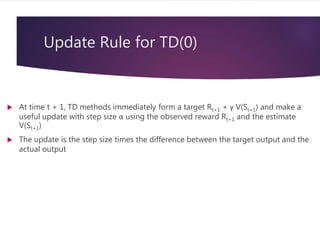
Update Rule for TD(0)
 At time t + 1, TD methods immediately form a target Rt+1 + γ V(St+1) and make a
useful update with step size α using the observed reward Rt+1 and the estimate
V(St+1)
 The update is the step size times the difference between the target output and the
actual output
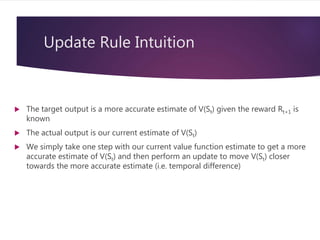
Update Rule Intuition
 The target output is a more accurate estimate of V(St) given the reward Rt+1 is
known
 The actual output is our current estimate of V(St)
 We simply take one step with our current value function estimate to get a more
accurate estimate of V(St) and then perform an update to move V(St) closer
towards the more accurate estimate (i.e. temporal difference)
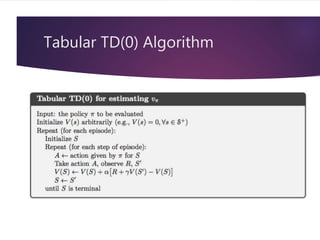
Tabular TD(0) Algorithm
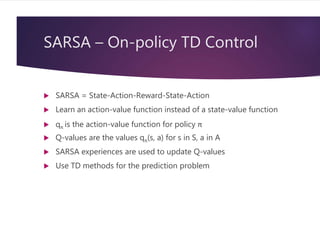
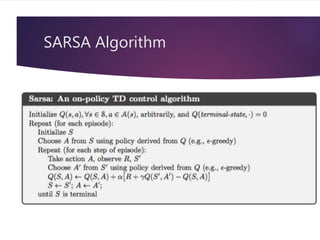
SARSA – On-policy TD Control
 SARSA = State-Action-Reward-State-Action
 Learn an action-value function instead of a state-value function
 qπ is the action-value function for policy π
 Q-values are the values qπ(s, a) for s in S, a in A
 SARSA experiences are used to update Q-values
 Use TD methods for the prediction problem
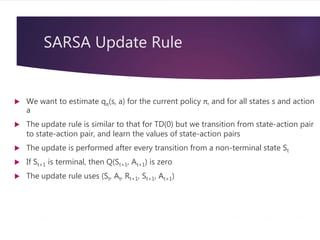
SARSA Update Rule
 We want to estimate qπ(s, a) for the current policy π, and for all states s and action
a
 The update rule is similar to that for TD(0) but we transition from state-action pair
to state-action pair, and learn the values of state-action pairs
 The update is performed after every transition from a non-terminal state St
 If St+1 is terminal, then Q(St+1, At+1) is zero
 The update rule uses (St, At, Rt+1, St+1, At+1)
SARSA Algorithm
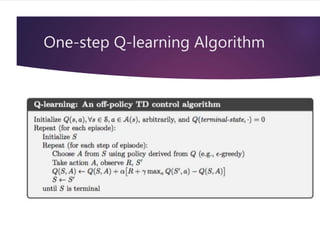
Q-learning – Off-policy TD Control
 Similar to SARSA but off-policy updates
 The learned action-value function Q directly approximates the optimal action-
value function q* independent of the policy being followed
 In update rule, choose action a that maximises Q given St+1 and use the resulting
Q-value (i.e. estimated value given by optimal action-value function) plus the
observed reward as the target
 This method is off-policy because we do not have a fixed policy that maps from
states to actions. This is why At+1 is not used in the update rule
One-step Q-learning Algorithm
Epsilon-greedy Policy
 At each time step, the agent selects an action
 The agent follows the greedy strategy with probability 1 – epsilon
 The agent selects a random action with probability epsilon
 With Q-learning, the greedy strategy is the action a that maximises Q given St+1
Deep Q-Networks (DQN)
 Introduced deep reinforcement learning
 It is common to use a function approximator Q(s, a; θ) to approximate the action-
value function in Q-learning
 Deep Q-Networks is Q-learning with a deep neural network function approximator
called the Q-network
 Discrete and finite set of actions A
 Example: Breakout has 3 actions – move left, move right, no movement
 Uses epsilon-greedy policy to select actions
Q-Networks
 Core idea: We want the neural network to learn a non-linear hierarchy of features
or feature representation that gives accurate Q-value estimates
 The neural network has a separate output unit for each possible action, which
gives the Q-value estimate for that action given the input state
 The neural network is trained using mini-batch stochastic gradient updates and
experience replay
Experience Replay
 The state is a sequence of actions and observations st = x1, a1, x2, …, at-1, xt
 Store the agent’s experiences at each time step et = (st, at, rt, st+1) in a dataset D =
e1, ..., en pooled over many episodes into a replay memory
 In practice, only store the last N experience tuples in the replay memory and
sample uniformly from D when performing updates
State representation
 It is difficult to give the neural network a sequence of arbitrary length as input
 Use fixed length representation of sequence/history produced by a function ϕ(st)
 Example: The last 4 image frames in the sequence of Breakout gameplay
Q-Network Training
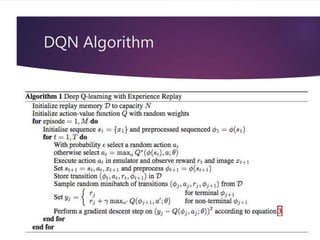
 Sample random mini-batch of experience tuples uniformly at random from D
 Similar to Q-learning update rule but:
 Use mini-batch stochastic gradient updates
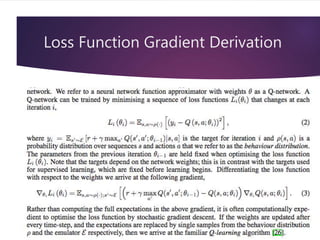
 The gradient of the loss function for a given iteration with respect to the parameter θi is
the difference between the target value and the actual value is multiplied by the
gradient of the Q function approximator Q(s, a; θ) with respect to that specific
parameter
 Use the gradient of the loss function to update the Q function approximator
Loss Function Gradient Derivation
DQN Algorithm
Comments
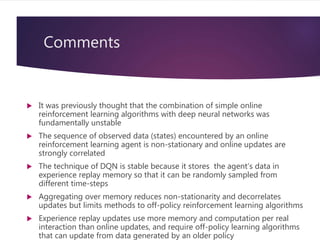
 It was previously thought that the combination of simple online
reinforcement learning algorithms with deep neural networks was
fundamentally unstable
 The sequence of observed data (states) encountered by an online
reinforcement learning agent is non-stationary and online updates are
strongly correlated
 The technique of DQN is stable because it stores the agent’s data in
experience replay memory so that it can be randomly sampled from
different time-steps
 Aggregating over memory reduces non-stationarity and decorrelates
updates but limits methods to off-policy reinforcement learning algorithms
 Experience replay updates use more memory and computation per real
interaction than online updates, and require off-policy learning algorithms
that can update from data generated by an older policy
Policy Gradient Methods
Chapter 13 – Reinforcement Learning: An Introduction
Policy Gradient Lecture Slides from David Silver’s
Reinforcement Learning Course
David Silver’s Tutorial on Deep Reinforcement Learning
What are Policy Gradient Methods?
 Before: Learn the values of actions and then select actions based on their
estimated action-values. The policy was generated directly from the value
function
 We want to learn a parameterised policy that can select actions without
consulting a value function. The parameters of the policy are called policy
weights
 A value function may be used to learn the policy weights but this is not
required for action selection
 Policy gradient methods are methods for learning the policy weights using
the gradient of some performance measure with respect to the policy
weights
Policy-based Reinforcement Learning
 Search directly for the optimal policy π*
 Can use any parametric supervised machine learning model to learn policies π(a |s;
θ) where θ represents the learned parameters
 Recall that the optimal policy is the policy that achieves maximum future return
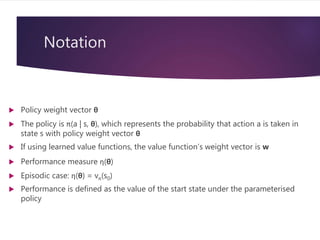
Notation
 Policy weight vector θ
 The policy is π(a | s, θ), which represents the probability that action a is taken in
state s with policy weight vector θ
 If using learned value functions, the value function’s weight vector is w
 Performance measure η(θ)
 Episodic case: η(θ) = vπ(s0)
 Performance is defined as the value of the start state under the parameterised
policy
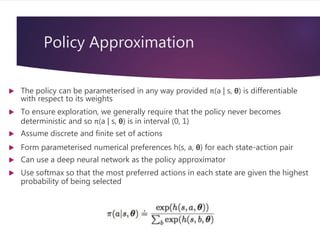
Policy Approximation
 The policy can be parameterised in any way provided π(a | s, θ) is differentiable
with respect to its weights
 To ensure exploration, we generally require that the policy never becomes
deterministic and so π(a | s, θ) is in interval (0, 1)
 Assume discrete and finite set of actions
 Form parameterised numerical preferences h(s, a, θ) for each state-action pair
 Can use a deep neural network as the policy approximator
 Use softmax so that the most preferred actions in each state are given the highest
probability of being selected
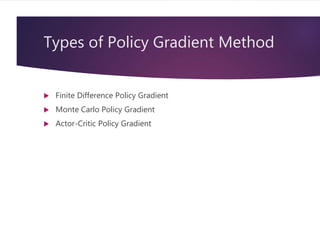
Types of Policy Gradient Method
 Finite Difference Policy Gradient
 Monte Carlo Policy Gradient
 Actor-Critic Policy Gradient
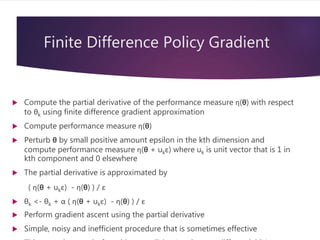
Finite Difference Policy Gradient
 Compute the partial derivative of the performance measure η(θ) with respect
to θk using finite difference gradient approximation
 Compute performance measure η(θ)
 Perturb θ by small positive amount epsilon in the kth dimension and
compute performance measure η(θ + ukε) where uk is unit vector that is 1 in
kth component and 0 elsewhere
 The partial derivative is approximated by
( η(θ + ukε) - η(θ) ) / ε
 θk <- θk + α ( η(θ + ukε) - η(θ) ) / ε
 Perform gradient ascent using the partial derivative
 Simple, noisy and inefficient procedure that is sometimes effective
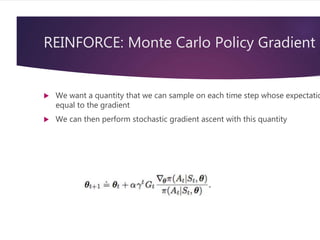
REINFORCE: Monte Carlo Policy Gradient
 We want a quantity that we can sample on each time step whose expectatio
equal to the gradient
 We can then perform stochastic gradient ascent with this quantity
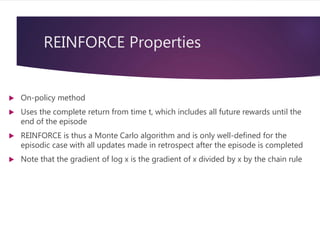
REINFORCE Properties
 On-policy method
 Uses the complete return from time t, which includes all future rewards until the
end of the episode
 REINFORCE is thus a Monte Carlo algorithm and is only well-defined for the
episodic case with all updates made in retrospect after the episode is completed
 Note that the gradient of log x is the gradient of x divided by x by the chain rule
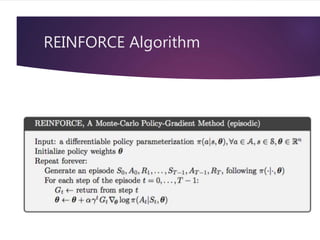
REINFORCE Algorithm
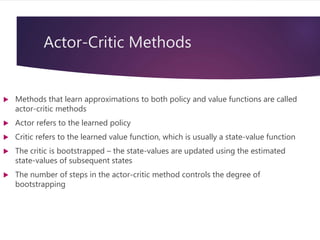
Actor-Critic Methods
 Methods that learn approximations to both policy and value functions are called
actor-critic methods
 Actor refers to the learned policy
 Critic refers to the learned value function, which is usually a state-value function
 The critic is bootstrapped – the state-values are updated using the estimated
state-values of subsequent states
 The number of steps in the actor-critic method controls the degree of
bootstrapping
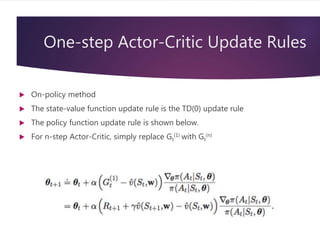
One-step Actor-Critic Update Rules
 On-policy method
 The state-value function update rule is the TD(0) update rule
 The policy function update rule is shown below.
 For n-step Actor-Critic, simply replace Gt
(1) with Gt
(n)
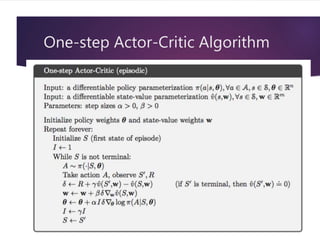
One-step Actor-Critic Algorithm
Asynchronous
Reinforcement Learning
Asynchronous Methods for Deep Reinforcement
Learning
What is Asynchronous Reinforcement Learni
 Use asynchronous gradient descent to optimise controllers
 This is useful for deep reinforcement learning where the controllers are deep
neural networks, which take a long time to train
 Asynchronous gradient descent speeds up the learning process
 Can use one multi-core CPU to train deep neural networks asynchronously instead
of multiple GPUs
Parallelism (1)
 Asynchronously execute multiple agents in parallel on multiple instances of the
environment
 This parallelism decorrelates the agents’ data into a more stationary process since at
any given time-step, the agents will be experiencing a variety of different states
 This approach enables a larger spectrum of fundamental on-policy and off-policy
reinforcement learning algorithms to be applied robustly and effectively using deep
neural networks
 Use asynchronous actor-learners (i.e. agents). Think of each actor-learner as a thread
 Run everything on a single multi-core CPU to avoid communication costs of sending
gradients and parameters
Parallelism (2)
 Multiple actor-learners running in parallel are likely to be exploring different
parts of the environment
 We can explicitly use different exploration policies in each actor-learner to
maximise this diversity
 By running different exploration policies in different threads, the overall
changes made to the parameters by multiple actor-learners applying
updates in parallel are less likely to be correlated in time than a single agent
applying online updates
No Experience Replay
 No need for a replay memory. We instead rely on parallel actors employing
different exploration policies to perform the stabilising role undertaken by
experience replay in the DQN training algorithm
 Since we no longer rely on experience replay for stabilising learning, we are able
to use on-policy reinforcement learning methods to train neural networks in a
stable way
Asynchronous Algorithms
 Asynchronous one-step Q-learning
 Asynchronous one-step SARSA
 Asynchronous n-step Q-learning
 Asynchronous Advantage Actor-Critic (A3C)
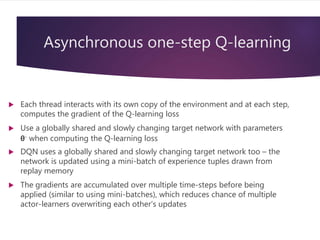
Asynchronous one-step Q-learning
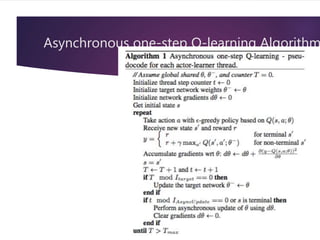
 Each thread interacts with its own copy of the environment and at each step,
computes the gradient of the Q-learning loss
 Use a globally shared and slowly changing target network with parameters
θ- when computing the Q-learning loss
 DQN uses a globally shared and slowly changing target network too – the
network is updated using a mini-batch of experience tuples drawn from
replay memory
 The gradients are accumulated over multiple time-steps before being
applied (similar to using mini-batches), which reduces chance of multiple
actor-learners overwriting each other’s updates
Exploration
 Giving each thread a different exploration policy helps improve robustness and
generally improves performance through better exploration
 Use epsilon-greedy exploration with epsilon periodically sampled from some
distribution by each thread
Asynchronous one-step Q-learning Algorithm
Asynchronous one-step SARSA
 This is the same algorithm as Asynchronous one-step Q-learning except the target
value used for Q(s, a) is different
 One-step SARSA uses r + γ Q(s’, a’; θ-) as the target value
n-step Q-learning
 So far we have been using one-step Q-learning
 One-step Q-learning updates the action value Q(s, a) towards r + γ maxa’ Q(s’, a’;
θ), which is the one-step return
 Obtaining a reward r only directly affects the value of the state-action pair (s, a)
that led to the reward
 The values of the other state-action pairs are affected only indirectly through the
updated value Q(s, a)
 This can make the learning process slow since many updates are required to
propagate a reward to the relevant preceding states and actions
 Use n-step returns to propagate the rewards faster
n-step Returns
 In n-step Q-learning, Q(s, a) is updated towards the n-step return:
 rt + γ rt+1 + … + γn-1 rt+n-1 + maxa γn Q(st+n, a)
 This results in a single reward directly affecting the values of n preceding state-
action pairs
 This makes the process of propagating rewards to relevant state-action pairs
potentially much more efficient
 One-step update for the last state, two-step update for the second last state, and
so on until n-step update for the nth last state
 Accumulated updates are applied in a single step
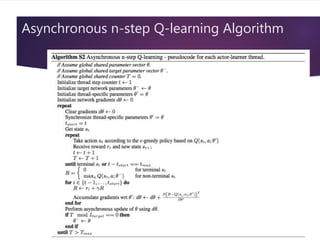
Asynchronous n-step Q-learning Algorithm
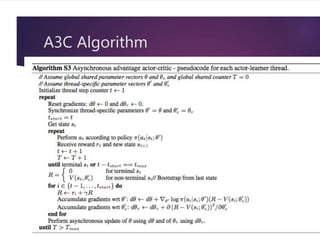
A3C
 Maintains a policy π(at| st; θ) and an estimate of the value function V(st; θv)
 n-step Actor-Critic method
 As with value-based methods, use parallel actor-learners and accumulate updates
to improve training stability
 In practice, the policy approximation and the value function share some
parameters
 Use a neural network that has one softmax output for the policy π(at| st; θ) and
one linear output for the value function V(st; θv) with all non-output parameters
shared
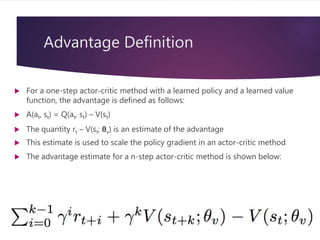
Advantage Definition
 For a one-step actor-critic method with a learned policy and a learned value
function, the advantage is defined as follows:
 A(at, st) = Q(at, st) – V(st)
 The quantity rt – V(st; θv) is an estimate of the advantage
 This estimate is used to scale the policy gradient in an actor-critic method
 The advantage estimate for a n-step actor-critic method is shown below:
A3C Algorithm
Summary
 Get faster training because of parallelism
 Can use on-policy reinforcement learning methods
 Diversity in exploration can lead to better performance than synchronous methods
 In practice, the on-policy A3C algorithm appears to be the best performing
asynchronous reinforcement learning method in terms of performance and
training speed

Reinforcement Learning

  • 1.
    Reinforcement Learning inArtificial intelligence PRESENTED BY S.VIJAYALAKSHMI I- MSC (IT) Nadar Saraswathi College of arts and science, Theni Department of CS &IT
  • 2.
  • 3.
    Overview  Introduction toReinforcement Learning  Finite Markov Decision Processes  Temporal-Difference Learning (SARSA, Q-learning, Deep Q-Networks)  Policy Gradient Methods (Finite Difference Policy Gradient, REINFORCE, Actor- Critic)  Asynchronous Reinforcement Learning
  • 4.
    Introduction to Reinforcement Learning Chapter1 – Reinforcement Learning: An Introduction Imitation Learning Lecture Slides from CMU Deep Reinforcement Learning Course
  • 5.
    What is ReinforcementLearning?  Learning from interaction with an environment to achieve some long-term goal that is related to the state of the environment  The goal is defined by reward signal, which must be maximised  Agent must be able to partially/fully sense the environment state and take action to influence the environment state  The state is typically described with a feature-vector
  • 6.
    Exploration versus Exploitation We want a reinforcement learning agent to earn lots of reward  The agent must prefer past actions that have been found to be effective at producing reward  The agent must exploit what it already knows to obtain reward  The agent must select untested actions to discover reward-producing actions  The agent must explore actions to make better action selections in the future  Trade-off between exploration and exploitation
  • 7.
    Reinforcement Learning Systems Reinforcement learning systems have 4 main elements:  Policy  Reward signal  Value function  Optional model of the environment
  • 8.
    Policy  A policyis a mapping from the perceived states of the environment to actio be taken when in those states  A reinforcement learning agent uses a policy to select actions given the curr environment state
  • 9.
    Reward Signal  Thereward signal defines the goal  On each time step, the environment sends a single number called the reward to the reinforcement learning agent  The agent’s objective is to maximise the total reward that it receives over the long run  The reward signal is used to alter the policy
  • 10.
    Value Function (1) The reward signal indicates what is good in the short run while the value function indicates what is good in the long run  The value of a state is the total amount of reward an agent can expect to accumulate over the future, starting in that state  Compute the value using the states that are likely to follow the current state and the rewards available in those states  Future rewards may be time-discounted with a factor in the interval [0, 1]
  • 11.
    Value Function (2) Use the values to make and evaluate decisions  Action choices are made based on value judgements  Prefer actions that bring about states of highest value instead of highest reward  Rewards are given directly by the environment  Values must continually be re-estimated from the sequence of observations that an agent makes over its lifetime
  • 12.
    Model-free versus Model-based A model of the environment allows inferences to be made about how the environment will behave  Example: Given a state and an action to be taken while in that state, the model could predict the next state and the next reward  Models are used for planning, which means deciding on a course of action by considering possible future situations before they are experienced  Model-based methods use models and planning. Think of this as modelling the dynamics p(s’ | s, a)  Model-free methods learn exclusively from trial-and-error (i.e. no modelling of the environment)  This presentation focuses on model-free methods
  • 13.
    On-policy versus Off-policy An on-policy agent learns only about the policy that it is executing  An off-policy agent learns about a policy or policies different from the one t is executing
  • 14.
    Credit Assignment Problem Given a sequence of states and actions, and the final sum of time-discounted future rewards, how do we infer which actions were effective at producing lots of reward and which actions were not effective?  How do we assign credit for the observed rewards given a sequence of actions over time?  Every reinforcement learning algorithm must address this problem
  • 15.
    Reward Design  Weneed rewards to guide the agent to achieve its goal  Option 1: Hand-designed reward functions  This is a black art  Option 2: Learn rewards from demonstrations  Instead of having a human expert tune a system to achieve the desired behaviour, the expert can demonstrate desired behaviour and the robot can tune itself to match the demonstration
  • 16.
    What is DeepReinforcement Learning?  Deep reinforcement learning is standard reinforcement learning where a deep neural network is used to approximate either a policy or a value function  Deep neural networks require lots of real/simulated interaction with the environment to learn  Lots of trials/interactions is possible in simulated environments  We can easily parallelise the trials/interaction in simulated environments  We cannot do this with robotics (no simulations) because action execution takes time, accidents/failures are expensive and there are safety concerns
  • 17.
    Finite Markov Decision Processes Chapter3 – Reinforcement Learning: An Introduction
  • 18.
    Markov Decision Process(MDP)  Set of states S  Set of actions A  State transition probabilities p(s’ | s, a). This is the probability distribution over the state space given we take action a in state s  Discount factor γ in [0, 1]  Reward function R: S x A -> set of real numbers  For simplicity, assume discrete rewards  Finite MDP if both S and A are finite
  • 19.
    Time Discounting  Theundiscounted formulation γ = 0 across episodes is appropriate for episodic tasks in which agent-environment interaction breaks into episodes (multiple trials to perform a task).  Example: Playing Breakout (each run of the game is an episode)  The discounted formulation 0 < γ <= 1 is appropriate for continuing tasks, in which the interaction continues without limit  Example: Vacuum cleaner robot  This presentation focuses on episodic tasks
  • 20.
    Agent-Environment Interaction (1) The agent and environment interact at each of a sequence of discrete time steps t = {0, 1, 2, 3, …, T} where T can be infinite  At each time step t, the agent receives some representation of the environment state St in S and uses this to select an action At in the set A(St) of available actions given that state  One step later, the agent receives a numerical reward Rt+1 and finds itself in a new state St+1
  • 21.
    Agent-Environment Interaction (2) At each time step, the agent implements a stochastic policy or mapping from states to probabilities of selecting each possible action  The policy is denoted πt where πt(a | s) is the probability of taking action a when in state s  A policy is a stochastic rule by which the agent selects actions as a function of states  Reinforcement learning methods specify how the agent changes its policy using its experience
  • 22.
    Action Selection  Attime t, the agent tries to select an action to maximise the sum Gt of discounted rewards received in the future
  • 23.
    MDP Dynamics  Givencurrent state s and action a in that state, the probability of the next st and the next reward r is given by:
  • 24.
    State Transition Probabilities Suppose the reward function is discrete and maps from S x A to W  The state transition probability or probability of transitioning to state s’ give current state s and action a in that state is given by:
  • 25.
    Expected Rewards  Theexpected reward for a given state-action pair is given by:
  • 26.
    State-Value Function (1) Value functions are defined with respect to particular policies because future rewards depend on the agent’s actions  Value functions give the expected return of a particular policy  The value vπ(s) of a state s under a policy π is the expected return when starting in state s and following the policy π from that state onwards
  • 27.
    State-Value Function (2) The state-value function vπ(s) for the policy π is given below. Note that the value of the terminal state (if any) is always zero.
  • 28.
    Action-Value Function  Thevalue qπ(s, a) of taking action a in state s under a policy π is defined as the expected return starting from s, taking the action a and thereafter following policy π  qπ is the action-value function for policy π
  • 29.
    Bellman Equation (1) The equation expresses the relationship between the value of a state s and the values of its successor states  The value of the next state must equal the discounted value of the expected next state, plus the reward expected along the way
  • 30.
    Bellman Equation (2) The value of state s is the expected value of the sum of time-discounted rewards (starting at current state) given current state s  This is expected value of r plus the sum of time-discounted rewards (starting at successor state) over all successor states s’ and all next rewards r and over all possible actions a in current state s
  • 31.
    Optimality  A policyis defined to be better than or equal to another policy if its expected return is greater than or equal to that of the other policy for all states  There is always at least one optimal policy π* that is better than or equal to all other policies  All optimal policies share the same optimal state-value function v*, which gives the maximum expected return for any state s over all possible policies  All optimal policies share the same optimal action-value function q*, which gives the maximum expected return for any state-action pair (s, a) over all possible policies
  • 32.
    Temporal-Difference Learning Chapter 6 –Reinforcement Learning: An Introduction Playing Atari with Deep Reinforcement Learning Asynchronous Methods for Deep Reinforcement Learning David Silver’s Tutorial on Deep Reinforcement Learning
  • 33.
    What is TDlearning?  Temporal-Difference learning = TD learning  The prediction problem is that of estimating the value function for a policy π  The control problem is the problem of finding an optimal policy π*  Given some experience following a policy π, update estimate v of vπ for non- terminal states occurring in that experience  Given current step t, TD methods wait until the next time step to update V(St)  Learn from partial returns
  • 34.
    Value-based Reinforcement Learning We want to estimate the optimal value V*(s) or action-value function Q*(s, a) usin a function approximator V(s; θ) or Q(s, a; θ) with parameters θ  This function approximator can be any parametric supervised machine learning model  Recall that the optimal value is the maximum value achievable under any policy
  • 35.
    Update Rule forTD(0)  At time t + 1, TD methods immediately form a target Rt+1 + γ V(St+1) and make a useful update with step size α using the observed reward Rt+1 and the estimate V(St+1)  The update is the step size times the difference between the target output and the actual output
  • 36.
    Update Rule Intuition The target output is a more accurate estimate of V(St) given the reward Rt+1 is known  The actual output is our current estimate of V(St)  We simply take one step with our current value function estimate to get a more accurate estimate of V(St) and then perform an update to move V(St) closer towards the more accurate estimate (i.e. temporal difference)
  • 37.
  • 38.
    SARSA – On-policyTD Control  SARSA = State-Action-Reward-State-Action  Learn an action-value function instead of a state-value function  qπ is the action-value function for policy π  Q-values are the values qπ(s, a) for s in S, a in A  SARSA experiences are used to update Q-values  Use TD methods for the prediction problem
  • 39.
    SARSA Update Rule We want to estimate qπ(s, a) for the current policy π, and for all states s and action a  The update rule is similar to that for TD(0) but we transition from state-action pair to state-action pair, and learn the values of state-action pairs  The update is performed after every transition from a non-terminal state St  If St+1 is terminal, then Q(St+1, At+1) is zero  The update rule uses (St, At, Rt+1, St+1, At+1)
  • 40.
  • 41.
    Q-learning – Off-policyTD Control  Similar to SARSA but off-policy updates  The learned action-value function Q directly approximates the optimal action- value function q* independent of the policy being followed  In update rule, choose action a that maximises Q given St+1 and use the resulting Q-value (i.e. estimated value given by optimal action-value function) plus the observed reward as the target  This method is off-policy because we do not have a fixed policy that maps from states to actions. This is why At+1 is not used in the update rule
  • 42.
  • 43.
    Epsilon-greedy Policy  Ateach time step, the agent selects an action  The agent follows the greedy strategy with probability 1 – epsilon  The agent selects a random action with probability epsilon  With Q-learning, the greedy strategy is the action a that maximises Q given St+1
  • 44.
    Deep Q-Networks (DQN) Introduced deep reinforcement learning  It is common to use a function approximator Q(s, a; θ) to approximate the action- value function in Q-learning  Deep Q-Networks is Q-learning with a deep neural network function approximator called the Q-network  Discrete and finite set of actions A  Example: Breakout has 3 actions – move left, move right, no movement  Uses epsilon-greedy policy to select actions
  • 45.
    Q-Networks  Core idea:We want the neural network to learn a non-linear hierarchy of features or feature representation that gives accurate Q-value estimates  The neural network has a separate output unit for each possible action, which gives the Q-value estimate for that action given the input state  The neural network is trained using mini-batch stochastic gradient updates and experience replay
  • 46.
    Experience Replay  Thestate is a sequence of actions and observations st = x1, a1, x2, …, at-1, xt  Store the agent’s experiences at each time step et = (st, at, rt, st+1) in a dataset D = e1, ..., en pooled over many episodes into a replay memory  In practice, only store the last N experience tuples in the replay memory and sample uniformly from D when performing updates
  • 47.
    State representation  Itis difficult to give the neural network a sequence of arbitrary length as input  Use fixed length representation of sequence/history produced by a function ϕ(st)  Example: The last 4 image frames in the sequence of Breakout gameplay
  • 48.
    Q-Network Training  Samplerandom mini-batch of experience tuples uniformly at random from D  Similar to Q-learning update rule but:  Use mini-batch stochastic gradient updates  The gradient of the loss function for a given iteration with respect to the parameter θi is the difference between the target value and the actual value is multiplied by the gradient of the Q function approximator Q(s, a; θ) with respect to that specific parameter  Use the gradient of the loss function to update the Q function approximator
  • 49.
  • 50.
  • 51.
    Comments  It waspreviously thought that the combination of simple online reinforcement learning algorithms with deep neural networks was fundamentally unstable  The sequence of observed data (states) encountered by an online reinforcement learning agent is non-stationary and online updates are strongly correlated  The technique of DQN is stable because it stores the agent’s data in experience replay memory so that it can be randomly sampled from different time-steps  Aggregating over memory reduces non-stationarity and decorrelates updates but limits methods to off-policy reinforcement learning algorithms  Experience replay updates use more memory and computation per real interaction than online updates, and require off-policy learning algorithms that can update from data generated by an older policy
  • 52.
    Policy Gradient Methods Chapter13 – Reinforcement Learning: An Introduction Policy Gradient Lecture Slides from David Silver’s Reinforcement Learning Course David Silver’s Tutorial on Deep Reinforcement Learning
  • 53.
    What are PolicyGradient Methods?  Before: Learn the values of actions and then select actions based on their estimated action-values. The policy was generated directly from the value function  We want to learn a parameterised policy that can select actions without consulting a value function. The parameters of the policy are called policy weights  A value function may be used to learn the policy weights but this is not required for action selection  Policy gradient methods are methods for learning the policy weights using the gradient of some performance measure with respect to the policy weights
  • 54.
    Policy-based Reinforcement Learning Search directly for the optimal policy π*  Can use any parametric supervised machine learning model to learn policies π(a |s; θ) where θ represents the learned parameters  Recall that the optimal policy is the policy that achieves maximum future return
  • 55.
    Notation  Policy weightvector θ  The policy is π(a | s, θ), which represents the probability that action a is taken in state s with policy weight vector θ  If using learned value functions, the value function’s weight vector is w  Performance measure η(θ)  Episodic case: η(θ) = vπ(s0)  Performance is defined as the value of the start state under the parameterised policy
  • 56.
    Policy Approximation  Thepolicy can be parameterised in any way provided π(a | s, θ) is differentiable with respect to its weights  To ensure exploration, we generally require that the policy never becomes deterministic and so π(a | s, θ) is in interval (0, 1)  Assume discrete and finite set of actions  Form parameterised numerical preferences h(s, a, θ) for each state-action pair  Can use a deep neural network as the policy approximator  Use softmax so that the most preferred actions in each state are given the highest probability of being selected
  • 57.
    Types of PolicyGradient Method  Finite Difference Policy Gradient  Monte Carlo Policy Gradient  Actor-Critic Policy Gradient
  • 58.
    Finite Difference PolicyGradient  Compute the partial derivative of the performance measure η(θ) with respect to θk using finite difference gradient approximation  Compute performance measure η(θ)  Perturb θ by small positive amount epsilon in the kth dimension and compute performance measure η(θ + ukε) where uk is unit vector that is 1 in kth component and 0 elsewhere  The partial derivative is approximated by ( η(θ + ukε) - η(θ) ) / ε  θk <- θk + α ( η(θ + ukε) - η(θ) ) / ε  Perform gradient ascent using the partial derivative  Simple, noisy and inefficient procedure that is sometimes effective
  • 59.
    REINFORCE: Monte CarloPolicy Gradient  We want a quantity that we can sample on each time step whose expectatio equal to the gradient  We can then perform stochastic gradient ascent with this quantity
  • 60.
    REINFORCE Properties  On-policymethod  Uses the complete return from time t, which includes all future rewards until the end of the episode  REINFORCE is thus a Monte Carlo algorithm and is only well-defined for the episodic case with all updates made in retrospect after the episode is completed  Note that the gradient of log x is the gradient of x divided by x by the chain rule
  • 61.
  • 62.
    Actor-Critic Methods  Methodsthat learn approximations to both policy and value functions are called actor-critic methods  Actor refers to the learned policy  Critic refers to the learned value function, which is usually a state-value function  The critic is bootstrapped – the state-values are updated using the estimated state-values of subsequent states  The number of steps in the actor-critic method controls the degree of bootstrapping
  • 63.
    One-step Actor-Critic UpdateRules  On-policy method  The state-value function update rule is the TD(0) update rule  The policy function update rule is shown below.  For n-step Actor-Critic, simply replace Gt (1) with Gt (n)
  • 64.
  • 65.
  • 66.
    What is AsynchronousReinforcement Learni  Use asynchronous gradient descent to optimise controllers  This is useful for deep reinforcement learning where the controllers are deep neural networks, which take a long time to train  Asynchronous gradient descent speeds up the learning process  Can use one multi-core CPU to train deep neural networks asynchronously instead of multiple GPUs
  • 67.
    Parallelism (1)  Asynchronouslyexecute multiple agents in parallel on multiple instances of the environment  This parallelism decorrelates the agents’ data into a more stationary process since at any given time-step, the agents will be experiencing a variety of different states  This approach enables a larger spectrum of fundamental on-policy and off-policy reinforcement learning algorithms to be applied robustly and effectively using deep neural networks  Use asynchronous actor-learners (i.e. agents). Think of each actor-learner as a thread  Run everything on a single multi-core CPU to avoid communication costs of sending gradients and parameters
  • 68.
    Parallelism (2)  Multipleactor-learners running in parallel are likely to be exploring different parts of the environment  We can explicitly use different exploration policies in each actor-learner to maximise this diversity  By running different exploration policies in different threads, the overall changes made to the parameters by multiple actor-learners applying updates in parallel are less likely to be correlated in time than a single agent applying online updates
  • 69.
    No Experience Replay No need for a replay memory. We instead rely on parallel actors employing different exploration policies to perform the stabilising role undertaken by experience replay in the DQN training algorithm  Since we no longer rely on experience replay for stabilising learning, we are able to use on-policy reinforcement learning methods to train neural networks in a stable way
  • 70.
    Asynchronous Algorithms  Asynchronousone-step Q-learning  Asynchronous one-step SARSA  Asynchronous n-step Q-learning  Asynchronous Advantage Actor-Critic (A3C)
  • 71.
    Asynchronous one-step Q-learning Each thread interacts with its own copy of the environment and at each step, computes the gradient of the Q-learning loss  Use a globally shared and slowly changing target network with parameters θ- when computing the Q-learning loss  DQN uses a globally shared and slowly changing target network too – the network is updated using a mini-batch of experience tuples drawn from replay memory  The gradients are accumulated over multiple time-steps before being applied (similar to using mini-batches), which reduces chance of multiple actor-learners overwriting each other’s updates
  • 72.
    Exploration  Giving eachthread a different exploration policy helps improve robustness and generally improves performance through better exploration  Use epsilon-greedy exploration with epsilon periodically sampled from some distribution by each thread
  • 73.
  • 74.
    Asynchronous one-step SARSA This is the same algorithm as Asynchronous one-step Q-learning except the target value used for Q(s, a) is different  One-step SARSA uses r + γ Q(s’, a’; θ-) as the target value
  • 75.
    n-step Q-learning  Sofar we have been using one-step Q-learning  One-step Q-learning updates the action value Q(s, a) towards r + γ maxa’ Q(s’, a’; θ), which is the one-step return  Obtaining a reward r only directly affects the value of the state-action pair (s, a) that led to the reward  The values of the other state-action pairs are affected only indirectly through the updated value Q(s, a)  This can make the learning process slow since many updates are required to propagate a reward to the relevant preceding states and actions  Use n-step returns to propagate the rewards faster
  • 76.
    n-step Returns  Inn-step Q-learning, Q(s, a) is updated towards the n-step return:  rt + γ rt+1 + … + γn-1 rt+n-1 + maxa γn Q(st+n, a)  This results in a single reward directly affecting the values of n preceding state- action pairs  This makes the process of propagating rewards to relevant state-action pairs potentially much more efficient  One-step update for the last state, two-step update for the second last state, and so on until n-step update for the nth last state  Accumulated updates are applied in a single step
  • 77.
  • 78.
    A3C  Maintains apolicy π(at| st; θ) and an estimate of the value function V(st; θv)  n-step Actor-Critic method  As with value-based methods, use parallel actor-learners and accumulate updates to improve training stability  In practice, the policy approximation and the value function share some parameters  Use a neural network that has one softmax output for the policy π(at| st; θ) and one linear output for the value function V(st; θv) with all non-output parameters shared
  • 79.
    Advantage Definition  Fora one-step actor-critic method with a learned policy and a learned value function, the advantage is defined as follows:  A(at, st) = Q(at, st) – V(st)  The quantity rt – V(st; θv) is an estimate of the advantage  This estimate is used to scale the policy gradient in an actor-critic method  The advantage estimate for a n-step actor-critic method is shown below:
  • 80.
  • 81.
    Summary  Get fastertraining because of parallelism  Can use on-policy reinforcement learning methods  Diversity in exploration can lead to better performance than synchronous methods  In practice, the on-policy A3C algorithm appears to be the best performing asynchronous reinforcement learning method in terms of performance and training speed