ENDOCRINE PHARMACOLOGY
Submitted by,
Pavan k A
M.Pharm, Pharmacology
COPS, DSU
ENDOCRINE SYSTEM
• The endocrine system is controlled by two parts of the brain: The
Pituitary gland and the Hypothalamus.
• This system coordinates the various functions of our body by
transmitting information in the form of biochemicals between
individual cells and tissues of the body.
• The messengers called as HORMONES.
• FUNCTIONS: Maintain Internal Homeostasis , Support Cell Growth,
Coordinate Development , Coordinate Reproduction, fertility, sexual
function AND Facilitate Responses to External Stimuli.
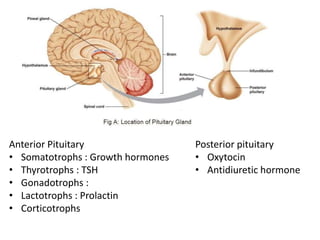
Anterior Pituitary
• Somatotrophs : Growth hormones
• Thyrotrophs : TSH
• Gonadotrophs :
• Lactotrophs : Prolactin
• Corticotrophs
Posterior pituitary
• Oxytocin
• Antidiuretic hormone
CONTENTS
• Growth Hormone
• Prolactin
• Sex Hormones
• Oral Contraceptives
• Corticosteroids
GROWTH HORMONE
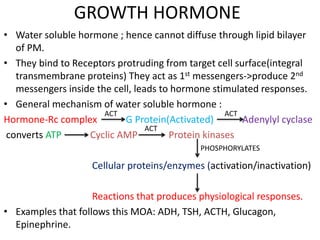
• Water soluble hormone ; hence cannot diffuse through lipid bilayer
of PM.
• They bind to Receptors protruding from target cell surface(integral
transmembrane proteins) They act as 1st messengers->produce 2nd
messengers inside the cell, leads to hormone stimulated responses.
• General mechanism of water soluble hormone :
Hormone-Rc complex G Protein(Activated) Adenylyl cyclase
converts ATP Cyclic AMP Protein kinases
Cellular proteins/enzymes (activation/inactivation)
Reactions that produces physiological responses.
• Examples that follows this MOA: ADH, TSH, ACTH, Glucagon,
Epinephrine.
ACT ACT
ACT
PHOSPHORYLATES
• Most abundant anterior pituitary hormone.
• Secreted by Somatotrophs, AP Cells.
• Somatotropins stimulates tissues to secrete Insulin like growth
factors(IGF) That produces hormones which stimulates general body
growth and regulate aspects of metabolism.
• Due to the alternative splicing of GH gene, anterior pituitary secrets
homogenous mixture of GH peptides that circulates in blood(protein
bound) to a corresponding extracellular domain of GH receptor.
Secretion and regulation
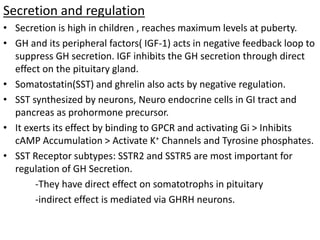
• Secretion is high in children , reaches maximum levels at puberty.
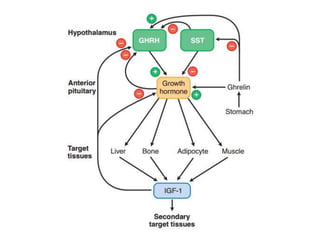
• GH and its peripheral factors( IGF-1) acts in negative feedback loop to
suppress GH secretion. IGF inhibits the GH secretion through direct
effect on the pituitary gland.
• Somatostatin(SST) and ghrelin also acts by negative regulation.
• SST synthesized by neurons, Neuro endocrine cells in GI tract and
pancreas as prohormone precursor.
• It exerts its effect by binding to GPCR and activating Gi > Inhibits
cAMP Accumulation > Activate K+ Channels and Tyrosine phosphates.
• SST Receptor subtypes: SSTR2 and SSTR5 are most important for
regulation of GH Secretion.
-They have direct effect on somatotrophs in pituitary
-indirect effect is mediated via GHRH neurons.
• Several Neurotransmitters, Drugs, Metabolites, Other stimuli
modulate release of GHRH or SST and Affect the GH secretion.
• Dopamine, 5-HT, α2-Agonist Stimulate GH release ( Hypoglycemia,
Exercise, stress, emotional excitement, ingestion of protein rich meals
also stimulates GH release)
• Β-Agonist, free fatty acids, IGF-1 and GH itself inhibits the release.
• GHRH and SST acts on somatotrophs in anterior pituitary to regulate
growth hormone secretion.
• SST inhibits GHRH release, GH has direct effects on target tissues ,
exerts indirect effect by stimulating release of IGF-1.
• Gastric peptide Ghrelin Enhances GH release.
Molecular and cellular action
• GH receptor - widely distributed, belongs to cytokine Rc superfamily.
• Extracellular domain (single membrane spanning region) where GH
binds and an intracellular domain which mediates the signal
transduction.
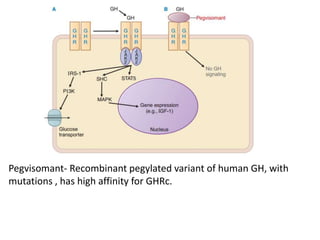
• A single GH molecule binds to 2 identical receptor(activates them)
thus forming ligand occupied receptor dimer(LORD) which
brings intracellular domains into close proximity activate
cytosolic components( important for cell signaling)
• The LORD doesn’t have tyrosine kinase activity ( But provides docking
sites for 2 molecules of JAK 2)
• Juxta position of 2 JAK 2 molecules brings about trans
phosphorylation and auto activation of JAK2 which further mediates
downstream signaling events.
Pegvisomant- Recombinant pegylated variant of human GH, with
mutations , has high affinity for GHRc.
Physiologic Effects of Growth Hormone
• Stimulate longitudinal growth of bones, increases bone mineral
density after growth ceases and epiphyses have closed.
• Stimulate myoblast differentiation( in experiment animals) increases
muscle mass ( in human with GH deficiency ) , increases GFR.
• Stimulate preadipocyte differentiation into adipocytes.
• Acts directly on adipocytes increases lipolysis . On hepatocytes it
stimulates Gluconeogenesis ( mediated by IGF-1)
• USFDA approved a NDA for recombinant human IGF-1 to treat short
stature in patients resistane to GH.
Clinical disorders
• GH deficiency in children leads to short stature, Turner’s syndrome,
Prader-willi syndrome, Chronic renal insufficiency.
• GH deficiency in adults leads to decrease in muscle mass, decreased
bone density, impaired psychosocial function.
• Increases mortality rates after Heart surgery or abdominal surgery,
acute respiratory failure.
Treatment
• Recombinant GH Replacement therapy- Genotropin, Humatrope,
Norditropin, Nutropin, Omnitrope etc
• Derivative of GH- Somatrem ( used in children with deficiency) Dose :
40 µg/kg/day – Subcutaneously in evening.
Turner’s syndrome : 50 µg/kg ; IGF-1 levels are monitored for initial
responses and compliance
SIDE EFFECTS: intra cranial HT with papilledema, visual
changes,headache, nausea/vomiting, Leukamia(some children),
Type 2DM. In Adults: Peripheral edema, Carpal tunnel syndrome,
Arthralgias, Myalgias.
Prolactin
• It is structurally related to GH.
• Secreted by Lactotrophs of anterior pituitary. With other hormones it
initiates milk production in mammary glands.
• Serum levels remains low in normal males throughout life and
somewhat in females.
• Prolactin levels rise markedly during pregnancy reach maximum at
term and decline thereafter unless the mother breast feeds the
infant.
• Only after mammary glands primed by Estrogen, Progesterone,
glucocorticoids, hGH , thyroxin and insulin exert permissive effects,
prolactin brings about milk secretion.
• Ejection of milk from mammary glands depends on Oxytocin
hormone( released from posterior pituitary)
• Suckling/Breast manipulation stimulates circulating prolactin
levels, rises 10-100 folds within 30 minutes.
• Prolactin inhibiting hormone- Dopamine inhibits release of prolactin(
D2 receptor) each month just before the menstruation begins , the
secretion of PIH diminishes and prolactin level rises( not enough to
stimulate milk production)
• Suckling action involves decreased secretion of dopamine by
tuberoinfundibular neurons and possibly increased release of factors
that stimulate prolactin and reduction In hypothalamic secretion of
PIH.
• Prolactin is also synthesized by decidual cells near the end of luteal
phase of menstrual cycle and early in pregnancy.
• Factors influencing prolactin secretion are similar to those that affect
GH secretion : Sleep, stress, Hypoglycemia, Exercise, Estrogen.
Molecular and cellular action
• Prolactin receptor is encoded by single gene alternative splicing gives
multiple forms of receptors(soluble forms in circulation with
extracellular domain)
• Membrane bound prolactin receptor structurally related to GHRc (But
it has no GH like activity) , Cytokines and uses similar signaling
mechanisms.
• Prolactin lacks intrinsic tyrosine kinase activity.
• Upon binding of prolactin to the receptor , it undergoes
conformational changes and leads to JAK kinase activation .
Activation of JAK 2 leads to phosphorylation , dimerization, Nuclear
translocation of transcription factor STAT5.
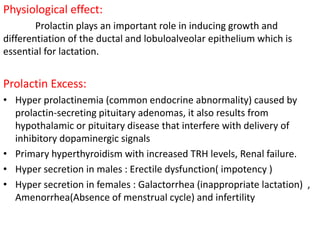
Physiological effect:
Prolactin plays an important role in inducing growth and
differentiation of the ductal and lobuloalveolar epithelium which is
essential for lactation.
Prolactin Excess:
• Hyper prolactinemia (common endocrine abnormality) caused by
prolactin-secreting pituitary adenomas, it also results from
hypothalamic or pituitary disease that interfere with delivery of
inhibitory dopaminergic signals
• Primary hyperthyroidism with increased TRH levels, Renal failure.
• Hyper secretion in males : Erectile dysfunction( impotency )
• Hyper secretion in females : Galactorrhea (inappropriate lactation) ,
Amenorrhea(Absence of menstrual cycle) and infertility
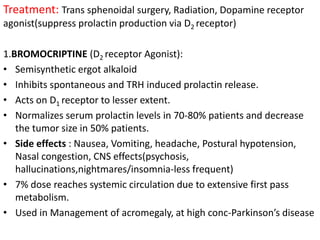
Treatment: Trans sphenoidal surgery, Radiation, Dopamine receptor
agonist(suppress prolactin production via D2 receptor)
1.BROMOCRIPTINE (D2 receptor Agonist):
• Semisynthetic ergot alkaloid
• Inhibits spontaneous and TRH induced prolactin release.
• Acts on D1 receptor to lesser extent.
• Normalizes serum prolactin levels in 70-80% patients and decrease
the tumor size in 50% patients.
• Side effects : Nausea, Vomiting, headache, Postural hypotension,
Nasal congestion, CNS effects(psychosis,
hallucinations,nightmares/insomnia-less frequent)
• 7% dose reaches systemic circulation due to extensive first pass
metabolism.
• Used in Management of acromegaly, at high conc-Parkinson’s disease
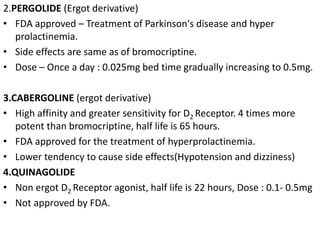
2.PERGOLIDE (Ergot derivative)
• FDA approved – Treatment of Parkinson's disease and hyper
prolactinemia.
• Side effects are same as of bromocriptine.
• Dose – Once a day : 0.025mg bed time gradually increasing to 0.5mg.
3.CABERGOLINE (ergot derivative)
• High affinity and greater sensitivity for D2 Receptor. 4 times more
potent than bromocriptine, half life is 65 hours.
• FDA approved for the treatment of hyperprolactinemia.
• Lower tendency to cause side effects(Hypotension and dizziness)
4.QUINAGOLIDE
• Non ergot D2 Receptor agonist, half life is 22 hours, Dose : 0.1- 0.5mg
• Not approved by FDA.
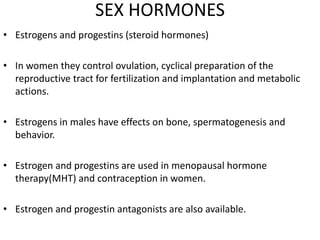
SEX HORMONES
• Estrogens and progestins (steroid hormones)
• In women they control ovulation, cyclical preparation of the
reproductive tract for fertilization and implantation and metabolic
actions.
• Estrogens in males have effects on bone, spermatogenesis and
behavior.
• Estrogen and progestins are used in menopausal hormone
therapy(MHT) and contraception in women.
• Estrogen and progestin antagonists are also available.
ESTROGENS
• Steroidal and non steroidal compounds. The most potent naturally
occurring estrogen in humans for both estrogen receptor α and β are
17 β- estradiol, estrone, estriol.
• They all contain a phenolic A ring with OH group at C3 and β-OH or
ketone in 17th position of ring D.
• Phenolic ring is responsible for selective high affinity for both
receptors.
• Diethyl stilbestrol, structurally similar to estradiol(trans), high affinity,
same potency but longer half life.
• Non steroidal compounds with estrogenic or anti estrogenic activity :
Flavones, isoflavones(genistain), coumestan derivatives, DES,
Bisphenol A, Genistein.
• Synthetic: Pesticides, Plasticizers etc
• Steroidal: Estradiol, Estradiol Valerate, Ethinyl estradiol, Mestranol,
Estrone sulfate, Equlin
Biosynthesis:
• Androstenedione/testosterone -> Aromatization of ring A, Catalyzed
by Aromatase(CYP19) an enzyme found in ovarian granulosa cells,
testicular Sertoli and Leydig cells, adipose stroma, placental
syncytiotrophoblast, preimplantation blastocysts, bone, various brain
regions, and other tissues.
• Ovaries are the principal source of circulating estrogen in
premenopausal women. Gonadotropins, acting via receptors that
couple to the Gs-adenylyl cyclase–cyclic AMP pathway, increase the
activities of aromatase and the cholesterol side-chain cleavage
enzyme. The ovary contains the type I isoform of 17 β-hydroxysteroid
dehydrogenase, which favors the production of testosterone and
estradiol from androstenedione and estrone, respectively. In the liver,
the type II isoform oxidizes circulating estradiol to estrone, which
then is converted to estriol.
• These estrogens are excreted in the urine along with their
glucuronide and sulfate conjugates. In postmenopausal women, the
principal source of circulating estrogen is adipose tissue stroma,
where estrone is synthesized from dehydroepiandrosterone (DHEA)
secreted by the adrenals.
• In men, the testes produce estrogens but extragonadal aromatization
of circulating androstenedione and DHEA accounts for most
circulating estrogens.
• Local production of estrogens by the aromatization of androgens may
play a causal role in the development or progression of diseases such
as breast cancer. Estrogens also may be produced from androgens by
CYP19 in the central nervous system (CNS) and other tissues and
exert local effects near their production site (e.g.,in bone they
increase bone mineral density).
Physiological and Pharmacological Actions
• Estrogens in girls cause growth and development of the vagina,
uterus, and fallopian tubes, and contribute to breast enlargement,
molding the body contours, shaping the skeleton, and causing the
pubertal growth spurt of the long bones and epiphyseal closure.
• Growth of axillary and pubic hair, pigmentation of the genital region,
and the regional pigmentation of the nipples and areolae that occur
after the first trimester of pregnancy are also estrogenic actions.
• Estrogens also play developmental roles in males. In boys, estrogen
deficiency diminishes the pubertal growth spurt and delays skeletal
maturation and epiphyseal closure so that linear growth continues
into adulthood.
• Estrogen deficiency in men leads to elevated gonadotropins, macro
orchidism, and increased testosterone levels and also may affect
carbohydrate and lipid metabolism and fertility.
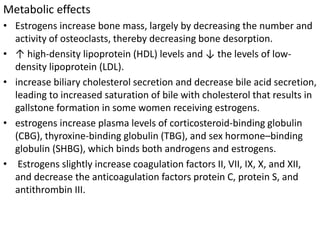
Metabolic effects
• Estrogens increase bone mass, largely by decreasing the number and
activity of osteoclasts, thereby decreasing bone desorption.
• ↑ high-density lipoprotein (HDL) levels and ↓ the levels of low-
density lipoprotein (LDL).
• increase biliary cholesterol secretion and decrease bile acid secretion,
leading to increased saturation of bile with cholesterol that results in
gallstone formation in some women receiving estrogens.
• estrogens increase plasma levels of corticosteroid-binding globulin
(CBG), thyroxine-binding globulin (TBG), and sex hormone–binding
globulin (SHBG), which binds both androgens and estrogens.
• Estrogens slightly increase coagulation factors II, VII, IX, X, and XII,
and decrease the anticoagulation factors protein C, protein S, and
antithrombin III.
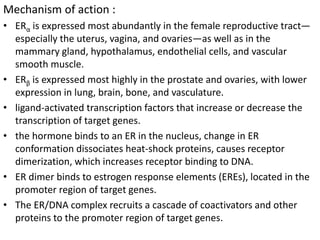
Mechanism of action :
• ERα is expressed most abundantly in the female reproductive tract—
especially the uterus, vagina, and ovaries—as well as in the
mammary gland, hypothalamus, endothelial cells, and vascular
smooth muscle.
• ERβ is expressed most highly in the prostate and ovaries, with lower
expression in lung, brain, bone, and vasculature.
• ligand-activated transcription factors that increase or decrease the
transcription of target genes.
• the hormone binds to an ER in the nucleus, change in ER
conformation dissociates heat-shock proteins, causes receptor
dimerization, which increases receptor binding to DNA.
• ER dimer binds to estrogen response elements (EREs), located in the
promoter region of target genes.
• The ER/DNA complex recruits a cascade of coactivators and other
proteins to the promoter region of target genes.
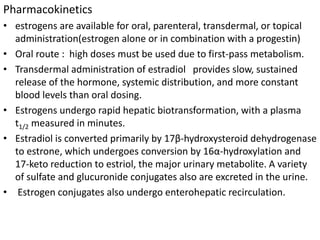
Pharmacokinetics
• estrogens are available for oral, parenteral, transdermal, or topical
administration(estrogen alone or in combination with a progestin)
• Oral route : high doses must be used due to first-pass metabolism.
• Transdermal administration of estradiol provides slow, sustained
release of the hormone, systemic distribution, and more constant
blood levels than oral dosing.
• Estrogens undergo rapid hepatic biotransformation, with a plasma
t1/2 measured in minutes.
• Estradiol is converted primarily by 17β-hydroxysteroid dehydrogenase
to estrone, which undergoes conversion by 16α-hydroxylation and
17-keto reduction to estriol, the major urinary metabolite. A variety
of sulfate and glucuronide conjugates also are excreted in the urine.
• Estrogen conjugates also undergo enterohepatic recirculation.
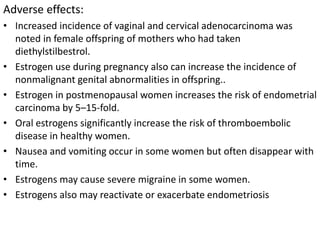
Adverse effects:
• Increased incidence of vaginal and cervical adenocarcinoma was
noted in female offspring of mothers who had taken
diethylstilbestrol.
• Estrogen use during pregnancy also can increase the incidence of
nonmalignant genital abnormalities in offspring..
• Estrogen in postmenopausal women increases the risk of endometrial
carcinoma by 5–15-fold.
• Oral estrogens significantly increase the risk of thromboembolic
disease in healthy women.
• Nausea and vomiting occur in some women but often disappear with
time.
• Estrogens may cause severe migraine in some women.
• Estrogens also may reactivate or exacerbate endometriosis
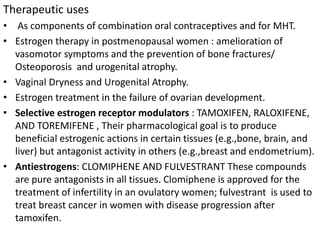
Therapeutic uses
• As components of combination oral contraceptives and for MHT.
• Estrogen therapy in postmenopausal women : amelioration of
vasomotor symptoms and the prevention of bone fractures/
Osteoporosis and urogenital atrophy.
• Vaginal Dryness and Urogenital Atrophy.
• Estrogen treatment in the failure of ovarian development.
• Selective estrogen receptor modulators : TAMOXIFEN, RALOXIFENE,
AND TOREMIFENE , Their pharmacological goal is to produce
beneficial estrogenic actions in certain tissues (e.g.,bone, brain, and
liver) but antagonist activity in others (e.g.,breast and endometrium).
• Antiestrogens: CLOMIPHENE AND FULVESTRANT These compounds
are pure antagonists in all tissues. Clomiphene is approved for the
treatment of infertility in an ovulatory women; fulvestrant is used to
treat breast cancer in women with disease progression after
tamoxifen.
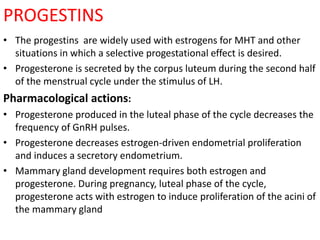
PROGESTINS
• The progestins are widely used with estrogens for MHT and other
situations in which a selective progestational effect is desired.
• Progesterone is secreted by the corpus luteum during the second half
of the menstrual cycle under the stimulus of LH.
Pharmacological actions:
• Progesterone produced in the luteal phase of the cycle decreases the
frequency of GnRH pulses.
• Progesterone decreases estrogen-driven endometrial proliferation
and induces a secretory endometrium.
• Mammary gland development requires both estrogen and
progesterone. During pregnancy, luteal phase of the cycle,
progesterone acts with estrogen to induce proliferation of the acini of
the mammary gland
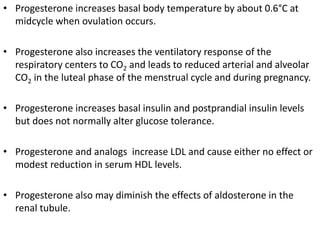
• Progesterone increases basal body temperature by about 0.6°C at
midcycle when ovulation occurs.
• Progesterone also increases the ventilatory response of the
respiratory centers to CO2 and leads to reduced arterial and alveolar
CO2 in the luteal phase of the menstrual cycle and during pregnancy.
• Progesterone increases basal insulin and postprandial insulin levels
but does not normally alter glucose tolerance.
• Progesterone and analogs increase LDL and cause either no effect or
modest reduction in serum HDL levels.
• Progesterone also may diminish the effects of aldosterone in the
renal tubule.
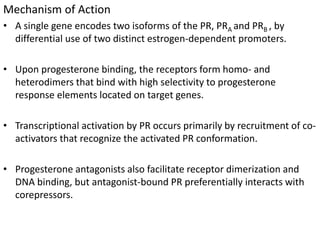
Mechanism of Action
• A single gene encodes two isoforms of the PR, PRA and PRB , by
differential use of two distinct estrogen-dependent promoters.
• Upon progesterone binding, the receptors form homo- and
heterodimers that bind with high selectivity to progesterone
response elements located on target genes.
• Transcriptional activation by PR occurs primarily by recruitment of co-
activators that recognize the activated PR conformation.
• Progesterone antagonists also facilitate receptor dimerization and
DNA binding, but antagonist-bound PR preferentially interacts with
corepressors.
Pharmacokinetics
• Progesterone undergoes rapid first-pass metabolism.
• Progesterone also is available in oil solution for injection, as a vaginal
gel, and as a slow-release intrauterine device for contraception.
• Esters are available for intramuscular administration.
• The elimination t1/2 of progesterone is : 5 minutes; the hormone is
metabolized primarily in the liver to hydroxylated metabolites and
their sulfate and glucuronide conjugates, which are eliminated in the
urine.
• The synthetic progestins have much longer half-lives.
• Metabolism of synthetic progestins is primarily hepatic, and
elimination is generally in the urine as conjugates and various polar
metabolites.
Therapeutic uses:
• The two most frequent uses of progestins are for contraception,
either alone or with an estrogen, and in combination with estrogen
for hormone therapy of postmenopausal women.
• Progestins also are used for secondary amenorrhea, abnormal
uterine bleeding in patients without underlying fibroids or cancer,
luteal-phase support to treat infertility, and premature labor.
• Progestins are used diagnostically to test for estrogen secretion and
for responsiveness of the endometrium.
• Progestins are highly efficacious in decreasing the occurrence of
endometrial hyperplasia and carcinoma caused by unopposed
estrogens.
• Progestins are also used for metastatic endometrial carcinoma.
Megestrol acetate is used as a second-line treatment for breast
cancer.
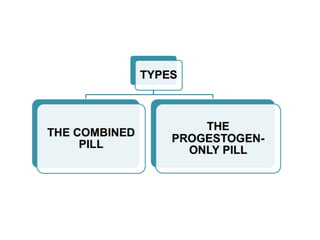
Oral contraceptives
• These are hormonal preparations used for reversible suppression
of fertility.
• In the earlier part of 20th century, methods of contraception
used (condoms, diaphragms, spermicidal creams, foam tablets, etc.)
• These also have higher failure rate.
• Oral contraceptives are medicines taken by mouth to help prevent
pregnancy.
• They are also known as “birth control pills”.
• Oral contraceptives are widely used worldwide and have had a
revolutionary impact by providing a convenient, affordable, and
reliable means of contraception.
• In addition to contraceptive actions, these agents have substantial
health benefits.
• Birth control (contraceptive) medications contain hormones
(estrogen and progesterone, or progesterone alone).
• Estrogens : Ethinyl estradiol, Mestranol
• Progesterones: Norethynodrel, Norethindrone
Norethindrone acetate, Norgestimate
Desogestrel, Ethynodiol diacetate
Norgestrel, Levonorgestrel,Drospirenone
Combination oral contraceptives :
• The most frequently used are combination oral contraceptives
containing both an estrogen and a progestin.
• Their theoretical efficacy is considered to be 99.9%.
• Ethinyl estradiol and mestranol are the two estrogens used (with
ethinyl estradiol being much more frequently used).
• The progestins have varying degrees of androgenic, estrogenic, and
antiestrogenic activities that may be responsible for some side
effects.
• Combination oral contraceptives are generally provided in 21-day
packs with an additional 7 pills containing no active hormone.
• For monophasic agents, fixed amounts of the estrogen and progestin
are present in each pill, which is taken daily for 21 days, followed by a
7-day “drug-free” period.
• The biphasic and triphasic preparations provide two or three
different pills containing varying amounts of active ingredients, for
different days in the 21-day cycle.
• The FDA recently approved a levonorgestrel–ethinyl estradiol
combination that is taken continuously for the full 90 days,
eliminating any menstrual periods.
• The estrogen content ranges from 20 to 50 µg; most contain 30–35
µg. Preparations containing ≤35 µg of an estrogen are termed “low-
dose” pills.
• Additional options include a once-monthly medroxy progesterone–
estradiol cypionate injectable , an ethinyl estradiol–
norelgestromin(the active metabolite of norgestimate) patch applied
weekly, and an ethinyl estradiol–etonogestrel(the active metabolite
of desogestrel) flexible vaginal ring used for 3 weeks (followed by a
removal for 1 week that leads to menstrual bleeding).
Progestin-only contraceptives :
• Progestin-only contraceptives are only slightly less efficacious than
combination oral contraceptives, with theoretical efficacy of 99%.
• Specific preparations include the “minipill” : low doses of progestins
(e.g.,350µg of norethindrone or 75 µg of norgestrel ) taken daily
without interruption.
• Subdermal implants of 216 mg of norgestrel for slow release and
resultant long-term contraceptive action .
• crystalline suspensions of MPA for intramuscular injection of 150 mg
of drug, which provides effective contraception for 3 months.
• An intrauterine device that releases low amounts of progesterone
locally is available for insertion on a yearly basis. Contraceptive action
probably is due to local effects on the endometrium
Postcoital or emergency contraceptives :
• The FDA has approved two preparations for postcoital contraception.
• PLAN-B is two doses of the “minipill” (0.75 mg levonorgestrel per pill)
separated by 12 hours.
• Will soon be available without a prescription for women 18 years old
and older.
• PREVEN is two 2-pill doses of a high-dose oral contraceptive (0.25 mg
of levonorgestrel and 0.05 mg of ethinyl estradiol per pill) separated
by 12 hours.
• The first dose of such preparations should be taken within 72 hours
after intercourse, and this should be followed 12 hours later by a
second dose.
• These treatments reduce the risk of pregnancy following unprotected
intercourse by approximately 60–80%.
Mechanism of Action
• Combination oral contraceptives : act by preventing ovulation.
• Plasma LH and FSH levels are suppressed, the midcycle surge of LH is
absent, endogenous steroid levels are diminished, and ovulation does
not occur.
• The combination synergistically decreases plasma gonadotropin
levels and suppresses ovulation more consistently than either alone.
• Oral contraceptives exert hypothalamic and pituitary effects.
Progesterone diminishes the frequency of GnRH pulses, and oral
contraceptives also decrease pituitary responsiveness to GnRH.
• Estrogens also suppress FSH release from the pituitary during the
follicular phase of the menstrual cycle, which likely contributes to the
lack of follicular development in oral contraceptive users.
• Progestin also leads to a thick, viscous mucus that reduces sperm
penetration and induces an endometrium that is not receptive to
implantation.
Progestin-only contraceptives
• Progestin-only pills and levonorgestrel implants are highly efficacious
for contraception.
• The pills block ovulation in only 60–80% of cycles,
• Effectiveness is thought to be due largely to local effects in the cervix
and uterus, such effects also account for the efficacy of intrauterine
devices that release progestins.
• Depot injections of MPA yield plasma levels of drug high enough to
prevent ovulation in virtually all patients, presumably by decreasing
the frequency of GnRH pulses.
Adverse effects:
Cardiovascular Effects :
• There is a 28% increase in relative risk for venous thromboembolism,
but the estimated increase is very small because these events are
rare in women without other predisposing factors.
• The incidence of hypertension is much lower with low-dose
preparations.
Cancer :
• Combined oral contraceptives may increase the risk of cervical cancer
by about twofold, but only in long-term users with human papilloma
virus infection.
• There are reported increases in the incidence of hepatic adenoma
and hepatocellular carcinoma in oral contraceptive users : very rare
Metabolic and Endocrine Effects :
• In women who smoke, the ethinyl estradiol in oral contraceptives
appears to cause a dose-dependent increase in several serum factors
that may shift the hemostatic profile toward a hypercoagulable
condition.
• oral contraceptives may increase hepatic synthesis of a number of
serum proteins, including CBG, TBG, and SHBG.
• Miscellaneous Effects : Nausea, edema, and mild headache occur in
some individuals. Some patients may experience breakthrough
bleeding during the 21-day cycle when the active pills are being
taken. Acne and hirsutism are thought to be mediated by the
androgenic activity of the 19-nor progestins.
• Amenorrhea becomes common after a year or more of use.
• Mood changes and weight gain also have been reported.
• Decreases in HDL levels and increases in LDL levels and decreased
bone density.
• Norethindrone implants may be associated with infection, local
irritation, pain at the insertion site, and rarely, expulsion of the
inserts. Headache, weight gain, mood changes, and acne occur in
some patients.
Contraindications:
the presence or history of thromboembolic disease, cerebrovascular
disease, myocardial infarction, coronary artery disease, or congenital
hyperlipidemia;known or suspected carcinoma of the breast, carcinoma
of the female reproductive tract, or other hormone-
dependent/responsive neoplasias; abnormal undiagnosed vaginal
bleeding; known or suspected pregnancy; and past or present liver
tumors or impaired liver function.
Corticosteroids
• These are a class of steroid hormones that are produced in the
adrenal cortex, it includes synthetic analogues of these hormones.
• The term ‘corticosteroid’ or ‘corticoid’ includes natural gluco- and
mineralo-corticoids and their synthetic analogues.
• Two main classes of corticosteroids: glucocorticoids and
mineralocorticoids.
• They are involved in a wide range of physiological processes,
including stress reponse, immune response, regulation of
inflammation, carbohydrate metabolism, protein catabolism, blood
electrolyte levels, and behavior.
Biosynthesis
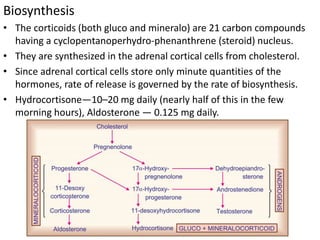
• The corticoids (both gluco and mineralo) are 21 carbon compounds
having a cyclopentanoperhydro-phenanthrene (steroid) nucleus.
• They are synthesized in the adrenal cortical cells from cholesterol.
• Since adrenal cortical cells store only minute quantities of the
hormones, rate of release is governed by the rate of biosynthesis.
• Hydrocortisone—10–20 mg daily (nearly half of this in the few
morning hours), Aldosterone — 0.125 mg daily.
Mineralocorticoid actions :
• The principal mineralocorticoid action is enhancement of Na+
reabsorption in the distal convoluted tubule in kidney.
• Its deficiency results in decreased maximal tubular reabsorptive
capacity for Na+
.
• Dilutional hyponatraemia →excess water enters cells →cellular
hydration: decreased blood volume and raised haematocrit.
Hyperkalaemia and acidosis.
• These distortions of fluid and electrolyte balance progress and
contribute to the circulatory collapse.
• The action of aldosterone is exerted by gene mediated increased
transcription of m-RNA in renal tubular cells which directs synthesis
of proteins.
• Synthesis of β subunit of amiloride sensitive Na+ channel is also
induced.
• Because of the time taken to induce protein synthesis, aldosterone
action has a latency of 1–2 hours.
• aldosterone rapidly induces phosphorylation and activation of
amiloride sensitive Na+ channel.
• The main adverse effect of excessive mineralocorticoid action is fluid
retention and hypertension.
• Natural and some of the synthetic glucocorticoids have significant
mineralocorticoid activity responsible for side effects like edema,
progressive rise in BP, hypokalemia and alkalosis.
• The diuretic induced hypokalemia is aggravated by mineralocorticoid
excess.
• Aldosterone has been shown to promote CHF associated myocardial
fibrosis and progression of the disease
Glucocorticoid actions:
Carbohydrate and protein metabolism:
• Promote glycogen deposition in liver( by inducing hepatic glycogen
synthase and promoting gluconeogenesis), inhibit glucose utilization
by peripheral tissues, increased glucose release from liver :
hyperglycaemia.
• They also cause protein breakdown and amino acid mobilization from
peripheral tissues. The amino acids so mobilized funnel into liver
→used up in gluconeogenesis, excess urea is produced → negative
nitrogen balance.
• Glucocorticoids are thus catabolic. Their function appears to be
aimed at maintaining blood glucose levels during starvation.
Fat metabolism: They promote lipolysis due to glucagon,
growth hormone, Adr and thyroxine.
Calcium metabolism : Glucocorticoids inhibit intestinal absorption and
enhance renal excretion of Ca2+. Loss of osteoid indirectly results in loss
of Ca2+ from bone, producing negative calcium balance.
Water excretion : Hydrocortisone and other glucocorticoids, but not
aldosterone, maintain normal g.f.r. In adrenal insufficiency, the capacity
to excrete a water load is markedly reduced.
CVS : Glucocorticoids restrict capillary permeability, maintain tone of
arterioles and myocardial contractility. They also play a permissive role
in development of hypertension, Adrenal insufficiency is attended by
low cardiac output, arteriolar dilatation, poor vasoconstrictor response
to Adrenaline and increased permeability of capillaries. These changes
along with hypovolemia (due to lack of mineralocorticoid) are
responsible for cardiovascular collapse.
Skeletal muscles: Optimum level of corticosteroids is needed for normal
muscular activity. Weakness occurs in both hypo- and hypercorticism,
but the causes are different.
Hypocorticism: diminished work capacity and weakness are primarily
due to hypodynamic circulation.
Hypercorticism: excess mineralocorticoid action →hypokalaemia
→weakness; Excess glucocorticoid action →muscle wasting and
myopathy →weakness.
CNS : Mild euphoria is quite common with pharmacological doses of
glucocorticoids. Glucocorticoids also maintain the level of sensory
perception and normal level of excitability of neurones.
Stomach : Secretion of gastric acid and pepsin is increased—may
aggravate peptic ulcer.
Inflammatory responses : inflammatory response is suppressed by
glucocorticoids. The cardinal signs of inflammation—redness, heat,
swelling and pain are suppressed.
Mechanism of action:
• Corticosteroids penetrate cells and bind to a high affinity cytoplasmic
receptor protein.
• A structural change occurs in the steroid receptor complex that
allows its migration into the nucleus and binding to glucocorticoid
response elements (GRE) on the chromatin.
• Transcription of specific m-RNA →regulation of protein synthesis.
• This process takes at least 30–60 min.
• The overall effect is catabolic, i.e. inhibition of protein synthesis. This
may be a consequence of steroid directed synthesis of an inhibitory
protein.
• The glucocorticoid receptor (GR) is very widely distributed .It has
been cloned and its structure determined. It is made up of 800
amino acids.
• Several coactivators and corepressors modulate the interaction of
liganded GR with the GREs, altering the intensity of response.
• Some actions of corticoids are exerted more rapidly (like inhibition of
ACTH release from pituitary). These may be mediated by a cell
membrane receptor or a different mechanism not involving protein
synthesis.
Pharmacokinetics:
• All natural and synthetic corticoids, except DOCA are absorbed and
are effective by the oral route.
• Hydrocortisone undergoes high first pass metabolism, has low oral:
parenteral activity ratio. Oral bioavailability of synthetic corticoids is
high.
• The corticosteroids are metabolized primarily by hepatic microsomal
enzymes. The metabolites are further conjugated with glucuronic
acid or sulfate and are excreted in urine.
• The plasma t½ of hydrocortisone is 1.5 hours However, the biological
t½ is longer because of action through intracellular receptors and
regulation of protein synthesis.
• Phenobarbitone and phenytoin induce metabolism of
hydrocortisone, prednisolone and dexamethasone, etc. to decrease
their therapeutic effect
1. Hydrocortisone (cortisol):
• Acts rapidly but has short duration of action. In addition to primary
glucocorticoid, it has significant mineralocorticoid activity as well.
• Replacement therapy—20 mg morning + 10 mg afternoon orally.
• Shock, status asthmaticus, acute adrenal insufficiency—100 mg i.v.
bolus + 100 mg 8 hourly i.v. infusion.
• Topically and as suspension for enema in ulcerative colitis.
2. Prednisolone:
• It is 4 times more potent than hydrocortisone, also more selective
glucocorticoid, but fluid retention does occur with high doses.
• Has intermediate duration of action.
• Used for allergic, inflammatory, autoimmune diseases and in
malignancies: 5–60 mg/day oral, 10–40 mg i.m., intraarticular; also
topically.
3. Methylprednisolone :
• Slightly more potent and more selective than prednisolone.
• 4–32 mg/ day oral. Methylprednisolone acetate has been used as a
retention enema in ulcerative colitis.
• high dose methylprednisolone (1 g infused i.v. every 6–8 weeks)
active rheumatoid arthritis, renal transplant, pemphigus, etc. with
good results and minimal suppression of pituitary adrenal axis.
4. Triamcinolone :
• Slightly more potent than prednisolone but highly selective
glucocorticoid
• 4–32 mg/day oral, 5–40 mg i.m., intraarticular injection. Also used
topically.
5. Dexamethasone :
• Very potent and highly selective glucocorticoid. long-acting,causes
marked pituitary-adrenal suppression.
• It is used for Inflammatory and allergic conditions 0.5–5 mg/day oral.
• For shock, cerebral edema, etc. 4–20 mg/day i.v. infusion or i.m.
injection is preferred. It can also be used topically.
6. Betamethasone :
• Similar to dexamethasone .
• 0.5–5 mg/ day oral, 4–20 mg i.m., i.v. injection or infusion, also
topical.
7. Desoxycorticosterone acetate (DOCA)
• It has only mineralocorticoid activity.
• Used occasionally for replacement therapy in Addison’s disease: 2–5
mg sublingual, 10–20 mg i.m. once or twice weekly.
8. Aldosterone :
• It is the most potent mineralocorticoid.
• Not used clinically because of low oral bioavailability and difficulties
in regulating doses.
Uses:
Replacement therapy :
• Acute adrenal insufficiency : In emergency conditions
Hydrocortisone or dexamethasone are given i.v., first as a bolus
injection and then as infusion, along with isotonic saline and glucose
solution.
• Chronic adrenal insufficiency (Addison’s disease) : Hydrocortisone
given orally is the most commonly used drug along with adequate
salt and water allowance. patients who continue to excrete excess
Na+ need additional mineralocorticoid.
• Congenital adrenal hyperplasia (Adrenogenital syndrome) : familial
disorder due to genetic deficiency of steroidogenic enzymes, mostly
21-hydroxylase. hydrocortisone 0.6 mg/ kg daily in divided doses
round the clock to maintain feed back suppression of pituitary.
Pharmacotherapy(for non endocrine diseases)
Arthritides :
• Rheumatoid arthritis: Corticosteroids are indicated only in severe
cases as adjuvants to NSAIDs.
• Osteoarthritis: It is treated with analgesics and NSAIDs; systemic use
of corticoids is rare.
• Rheumatic fever: Corticoids are used only in severe cases with
carditis and CHF with the aim of rapid suppression of symptoms,
because they act faster than aspirin.
• Gout:Corticoids (short course) should only be used in acute gouty
arthritis when NSAIDs have failed to afford relief and colchicine is
nottolerated.
(they are uricosuric—use in chronic gout is not recommended )
Collagen diseases :
• Most cases of systemic lupus erythematosus, polyarteritis nodosa,
dermatomyositis, nephrotic syndrome, glomerulonephritis need
corticosteroid therapy.
• They may be life saving in these diseases.
Severe allergic reactions :
• Corticoids may be used for short periods in anaphylaxis,
angioneurotic edema, urticaria and serum sickness.
Autoimmune diseases :
• Autoimmune haemolytic anaemia, idiopathic thrombocytopenic
purpura, active chronic hepatitis respond to corticoids :Prednisolone
Bronchial asthma :
• Systemic corticosteroids are used only for Status asthmaticus, Actue
asthma exacerbation, Severe chronic asthma not controlled by
inhaled steroids and bronchodilators.
Eye diseases :
• Corticoids are used in a large number of inflammatory ocular
diseases—may prevent blindness. allergic conjunctivitis, iritis,
iridocyclitis, keratitis.
Skin diseases :
• Topical corticosteroids are widely employed and are highly effective
in many eczematous skin diseases.
• Systemic therapy is needed (may be life-saving) in pemphigus
vulgaris, exfoliative dermatitis, Stevens-Johnson syndrome and other
severe afflictions.
Intestinal diseases :
• Ulcerative colitis , Crohn’s disease, coeliac disease are inflammatory
bowel diseases with exacerbations and remissions.Corticoids are
indicated during acute phases.
Malignancies :
• Corticoids are an essential component of combined chemotherapy of
acute lymphatic leukaemia, Hodgkin’s and other lymphomas.
Organ transplantation and skin allograft :
• High dose corticoids are given along with other immunosuppressants
to prevent the rejection reaction.
Adverse effects :
Mineralocorticoid : Sodium and water retention, edema, hypokalaemic
alkalosis and a progressive rise in BP. These are now rare due to
availability of highly selective glucocorticoids. Gradual rise in BP occurs
due to excess glucocorticoid action as well.
Glucocorticoid :
• Cushing’s habitus: characteristic appearance with rounded face,
narrow mouth, supraclavicular hump, obesity of trunk with relatively
thin limbs.
• Fragile skin, purple striae—typically on thighs and lower abdomen,
easy bruising, telangiectasis, hirsutism.
• Hyperglycaemia, may be glycosuria, precipitation of diabetes.
• Muscular weakness: proximal (shoulder,arm, pelvis, thigh) muscles
are primarily affected. Myopathy occurs occasionally.
• Delayed healing: of wounds and surgical incisions.
• Glaucoma: may develop in susceptible individuals after prolonged
topical therapy.
• Growth retardation: in children occurs even with small doses if given
for long periods.
• Psychiatric disturbances: mild euphoria frequently accompanies high
dose steroid treatment. This may rarely progress to manic psychosis.
Nervousness, decreased sleep and mood changes.
CONTRAINDICATIONS :
Peptic ulcer, Diabetes mellitus, Hypertension, Viral and fungal infections
Tuberculosis and other infections, Osteoporosis, Herpes simplex keratitis
Psychosis, Epilepsy, CHF, Renal failure.
References:
• Essentials of Medical Pharmacology , Seventh Edition ,KD TRIPATHI.
• Goodman and Gilman’s manual of pharmacology and therapeutics.
• https://www.slideshare.net/mobile/ankit_2408/oral-contraceptives-
12241098
• https://en.m.wikipedia.org/wiki/Combined_oral_contraceptive_pill
Endocrine pharmacology