INTRODUCTION OF
-PROCESSOR PART II
1
 What is the Microprocessor
Hist0ry
Capable of doing
PREVIOUSLY
2
NEXT
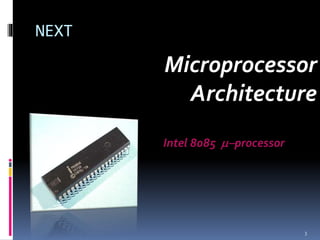
Microprocessor
Architecture
Intel 8085 processor
3
CONTENT
Microprocessor Architecture
The 8085 Architecture
OperationTypes in a Microprocessor
Reference
Conclusion
4
The microprocessor can be programmed to
perform functions on given data by writing specific
instructions into its memory.
 The microprocessor reads one instruction at a time,
matches it with its instruction set, and performs the data
manipulation specified.
 The result is either stored back into memory or displayed
on an output device.
Microprocessor Architecture
5
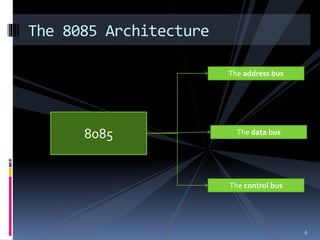
The 8085 Architecture
8085
The address bus
The data bus
The control bus
6
16 bits wide (A0 A1…A15)
 Therefore, the 8085 can access a total of 64K addresses.
Unidirectional
 Information flows out of the microprocessor and into the memory or
peripherals.
When the 8085 wants to access a peripheral or a memory
location, it places the 16-bit address on the address bus and
then sends the appropriate control signals.
The Address Bus
7
8 bits wide (D0 D1…D7)
Bi-directional
 Information flows both ways between the microprocessor and memory or
I/O.
The 8085 uses the data bus to transfer the binary
information.
Since the data bus has 8-bits only, then the 8085 can
manipulate data 8 bits at-a-time only.
The Data Bus
8
There is no real control bus. Instead, the control bus
is made up of a number of single bit control signals.
Which is essential to control the direction of data
flow on the bi-directional data bus and to differentiate
between I/O address and a memory address.
The Control Bus
9
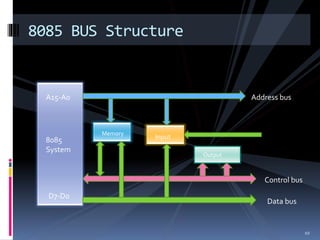
8085 BUS Structure
D7-D0
8085
System
A15-A0
Memory
Input
Output
Address bus
Control bus
Data bus
10
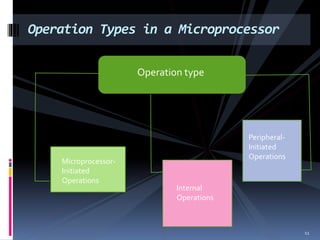
Operation Types in a Microprocessor
Operation type
Microprocessor-
Initiated
Operations
Internal
Operations
Peripheral-
Initiated
Operations
11
These are operations that the microprocessor
itself starts.
These are usually one of 4 operations:
Memory Read
MemoryWrite
I/O Read (Get data from an input device)
I/O write (Send data to an output device)
Microprocessor-Initiated Operations
12
It is important to note that the microprocessor
treats memory and I/O devices the same way.
 Input and output devices simply look like memory
locations to the microprocessor.
 The communication process between the
microprocessor and peripheral devices consist of the
following three steps:
Identify the address.
Transfer the binary information.
Provide the right timing signals.
Microprocessor-Initiated Operations
13
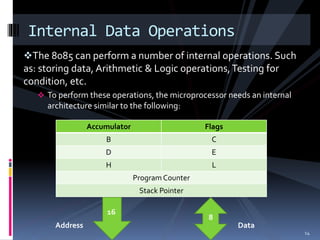
The 8085 can perform a number of internal operations. Such
as: storing data, Arithmetic & Logic operations,Testing for
condition, etc.
 To perform these operations, the microprocessor needs an internal
architecture similar to the following:
Internal Data Operations
Accumulator Flags
B C
D E
H L
Program Counter
Stack Pointer
16
8
DataAddress
14
Registers
 Six general purpose registers used to store 8-bit data during a program
execution
 The registers are identified as B, C, D, E, H, and L
 They can be combined as register pairs: BC, DE, and HL to perform 16-bit
operations
Accumulator
 8-bit register that is part of the ALU
 Used to store 8-bit data and in performing 8-bit arithmetic and logical
operations, and in storing the results of operations
Internal Data Operations
15
Reference
http://www.tutorsglobe.com/homework-
help/microprocessor-asignment-help-73766.aspx
http://en.wikipedia.org/wiki/Main_Page
16
PRESENTED BY:Tharindu Darshana
17
Student at Open University of Sri Lanka , Faculty of EngineeringTechnology

Introduction of CPU part 2

  • 1.
  • 2.
     What isthe Microprocessor Hist0ry Capable of doing PREVIOUSLY 2
  • 3.
  • 4.
    CONTENT Microprocessor Architecture The 8085Architecture OperationTypes in a Microprocessor Reference Conclusion 4
  • 5.
    The microprocessor canbe programmed to perform functions on given data by writing specific instructions into its memory.  The microprocessor reads one instruction at a time, matches it with its instruction set, and performs the data manipulation specified.  The result is either stored back into memory or displayed on an output device. Microprocessor Architecture 5
  • 6.
    The 8085 Architecture 8085 Theaddress bus The data bus The control bus 6
  • 7.
    16 bits wide(A0 A1…A15)  Therefore, the 8085 can access a total of 64K addresses. Unidirectional  Information flows out of the microprocessor and into the memory or peripherals. When the 8085 wants to access a peripheral or a memory location, it places the 16-bit address on the address bus and then sends the appropriate control signals. The Address Bus 7
  • 8.
    8 bits wide(D0 D1…D7) Bi-directional  Information flows both ways between the microprocessor and memory or I/O. The 8085 uses the data bus to transfer the binary information. Since the data bus has 8-bits only, then the 8085 can manipulate data 8 bits at-a-time only. The Data Bus 8
  • 9.
    There is noreal control bus. Instead, the control bus is made up of a number of single bit control signals. Which is essential to control the direction of data flow on the bi-directional data bus and to differentiate between I/O address and a memory address. The Control Bus 9
  • 10.
  • 11.
    Operation Types ina Microprocessor Operation type Microprocessor- Initiated Operations Internal Operations Peripheral- Initiated Operations 11
  • 12.
    These are operationsthat the microprocessor itself starts. These are usually one of 4 operations: Memory Read MemoryWrite I/O Read (Get data from an input device) I/O write (Send data to an output device) Microprocessor-Initiated Operations 12
  • 13.
    It is importantto note that the microprocessor treats memory and I/O devices the same way.  Input and output devices simply look like memory locations to the microprocessor.  The communication process between the microprocessor and peripheral devices consist of the following three steps: Identify the address. Transfer the binary information. Provide the right timing signals. Microprocessor-Initiated Operations 13
  • 14.
    The 8085 canperform a number of internal operations. Such as: storing data, Arithmetic & Logic operations,Testing for condition, etc.  To perform these operations, the microprocessor needs an internal architecture similar to the following: Internal Data Operations Accumulator Flags B C D E H L Program Counter Stack Pointer 16 8 DataAddress 14
  • 15.
    Registers  Six generalpurpose registers used to store 8-bit data during a program execution  The registers are identified as B, C, D, E, H, and L  They can be combined as register pairs: BC, DE, and HL to perform 16-bit operations Accumulator  8-bit register that is part of the ALU  Used to store 8-bit data and in performing 8-bit arithmetic and logical operations, and in storing the results of operations Internal Data Operations 15
  • 16.
  • 17.
    PRESENTED BY:Tharindu Darshana 17 Studentat Open University of Sri Lanka , Faculty of EngineeringTechnology