CHAPTER 5 : Introduction
to Intel 8085
Microprocessor Hardware
BENG 2223 MICROPROCESSOR
TECHNOLOGY
The 8085
Microprocessor
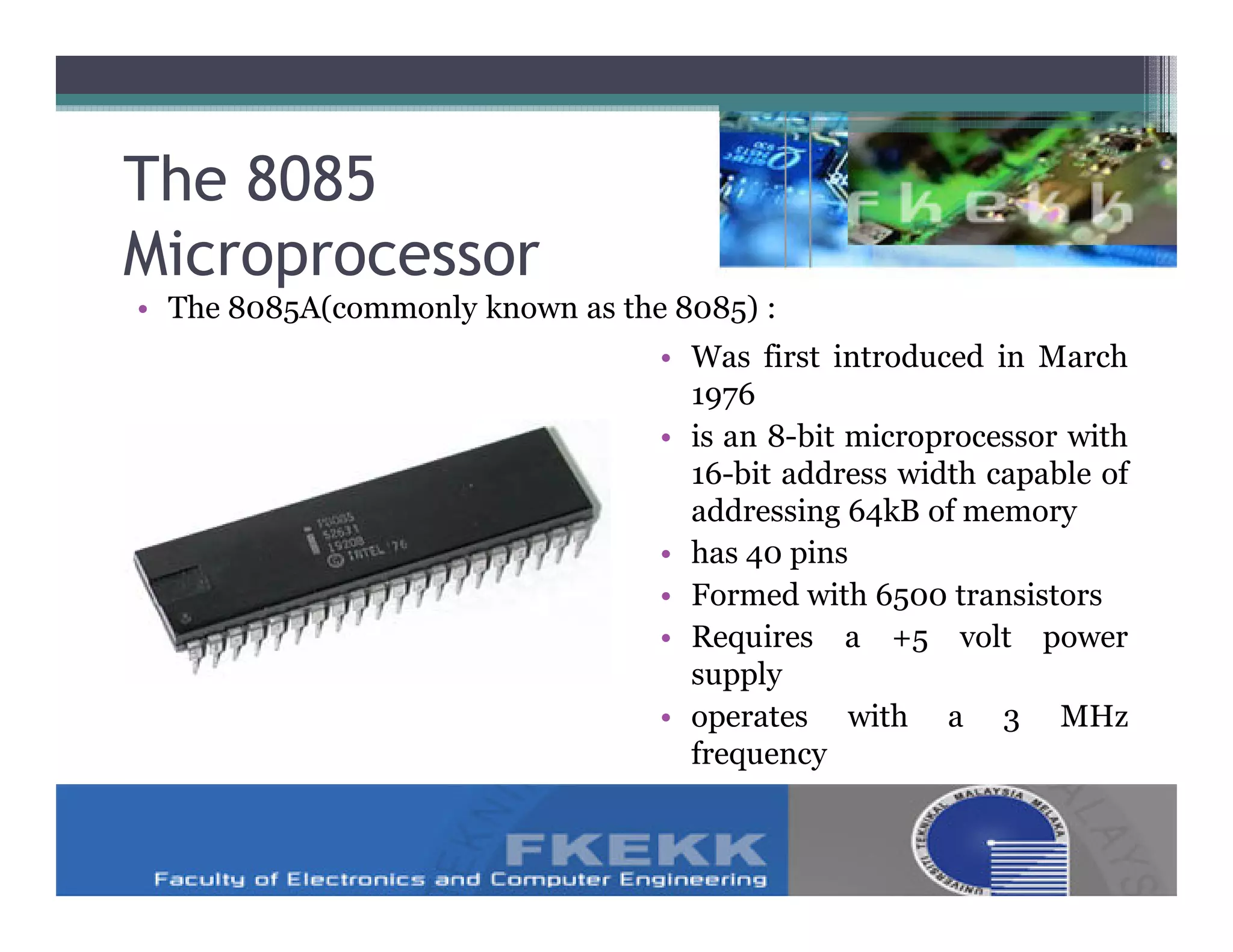
• The 8085A(commonly known as the 8085) :
                                 • Was first introduced in March
                                   1976
                                 • is an 8-bit microprocessor with
                                   16-bit address width capable of
                                   addressing 64kB of memory
                                 • has 40 pins
                                 • Formed with 6500 transistors
                                 • Requires a +5 volt power
                                   supply
                                 • operates with a 3 MHz
                                   frequency
The 8085
Microprocessor
• The 8085 is chosen for our look into the
  microprocessor because:
 â–« It is still widely in use
 â–« It is easy to use
 â–« It has simple architecture and an adequate
   instruction set that enable students to learn
   necessary programming concept easily.
The 8085
Microprocessor
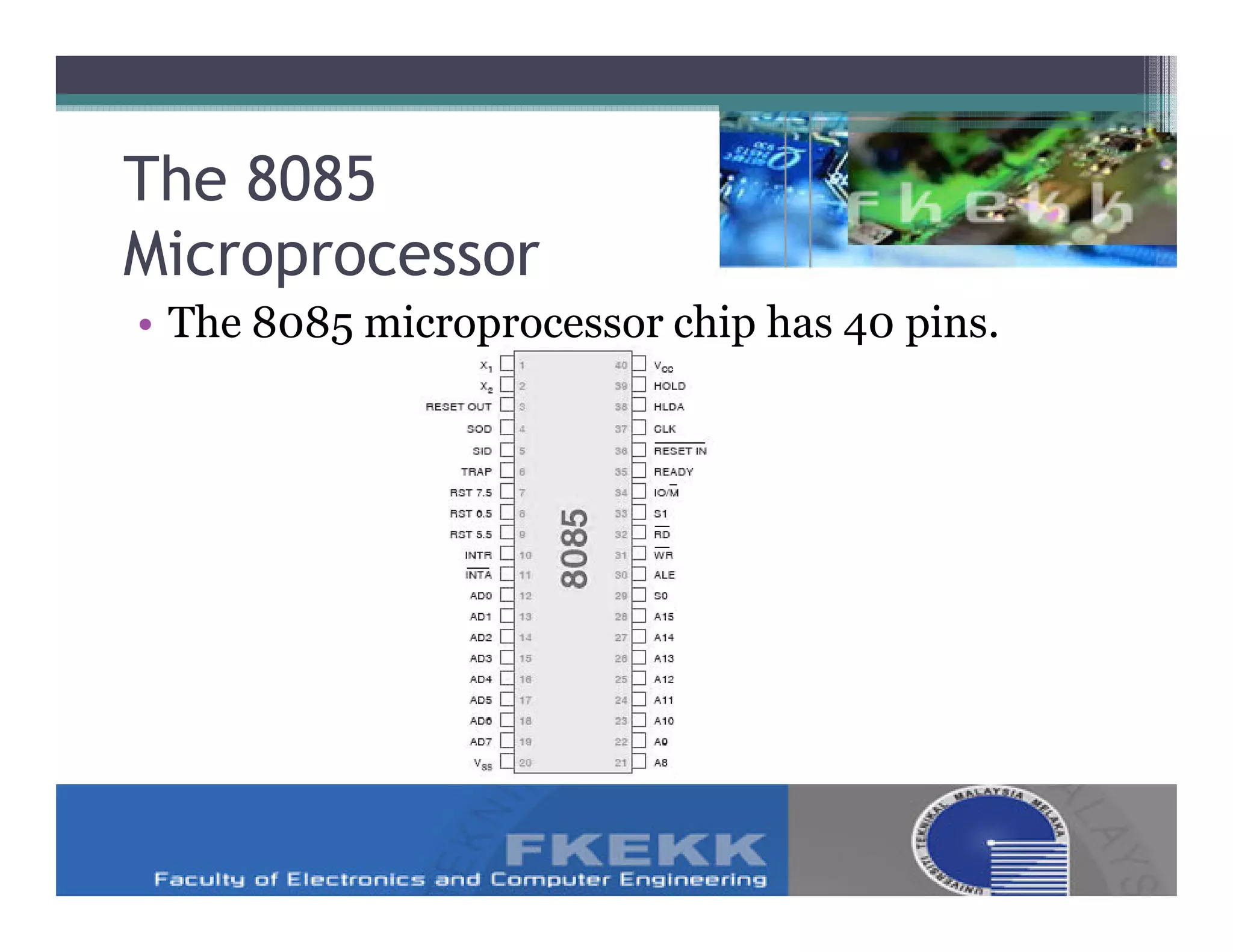
• The 8085 microprocessor chip has 40 pins.
The 8085
Microprocessor
• The pins can be grouped into 6 categories:
 1.   Address bus
 2.   Data bus
 3.   Control & Status bus
 4.   Power supply & frequency
 5.   Externally initiated & acknowledgement signals
 6.   Serial I/O ports
The 8085
Microprocessor
• Address bus (16 pins)
 â–« The 8085 has 16 signal lines (pins) that are used as the address
   bus for the transferring destination information for data.
 ▫ These lines are split into 2 segments, A15 – A8 and AD7 – AD0
 â–« Address bus occupied 16 bits wide, therefore 8085 can access 216
   locations (65,536) with numbers, from 0 to 65,535.
 â–« These range from 0000 to FFFF and is referred as 64kB of
   memory space.
 ▫ The 8 signal lines, A15 – A8 , are unidirectional and used for the
   most significant bits, called the high-order address, of a 16-bit
   address.
 ▫ The signal lines AD7 – AD0 are used for a dual purpose : as a
   lower-order address lines and also as a data bus.
The 8085
Microprocessor
• Address bus (16 pins)
 â–« When the 8085 wants to access a peripheral or a memory
   location, it places the 16-bit address on the address bus and then
   sends the appropriate control signals.
 ▫ The high order unidirectional address lines (A15–A8 ) are used to
   verify the memory address or I/O for one data transfer cycle.
 ▫ The low-order bidirectional address lines (AD7 – AD0) are
   multiplexed with data bus.
 â–« During the first clock cycle they bring memory address of the low
   order memory or I/O address. They then become the data bus
   during the second and third clock cycle.
The 8085
Microprocessor
• Address bus (16 pins)
 ▫ The demultiplexing of AD7 – AD0 is determined by
   ALE (Address Latch Enable) signal.
 â–« When this control signal is going high, the content of
   the address bus is address bits.
 â–« When ALE is low, data is placed on the bus.
The 8085
Microprocessor
• Address bus (16 pins)
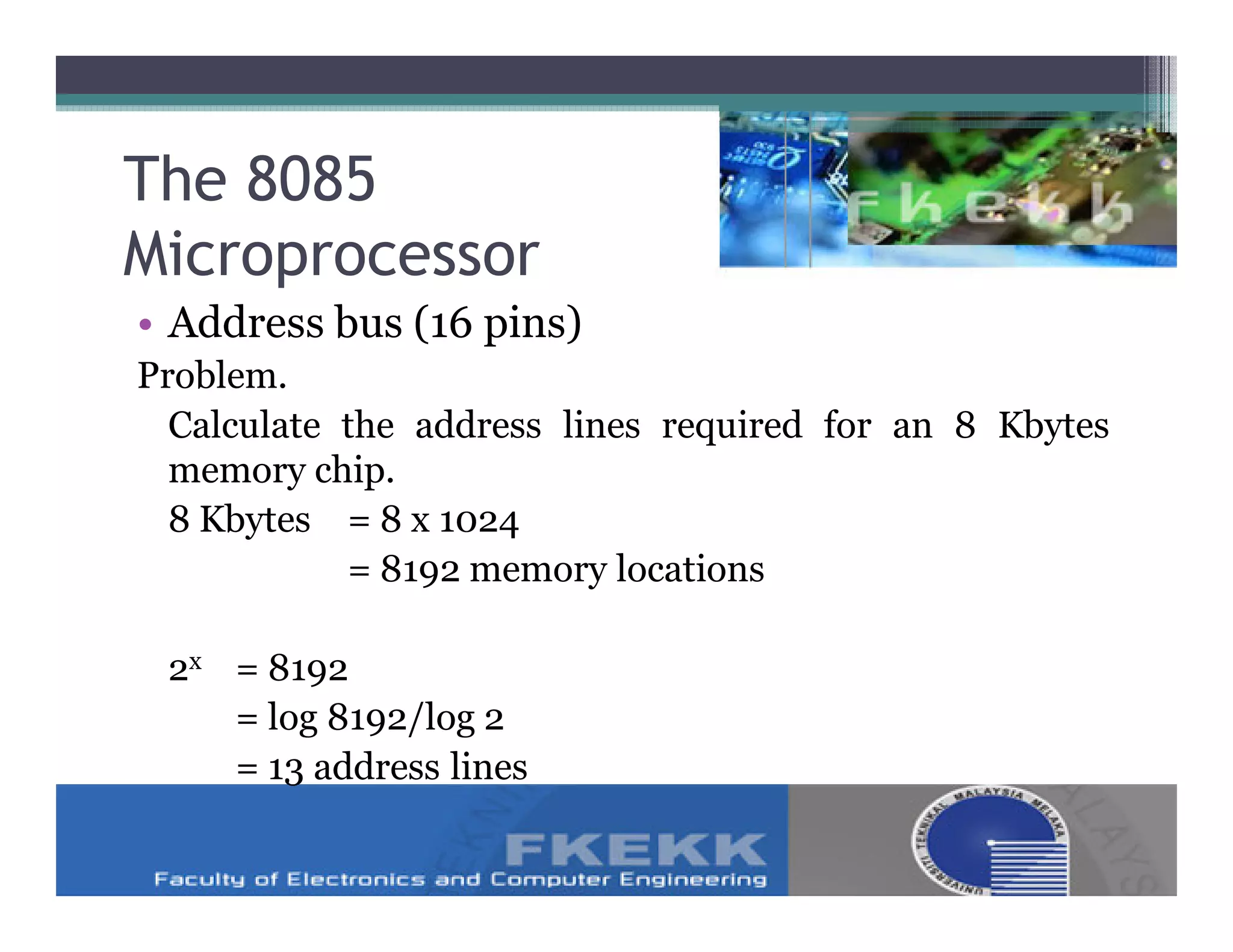
Problem.
  Calculate the address lines required for an 8 Kbytes
  memory chip.
  8 Kbytes = 8 x 1024
            = 8192 memory locations

 2x = 8192
    = log 8192/log 2
    = 13 address lines
The 8085
Microprocessor
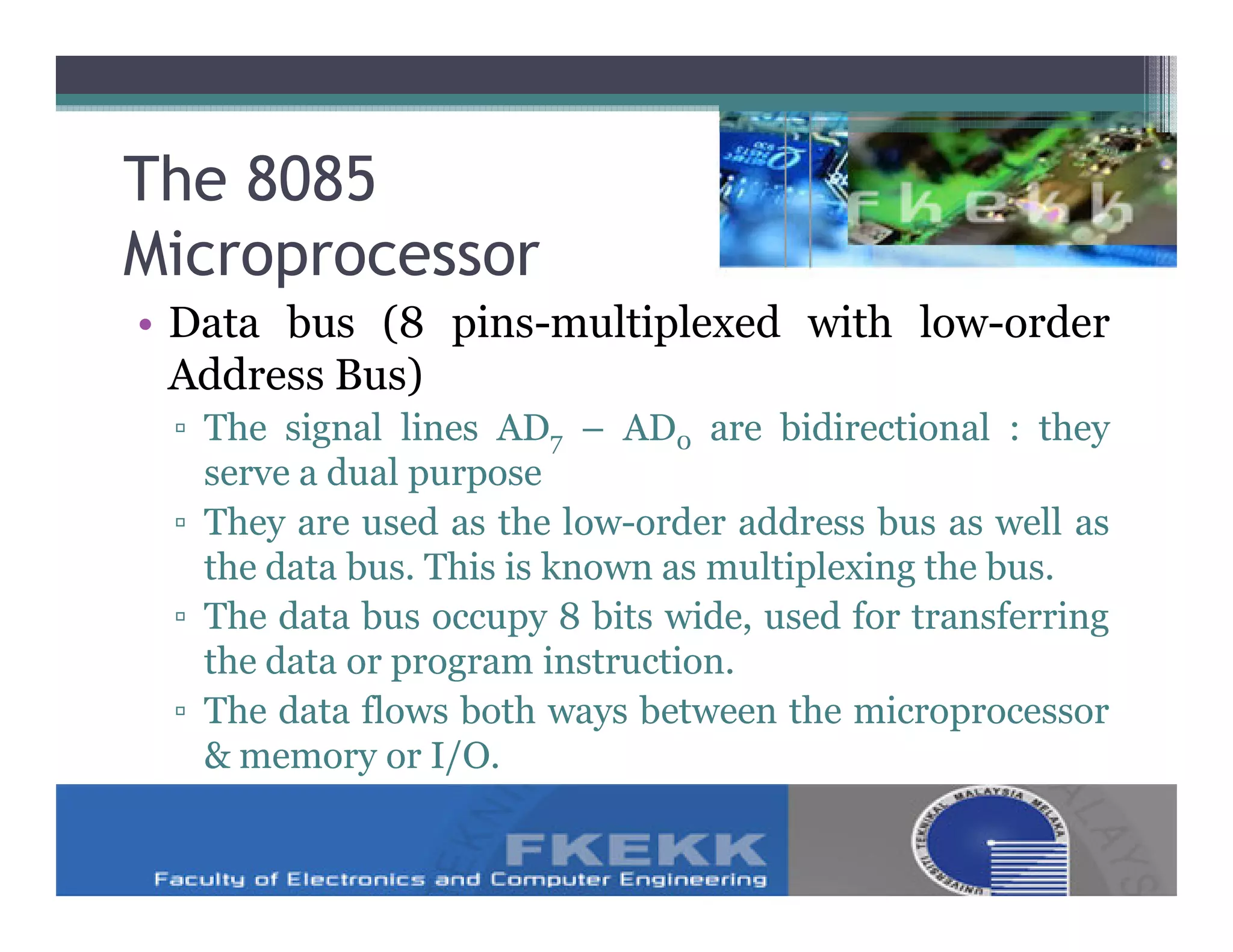
• Data bus (8 pins-multiplexed with low-order
  Address Bus)
 ▫ The signal lines AD7 – AD0 are bidirectional : they
   serve a dual purpose
 â–« They are used as the low-order address bus as well as
   the data bus. This is known as multiplexing the bus.
 â–« The data bus occupy 8 bits wide, used for transferring
   the data or program instruction.
 â–« The data flows both ways between the microprocessor
   & memory or I/O.
The 8085
Microprocessor
• Data bus (8 pins-multiplexed with low-order
  Address Bus)
 â–« The 8085 uses the data bus to transfer binary
   information.
 â–« Since the data bus has 8 bits, then the 8085 can
   manipulate data 8 bits at a time only.
 â–« The 8 data lines enable the 8085 to manipulate 8 bits
   data only at a time, ranging from OO to FF (28 = 256
   numbers).
 â–« The largest number that can appear on the data bus is
   11111111(25510)
The 8085
Microprocessor
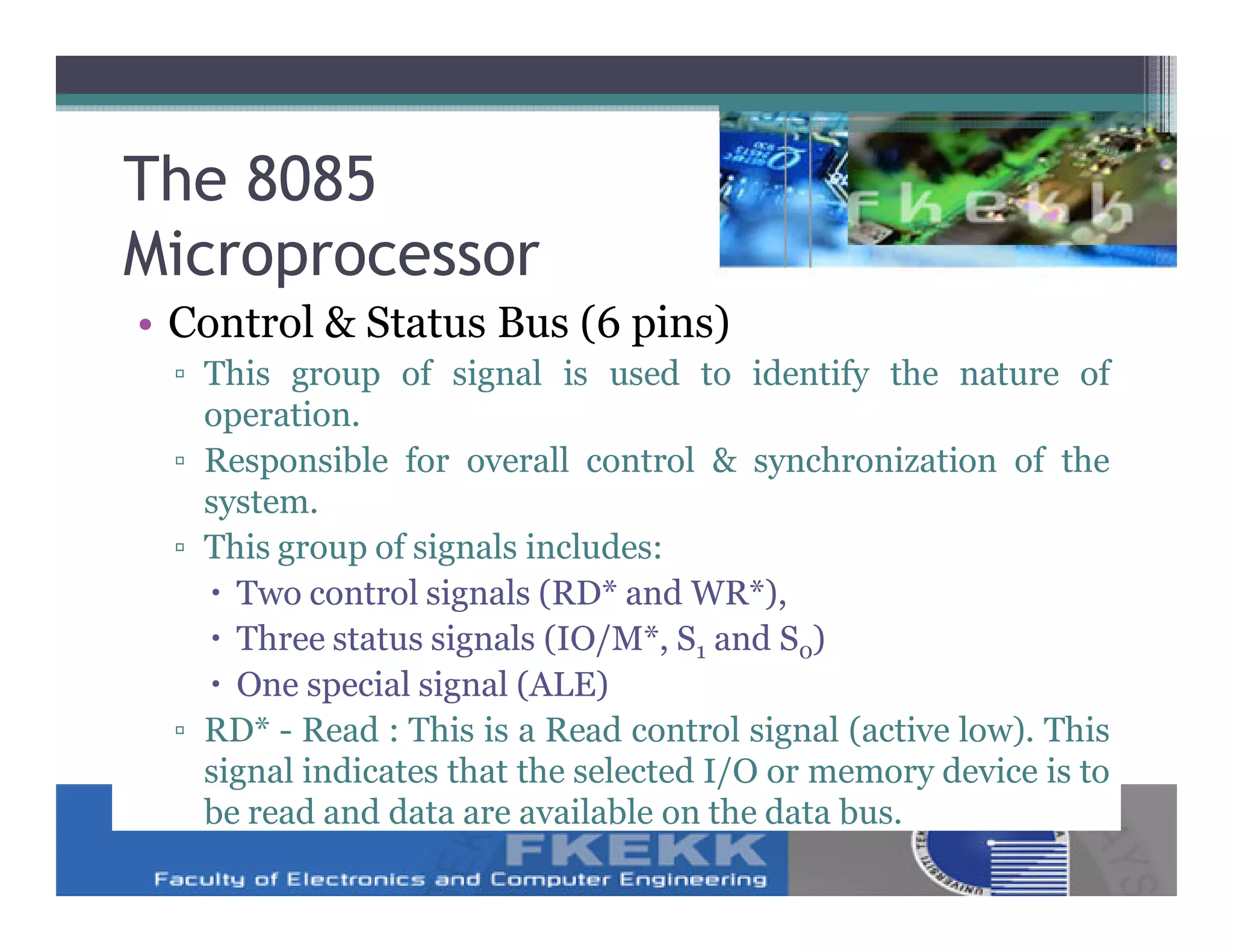
• Control & Status Bus (6 pins)
 â–« This group of signal is used to identify the nature of
   operation.
 â–« Responsible for overall control & synchronization of the
   system.
 â–« This group of signals includes:
     Two control signals (RD* and WR*),
     Three status signals (IO/M*, S1 and S0)
     One special signal (ALE)
 â–« RD* - Read : This is a Read control signal (active low). This
   signal indicates that the selected I/O or memory device is to
   be read and data are available on the data bus.
The 8085
Microprocessor
• Control Bus (6 pins)
 â–« WR* - Write : This is a Write control signal (active low). This
   signal indicates that the data on the data bus are to be written
   into selected memory or I/O location.
 â–« IO/M* : This is a status signal used to differentiate between I/O
   and memory operations. When it is high, it indicates an I/O
   operation & when it is low, it indicates a memory operation. This
   signal is combined with RD* and WR* to generate I/O and
   memory control signals.
 â–« S1 and S0: These status signals, similar to IO/M* can identify
   various operations, but they are rarely used in small system.
 ▫ ALE – Address Latch Enable : This is a positive going pulse
   generated every time the 8085 begins an operation. It indicates
   that the bits on AD7 - AD0 are address bits.
The 8085
Microprocessor
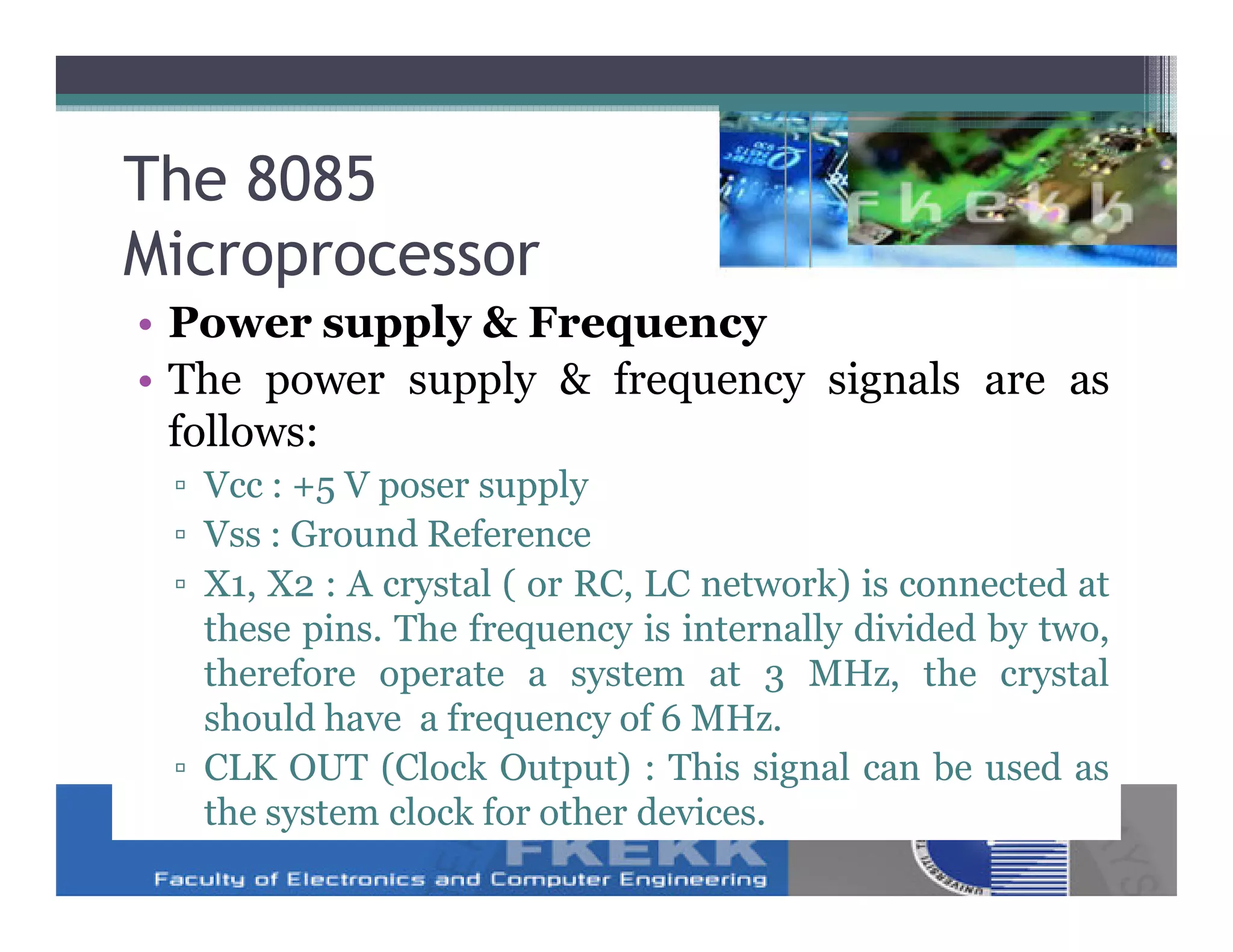
• Power supply & Frequency
• The power supply & frequency signals are as
  follows:
 â–« Vcc : +5 V poser supply
 â–« Vss : Ground Reference
 â–« X1, X2 : A crystal ( or RC, LC network) is connected at
   these pins. The frequency is internally divided by two,
   therefore operate a system at 3 MHz, the crystal
   should have a frequency of 6 MHz.
 â–« CLK OUT (Clock Output) : This signal can be used as
   the system clock for other devices.
The 8085
Microprocessor
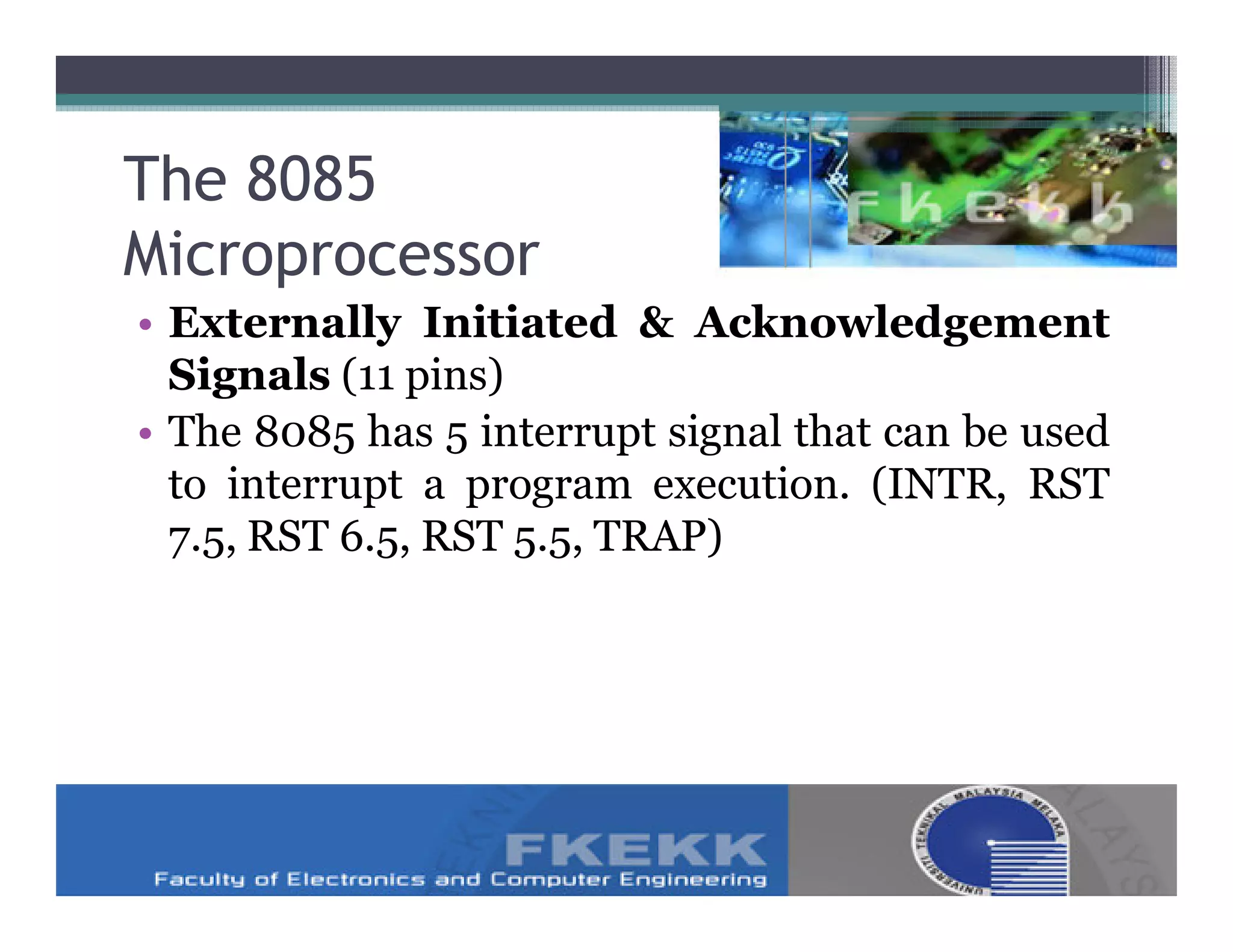
• Externally Initiated & Acknowledgement
  Signals (11 pins)
• The 8085 has 5 interrupt signal that can be used
  to interrupt a program execution. (INTR, RST
  7.5, RST 6.5, RST 5.5, TRAP)
The 8085
Microprocessor
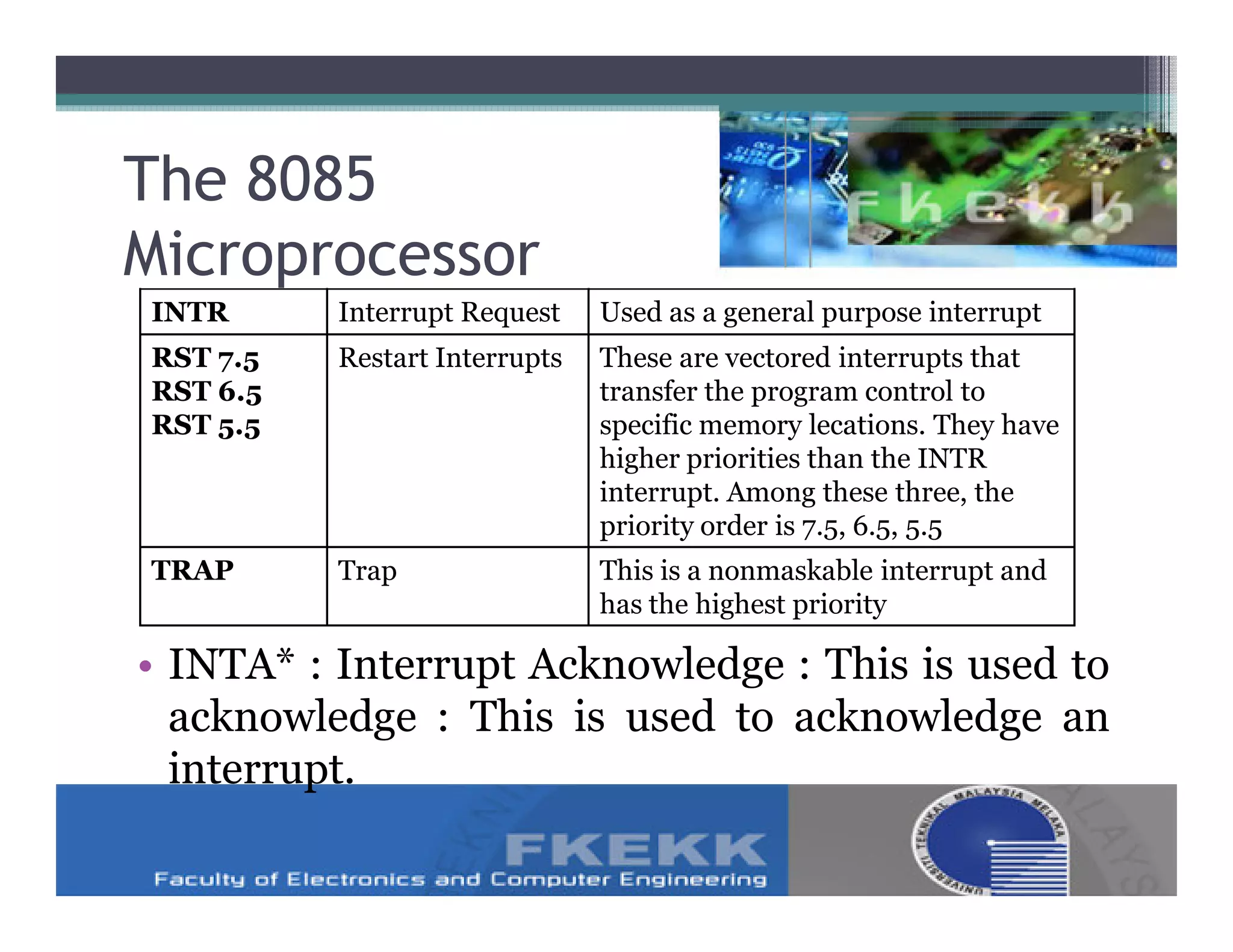
INTR      Interrupt Request    Used as a general purpose interrupt
RST 7.5   Restart Interrupts   These are vectored interrupts that
RST 6.5                        transfer the program control to
RST 5.5                        specific memory lecations. They have
                               higher priorities than the INTR
                               interrupt. Among these three, the
                               priority order is 7.5, 6.5, 5.5
TRAP      Trap                 This is a nonmaskable interrupt and
                               has the highest priority

• INTA* : Interrupt Acknowledge : This is used to
  acknowledge : This is used to acknowledge an
  interrupt.
The 8085
Microprocessor
• Externally Initiated & Acknowledgement
  Signals (11 pins)
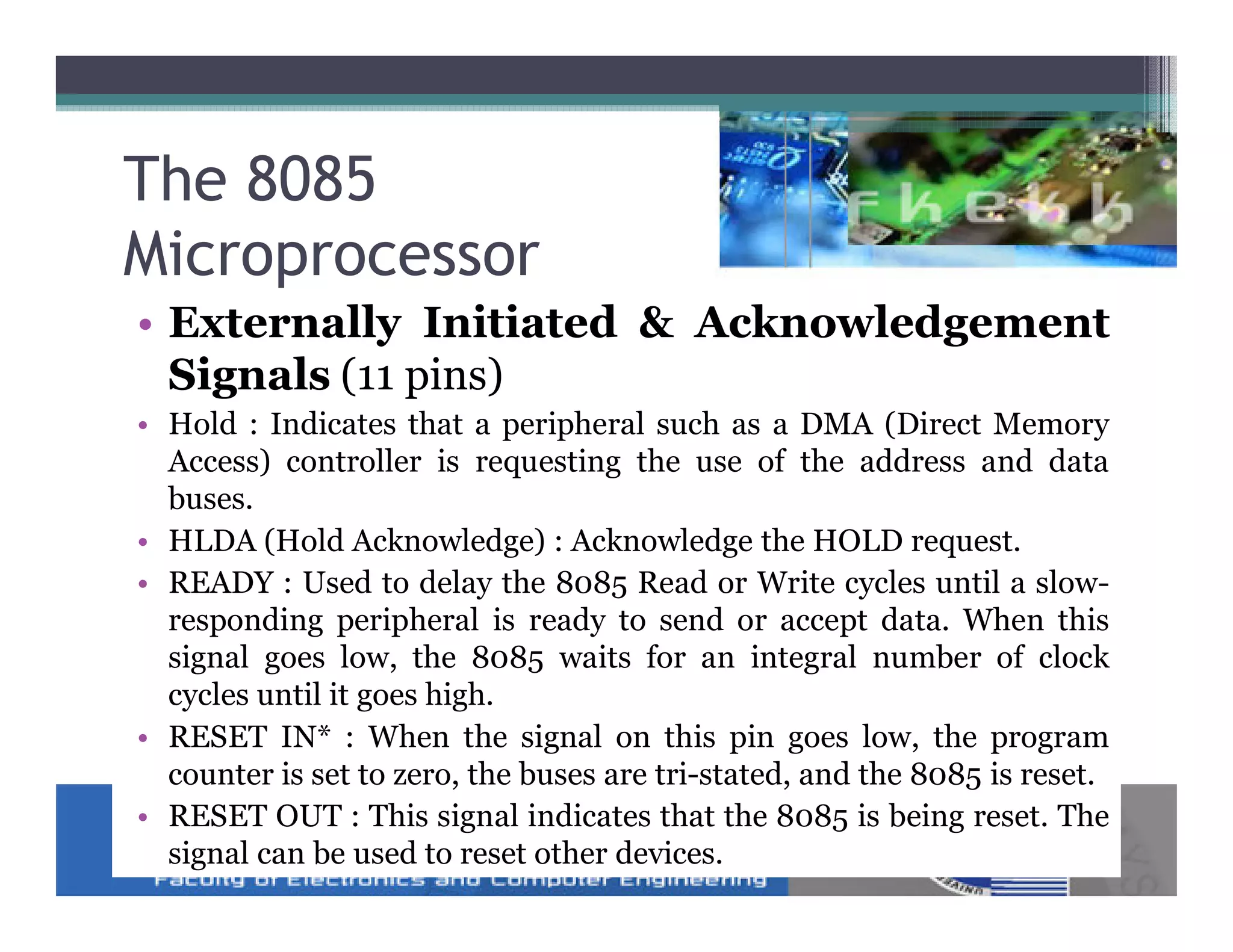
• Hold : Indicates that a peripheral such as a DMA (Direct Memory
  Access) controller is requesting the use of the address and data
  buses.
• HLDA (Hold Acknowledge) : Acknowledge the HOLD request.
• READY : Used to delay the 8085 Read or Write cycles until a slow-
  responding peripheral is ready to send or accept data. When this
  signal goes low, the 8085 waits for an integral number of clock
  cycles until it goes high.
• RESET IN* : When the signal on this pin goes low, the program
  counter is set to zero, the buses are tri-stated, and the 8085 is reset.
• RESET OUT : This signal indicates that the 8085 is being reset. The
  signal can be used to reset other devices.
The 8085
Microprocessor
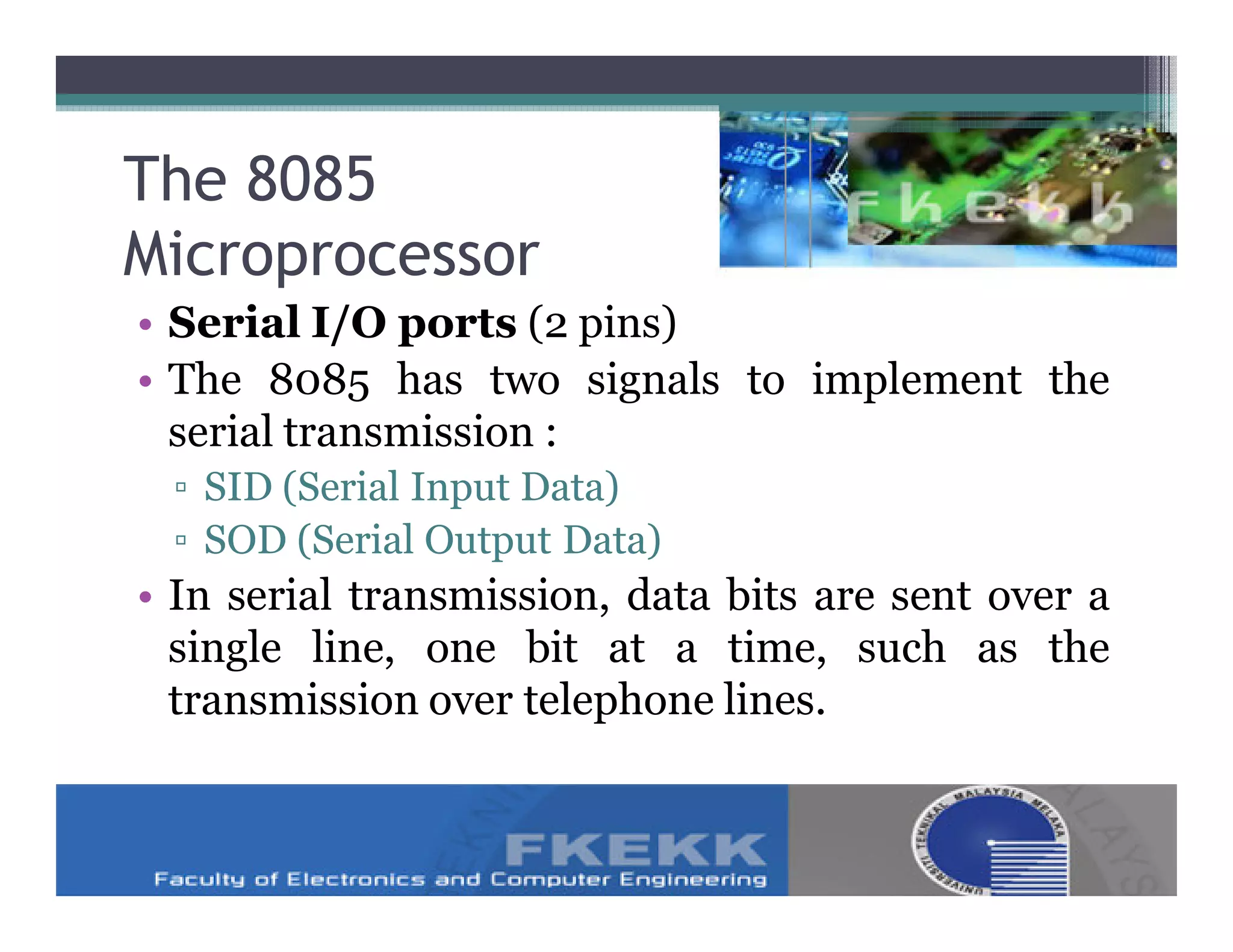
• Serial I/O ports (2 pins)
• The 8085 has two signals to implement the
  serial transmission :
 â–« SID (Serial Input Data)
 â–« SOD (Serial Output Data)
• In serial transmission, data bits are sent over a
  single line, one bit at a time, such as the
  transmission over telephone lines.
The 8085
Microprocessor
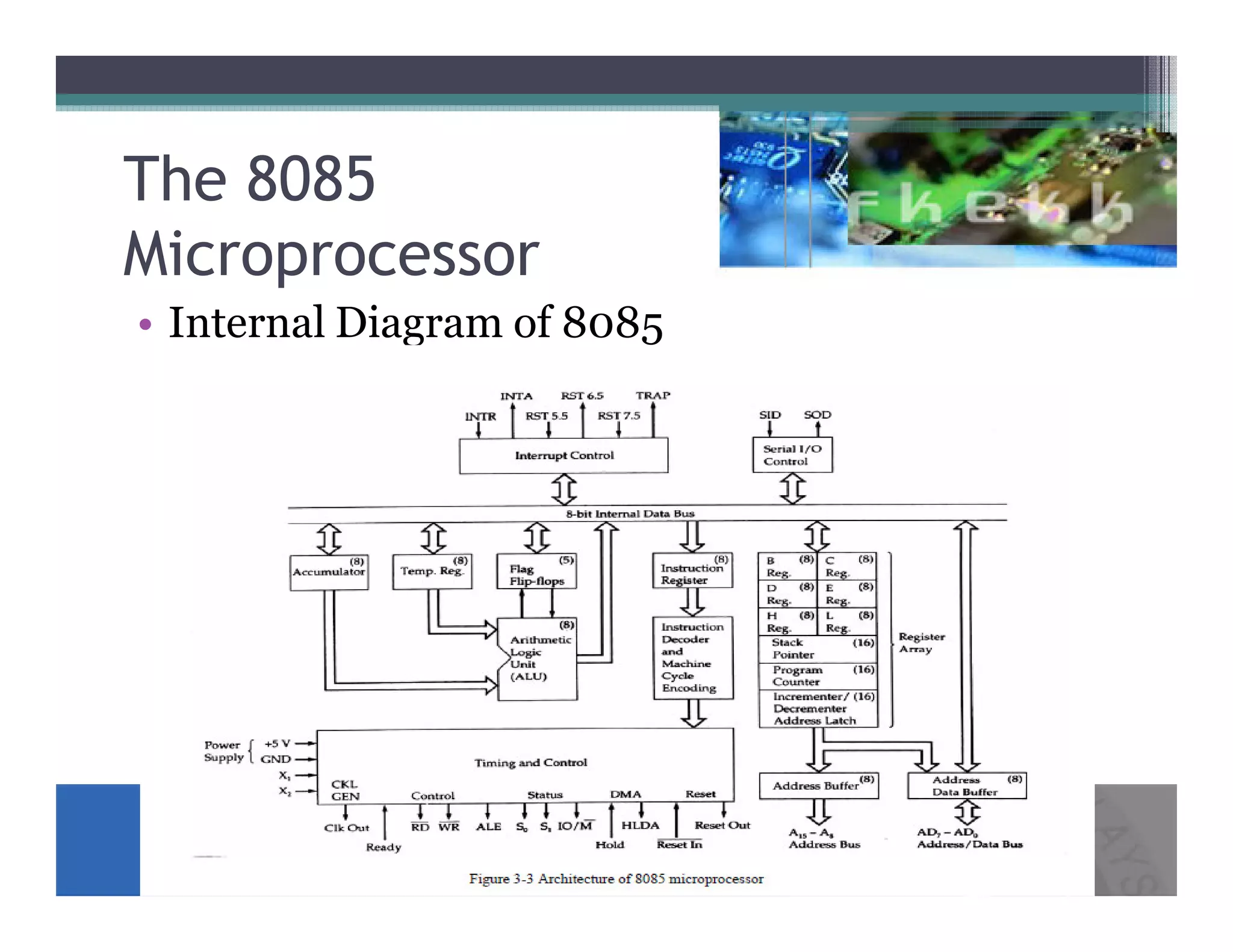
• Internal Diagram of 8085
• The internal architecture of the 8085 microprocessor
  determines how and what operations can be performed with
  the data.
• The operation are :
  â–« Store 8 bit data
  â–« Perform arithmetic & logical operation
  â–« Test for condition
  â–« Sequence the execution of instruction
  â–« Store data temporary during execution in the defined R/W
    memory location called the stack.
• To perform the operations, microprocessor requires ALU,
  registers, control logic and internal buses.
The 8085
Microprocessor
• Internal Diagram of 8085
The 8085
Microprocessor
• Internal Diagram of 8085
• 6 main components of 8085 microprocessor :
 1.   ALU
 2.   Timing & Control Unit
 3.   Instruction Register & Decoder
 4.   Register Array
 5.   Interrupt Control
 6.   Serial I/O Control
The 8085
Microprocessor
• Arithmetic Logic Unit (ALU)
• The ALU performs many of the function that involve
  arithmetic and logic operations
  â–« Arithmetic
       Addition
       Subtraction (adding the 2’s complement)
       Multiplication (adding the value multiple times)
       Division (subtracting the value multiple times)
  â–« Logic
       AND, OR, XOR, Incrementing a number
• The Arithmetic unit also handles all data manipulation, such
  as shift left/right, rotate, and the 2’s complement operations.
The 8085
Microprocessor
• Arithmetic Logic Unit (ALU)
• The ALU includes:
  â–« Accumulator
  â–« Temporary register
  â–« Arithmetic & logic circuits.
  â–« Status register (flag flip-flops)
• ALU → Accumulator
  â–« Accumulator is an 8-bit register that is part of the ALU.
  â–« It is one of the most used registers, often referred to as the
    A register and occasionally labeled as Acc.
  â–« It stores the 8-bit result of an arithmetic operation or a
    logic operation.
The 8085
Microprocessor
• ALU → Temporary Register
 â–« The temporary register is used to hold data during an
   arithmetic/logic operation.
 â–« It is used to transfer data to the ALU and usually contains
   the second value required for arithmetic operations.
• ALU → Status Register (Flag Flip-Flops)
 â–« The ALU includes 5 flip-flops, known as the status register
   or the flag flip-flops
 â–« Flags is status register are set to reset after an operation
   depending on data conditions of the result in the
   accumulator and other registers.
 â–« They are called Zero (Z), Carry (CY), Sign (S), Parity (P) and
   Auxiliary Carry (AC) flags.
The 8085
Microprocessor
• ALU → Status Register (Flag Flip-Flops)
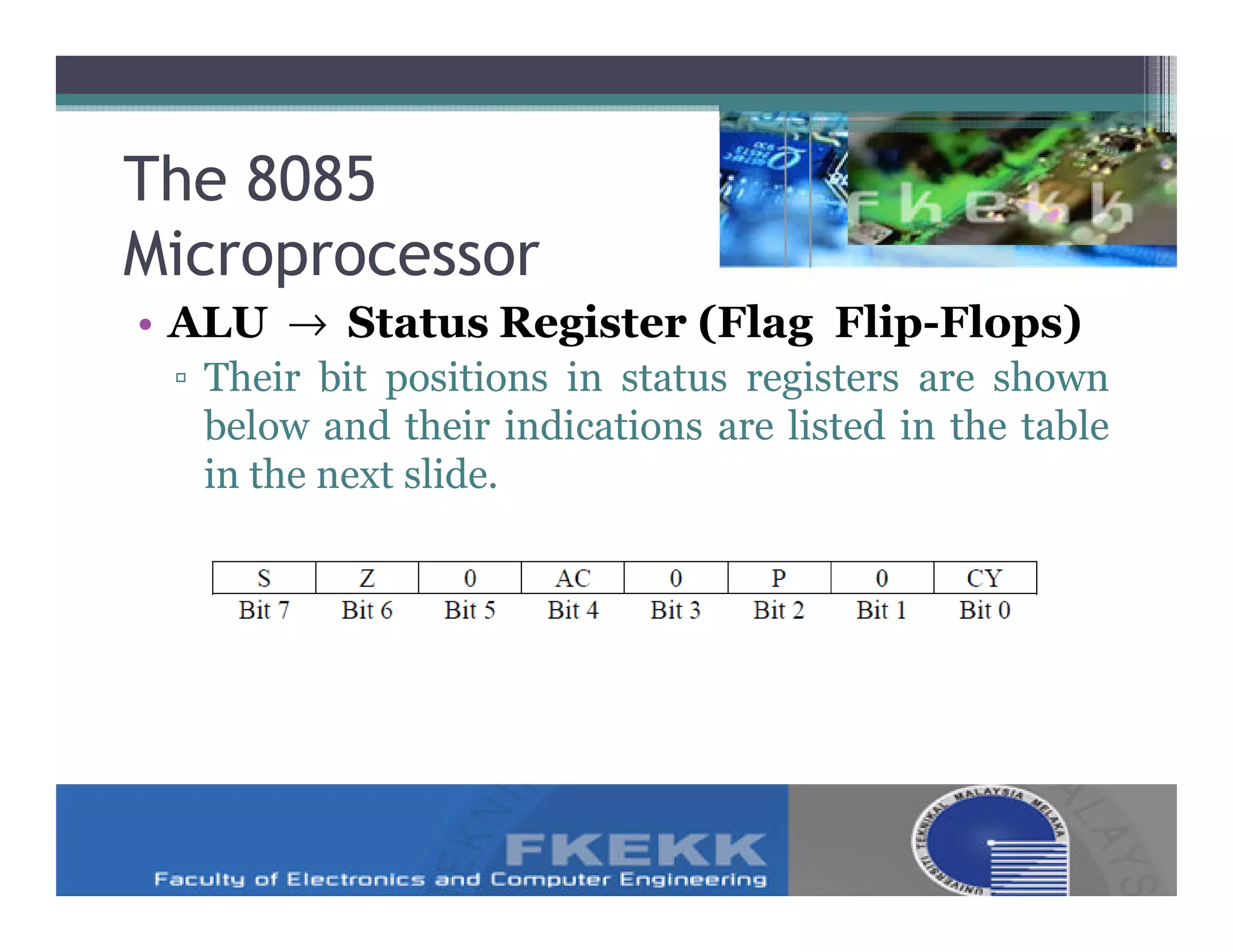
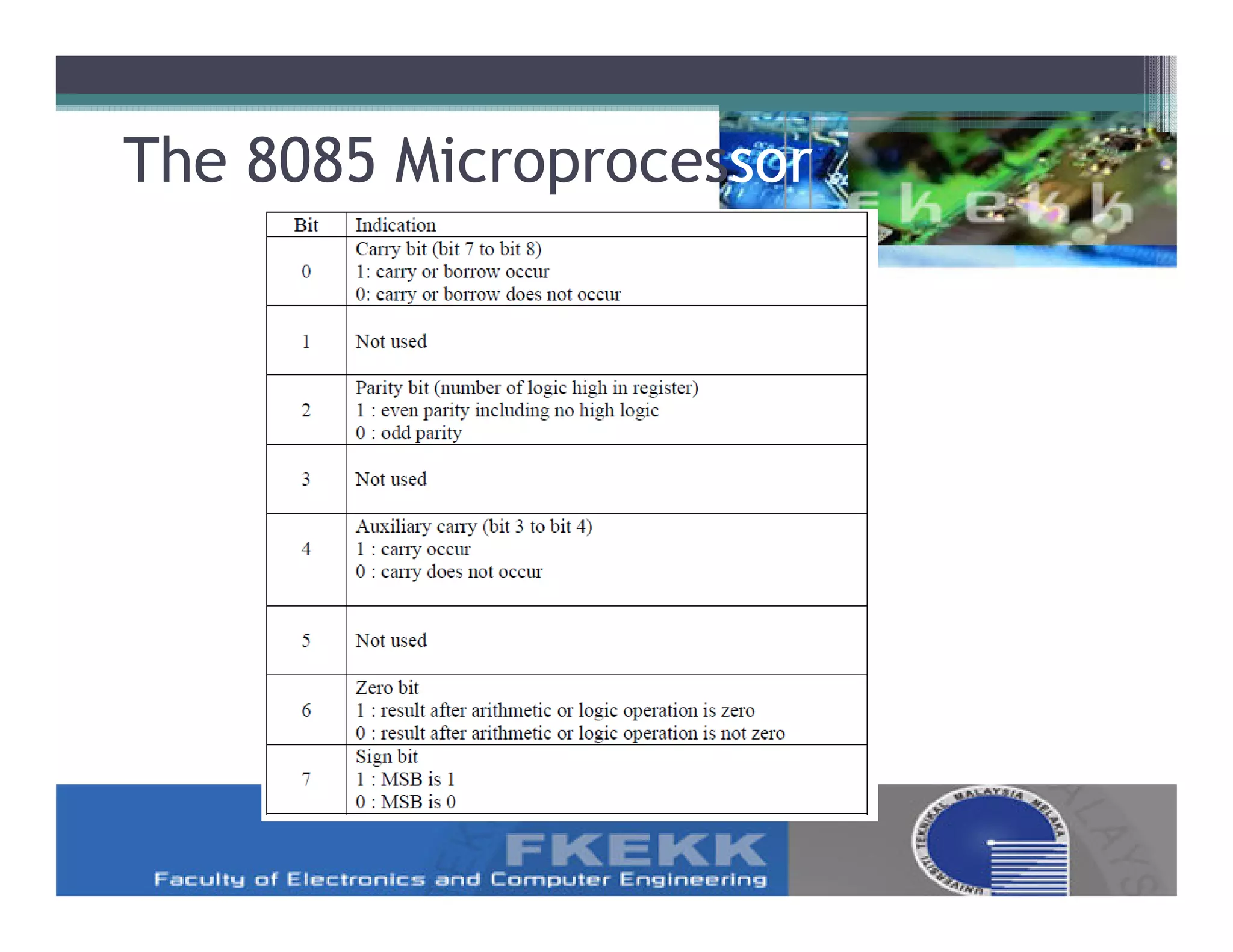
 â–« Their bit positions in status registers are shown
   below and their indications are listed in the table
   in the next slide.
The 8085 Microprocessor
The 8085
Microprocessor
• ALU → Status Register (Flag Flip-Flops)
 â–« The most commonly used flags are Z, CY and S. The
   microprocessor uses these flags to test data conditions.
 â–« These flags have critical importance in the decision-making
   process of the microprocessor. The conditions (set or reset)
   of the flags are tested through programming instructions.
 â–« For example, the instruction JC (Jump on Carry) is
   implemented to change the sequence of a programming
   when CY flag is set.
 â–« The thorough understanding of flags is essential in writing
   assembly language program.
The 8085
Microprocessor
• Timing & Control Unit
• The timing & control unit of the 8085 is responsible for:
  â–« Timing of all components (within and outside the
    microprocessor)
  â–« Clock input
  â–« Input and Output traffic flow on all busses
  â–« External inputs (for example, reset)
  â–« External outputs (for example, status)
• Ensures proper traffic flow on all buses
The 8085
Microprocessor
• Instruction Register & Decoder
• When an instruction is fetched from memory, it
  is loaded in the instruction register.
• The decoder decodes the instruction &
  establishes the sequence of events to follow.
• The instruction register is not programmable &
  cannot be accessed through any instructions.
The 8085
Microprocessor
• Register Array
• Data registers are locations where data is stored
  temporary within the microprocessor.
• These are a larger number of registers in the 8085,
  each with a specific function. Register are flip-flops
  configured as memory elements
The 8085
Microprocessor
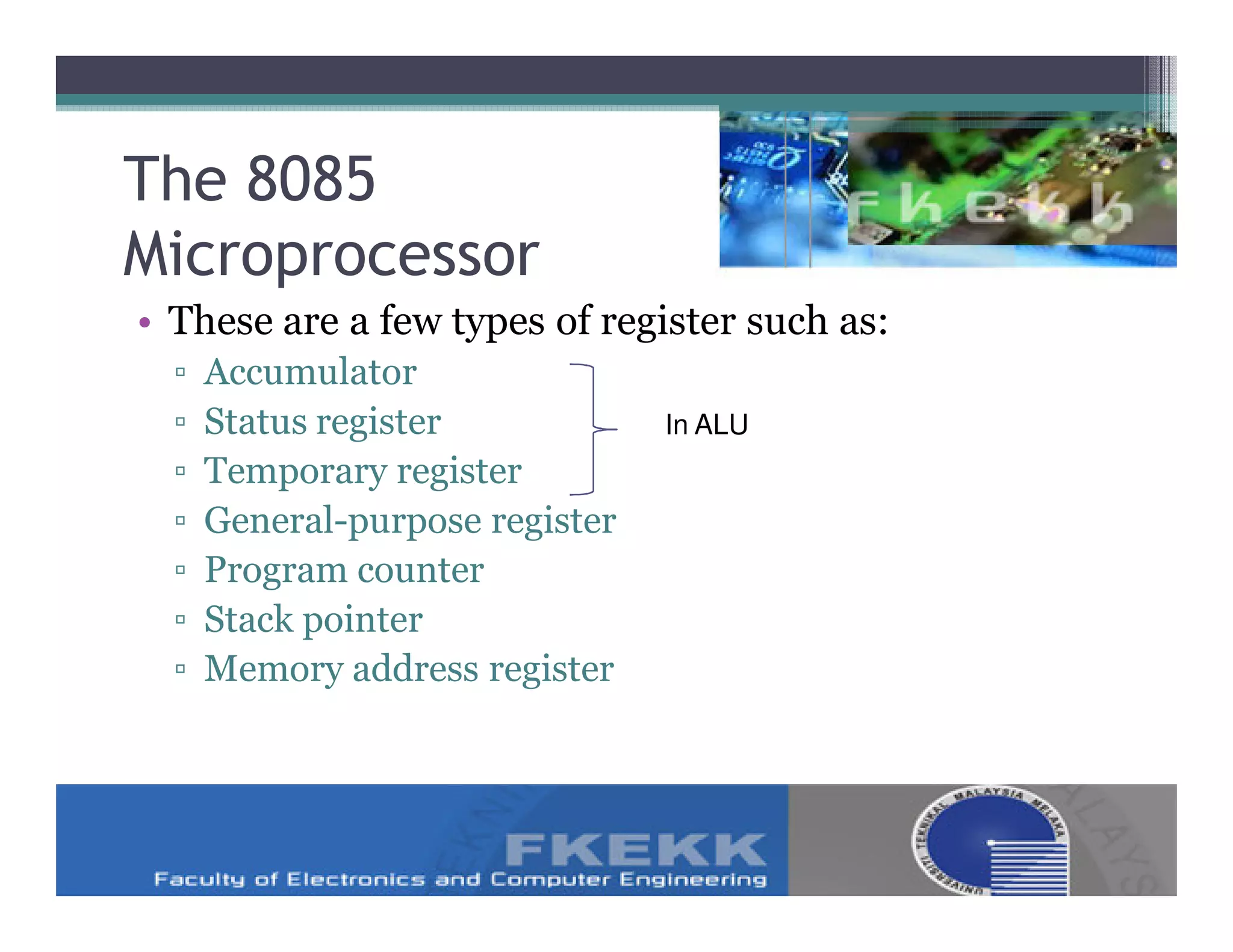
• These are a few types of register such as:
  â–«   Accumulator
  â–«   Status register            In ALU
  â–«   Temporary register
  â–«   General-purpose register
  â–«   Program counter
  â–«   Stack pointer
  â–«   Memory address register
The 8085
Microprocessor
• Register Array → General Purpose Register
 â–« The 8085 has six 8-bit general purpose registers to store 8-
   bit data, identified as B, C, D, E, H and L.
 â–« These registers are used to store various binary values and
   can be accessed quickly.
 â–« They can be combined as register pairs, identified as BC,
   DE and HL to perform some 16-bit operations.
 â–« These registers are controllable with programming
   instructions where programmer can use these registers to
   store or copy data into the registers by using data copy
   instructions.
 â–« Register pair HL is usually used as memory pointing
   operation.
The 8085
Microprocessor
• Register Array → Program Counter
 â–« Program counter, often referred to as PC, is a 16-bit register used
   to hold memory addresses.
 â–« The microprocessor uses PC register to sequence the execution on
   the instructions.
 â–« The function of PC register is to point to the memory address
   from which the next byte is to be fetched.
 â–« This register keeps track of the addresses of the instructions as
   they are being fetched from memory.
 â–« When a byte (machine code) is being fetched, the program
   counter is incremented by one to point to the next memory
   location.
 â–« The register holds the next address of the memory to the current
   address that is being executed.
The 8085
Microprocessor
• Register Array → Stack Pointer
 â–« Stack pointer, often referred to as SP, is also a 16-bit register used
   as a memory pointer.
 â–« It points to a memory location called the stack. The beginning of
   the stack is defined by loading a 16-bit address in the SP.
 â–« Used to store the address of the skipped address during CALL
   function.
 â–« SP stores (pushes) the address onto a memory area that is often
   called the stack and removes (pops) the address back whenever
   required in reverse order.
 â–« It uses First In Last Out (FILO) and Last In First Out (LIFO)
   operation.
• End

Chapter 5

  • 1.
    CHAPTER 5 :Introduction to Intel 8085 Microprocessor Hardware BENG 2223 MICROPROCESSOR TECHNOLOGY
  • 2.
    The 8085 Microprocessor • The8085A(commonly known as the 8085) : • Was first introduced in March 1976 • is an 8-bit microprocessor with 16-bit address width capable of addressing 64kB of memory • has 40 pins • Formed with 6500 transistors • Requires a +5 volt power supply • operates with a 3 MHz frequency
  • 3.
    The 8085 Microprocessor • The8085 is chosen for our look into the microprocessor because: ▫ It is still widely in use ▫ It is easy to use ▫ It has simple architecture and an adequate instruction set that enable students to learn necessary programming concept easily.
  • 4.
    The 8085 Microprocessor • The8085 microprocessor chip has 40 pins.
  • 5.
    The 8085 Microprocessor • Thepins can be grouped into 6 categories: 1. Address bus 2. Data bus 3. Control & Status bus 4. Power supply & frequency 5. Externally initiated & acknowledgement signals 6. Serial I/O ports
  • 6.
    The 8085 Microprocessor • Addressbus (16 pins) ▫ The 8085 has 16 signal lines (pins) that are used as the address bus for the transferring destination information for data. ▫ These lines are split into 2 segments, A15 – A8 and AD7 – AD0 ▫ Address bus occupied 16 bits wide, therefore 8085 can access 216 locations (65,536) with numbers, from 0 to 65,535. ▫ These range from 0000 to FFFF and is referred as 64kB of memory space. ▫ The 8 signal lines, A15 – A8 , are unidirectional and used for the most significant bits, called the high-order address, of a 16-bit address. ▫ The signal lines AD7 – AD0 are used for a dual purpose : as a lower-order address lines and also as a data bus.
  • 7.
    The 8085 Microprocessor • Addressbus (16 pins) ▫ When the 8085 wants to access a peripheral or a memory location, it places the 16-bit address on the address bus and then sends the appropriate control signals. ▫ The high order unidirectional address lines (A15–A8 ) are used to verify the memory address or I/O for one data transfer cycle. ▫ The low-order bidirectional address lines (AD7 – AD0) are multiplexed with data bus. ▫ During the first clock cycle they bring memory address of the low order memory or I/O address. They then become the data bus during the second and third clock cycle.
  • 8.
    The 8085 Microprocessor • Addressbus (16 pins) ▫ The demultiplexing of AD7 – AD0 is determined by ALE (Address Latch Enable) signal. ▫ When this control signal is going high, the content of the address bus is address bits. ▫ When ALE is low, data is placed on the bus.
  • 9.
    The 8085 Microprocessor • Addressbus (16 pins) Problem. Calculate the address lines required for an 8 Kbytes memory chip. 8 Kbytes = 8 x 1024 = 8192 memory locations 2x = 8192 = log 8192/log 2 = 13 address lines
  • 10.
    The 8085 Microprocessor • Databus (8 pins-multiplexed with low-order Address Bus) ▫ The signal lines AD7 – AD0 are bidirectional : they serve a dual purpose ▫ They are used as the low-order address bus as well as the data bus. This is known as multiplexing the bus. ▫ The data bus occupy 8 bits wide, used for transferring the data or program instruction. ▫ The data flows both ways between the microprocessor & memory or I/O.
  • 11.
    The 8085 Microprocessor • Databus (8 pins-multiplexed with low-order Address Bus) ▫ The 8085 uses the data bus to transfer binary information. ▫ Since the data bus has 8 bits, then the 8085 can manipulate data 8 bits at a time only. ▫ The 8 data lines enable the 8085 to manipulate 8 bits data only at a time, ranging from OO to FF (28 = 256 numbers). ▫ The largest number that can appear on the data bus is 11111111(25510)
  • 12.
    The 8085 Microprocessor • Control& Status Bus (6 pins) ▫ This group of signal is used to identify the nature of operation. ▫ Responsible for overall control & synchronization of the system. ▫ This group of signals includes: Two control signals (RD* and WR*), Three status signals (IO/M*, S1 and S0) One special signal (ALE) ▫ RD* - Read : This is a Read control signal (active low). This signal indicates that the selected I/O or memory device is to be read and data are available on the data bus.
  • 13.
    The 8085 Microprocessor • ControlBus (6 pins) ▫ WR* - Write : This is a Write control signal (active low). This signal indicates that the data on the data bus are to be written into selected memory or I/O location. ▫ IO/M* : This is a status signal used to differentiate between I/O and memory operations. When it is high, it indicates an I/O operation & when it is low, it indicates a memory operation. This signal is combined with RD* and WR* to generate I/O and memory control signals. ▫ S1 and S0: These status signals, similar to IO/M* can identify various operations, but they are rarely used in small system. ▫ ALE – Address Latch Enable : This is a positive going pulse generated every time the 8085 begins an operation. It indicates that the bits on AD7 - AD0 are address bits.
  • 14.
    The 8085 Microprocessor • Powersupply & Frequency • The power supply & frequency signals are as follows: ▫ Vcc : +5 V poser supply ▫ Vss : Ground Reference ▫ X1, X2 : A crystal ( or RC, LC network) is connected at these pins. The frequency is internally divided by two, therefore operate a system at 3 MHz, the crystal should have a frequency of 6 MHz. ▫ CLK OUT (Clock Output) : This signal can be used as the system clock for other devices.
  • 15.
    The 8085 Microprocessor • ExternallyInitiated & Acknowledgement Signals (11 pins) • The 8085 has 5 interrupt signal that can be used to interrupt a program execution. (INTR, RST 7.5, RST 6.5, RST 5.5, TRAP)
  • 16.
    The 8085 Microprocessor INTR Interrupt Request Used as a general purpose interrupt RST 7.5 Restart Interrupts These are vectored interrupts that RST 6.5 transfer the program control to RST 5.5 specific memory lecations. They have higher priorities than the INTR interrupt. Among these three, the priority order is 7.5, 6.5, 5.5 TRAP Trap This is a nonmaskable interrupt and has the highest priority • INTA* : Interrupt Acknowledge : This is used to acknowledge : This is used to acknowledge an interrupt.
  • 17.
    The 8085 Microprocessor • ExternallyInitiated & Acknowledgement Signals (11 pins) • Hold : Indicates that a peripheral such as a DMA (Direct Memory Access) controller is requesting the use of the address and data buses. • HLDA (Hold Acknowledge) : Acknowledge the HOLD request. • READY : Used to delay the 8085 Read or Write cycles until a slow- responding peripheral is ready to send or accept data. When this signal goes low, the 8085 waits for an integral number of clock cycles until it goes high. • RESET IN* : When the signal on this pin goes low, the program counter is set to zero, the buses are tri-stated, and the 8085 is reset. • RESET OUT : This signal indicates that the 8085 is being reset. The signal can be used to reset other devices.
  • 18.
    The 8085 Microprocessor • SerialI/O ports (2 pins) • The 8085 has two signals to implement the serial transmission : ▫ SID (Serial Input Data) ▫ SOD (Serial Output Data) • In serial transmission, data bits are sent over a single line, one bit at a time, such as the transmission over telephone lines.
  • 19.
    The 8085 Microprocessor • InternalDiagram of 8085 • The internal architecture of the 8085 microprocessor determines how and what operations can be performed with the data. • The operation are : ▫ Store 8 bit data ▫ Perform arithmetic & logical operation ▫ Test for condition ▫ Sequence the execution of instruction ▫ Store data temporary during execution in the defined R/W memory location called the stack. • To perform the operations, microprocessor requires ALU, registers, control logic and internal buses.
  • 20.
  • 21.
    The 8085 Microprocessor • InternalDiagram of 8085 • 6 main components of 8085 microprocessor : 1. ALU 2. Timing & Control Unit 3. Instruction Register & Decoder 4. Register Array 5. Interrupt Control 6. Serial I/O Control
  • 22.
    The 8085 Microprocessor • ArithmeticLogic Unit (ALU) • The ALU performs many of the function that involve arithmetic and logic operations ▫ Arithmetic Addition Subtraction (adding the 2’s complement) Multiplication (adding the value multiple times) Division (subtracting the value multiple times) ▫ Logic AND, OR, XOR, Incrementing a number • The Arithmetic unit also handles all data manipulation, such as shift left/right, rotate, and the 2’s complement operations.
  • 23.
    The 8085 Microprocessor • ArithmeticLogic Unit (ALU) • The ALU includes: ▫ Accumulator ▫ Temporary register ▫ Arithmetic & logic circuits. ▫ Status register (flag flip-flops) • ALU → Accumulator ▫ Accumulator is an 8-bit register that is part of the ALU. ▫ It is one of the most used registers, often referred to as the A register and occasionally labeled as Acc. ▫ It stores the 8-bit result of an arithmetic operation or a logic operation.
  • 24.
    The 8085 Microprocessor • ALU→ Temporary Register ▫ The temporary register is used to hold data during an arithmetic/logic operation. ▫ It is used to transfer data to the ALU and usually contains the second value required for arithmetic operations. • ALU → Status Register (Flag Flip-Flops) ▫ The ALU includes 5 flip-flops, known as the status register or the flag flip-flops ▫ Flags is status register are set to reset after an operation depending on data conditions of the result in the accumulator and other registers. ▫ They are called Zero (Z), Carry (CY), Sign (S), Parity (P) and Auxiliary Carry (AC) flags.
  • 25.
    The 8085 Microprocessor • ALU→ Status Register (Flag Flip-Flops) ▫ Their bit positions in status registers are shown below and their indications are listed in the table in the next slide.
  • 26.
  • 27.
    The 8085 Microprocessor • ALU→ Status Register (Flag Flip-Flops) ▫ The most commonly used flags are Z, CY and S. The microprocessor uses these flags to test data conditions. ▫ These flags have critical importance in the decision-making process of the microprocessor. The conditions (set or reset) of the flags are tested through programming instructions. ▫ For example, the instruction JC (Jump on Carry) is implemented to change the sequence of a programming when CY flag is set. ▫ The thorough understanding of flags is essential in writing assembly language program.
  • 28.
    The 8085 Microprocessor • Timing& Control Unit • The timing & control unit of the 8085 is responsible for: ▫ Timing of all components (within and outside the microprocessor) ▫ Clock input ▫ Input and Output traffic flow on all busses ▫ External inputs (for example, reset) ▫ External outputs (for example, status) • Ensures proper traffic flow on all buses
  • 29.
    The 8085 Microprocessor • InstructionRegister & Decoder • When an instruction is fetched from memory, it is loaded in the instruction register. • The decoder decodes the instruction & establishes the sequence of events to follow. • The instruction register is not programmable & cannot be accessed through any instructions.
  • 30.
    The 8085 Microprocessor • RegisterArray • Data registers are locations where data is stored temporary within the microprocessor. • These are a larger number of registers in the 8085, each with a specific function. Register are flip-flops configured as memory elements
  • 31.
    The 8085 Microprocessor • Theseare a few types of register such as: ▫ Accumulator ▫ Status register In ALU ▫ Temporary register ▫ General-purpose register ▫ Program counter ▫ Stack pointer ▫ Memory address register
  • 32.
    The 8085 Microprocessor • RegisterArray → General Purpose Register ▫ The 8085 has six 8-bit general purpose registers to store 8- bit data, identified as B, C, D, E, H and L. ▫ These registers are used to store various binary values and can be accessed quickly. ▫ They can be combined as register pairs, identified as BC, DE and HL to perform some 16-bit operations. ▫ These registers are controllable with programming instructions where programmer can use these registers to store or copy data into the registers by using data copy instructions. ▫ Register pair HL is usually used as memory pointing operation.
  • 33.
    The 8085 Microprocessor • RegisterArray → Program Counter ▫ Program counter, often referred to as PC, is a 16-bit register used to hold memory addresses. ▫ The microprocessor uses PC register to sequence the execution on the instructions. ▫ The function of PC register is to point to the memory address from which the next byte is to be fetched. ▫ This register keeps track of the addresses of the instructions as they are being fetched from memory. ▫ When a byte (machine code) is being fetched, the program counter is incremented by one to point to the next memory location. ▫ The register holds the next address of the memory to the current address that is being executed.
  • 34.
    The 8085 Microprocessor • RegisterArray → Stack Pointer ▫ Stack pointer, often referred to as SP, is also a 16-bit register used as a memory pointer. ▫ It points to a memory location called the stack. The beginning of the stack is defined by loading a 16-bit address in the SP. ▫ Used to store the address of the skipped address during CALL function. ▫ SP stores (pushes) the address onto a memory area that is often called the stack and removes (pops) the address back whenever required in reverse order. ▫ It uses First In Last Out (FILO) and Last In First Out (LIFO) operation.
  • 35.