PRESENTED BY
UMANG DHURI
MICROPROCESSOR
8086
DEPARTMENT OF INFORMATION TECHNOLOGY
SHAH AND ANCHOR KUTCHHI ENGINEERING COLLEGE
TABLE OF CONTENTS
1. FEATURES
2. PIN DIAGRAM
3. ARCHITECTURE
4. ADDRESSING MODES
5. COMPARISON WITH 8085
FEATURES
 16-Bit Data Transfer
 Reverse Compatibility
 Processor Speed and Memory
 Co-processor Support
The introduction of the 8086 microprocessor in 1978 set the
stage for an industry and worldwide standard that would
become the basis for the architecture of every computer made
today, regardless of the operating system. This chip had a
certain set of features that led to it becoming the chip that
almost all modern processors are based on.
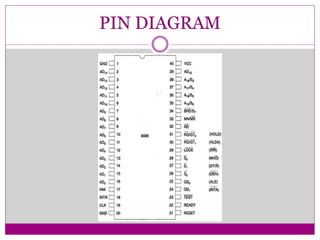
PIN DIAGRAM
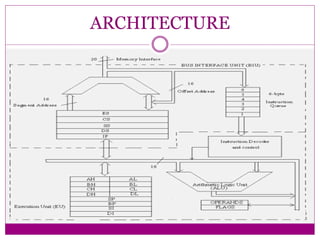
ARCHITECTURE
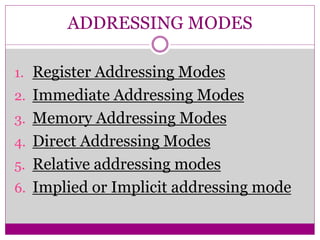
ADDRESSING MODES
1. Register Addressing Modes
2. Immediate Addressing Modes
3. Memory Addressing Modes
4. Direct Addressing Modes
5. Relative addressing modes
6. Implied or Implicit addressing mode
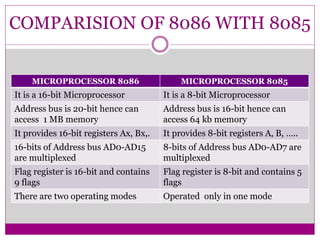
COMPARISION OF 8086 WITH 8085
MICROPROCESSOR 8086 MICROPROCESSOR 8085
It is a 16-bit Microprocessor It is a 8-bit Microprocessor
Address bus is 20-bit hence can
access 1 MB memory
Address bus is 16-bit hence can
access 64 kb memory
It provides 16-bit registers Ax, Bx,. It provides 8-bit registers A, B, …..
16-bits of Address bus AD0-AD15
are multiplexed
8-bits of Address bus AD0-AD7 are
multiplexed
Flag register is 16-bit and contains
9 flags
Flag register is 8-bit and contains 5
flags
There are two operating modes Operated only in one mode
Microprocessor 8086

Microprocessor 8086

  • 1.
    PRESENTED BY UMANG DHURI MICROPROCESSOR 8086 DEPARTMENTOF INFORMATION TECHNOLOGY SHAH AND ANCHOR KUTCHHI ENGINEERING COLLEGE
  • 2.
    TABLE OF CONTENTS 1.FEATURES 2. PIN DIAGRAM 3. ARCHITECTURE 4. ADDRESSING MODES 5. COMPARISON WITH 8085
  • 3.
    FEATURES  16-Bit DataTransfer  Reverse Compatibility  Processor Speed and Memory  Co-processor Support The introduction of the 8086 microprocessor in 1978 set the stage for an industry and worldwide standard that would become the basis for the architecture of every computer made today, regardless of the operating system. This chip had a certain set of features that led to it becoming the chip that almost all modern processors are based on.
  • 4.
  • 5.
  • 6.
    ADDRESSING MODES 1. RegisterAddressing Modes 2. Immediate Addressing Modes 3. Memory Addressing Modes 4. Direct Addressing Modes 5. Relative addressing modes 6. Implied or Implicit addressing mode
  • 7.
    COMPARISION OF 8086WITH 8085 MICROPROCESSOR 8086 MICROPROCESSOR 8085 It is a 16-bit Microprocessor It is a 8-bit Microprocessor Address bus is 20-bit hence can access 1 MB memory Address bus is 16-bit hence can access 64 kb memory It provides 16-bit registers Ax, Bx,. It provides 8-bit registers A, B, ….. 16-bits of Address bus AD0-AD15 are multiplexed 8-bits of Address bus AD0-AD7 are multiplexed Flag register is 16-bit and contains 9 flags Flag register is 8-bit and contains 5 flags There are two operating modes Operated only in one mode